Nikola Tesla
Nikola Tesla — an illustrated biography story, set in Global. 10 illustrated pages, free to read on Wonder People.
Page 1
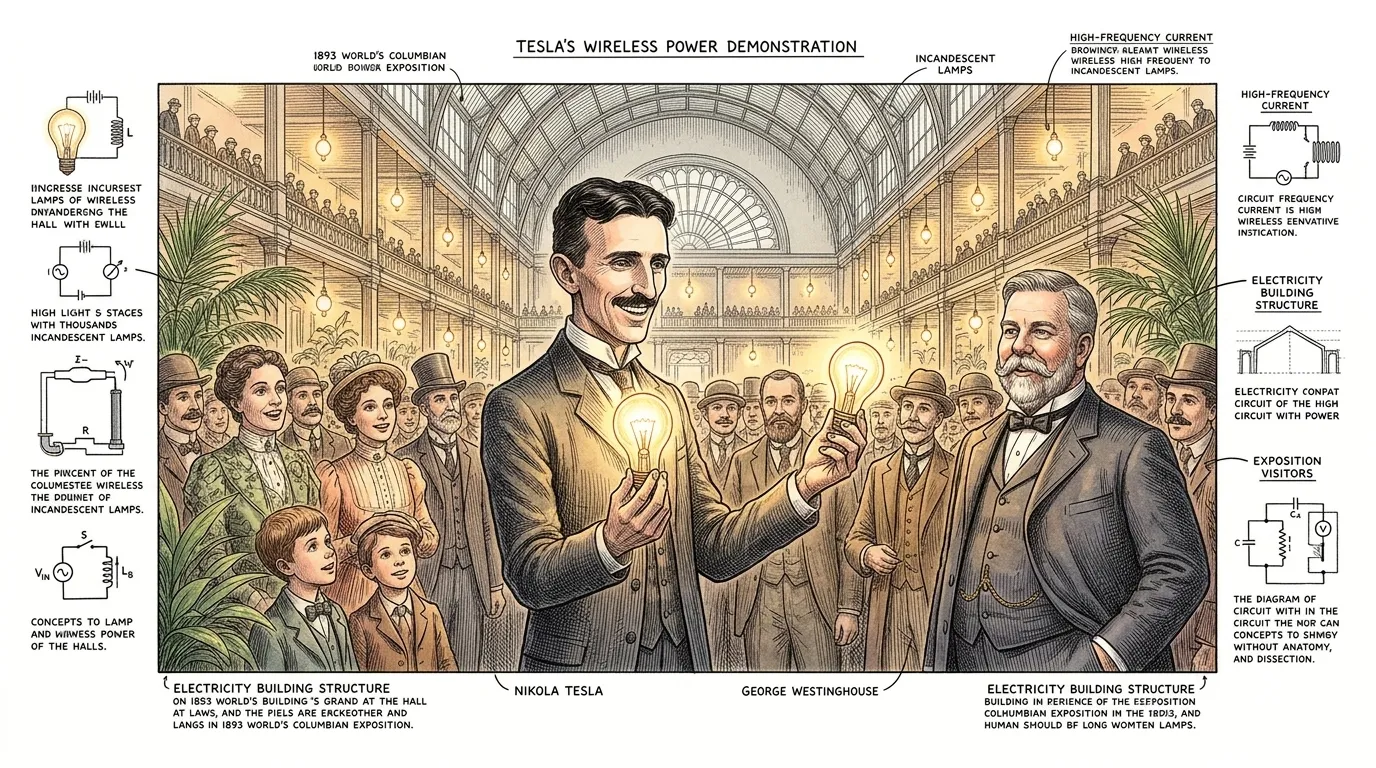
At the 1893 World's Columbian Exposition in Chicago, the future was illuminated. Nikola Tesla, a gaunt 37-year-old inventor, stood at the heart of the Electricity Building, his polyphase alternating current system powering over 250,000 incandescent lamps. Before a mesmerized public and his financier George Westinghouse, Tesla demonstrated the safe transmission of high-frequency currents, causing light bulbs to glow in his hands without wires. This spectacle was more than a display; it was a decisive victory in the 'War of Currents,' validating his vision and forever changing how the world would be powered.
Biographical Fact: The 1893 Chicago World's Fair was a pivotal moment for AC power. Westinghouse Electric, using Tesla's patents, famously underbid Edison's DC system, securing the contract to light the entire exposition, showcasing the efficiency and safety of alternating current on an unprecedented scale.
Page 2
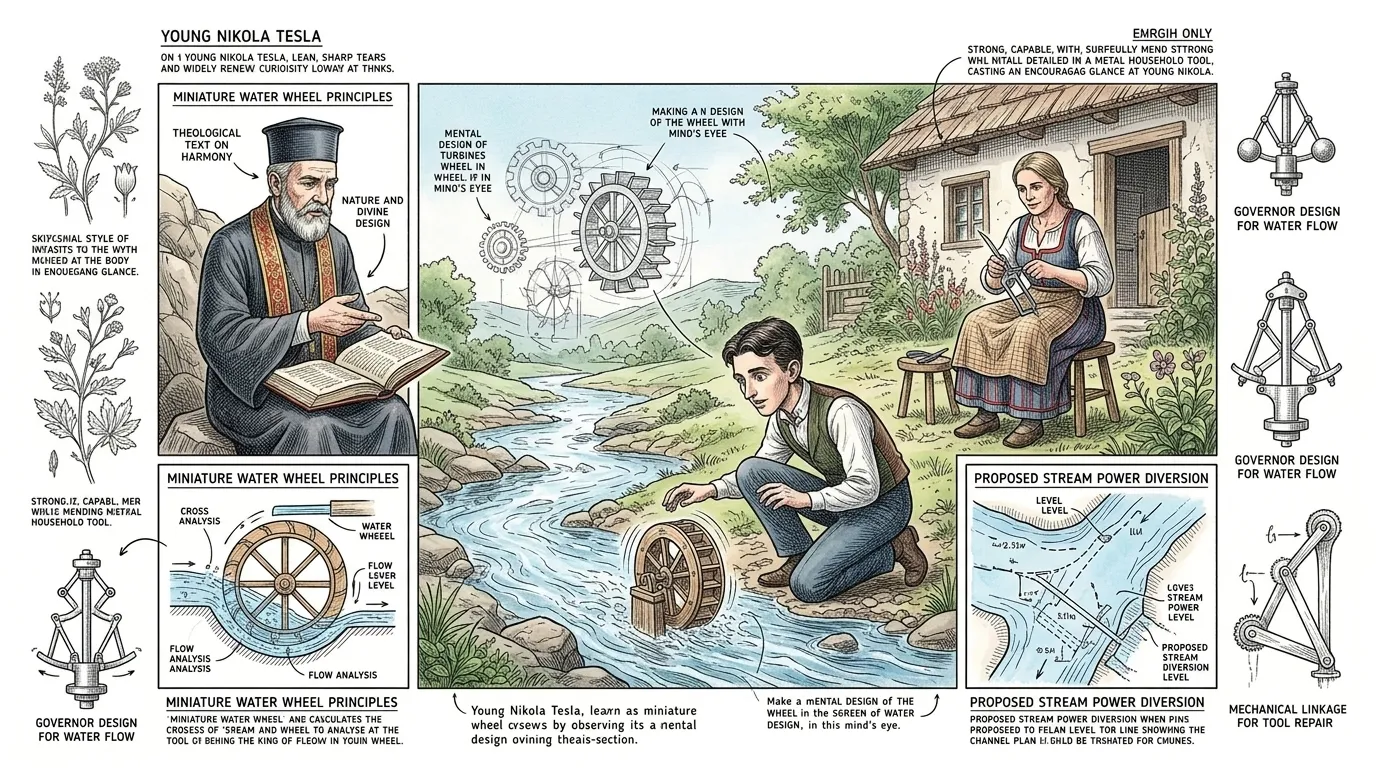
Born in 1856 amidst the rural landscape of Smiljan, Austrian Empire, Nikola Tesla's early life was marked by an extraordinary observational intellect. His Serbian Orthodox priest father, Milutin, pushed for a theological path, but it was his mother, Đuka Mandić, an inventor of practical household tools, who fostered his innate curiosity. Young Tesla would spend hours observing the mechanics of nature – water wheels, thunderstorms, the flow of rivers – mentally designing and redesigning devices, seeing the invisible forces that drove the world around him. This early, intense introspection forged a mind uniquely attuned to the principles of engineering.
Biographical Fact: Tesla often credited his mother, Đuka, with his inventive spirit and eidetic memory. His early experiences in Smiljan, particularly observing nature, laid the foundation for his later groundbreaking work in electrical engineering.
Page 3
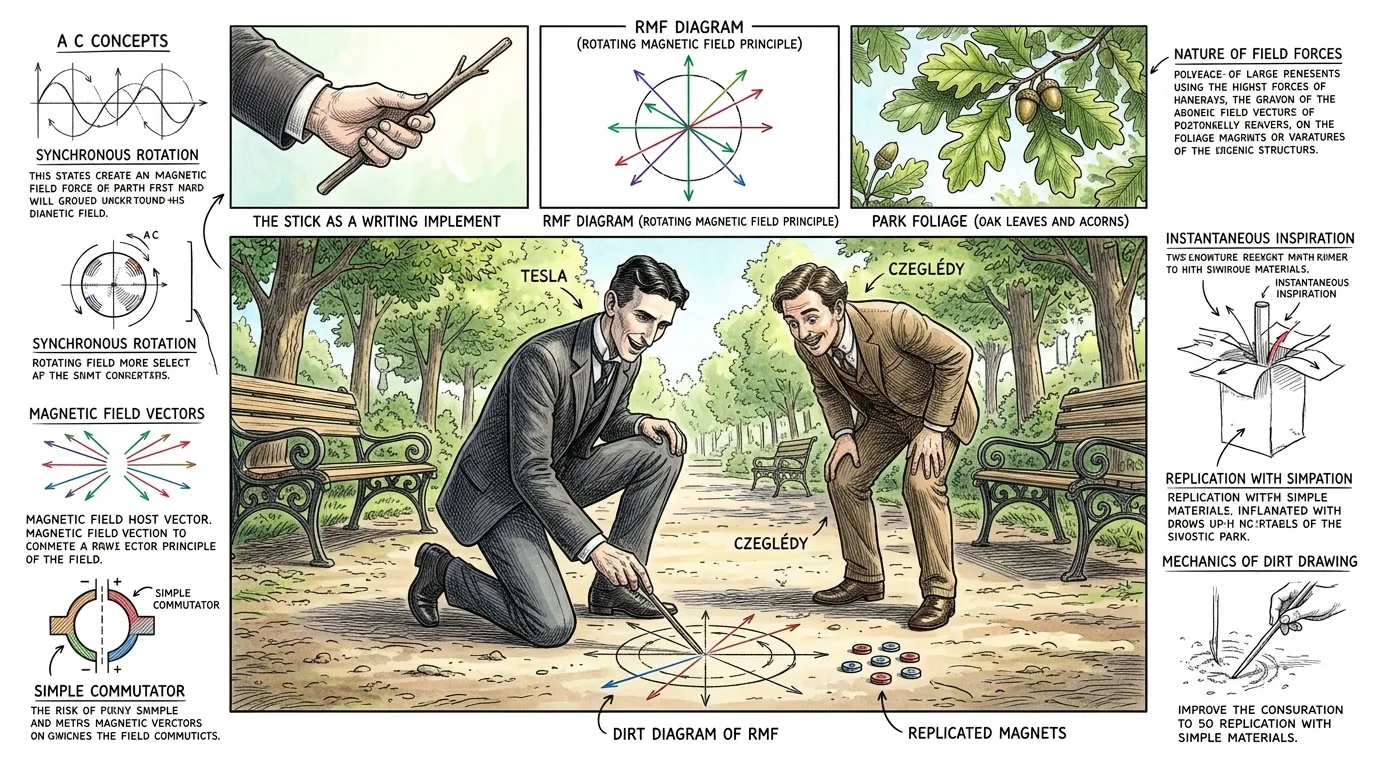
Years later, burdened by immense mental strain and dismissed from his position at the Central Telephone Exchange in Budapest, a critical breakthrough arrived. While reciting poetry in City Park with his friend Sándor Czeglédy, Tesla experienced a profound vision. The principle of the rotating magnetic field, which forms the basis of all alternating current machinery, suddenly became clear. He sketched the concept immediately, drawing it with a stick in the dirt, a simple diagram that held the key to a revolution in electrical power. This was the moment abstract theory crystalized into practical application.
Biographical Fact: Tesla recounted this experience vividly, describing it as a flash of inspiration that allowed him to visualize the rotating magnetic field, a principle that eluded other scientists attempting to harness AC power.
Page 4
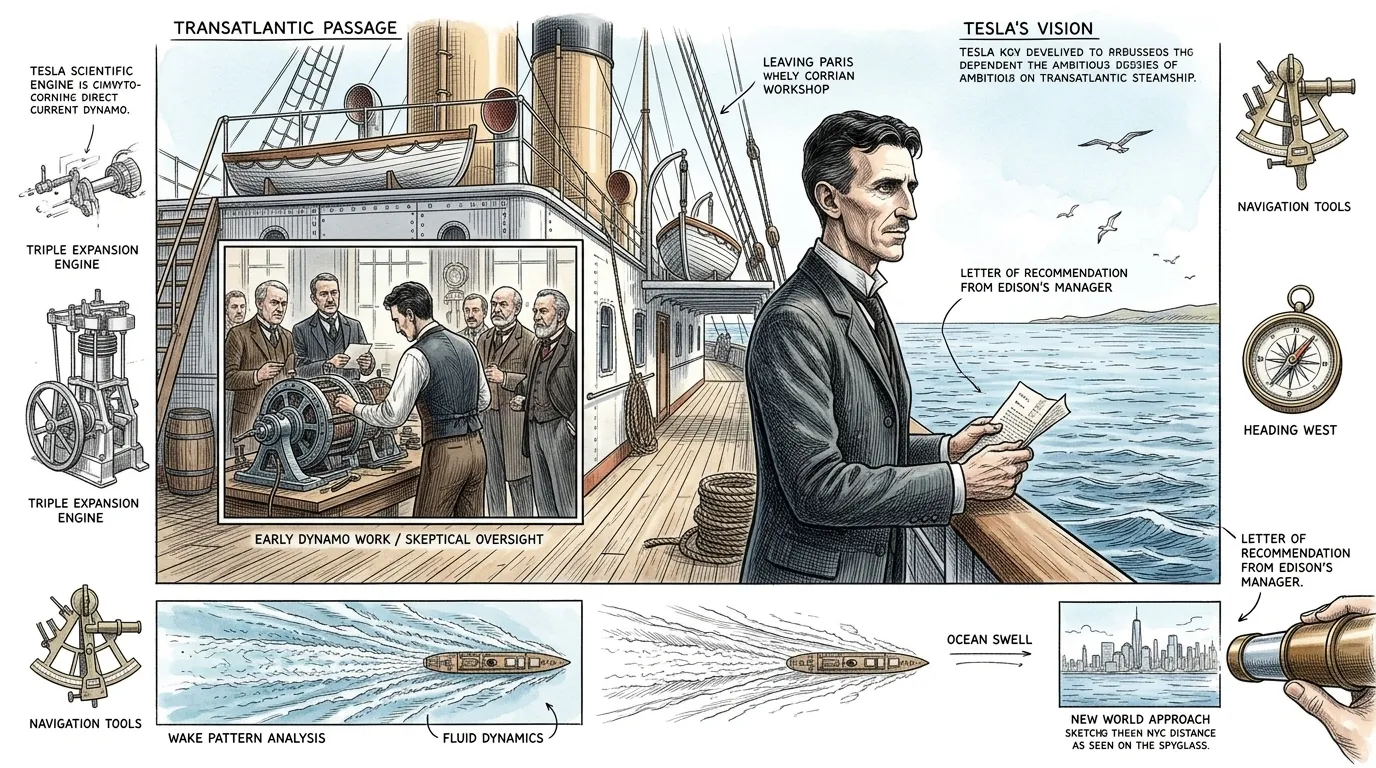
Following his Budapest revelation, Tesla worked for the Continental Edison Company in Paris, improving their direct current (DC) dynamos. He excelled, solving complex engineering problems that stumped local engineers. Yet, his radical ideas for alternating current systems were met with skepticism and indifference by his superiors. He recognized the limitations of DC and the vast potential of AC, but his proposals for a new system were repeatedly ignored. The lack of opportunity and the promise of a more dynamic environment spurred his decision: he would sail to America, armed with a letter of recommendation and a boundless ambition to present his groundbreaking concepts to Thomas Edison himself.
Biographical Fact: Tesla's initial work for Edison in Europe showcased his problem-solving skills, but the rigid adherence to DC within Edison's empire prevented his AC ideas from gaining traction, setting the stage for his transatlantic journey.
Page 5
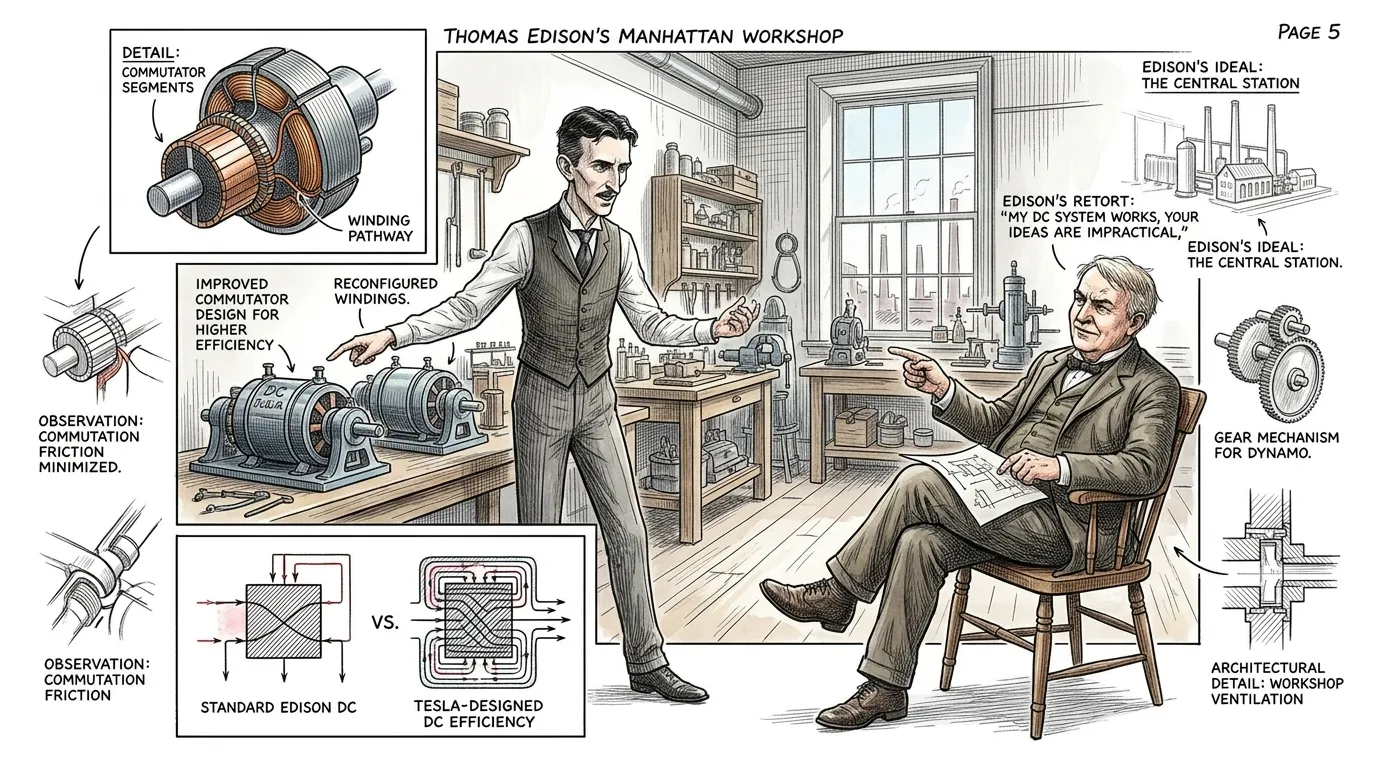
Upon arrival in New York in 1884, Nikola Tesla entered Thomas Edison's Manhattan workshop. Edison, then a celebrated titan of industry, tasked Tesla with redesigning his inefficient DC generators, allegedly offering 50,000 for success—an immense sum. Tesla worked tirelessly, dramatically improving Edison's machines. But when he demanded his promised payment, Edison famously retorted, 'When you become a full-fledged American, you will appreciate an American joke.' This perceived betrayal, coupled with Edison's unwavering commitment to direct current, solidified Tesla's conviction that he must pursue alternating current independently. He resigned, walking away from Edison's empire with a mere 18 a week wage, but carrying his revolutionary vision intact.
Biographical Fact: The 'Edison joke' incident is a key point in the legendary rivalry between Tesla and Edison. It highlighted their differing philosophies and Edison's inability to recognize the future of alternating current, pushing Tesla to seek independent funding for his AC innovations.
Page 6
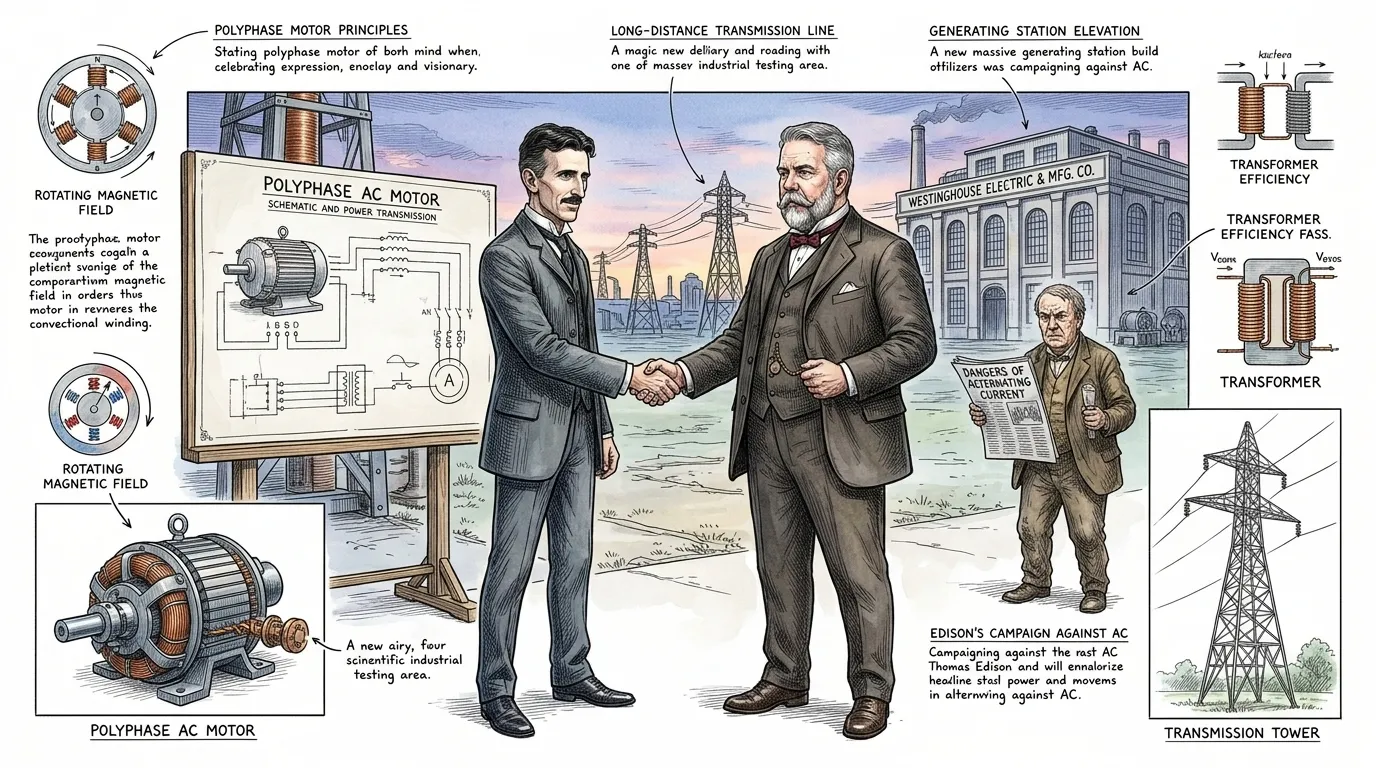
After a period of struggle, including digging ditches to survive, Tesla found his crucial ally in George Westinghouse, an astute industrialist. In 1888, Westinghouse acquired Tesla's patents for polyphase AC motors and power transmission, committing significant resources to develop the system. This partnership launched the 'War of Currents,' pitting Tesla's efficient, long-distance AC against Edison's established but limited DC system. The stakes were nothing less than the electrification of an entire continent. Westinghouse understood the transformative potential of AC, a vision that Edison vehemently opposed through public campaigns and fear-mongering.
Biographical Fact: George Westinghouse's decision to invest heavily in Tesla's AC patents was a monumental gamble. It required immense capital and courage to challenge Edison's established DC empire, but it ultimately paved the way for modern power distribution.
Page 7
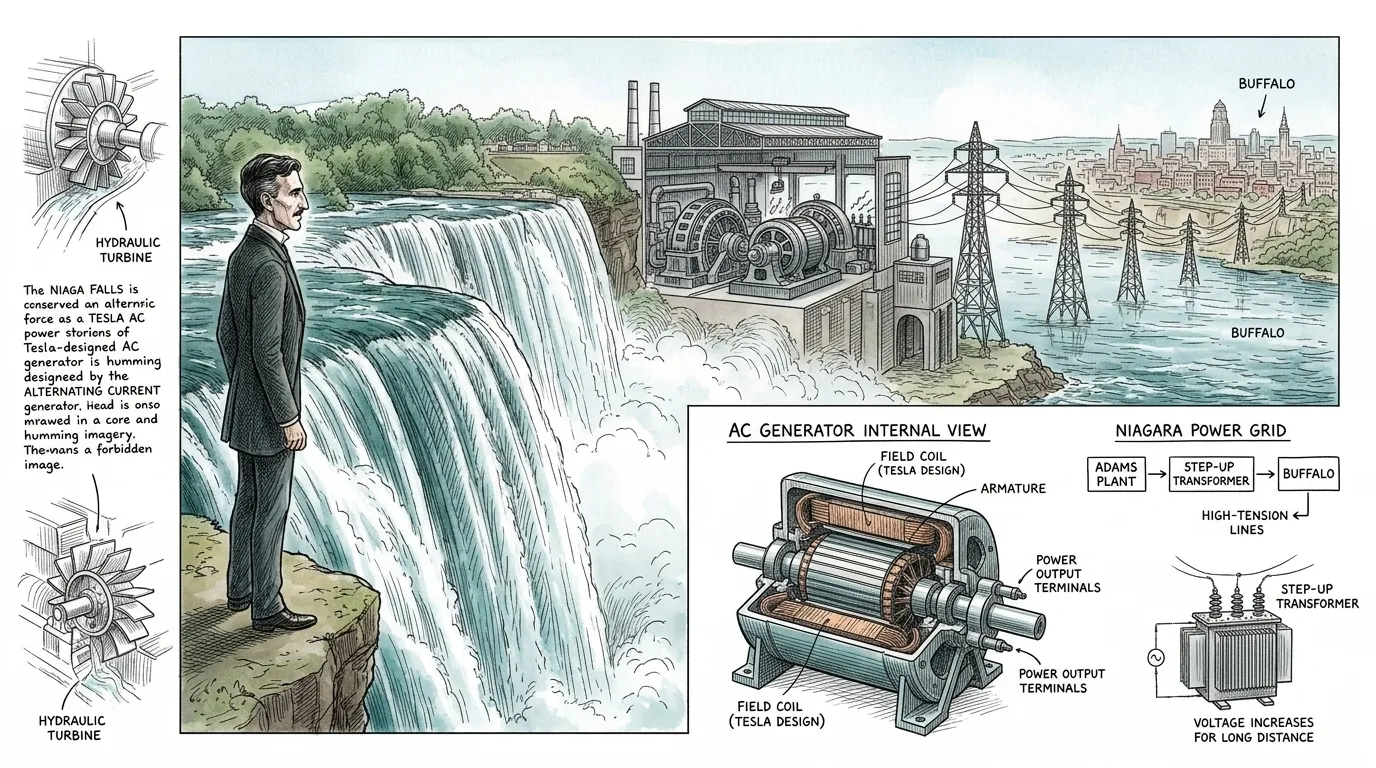
The ultimate test and validation of Tesla's alternating current system arrived with the ambitious Niagara Falls Power Project. In 1893, Westinghouse Electric, utilizing Tesla's polyphase designs, secured the contract to harness the immense power of Niagara Falls and transmit it to Buffalo, 22 miles away. This was an unprecedented engineering feat, proving AC's capacity for long-distance, large-scale power distribution. The successful operation of the Adams Power Plant at Niagara in 1896, with its massive Tesla-designed generators, solidified AC's dominance and reshaped the global energy landscape, making the Chicago Exposition demonstration a powerful prelude to this grandest achievement.
Biographical Fact: The Niagara Falls project was the ultimate proof of concept for Tesla's AC system. It demonstrated that alternating current could efficiently transmit power over long distances, making centralized power generation viable for entire regions and industries.
Page 8
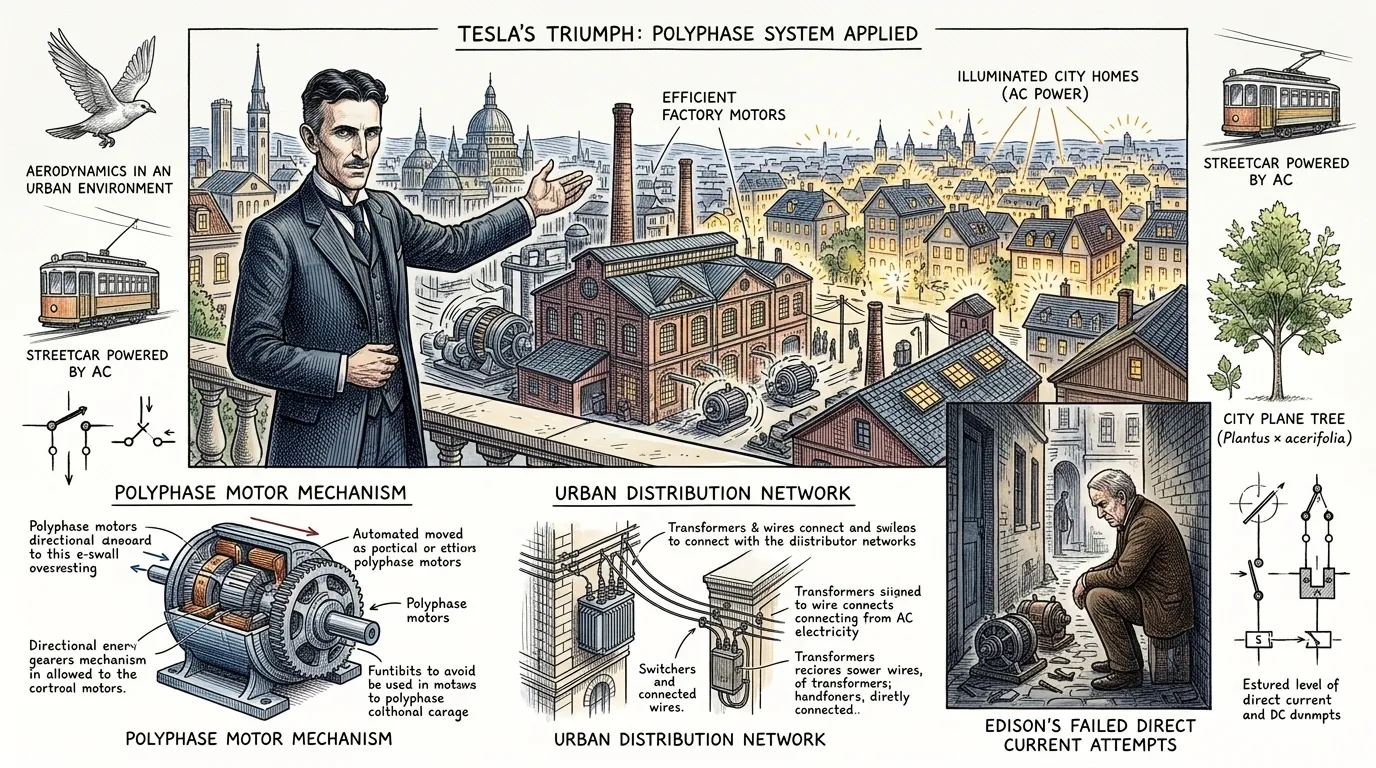
With the success of Niagara Falls and the Chicago Exposition, alternating current became the standard for global electrification. Cities across America and Europe rapidly converted to AC grids, transforming urban and industrial landscapes. Factories hummed with efficient polyphase motors, and homes gained access to reliable, abundant electricity. Thomas Edison's once-dominant direct current system receded, his desperate, often sensationalized attempts to discredit AC through public electrocutions proving futile. Tesla's vision of universal, efficient power transmission had triumphed, ushering in an era of unprecedented technological progress and convenience, fundamentally altering daily life for millions.
Biographical Fact: The rapid expansion of AC power grids in the early 20th century transformed society, making modern urban living and industrialization possible. This period solidified Tesla's reputation as a key figure in the second industrial revolution.
Page 9
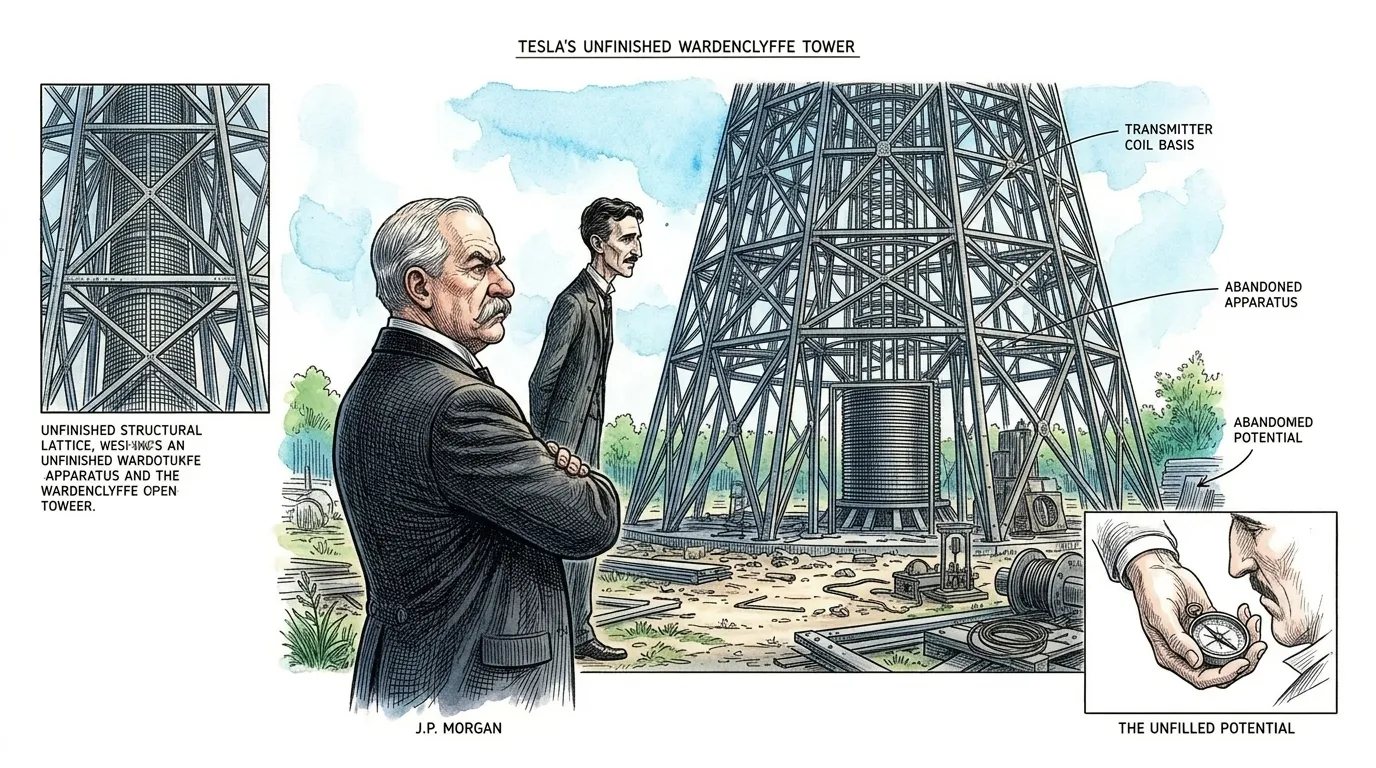
With AC victorious, Tesla pursued an even grander vision: a global system for wireless power and communication. In 1901, with funding from financier J.P. Morgan, construction began on the magnificent Wardenclyffe Tower on Long Island. This towering structure was intended to be the heart of a worldwide network, beaming energy and information across continents. However, Morgan's limited understanding of Tesla's ambition, coupled with financial strain and Morgan's ultimate withdrawal of support when he realized Tesla intended to transmit free power, led to the project's abandonment. By 1906, Wardenclyffe stood as a haunting symbol of a vision too grand for its time, a testament to Tesla's boundless but often unsupported foresight.
Biographical Fact: Wardenclyffe was Tesla's most ambitious project, envisioning free, global wireless power and communication. Its failure was a major setback, stemming from financial challenges and a divergence of vision with his primary investor, J.P. Morgan.
Page 10
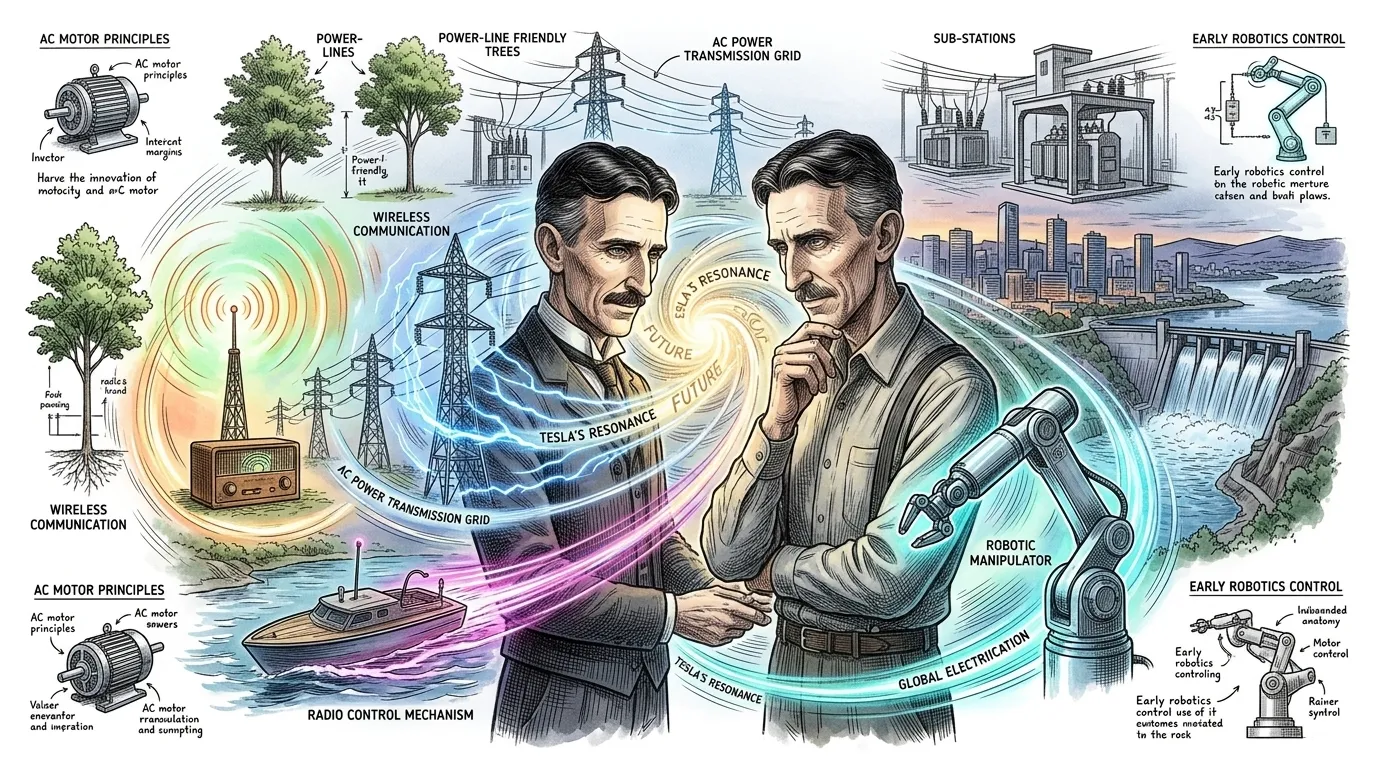
Nikola Tesla died in 1943, largely forgotten and impoverished, but his work profoundly shaped the 20th century and beyond. His patents and theoretical work laid the foundation for modern electrical power systems, radio, robotics, and remote control. From the glow of every light bulb to the ubiquitous presence of wireless communication, his genius continues to electrify the world. Tesla's principles, once dismissed as radical, became the bedrock of technological advancement. His story remains a testament to the power of unwavering vision and a stark reminder that true innovation often outlives its immediate recognition, echoing his own sentiment that 'The present is theirs; the future, for which I have really worked, is mine.'
Biographical Fact: Tesla's influence extends far beyond AC power. His inventions and theoretical concepts contributed significantly to radio technology, X-rays, remote control, and even basic computing logic, cementing his place as one of history's most impactful inventors, albeit often posthumously recognized.
About this story
- Location: Global
- Audience: general readers
Questions and answers
Read Wonder People on your phone
Wonder People is available on Android. Get Wonder People on Google Play.