Rumi
Rumi — an illustrated biography story, set in Global. 10 illustrated pages, free to read on Wonder People.
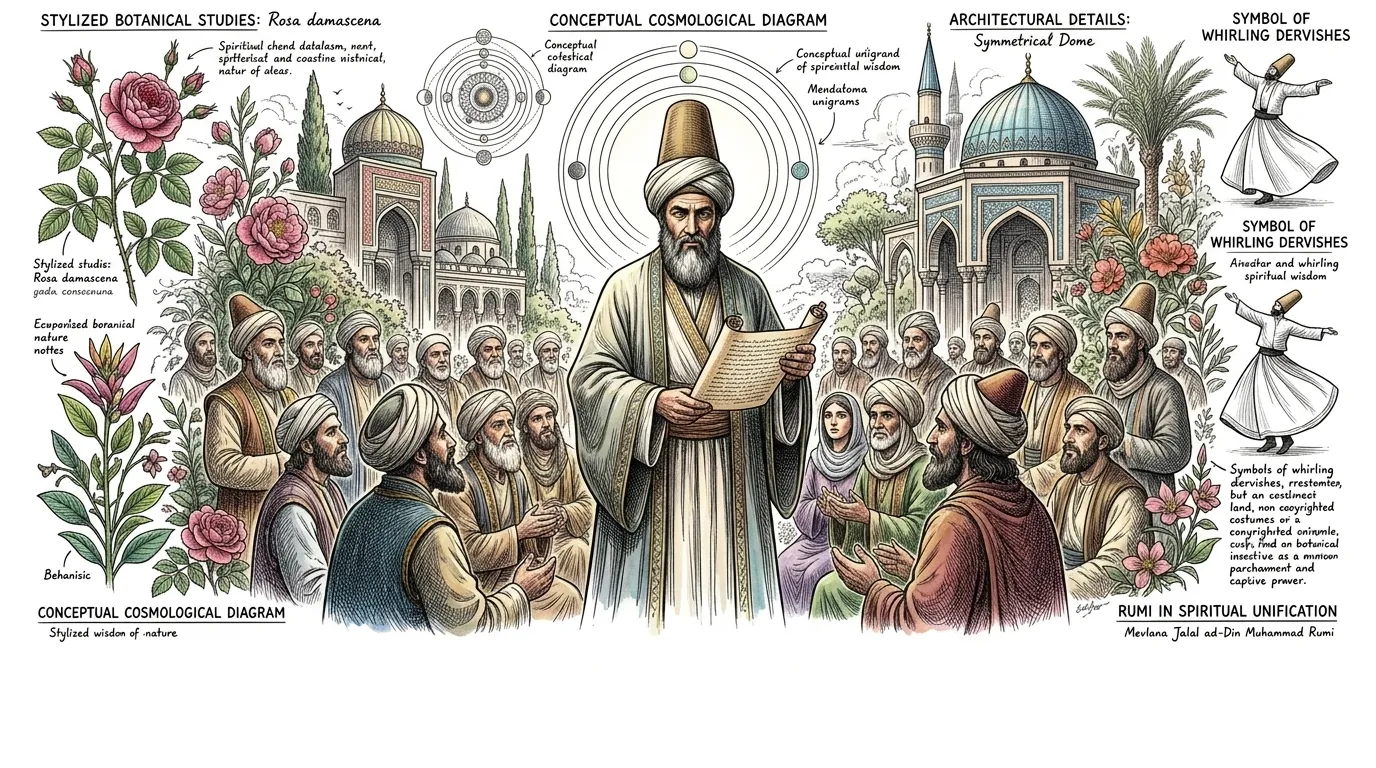
Page 1
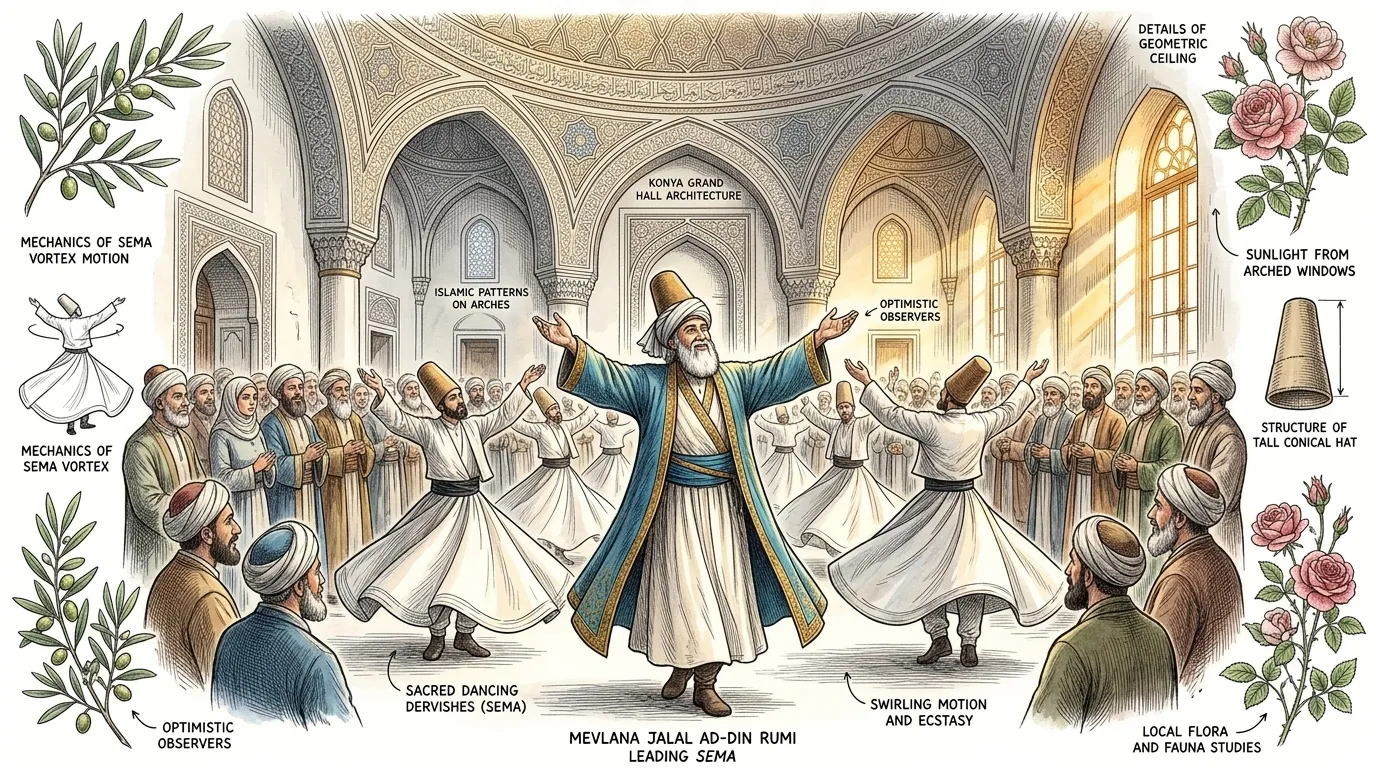
In 1273, in the heart of Konya, Anatolia, a profound spiritual event unfolded. Mevlana Jalal ad-Din Muhammad Rumi, the revered master, entered a state of ecstatic trance, his arms open to the heavens, guiding his disciples, known as dervishes, through the sacred dance of Sema. Around him, hundreds of Konya's citizens, scholars, and merchants stood in hushed reverence, witnessing a spiritual phenomenon that would transcend centuries and borders, solidifying Rumi's place as a global icon of mystical poetry and love. His teachings, crystallized in over 25,000 couplets of the Masnavi, resonated deeply with a world yearning for unity and divine connection.
Page 2
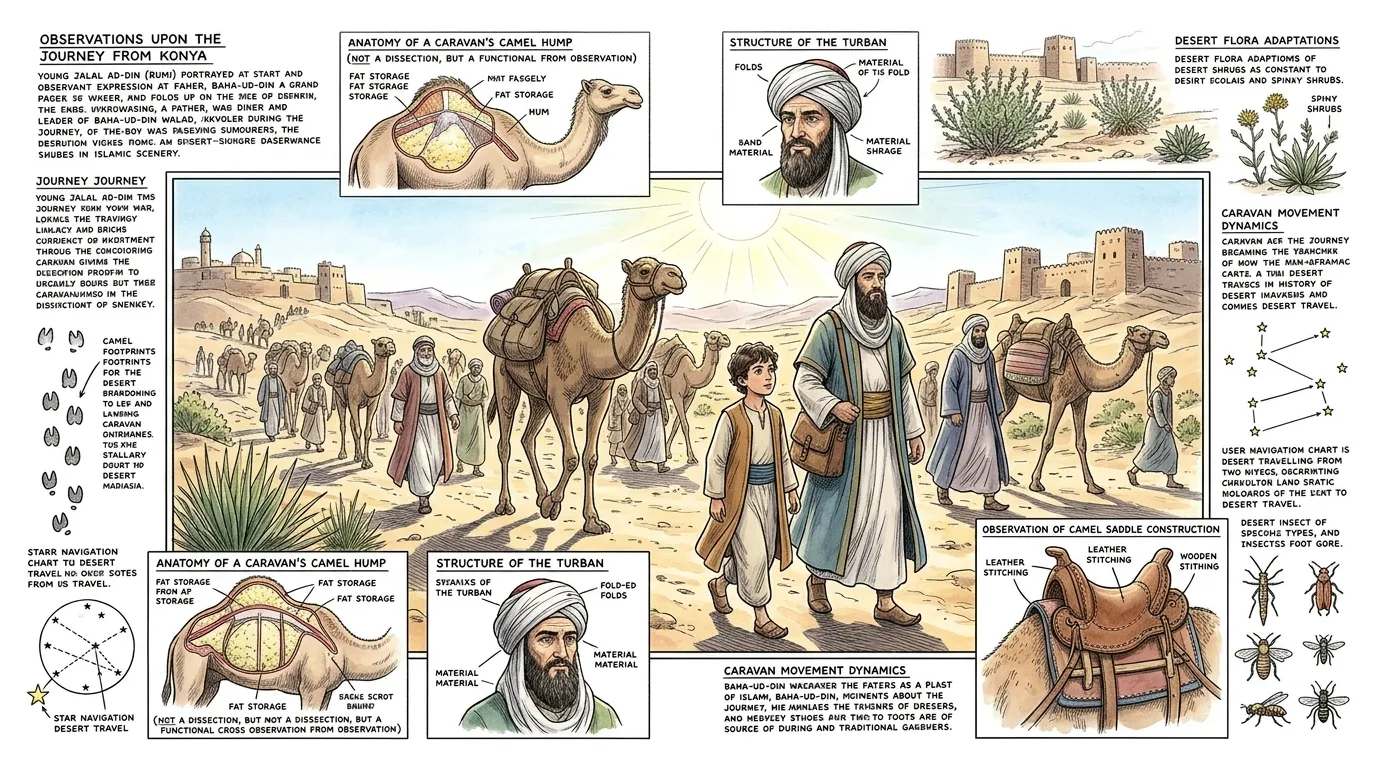
Born in Balkh, Persia, in 1207, Jalal ad-Din was the son of Baha-ud-Din Walad, a renowned Islamic scholar and mystic. His early life was shaped by intellectual rigor within a cultured, prosperous city. However, the relentless advance of the Mongol Empire forced Rumi's family to undertake a vast migration, relocating across the Islamic world. This displacement instilled in the young scholar an early understanding of impermanence and the fragility of worldly attachments, forming a crucial foundation for his later spiritual seeking, as he observed diverse cultures and hardships on their journey.
Page 3

After settling in Konya, Rumi became a respected professor of Islamic law and theology, following in his father's footsteps. His lectures drew large crowds, cementing his status as a leading intellectual. Then, in 1244, a pivotal event occurred: he met Shams-i Tabrizi, a wandering dervish of enigmatic presence. This encounter shattered Rumi's academic certainties, igniting an intense spiritual friendship that transmuted his scholarly pursuits into a passionate quest for divine love and poetic expression.
Page 4

Shams-i Tabrizi challenged Rumi's intellectualism, urging him to experience, rather than merely study, divine love. Their connection was so profound that Rumi abandoned his teaching post for long periods of spiritual retreat and conversation with Shams. This intense, almost consuming bond provoked controversy among Rumi's established students and the conservative elements in Konya, who viewed Shams with suspicion and envy, unable to comprehend the spiritual revolution unfolding before them. Rumi's life was irrevocably altered, moving from rote scholarship to ecstatic contemplation.
Page 5
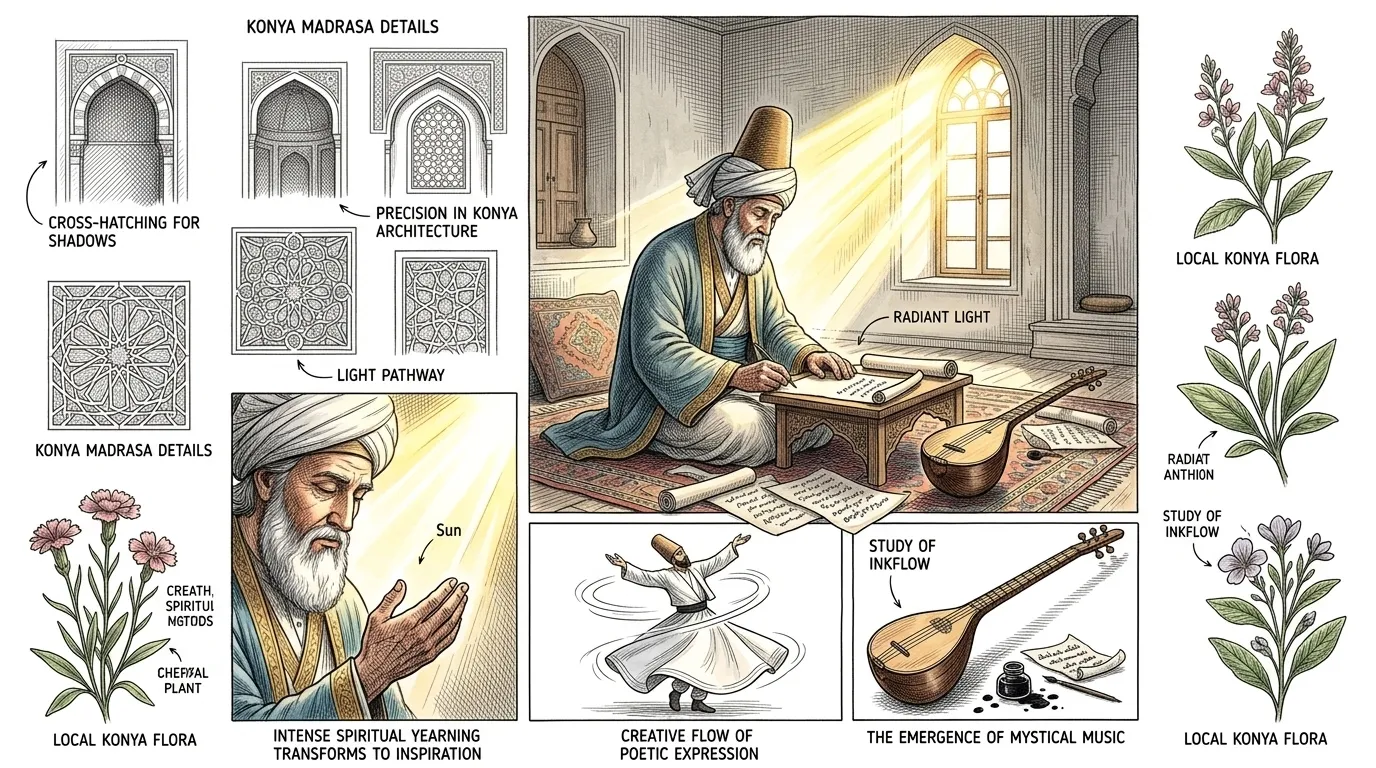
The animosity towards Shams-i Tabrizi intensified, leading to his repeated disappearances and eventual, definitive vanishing in 1248, likely due to foul play orchestrated by those jealous of his influence over Rumi. This loss plunged Rumi into an abyss of grief and longing, not for a friend, but for the 'Sun' (Shams means 'Sun' in Arabic) of divine truth that Shams had represented. Out of this profound sorrow, Rumi did not break; instead, he transmuted his pain into an unparalleled outpouring of mystical poetry and music, seeing Shams' essence in every particle of existence.
Page 6
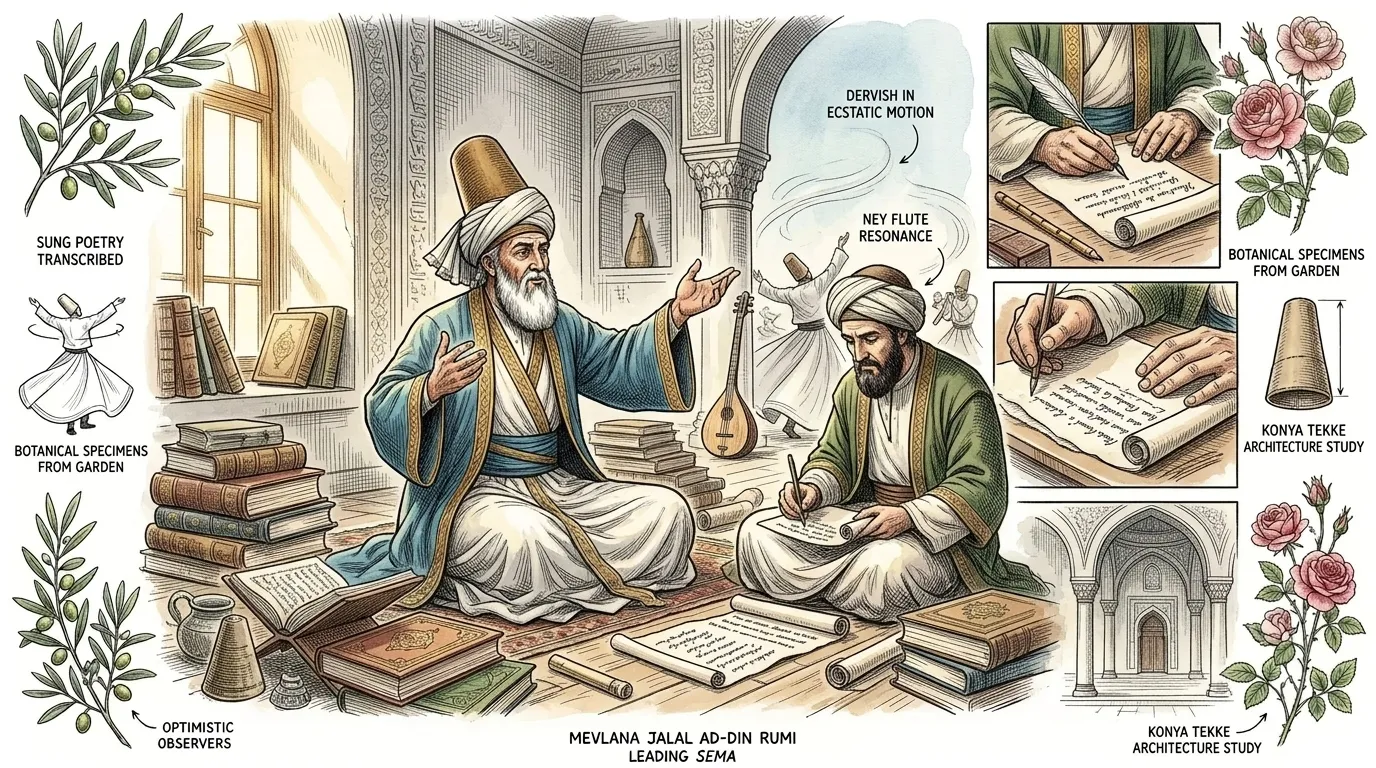
Following Shams' disappearance, Rumi found solace and expression in spontaneous poetic composition, often accompanied by music and dance. His disciple, Husam al-Din Chalabi, recognized the profound significance of these verses and encouraged Rumi to organize them into a unified work. Thus began the dictation of the Masnavi, a monumental spiritual epic that would become a cornerstone of Islamic mysticism and world literature. Rumi's sorrow became a wellspring of profound insights, shaping his spiritual legacy.
Page 7
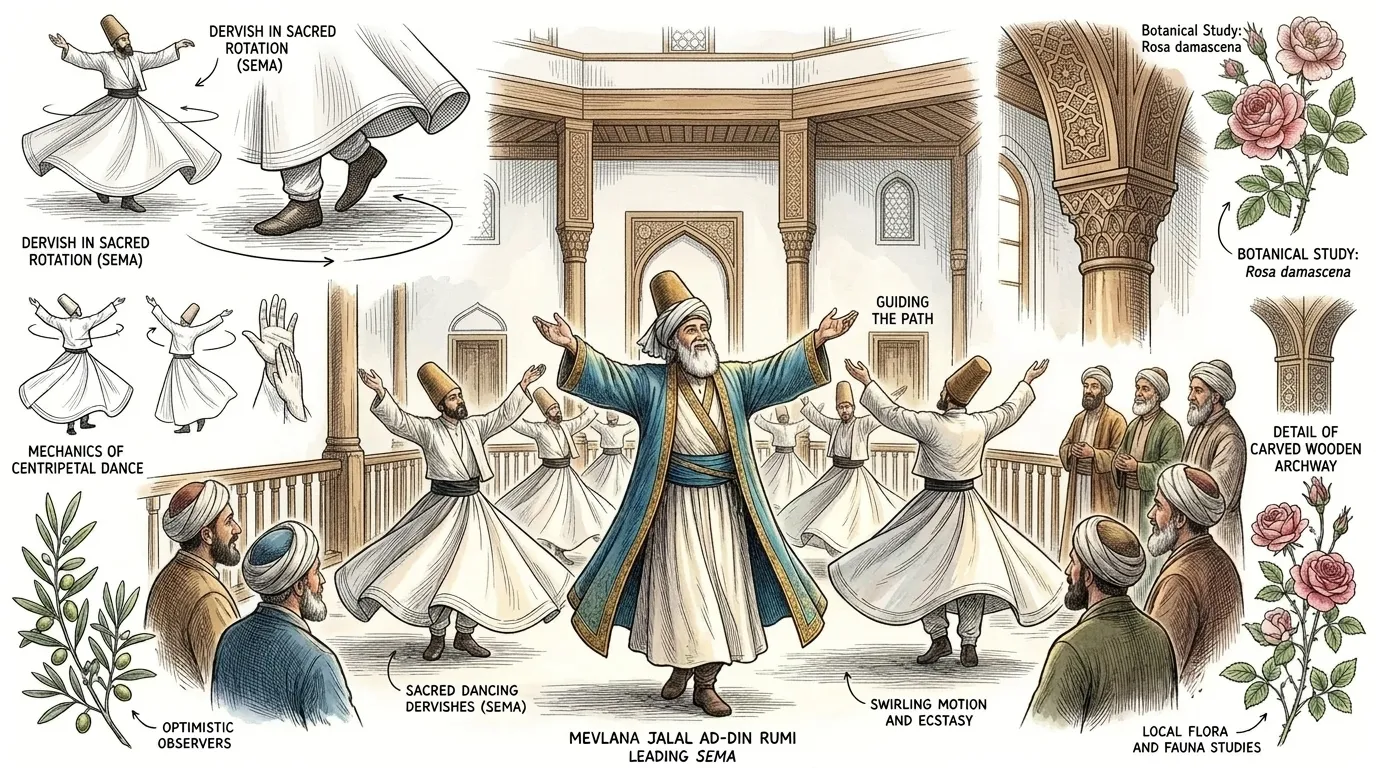
Rumi's mystical practices, centered on music, poetry, and the whirling meditation (Sema), attracted a diverse group of followers who sought spiritual enlightenment through his path of divine love. Under the guidance of his son, Sultan Walad, and his successor, Husam al-Din Chalabi, these practices coalesced into the Mevlevi Order, a Sufi brotherhood dedicated to preserving and propagating Rumi's teachings. The dervishes, through their structured spiritual path, formalized the ecstatic tradition Rumi had embodied, creating a lasting institutional expression of his mystical vision.
Page 8

When Rumi passed away in Konya on December 17, 1273, his funeral became an unprecedented display of communal grief and universal reverence. Muslims, Christians, and Jews, scholars, merchants, and peasants alike, joined in the procession, united by their profound respect for his teachings of love and tolerance. This spontaneous coming together of diverse faiths and social strata underscored the immense impact Rumi had on the social and spiritual fabric of Anatolia, proving his message transcended sectarian boundaries and spoke directly to the human soul. The very city that once harbored skepticism now mourned as one.
Page 9
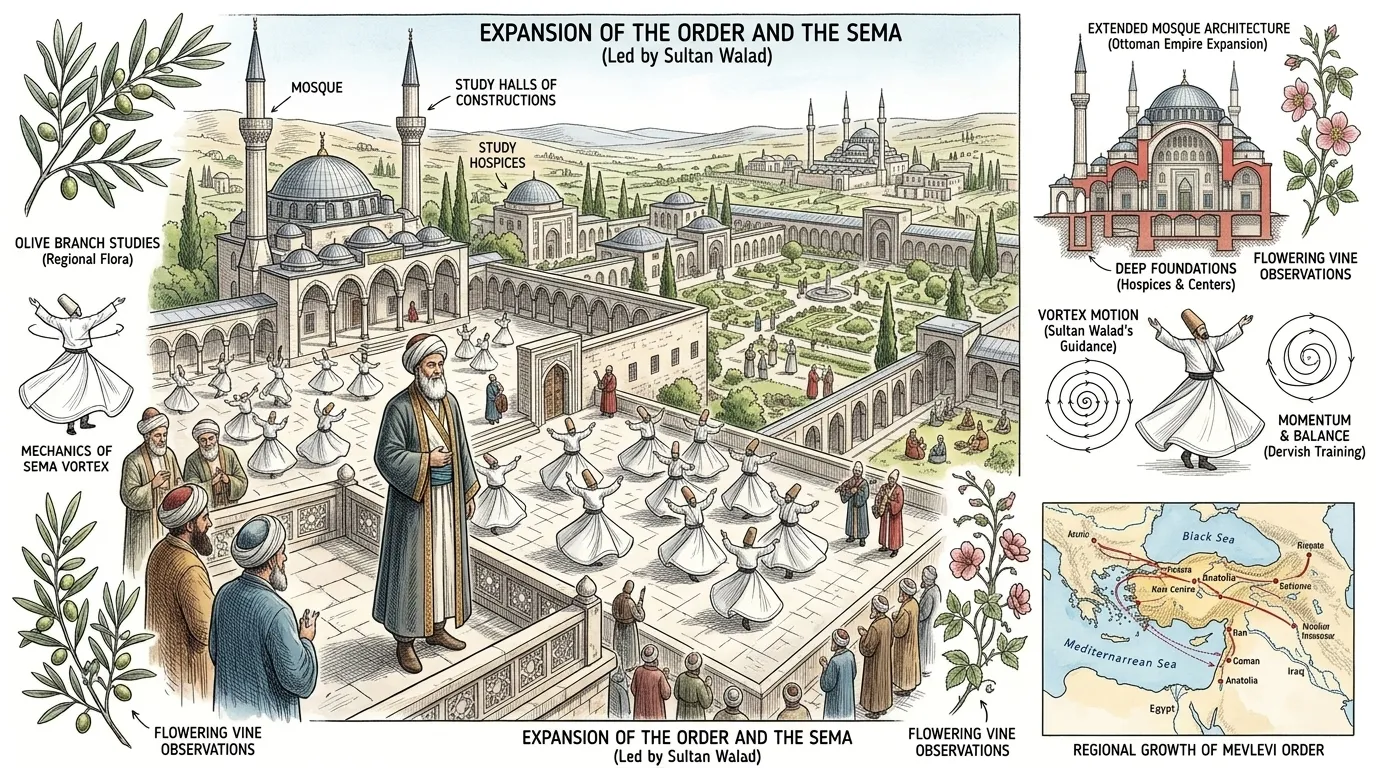
After Rumi's passing, the Mevlevi Order, often known as the Whirling Dervishes, grew steadily under the leadership of his son, Sultan Walad, and later, other descendants. The order established hospices and centers, not only in Anatolia but spreading across the Ottoman Empire, becoming a powerful spiritual force. Their unique practices, combining devotion, music, and the ecstatic dance of Sema, continued to attract seekers. The order became the living embodiment of Rumi's philosophical and poetic legacy, transmitting his message through centuries, adapting to new contexts while maintaining its core principles.
Page 10
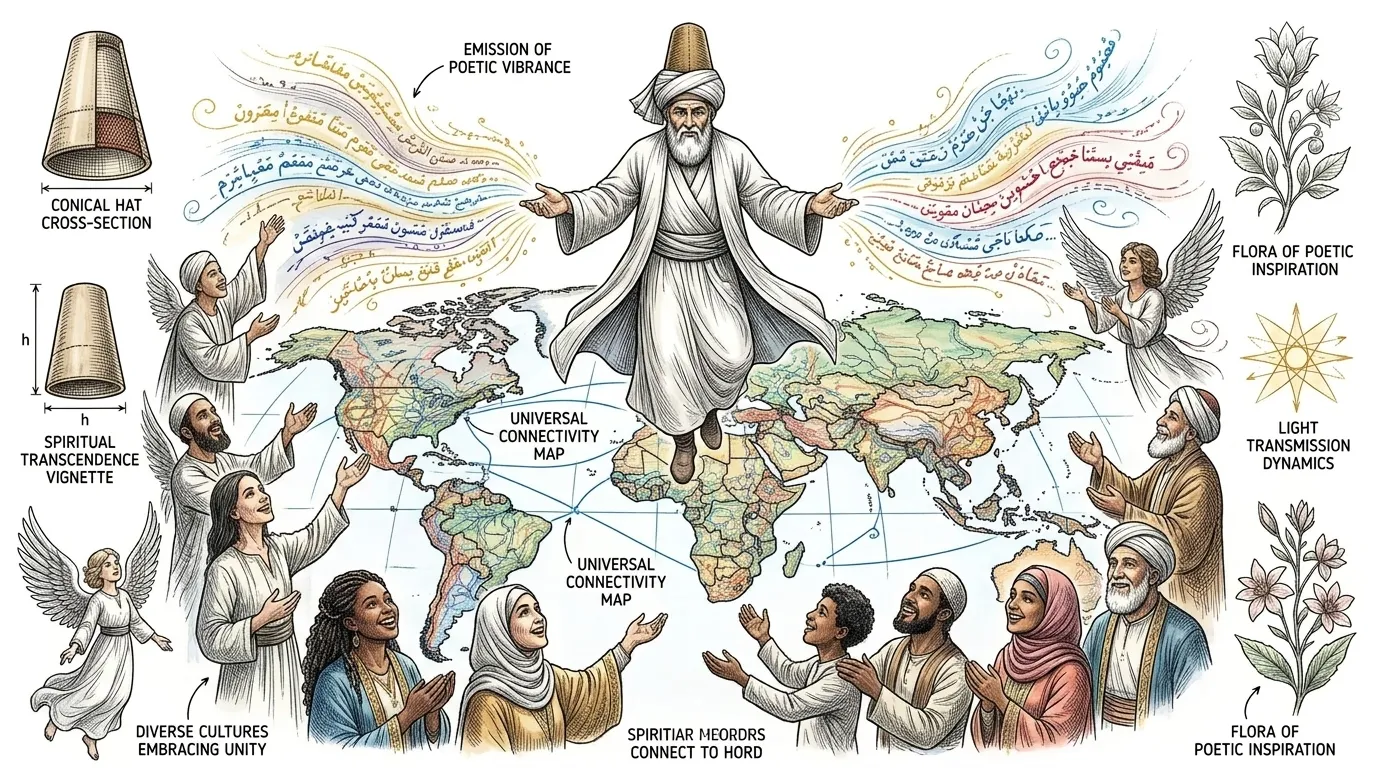
Centuries after his passing, Rumi's voice resonates globally, his poetry translated into countless languages, reaching millions across diverse cultures and faiths. His emphasis on universal love, unity, and the direct experience of the divine transcends religious dogma and geographical boundaries. What he spoke into existence continues to offer solace and inspiration, connecting humanity to an inner spiritual yearning. As Rumi himself once proclaimed, 'You were born with wings, why prefer to crawl through life?' His work remains a timeless invitation to transcend limitations and embrace the boundless possibilities of the human spirit.
About this story
- Location: Global
- Audience: general readers
Questions and answers
Read Wonder People on your phone
Wonder People is available on Android. Get Wonder People on Google Play.