Samuel Morse
Samuel Morse — an illustrated biography story, set in Global. 10 illustrated pages, free to read on Wonder People.
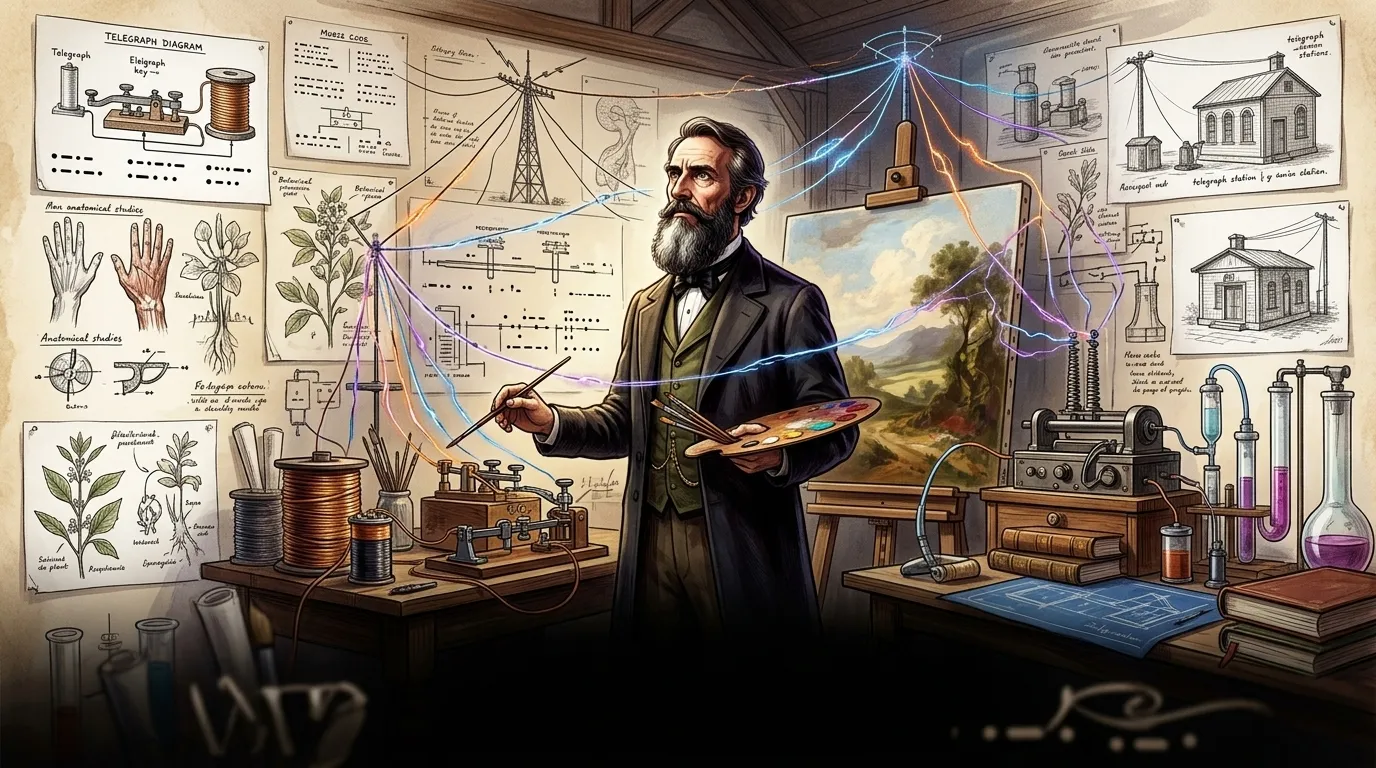
Page 1
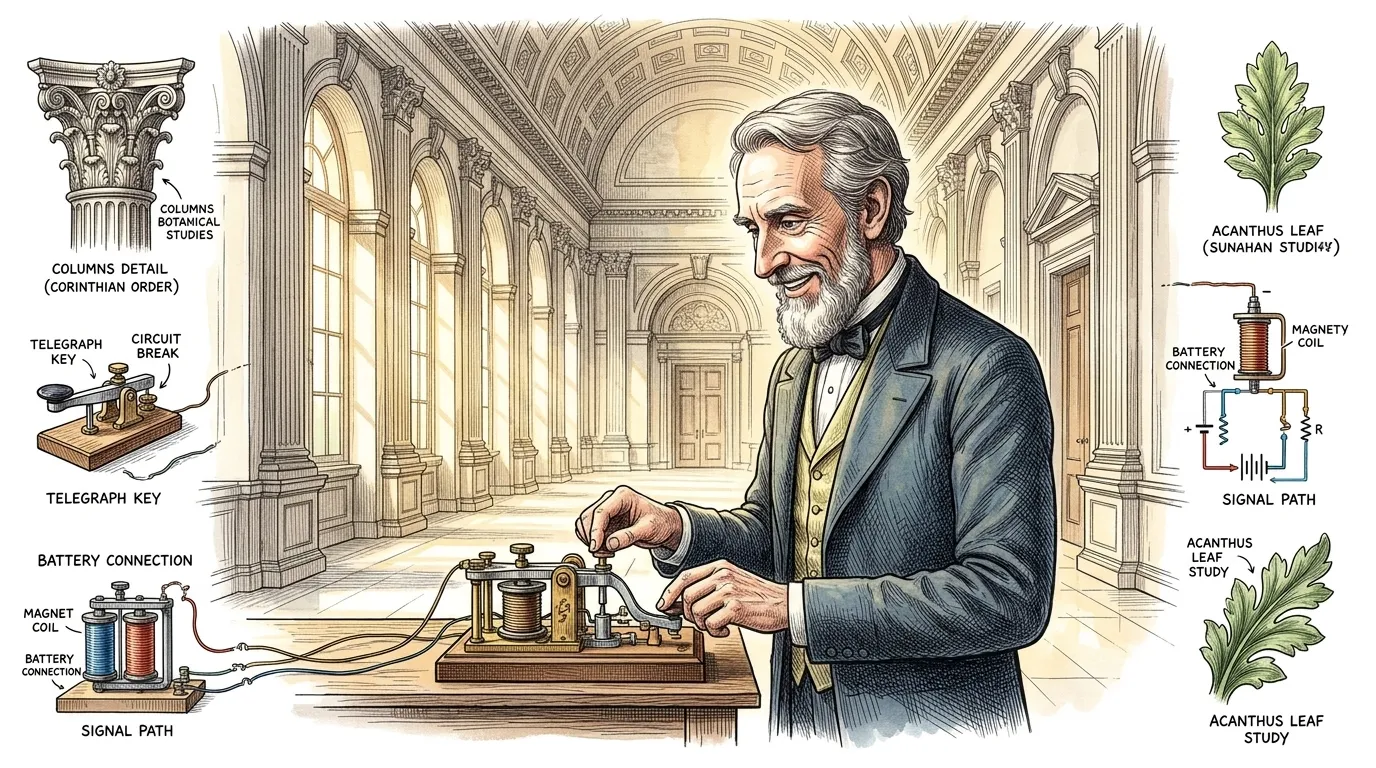
At the United States Capitol Building in Washington D.C., in the Spring of 1844, a pivotal moment arrived for Samuel Morse. He stood before his telegraph instrument, having secured a 30,000 appropriation from Congress after years of relentless advocacy. With his assistant Alfred Vail poised at the receiving end in Baltimore, Morse transmitted the world's first public telegram.
"Morse tapped the key, his voice clear, 'What hath God wrought?' The message, born of a biblical verse suggested by Annie Ellsworth, raced nearly 40 miles, instantly shrinking distance and announcing a new era."
Page 2
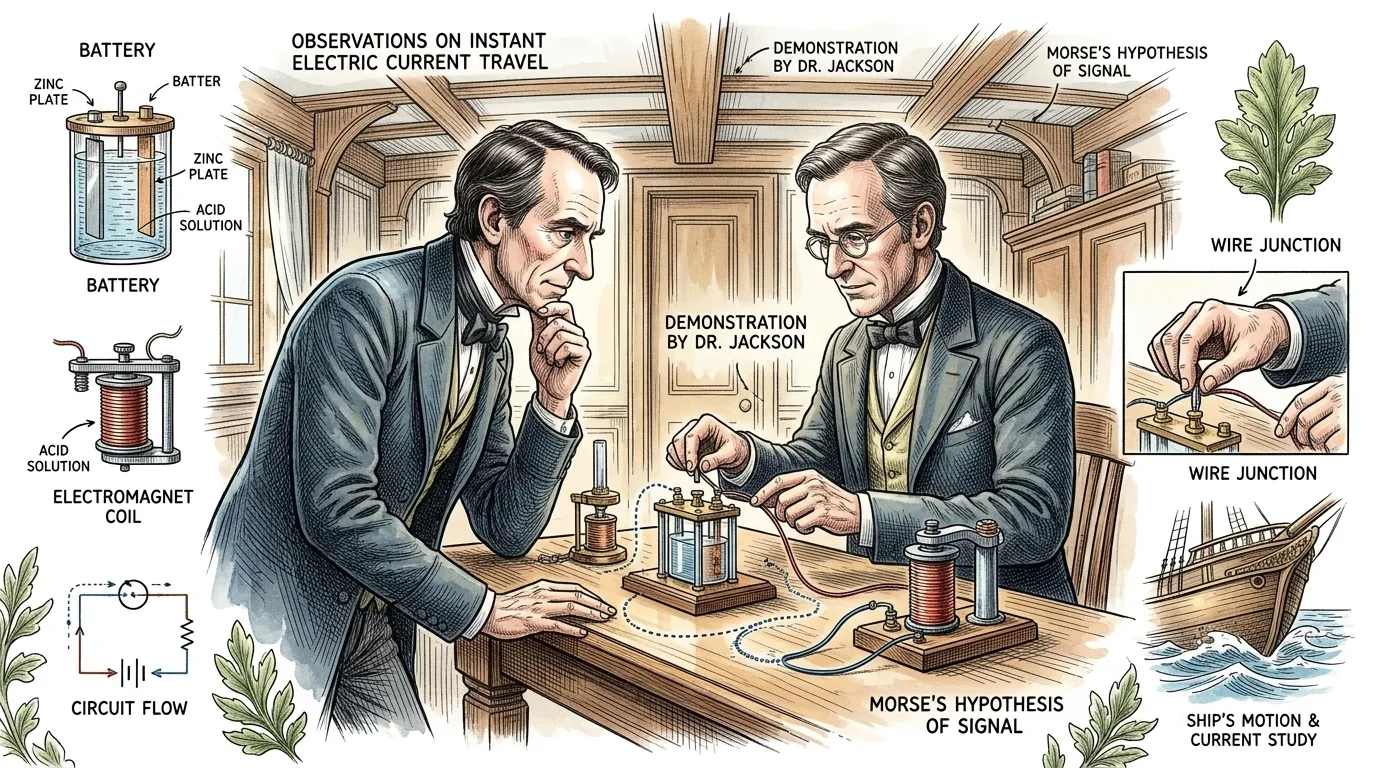
Years earlier, in 1832, on a return voyage from Europe aboard the packet ship Sully, Samuel Morse, then a renowned painter, found himself amidst conversations that would change his life. Dr. Charles Thomas Jackson, a fellow passenger, demonstrated experiments with electromagnets and discussed the properties of electricity.
"Morse watched intently as Dr. Jackson connected a wire to a battery. 'This current,' Jackson explained, 'travels almost instantly through the wire, but its power weakens over distance. It takes cleverness to make it useful for real messages.' Morse pondered, 'If electricity can make a mark at one end, can it make a series of marks at great distances? The key is maintaining the signal's strength.'"
Page 3
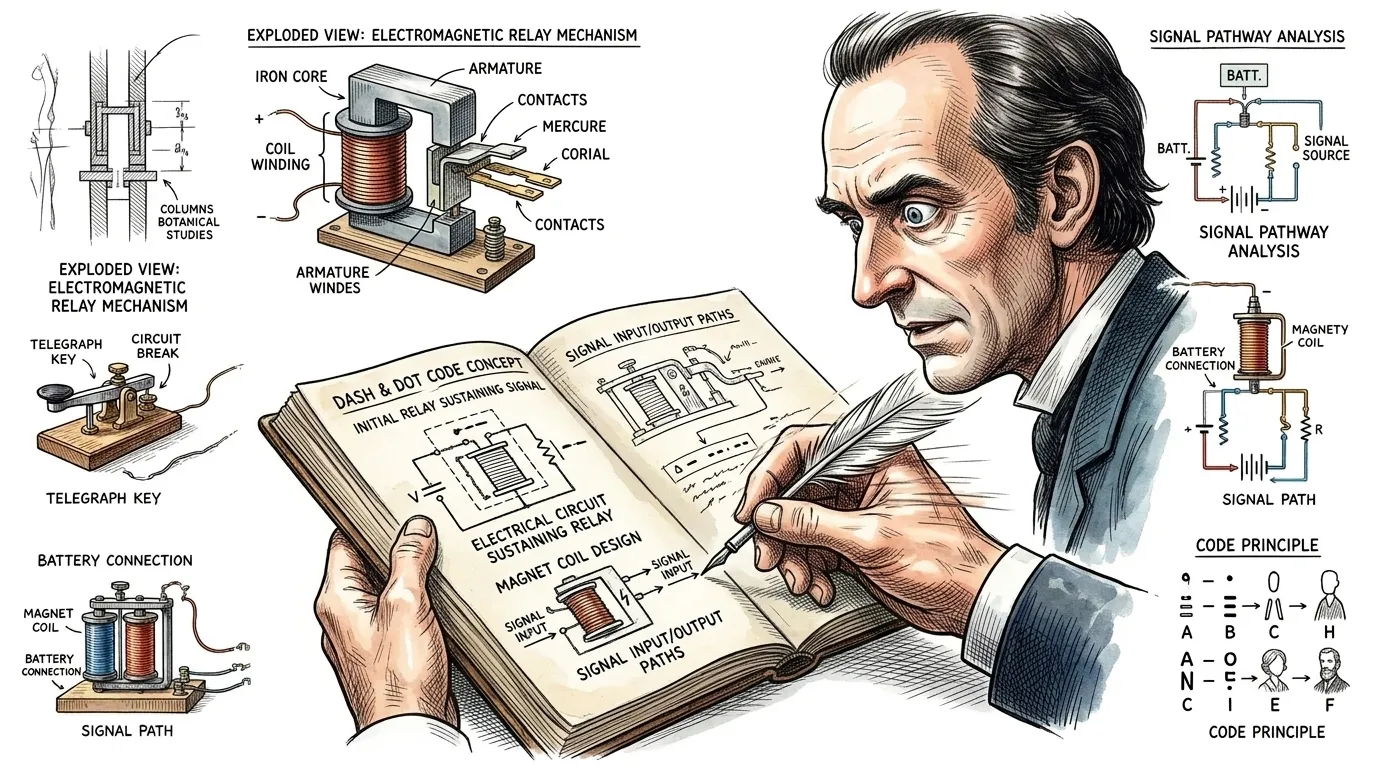
Inspired by Dr. Jackson's demonstration, a profound vision seized Morse. He realized electricity's instantaneous travel could be harnessed for communication, far beyond simple signals. The challenge was to make a weak electrical impulse leave a permanent record, and to create a universal language for it.
"Morse sketched furiously in his notebook. 'The current acts as a carrier!' he exclaimed to himself, his eyes wide with discovery. 'If a short burst creates one mark, and a long burst another, then combinations can represent letters! But how do we sustain the signal over vast distances?' He remembered the principle of electromagnetism and knew a repeating mechanism, a relay, would be essential for amplification."
Page 4
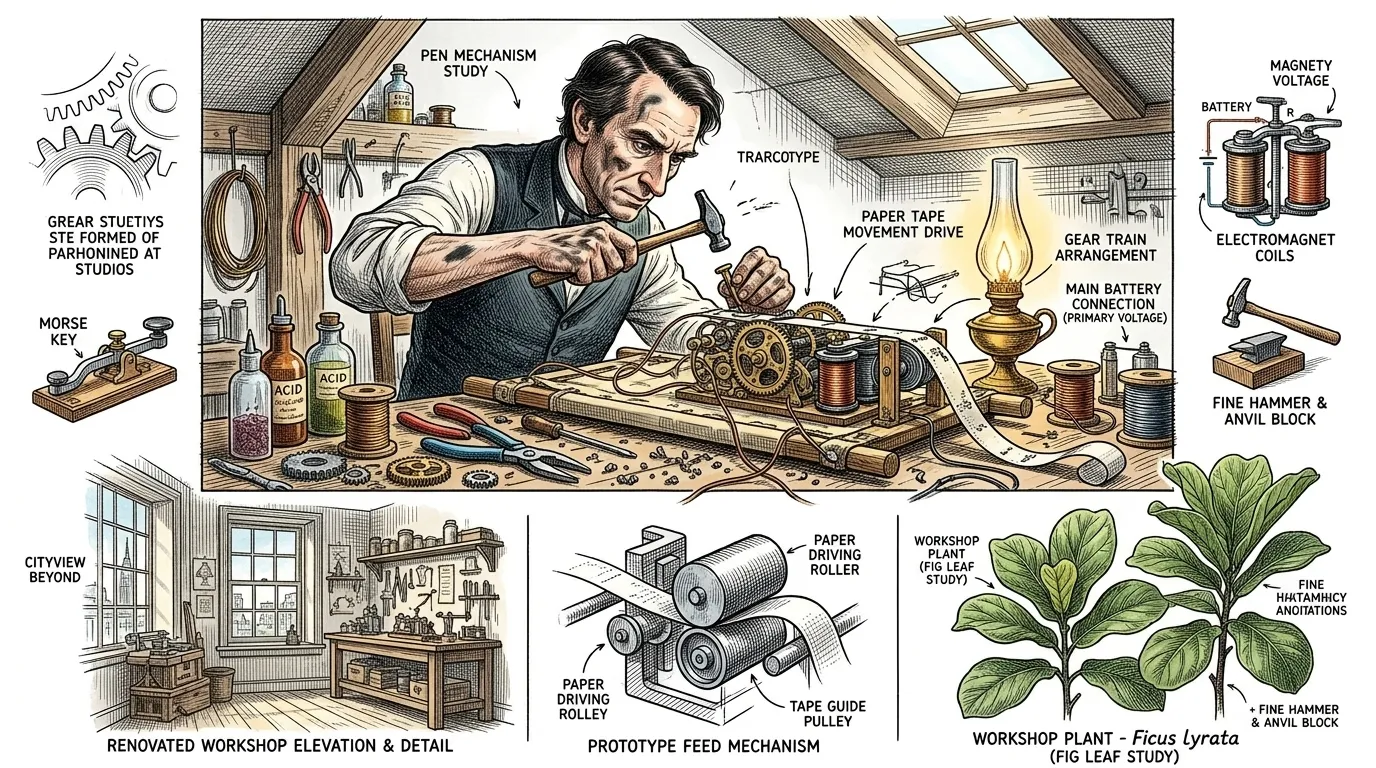
Back in New York, Morse dedicated himself to realizing his vision. His artistic pursuits now took a backseat as he transformed his studio into a workshop. He began constructing a crude, but functional, prototype using everyday materials.
"Morse hammered and wired, often frustrated. 'It must work reliably!' he declared, wiping grease from his brow. 'The paper tape must move, the pen must mark precisely when the current flows!' He looked at his creation—an old canvas stretcher, clockwork gears, and wires. 'Every resistance must be overcome, every connection perfected.'"
Page 5
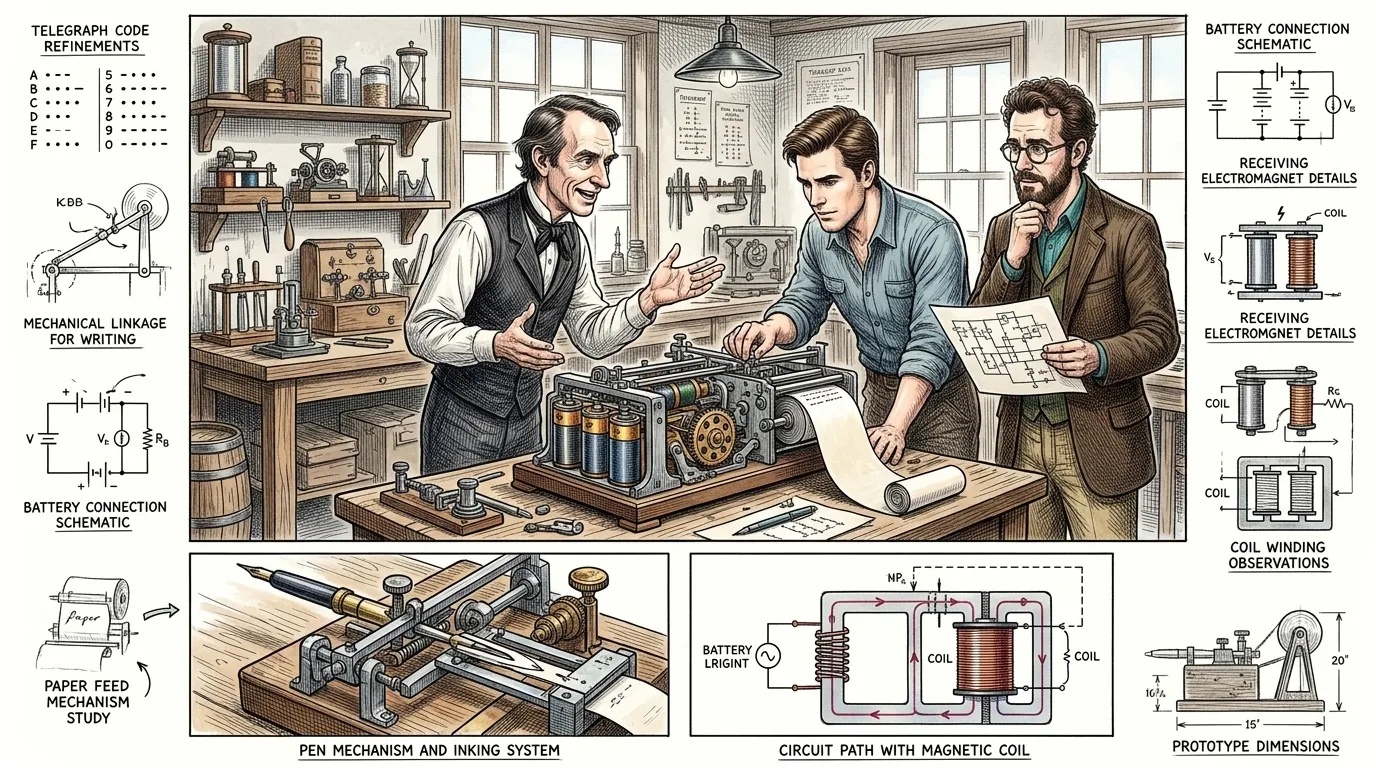
The complexity of the telegraph system demanded more than one mind. Morse soon found crucial collaborators. Leonard Gale, a professor, offered scientific assistance, and more importantly, Alfred Vail, a young, brilliant mechanic and industrialist, joined the endeavor, contributing financially and technically.
"Morse pointed to his unwieldy machine. 'Alfred, your mechanical skill is invaluable!' Vail, inspecting the crude pen mechanism, nodded. 'We need greater precision. And for a truly universal system, the code needs refinement, something efficient for every letter.' He proposed changes to the code, making the frequent letters shorter, optimizing the system for speed."
Page 6
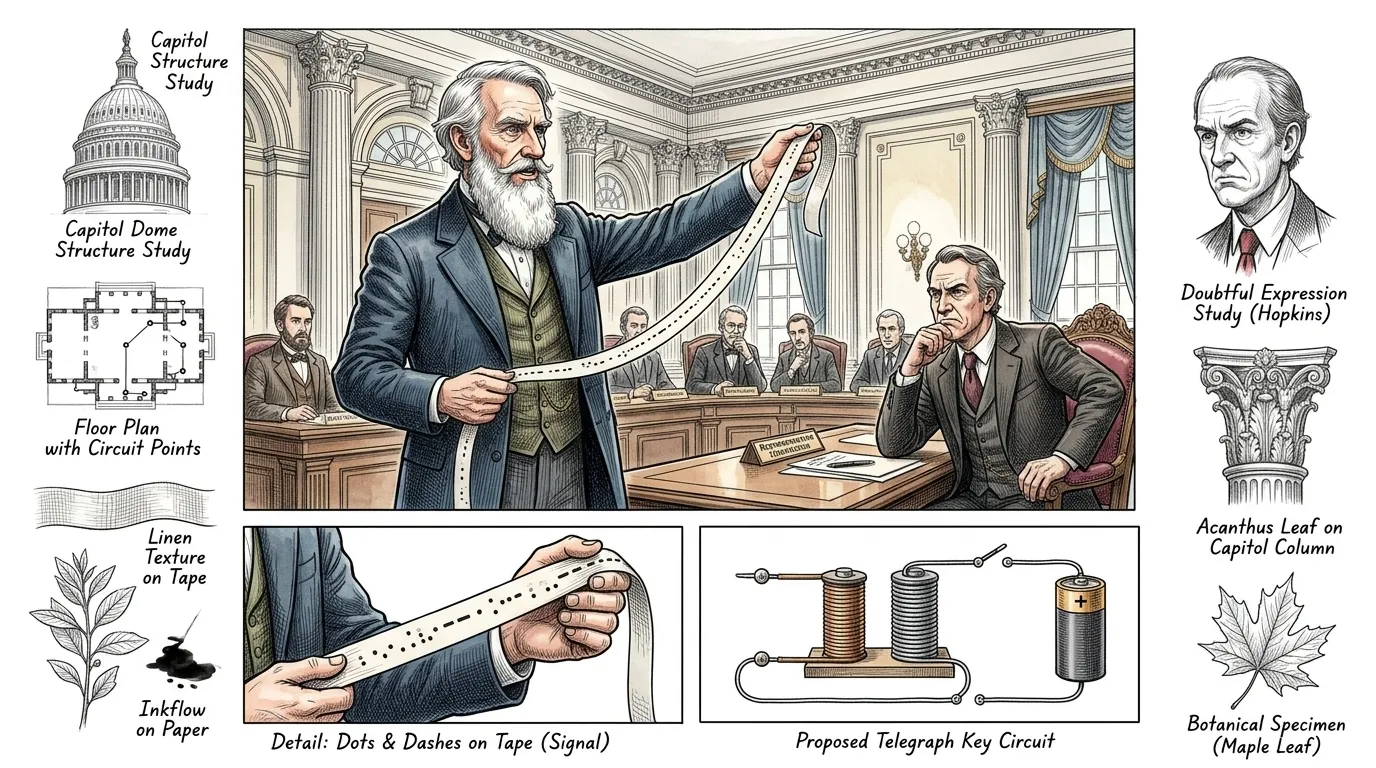
With a working prototype, Morse understood the next challenge was not technical, but political and financial. The sheer cost of laying a telegraph line required government backing. For years, he campaigned tirelessly, facing skepticism and legislative delays in Washington D.C.
"Morse addressed a committee of Congressmen, holding up a sample of telegraph tape with the recorded dots and dashes. 'Gentlemen, this invention will bind our nation, transmit knowledge across states faster than any horse or rail!' A skeptical Congressman, Representative Hopkins, scoffed, 'A talking wire? Pure fantasy, Mr. Morse. Where is the evidence of its practical use over vast distances?' Morse firmly replied, 'The evidence lies in its potential, a potential we only unlock with your vision and support.'"
Page 7
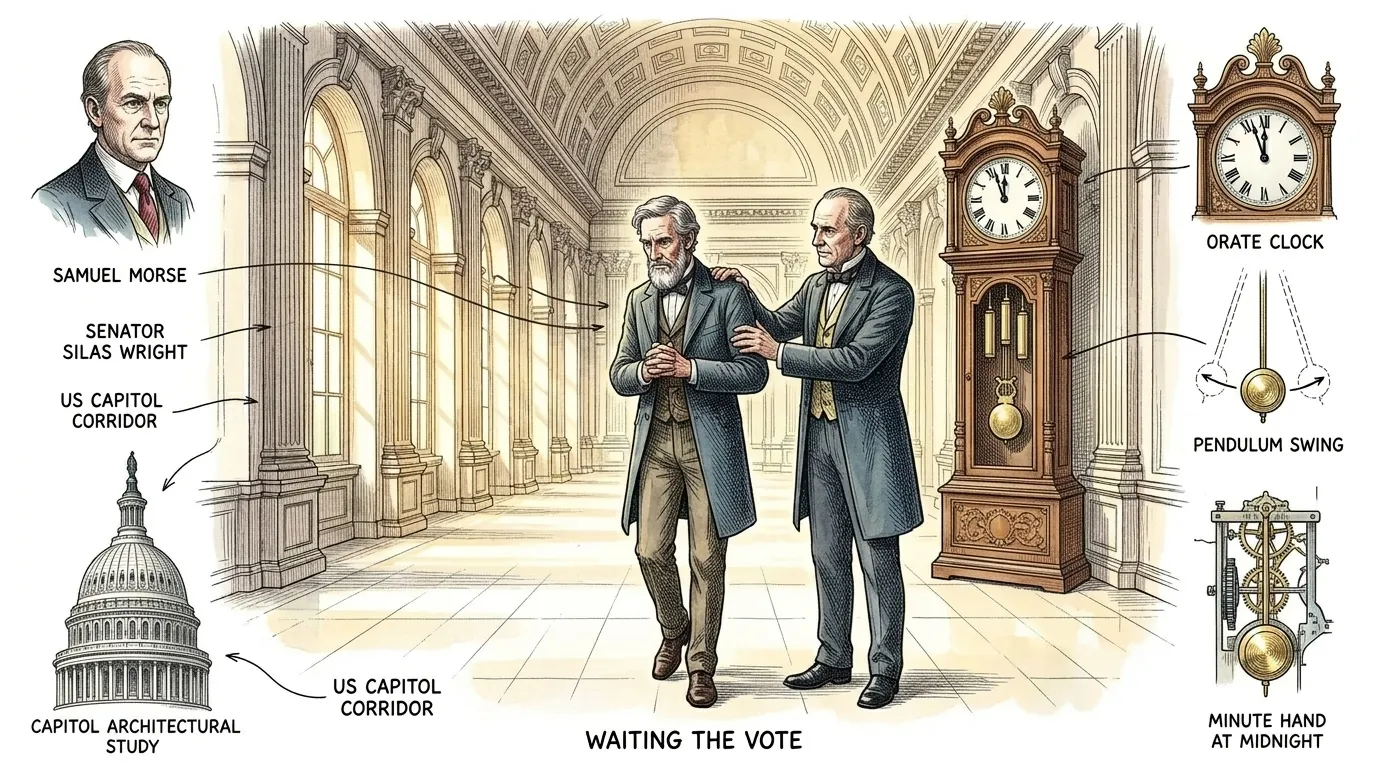
The push for congressional funding reached its climax in 1843. Morse waited anxiously as the bill for 30,000 for an experimental telegraph line was debated. On the final day of the session, the bill still hung in the balance, a mere few votes from failure.
"Morse paced the Capitol corridors, his heart heavy. 'After all these years, could it truly fail?' he muttered to his supporter, Senator Silas Wright. Wright grasped his shoulder. 'The vote is coming, Samuel. It is impossibly close. Remember what Henry Wadsworth Longfellow once wrote: "A thought is an arrow shot from the bow of the mind; it may hit or may miss." We have aimed true, now we must await the flight.' The clock ticked relentlessly toward midnight."
Page 8
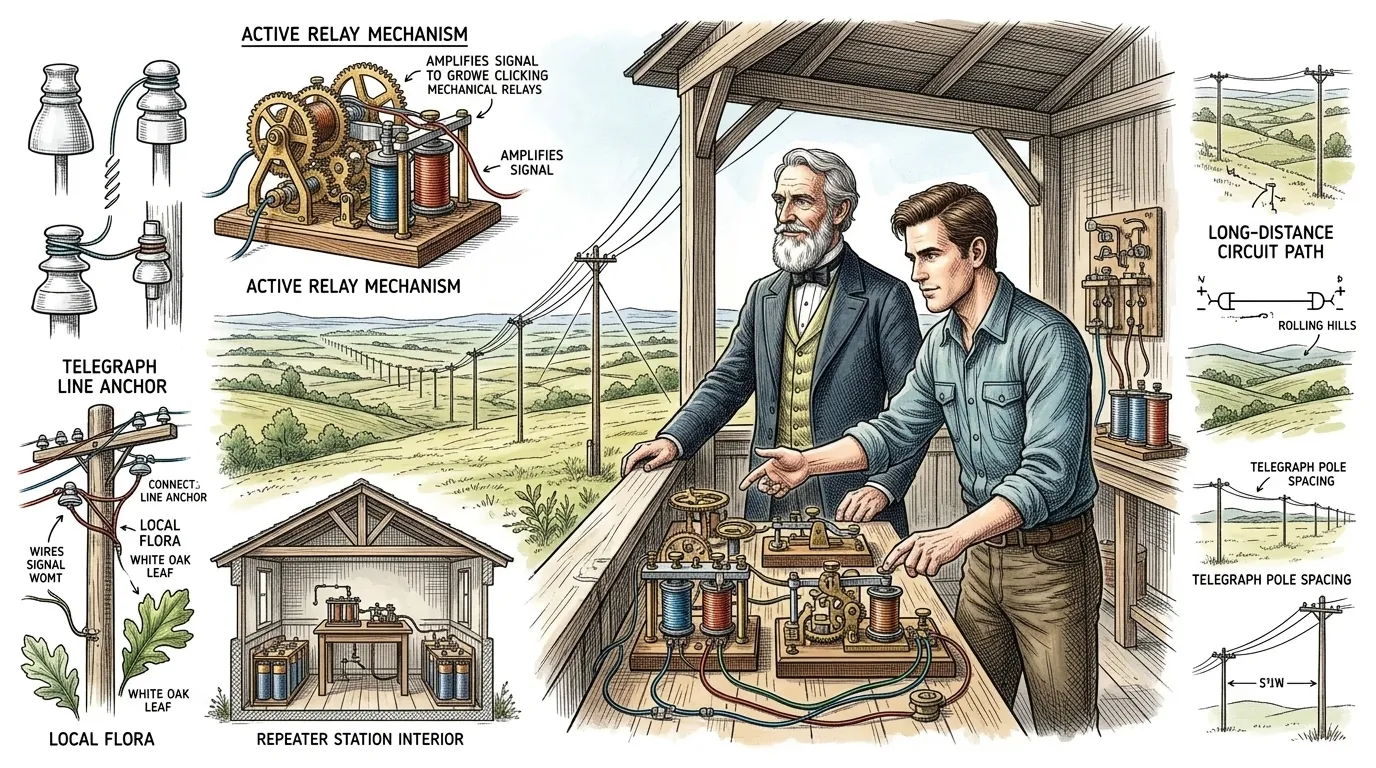
The success of the Baltimore-Washington line unleashed a communication revolution. Companies rapidly emerged, laying thousands of miles of wire across the United States. However, connecting truly vast distances, especially across oceans, presented a significant hurdle for the electrical signal.
"Morse, now an industry patriarch, observed the sprawling network. 'The relay system we devised, Alfred,' he stated to Alfred Vail, who was overseeing a new repeater station, 'it was the crucial element we discussed on the Sully, wasn't it? Without it, the signal would fade to nothing after a few dozen miles.' Vail nodded, pointing to the clicking mechanisms. 'Indeed, Samuel. Each relay station is a new launch point, amplifying the message. It is how we truly overcome the vastness of the continent, and one day, the oceans.'"
Page 9
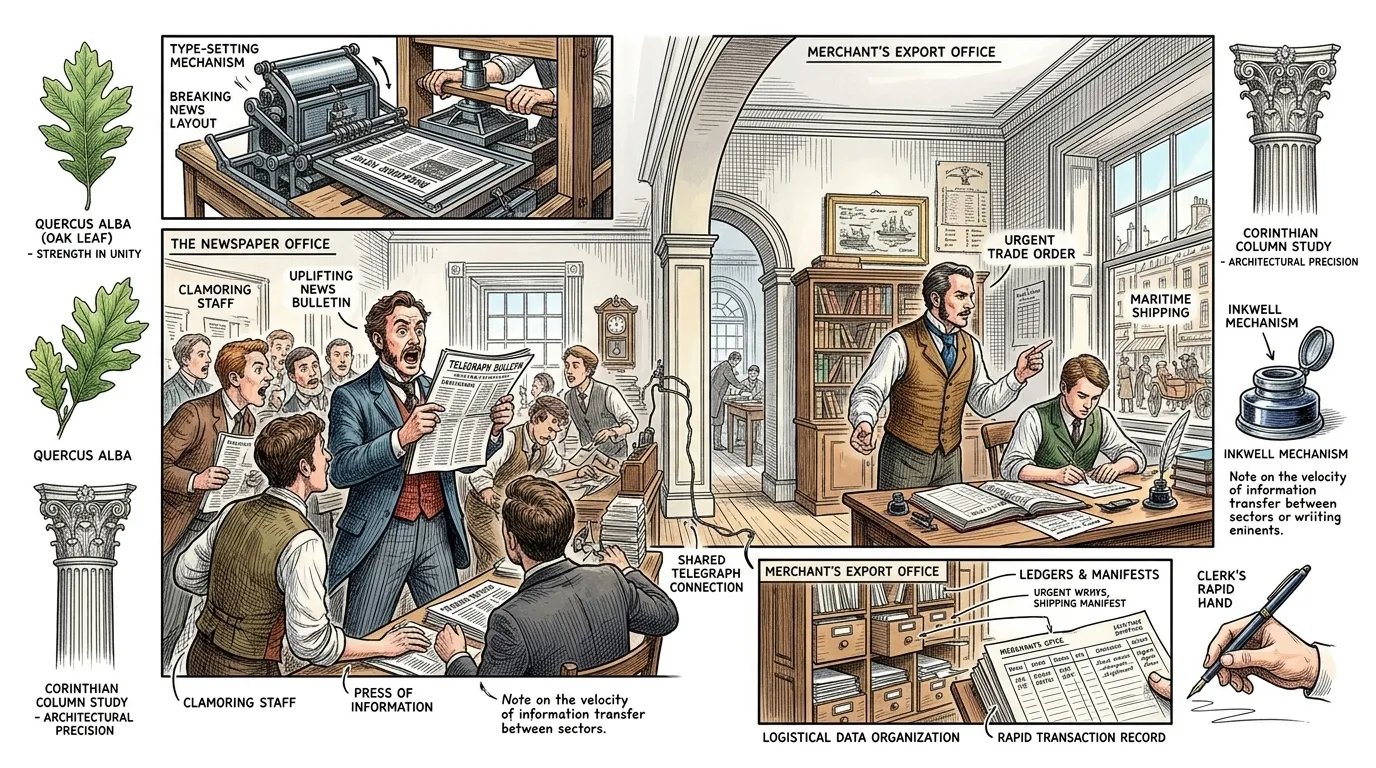
Morse's telegraph changed everything. News traveled at the speed of light, not horses. Business transactions became instantaneous. Armies communicated rapidly across battlefields. The world contracted, becoming profoundly interconnected in ways unimaginable just decades before.
"A newspaper editor in New York City read a bulletin arriving by telegraph, his eyes wide. 'President Lincoln has declared...' he announced to his staff, who were clamoring for the news. 'This is unprecedented speed! Information now shapes events in mere minutes, not weeks!' In another room, a merchant dictated a trade order, 'Sell immediately! The price just plummeted in London!' The instantaneous flow of information redefined commerce and conflict."
Page 10
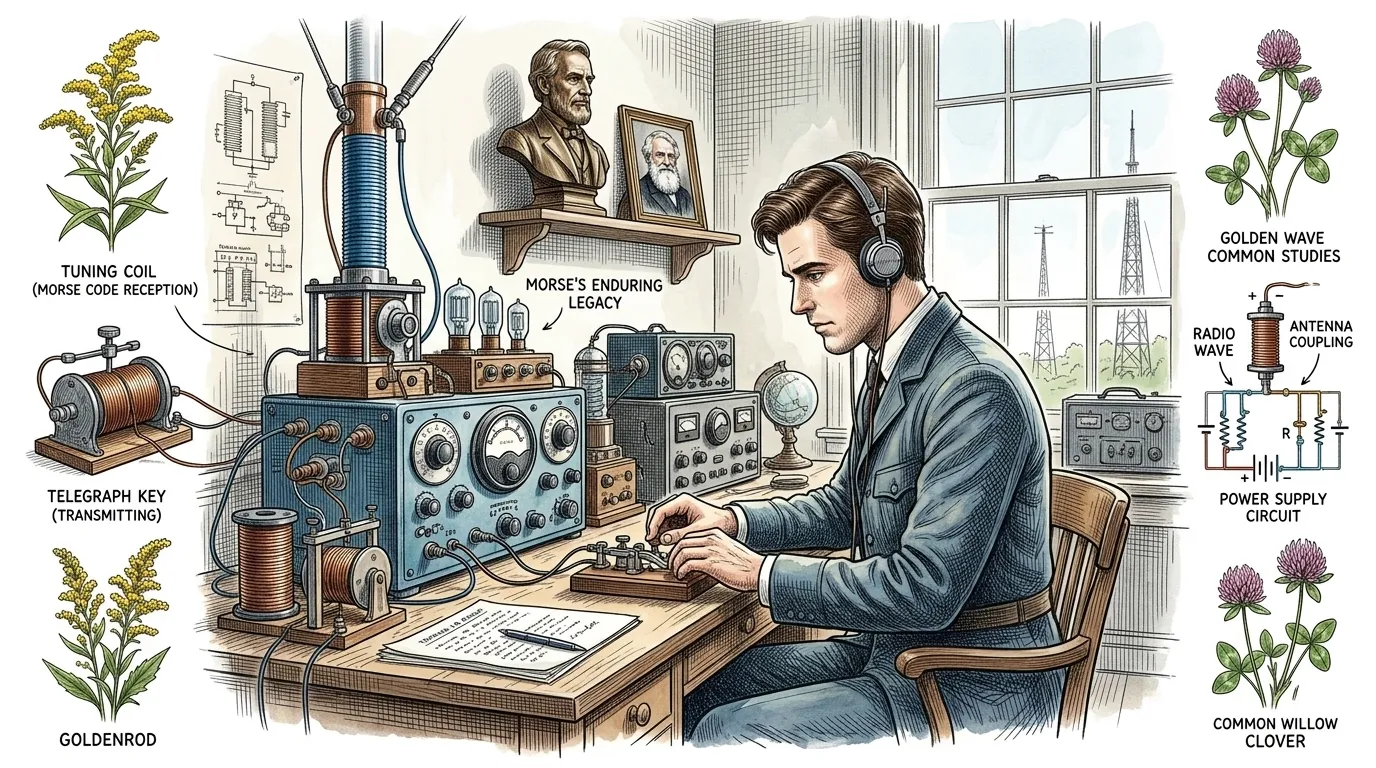
Samuel Morse died a celebrated figure, his invention having reshaped civilization. His seemingly simple system of dots and dashes, borne from artistic observation and scientific persistence, became the global standard for long-distance communication. What he built would outlive him, forging an enduring legacy.
"Decades later, a young radio operator, learning Morse Code, tapped out a message. 'This language,' he thought, 'is the grandparent of all our electronic communication. It taught us how to send thoughts across oceans, silently, swiftly.' The legacy was not just the machine, but the concept of instantaneous, codified global connection, an invisible web woven by a painter's vision."
About this story
- Location: Global
- Audience: general readers
Questions and answers
Read Wonder People on your phone
Wonder People is available on Android. Get Wonder People on Google Play.