Tim Berners-Lee
Tim Berners-Lee — an illustrated biography story, set in Global. 10 illustrated pages, free to read on Wonder People.

Page 1

At CERN in Geneva, Switzerland, a pivotal document circulated in April 1993. Tim Berners-Lee, a British computer scientist, stood before the CERN Directorate, presenting the World Wide Web software for public release. His radical proposal: make the foundational code and protocols freely available to all, ensuring a global network where information could flow without proprietary barriers, a decision that would connect over a billion people within a decade.
Biographical Fact: CERN (European Organization for Nuclear Research), Geneva, Switzerland. April 1993. The decision to release the World Wide Web into the public domain, free of charge and royalties, ensured its unprecedented global adoption.
Page 2
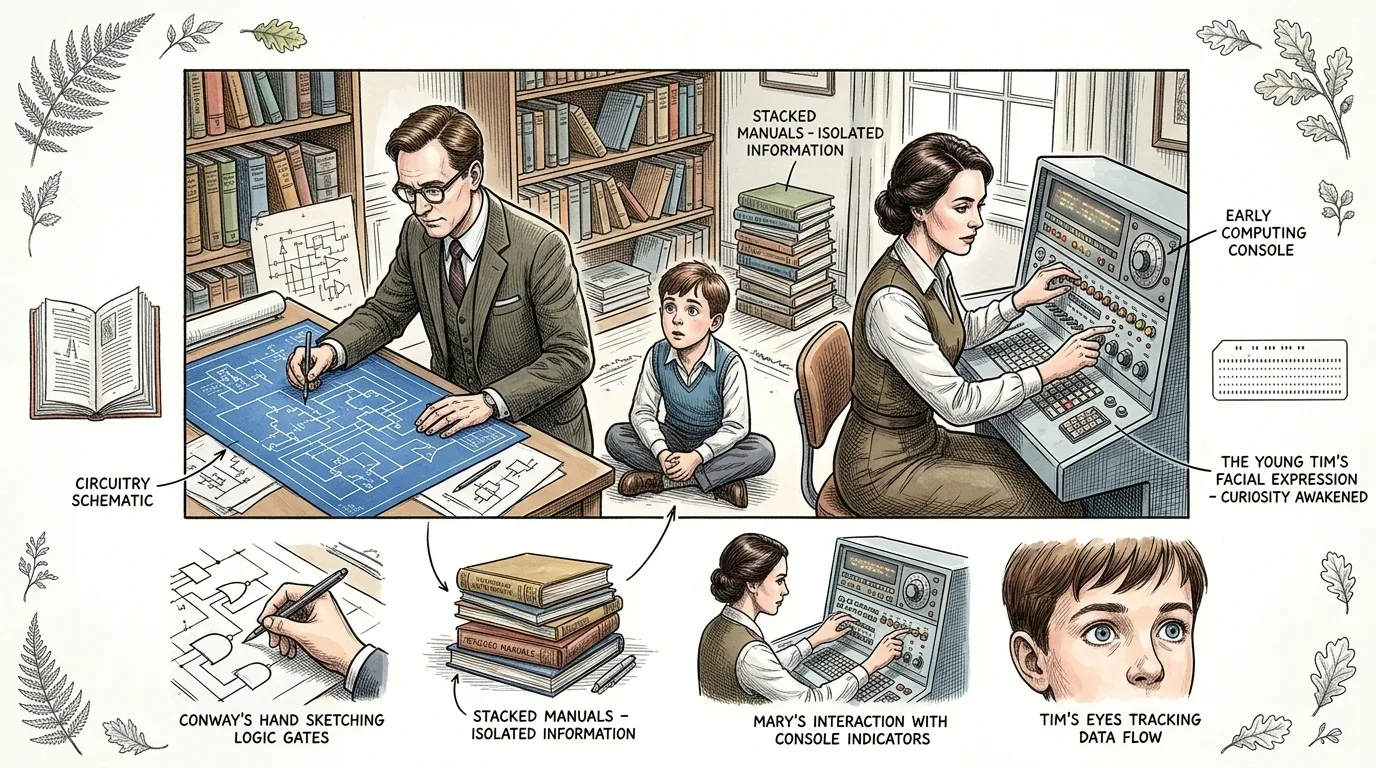
From a young age in London, England, the intellectual environment shaped Tim Berners-Lee's perception of information. His parents, mathematicians who worked on the pioneering Manchester Mark 1 computer, cultivated a household immersed in logic and computation. He observed how disparate pieces of data, from circuit diagrams to historical texts, often remained isolated within separate systems, fostering a deep conviction in the potential of universal interconnectedness.
Biographical Fact: London, England, 1960s. Berners-Lee's parents, Conway Berners-Lee and Mary Lee Woods, were both mathematicians and computer scientists, deeply influencing his early exposure to computing and systems thinking.
Page 3

In March 1989, within the bustling, often chaotic environment of CERN, Tim Berners-Lee authored a critical internal document titled 'Information Management: A Proposal.' He envisioned a system for linking information across the vast, disparate network of research data, aiming to solve the acute problem of data loss and disorganized communication. His supervisor, Mike Sendall, famously deemed it 'vague but exciting,' greenlighting the experimental project.
Biographical Fact: CERN, Geneva, Switzerland. March 1989. Berners-Lee's initial proposal outlined a hypertext system to improve information sharing among researchers. Mike Sendall, his supervisor, provided the crucial approval to proceed.
Page 4

Years before the Web's formal proposal, during a consulting stint at CERN in 1980, Berners-Lee developed a personal software project he called 'ENQUIRE.' This primitive, desktop-based program used hypertext to link arbitrary information, creating a personal 'memory' system that demonstrated the power of associative data connection. This early, experimental work laid the foundational concepts for the later global World Wide Web.
Biographical Fact: CERN, Geneva, Switzerland. 1980. 'ENQUIRE' was a personal hypertext program Berners-Lee created, allowing him to link and retrieve information. It served as a conceptual precursor to the World Wide Web.
Page 5
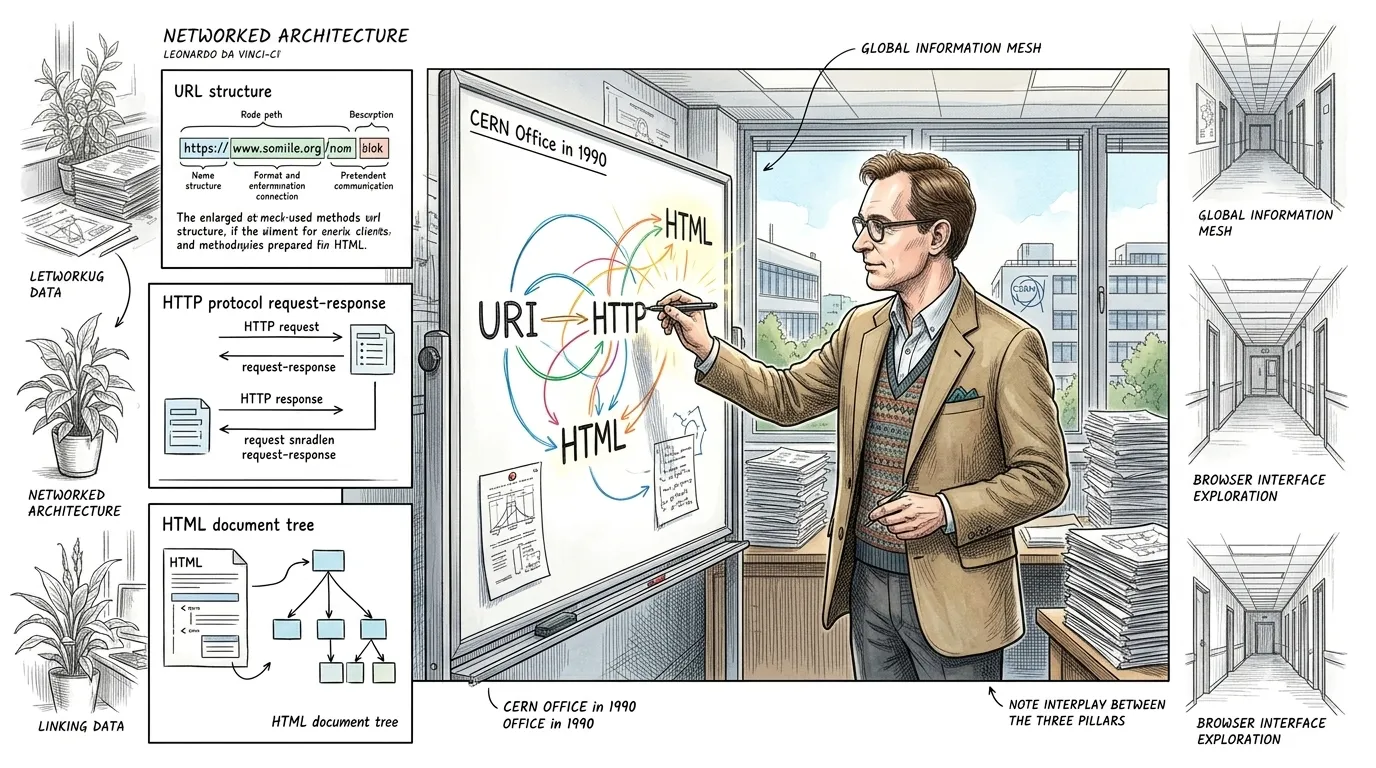
The core challenge was to define a universal language for information sharing. In 1990, Tim Berners-Lee meticulously articulated the three foundational pillars of the Web: the Uniform Resource Identifier (URI, later URL) for identifying resources, the Hypertext Transfer Protocol (HTTP) for transferring them, and HyperText Markup Language (HTML) for structuring them. This intellectual synthesis provided the technical bedrock for a global, interconnected information space.
Biographical Fact: CERN, Geneva, Switzerland. 1990. Berners-Lee formally defined URI (Uniform Resource Identifier), HTTP (Hypertext Transfer Protocol), and HTML (HyperText Markup Language), creating the essential standards for the Web.
Page 6

By late 1990, the theoretical framework had to become a tangible reality. Working intensely on a NeXT computer, Tim Berners-Lee single-handedly developed the first web browser, also named 'WorldWideWeb,' which served as both an editor and a browser. Simultaneously, he wrote the world's first web server, 'CERN httpd.' This dual creation instantiated his vision, providing the initial operational tools for the nascent network.
Biographical Fact: CERN, Geneva, Switzerland. Late 1990. Berners-Lee developed the 'WorldWideWeb' browser (also a rudimentary editor) and the 'CERN httpd' web server on a NeXT computer, bringing the theoretical Web to life.
Page 7
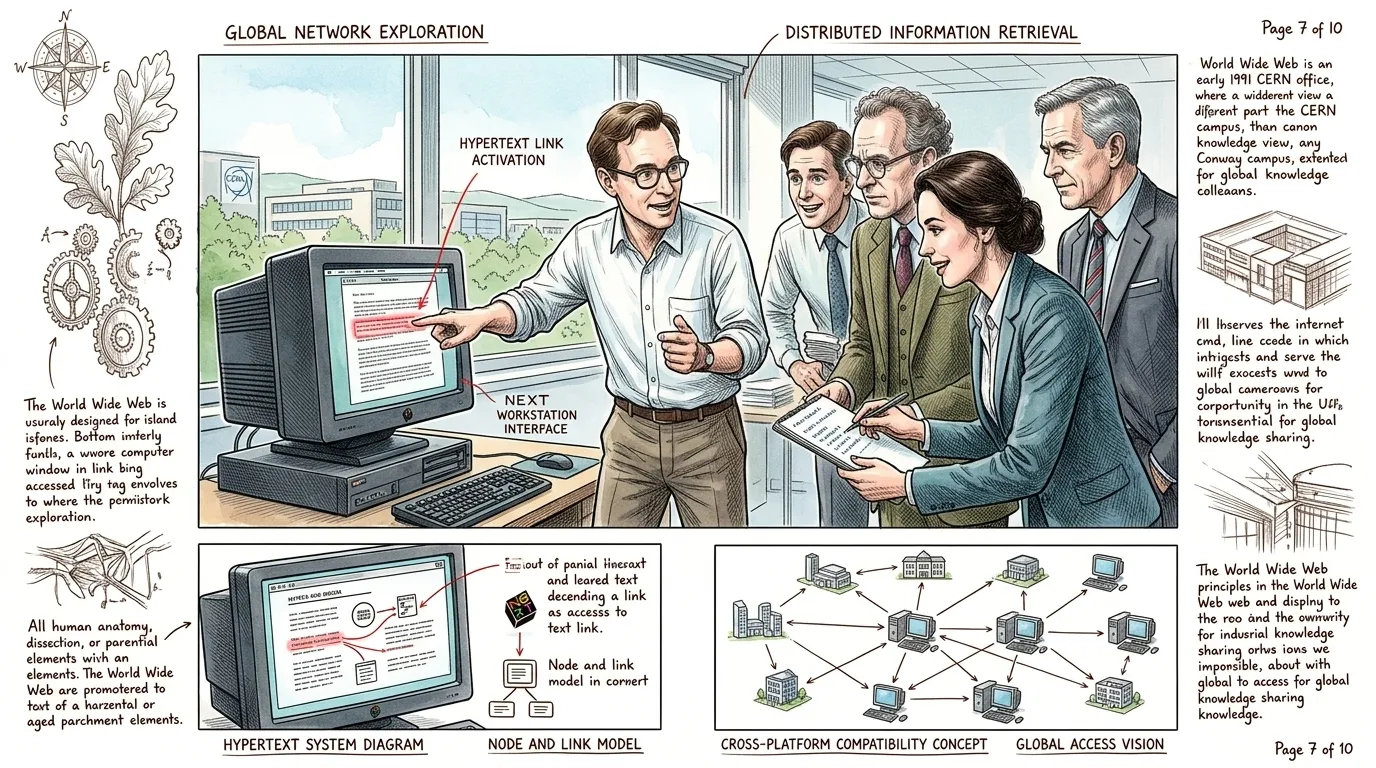
Having built the system, Tim Berners-Lee began demonstrating the World Wide Web to colleagues within CERN. He showcased how a user could navigate linked documents, access remote information, and even create new connections. These early internal presentations ignited curiosity and provided crucial feedback, validating the system's potential and preparing it for a wider audience beyond the confines of the European physics laboratory.
Biographical Fact: CERN, Geneva, Switzerland. Early 1991. Berners-Lee demonstrated the functioning World Wide Web to his colleagues, showing its ability to link information efficiently and foster collaboration within the scientific community.
Page 8
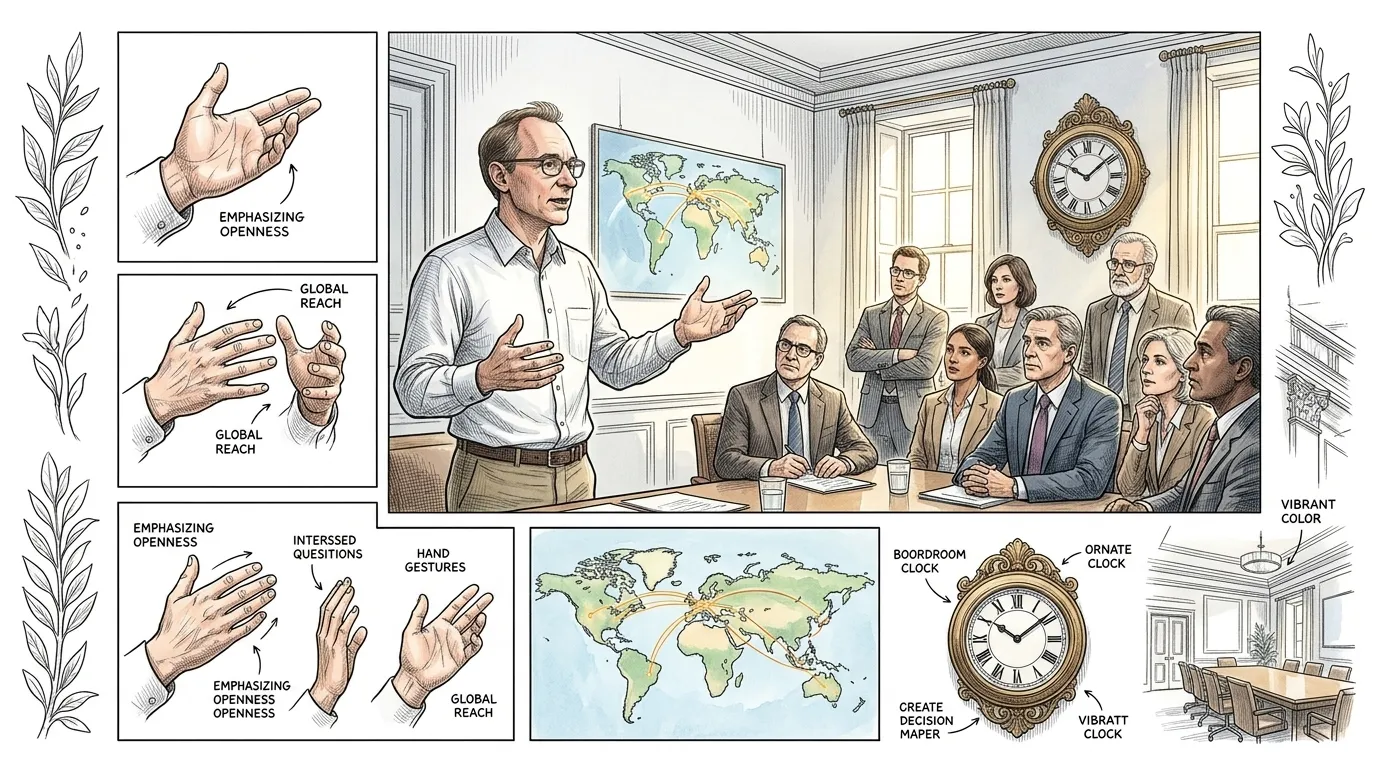
As the World Wide Web garnered interest, CERN faced a monumental decision: whether to commercialize or patent the technology. Tim Berners-Lee vehemently advocated for its unfettered openness, arguing that its power lay in universal, non-proprietary access. He understood, as the intellectual groundwork of science often asserted, that 'the true value of knowledge emerges when it is shared freely and universally,' echoing principles of scientific collaboration fundamental to CERN itself. This ethical stance, profoundly influenced by his early observations of disconnected information, convinced CERN to declare the Web freely available to everyone, forever shaping its global trajectory.
Biographical Fact: CERN, Geneva, Switzerland. April 30, 1993. CERN's formal statement declared the Web software freely available, a direct result of Berners-Lee's advocacy, preventing the creation of a 'toll road' for information.
Page 9
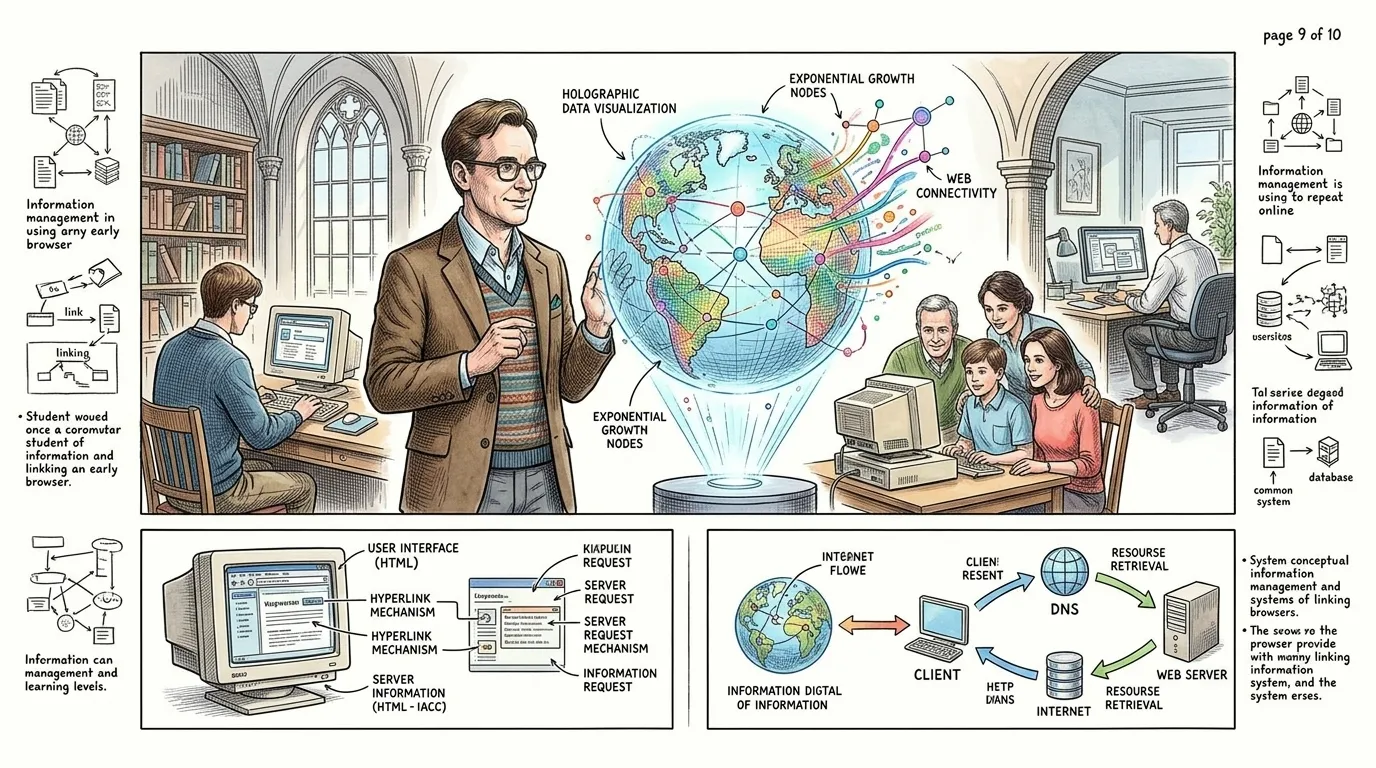
The decision for open access unleashed unprecedented growth. Within a few years, the Web exploded from a niche scientific tool to a global phenomenon, connecting millions of users and transforming industries, communication, and culture. Tim Berners-Lee observed his creation's exponential expansion, witnessing the rapid development of new browsers, websites, and applications that continuously reshaped the digital landscape, a direct consequence of the unrestricted platform he had fought for.
Biographical Fact: Mid-1990s, Global. The Web's rapid adoption marked a pivotal shift in global communication and commerce. By 1997, there were over 100 million users, a testament to the power of open standards.
Page 10

Tim Berners-Lee continued to shape the Web's evolution, establishing the World Wide Web Consortium (W3C) to oversee its ongoing technical standards. His legacy is not merely the invention itself, but his unwavering commitment to its foundational principles: universal access, decentralization, and net neutrality. He remains a vigilant advocate for an open, free, and accessible Web, understanding that its continued integrity is essential for global knowledge and human connection.
Biographical Fact: Ongoing. As director of the World Wide Web Consortium (W3C), Tim Berners-Lee continues to guide the Web's development, advocating for its core principles of openness, accessibility, and neutrality.
About this story
- Location: Global
- Audience: general readers