Laozi
Laozi — an illustrated philosophy story. 10 illustrated pages, free to read on Wonder Philosophy.
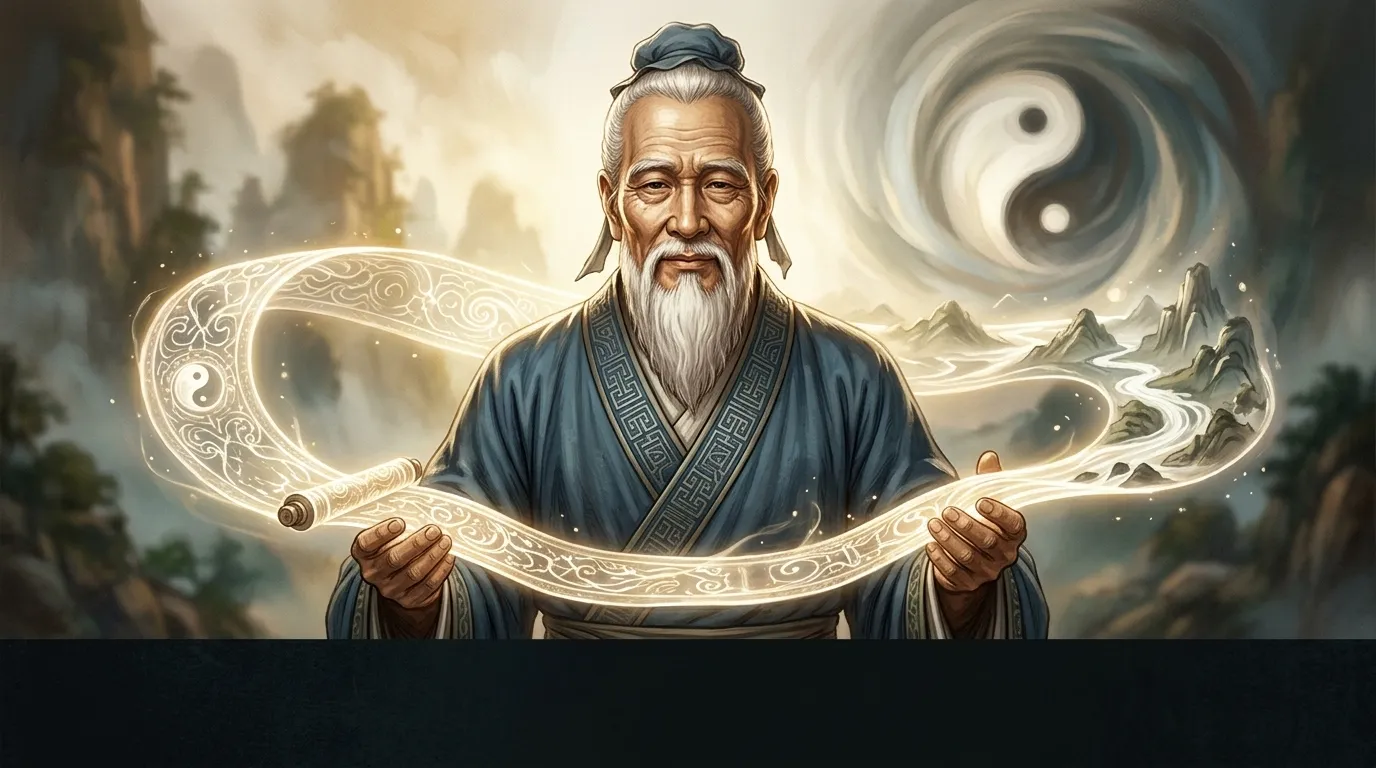
Page 1
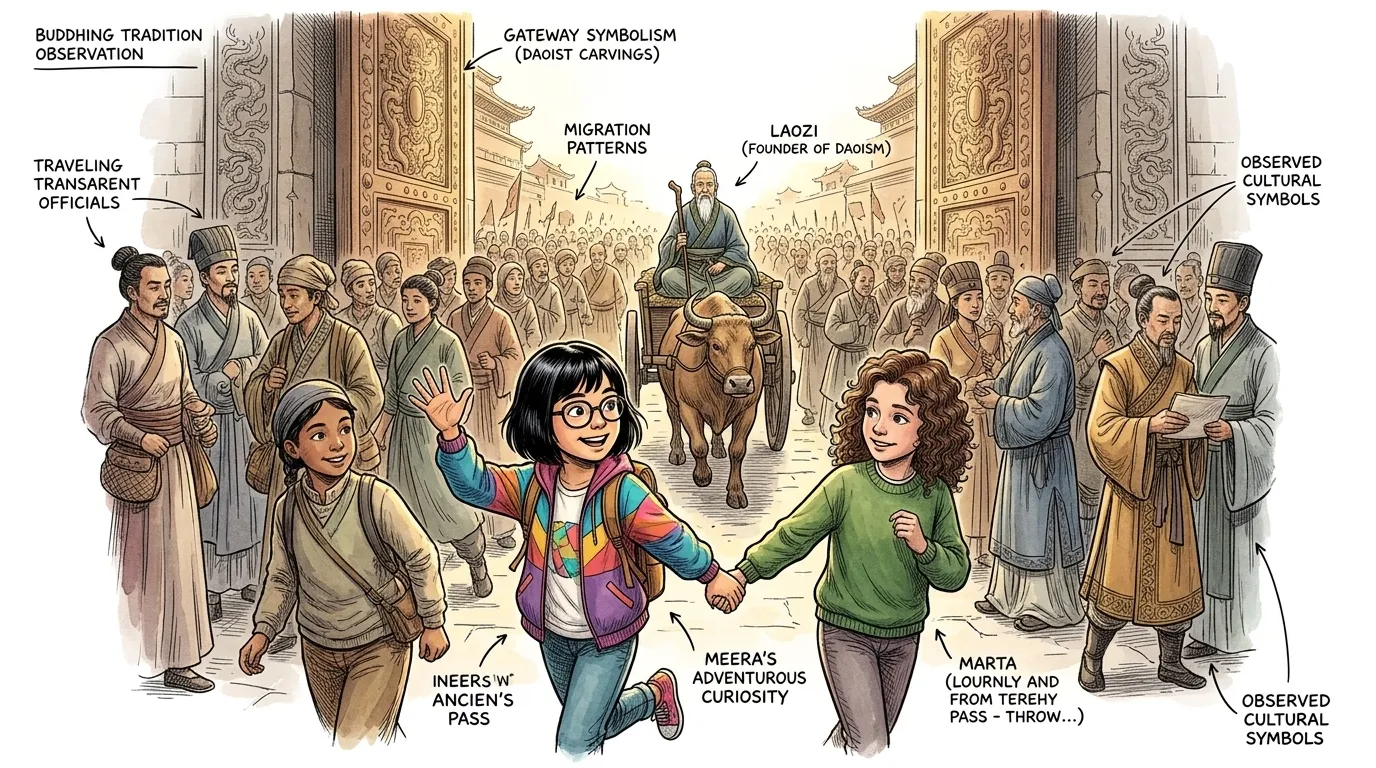
A vast, ancient pass, bustling with merchants, travelers, and officials, stretched before Meera and Marta, its massive gates carved with intricate symbols. The air vibrated with a thousand conversations and the distant cries of animals. Meera tugged at Marta's hand, her eyes wide with the sheer scale of the historical moment unfolding around them.
"'Marta, look at all these people!' Meera exclaimed, pointing towards a small, dignified figure on an ox cart, slowly making his way through the throng. 'They're all looking at that old man! Who is he?' Marta smiled, her gaze thoughtful as she watched the figure. 'That, Meera, is the legendary Laozi, about to depart for the West, and with him, a profound idea that would shape a civilization: the Dao, or 'The Way'.' "
Philosophy Note: The Hangu Pass is a significant historical location in China, traditionally associated with Laozi. Legend states that the border guard Yin Xi requested Laozi to write down his wisdom before departing into the wilderness, resulting in the Dao De Jing.
Page 2
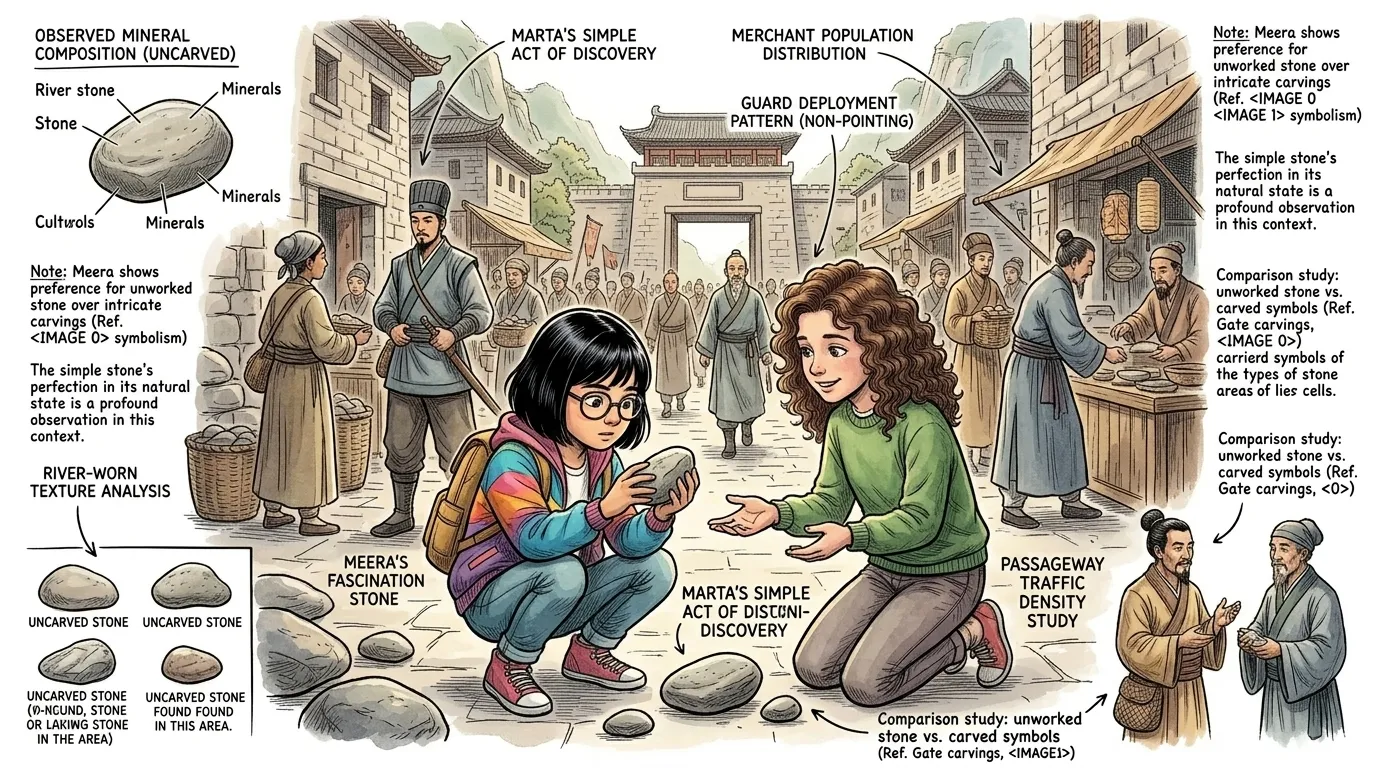
Meera looked around the busy pass, observing the meticulous order of the guards and the hurried movements of the merchants, each seemingly striving against the other. The chaos, yet underlying rhythm, of the world around them felt immense. Marta then knelt beside her, a gentle smile on her face.
"'Laozi taught that the universe has a natural flow, a 'Way' called the Dao,' Marta explained softly, picking up a smooth, uncarved river stone from the path and holding it out. 'He called it the 'uncarved block,' simple and true to its nature, before we try to force it into something else. Just like this stone has its own perfect form.' Meera carefully took the cool, smooth stone, turning it over in her small hands, feeling its inherent simplicity."
Philosophy Note: The concept of the 'uncarved block' (Pu, 朴) is a key Daoist metaphor, representing inherent simplicity, naturalness, and potential before artificial shaping or external influence. It suggests a return to an original, untainted state of being.
Page 3
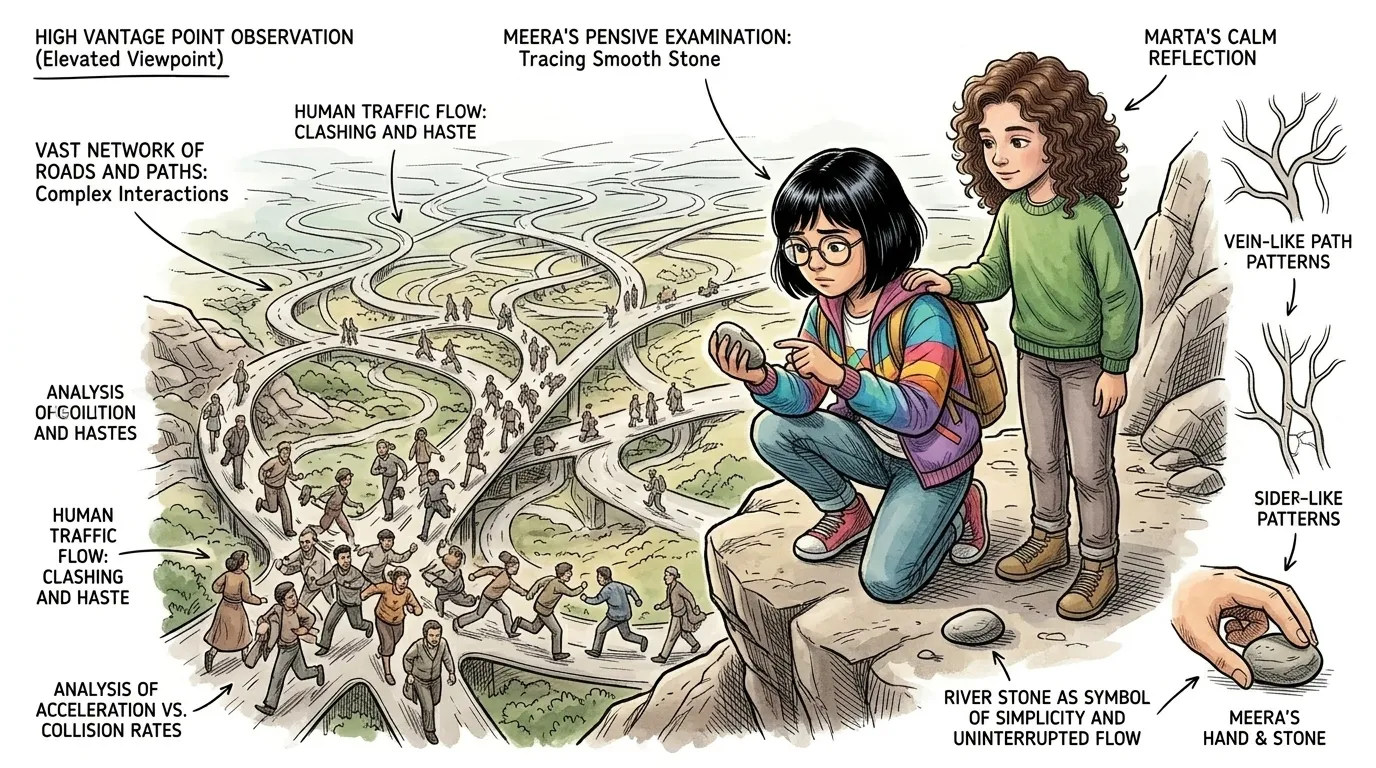
From a high vantage point overlooking the pass, Meera and Marta could see the vast, interconnected network of roads and paths, winding like veins across the land. Below them, people hurried, driven by myriad purposes, often clashing in their haste. Meera pondered the smooth stone still clutched in her hand.
"'So, the Dao is like... being simple, like this stone?' Meera asked, tracing a finger over its surface. 'But everyone down there looks so busy, trying to get somewhere.' Marta nodded, her gaze sweeping over the scene. 'Exactly, Meera. Laozi saw that all this striving and forcing often led to more trouble, more fighting. He suggested that true power comes not from pushing against the world, but from aligning with its natural rhythms.'"
Philosophy Note: Laozi's philosophy, particularly as expressed in the Dao De Jing, often critiques human ambition, excessive laws, and forceful governance, advocating instead for a humble and natural approach to life and leadership.
Page 4
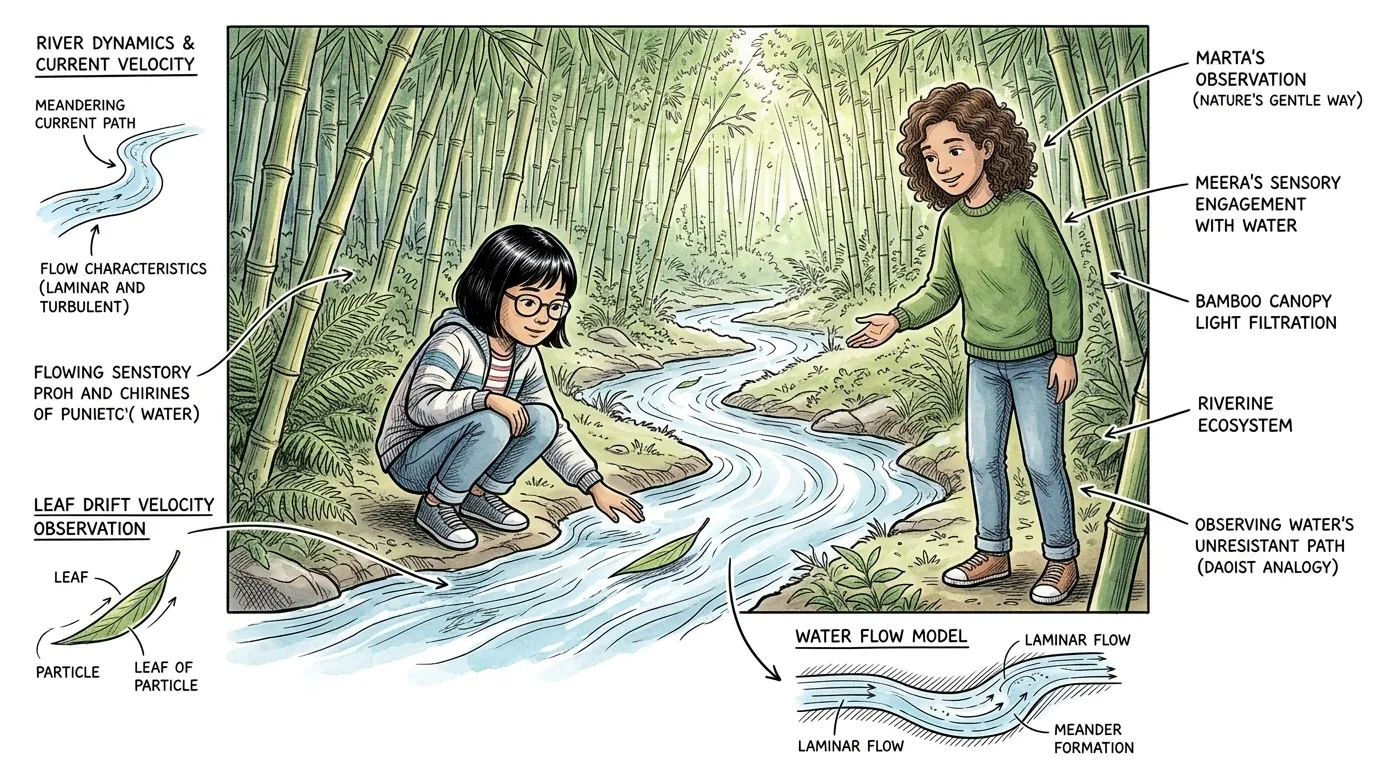
Meera and Marta now followed a small, winding river that flowed through a bamboo forest, its water gently carving a path around smooth stones and ancient roots. The river seemed to move with effortless grace, never forcing its way. Meera watched a leaf drift downstream, perfectly carried by the current.
"'This is 'Wu Wei',' Marta explained, gesturing towards the flowing water. 'It means 'non-action' or 'effortless action' – not doing nothing, but acting in harmony with the flow of things, without forcing. See how the water wears away the rock, not by force, but by persistence and yielding?' Meera reached out a hand, feeling the cool, gentle current. 'It looks so strong, even though it's soft.'"
Philosophy Note: Wu Wei (無為) is a central concept in Daoism, often translated as 'non-action,' 'effortless action,' or 'actionless action.' It describes a state of natural, spontaneous, and unforced action that arises in harmony with the Dao, leading to effective and sustainable outcomes.
Page 5
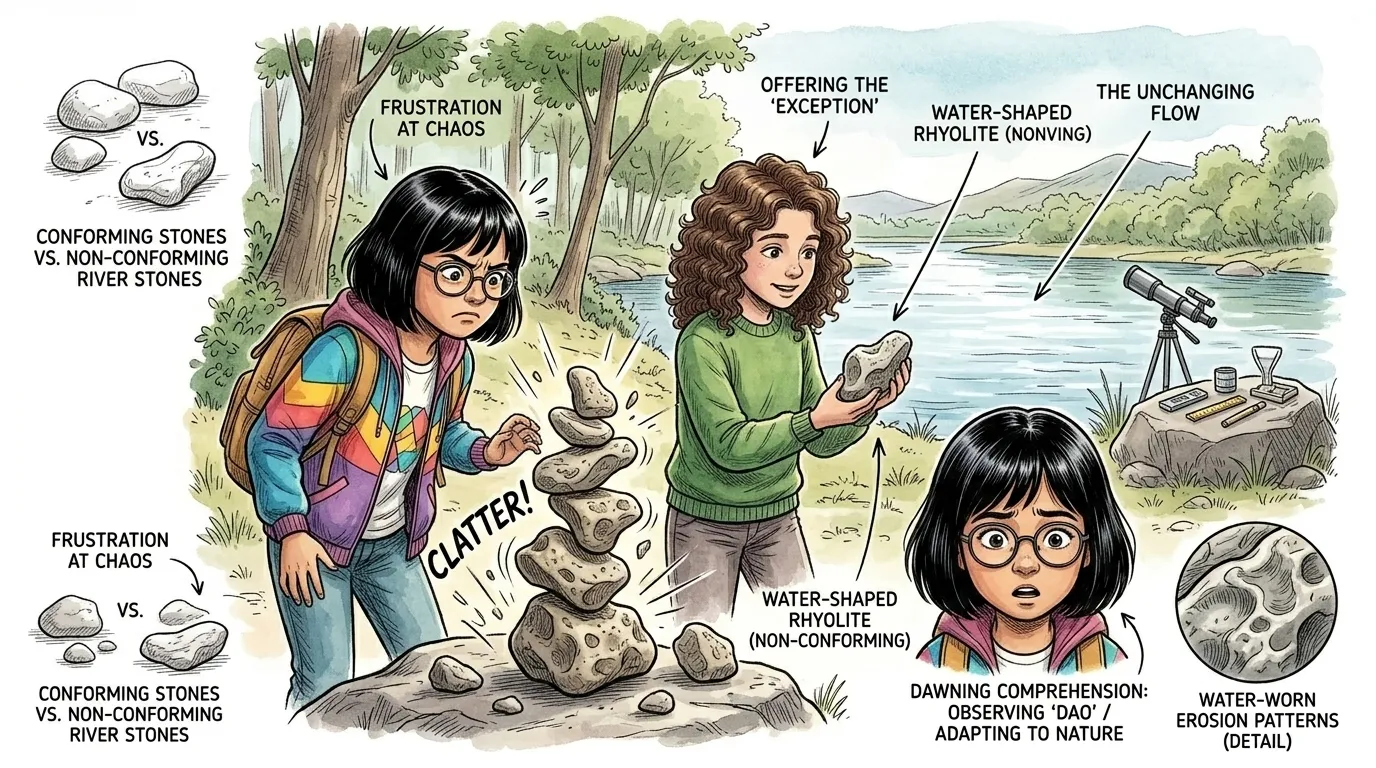
Later, Meera tried to stack a pile of unusually shaped stones on top of each other, but they kept toppling over with a clatter. She frowned in frustration, her brow furrowed with effort. Marta watched patiently, then offered a suggestion.
"'Sometimes, when we try too hard, things just don't work, do they?' Marta observed, picking up one of the oddly shaped stones. 'Laozi believed that when you stop forcing things, when you find the natural way, everything falls into place. Like 'our life is frittered away by detail. Simplify, simplify,' as the American writer Henry David Thoreau once said.' Meera looked at the stone, then back at the river, a new understanding dawning in her eyes."
Philosophy Note: Henry David Thoreau (1817–1862) was an American naturalist, essayist, poet, and philosopher. His work Walden advocated for simple living in natural surroundings, echoing sentiments of Daoist philosophy regarding detachment from material excess and societal pressures.
Page 6
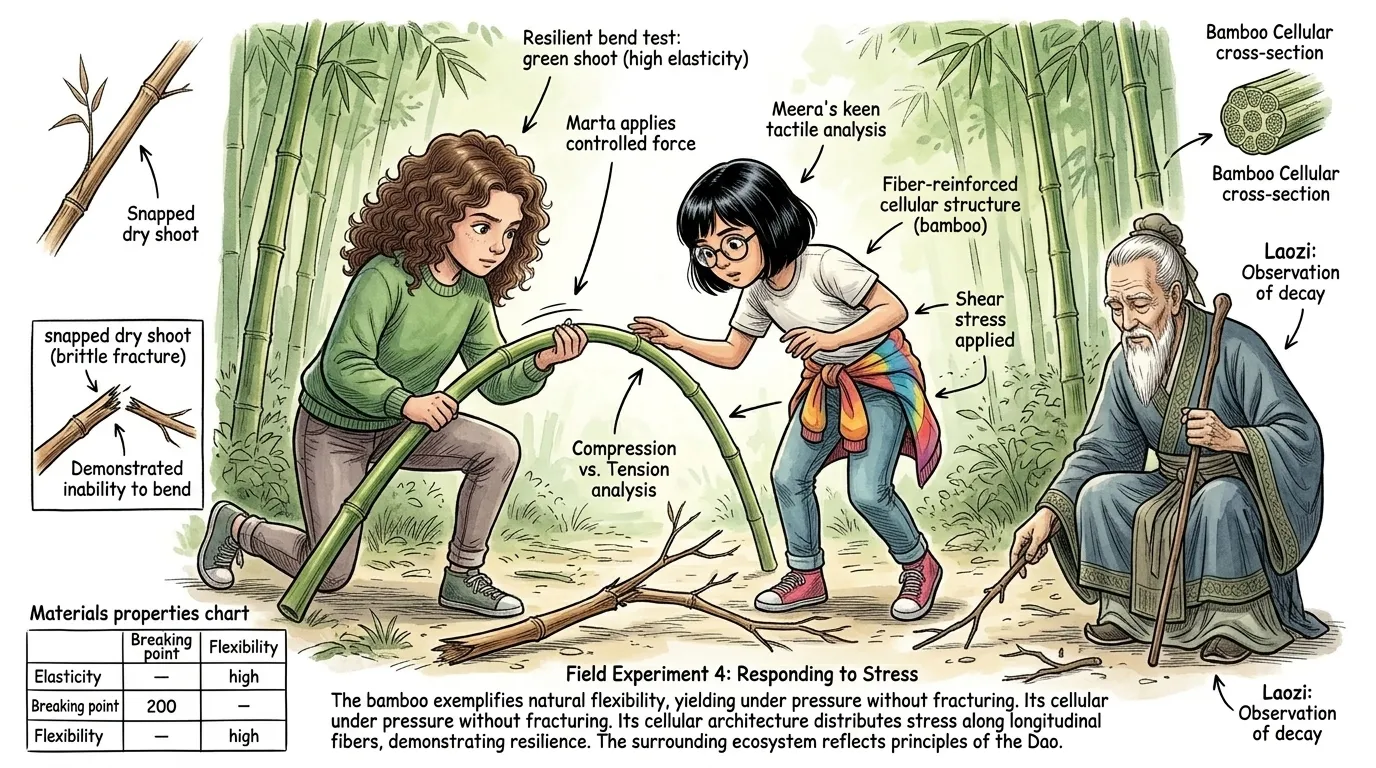
Marta picked up a fallen bamboo shoot, still green and flexible, and then a brittle, dry branch. She demonstrated how the bamboo bent without breaking, while the dry branch snapped easily under pressure. Meera watched, fascinated by the contrast.
"'Laozi taught that the soft and yielding often overcome the hard and rigid,' Marta explained, bending the bamboo shoot gently. 'Like water wearing down stone, or a flexible tree surviving a storm while a stiff one breaks. It's about being adaptable, not stubborn.' Meera reached out to touch the smooth, resilient bamboo. 'So, it's better to be like the bamboo, not the dry branch?'"
Philosophy Note: The Daoist principle that 'the soft overcomes the hard' (or 'the weak overcomes the strong') emphasizes the power of flexibility, yielding, and adaptability over rigid force. Water, being soft, can erode mountains, and a flexible tree can weather a storm better than a rigid one.
Page 7
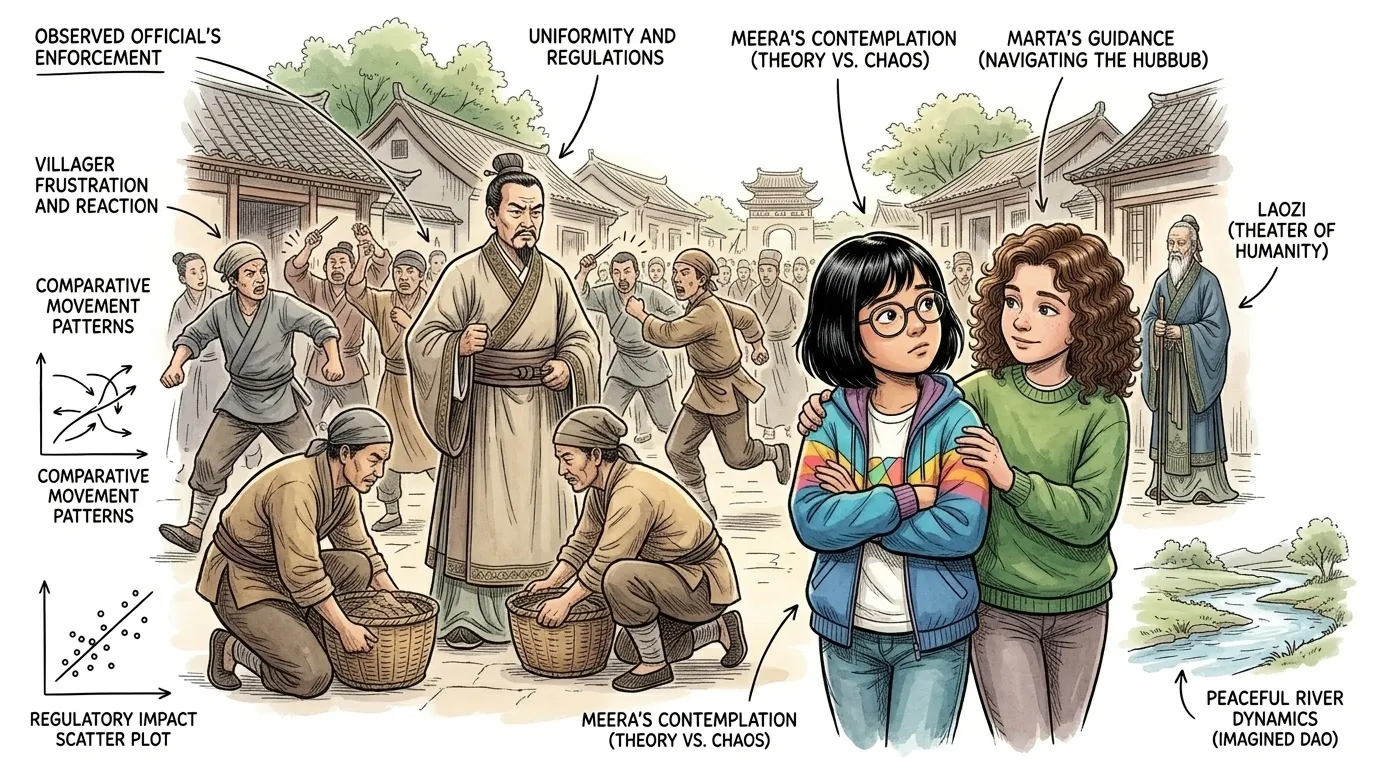
Walking through a bustling village, they observed a local official meticulously enforcing a long list of rules and regulations, causing a flurry of activity and some frustration among the villagers. Meera noticed the contrast with the peaceful river. Marta gently guided her away from the commotion.
"'While some philosophies focus on many rules and strict duties, Laozi suggested a different path for governing, and for living,' Marta explained, her voice calm amidst the village noise. 'He believed that too many laws only create more crime, and too much striving for wealth leads to discontent. He advocated for simplicity and minimal interference.' Meera looked thoughtful, comparing the official's struggle to the river's easy flow."
Philosophy Note: Daoism, particularly in its political philosophy, often contrasts with Confucianism. While Confucianism emphasizes social hierarchy, rituals (li), and strict moral codes for an ordered society, Daoism advocates for less government intervention and a return to natural simplicity to achieve harmony.
Page 8
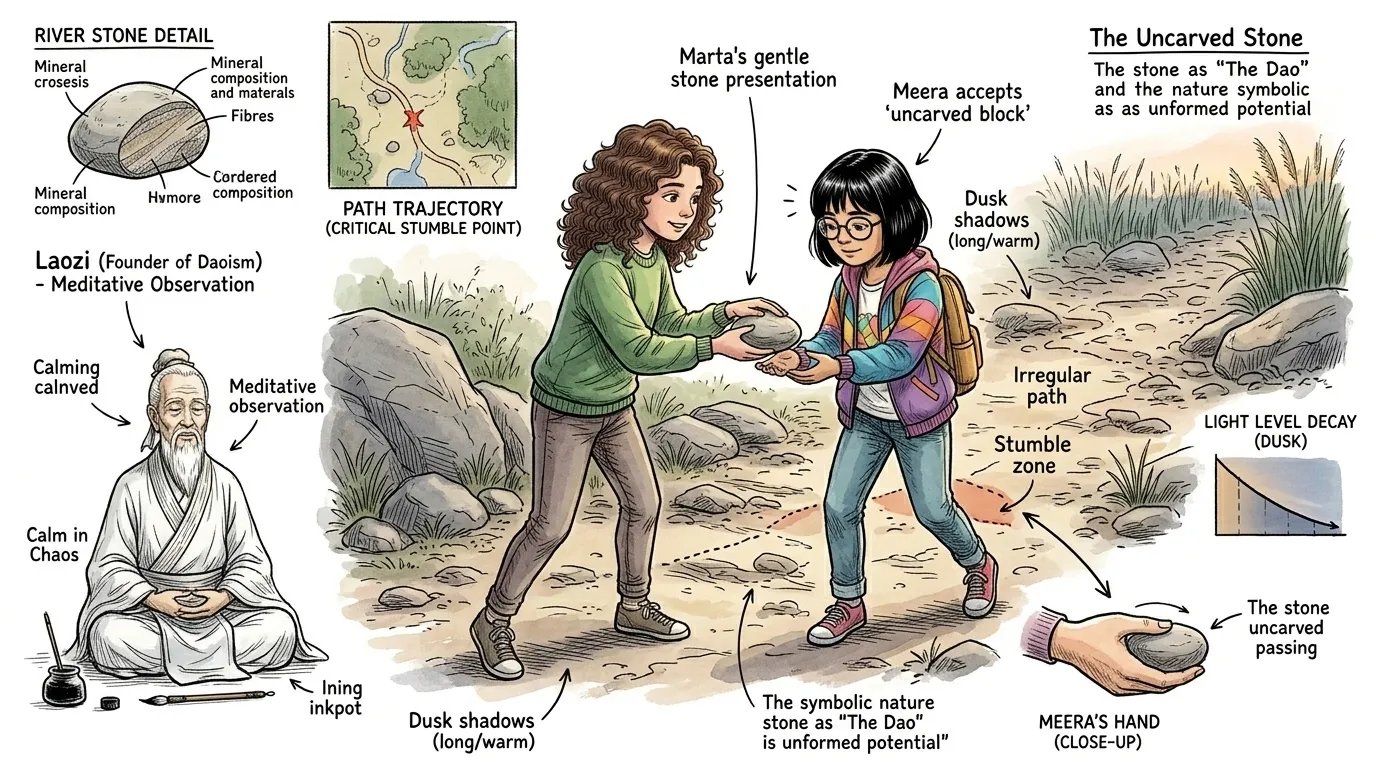
As dusk began to settle, casting long shadows, Meera stumbled on an uneven part of the path, dropping the uncarved river stone she had been carrying all day. A moment of frustration welled up within her, similar to her earlier attempts to stack the stones. Marta picked up the stone, handing it back to her with a knowing look.
"'Remember this 'uncarved block' we talked about earlier?' Marta said, presenting the stone to Meera once more. 'It reminds us that sometimes the best solution isn't to force things, but to trust in the natural way, to find the simplest path. Like Laozi said, 'To yield is to be preserved whole.' Don't try to change the path, just find your balance and walk with it.' Meera carefully took the stone, a calm returning to her expression as she nodded."
Philosophy Note: The concept of 'yielding' (rou) is another core Daoist idea, closely linked to Wu Wei. It emphasizes flexibility and adaptability, suggesting that by yielding rather than resisting, one can overcome obstacles and maintain integrity. This connects to the earlier 'uncarved block' as a reminder of intrinsic nature.
Page 9
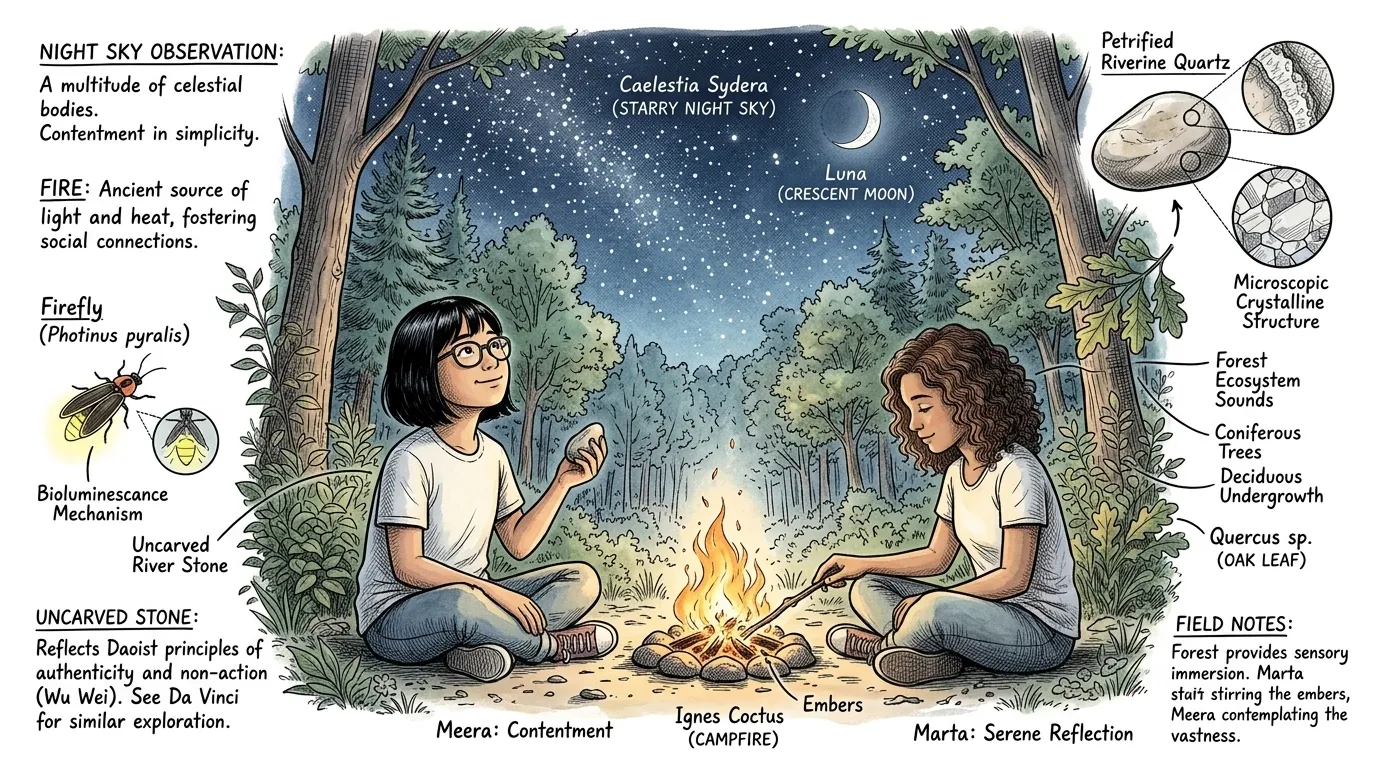
As night fully embraced the landscape, Meera and Marta sat by a small, crackling campfire, gazing up at the countless stars in the clear night sky. The vastness reminded Meera of the Dao, stretching out infinitely. The sounds of the forest were soft whispers, unforced and natural.
"'Even though Laozi lived so long ago, his ideas about living simply, going with the flow, and not always forcing our will still matter today,' Marta murmured, stirring the embers. 'They help us find peace in a busy world, to look for the natural solution instead of the complicated one. They remind us to slow down, and truly see the Way.' Meera felt a quiet contentment settle over her, looking at the familiar stone in her hand."
Philosophy Note: Laozi's philosophy, Daoism, continues to influence contemporary thought in areas such as environmentalism (harmony with nature), mindfulness, simple living movements, and even leadership styles that emphasize decentralized decision-making and allowing natural processes to unfold.
Page 10
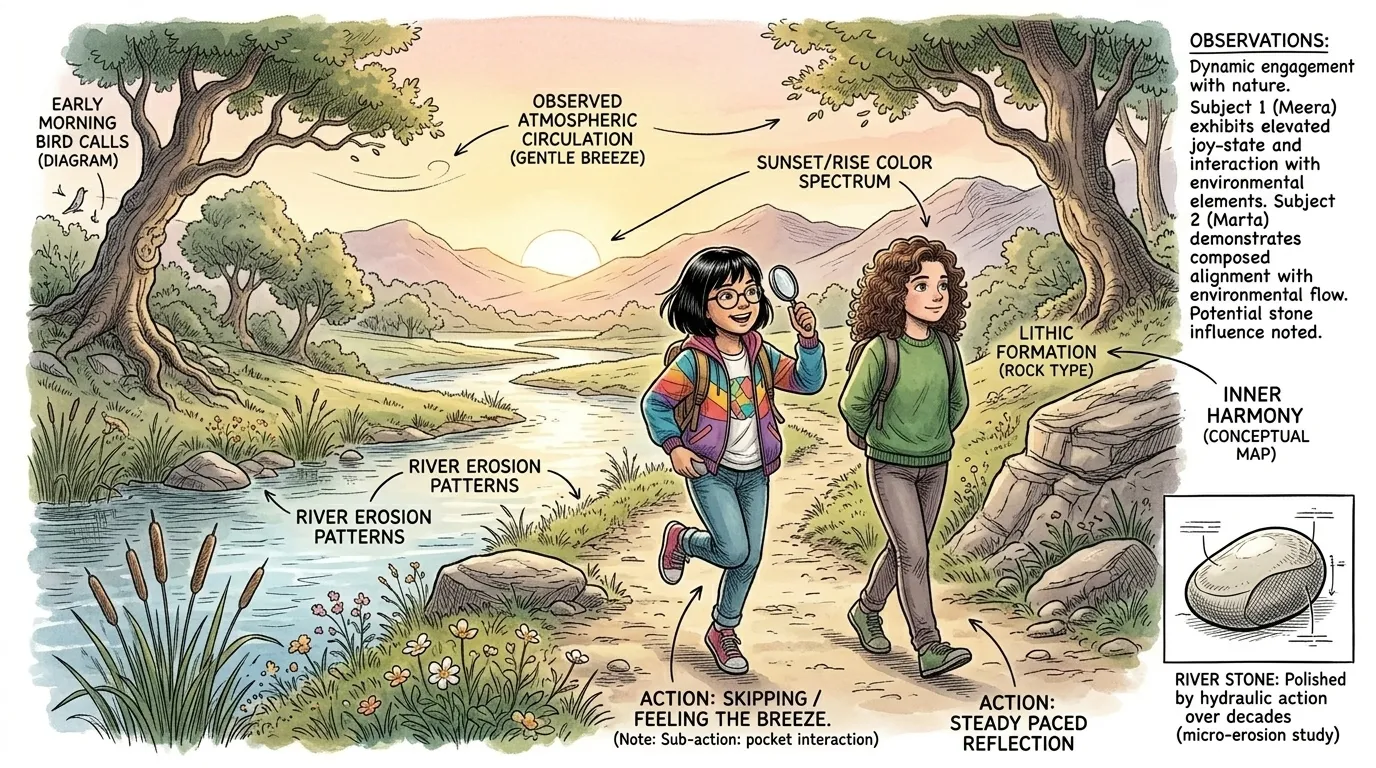
The next morning, as the sun rose, painting the world in soft, new light, Meera and Marta continued their journey, walking side-by-side along a quiet path. Meera skipped a little, then paused to feel the gentle breeze against her face. She held the smooth river stone in her pocket, a small reminder of a profound wisdom. Marta walked with a steady, peaceful pace.
"'Laozi's wisdom isn't about giving up or being lazy, but about choosing the path of least resistance when it's the wisest path,' Marta concluded, looking at the peaceful landscape. 'It's about finding strength in flexibility, and greatness in humility. It's truly a 'way' of life that brings inner harmony.' Meera smiled, feeling the sun's warmth. 'I think I understand a little bit of the 'Way' now, Marta. Like the river, making its own path.'"
Philosophy Note: The legacy of Laozi and the Dao De Jing is immense, influencing not only philosophical and religious traditions in East Asia but also art, literature, and even modern concepts of sustainable living and leadership worldwide. His emphasis on naturalness and effortless action remains a compelling alternative to striving and force.
About this story
- Audience: general readers
Questions and answers
Read Wonder Philosophy on your phone
Wonder Philosophy is available on Android and iPhone and iPad. Get Wonder Philosophy on Google Play · Get Wonder Philosophy on the App Store.