Plotinus

Plotinus — an illustrated philosophy story. 10 illustrated pages, free to read on Wonder Philosophy.
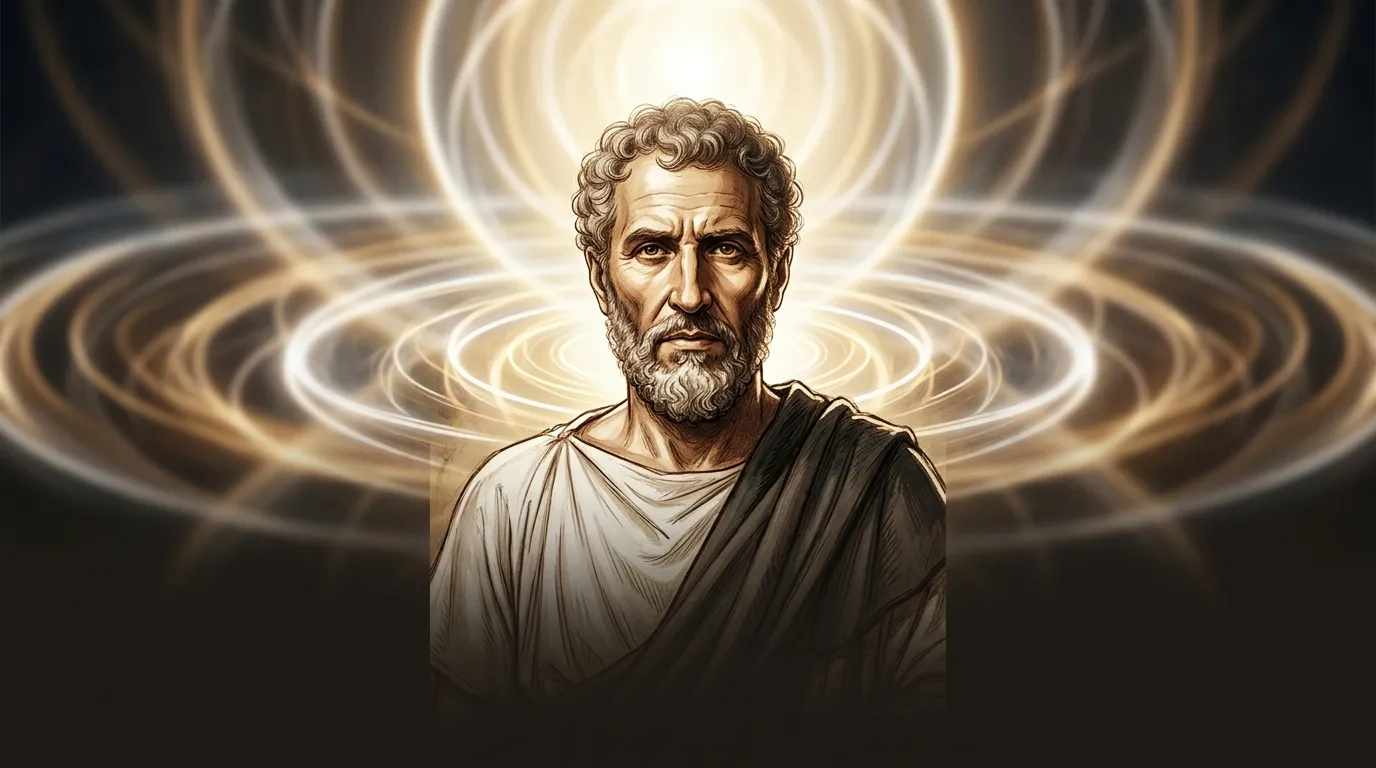
Plotinus — book cover — Wonder Philosophy
Plotinus — an illustrated philosophy story. 10 illustrated pages, free to read on Wonder Philosophy.

Page 1

The idea of 'The One'—a source from which all existence emanates—might seem abstract, but it offers a way to understand our place in the universe.
The idea of 'The One'—a source from which all existence emanates—might seem abstract, but it offers a way to understand our place in the universe. Plotinus [204/5 – 270 CE], a philosopher in Roman Egypt, explored this concept, influencing thinkers for centuries. His ideas provide a lens through which we can examine questions of unity, purpose, and the nature of reality. Why should we care about Plotinus today?

The idea of 'The One'—a source from which all existence emanates—might seem abstract, but it offers a way to understand our place in the universe. Plotinus [204/5 – 270 CE], a philosopher in Roman Egypt, explored this concept, influencing thinkers for centuries. His ideas provide a lens through which we can examine questions of unity, purpose, and the nature of reality. Why should we care about Plotinus today? Because his philosophy, Neoplatonism, connects spirituality and intellect, offering a framework to address feelings of disconnection in our modern world.

Philosophy Note: Plotinus founded Neoplatonism, a school of philosophy that synthesized Plato's ideas with Eastern mysticism.

Page 2

Min, a curious student, approached Clara, a philosophy enthusiast. He struggled to understand how Plotinus fit into the broader history of philosophy.
Min, a curious student, approached Clara, a philosophy enthusiast. He struggled to understand how Plotinus fit into the broader history of philosophy. ""Clara, I'm trying to grasp Plotinus, but it feels disconnected from everyone else. How does he relate to Plato or Aristotle?" Min asked, adjusting his glasses." Philosophy Note: Plotinus sought to reconcile Aristotelian logic with Plato's theory of Forms.

Min, a curious student, approached Clara, a philosophy enthusiast. He struggled to understand how Plotinus fit into the broader history of philosophy.

""Clara, I'm trying to grasp Plotinus, but it feels disconnected from everyone else. How does he relate to Plato or Aristotle?" Min asked, adjusting his glasses."

Philosophy Note: Plotinus sought to reconcile Aristotelian logic with Plato's theory of Forms.

Page 3

Clara smiled, ready to explain Plotinus's intellectual heritage. ""Think of it like a family tree, Min. Socrates taught Plato, Plato taught Aristotle, and…
Clara smiled, ready to explain Plotinus's intellectual heritage. ""Think of it like a family tree, Min. Socrates taught Plato, Plato taught Aristotle, and Plotinus came much later, building on their ideas, but also introducing his own unique perspective," Clara replied. "He admired Plato especially, but faced new questions in a world very different from ancient Greece."" Philosophy Note: Neoplatonism emerged in a world increasingly influenced by Christianity and Eastern…

Clara smiled, ready to explain Plotinus's intellectual heritage.

""Think of it like a family tree, Min. Socrates taught Plato, Plato taught Aristotle, and Plotinus came much later, building on their ideas, but also introducing his own unique perspective," Clara replied. "He admired Plato especially, but faced new questions in a world very different from ancient Greece.""

Philosophy Note: Neoplatonism emerged in a world increasingly influenced by Christianity and Eastern thought.

Page 4

Clara continued, explaining the core of Plotinus's philosophy. ""Plotinus posited 'The One,' an ultimate, indescribable source of all being.
Clara continued, explaining the core of Plotinus's philosophy. ""Plotinus posited 'The One,' an ultimate, indescribable source of all being. From The One emanates 'Intellect' (Nous), then 'Soul' (Psyche), and finally the physical world," she explained, tracing diagrams in the air. "Each emanation is a step further removed from the perfection of The One."" Philosophy Note: Emanation is the process by which all existence flows from 'The One', according to Plotinus.

Clara continued, explaining the core of Plotinus's philosophy.

""Plotinus posited 'The One,' an ultimate, indescribable source of all being. From The One emanates 'Intellect' (Nous), then 'Soul' (Psyche), and finally the physical world," she explained, tracing diagrams in the air. "Each emanation is a step further removed from the perfection of The One.""

Philosophy Note: Emanation is the process by which all existence flows from 'The One', according to Plotinus.

Page 5

Min frowned, considering the implications. If the physical world is so far removed from The One, what's the point? ""So, we're stuck in this imperfect world…
Min frowned, considering the implications. If the physical world is so far removed from The One, what's the point? ""So, we're stuck in this imperfect world, far from The One?" Min questioned. Clara responded, "Not at all! Plotinus believed we could use intellect and contemplation to ascend back towards The One, to achieve a state of union with the divine."" Philosophy Note: Plotinus outlined a path of intellectual and spiritual ascent to reunite with 'The One'.

Min frowned, considering the implications. If the physical world is so far removed from The One, what's the point?

""So, we're stuck in this imperfect world, far from The One?" Min questioned. Clara responded, "Not at all! Plotinus believed we could use intellect and contemplation to ascend back towards The One, to achieve a state of union with the divine.""

Philosophy Note: Plotinus outlined a path of intellectual and spiritual ascent to reunite with 'The One'.

Page 6

Another student, overhearing the conversation, posed a critical question about the problem of evil. ""But if everything comes from The One, how do you explain…
Another student, overhearing the conversation, posed a critical question about the problem of evil. ""But if everything comes from The One, how do you explain evil and suffering?" the student asked, stepping into the conversation." Philosophy Note: The existence of evil poses a significant challenge to philosophies that posit a singular, perfect source of all things.

Another student, overhearing the conversation, posed a critical question about the problem of evil.

""But if everything comes from The One, how do you explain evil and suffering?" the student asked, stepping into the conversation."

Philosophy Note: The existence of evil poses a significant challenge to philosophies that posit a singular, perfect source of all things.

Page 7

Clara acknowledged the difficulty of the question. ""Plotinus argued that evil is not a positive entity, but rather a lack of good, a deficiency in being.
Clara acknowledged the difficulty of the question. ""Plotinus argued that evil is not a positive entity, but rather a lack of good, a deficiency in being. It arises when things are further removed from The One," she explained. "Think of it like shadow—it's not a thing in itself, but the absence of light."" Philosophy Note: Plotinus viewed evil as a privation, a lack of being or goodness, not a positive force.

Clara acknowledged the difficulty of the question.

""Plotinus argued that evil is not a positive entity, but rather a lack of good, a deficiency in being. It arises when things are further removed from The One," she explained. "Think of it like shadow—it's not a thing in itself, but the absence of light.""

Philosophy Note: Plotinus viewed evil as a privation, a lack of being or goodness, not a positive force.

Page 8

Clara explained how Plotinus's ideas resonated throughout history, influencing both pagan and Christian thinkers. ""His philosophy deeply influenced Christian…
Clara explained how Plotinus's ideas resonated throughout history, influencing both pagan and Christian thinkers. ""His philosophy deeply influenced Christian mystics like Augustine and continues to inspire spiritual seekers today. As Marcus Aurelius, a stoic philosopher, said 'You have power over your mind - not outside events.

Clara explained how Plotinus's ideas resonated throughout history, influencing both pagan and Christian thinkers.

""His philosophy deeply influenced Christian mystics like Augustine and continues to inspire spiritual seekers today. As Marcus Aurelius, a stoic philosopher, said 'You have power over your mind - not outside events. Realize this, and you will find strength.' Plotinus offers a means to find that strength, and control over your own mind, through contemplation of The One.""

Philosophy Note: Neoplatonism profoundly influenced the development of Christian theology and Western mysticism.

Page 9

Min reflected on the conversation. He realized Plotinus offered a way to find meaning in a fragmented world. ""So, in a world that often feels chaotic and…
Min reflected on the conversation. He realized Plotinus offered a way to find meaning in a fragmented world. ""So, in a world that often feels chaotic and disconnected, Plotinus reminds us of the underlying unity of all things?" Min asked. Clara nodded. "Exactly. He encourages us to seek that unity within ourselves, to find our connection to something greater."" Philosophy Note: Plotinus's ideas resonate today by offering a framework for addressing feelings of disconnection…

Min reflected on the conversation. He realized Plotinus offered a way to find meaning in a fragmented world.

""So, in a world that often feels chaotic and disconnected, Plotinus reminds us of the underlying unity of all things?" Min asked. Clara nodded. "Exactly. He encourages us to seek that unity within ourselves, to find our connection to something greater.""

Philosophy Note: Plotinus's ideas resonate today by offering a framework for addressing feelings of disconnection and finding meaning in life.

Page 10

Plotinus's legacy endures not as a set of rigid doctrines, but as an invitation to explore the depths of consciousness and the nature of reality.
Plotinus's legacy endures not as a set of rigid doctrines, but as an invitation to explore the depths of consciousness and the nature of reality. Philosophy Note: Plotinus offers a framework to connect with something greater in the world.

Plotinus's legacy endures not as a set of rigid doctrines, but as an invitation to explore the depths of consciousness and the nature of reality.

Philosophy Note: Plotinus offers a framework to connect with something greater in the world.

About this story

  • Audience: general readers

More Wonder Philosophy stories

All Wonder Philosophy stories · Open the library