Andreas Vesalius
Andreas Vesalius — an illustrated science story, set in Global. 10 illustrated pages, free to read on Wonder Science.
Page 1
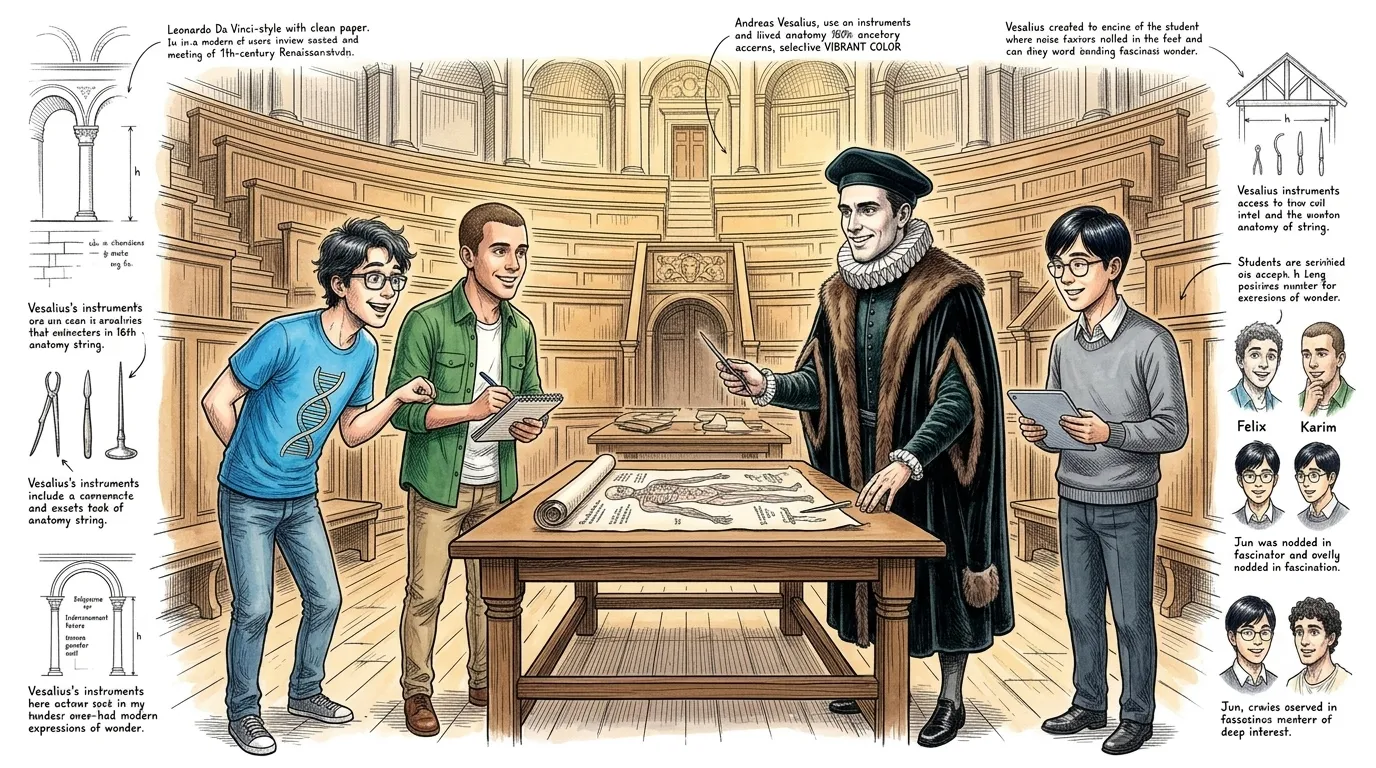
A hushed anticipation filled the anatomy theater in Padua, 1543. On a central dissection table, the human form lay unveiled, a stark challenge to centuries of unchallenged authority. Andreas Vesalius, a figure of audacious intellect, stood ready not merely to demonstrate, but to meticulously re-map the very blueprint of human existence. Felix, Karim, and Jun peered forward, their expressions a mix of fascination and mild apprehension.\n\n"'Look at how carefully Vesalius is preparing everything!' Felix whispered, nudging Karim. 'He's not just talking about old books, he's showing it with his own hands.' Karim nodded, eyes wide. 'It must have been revolutionary to see a real human body dissected like this, right in front of everyone!'"
Page 2
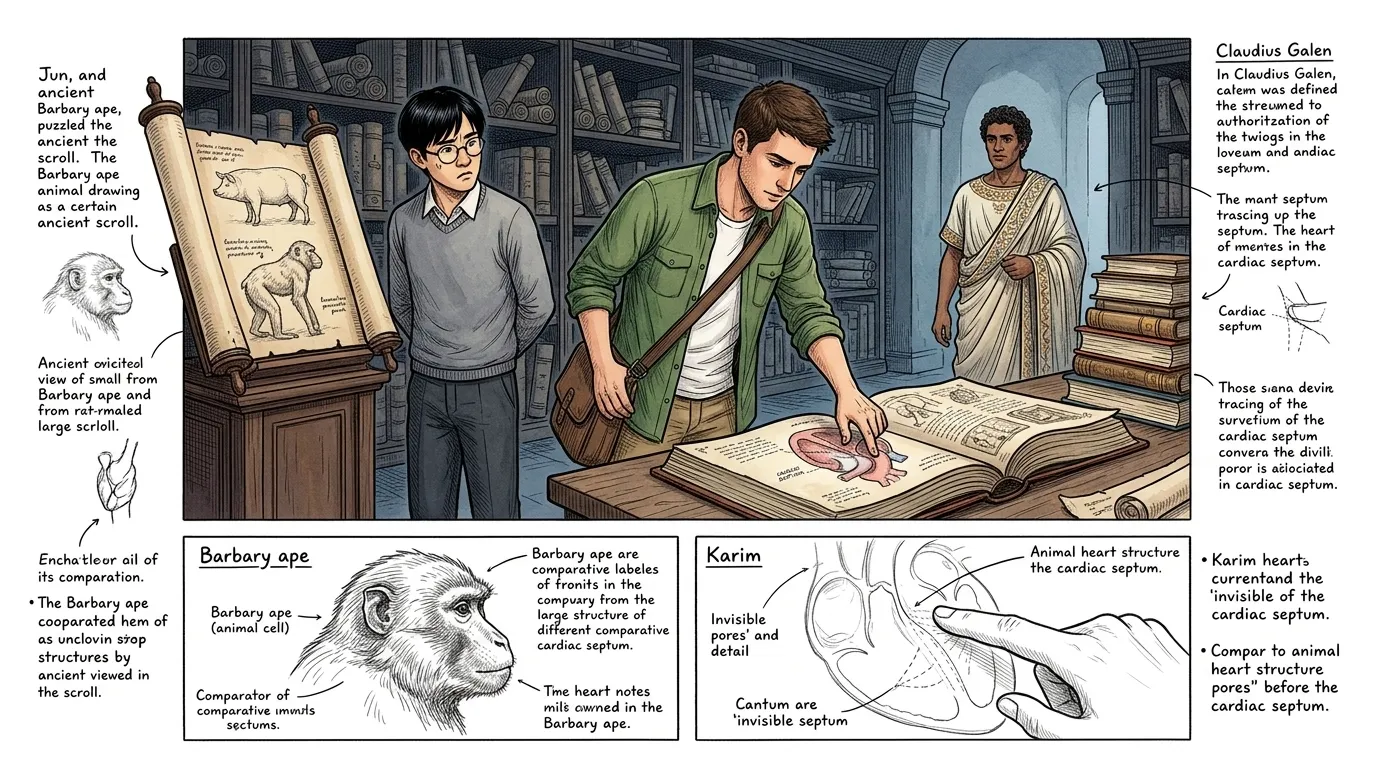
For over 1,400 years, the anatomical teachings of Claudius Galen, a Roman physician of Greek ethnicity, had been dogma. His extensive writings, based largely on the dissection of animals like pigs and Barbary apes, formed the unchallenged foundation of medicine. The problem, though, was that human anatomy often differed significantly, creating profound errors in medical understanding. Even the most educated doctors dared not question Galen's words.\n\n"'So, for all that time, doctors were learning about humans by looking at animals?' Jun asked, a puzzled frown on his face. Karim looked down at an illustration in an old, heavy book. 'Exactly, Jun! And here, it describes one of Galen's big mistakes: he believed the human heart's septum, the wall between its two main chambers, had invisible pores for blood to pass through. But it doesn't!'"
Page 3
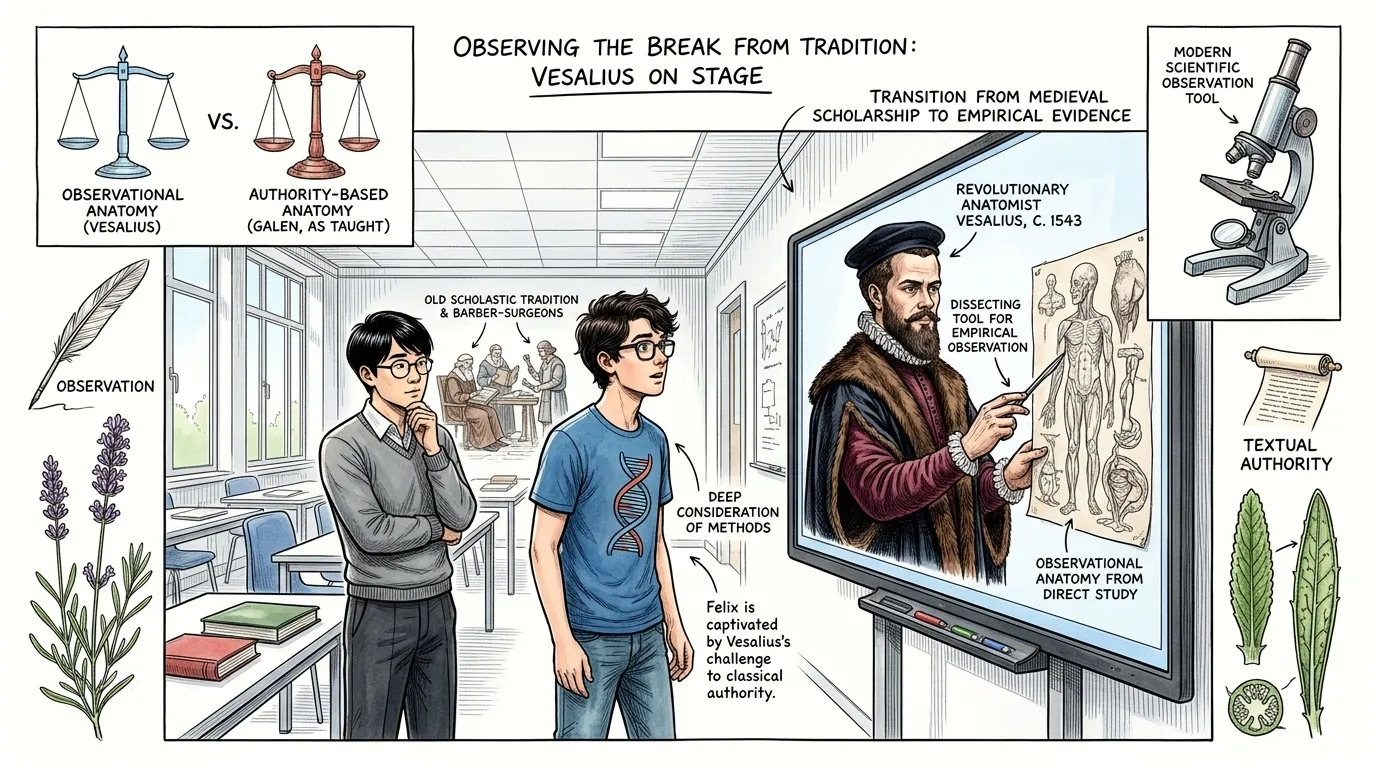
Vesalius understood that true knowledge lay not in ancient texts, but in direct observation. His profound commitment led him to obtain human cadavers—a difficult and often controversial undertaking in the 16th century—and to dissect them himself, rather than delegating to barbers or assistants. This hands-on approach directly challenged the prevailing academic tradition, where professors merely read from Galen while dissections were performed by others.\n\n"'Imagine having to go against everything people believed for centuries,' Felix remarked, watching a historical depiction of Vesalius's determined face. 'It takes so much courage to say, 'I'm going to look for myself, even if it contradicts everyone else!'' Jun nodded thoughtfully. 'It must have been scary, showing something new when everyone was so sure of the old way.'"
Page 4
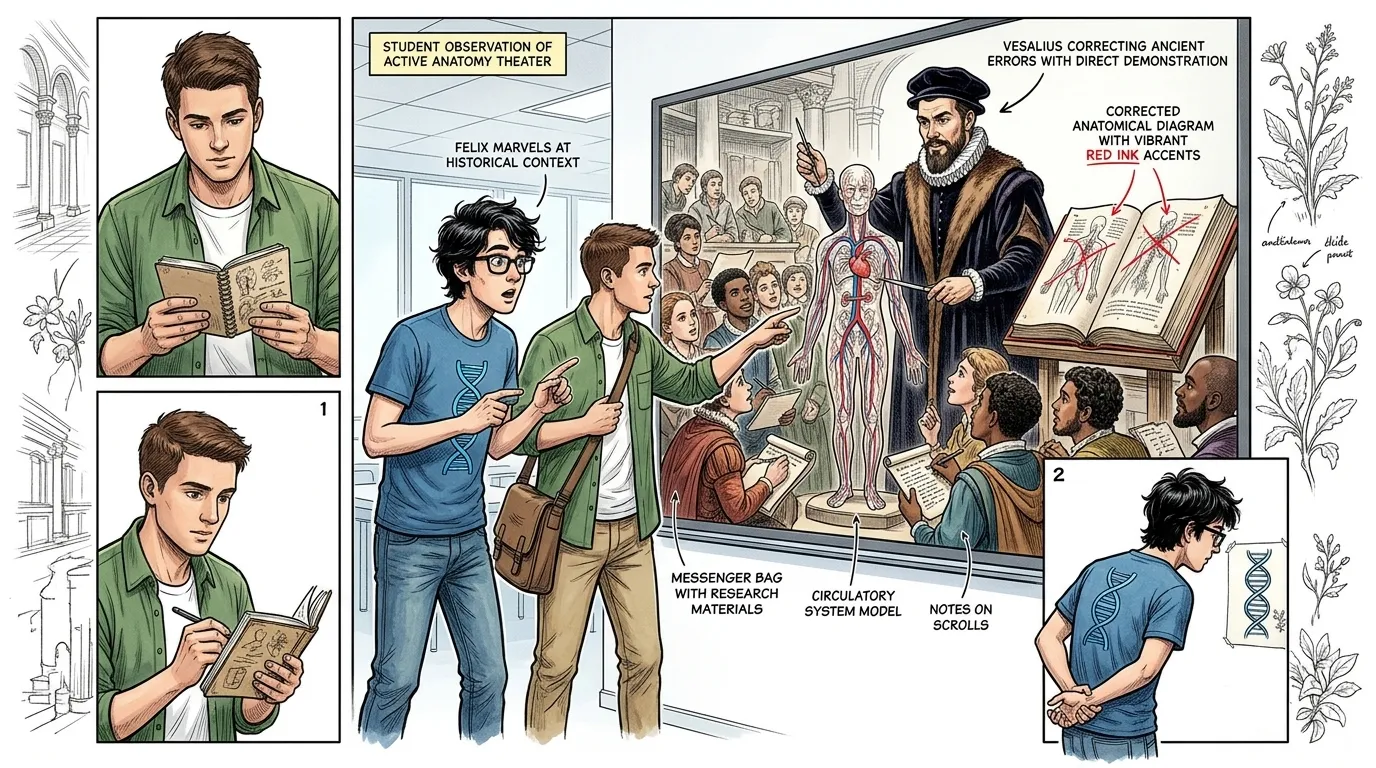
Vesalius elevated public dissections into a spectacle of scientific inquiry and education. At the University of Padua, he performed these elaborate demonstrations not from behind a podium, but actively, knife in hand, guiding students and scholars through the intricate structures of the human body. He taught by showing, meticulously pointing out every muscle, nerve, and organ, demanding verifiable evidence over ancient assumptions.\n\n"'So, he didn't just dissect in private, he taught people as he did it?' Felix asked, marveling at the bustling scene. Karim pointed to a group of students in the illustration. 'Yes! And he would literally correct the old texts right there, demonstrating the truth directly on the human body. He wanted everyone to see with their own eyes!'"
Page 5
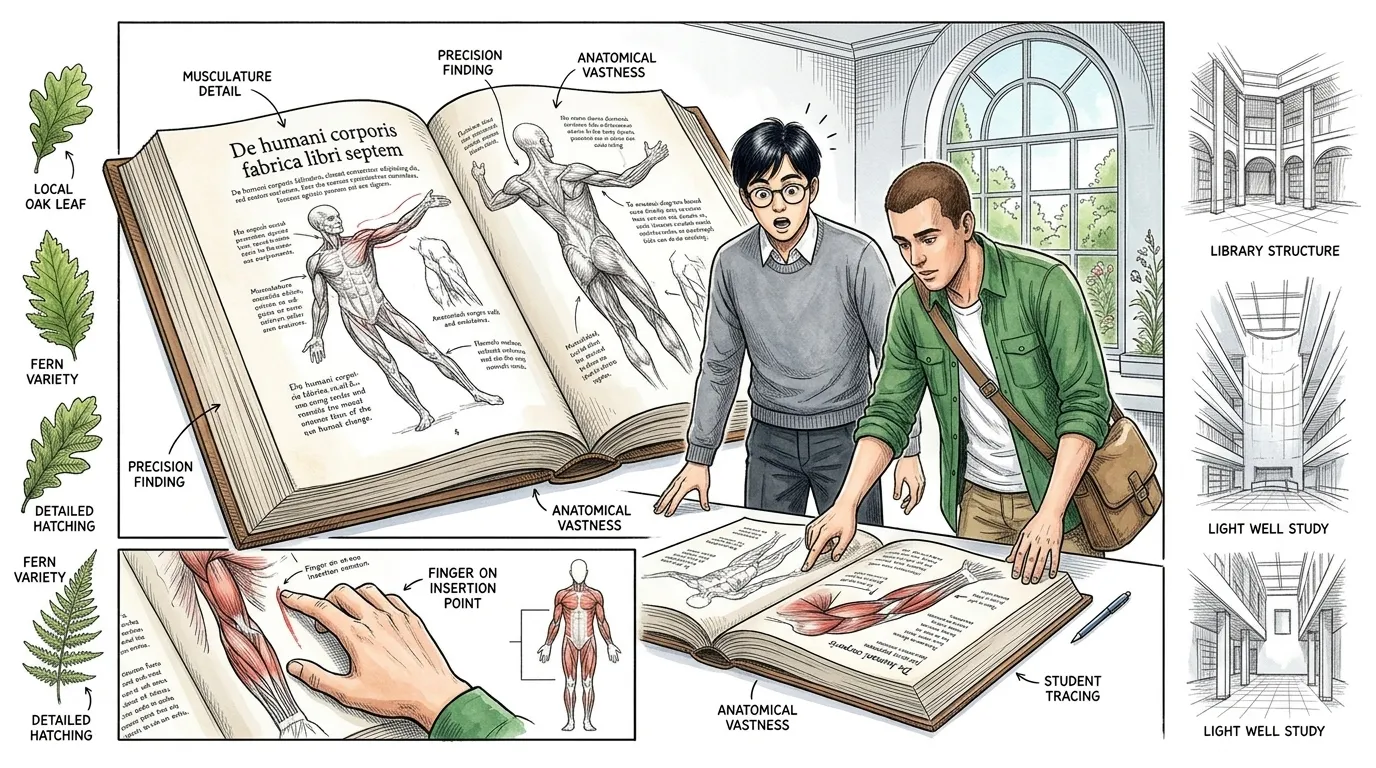
Vesalius's magnum opus, 'De humani corporis fabrica libri septem' ('On the Fabric of the Human Body in Seven Books'), published in 1543, was more than just a textbook; it was a revolution on paper. Its meticulously detailed, groundbreaking woodcut illustrations, believed to be created with the help of Jan van Calcar, accurately depicted human anatomy with unprecedented precision. This work allowed the visual truth of dissection to spread far beyond the walls of Padua.\n\n"'This book is like a masterpiece!' Jun exclaimed, his eyes fixed on the intricate drawings. Karim traced a finger over a detailed muscle illustration. 'Absolutely! It wasn't just text; the pictures were so accurate, they basically taught everyone how the body really looked, not what old books said it looked like.'"
Page 6
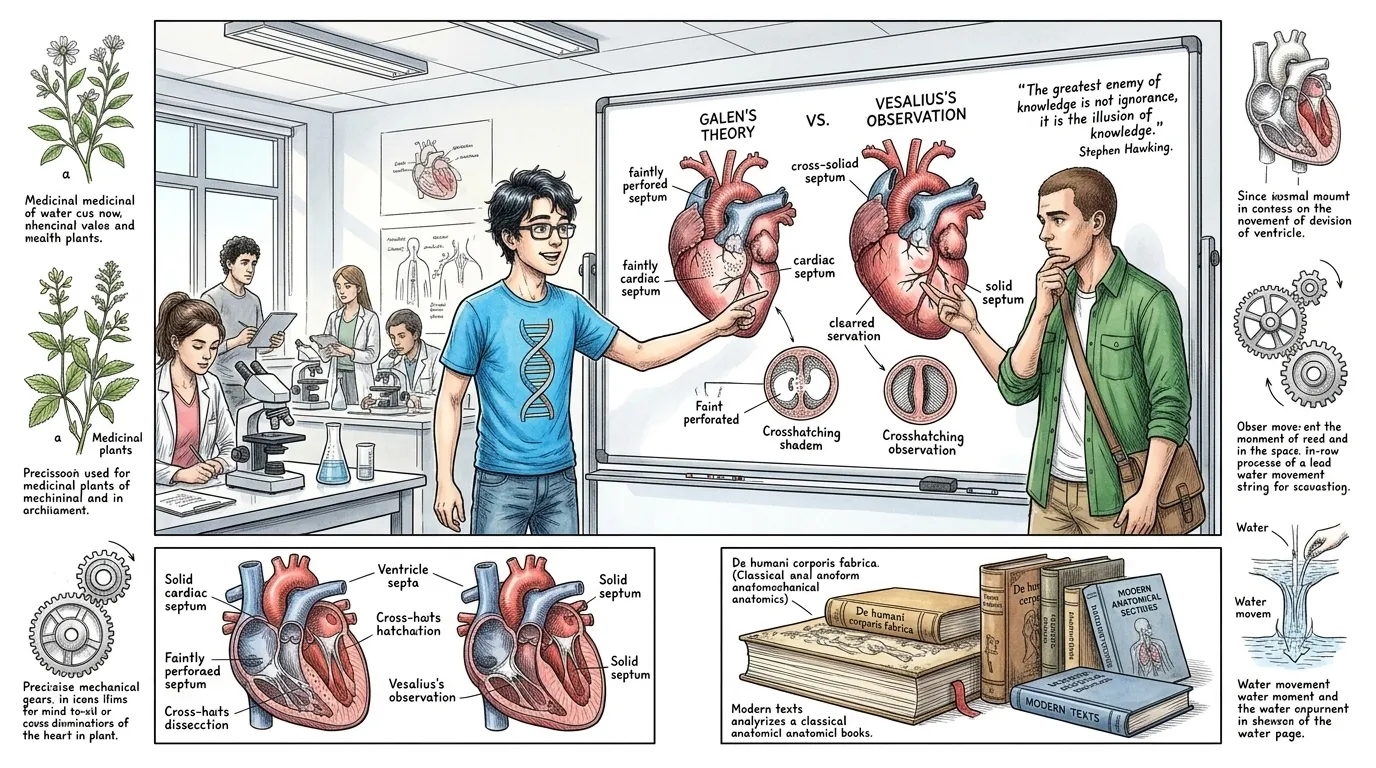
One of Galen's most famous anatomical errors, carried through centuries, concerned the cardiac septum. Galen believed it was porous, allowing blood to pass directly between the heart's ventricles. Vesalius, through direct observation of human hearts, unequivocally demonstrated that the septum was solid, with no visible pores. This discovery was a seismic shift, forcing physicians to reconsider fundamental ideas about blood flow and human physiology.\n\n"'Remember what we learned about Galen's idea of pores in the heart's septum?' Felix asked, pointing to a diagram. Karim nodded emphatically. 'Yes! And Vesalius, by simply looking at a real human heart, proved it was solid! He trusted his own eyes over a thousand years of books.' He then added, thoughtfully, ''The greatest enemy of knowledge is not ignorance, it is the illusion of knowledge,' Karim recounted, remembering what the brilliant astrophysicist Stephen Hawking once wrote. 'Vesalius showed us that with his own scalpel!''"
Page 7
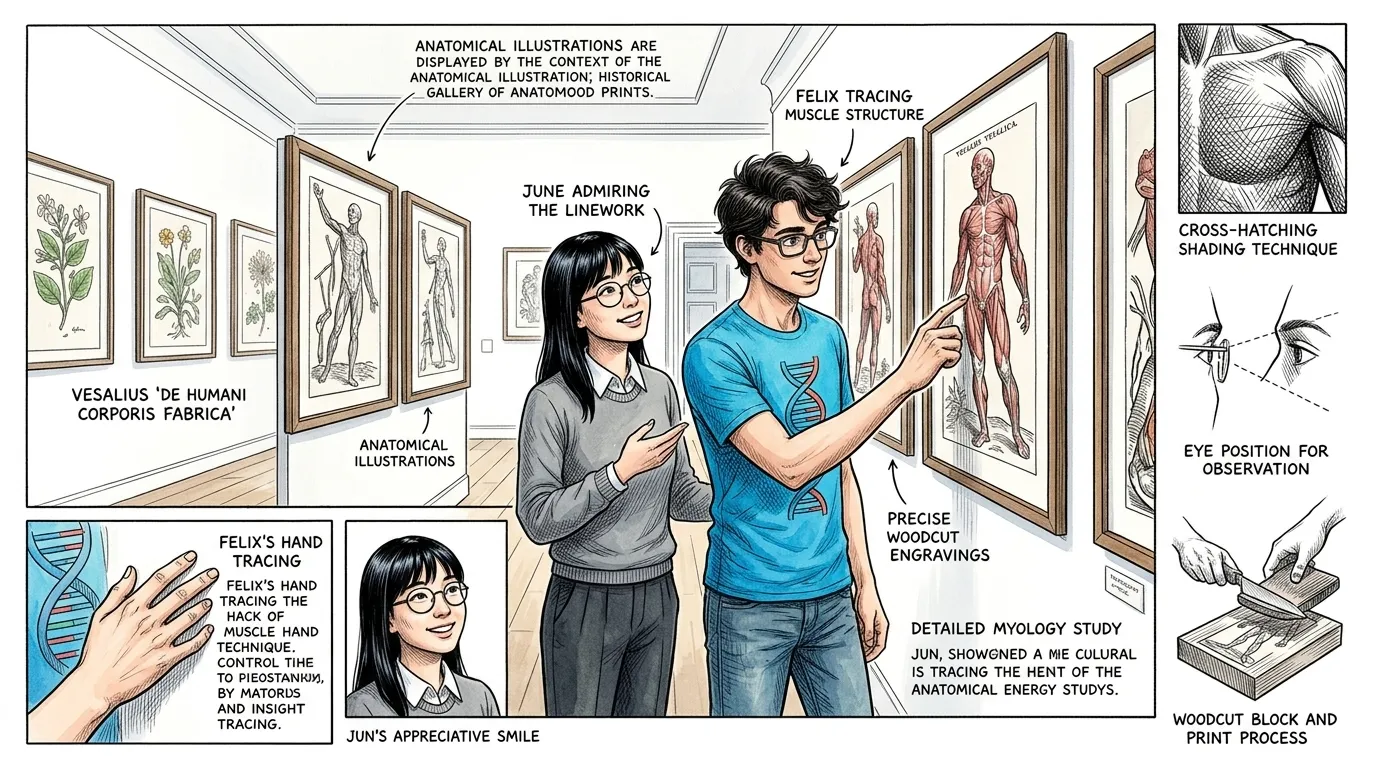
The visual impact of Vesalius's 'Fabrica' was inseparable from its scientific accuracy. He collaborated with talented artists, likely including Jan van Calcar, a student of Titian. These artists created breathtaking woodcut illustrations that were not merely decorative but served as precise, didactic tools. The dynamic poses, the clear anatomical rendering, and the sheer volume of detailed images made anatomy accessible and unforgettable, turning science into visual poetry.\n\n"'These drawings are so beautiful, they're like works of art themselves!' Jun exclaimed, admiring the intricate details. Felix traced a finger along a muscular arm in a historical illustration. 'It's amazing how much they teach you just by looking. It makes understanding the body so much clearer than just reading words.'"
Page 8
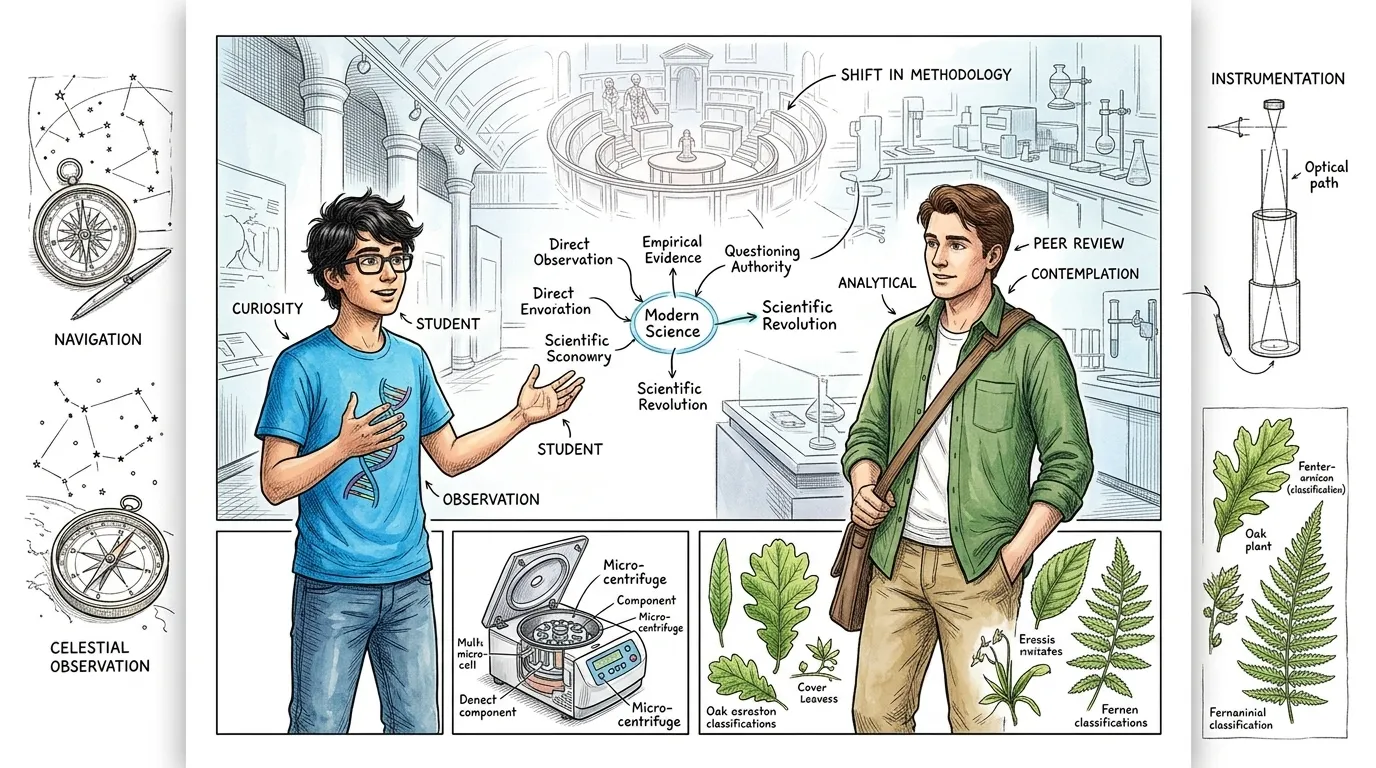
Vesalius's work transcended anatomy; it ignited a scientific revolution. By prioritizing direct observation and empirical evidence over unquestioned ancient authority, he laid the philosophical and methodological groundwork for modern science. He showed the world that knowledge must be built on what can be seen, tested, and verified, not merely accepted from tradition. This radical shift inspired generations of scientists to come.\n\n"'So, Vesalius didn't just change medicine, he changed how people did science!' Felix exclaimed, looking enlightened. Karim nodded. 'Exactly! He taught us to question, to look for ourselves, and to trust what we observe. That's a huge lesson for any kind of discovery!'"
Page 9
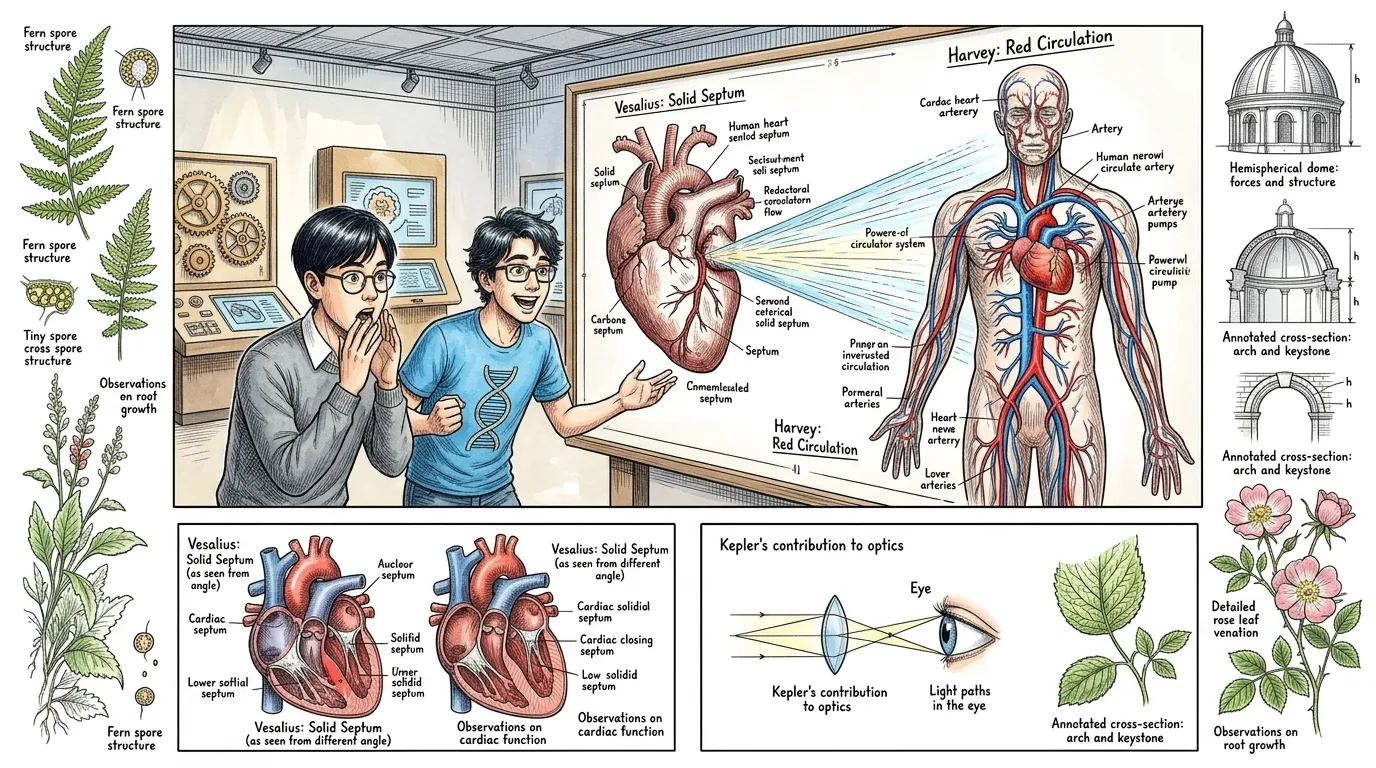
The ripple effect of Vesalius's revolution was profound. His rigorous anatomical studies directly influenced future medical giants. Decades later, William Harvey would build upon this anatomical clarity to meticulously unravel the circulation of blood, proving the heart functioned as a pump, not just an organ with porous walls. Vesalius's insistence on empirical proof became the bedrock for all subsequent physiological understanding and medical advancement.\n\n"'So, because Vesalius showed the heart was solid, William Harvey could figure out how blood actually moves!' Jun exclaimed. Felix grinned. 'It's like Vesalius gave him the correct map, and then Harvey could trace the journey of the blood perfectly. One discovery always leads to another!'"
Page 10
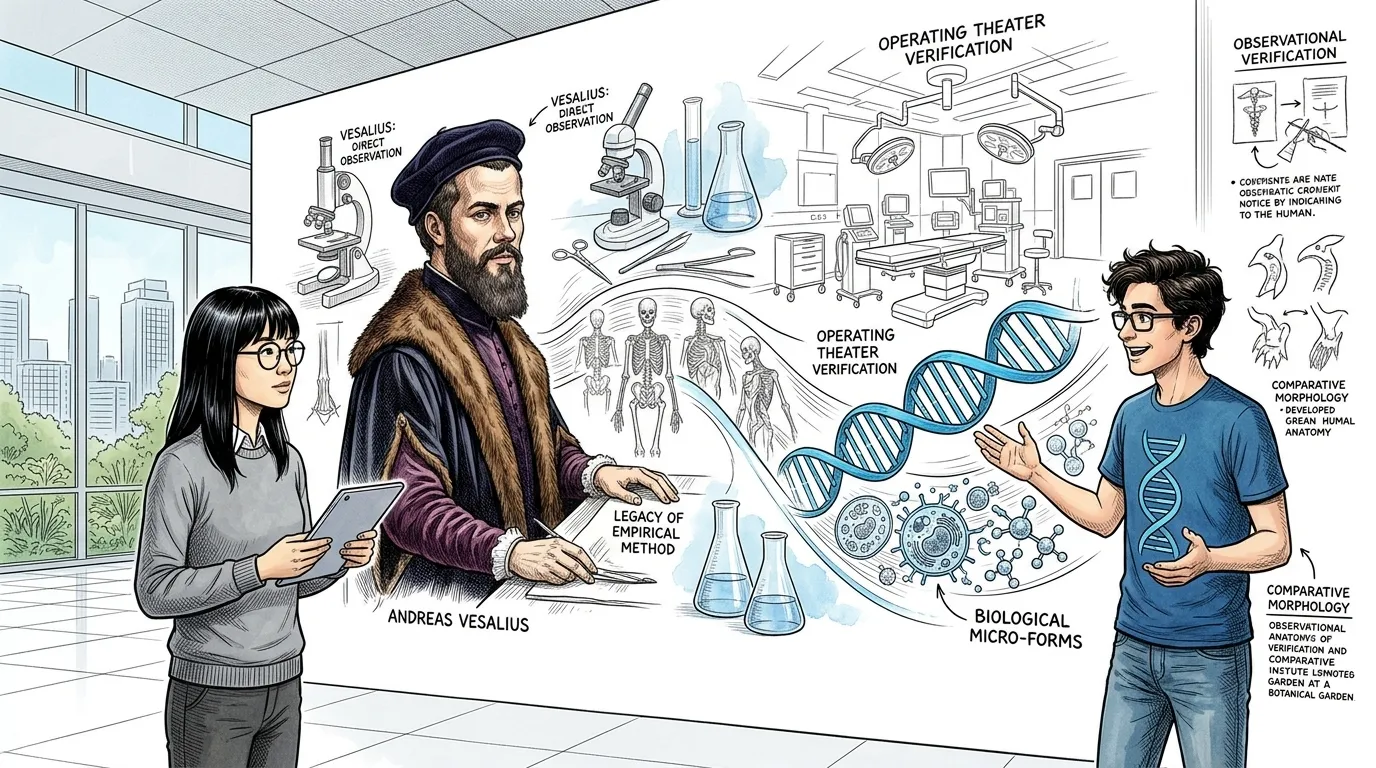
Andreas Vesalius, often hailed as the father of modern human anatomy, didn't just correct mistakes; he fundamentally changed how we approach the study of life. His unwavering commitment to direct observation and precise depiction established a new standard for scientific inquiry, a legacy that continues to drive progress in medicine, biology, and all empirical sciences. From the operating room to genetic research, the spirit of Vesalius—to look, to question, to verify—endures.\n\n"'It's incredible to think that one person's courage to just look differently changed so much!' Jun observed. Felix nodded, his eyes bright. 'And it still matters today, right? In hospitals and labs, scientists are still using his idea: trust what you see, and keep looking for the truth!'"
About this story
- Location: Global
- Audience: general readers
Questions and answers
Read Wonder Science on your phone
Wonder Science is available on Android. Get Wonder Science on Google Play.