Annie Jump Cannon
Annie Jump Cannon — an illustrated science story, set in Global. 10 illustrated pages, free to read on Wonder Science.

Page 1
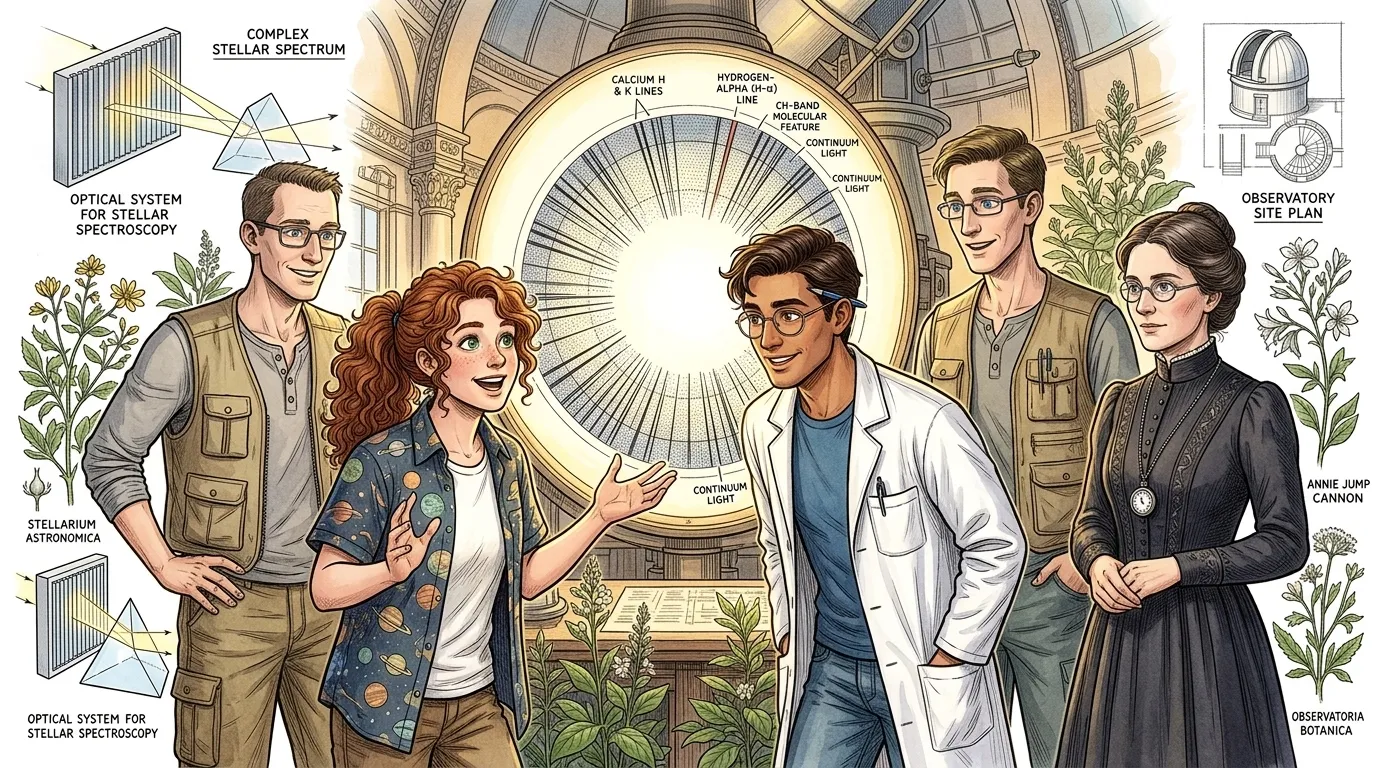
At the turn of the 20th century, the universe was a vast, uncatalogued mystery. Starlight, once seen merely as twinkling points, held secrets about the stars themselves, hidden within its intricate spectrum. Yet, without a universal language to describe it, this cosmic library remained largely unread.\n\n"Teodoro, Koa, and Stefan stood before a large, illuminated display. 'Look at all these lines!' Koa exclaimed, pointing at a projected star spectrum. 'It's like a barcode for a star!' Teodoro leaned closer, his brow furrowed in concentration. 'But how do you even begin to sort something this complicated?' he wondered aloud."
Page 2
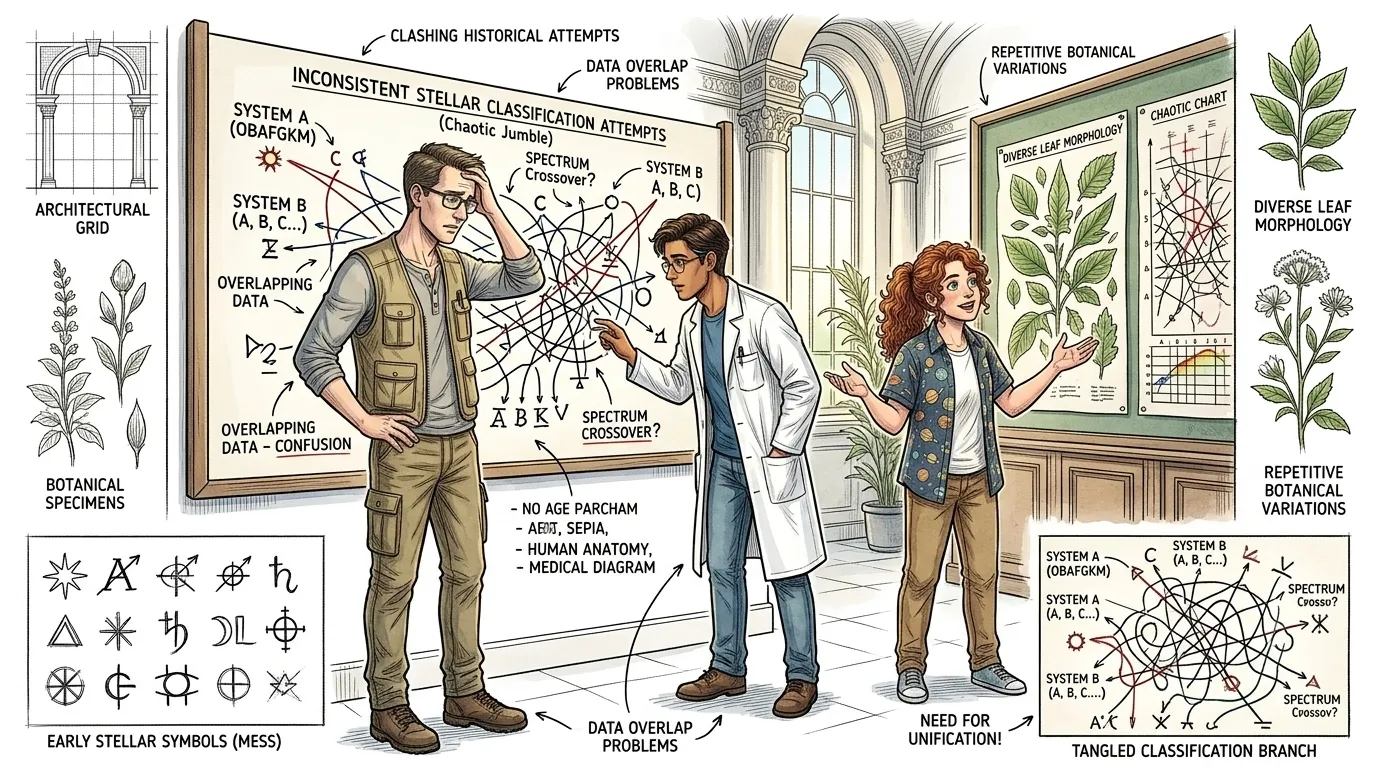
Before Annie Jump Cannon, attempts to classify stars were often inconsistent and unwieldy, like trying to sort all the books in a giant library without an alphabet. Astronomers tried many different systems, but none could truly bring order to the bewildering diversity of stellar light.\n\n"'This looks like a massive mess!' Stefan said, shaking his head at a historical diagram showing various, clashing stellar classification attempts. 'How could anyone find anything if everyone uses a different system?' Teodoro carefully traced a finger over one particularly complex chart. 'It's like trying to put together a puzzle when all the pieces are from different boxes,' he observed. Koa added, 'Imagine trying to classify every single leaf in a forest – you'd need a really good plan!'"
Page 3
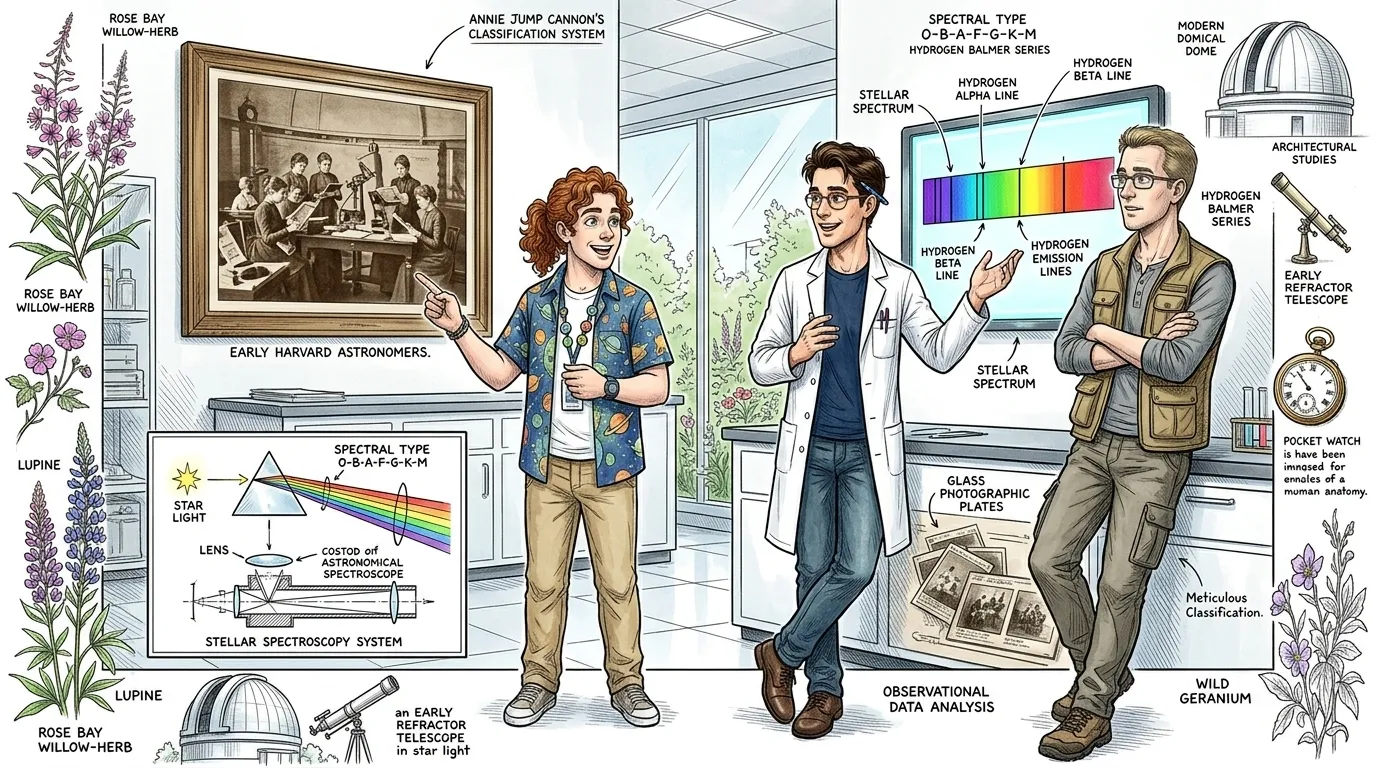
At Harvard College Observatory, under the direction of Edward Pickering, a team of dedicated women, often referred to as 'human computers,' undertook the colossal task of analyzing photographic plates. Williamina Fleming and Antonia Maury made significant early contributions, developing their own classification schemes based on the hydrogen lines in stellar spectra.\n\n"Koa pointed to an old photograph of a group of women working. 'These are the Harvard Computers!' he exclaimed. 'They were like the super-analysts of their time.' Teodoro noted, 'They started to see patterns in the star-light, like how bright the hydrogen lines were.' Stefan leaned in. 'But even they had different ways of classifying. It still wasn't a single, clear system for everyone to use.'"
Page 4
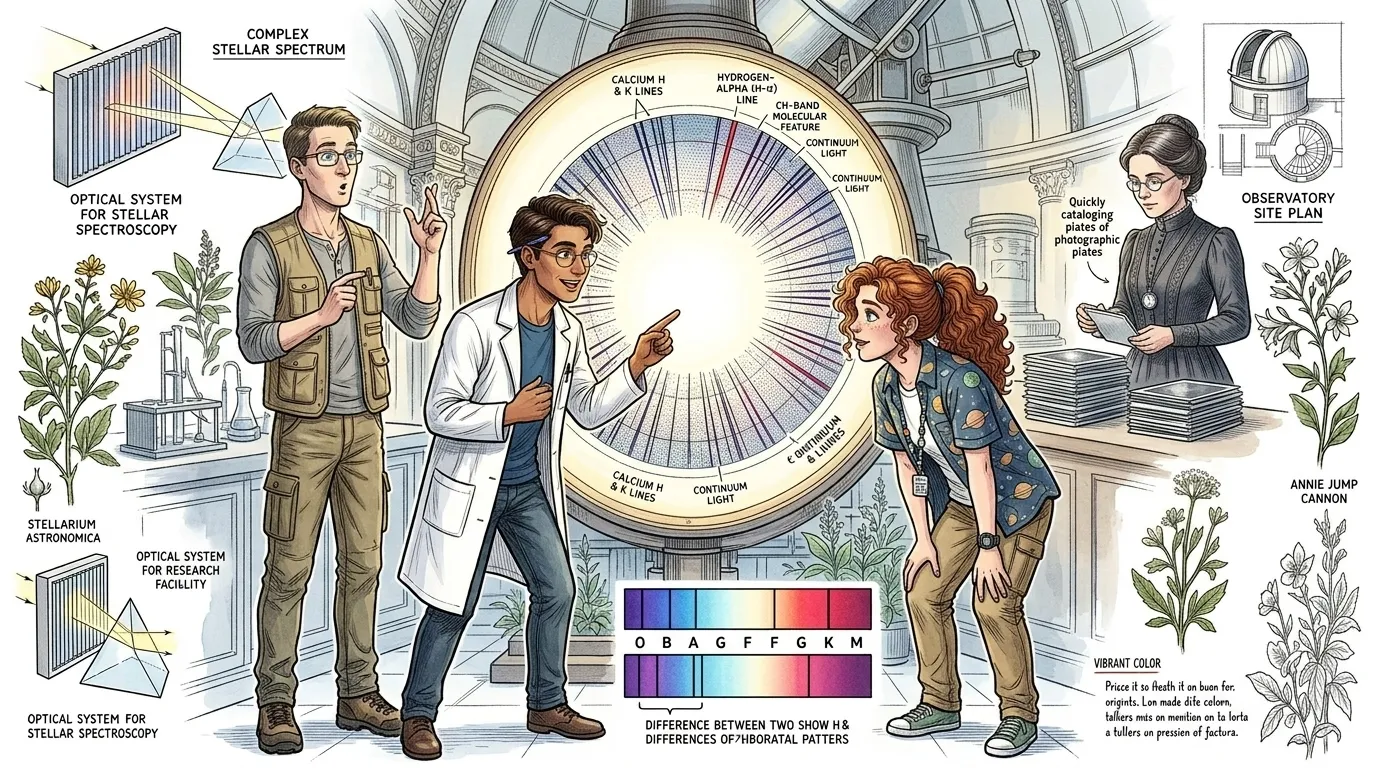
Annie Jump Cannon joined this remarkable team and, with her unique ability to discern subtle differences in spectral patterns and her exceptional speed, she quickly streamlined the classification process. She could classify three stars per minute, a staggering pace that allowed her to bring unprecedented efficiency to the observatory's efforts.\n\n"'Three stars a minute!' Stefan whistled, trying to imagine the speed. 'That's faster than I can even blink!' Teodoro nodded, 'She wasn't just fast; she saw the key differences that other people might miss. It was about finding the right way to group them.' Koa peered at a visual representation of a simplified star spectrum, 'It's like seeing the crucial details in a really complex picture.'"
Page 5
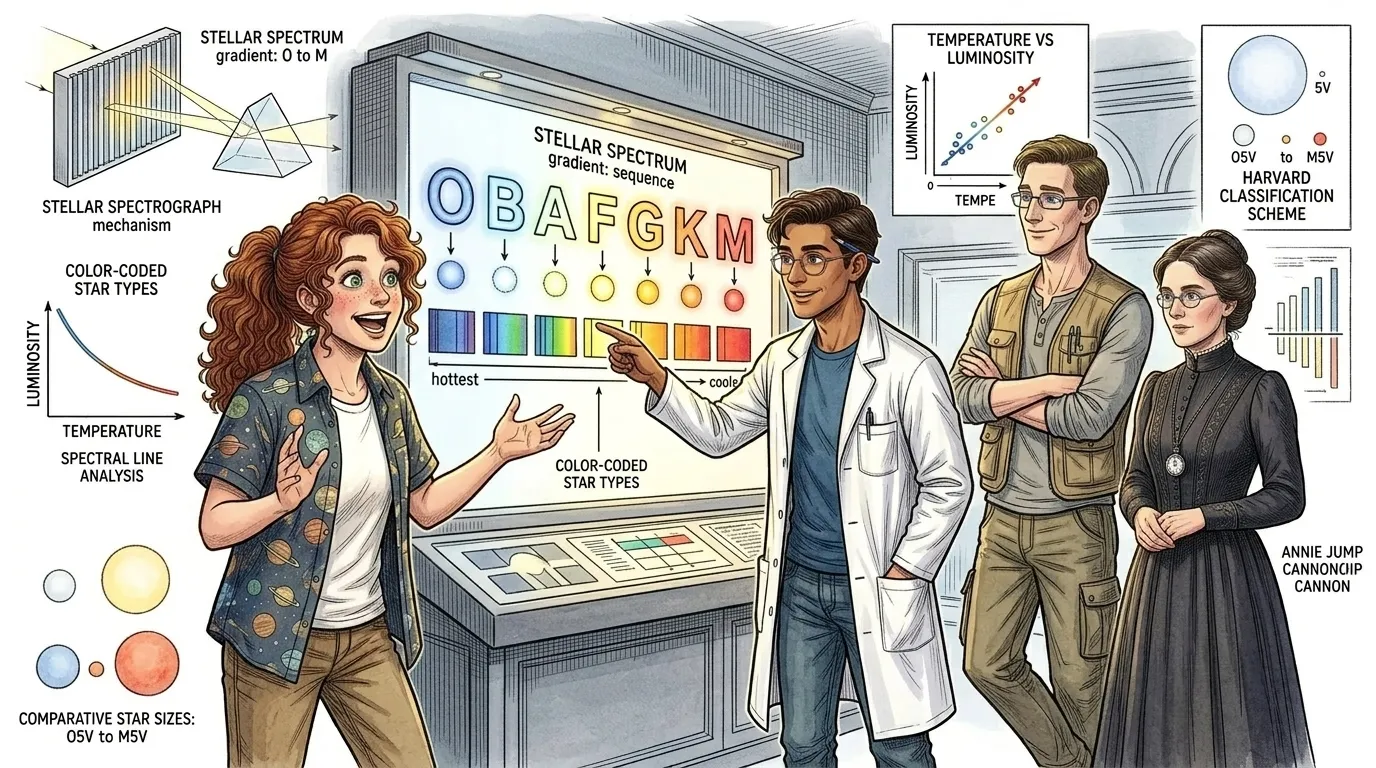
Cannon's stroke of genius was to refine the classification system into a simpler, more intuitive sequence. She arranged stars not by the number of hydrogen lines, but by their temperature, which directly relates to their spectral appearance. This gave birth to the enduring OBAFGKM sequence, instantly recognizable to astronomers worldwide.\n\n"'So it's not random letters!' Koa exclaimed, as they looked at an interactive display showing different star types. 'O, B, A, F, G, K, M – they actually mean something!' Teodoro pointed, 'They're arranged by temperature! O is the hottest, and M is the coolest.' Stefan mused, 'It's like categorizing animals by habitat, but for stars, it's by how hot they are!'"
Page 6
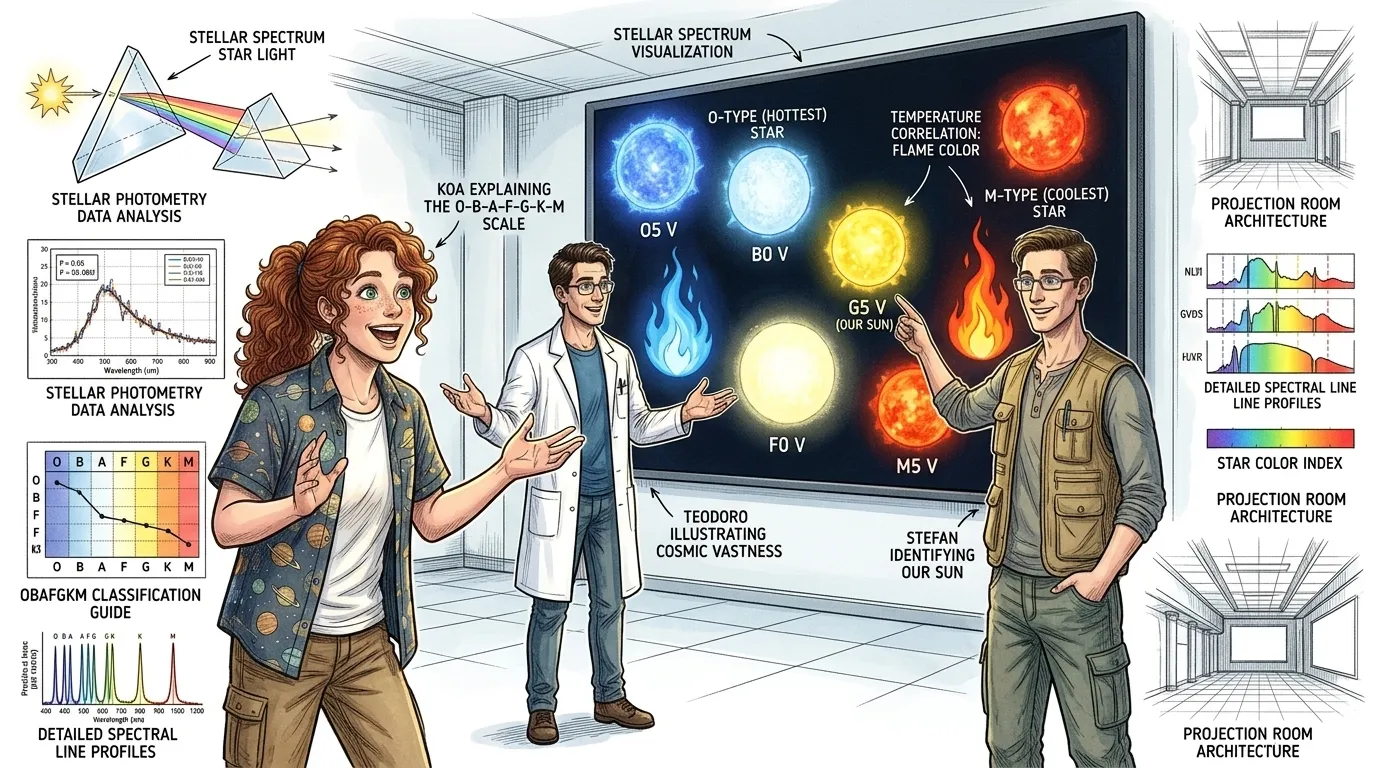
This revolutionary system revealed that a star's spectrum is a direct window into its temperature, and subsequently, its color. The hottest 'O' and 'B' stars blaze a brilliant blue-white, while the cooler 'M' stars glow a deep, fiery red. Our own Sun, a 'G' type, shines a comfortable yellow.\n\n"'So, the color of a star tells you how hot it is!' Koa exclaimed, looking at a visualization showing different colored stars. 'Like a blue flame is hotter than a red flame!' Teodoro added, 'Exactly! And Annie Jump Cannon figured out this cosmic connection just by looking at lines in light.' Stefan pointed to the yellow star representing the Sun. 'Our Sun is a G-type! It's right in the middle, not too hot, not too cool.'"
Page 7
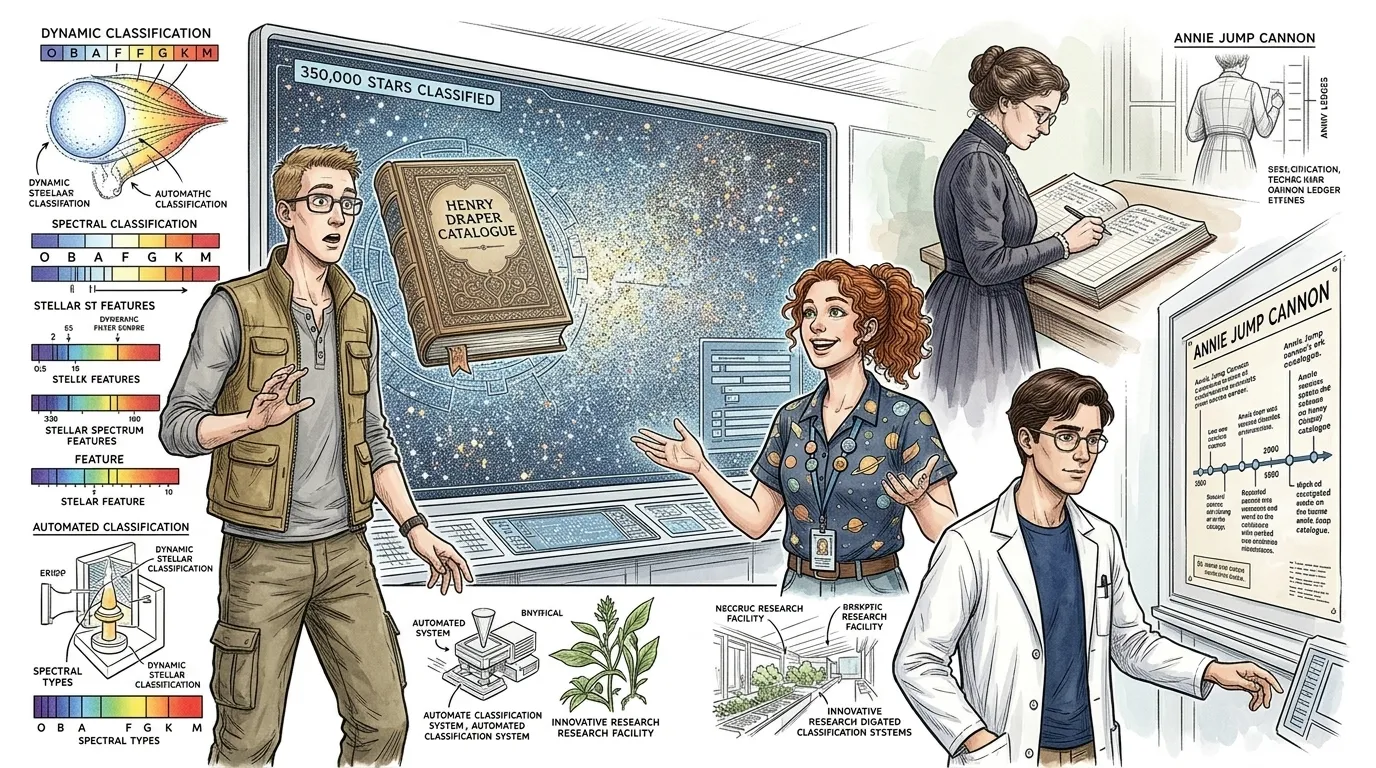
Over her extraordinary career, Annie Jump Cannon classified an astonishing 350,000 stars. Her prolific work culminated in the publication of the Henry Draper Catalogue, which became the cornerstone of modern astrophysics. Every single one of those stars was meticulously scrutinized and categorized by her keen eye.\n\n"Stefan's eyes widened. '350,000 stars! That's more stars than I could count in my whole life!' Koa, trying to grasp the scale, said, 'It's like she built a massive dictionary for the entire universe, one word at a time.' Teodoro, looking at a visual timeline of Cannon's work, added, 'And astronomers still use her system today. She created the language we use to talk about stars.'"
Page 8
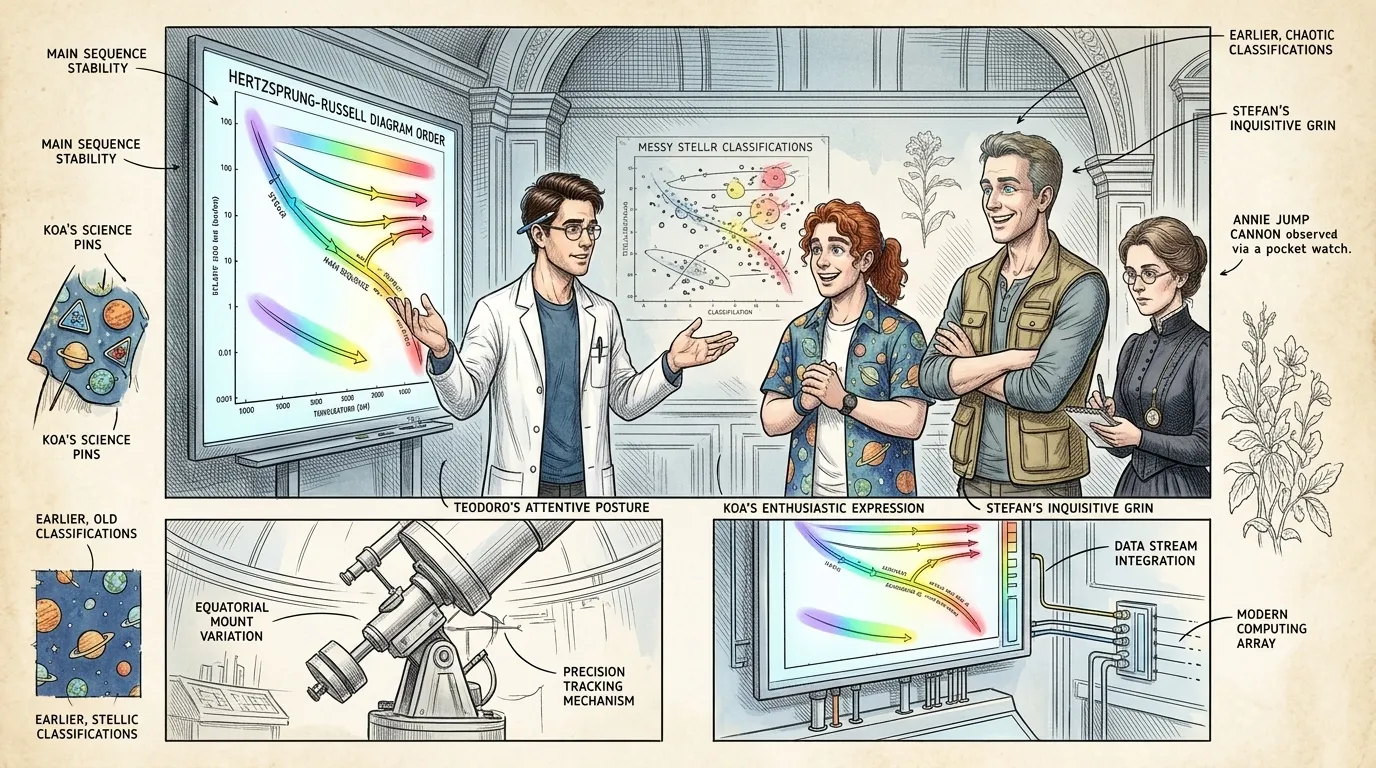
Cannon's systematic approach provided astronomers with a crucial tool, allowing them to classify new stars quickly and efficiently. This unified language for stars was essential for understanding how stars are born, live, and die, paving the way for monumental discoveries like the Hertzsprung-Russell diagram.\n\n"'Remember those messy classification charts from before?' Teodoro asked, looking at Koa and Stefan. 'Annie Jump Cannon's system brought total order to that chaos.' Koa nodded vigorously. 'It's like she gave us the master key to unlock all the star secrets!' Stefan grinned, 'As the American writer Mark Twain once said, 'The secret of getting ahead is getting started.' Cannon definitely got started and made a huge difference!'"
Page 9
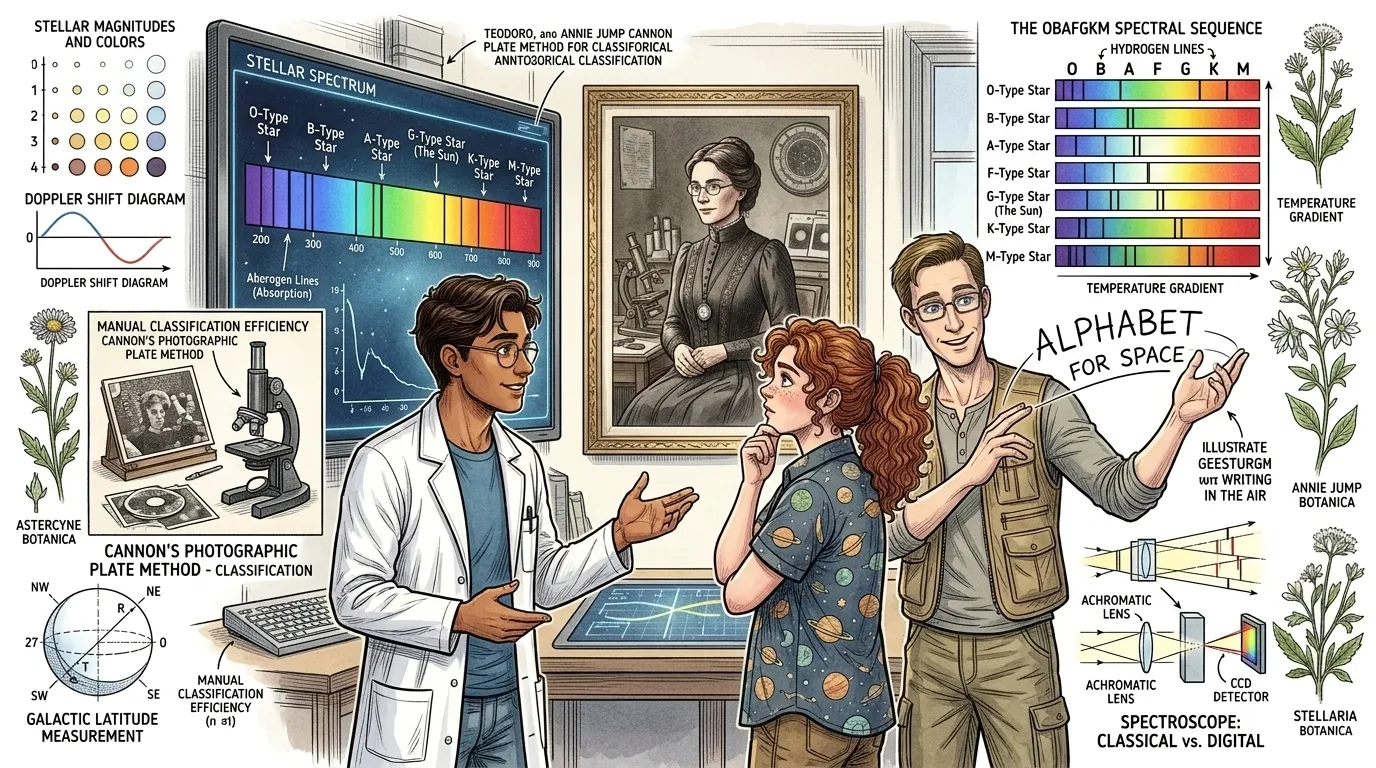
Her work formed the backbone of stellar astronomy for over a century and remains in use today, albeit with modern refinements. Every astronomer, from student to seasoned researcher, speaks the language of OBAFGKM, a testament to Cannon's remarkable ability to distill complexity into clarity.\n\n"'It's amazing how one person's careful work can shape an entire field of science,' Koa mused, looking at a historical photo of Annie Jump Cannon surrounded by her astronomical tools. Teodoro nodded, 'Her classification system is still so useful, even with all our advanced telescopes today.' Stefan concluded, 'It's like she wrote the alphabet for all of space, so everyone could start reading the stars.'"
Page 10
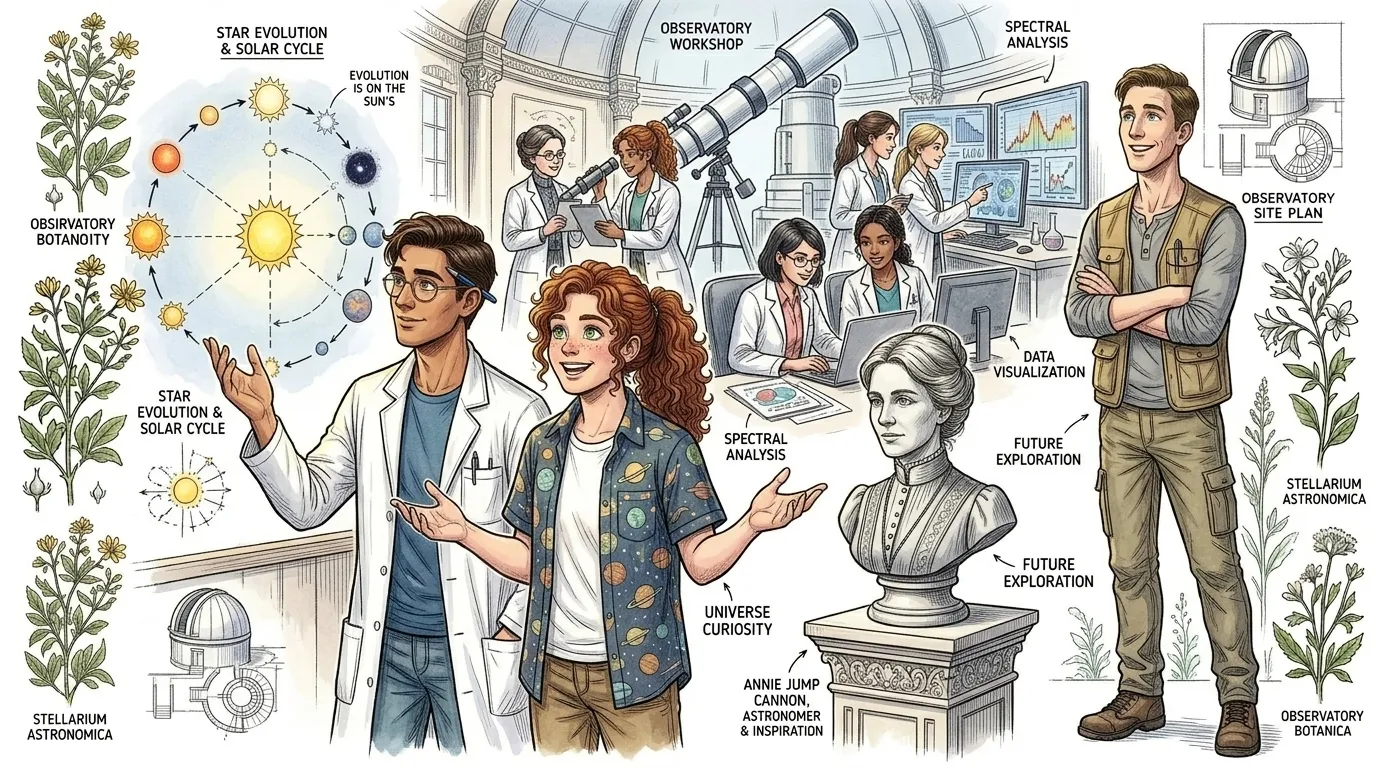
Annie Jump Cannon's legacy extends far beyond her catalogue. She became a tireless advocate for women in science, demonstrating that intellectual prowess knows no gender. Her pioneering work laid the groundwork for countless discoveries, inspiring generations to look up and decipher the messages written in starlight.\n\n"Teodoro looked thoughtful. 'Her work helped us understand where our Sun fits in, and how stars change over billions of years.' Koa added, 'And she showed everyone that women could do incredible science, too!' Stefan smiled, 'She didn't just classify stars; she classified a path for future scientists, proving that meticulous observation can unlock the biggest mysteries.'"
About this story
- Location: Global
- Audience: general readers
Questions and answers
Read Wonder Science on your phone
Wonder Science is available on Android. Get Wonder Science on Google Play.