Caroline Herschel
Caroline Herschel — an illustrated science story, set in Global. 10 illustrated pages, free to read on Wonder Science.
Page 1
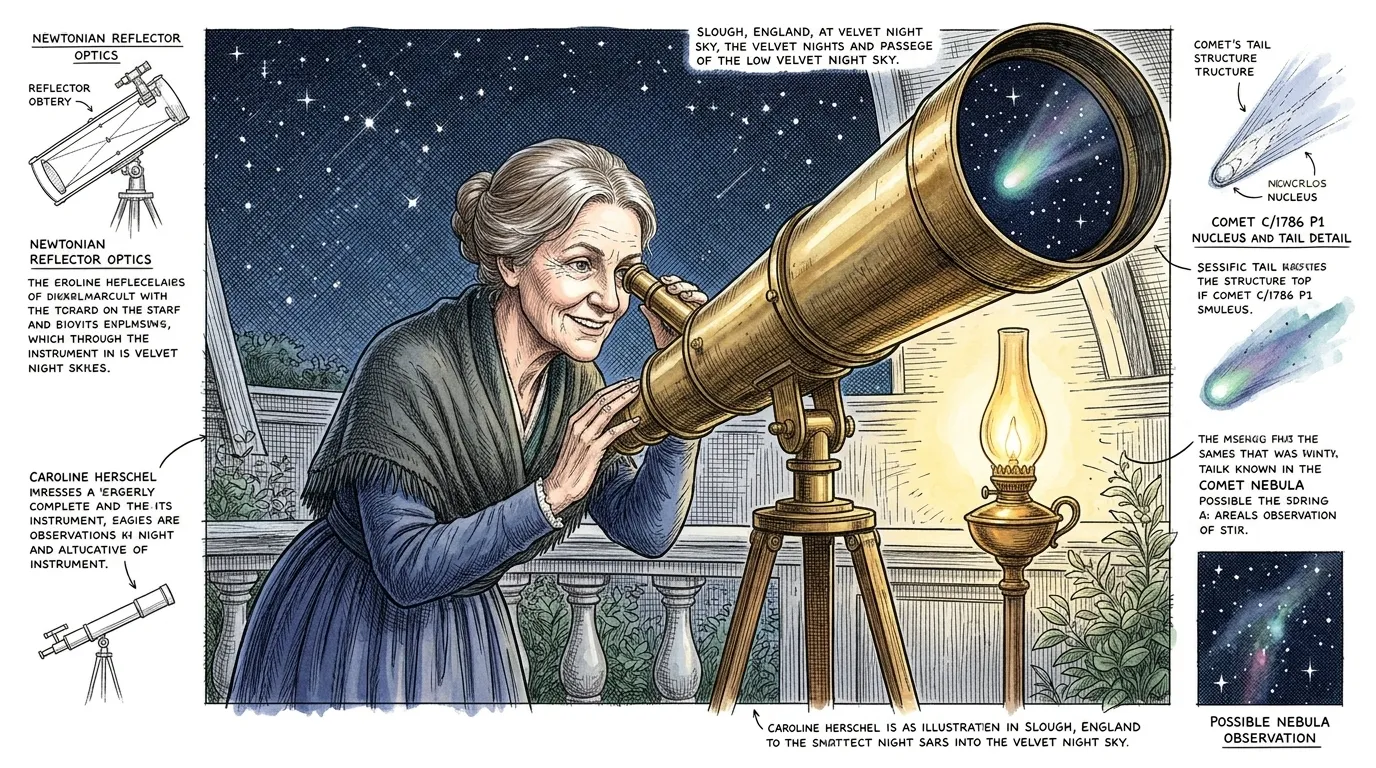
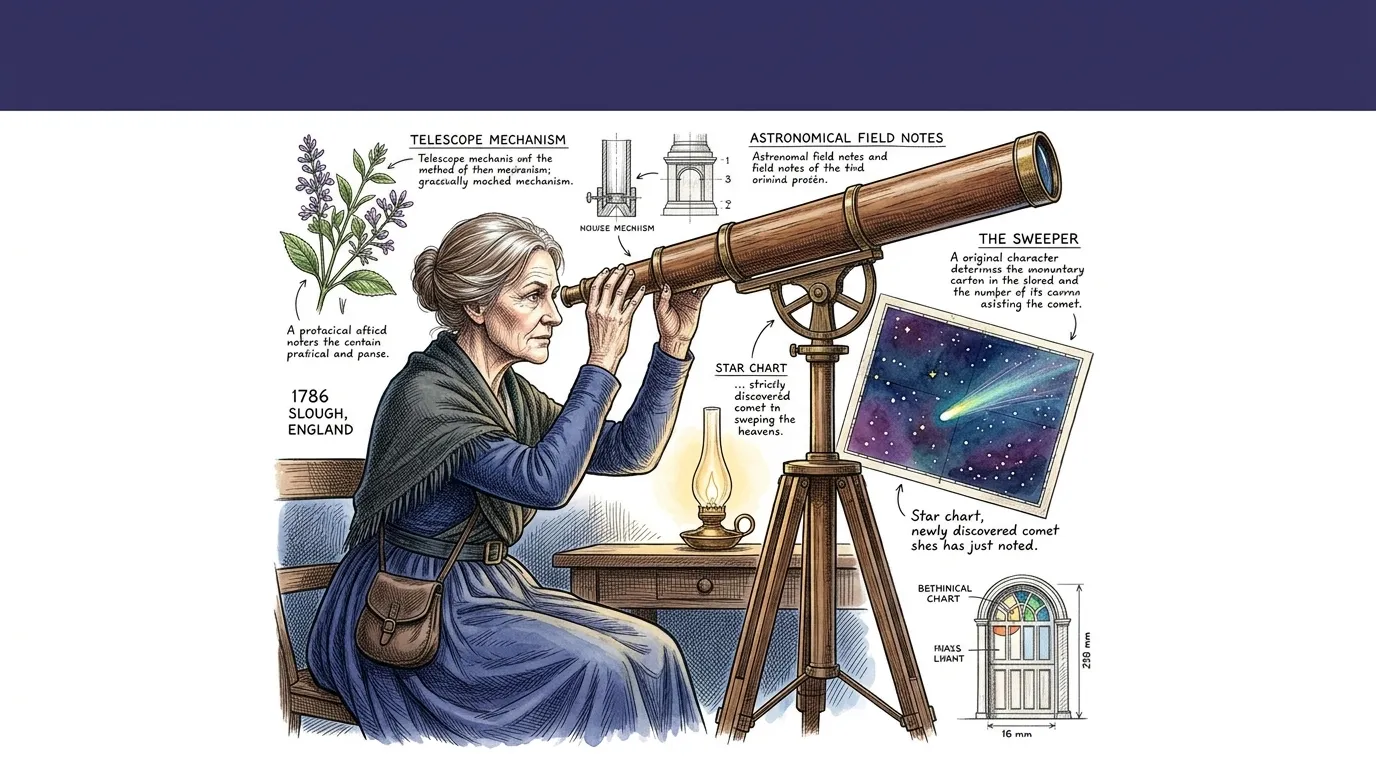
Beneath a velvet sky pierced by countless stars, a woman sat, her eye pressed to a telescope eyepiece. The year was 1786, and in the small English town of Slough, Caroline Herschel was meticulously sweeping the heavens, a task of immense patience and singular dedication. On August 1st, her gaze fell upon a faint, nebulous object that did not belong. This was Comet C/1786 P1, her first independent discovery, and a celestial signature that would forever etch her name into the annals of science.
Page 2
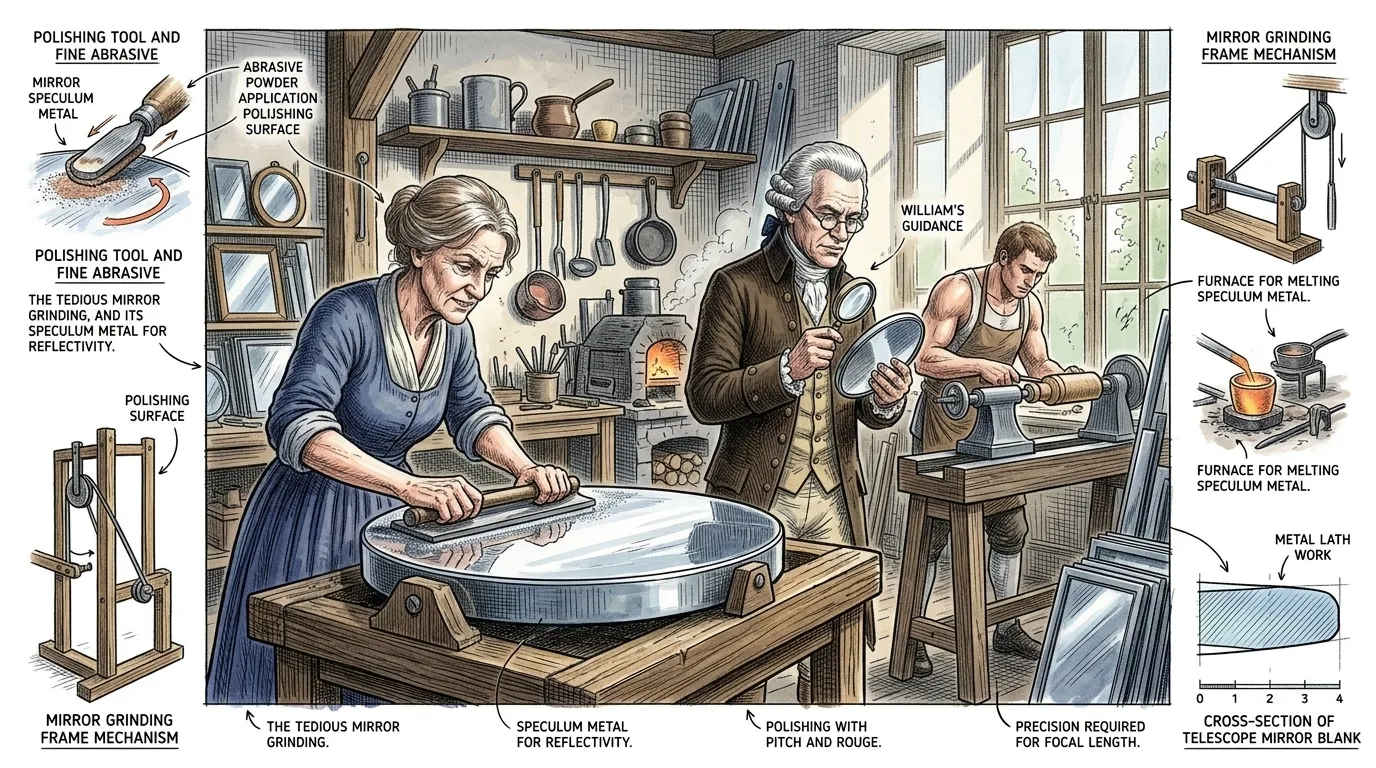
Born in Hanover, Germany, in 1750, Caroline Lucretia Herschel's early life was marked by hardship and limited opportunities, primarily training as a singer. It was her elder brother, William Herschel, who summoned her to Bath, England, in 1772, to assist him not just in music, but in his burgeoning passion: astronomy. This involved tedious, physically demanding work, such as grinding and polishing the massive metal mirrors for William's increasingly ambitious telescopes—an endeavor that could take days, even weeks, of continuous effort. This exacting labor was the foundation of their future discoveries.
Page 3
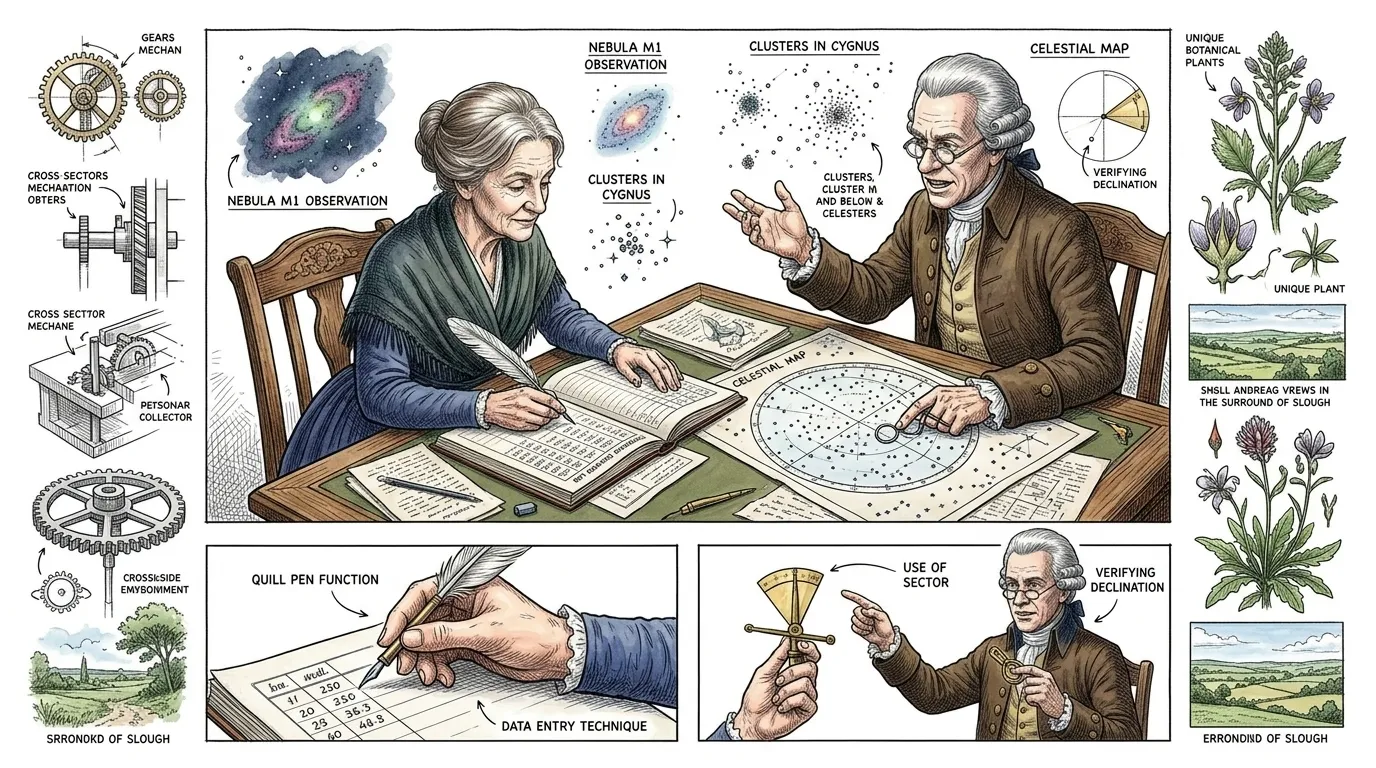
William's colossal telescopes were revolutionary, revealing countless new objects beyond the reach of others. But this presented a new challenge: how to systematically observe, record, and categorize an expanding universe of nebulae, star clusters, and potential comets. Caroline's exceptional organizational skills, honed from her musical training, proved invaluable. She spent countless hours reducing William's raw observations into coherent catalogs, translating his spoken descriptions into precise numerical data and celestial coordinates, laying the groundwork for systematic sky surveys.
Page 4
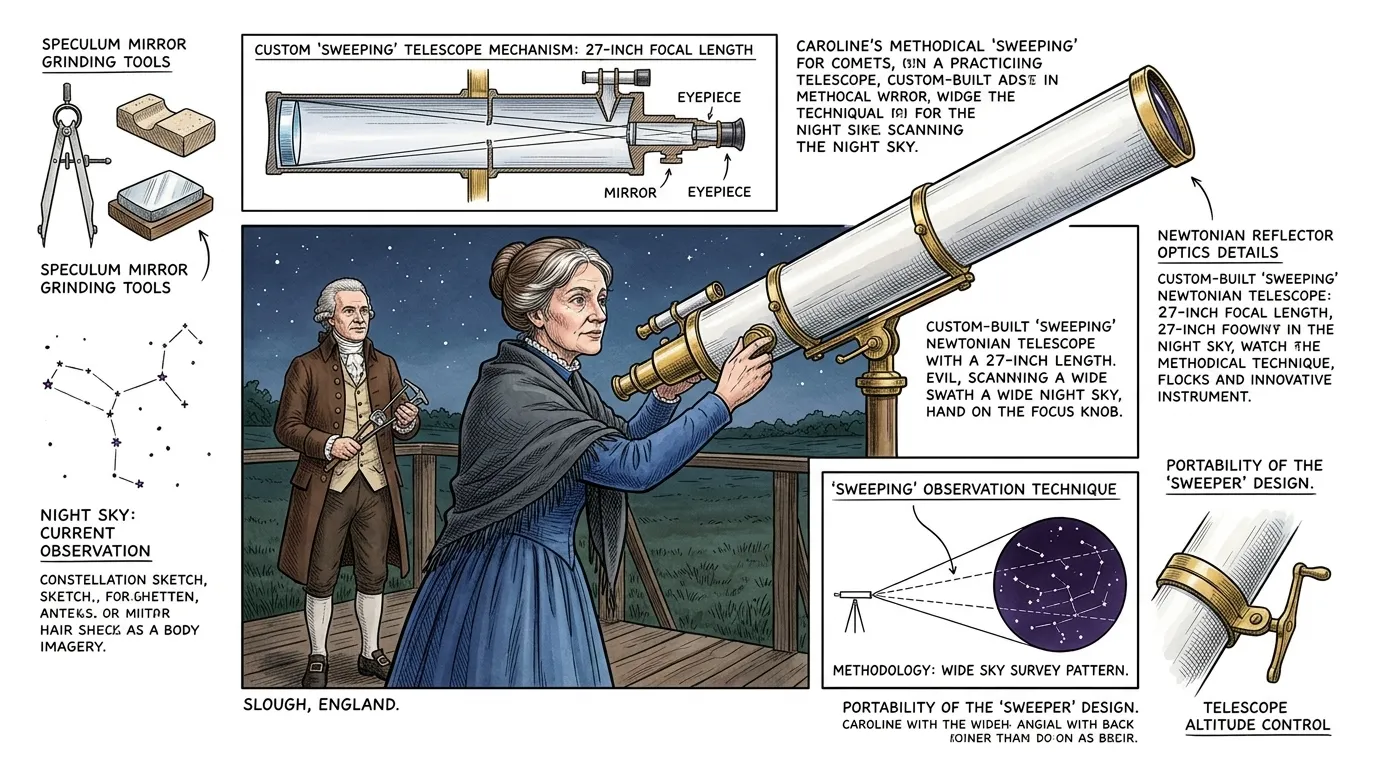
Recognizing her unparalleled dedication, William built Caroline a dedicated 'sweeping' Newtonian telescope with a focal length of 27 inches. This instrument was specifically designed for comet hunting, allowing her to systematically scan wide swathes of the night sky, inch by painstaking inch. Unlike tracking specific objects, her method involved sweeping a narrow band across the heavens, searching for anything that appeared anomalous—a faint smudge where only stars should be. This methodical approach revolutionized the search for transient celestial bodies.
Page 5
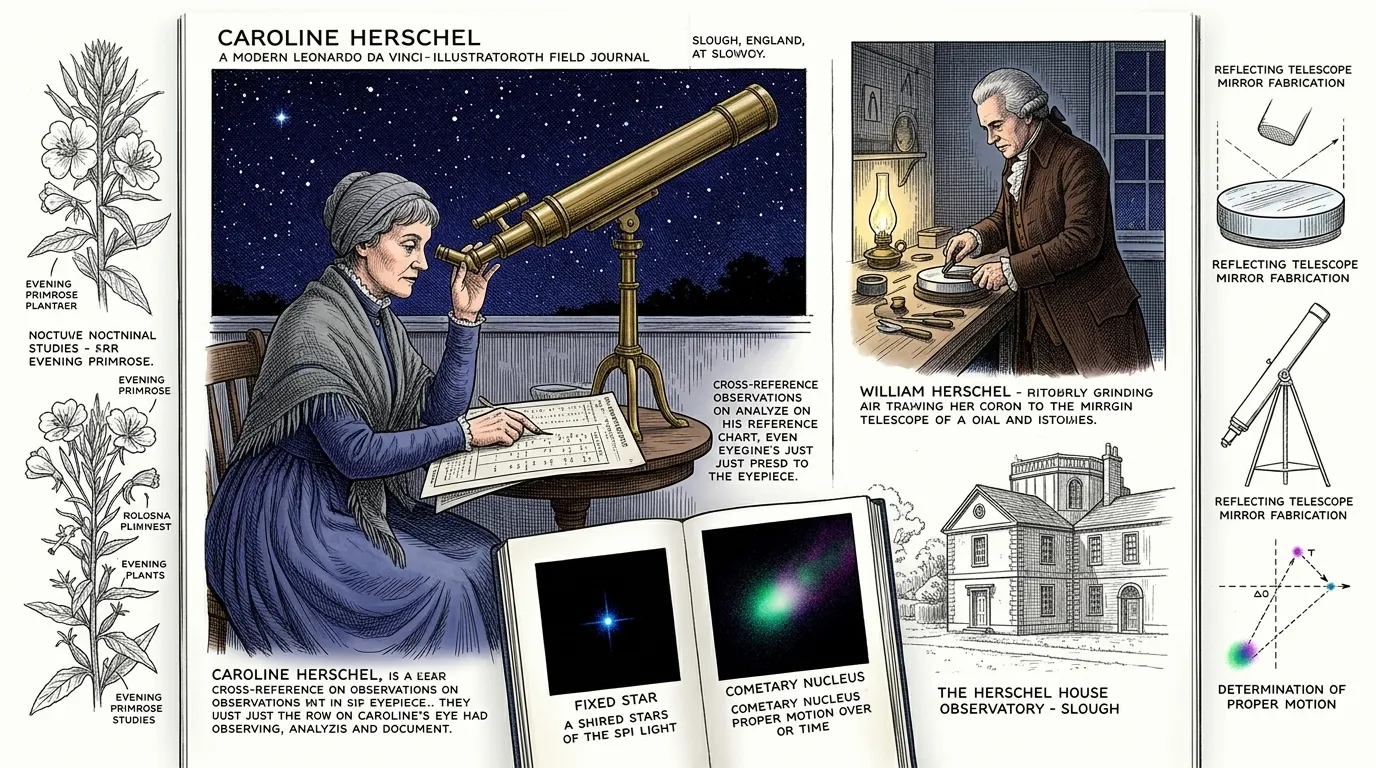
The primary challenge in comet hunting was distinguishing a faint, fuzzy comet from the myriad of fixed stars or distant nebulae. Caroline learned to recognize the subtle characteristics: a cometary nucleus, unlike a star, would appear as a diffuse, sometimes elongated smudge rather than a sharp point of light. More crucially, over time, a comet would exhibit proper motion against the static background of stars. Her keen observational eye and systematic catalog cross-referencing were critical in making these initial, crucial identifications.
Page 6
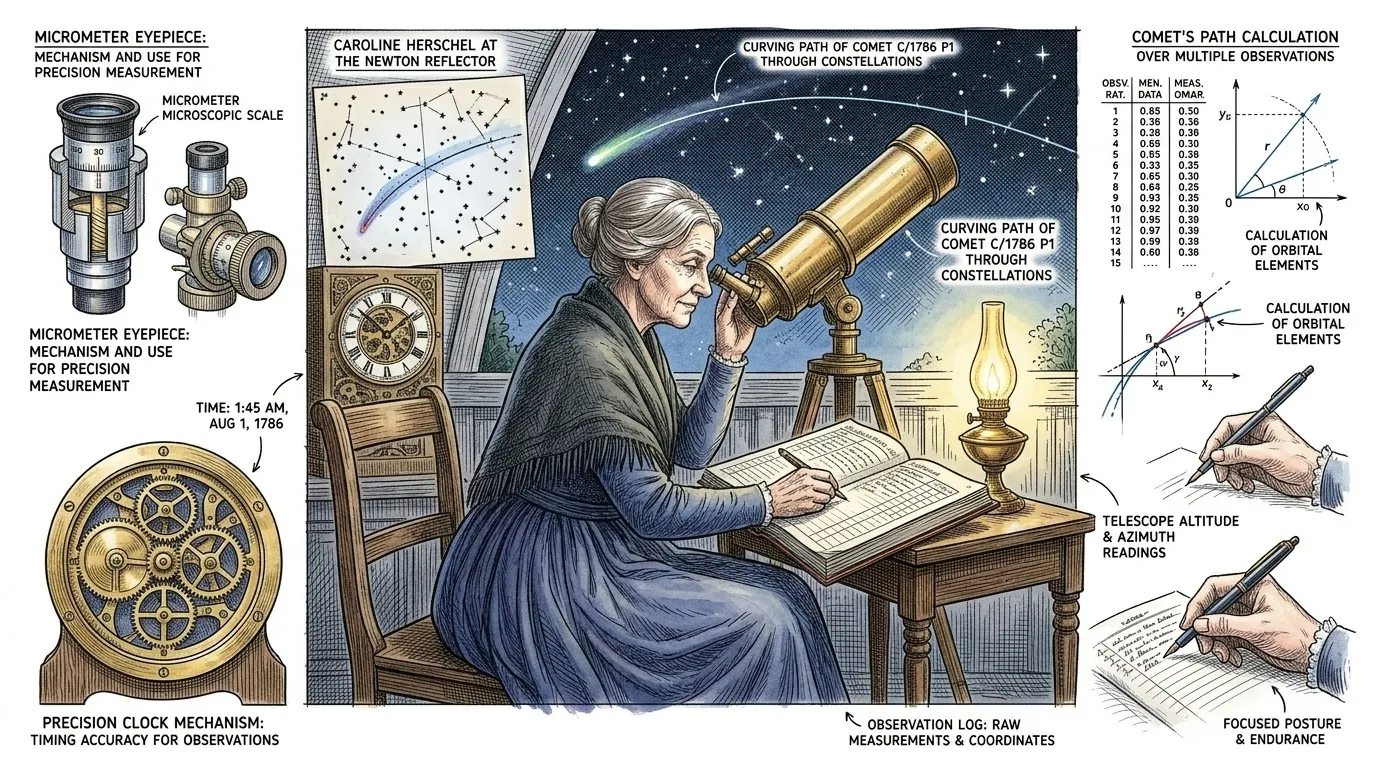
Once a potential comet was identified, the real work began. Caroline would meticulously record its exact position using a micrometer eyepiece, taking multiple readings. These raw measurements, combined with precise timekeeping, allowed her to calculate its celestial coordinates. She would then re-observe the object over subsequent nights, charting its movement to confirm its cometary nature and begin plotting its orbital path. Her rigorous data logging was paramount, often performed in freezing conditions, demonstrating remarkable endurance and precision.
Page 7
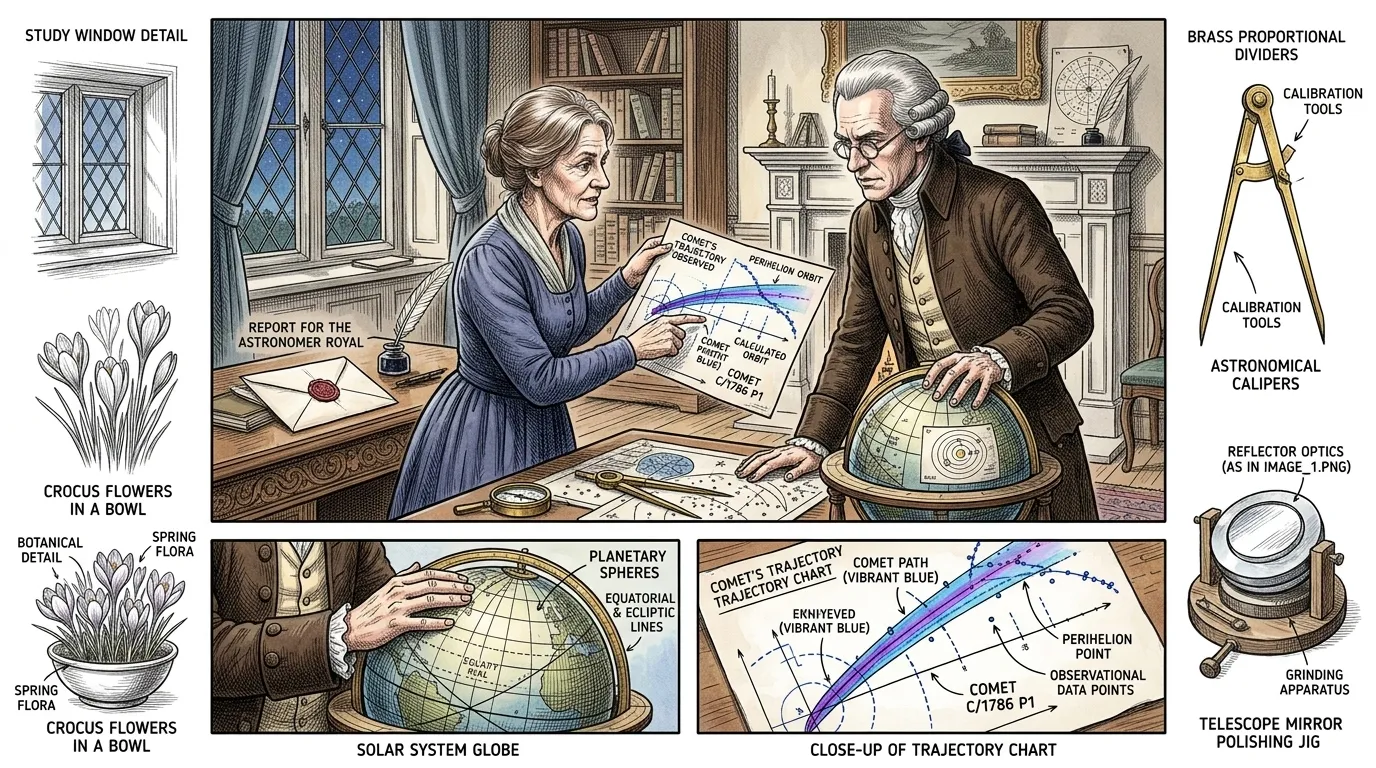
Confirming a comet's trajectory required patience and repeated observations. Once satisfied with the data, Caroline would communicate her findings to William, who, in turn, would verify them and, if confirmed, report to the Astronomer Royal. This collaboration was essential for validating new discoveries and integrating them into the broader scientific understanding of the solar system. Her contributions were not just in observing, but in systematically contributing verifiable, published data to the nascent field of stellar cartography.
Page 8
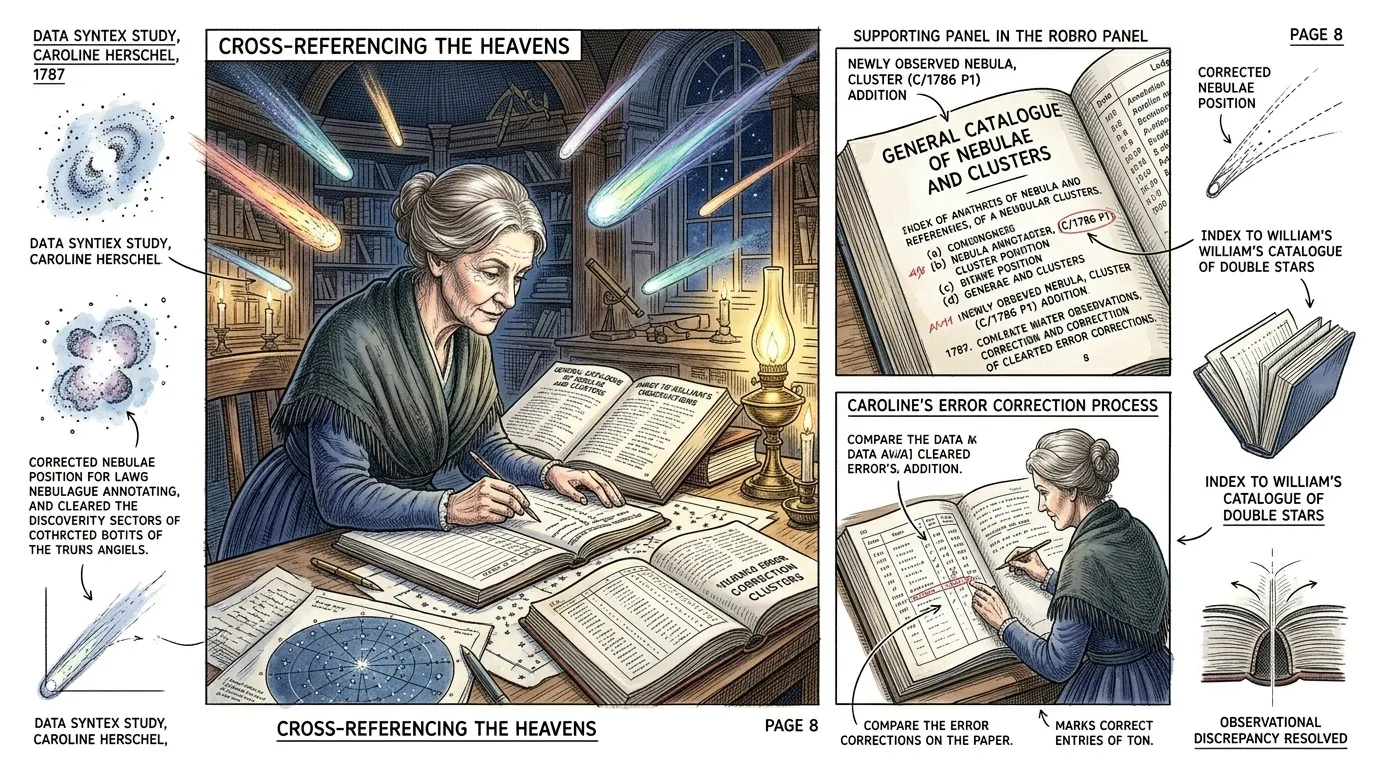
Caroline Herschel's career blossomed beyond her brother's shadow. She would go on to discover eight comets, challenging the notion that such celestial detective work was solely a male domain. Beyond these individual discoveries, her most enduring contribution might be her systematic work on the 'General Catalogue of Nebulae and Clusters' and an essential index to William's observations. Her meticulous cross-referencing and error corrections greatly improved the accuracy of existing star catalogs, providing invaluable resources for generations of astronomers. Her work established a new standard for astronomical documentation.
Page 9
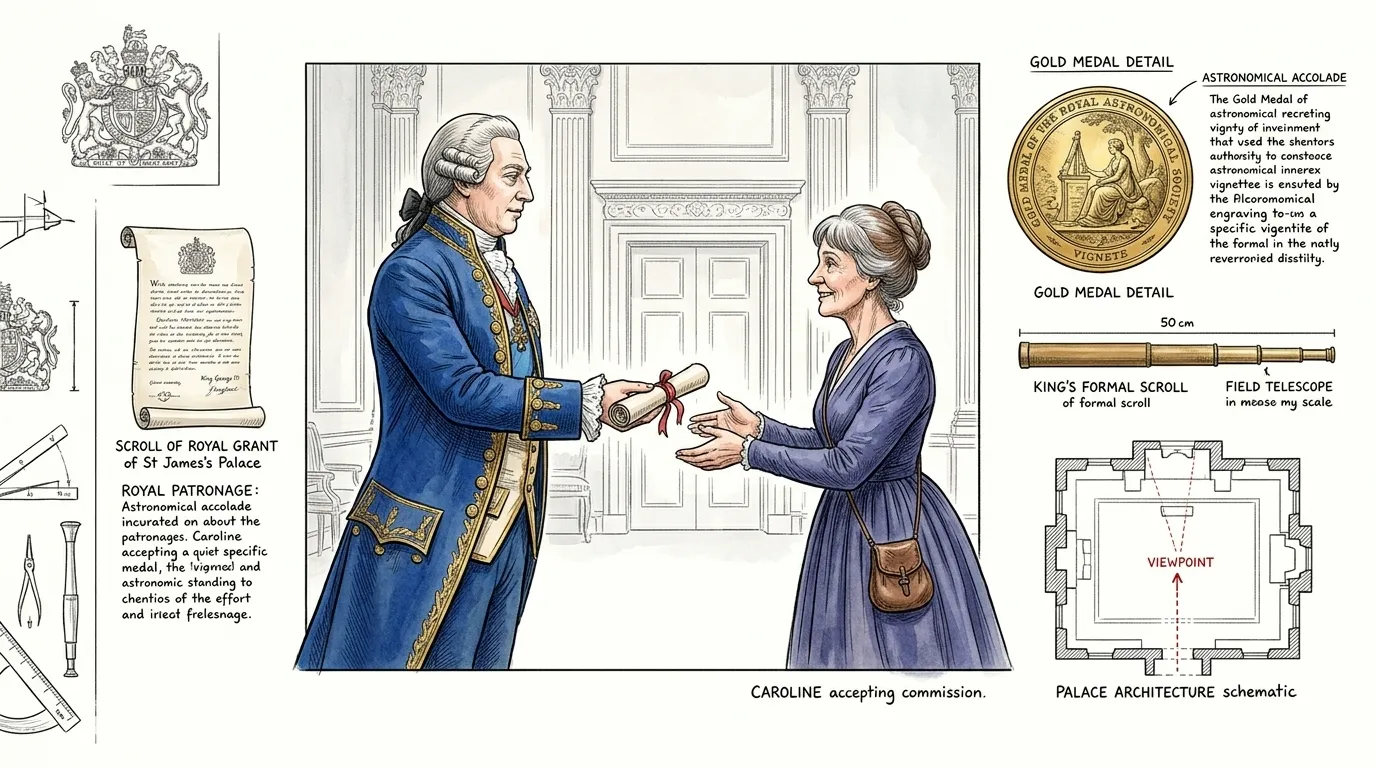
Caroline Herschel's independent scientific achievements were groundbreaking, earning her unprecedented recognition. In 1787, King George III awarded her a salary for her work as William's assistant, making her the first woman in England to be officially paid for scientific work. Years later, at the age of 78, she was awarded the Gold Medal of the Royal Astronomical Society, and made an honorary member—the first woman to receive such accolades. Her accomplishments inspired countless women to pursue scientific careers, proving that intellect and perseverance knew no gender bounds, despite the deeply ingrained societal limitations.
Page 10
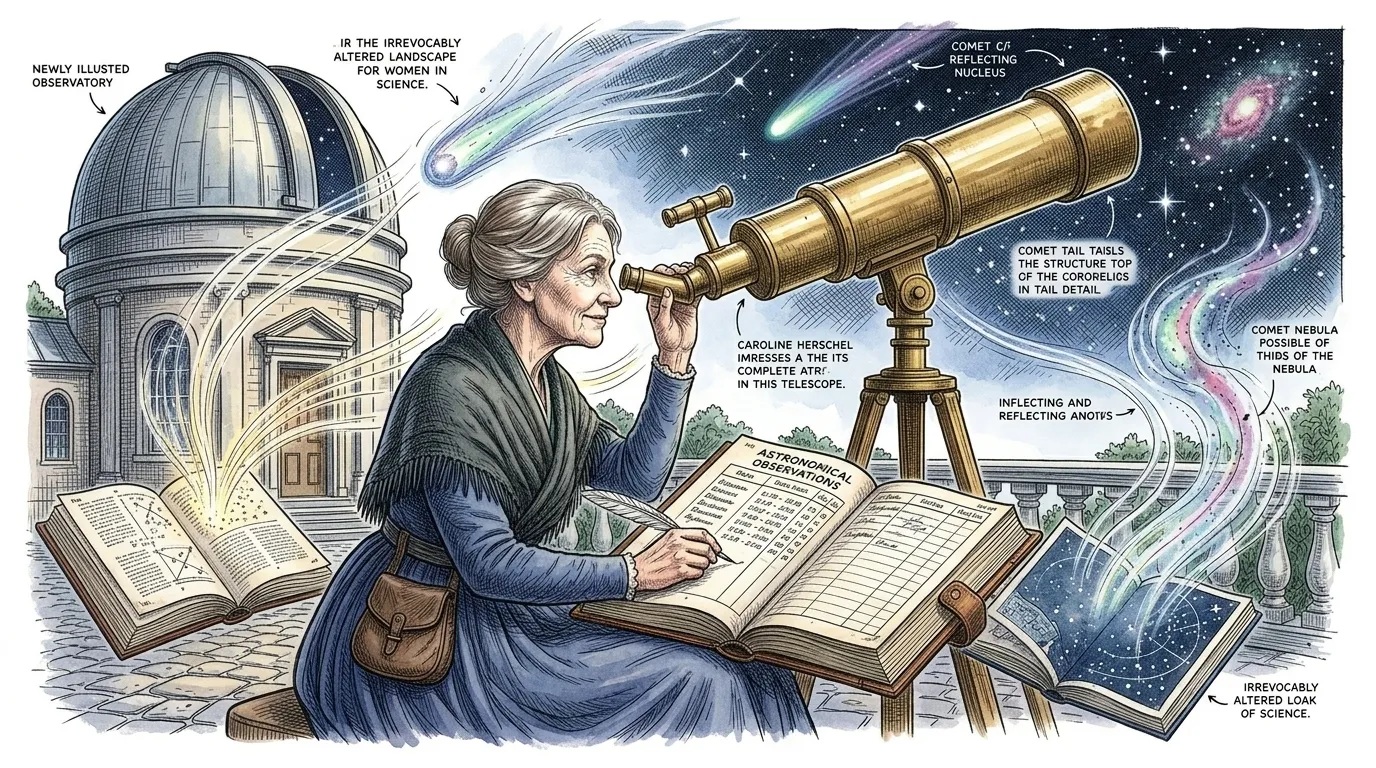
Caroline Herschel died in 1848 at the age of 97, leaving behind a legacy that transcended her individual discoveries. She demonstrated the immense value of meticulous, systematic observation and the critical role of data processing in scientific advancement. Her quiet revolution, driven by an insatiable curiosity and unwavering dedication, not only expanded humanity's understanding of the cosmos but also irrevocably altered the landscape for women in science. Her name remains synonymous with pioneering astronomical endeavor and the enduring power of human intellect to pierce the veil of the unknown.
About this story
- Location: Global
- Audience: general readers
Questions and answers
Read Wonder Science on your phone
Wonder Science is available on Android. Get Wonder Science on Google Play.