Charles Darwin

Charles Darwin — an illustrated science story, set in Global. 10 illustrated pages, free to read on Wonder Science.
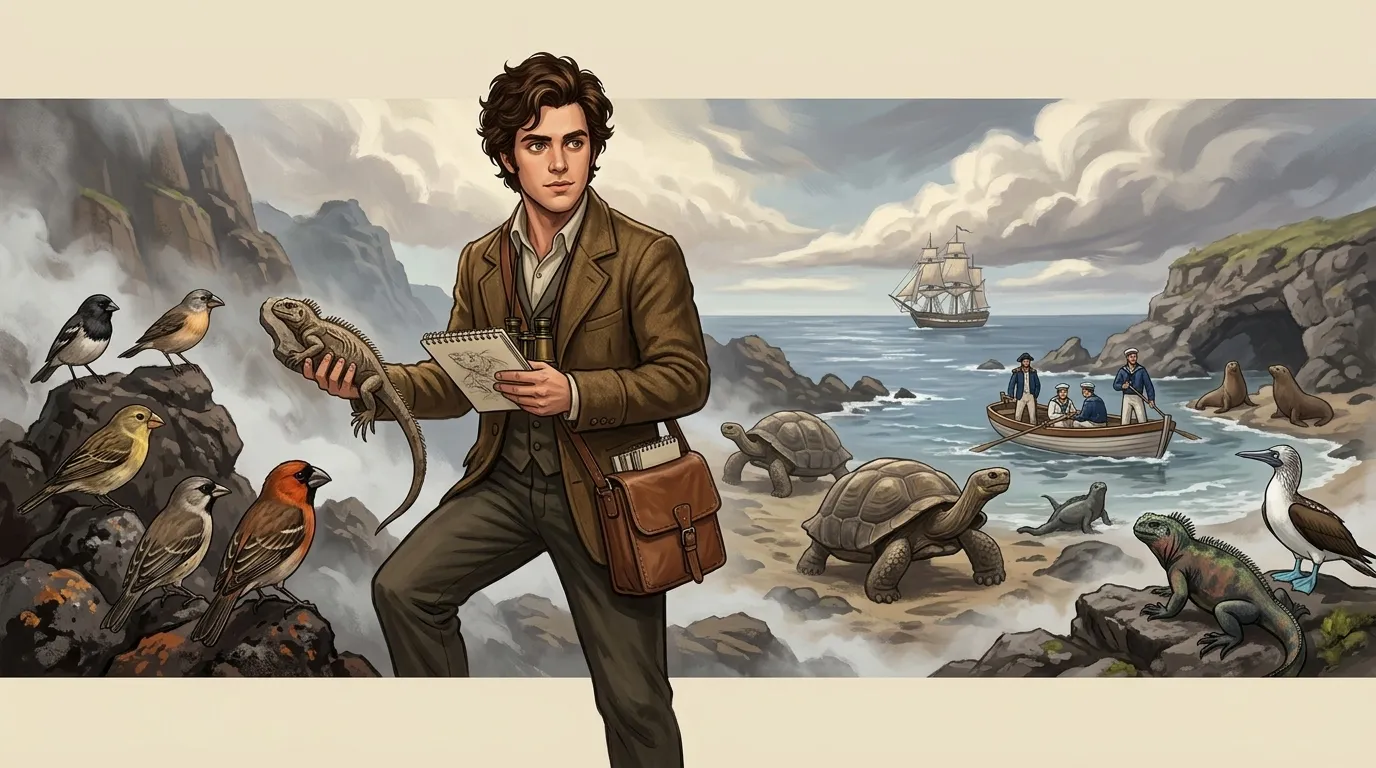
Charles Darwin — book cover — Wonder Science
Charles Darwin — an illustrated science story, set in Global. 10 illustrated pages, free to read on Wonder Science.

Page 1
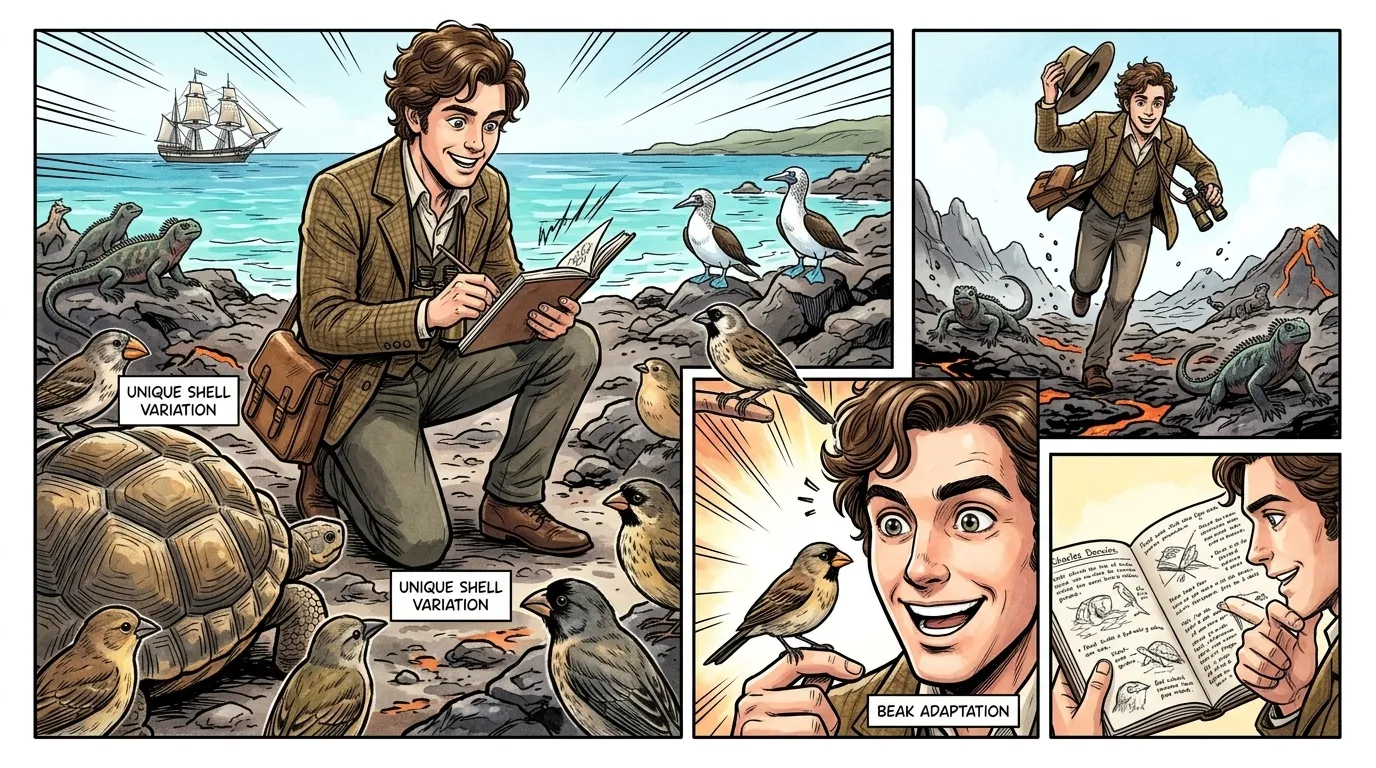
A remote archipelago, forged by volcanic fire, became the crucible for one of science's most revolutionary ideas. In 1835, aboard HMS Beagle, a young naturalist…
A remote archipelago, forged by volcanic fire, became the crucible for one of science's most revolutionary ideas. In 1835, aboard HMS Beagle, a young naturalist named Charles Darwin observed phenomena that defied prevailing wisdom. The Galápagos Islands, a scattering of life far removed from any continent, presented a living laboratory, where species exhibited astonishing variations unique to each island, yet clearly related.

A remote archipelago, forged by volcanic fire, became the crucible for one of science's most revolutionary ideas. In 1835, aboard HMS Beagle, a young naturalist named Charles Darwin observed phenomena that defied prevailing wisdom. The Galápagos Islands, a scattering of life far removed from any continent, presented a living laboratory, where species exhibited astonishing variations unique to each island, yet clearly related.

Page 2
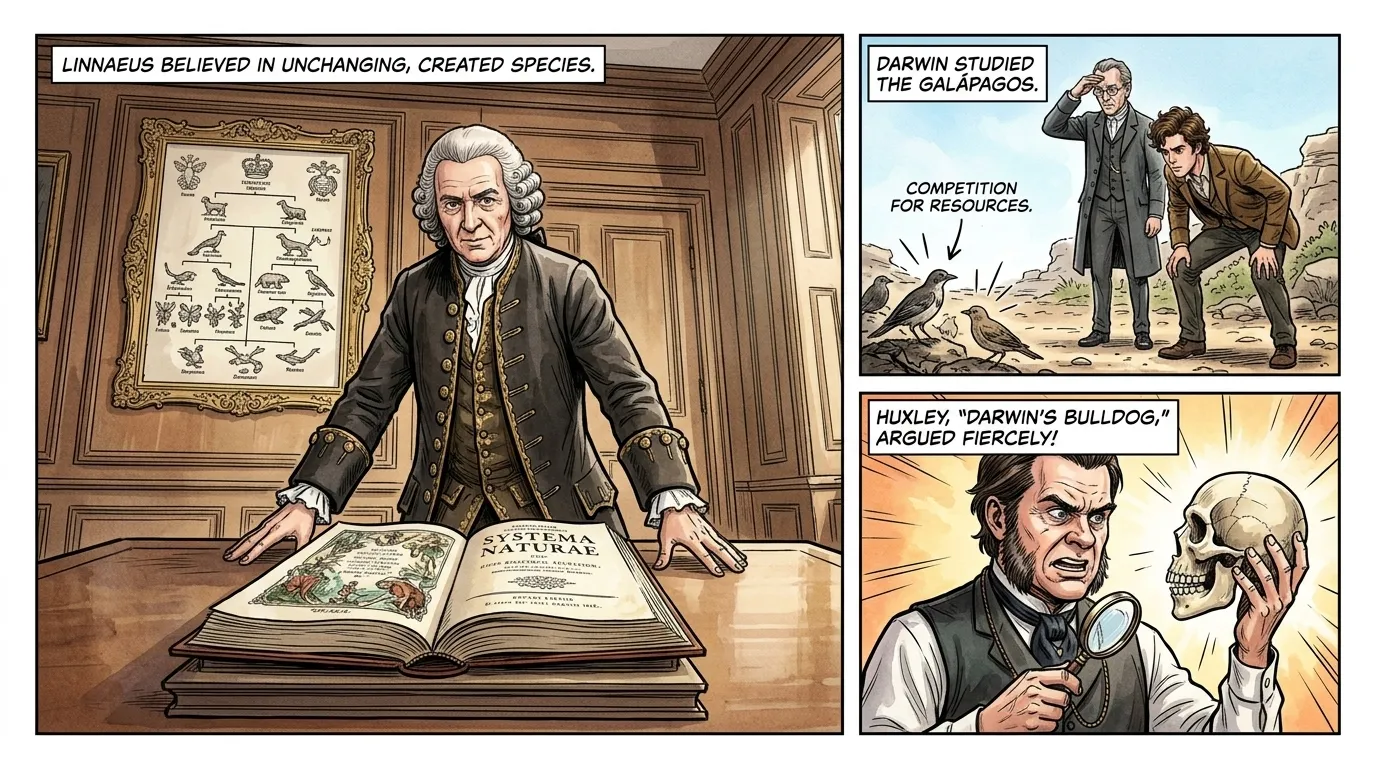
For centuries, the dominant scientific and theological paradigm posited a world of fixed species, created immutable and unchanging.
For centuries, the dominant scientific and theological paradigm posited a world of fixed species, created immutable and unchanging. Caroli Linnaei's meticulous classification system, published in 1735, elegantly organized the diversity of life, yet reinforced the belief in static forms. This fixed view left no room for the radical idea that life itself could transform, adapting over vast spans of time to new environments.

For centuries, the dominant scientific and theological paradigm posited a world of fixed species, created immutable and unchanging. Caroli Linnaei's meticulous classification system, published in 1735, elegantly organized the diversity of life, yet reinforced the belief in static forms. This fixed view left no room for the radical idea that life itself could transform, adapting over vast spans of time to new environments.

Page 3
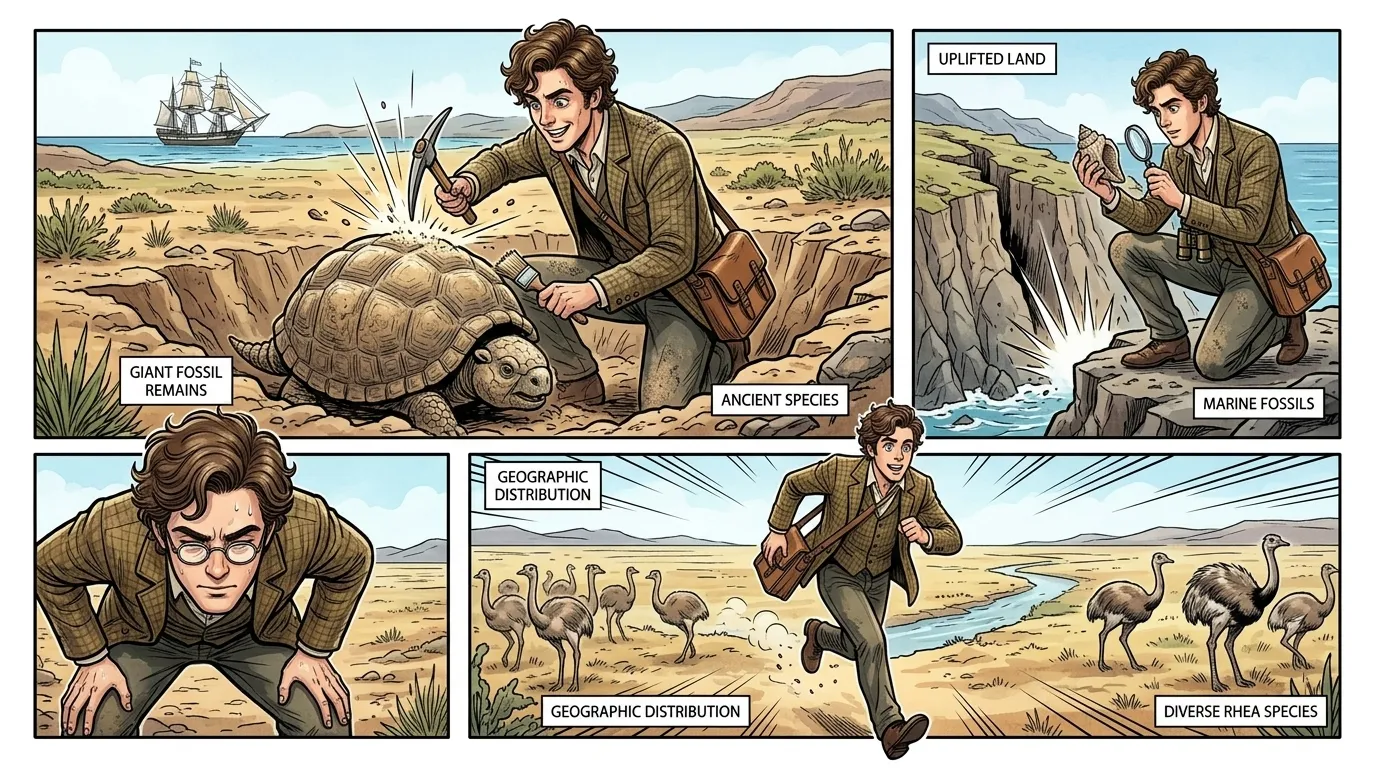
Darwin's five-year voyage on the Beagle exposed him to a dizzying array of life and geological formations across South America and beyond.
Darwin's five-year voyage on the Beagle exposed him to a dizzying array of life and geological formations across South America and beyond. He unearthed gigantic fossilized sloths in Argentina, observed earthquake-induced land uplift in Chile, and noted the curious geographic distribution of rheas. Each observation, meticulously recorded in his notebooks, chipped away at the notion of a static Earth and its inhabitants, revealing a dynamic planet with a deep, evolving history.

Darwin's five-year voyage on the Beagle exposed him to a dizzying array of life and geological formations across South America and beyond. He unearthed gigantic fossilized sloths in Argentina, observed earthquake-induced land uplift in Chile, and noted the curious geographic distribution of rheas. Each observation, meticulously recorded in his notebooks, chipped away at the notion of a static Earth and its inhabitants, revealing a dynamic planet with a deep, evolving history.

Page 4
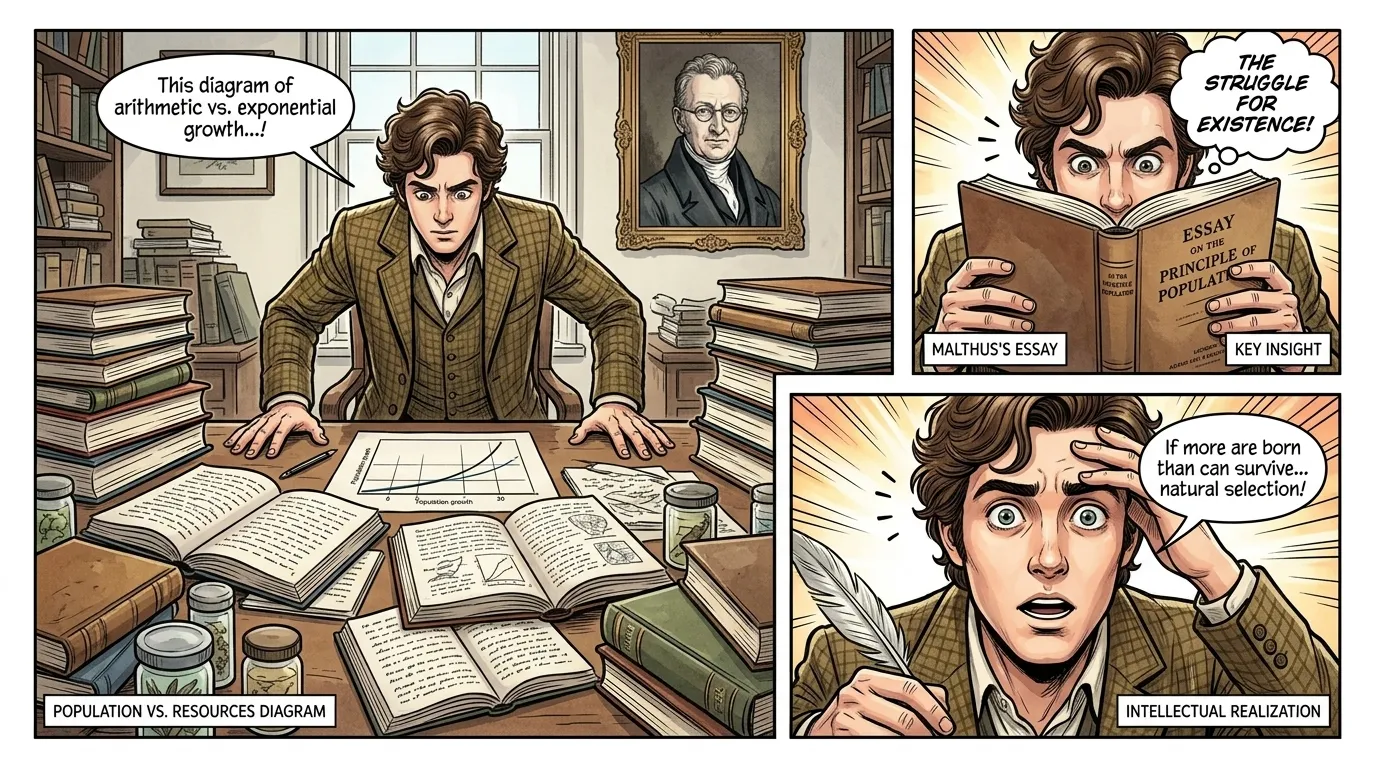
Years after his voyage, poring over his vast collection of notes, Darwin found the crucial piece of his evolutionary puzzle.
Years after his voyage, poring over his vast collection of notes, Darwin found the crucial piece of his evolutionary puzzle. Reading Thomas Malthus's 'An Essay on the Principle of Population' (1798), which argued that populations grow exponentially while resources grow arithmetically, sparked the profound realization.

Years after his voyage, poring over his vast collection of notes, Darwin found the crucial piece of his evolutionary puzzle. Reading Thomas Malthus's 'An Essay on the Principle of Population' (1798), which argued that populations grow exponentially while resources grow arithmetically, sparked the profound realization. This inescapable 'struggle for existence' meant only a fraction of individuals could survive and reproduce, linking competition directly to the continuation of traits.

Page 5
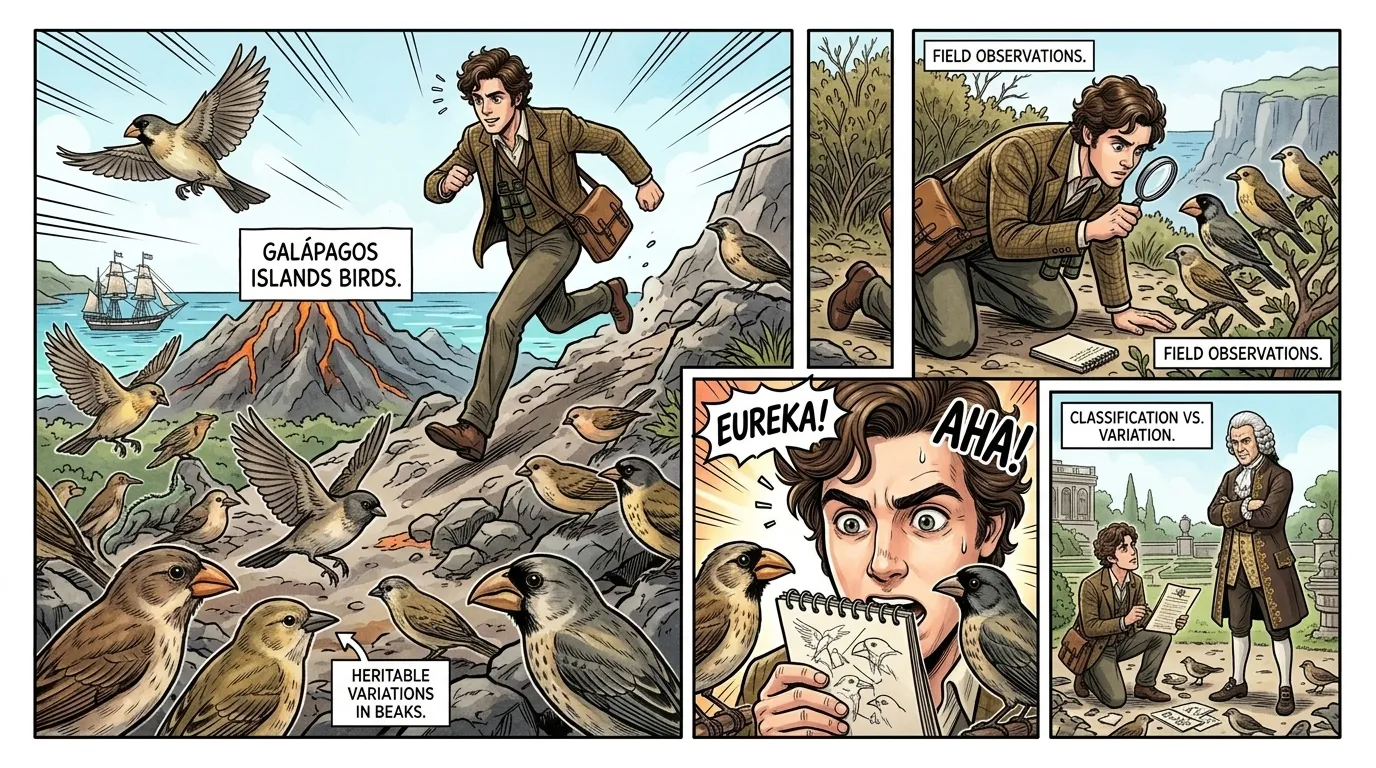
Darwin's central mechanism, natural selection, hinged on two fundamental observations: first, that within any population, individuals exhibit heritable…
Darwin's central mechanism, natural selection, hinged on two fundamental observations: first, that within any population, individuals exhibit heritable variations. No two organisms are exactly alike, even siblings. These differences, whether in beak size, fur color, or disease resistance, are passed down from one generation to the next. This constant, subtle reshuffling of traits provides the raw material upon which evolution can act.

Darwin's central mechanism, natural selection, hinged on two fundamental observations: first, that within any population, individuals exhibit heritable variations. No two organisms are exactly alike, even siblings. These differences, whether in beak size, fur color, or disease resistance, are passed down from one generation to the next. This constant, subtle reshuffling of traits provides the raw material upon which evolution can act.

Page 6
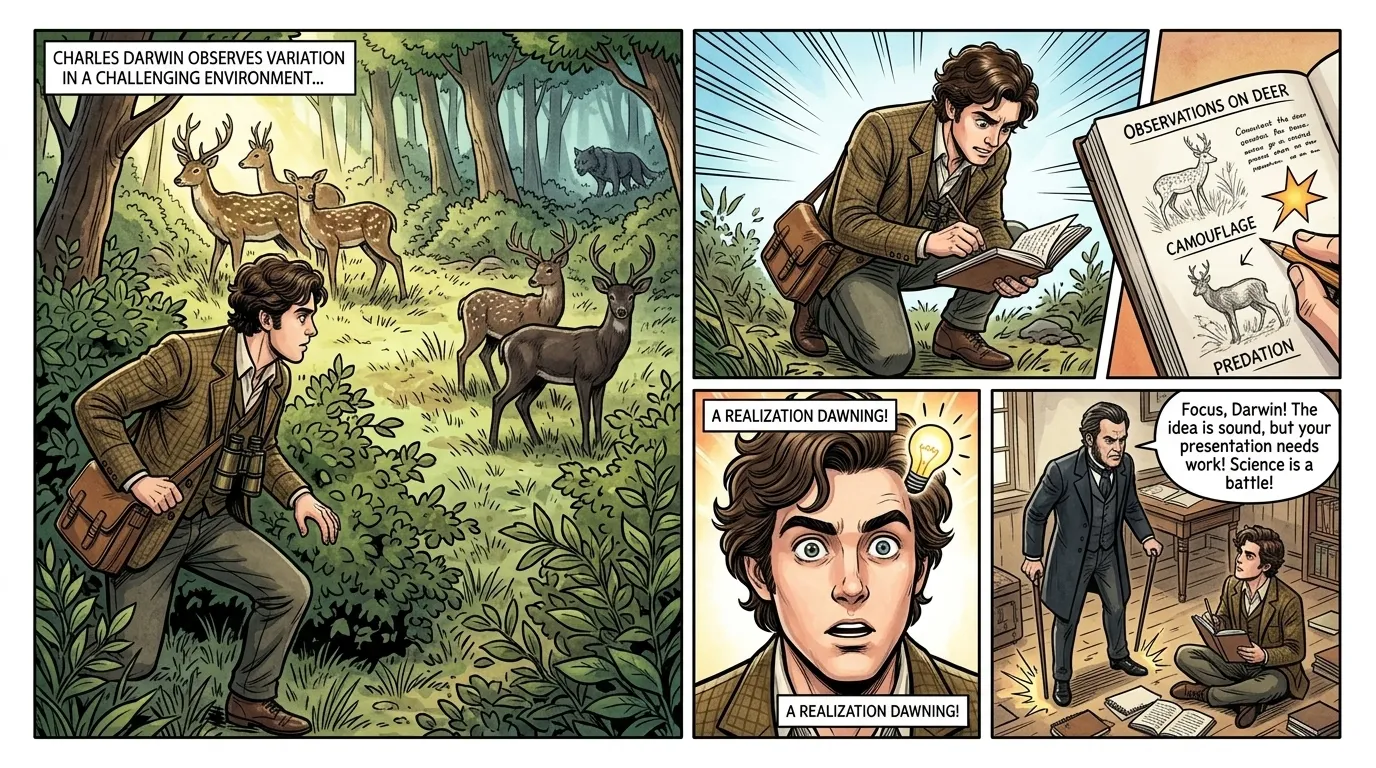
The second crucial aspect of natural selection is differential survival and reproduction. Environmental pressures—scarcity of food, predation, disease, or…
The second crucial aspect of natural selection is differential survival and reproduction. Environmental pressures—scarcity of food, predation, disease, or climate changes—act as selective filters. Individuals possessing advantageous heritable variations are more likely to survive, out-compete rivals, and, critically, reproduce. Over countless generations, these favorable traits accumulate, gradually transforming populations to better suit their changing surroundings.

The second crucial aspect of natural selection is differential survival and reproduction. Environmental pressures—scarcity of food, predation, disease, or climate changes—act as selective filters. Individuals possessing advantageous heritable variations are more likely to survive, out-compete rivals, and, critically, reproduce. Over countless generations, these favorable traits accumulate, gradually transforming populations to better suit their changing surroundings.

Page 7
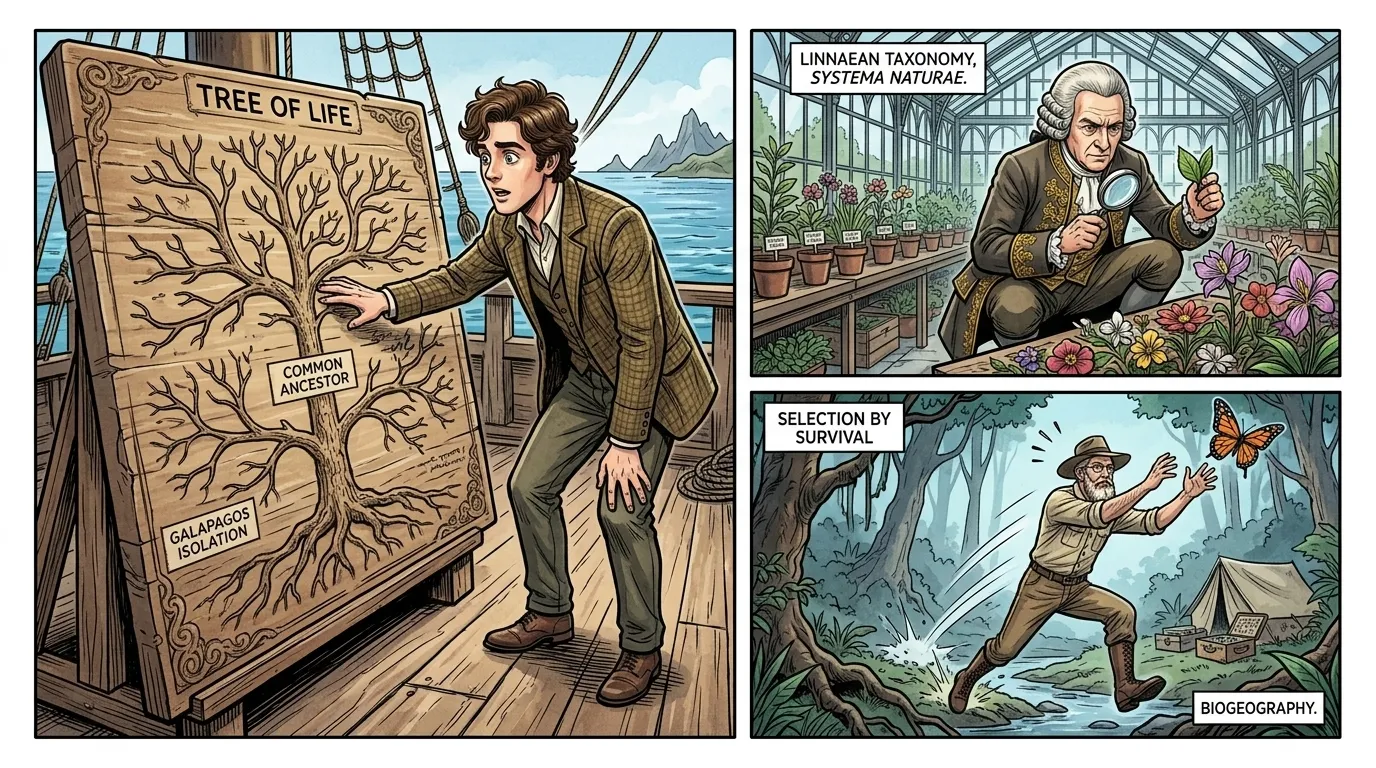
As populations expand into new ecological niches or become geographically isolated, natural selection can drive divergence.
As populations expand into new ecological niches or become geographically isolated, natural selection can drive divergence. Over immense geological timescales, the accumulation of distinct advantageous traits can lead to groups becoming so genetically different that they can no longer interbreed. This process, known as speciation, explains the vast 'tree of life,' where all living organisms share common ancestry but have diversified into millions of unique forms.

As populations expand into new ecological niches or become geographically isolated, natural selection can drive divergence. Over immense geological timescales, the accumulation of distinct advantageous traits can lead to groups becoming so genetically different that they can no longer interbreed. This process, known as speciation, explains the vast 'tree of life,' where all living organisms share common ancestry but have diversified into millions of unique forms.

Page 8
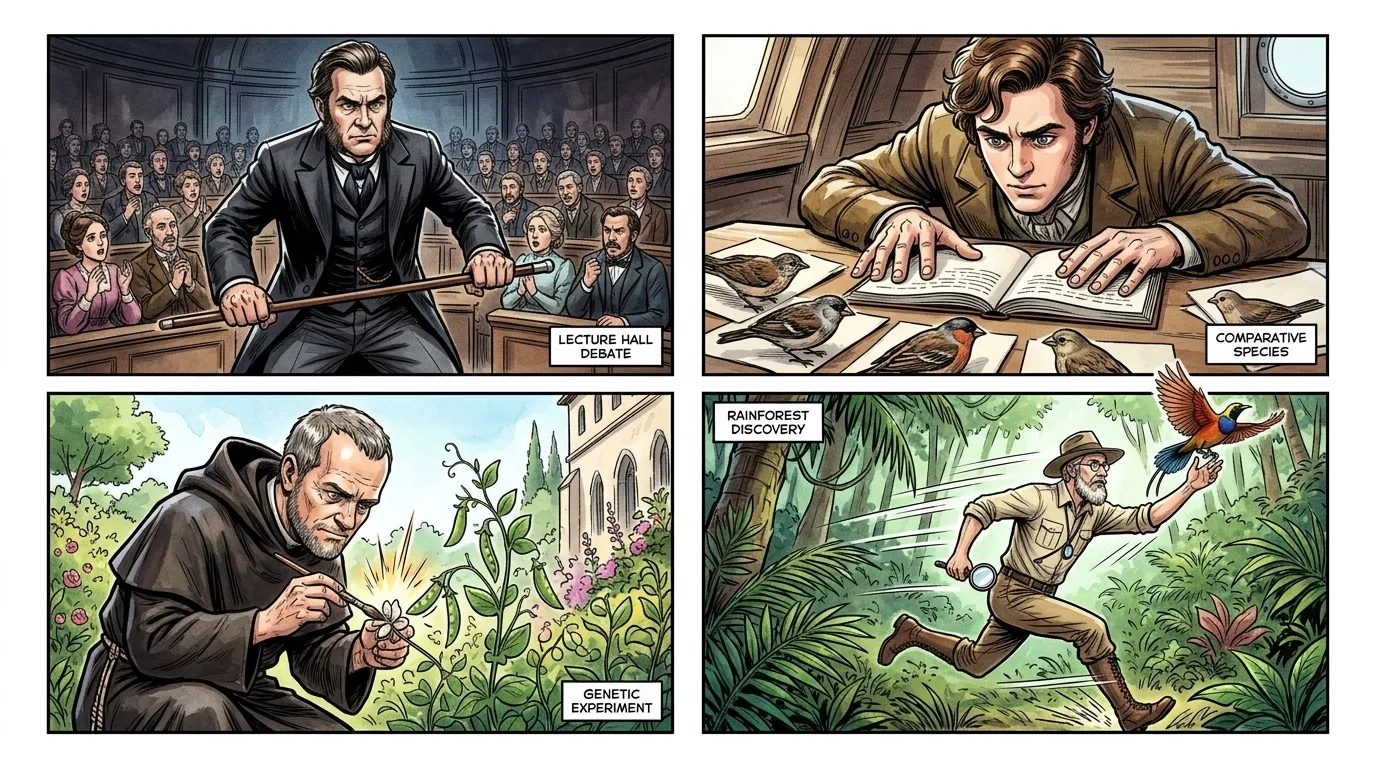
In 1859, after decades of meticulous research and driven by Alfred Russel Wallace's independent articulation of a similar theory, Charles Darwin published 'On…
In 1859, after decades of meticulous research and driven by Alfred Russel Wallace's independent articulation of a similar theory, Charles Darwin published 'On the Origin of Species by Means of Natural Selection.' The book sent shockwaves through Victorian society, challenging deeply held beliefs about humanity's place in the world and the literal interpretation of creation.

In 1859, after decades of meticulous research and driven by Alfred Russel Wallace's independent articulation of a similar theory, Charles Darwin published 'On the Origin of Species by Means of Natural Selection.' The book sent shockwaves through Victorian society, challenging deeply held beliefs about humanity's place in the world and the literal interpretation of creation. It presented a compelling, evidence-based argument for descent with modification, fundamentally reshaping biological thought.

Page 9
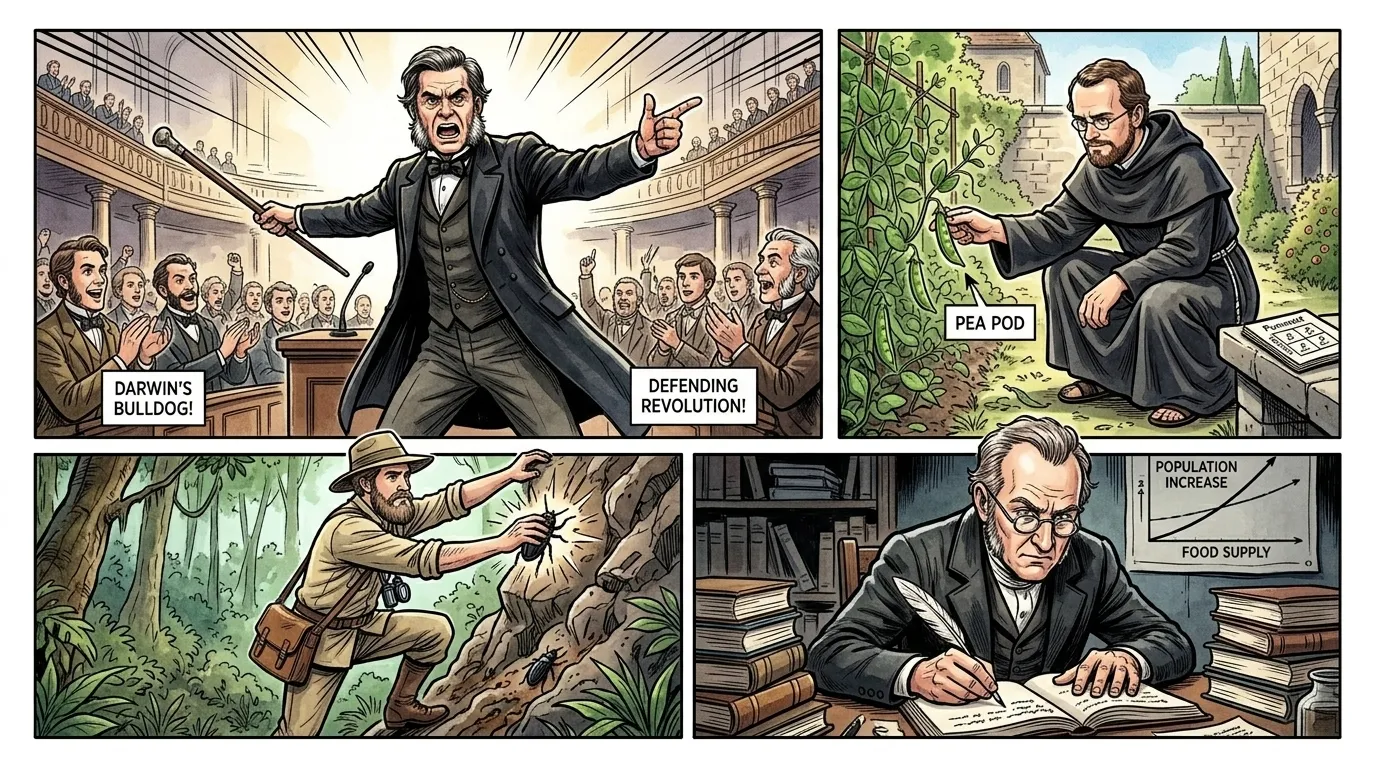
Darwin's theory, initially met with fierce debate, found increasing scientific validation over time. Supporters like Thomas Henry Huxley championed 'Darwin's…
Darwin's theory, initially met with fierce debate, found increasing scientific validation over time. Supporters like Thomas Henry Huxley championed 'Darwin's Bulldog,' while independent discoveries, such as Gregor Mendel's work on heredity in the 1860s, provided the underlying mechanism for how traits were passed down.

Darwin's theory, initially met with fierce debate, found increasing scientific validation over time. Supporters like Thomas Henry Huxley championed 'Darwin's Bulldog,' while independent discoveries, such as Gregor Mendel's work on heredity in the 1860s, provided the underlying mechanism for how traits were passed down. Though unaware of Mendel's findings, Darwin's work profoundly influenced subsequent biological inquiry, laying the groundwork for a unified understanding of life's vast diversity and interconnectedness.

Page 10
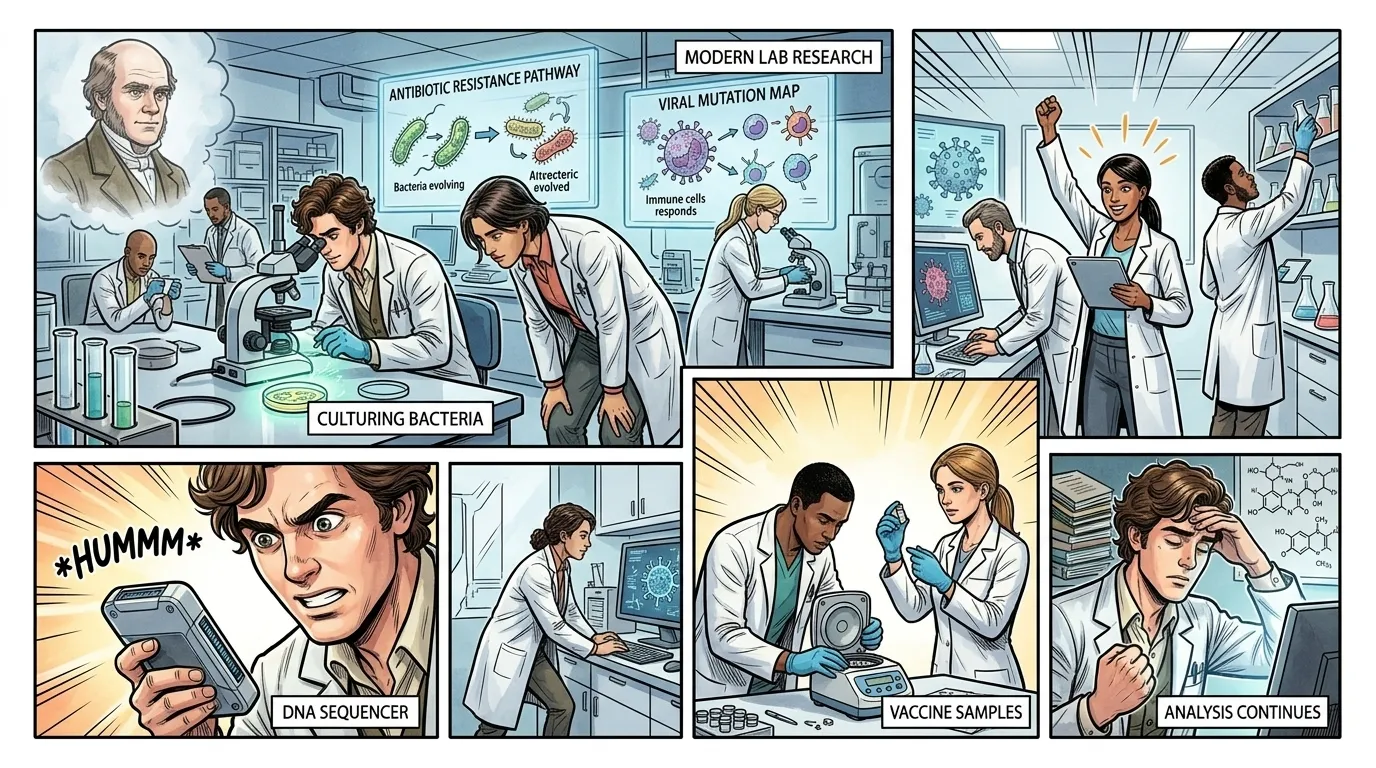
More than a century and a half later, Darwin's theory of evolution by natural selection remains the foundational cornerstone of modern biology.
More than a century and a half later, Darwin's theory of evolution by natural selection remains the foundational cornerstone of modern biology. From genetics and medicine to public health and ecology, evolutionary principles illuminate every aspect of the living world. It explains antibiotic resistance, vaccine development, and even the very origins of human disease.

More than a century and a half later, Darwin's theory of evolution by natural selection remains the foundational cornerstone of modern biology. From genetics and medicine to public health and ecology, evolutionary principles illuminate every aspect of the living world. It explains antibiotic resistance, vaccine development, and even the very origins of human disease. His intellectual courage paved the way for scientists like Alexander Fleming, Louis Pasteur, and Edward Jenner, transforming our understanding and ability to shape life on Earth, continuing to inspire new frontiers in research.

About this story

  • Location: Global
  • Audience: general readers

Questions and answers

Questions and answers about Charles Darwin

Read Wonder Science on your phone

Wonder Science is available on Android. Get Wonder Science on Google Play.

More Wonder Science stories

All Wonder Science stories · Open the library