Edmond Halley
Edmond Halley — an illustrated science story, set in Global. 10 illustrated pages, free to read on Wonder Science.
Page 1
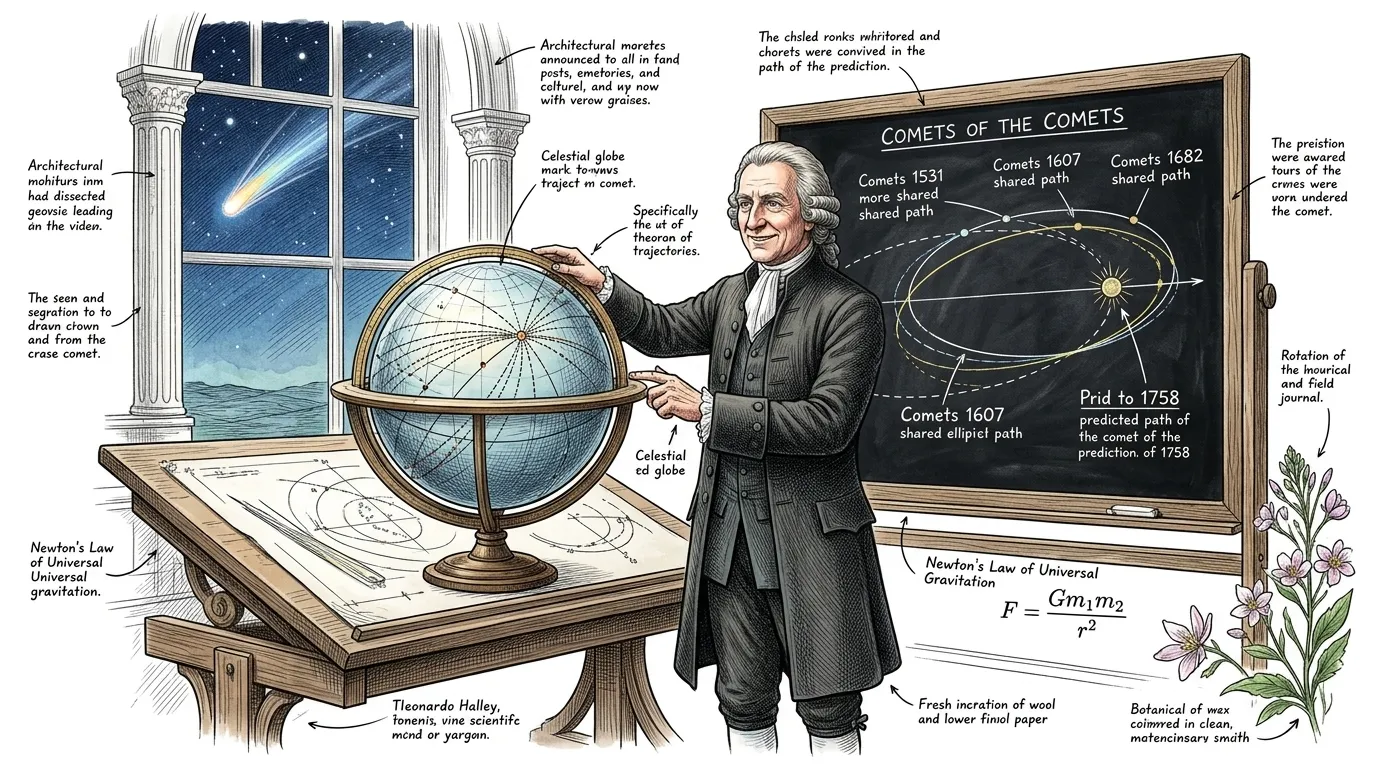
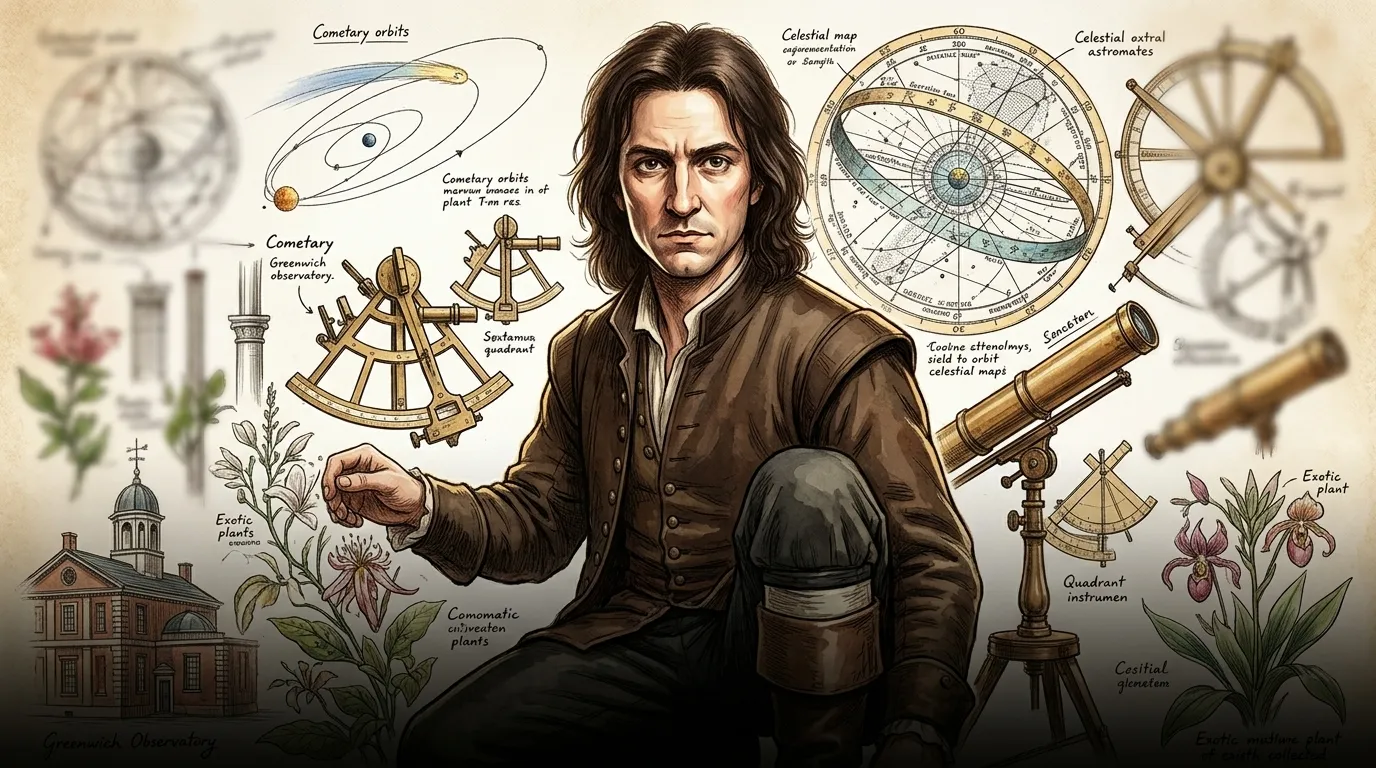
In the year 1705, an unprecedented scientific pronouncement reverberated through the burgeoning intellectual circles of Europe. Against a backdrop of celestial phenomena long interpreted as omens, one man dared to predict the future passage of a celestial wanderer. Edmond Halley, leveraging Isaac Newton's groundbreaking laws of gravitation, meticulously charted the paths of comets observed in 1531, 1607, and 1682. His bold assertion: these were not distinct entities, but the very same comet, destined to reappear in 1758.
Page 2
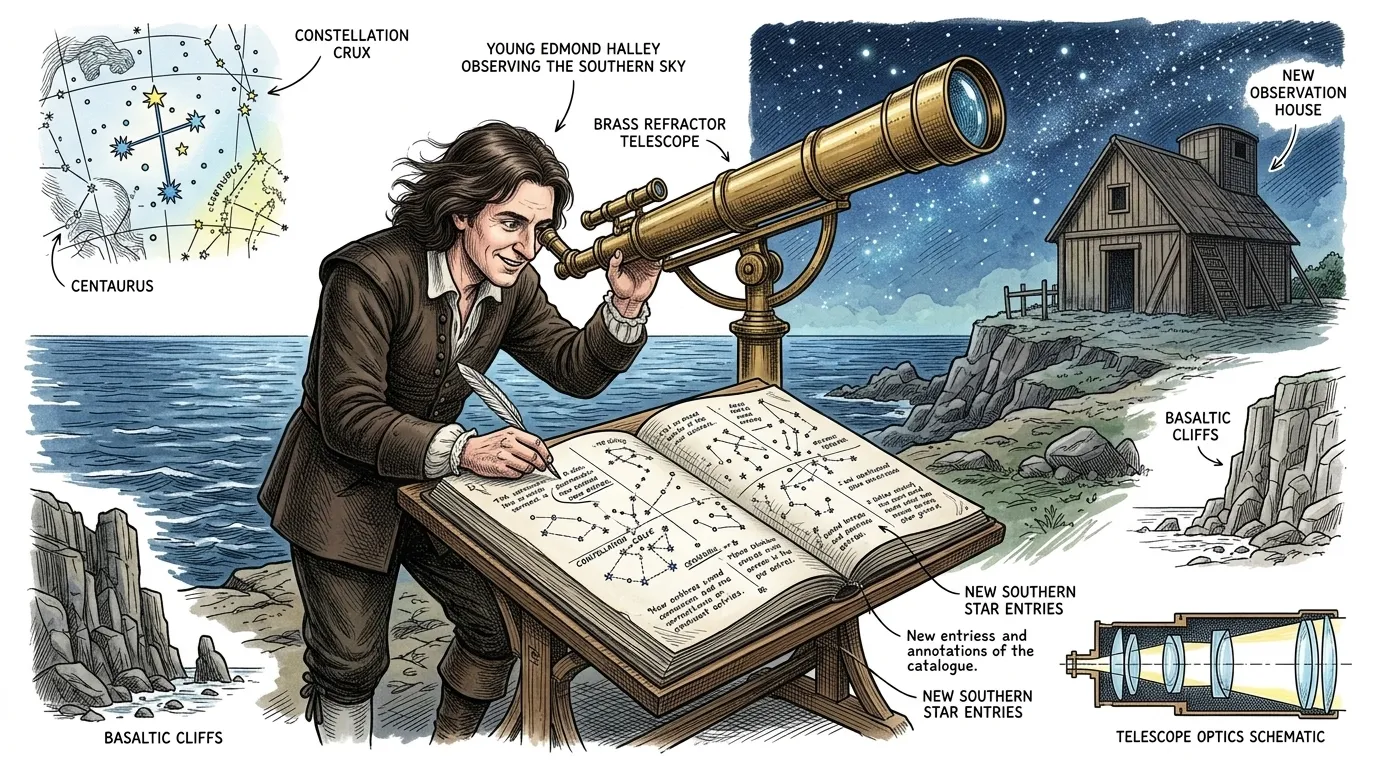
Born in 1656, Edmond Halley's prodigious talent for astronomy manifested early. Driven by an insatiable curiosity that extended beyond the established observations of the northern hemisphere, the young Halley embarked on a daring two-year voyage to the remote island of St. Helena in 1676. There, he established the first observatory to systematically chart the stars of the Southern Celestial Hemisphere, correcting existing catalogues and adding hundreds of new entries. This foundational work provided crucial data for celestial navigation and a more comprehensive understanding of the stellar firmament, laying groundwork for future astronomical challenges.
Page 3
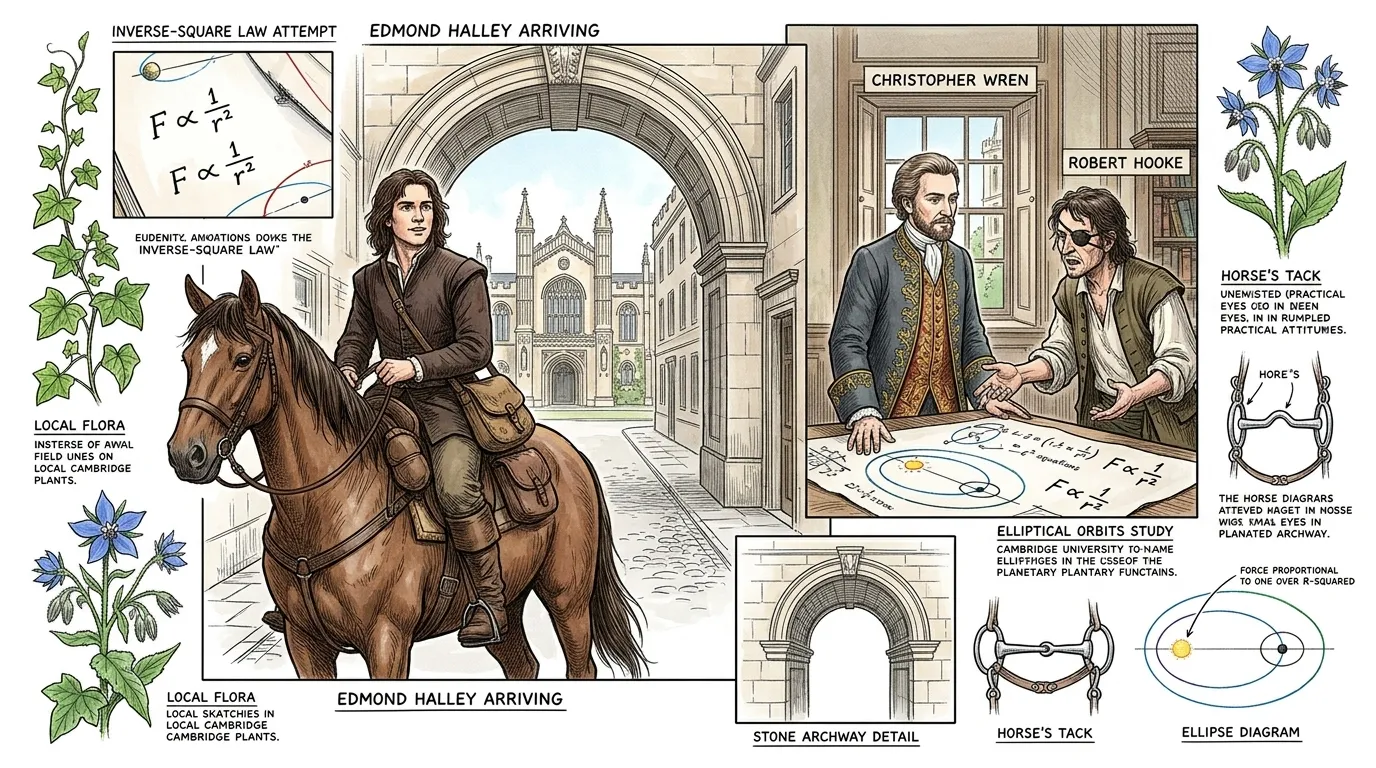
Decades later, a critical problem vexed Europe's greatest scientific minds: understanding the true nature of planetary orbits. While Johannes Kepler had empirically described elliptical paths, the underlying physical mechanism remained elusive. Halley, along with fellow luminaries Christopher Wren and Robert Hooke, grappled with the mathematical proof that celestial bodies orbit under an inverse-square law of gravity. Unable to definitively solve it, Halley journeyed to Cambridge in 1684, seeking the reclusive Isaac Newton. This pivotal visit would change the course of science forever.
Page 4
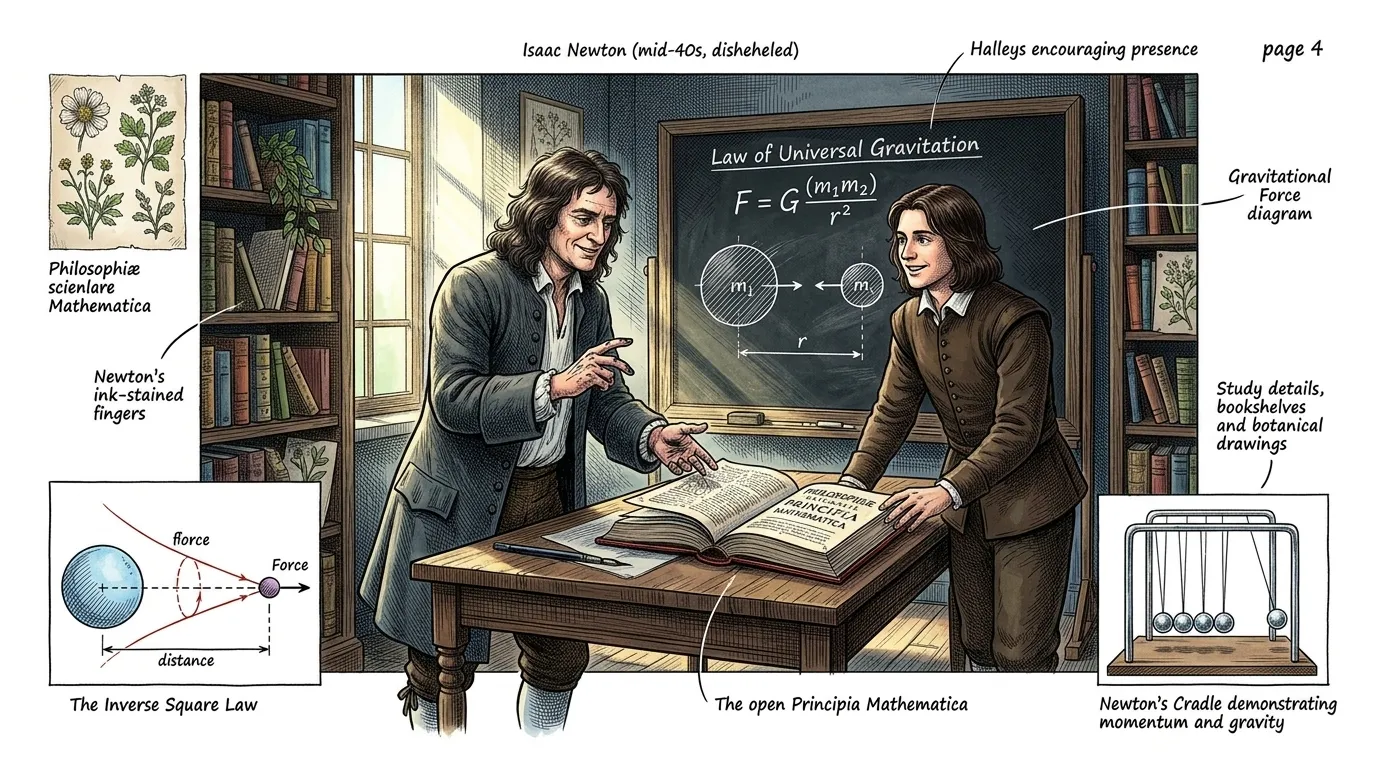
Halley's visit ignited Newton's genius. Newton, having already developed the mathematical framework but hesitant to publish, was finally persuaded by Halley's relentless encouragement and financial backing. The result was Philosophiæ Naturalis Principia Mathematica (Mathematical Principles of Natural Philosophy), published in 1687, with Halley overseeing its production and funding the monumental work. This opus introduced the law of universal gravitation, defining a force proportional to the product of masses and inversely proportional to the square of the distance between them. It was a singular intellectual achievement, unifying terrestrial and celestial mechanics.
Page 5
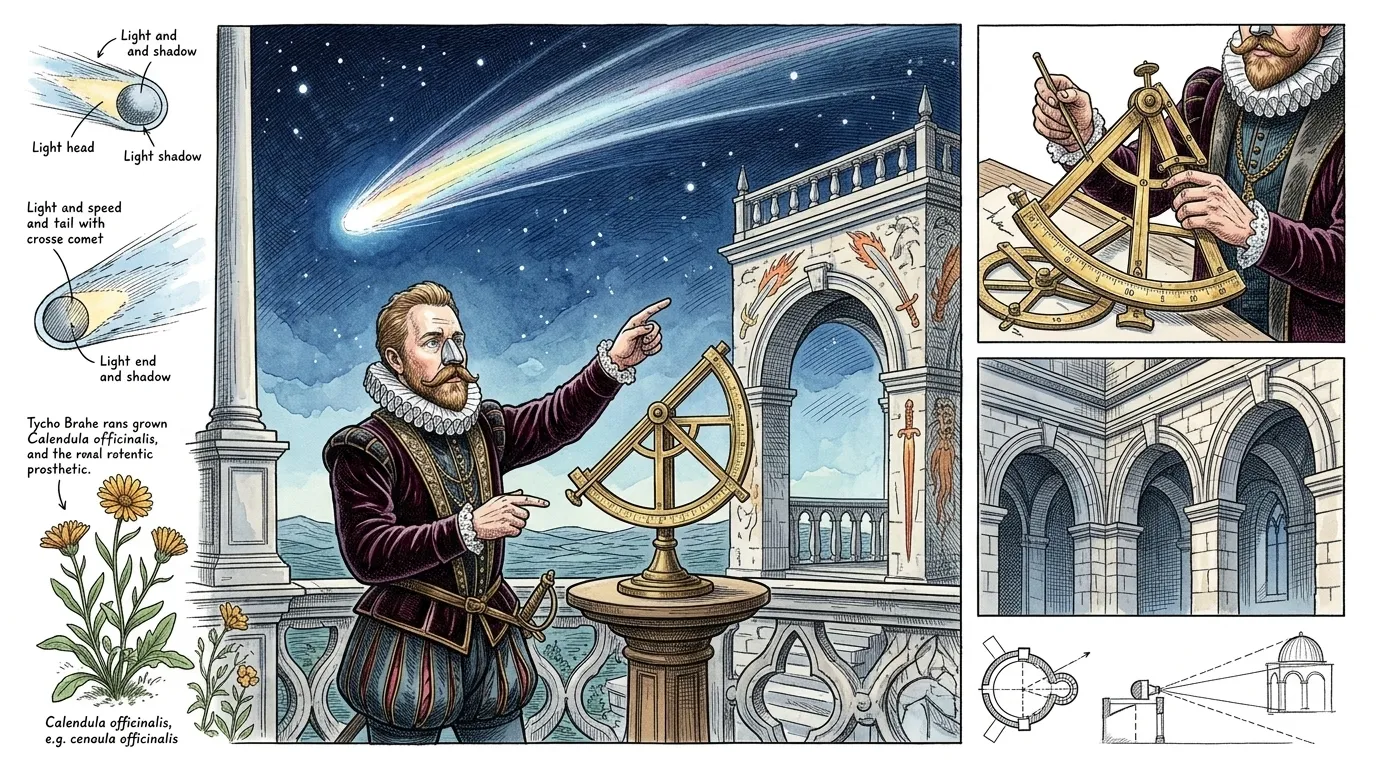
Before Halley's work, comets were largely viewed as unpredictable harbingers of doom, divine wrath, or significant earthly events. Their transient appearances in the night sky defied regular patterns, leading to interpretations steeped in superstition and fear. While astronomers like Tycho Brahe had established their extraterrestrial nature, proving they were not atmospheric phenomena, their true orbital mechanics remained an enigma. They were fleeting visitors, disconnected from the orderly clockwork of planets and stars, symbols of chaos in the otherwise predictable cosmos.
Page 6
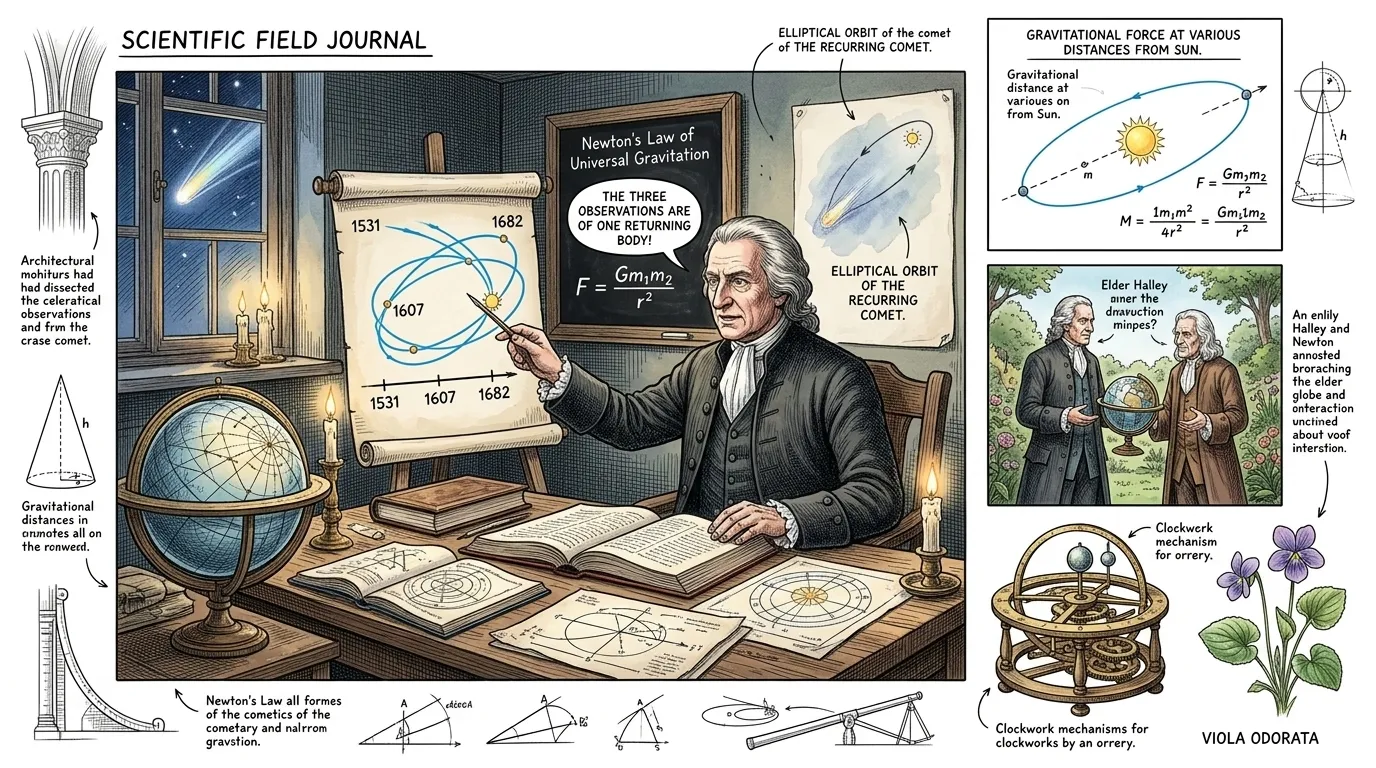
Edmond Halley saw not omens, but patterns. Armed with Newton's universal law, he understood that if comets were indeed celestial bodies, they too must obey gravitational laws and travel in elliptical orbits, albeit highly elongated ones. He delved into historical astronomical records, a painstaking task of sifting through accounts stretching back centuries. His pivotal realization came when he noticed striking similarities between the comets observed in 1531, 1607, and 1682: their orbital elements and paths were almost identical. This was the 'aha!' moment: it was one comet, returning again and again.
Page 7
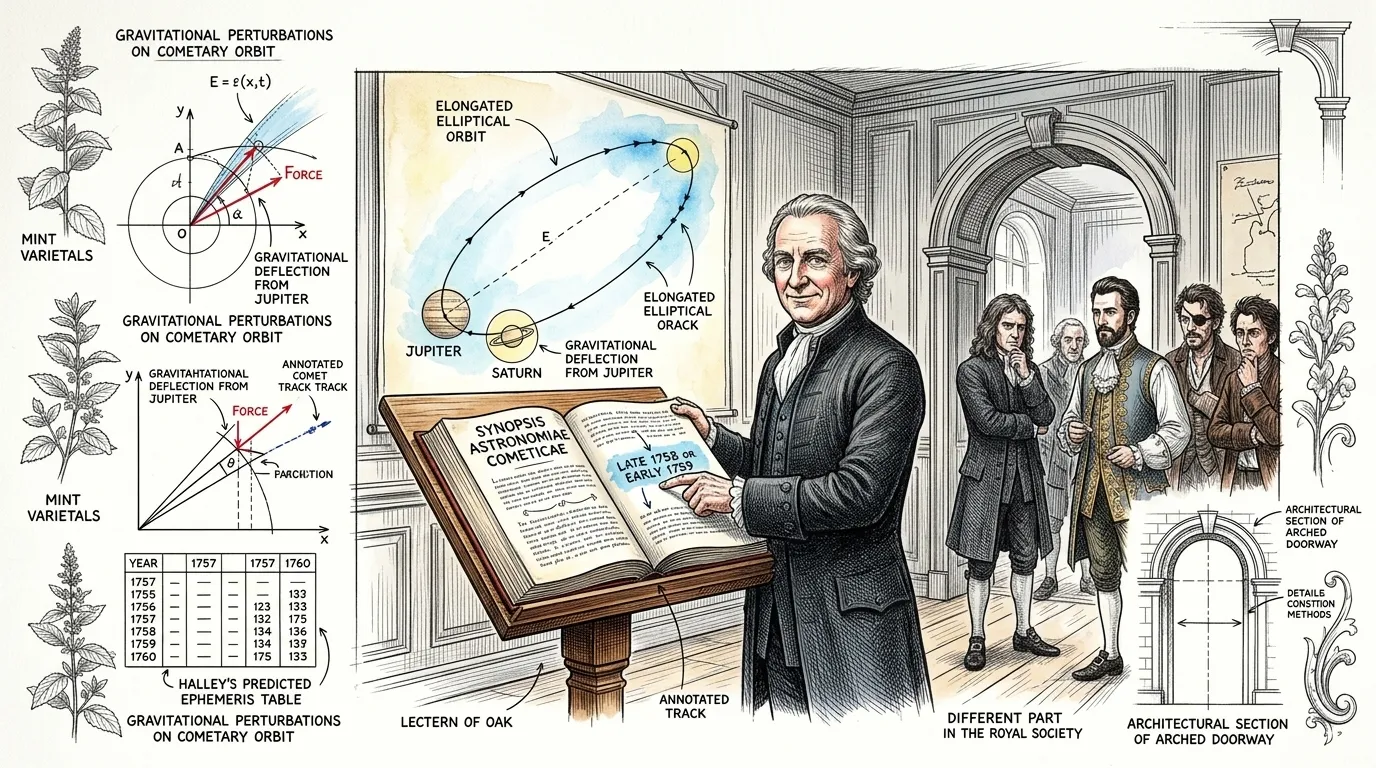
The culmination of Halley's historical research and Newtonian calculations was his extraordinary prediction. He accounted for slight gravitational perturbations from Jupiter and Saturn, refining his estimated period. In his 1705 publication Synopsis Astronomiae Cometicae, he confidently declared that the comet of 1682 would return in late 1758 or early 1759. This was not a vague prophecy, but a scientific forecast, challenging the very perception of celestial permanence and offering a verifiable test of Newton's laws. The scientific community watched, some with skepticism, for a distant future that Halley himself would not live to see.
Page 8
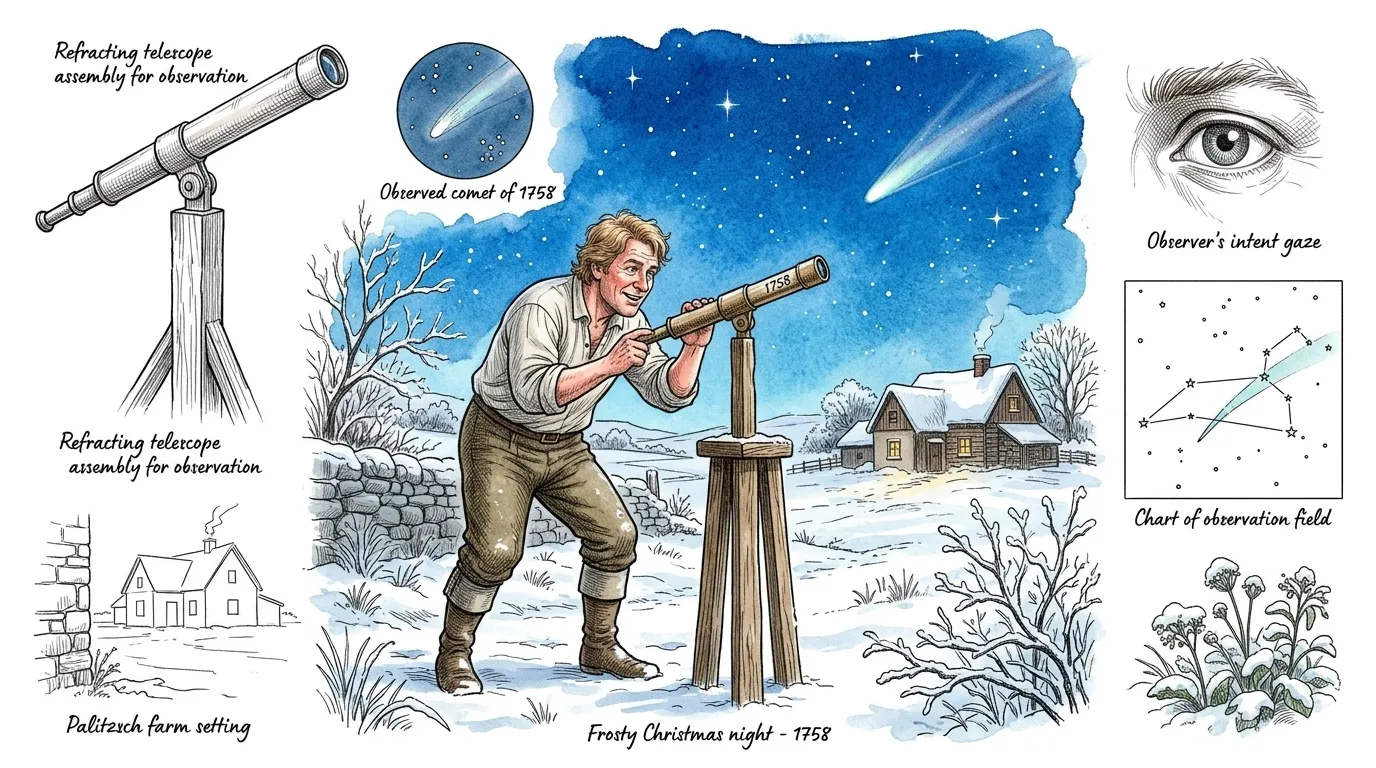
Halley passed away in 1742, sixteen years before his monumental prediction was to be fulfilled. As 1758 drew to a close, a collective anticipation gripped astronomers across Europe. On Christmas Day, 1758, the German farmer and amateur astronomer Johann Georg Palitzsch sighted a faint object near the expected position. Over subsequent weeks, observations confirmed it: the comet had returned, precisely as Halley had foreseen. This triumphant reappearance was not merely a celestial event; it was a profound vindication of Newtonian mechanics and a testament to Halley's intellectual courage, cementing his legacy and forever changing humanity's understanding of comets.
Page 9
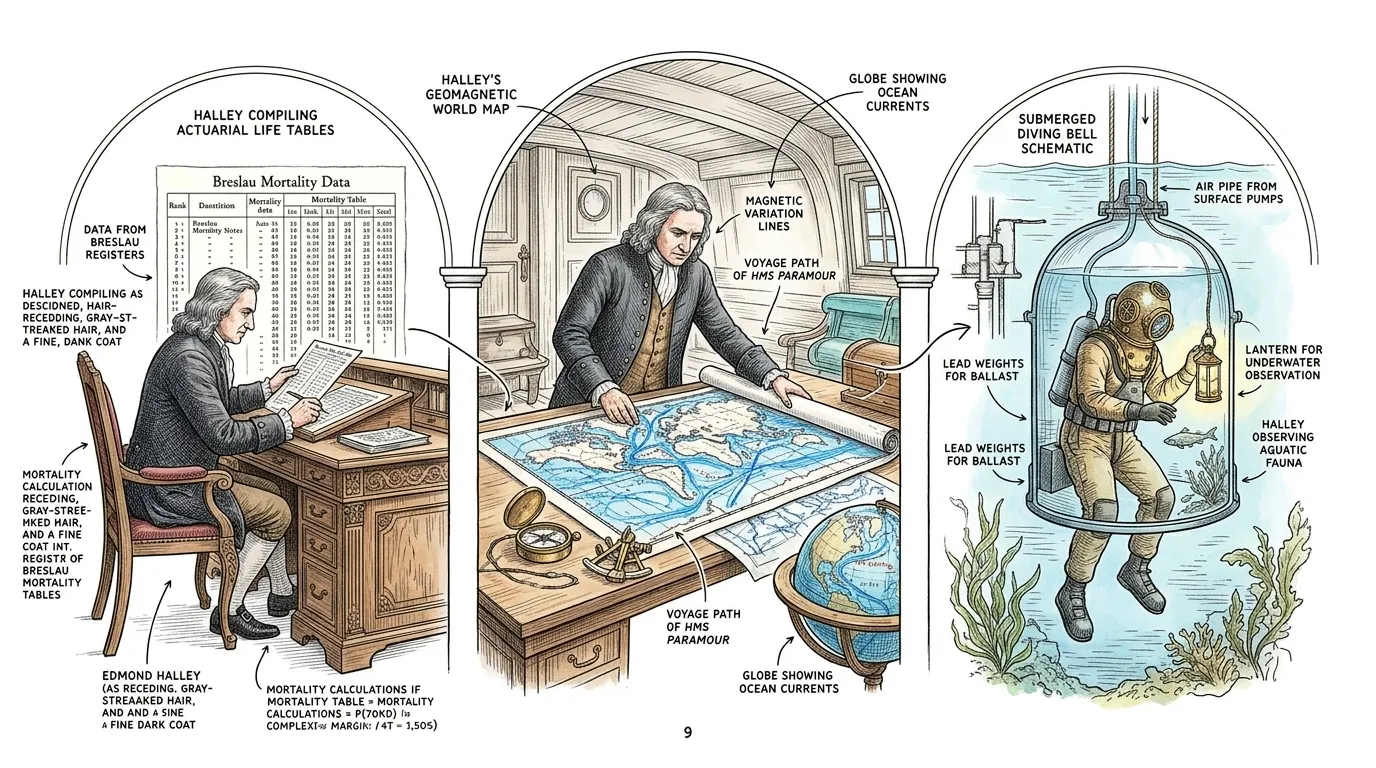
While the comet bears his name, Halley's contributions extended far beyond celestial mechanics. He pioneered the first geomagnetic maps, displaying compass variations for navigators, a vital tool for maritime exploration. His work on mortality tables, based on data from Breslau, became a cornerstone of actuarial science, influencing modern life insurance. He experimented with a diving bell, even conducting underwater expeditions himself, pushing the boundaries of oceanic exploration. From lunar observations to understanding tides, Halley was a true polymath, applying rigorous scientific methods to an astonishing array of disciplines.
Page 10
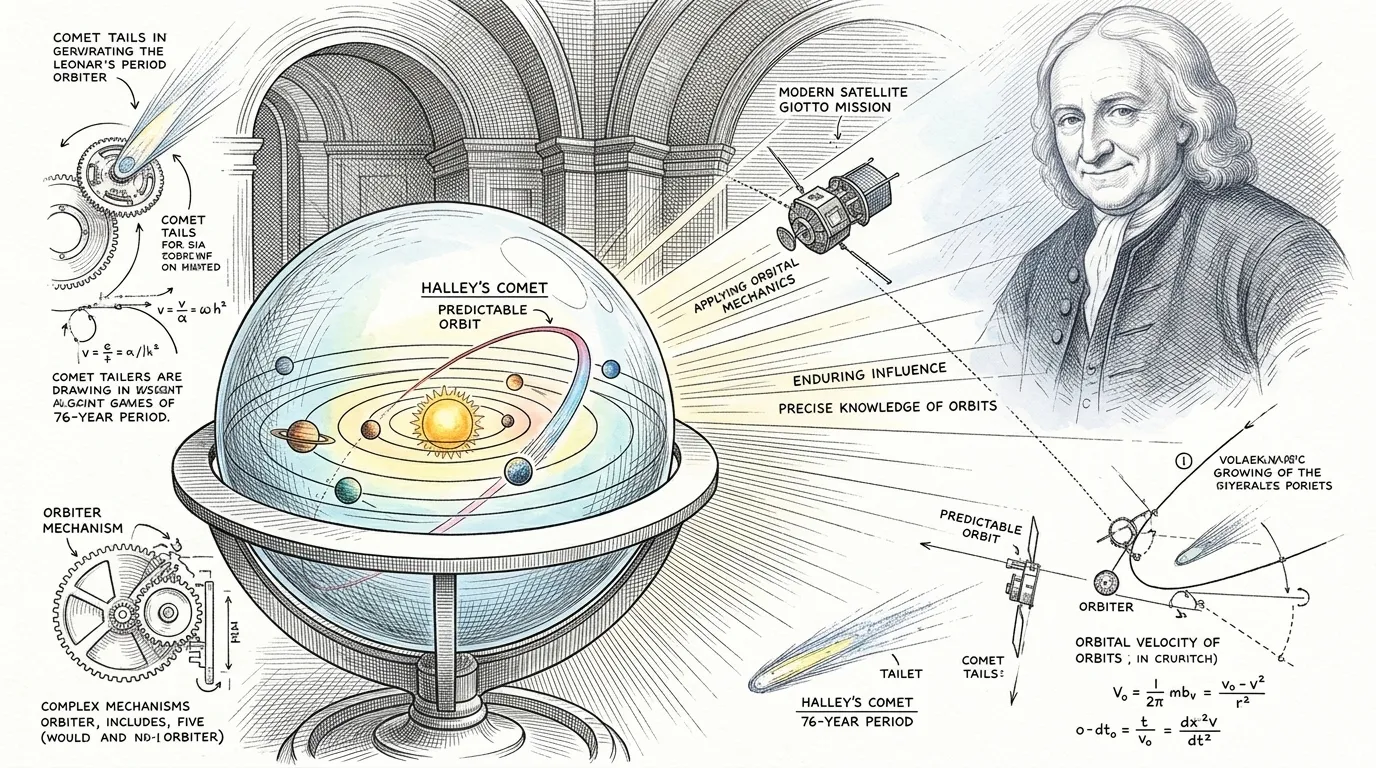
Edmond Halley's profound influence resonates across centuries. His work transformed comets from supernatural phenomena into predictable celestial objects, firmly integrating them into the grand cosmic mechanism governed by universal laws. This paradigm shift was critical for the advancement of orbital mechanics, enabling future astronomers and engineers to precisely calculate trajectories for planetary probes and understand gravitational interactions throughout our solar system. From charting distant stars to predicting the return of a cosmic wanderer, Halley's legacy is etched into the very fabric of space science, inspiring generations to look skyward with wonder and a profound understanding.
About this story
- Location: Global
- Audience: general readers
Questions and answers
Read Wonder Science on your phone
Wonder Science is available on Android. Get Wonder Science on Google Play.