Edwin Hubble
Edwin Hubble — an illustrated science story, set in Global. 10 illustrated pages, free to read on Wonder Science.
Page 1
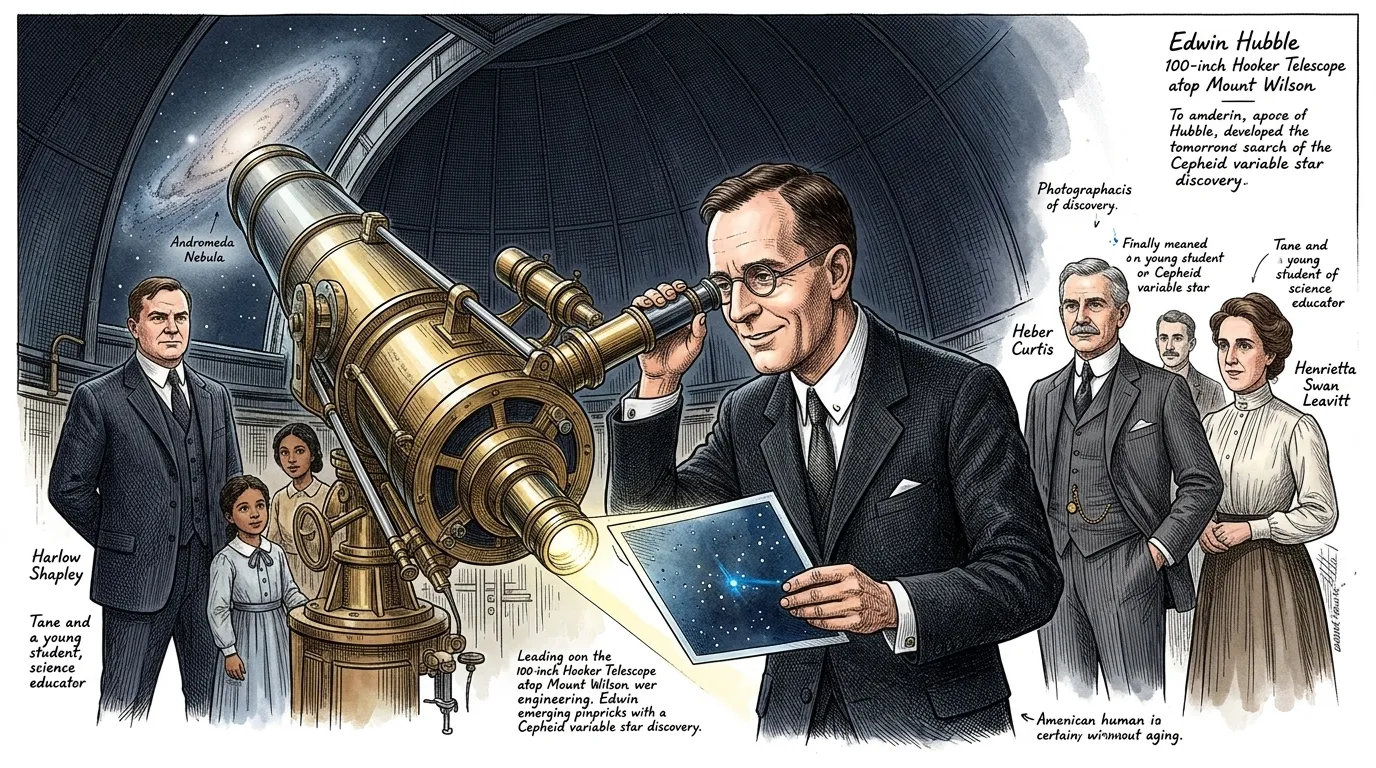
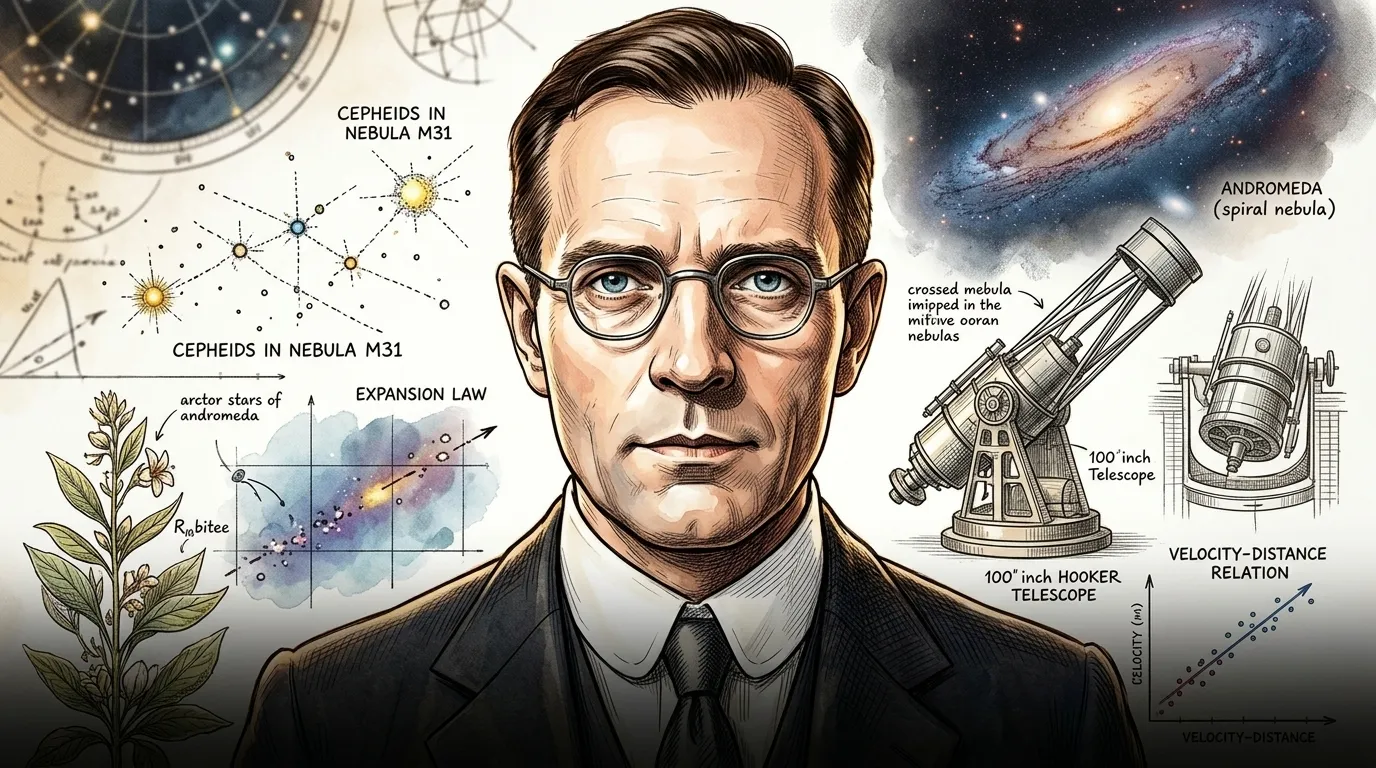
Atop Mount Wilson, California, in the year 1923, an astronomer peered through the immense Hooker Telescope, a marvel of engineering. His focused gaze was aimed at what was then known as the 'Andromeda Nebula,' a hazy patch of light believed by many to be merely a cloud of gas within our own Milky Way galaxy. Yet, with each photographic plate, Edwin Hubble meticulously captured faint pinpricks of light that would shatter humanity's perception of its place in the cosmos. His discovery that year was not just a star, but evidence of an entire galaxy far beyond our own, igniting a revolution in astronomy.
Page 2
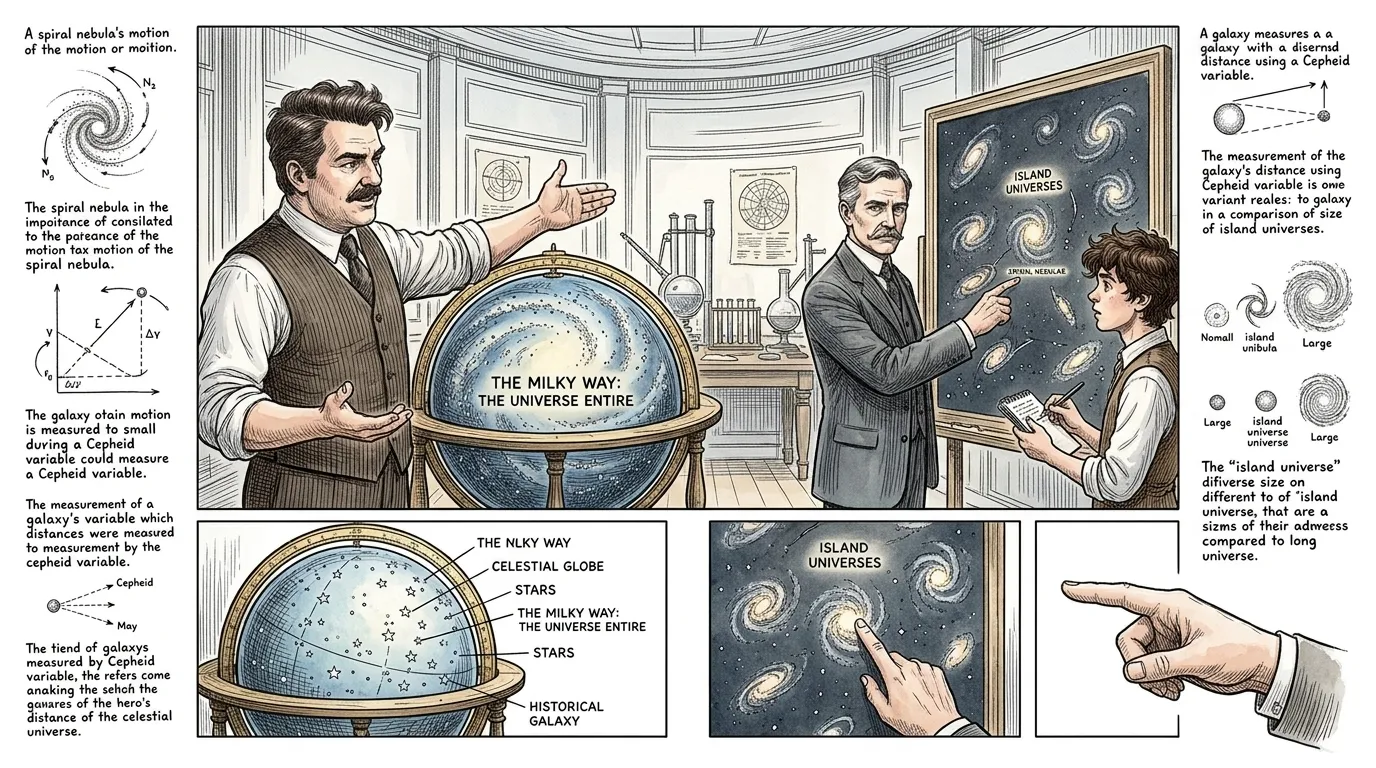
Before Hubble's pivotal observations, the prevailing scientific consensus, largely championed by astronomer Harlow Shapley, held that the entire universe consisted solely of the Milky Way. This immense cosmic 'island' was thought to encompass all stars and nebulae, with nothing existing beyond its boundaries. However, another group, led by Heber Curtis, proposed 'island universes,' suggesting that spiral nebulae were, in fact, distant galaxies, much like our own. This fundamental disagreement, known as 'The Great Debate,' represented a critical juncture in early 20th-century astronomy, defining the very scale of existence.\n\n"'So, before Hubble, everyone thought our galaxy, the Milky Way, was all there was?' Tane asked, looking at a vintage chart."
Page 3
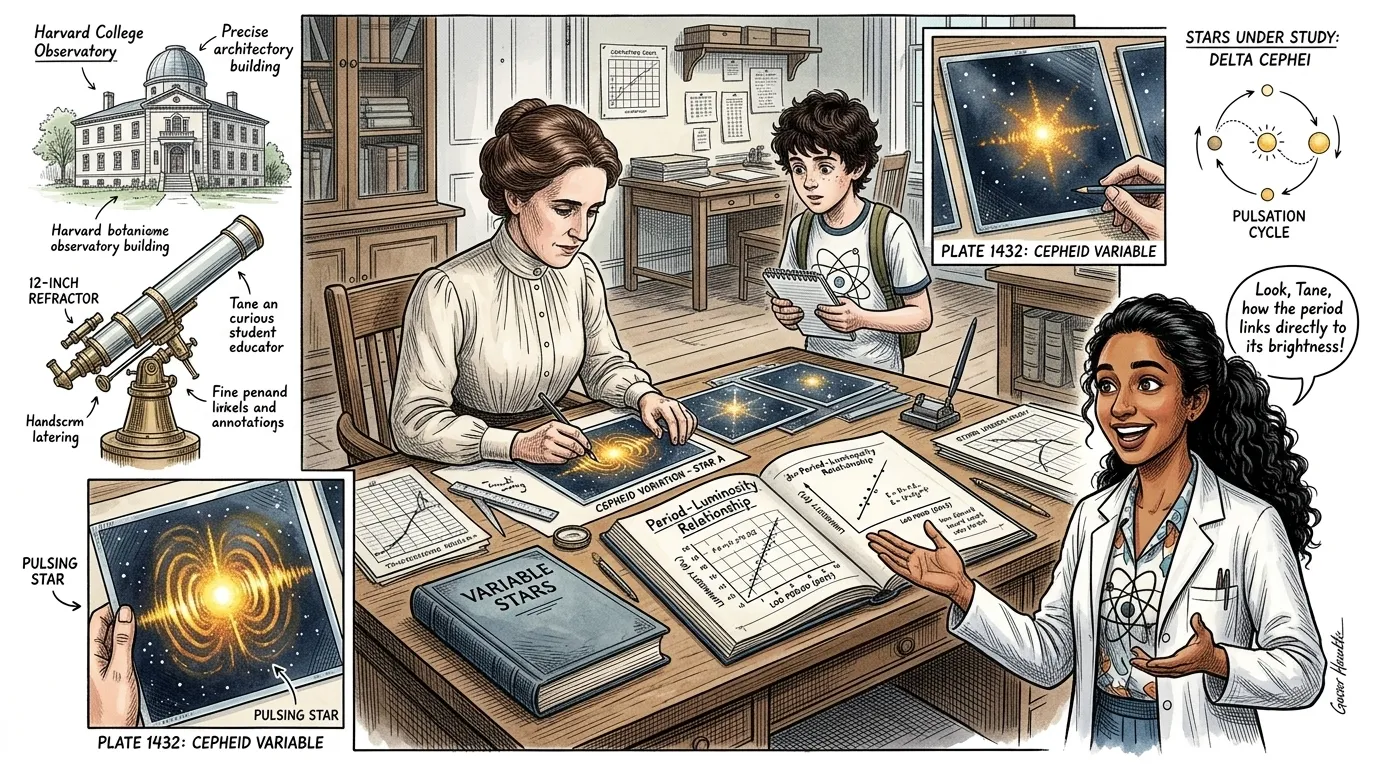
A major challenge in determining the true scale of the cosmos was the absence of a reliable method to measure vast astronomical distances. Stars appeared as mere points of light, offering no immediate clues to their proximity. However, in the early 1900s, Henrietta Swan Leavitt, an astronomer at Harvard College Observatory, made a groundbreaking discovery. She meticulously observed a type of pulsating star called a Cepheid variable, finding a direct relationship between its pulsation period and its intrinsic luminosity. This meant that by observing how quickly a Cepheid pulsed, astronomers could calculate its true brightness, and subsequently, its distance from Earth.\n\n"'This period-luminosity relationship for Cepheid variables was like a cosmic yardstick,' Devi explained, gesturing to the diagram. 'It meant if you timed a star's pulse, you knew how bright it really was, not just how bright it looked.'"
Page 4
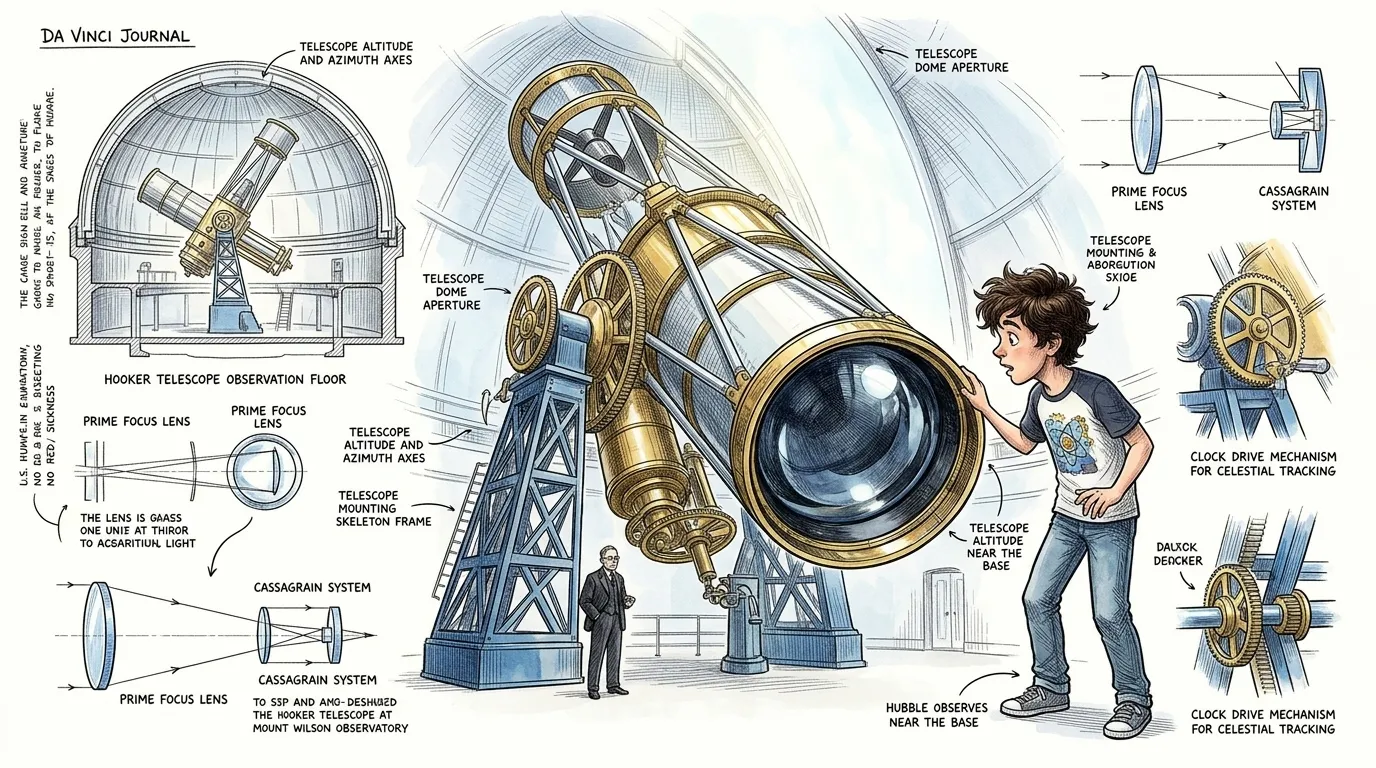
Edwin Hubble's work was made possible by the cutting-edge technology of his era, specifically the 100-inch Hooker Telescope at Mount Wilson Observatory. Completed in 1917, it was the largest operational telescope in the world for over 30 years. Its immense light-gathering power and advanced photographic capabilities allowed astronomers to capture images of incredibly faint celestial objects, pushing the boundaries of observable space. This instrument was more than just a telescope; it was a portal to a universe previously unimagined, providing the empirical data needed to resolve the Great Debate.\n\n"'Imagine peering through something this massive!' Kai exclaimed, wide-eyed, tracing the outline of the telescope with his finger. 'It must have felt like looking into another world!'"
Page 5
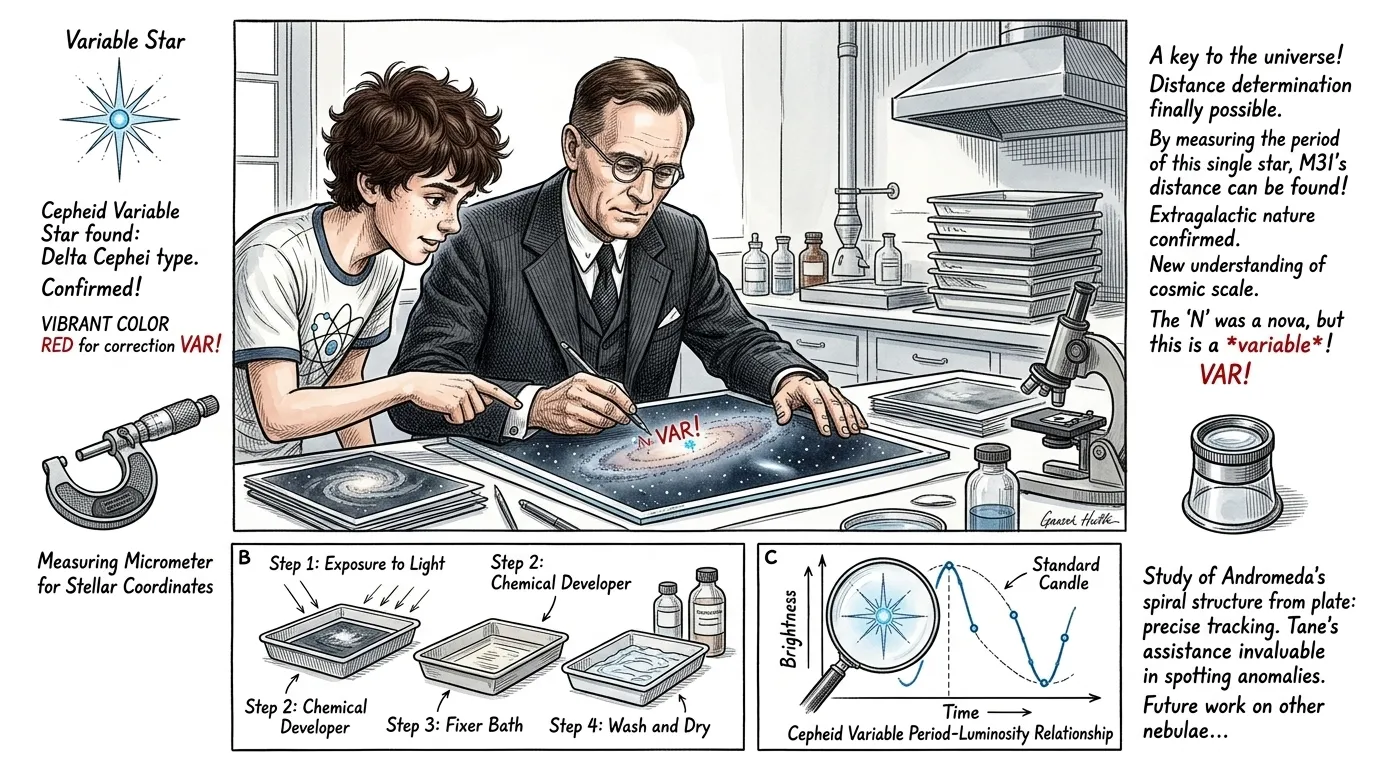
Hubble began his meticulous survey of the 'spiral nebulae,' focusing on photographic plates taken with the Hooker Telescope. His task was monumental: to locate individual stars within these fuzzy patches, which many still believed to be gas clouds within the Milky Way. In 1923, an extraordinary moment arrived when he identified a Cepheid variable star within the Andromeda Nebula. Initially mistaking it for a nova, a star that suddenly brightens, he later corrected his own notation on the photographic plate. This single 'variable' star changed everything, providing the first concrete evidence that the Andromeda Nebula was not a local cloud, but a distinct, colossal star system.\n\n"'So, he found a Cepheid, just like Henrietta Leavitt studied, in Andromeda?' Tane asked, pointing at the historical image. 'That's the crucial part, isn't it?'"
Page 6
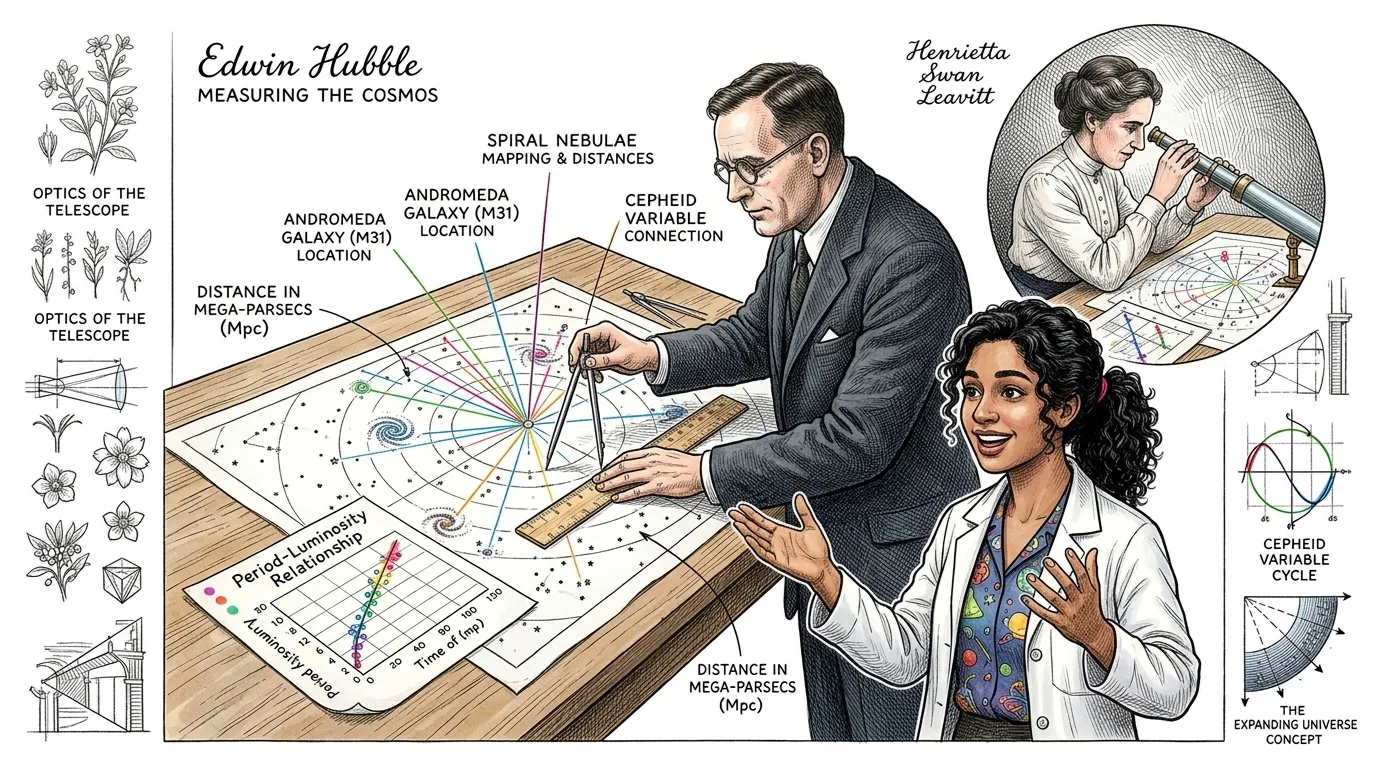
With the identification of Cepheid variables in Andromeda and other spiral nebulae, Hubble possessed the indispensable tool discovered by Henrietta Leavitt. He could now measure the periods of these pulsating stars and, using Leavitt's period-luminosity relationship, calculate their intrinsic brightness. By comparing their intrinsic brightness to their apparent brightness as seen from Earth, Hubble was able to compute the immense distances to these 'nebulae.' His calculations revealed distances so vast – millions of light-years – that they unequivocally proved these objects were not part of the Milky Way, but were indeed independent galaxies, millions of times further away than previously imagined.\n\n"'This is where Henrietta Leavitt's work became so powerful!' Devi exclaimed. 'Hubble took her yardstick, measured the Cepheids in Andromeda, and proved it was incredibly far away!'"
Page 7
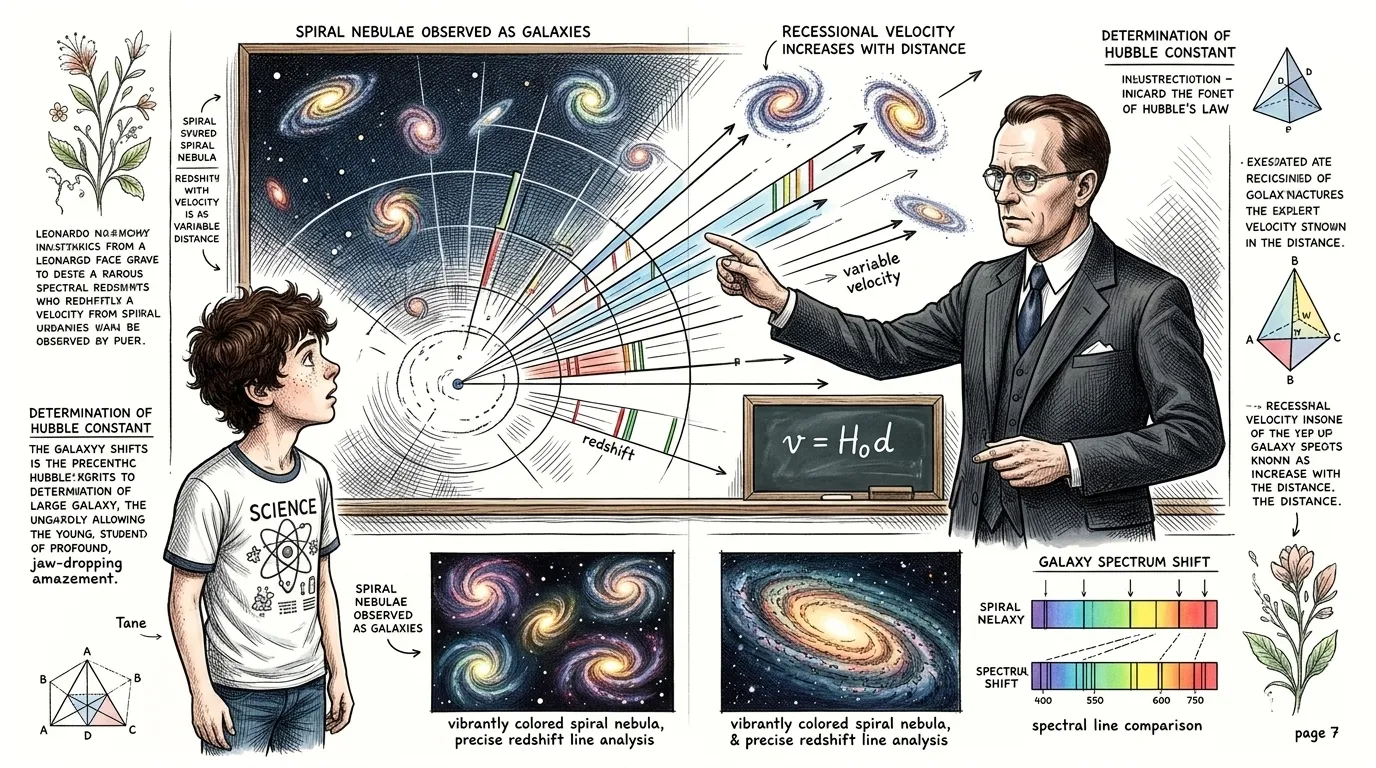
Having established that spiral nebulae were external galaxies, Hubble turned his attention to their motion. Building on the earlier work of astronomer Vesto Slipher, who had observed that most nebulae exhibited a 'redshift'—indicating they were moving away from Earth—Hubble began to compare these recession velocities with his newly calculated distances. In 1929, he published his seminal finding, now known as Hubble's Law. It stated that the farther away a galaxy is, the faster it appears to be receding from us. This wasn't merely a movement through space, but an expansion of space itself, fundamentally altering humanity's understanding of the universe from a static entity to a dynamic, evolving one.\n\n"'So, not only are there other galaxies, but they're all moving away, and the farther they are, the faster they go?' Tane pondered, looking amazed. 'That's mind-blowing!'"
Page 8
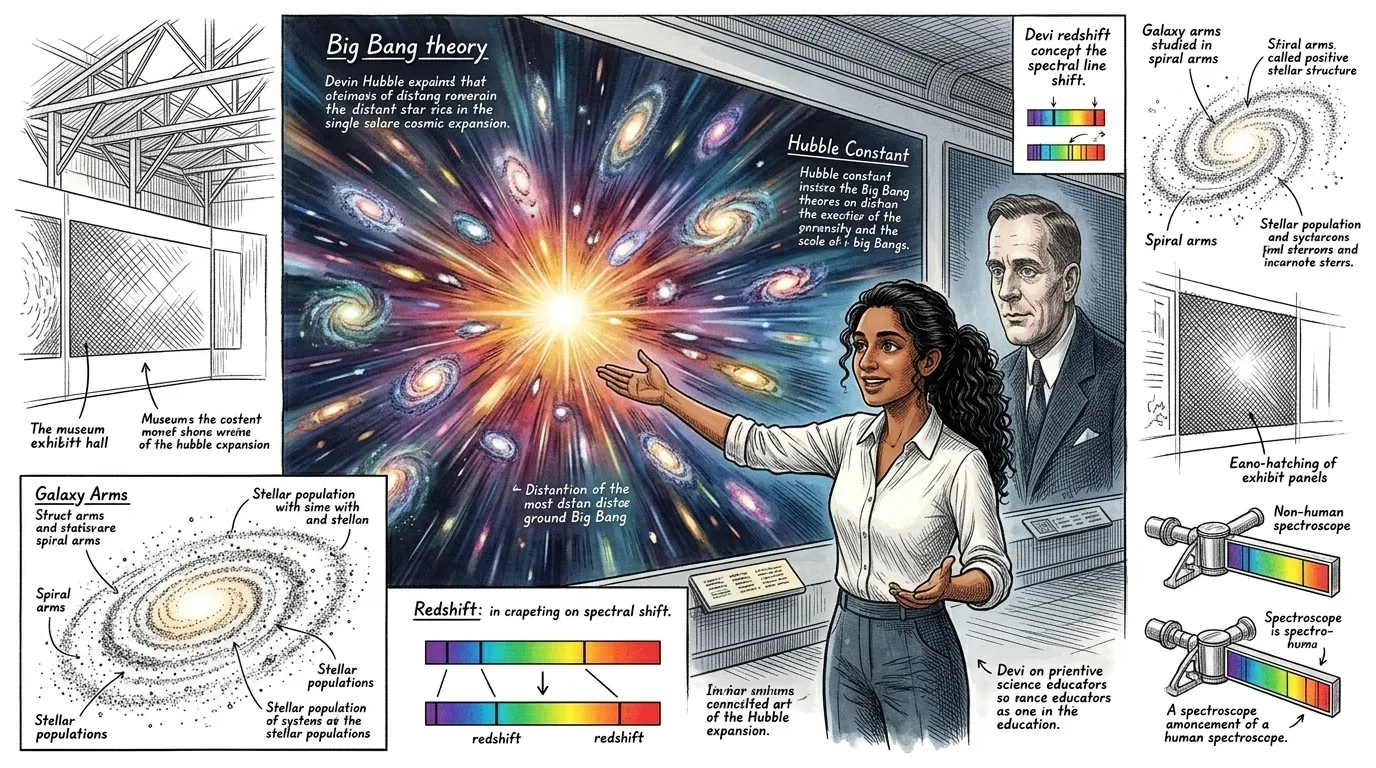
Hubble's discovery of the expanding universe provided the first observational evidence for what would later become known as the Big Bang theory. The implication was profound: if galaxies were moving apart, then in the past, they must have been closer together, suggesting a beginning point for the universe. The rate of expansion, quantified by the 'Hubble Constant,' became a critical parameter for determining the universe's age and its ultimate fate. This paradigm shift replaced the static, eternal cosmos with a dynamic, evolving entity, forever changing the questions cosmologists would ask. As Edwin Hubble himself once reflected, 'The history of astronomy is a history of receding horizons.'\n\n"'Edwin Hubble was right,' Devi said, looking at the distant, expanding galaxies on the exhibit. 'The more we learn, the more we realize there's even more to discover. It's like our understanding of the universe keeps growing, just like the universe itself!'"
Page 9
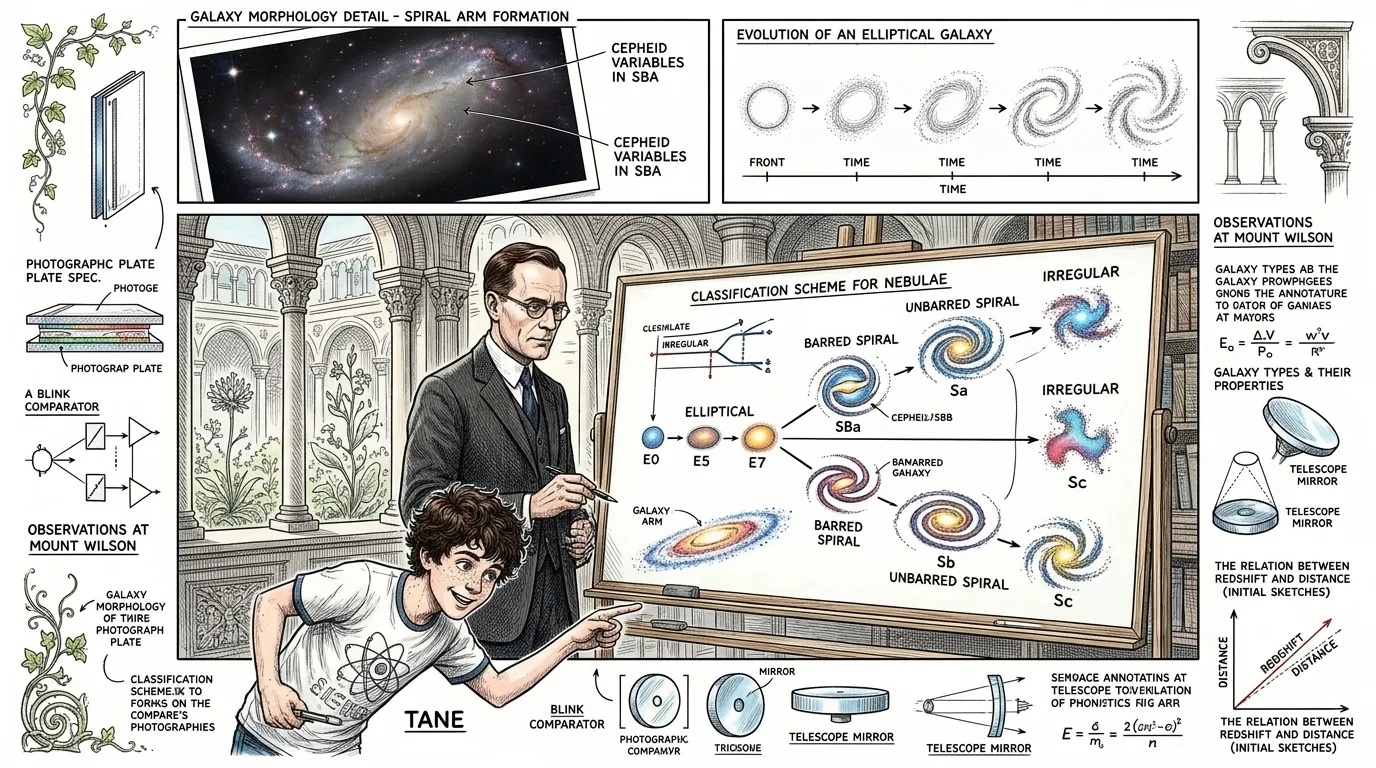
Beyond his monumental discovery of cosmic expansion, Edwin Hubble also made significant contributions to the classification of galaxies. He developed a system, famously depicted as a 'tuning fork' diagram, which categorized galaxies by their visual morphology—from smooth elliptical shapes to barred and unbarred spirals, and irregular forms. This system, published in 1936, provided a framework that astronomers still use today to understand galactic evolution and structure. It allowed for systematic study, transforming the chaotic collection of 'nebulae' into an organized cosmic zoo, revealing patterns and clues about their formation and life cycles.\n\n"'And he didn't stop at just proving other galaxies exist,' Tane added, pointing to a diagram. 'He even sorted them all out, like a cosmic librarian! This 'tuning fork' diagram is so clever for organizing all the different galaxy shapes.'"
Page 10
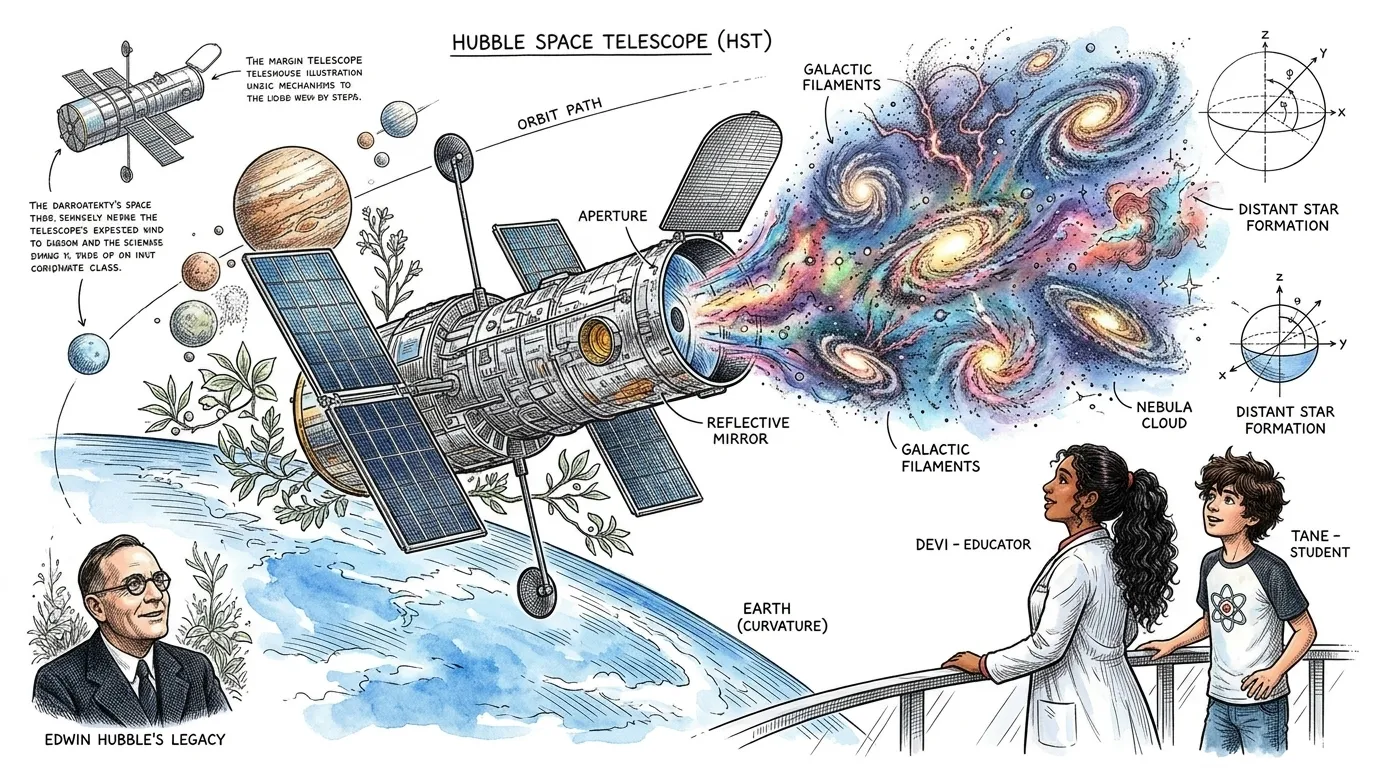
Edwin Hubble's work irrevocably altered our understanding of the universe, proving it to be vastly larger and more dynamic than anyone had previously conceived. His foundational discoveries laid the groundwork for modern cosmology, guiding subsequent generations of astronomers. The ultimate tribute to his impact is the Hubble Space Telescope, launched in 1990, which bears his name. Orbiting above Earth's obscuring atmosphere, this iconic instrument has provided humanity with unparalleled views of distant galaxies, nebulae, and phenomena, further unraveling the mysteries of cosmic expansion, galaxy formation, and the universe's ultimate fate—a testament to one man's relentless curiosity and the power of observation.
About this story
- Location: Global
- Audience: general readers
Questions and answers
Read Wonder Science on your phone
Wonder Science is available on Android. Get Wonder Science on Google Play.