Isaac Newton
Isaac Newton — an illustrated science story, set in Global. 10 illustrated pages, free to read on Wonder Science.
Page 1
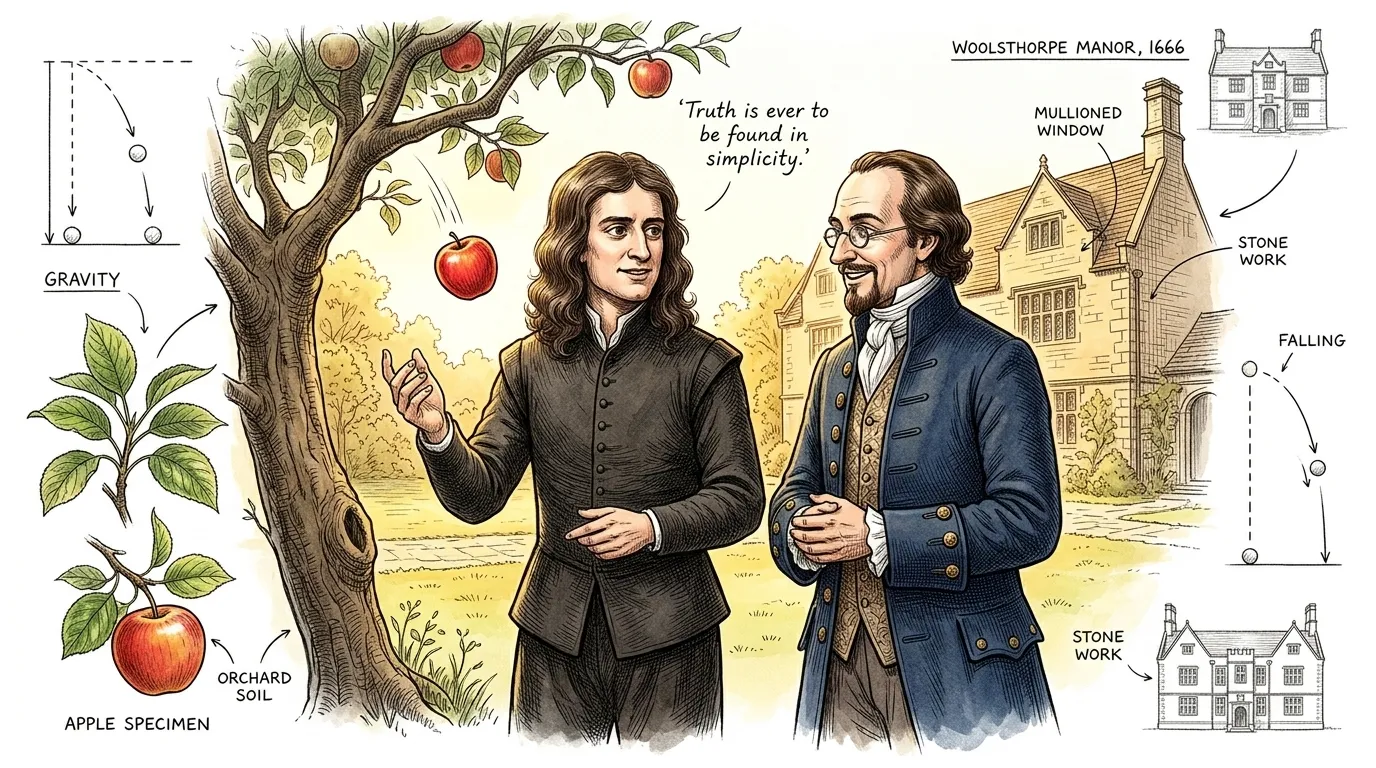
At Woolsthorpe Manor, 1666. Isaac Newton, then a young scholar, found his studies at Cambridge interrupted by the Great Plague. Retreating to his family estate, this period of isolation became a crucible for revolutionary thought. It was here that he began to synthesize disparate observations into a singular, breathtaking framework.
""Master Newton," Edmond Halley began, his voice imbued with a certain urgency, "the Royal Society is stumped. Kepler described the planetary paths, but the cause of their relentless journey remains elusive. What force guides these celestial bodies?"
Newton, gesturing towards a falling apple, replied with a quiet intensity, "Indeed, Mr. Halley. And why should the force that brings an apple to the ground be any different from the force that holds the Moon in its perpetual dance? As I have often thought, 'Truth is ever to be found in simplicity, and not in the multiplicity and confusion of things,' a principle I find guiding my inquiries.""
Page 2
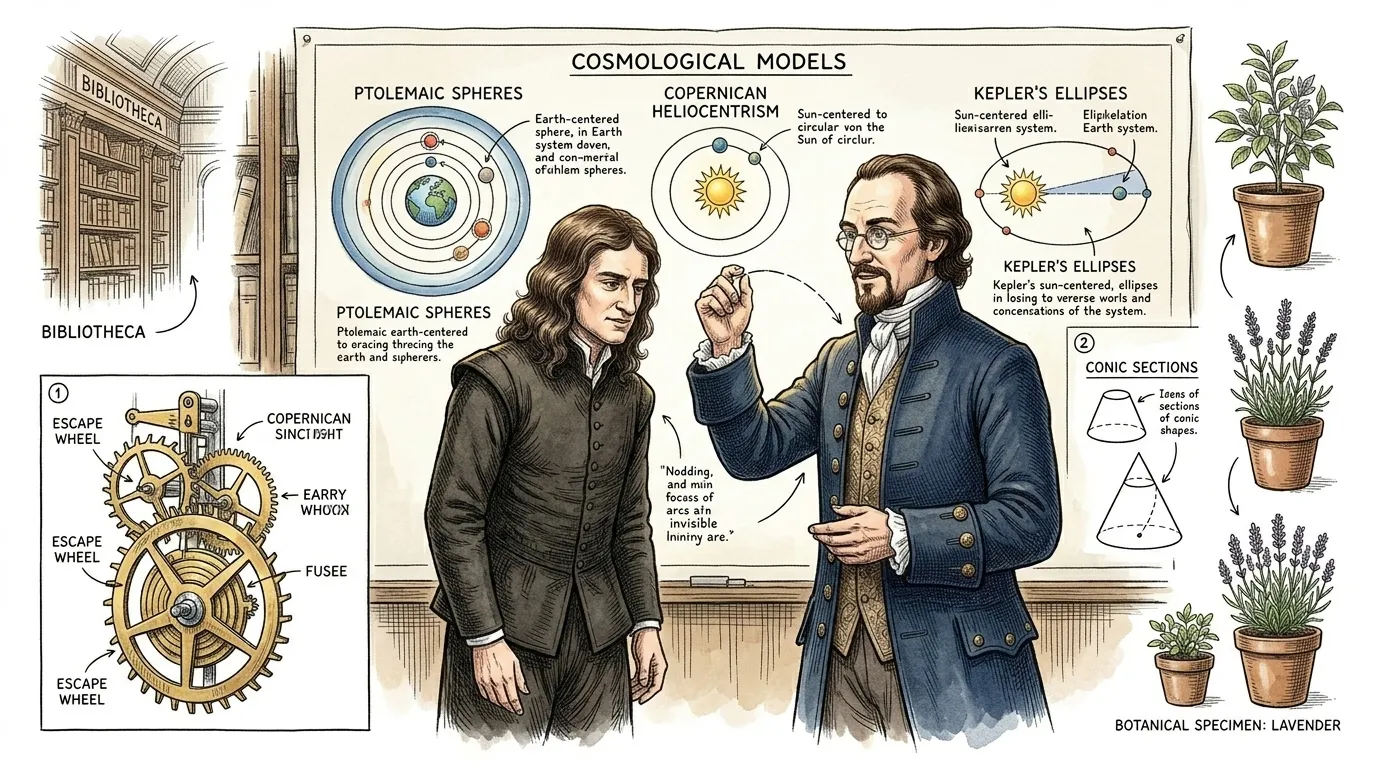
For millennia, human understanding of the cosmos remained largely segmented. Terrestrial laws, governing the falling apple, were deemed separate from the celestial mechanics that guided the stars and planets. Philosophers from Aristotle to Ptolemy conceived of perfect, crystalline spheres carrying heavenly bodies, unaffected by the imperfect physics of Earth.
""Before Galileo's telescope," Halley mused, tracing an invisible arc in the air, "the heavens were immutable, a realm of divine perfection. Yet, even Copernicus, who bravely shifted the Earth from the center, still imagined circular orbits for his planets. It was a conceptual leap, but not a full explanation of why."
Newton nodded, "Precisely. Kepler then observed these paths were ellipses, and his laws described how they moved with uncanny precision. But without a unifying force, the 'why' remained a profound mystery, a fundamental gap in our understanding of the universe.""
Page 3
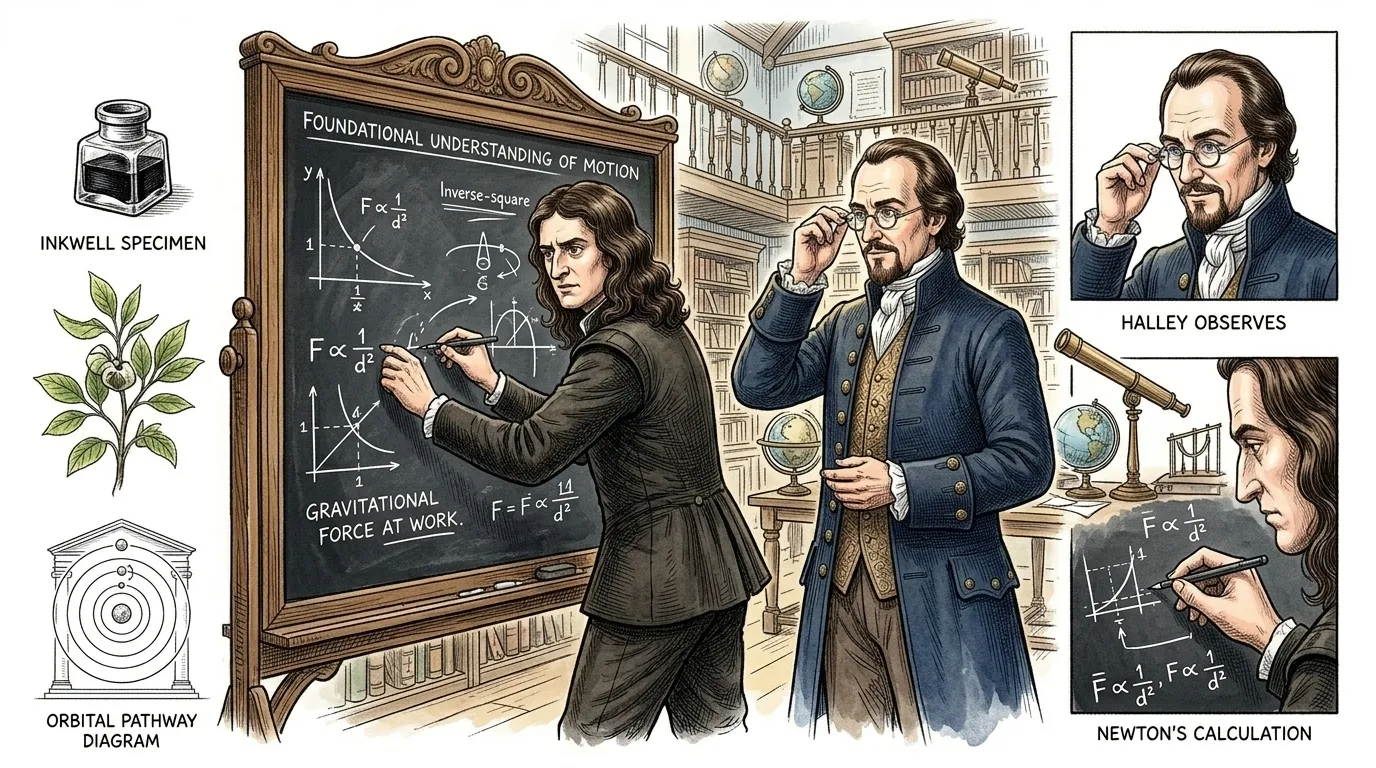
The challenge for seventeenth-century natural philosophers was immense: to reconcile the observable phenomena of Earth with the intricate, seemingly independent motions of the heavens. How could a single, universal principle govern both the trajectory of a cannonball and the majestic sweep of a planet?
""The Royal Society, as you know," Halley continued, adjusting his spectacles, "has long debated this. Robert Hooke, Christopher Wren, and I have grappled with the inverse-square law – the idea that a force might diminish with the square of the distance. But proving it, let alone showing it compels elliptical orbits, has eluded us."
Newton turned to a chalkboard, beginning to sketch, "Indeed, Mr. Halley. The true test lies in demonstrating that this force is not merely speculative, but a mathematical necessity. It requires a foundational understanding of motion itself, a language for cause and effect.""
Page 4
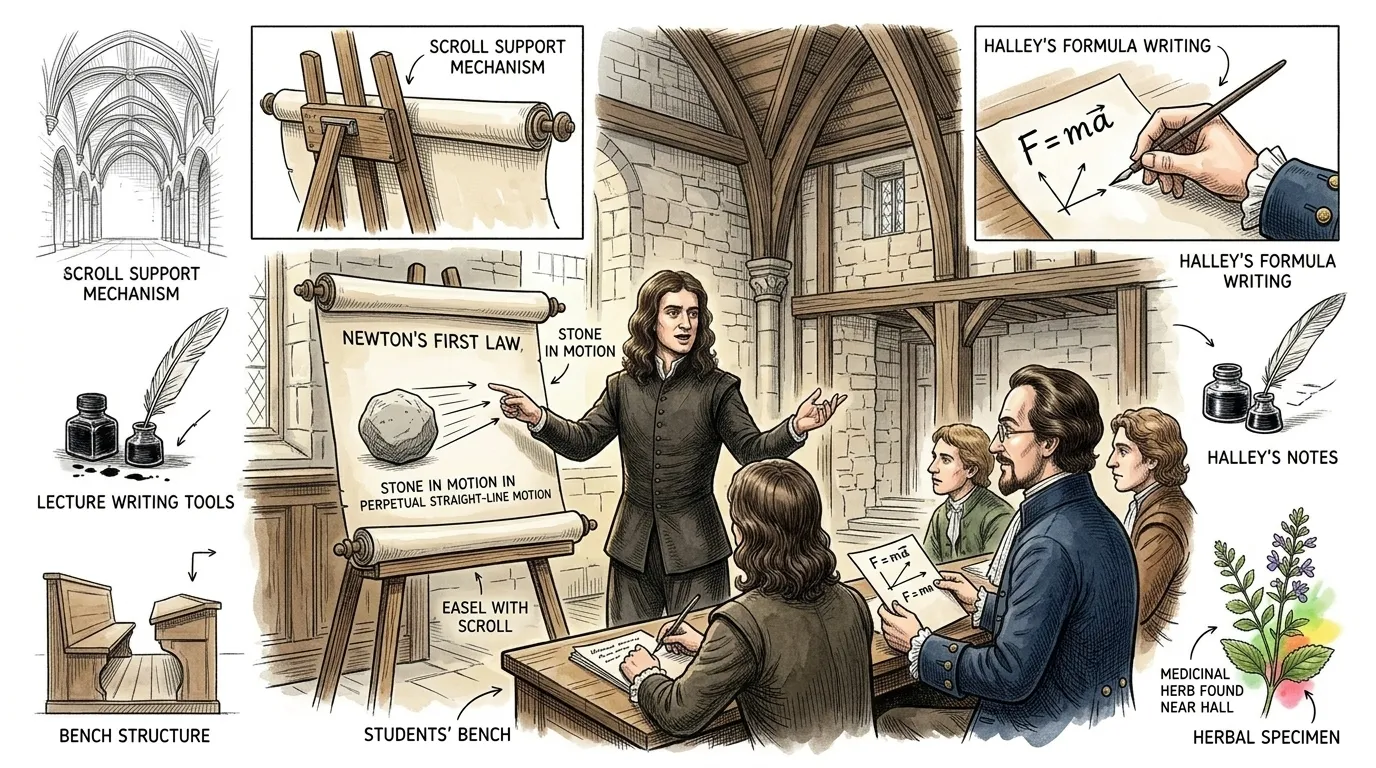
Before unlocking gravitation, Newton first had to define motion itself. His three Laws of Motion provided the crucial vocabulary: inertia, the relationship between force and acceleration, and action-reaction. These principles laid the groundwork, clarifying how objects move, and, crucially, how their motion changes.
""Consider a stone," Newton explained to a small group of students and scholars gathered in his lecture hall, pointing to a diagram, "set in motion. Without external force, it would continue in a straight line, indefinitely. This is the essence of inertia – my First Law."
Halley, present amongst the audience, interjected, "And the Second Law, Master Newton, that the change of motion is proportional to the impressed force – that is where the 'why' truly begins to reveal itself. F ma, the very calculus of change, linking force to observable acceleration.""
Page 5
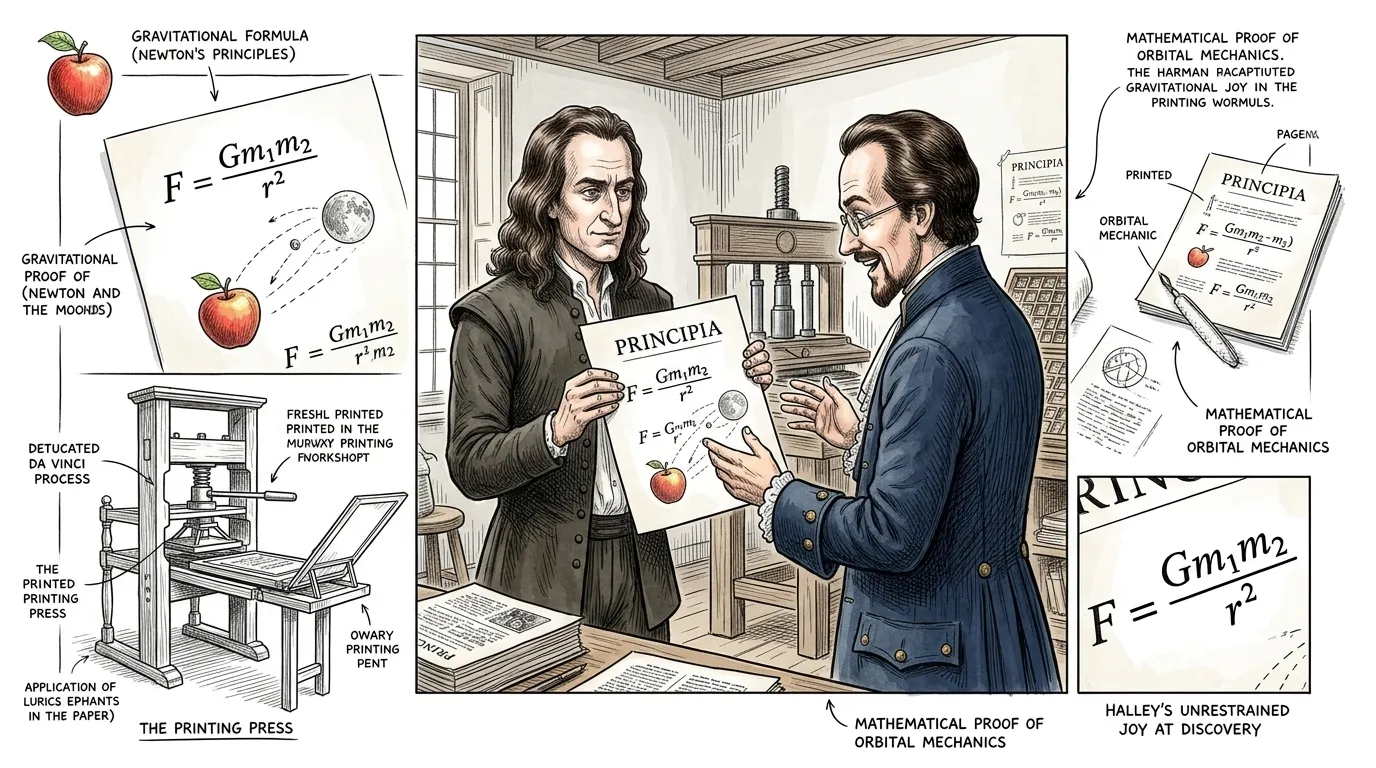
The culmination of Newton's thinking was the Law of Universal Gravitation, published in his 1687 masterwork, 'Philosophiæ Naturalis Principia Mathematica.' It stated that every particle of matter in the universe attracts every other particle with a force directly proportional to the product of their masses and inversely proportional to the square of the distance between their centers.
""This is it, Mr. Halley," Newton declared, presenting a freshly printed page of his 'Principia,' "the mathematical proof. The inverse-square law applies universally. From the smallest pebble to the grandest planet, the force of attraction can be calculated."
Halley, examining the intricate equations, exclaimed, "So, the apple and the Moon are indeed bound by the same invisible tether! This equation, F Gm1m2/r2, unlocks the cosmos! It explains not just how planets move, but why they obey Kepler's laws.""
Page 6
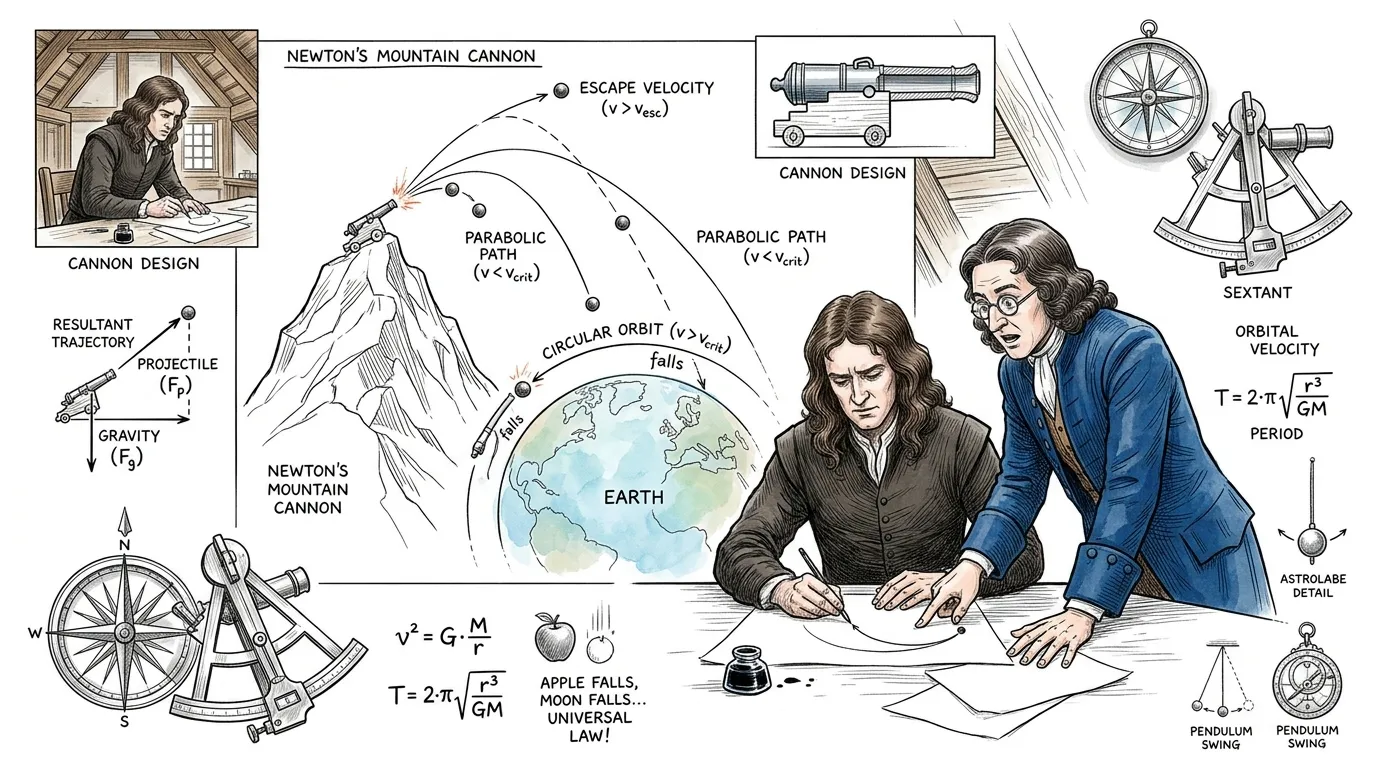
One of Newton's most counter-intuitive yet profound insights was his explanation of orbital motion. He conceived of an orbit not as a body being held up, but as an object perpetually falling towards another, yet moving so fast horizontally that it continually misses the ground.
""Imagine a cannon," Newton proposed to Halley, sketching rapidly on a diagram, "placed atop a very high mountain. Fire a cannonball: it falls. Fire it harder, it falls further away. Fire it with tremendous velocity, and it falls around the Earth, never touching it, continually drawn by gravity but never quite reaching the surface."
Halley's eyes widened. "So, the Moon isn't 'floating' in the sky, it's just falling sideways around the Earth, caught in an eternal freefall! It's a continuous state of motion, prevented from escaping by inertia and prevented from crashing by its lateral speed. Remarkable!""
Page 7
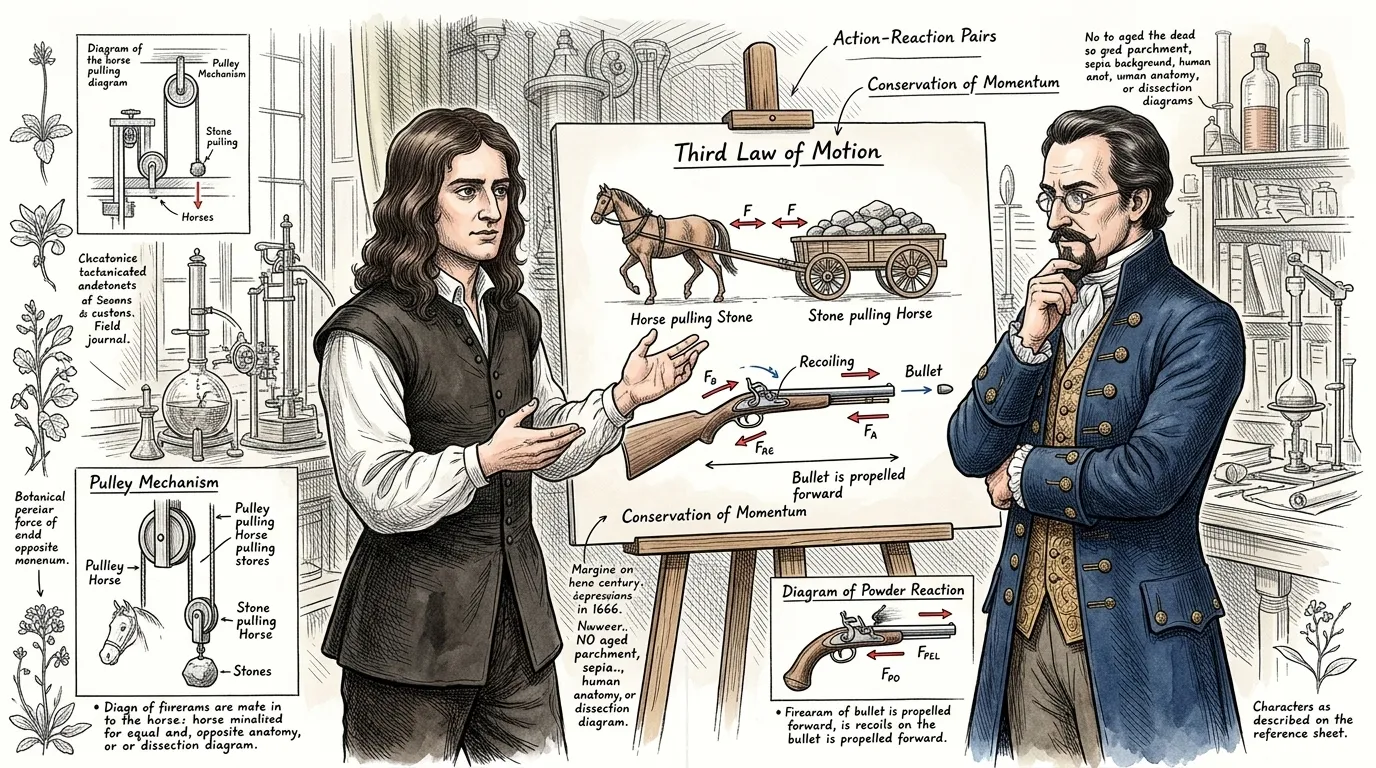
Newton's Third Law of Motion states that for every action, there is an equal and opposite reaction. While Newton himself did not envision rockets, this fundamental principle is the bedrock of all propulsion, from terrestrial engines to the colossal thrust required for space travel.
""The implications are vast," Halley remarked, studying one of Newton's diagrams illustrating the Third Law. "If a horse pulls a stone, the stone pulls the horse. The forces are equal, though their effects differ due to mass. This 'action-reaction' is not merely an abstract concept, but a powerful mechanism for imparting motion."
Newton clarified, "Indeed. Consider the recoil of a firearm. The gunpowder propels the bullet forward with great force, and an equal, opposing force is exerted upon the weapon. This fundamental principle, that bodies exert forces upon one another, reveals how force can be generated and directed for movement.""
Page 8
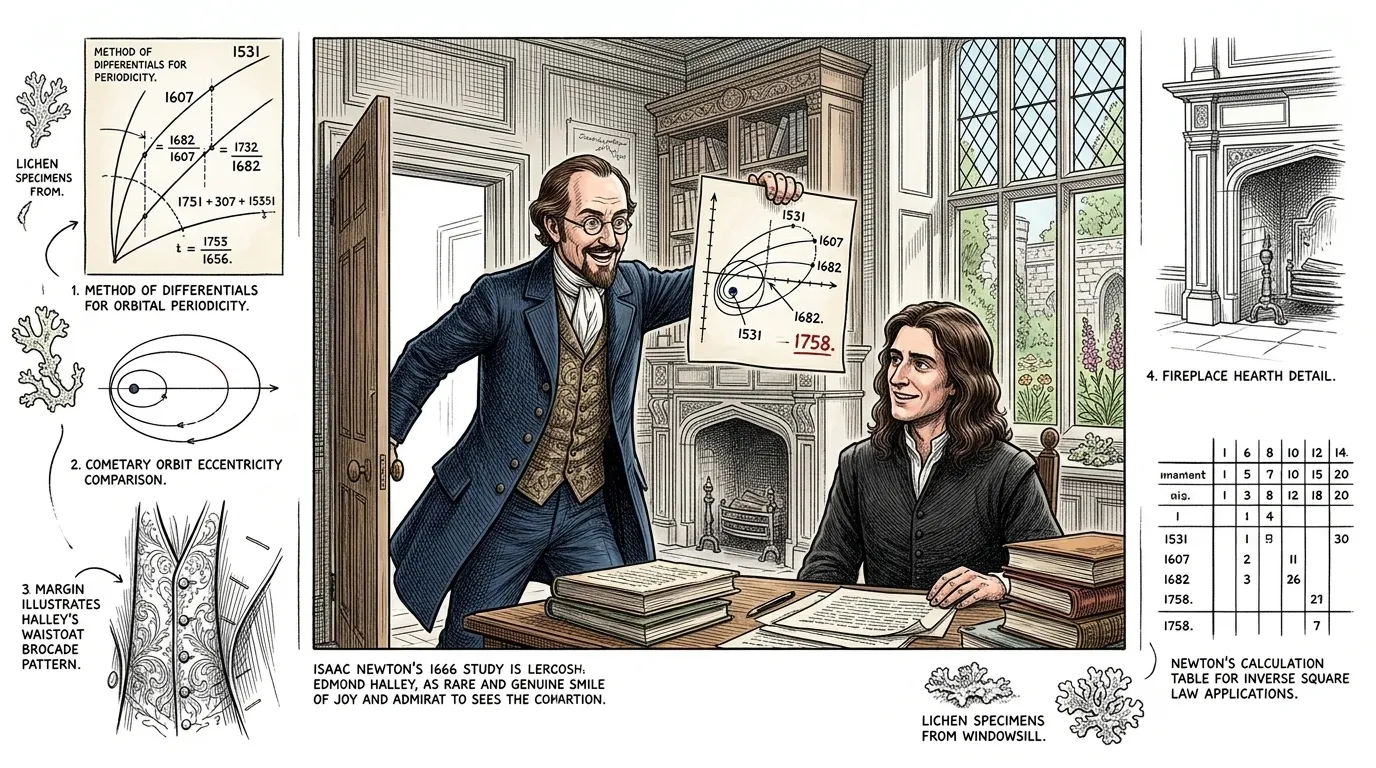
The true power of Newton's universal laws was spectacularly demonstrated by Edmond Halley. Using Newton's mathematical framework, Halley painstakingly calculated the orbital parameters of several comets, culminating in his breathtaking prediction of the return of the comet now bearing his name.
""Master Newton," Halley exclaimed, bursting into Newton's study, holding up a meticulously calculated chart, "The comet of 1531, 1607, and 1682 – they are one and the same! Your laws reveal a precise periodicity. I predict its return in the year 1758!"
Newton, his usual stoicism momentarily broken by a rare smile, responded, "A triumph, Mr. Halley! Your diligence has provided the irrefutable evidence. The 'why' of planetary motion, the universal force we discussed years ago, has now become a tool for predicting the very fabric of the heavens.""
Page 9
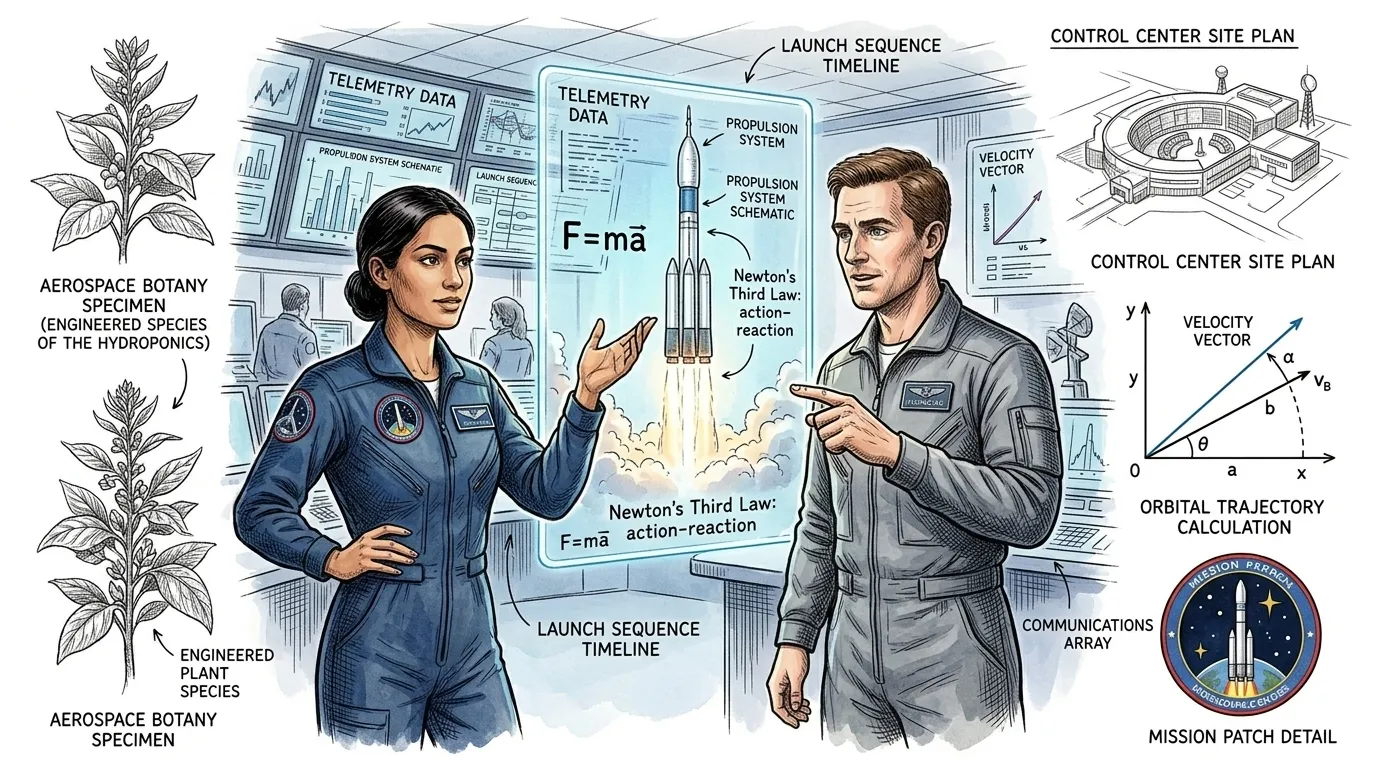
Centuries after Newton, his laws became the indispensable blueprint for humanity's greatest voyages: space exploration. Rocket engineers, from Konstantin Tsiolkovsky to Robert Goddard and Wernher von Braun, meticulously applied Newtonian mechanics to overcome Earth's gravity and chart courses to other worlds.
""Every mission, every orbital maneuver, every trajectory correction hinges on Newton's equations," a modern-day aerospace engineer explained to a fellow colleague in a bustling mission control center. "Calculating the precise thrust, the burn duration, the escape velocity – it all originates from F ma and the law of gravitation."
"Indeed," her colleague responded, pointing to a holographic display showing a rocket launch. "Newton's Third Law, the action-reaction principle, is literally the engine of our ambition. The expulsion of mass at high velocity creating an equal and opposite force, propelling us skyward. Without his foundational work, space travel would be conceptually impossible.""
Page 10
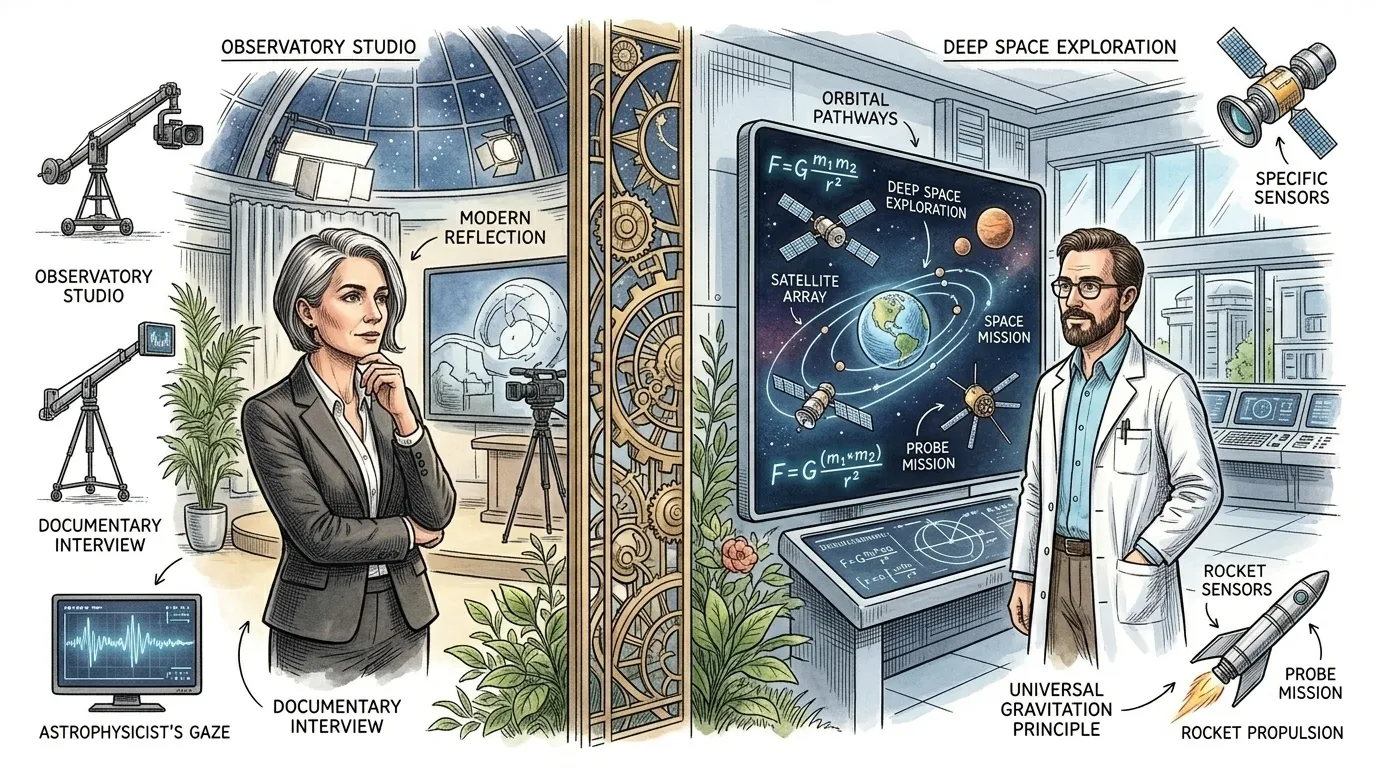
Isaac Newton's legacy is not merely historical; it is foundational to our modern world. From satellites relaying global communications to probes exploring distant planets, his universal laws continue to guide humanity's reach into the cosmos. While Einstein later refined our understanding of gravity at extreme scales, Newton's classical mechanics remain the practical framework for almost all celestial navigation.
""Newton provided the language for the universe," a contemporary astrophysicist reflected during a documentary interview, her voice resonating with admiration. "He didn't just describe the cosmos; he made it predictable, quantifiable. Every time we launch a satellite, every time we calculate an asteroid's path, we are walking in the footsteps of Newton."
"His work truly united the heavens and the Earth," another scientist added, standing beside a large display of space-age technology. "It inspired generations to look beyond the immediate, to seek universal principles. The curiosity he ignited in a plague-ridden manor continues to propel us among the stars.""
About this story
- Location: Global
- Audience: general readers
Questions and answers
Read Wonder Science on your phone
Wonder Science is available on Android. Get Wonder Science on Google Play.