James Webb
James Webb — an illustrated science story, set in Global. 10 illustrated pages, free to read on Wonder Science.
Page 1
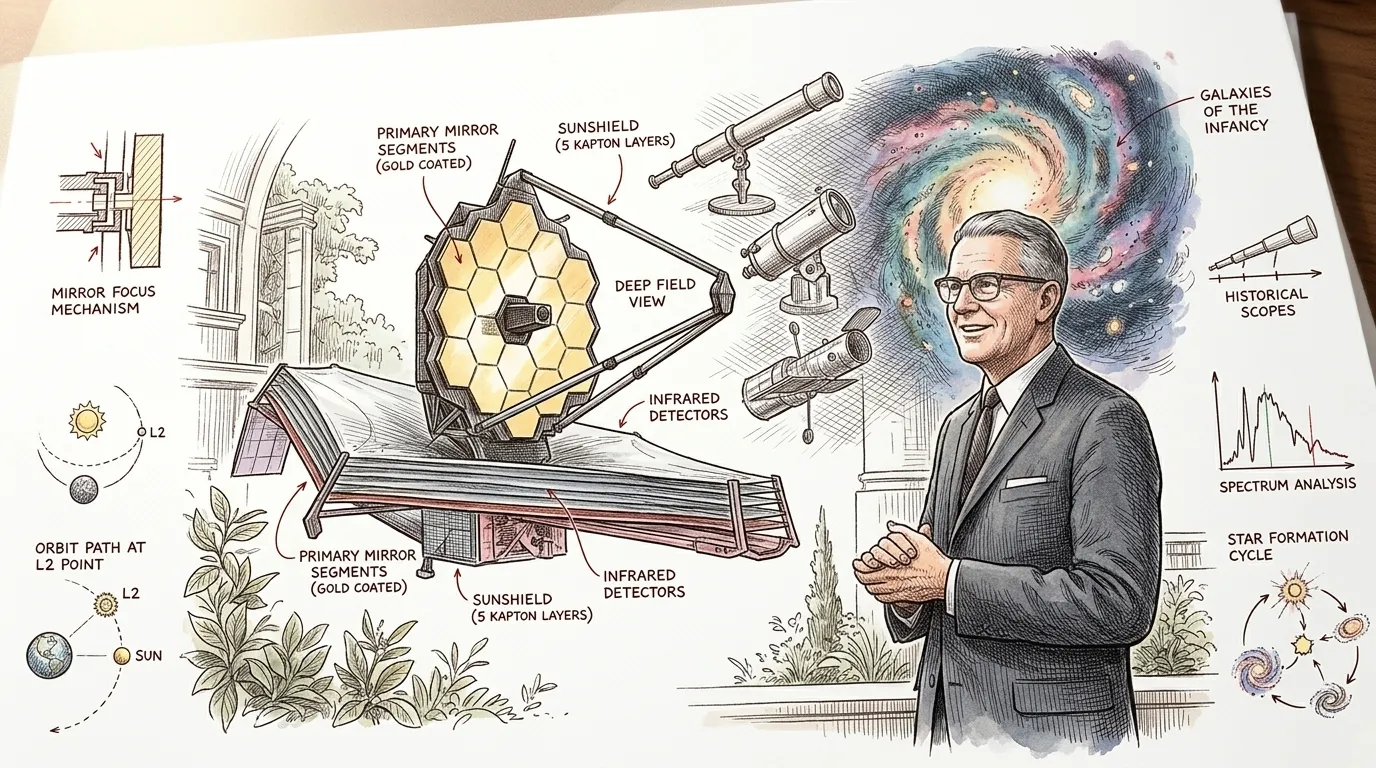
For centuries, humanity has gazed at the stars, limited by what our eyes, and then our telescopes, could perceive. But what if we could peer back through time itself, to the universe's infancy, witnessing the birth of the very first galaxies? This profound ambition fueled the creation of the James Webb Space Telescope, a monumental feat of engineering named after a man whose relentless dedication transformed NASA's scientific trajectory.
Page 2
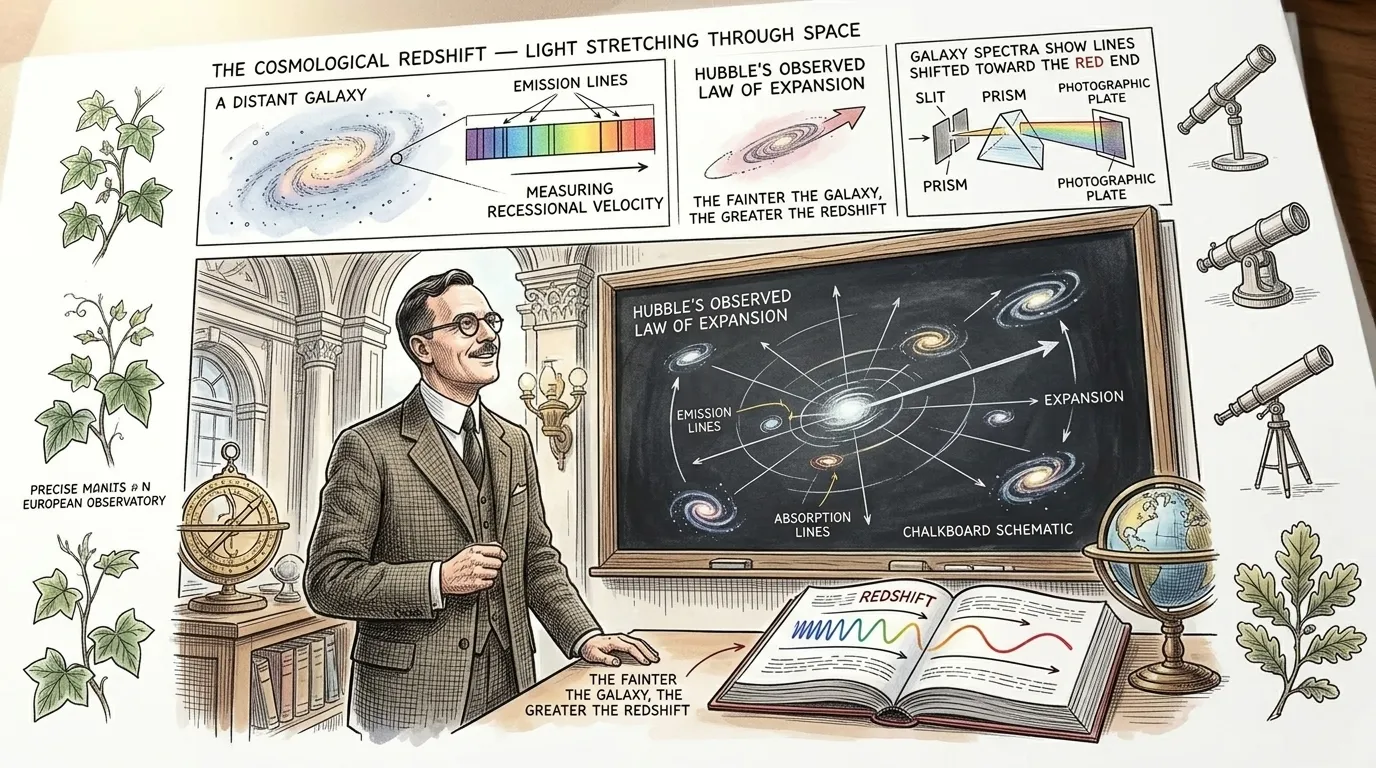
Our universe is a vast, expanding tapestry, a concept dramatically confirmed by Edwin Hubble in the early 20th century. As space itself stretches, the light from distant galaxies is redshifted, elongated to longer, redder wavelengths—often beyond what the human eye, or even traditional optical telescopes, can detect. To witness the universe's 'Cosmic Dawn,' the era when the first stars and galaxies ignited, we must look not in visible light, but in the infrared spectrum. It is in this invisible realm that the faint echoes of the nascent cosmos reside, a profound challenge for observation.
Page 3
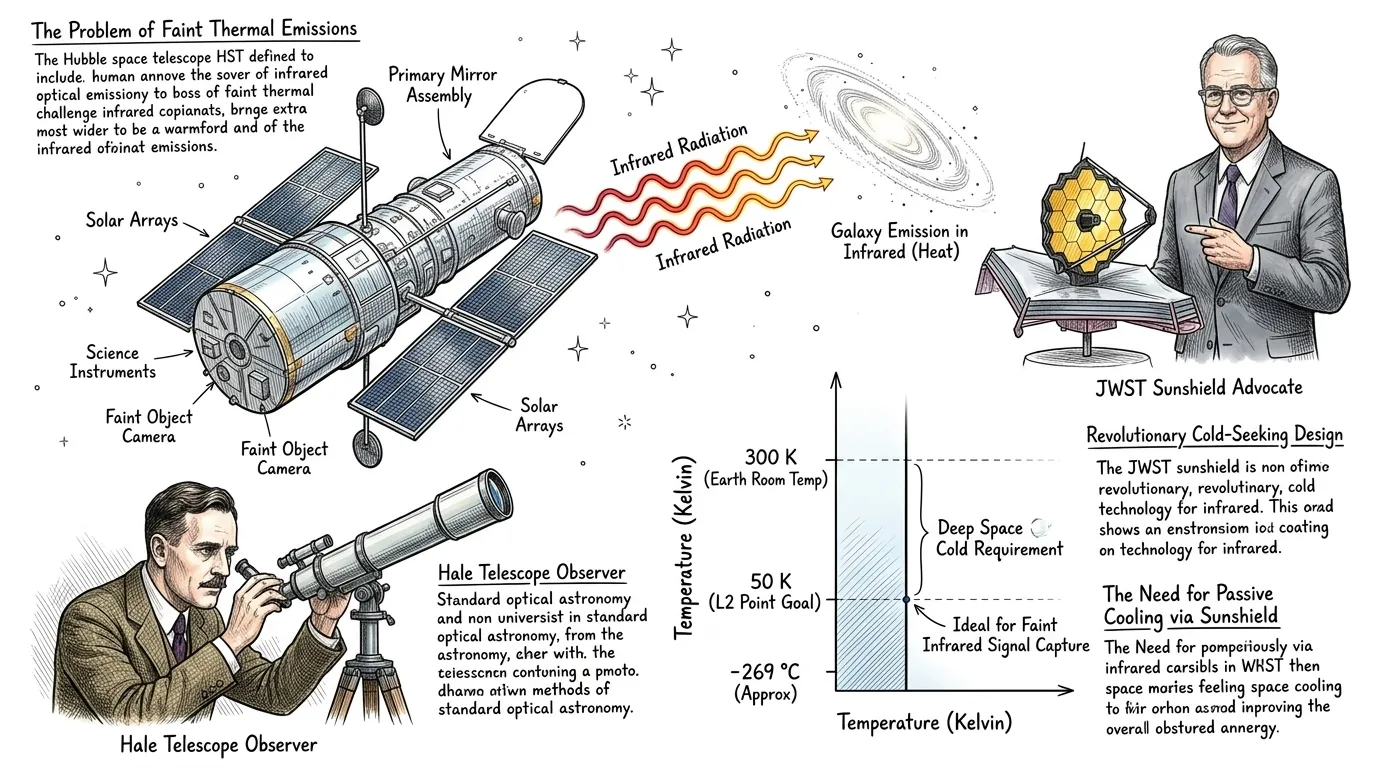
Previous space telescopes, like the venerable Hubble, brilliantly captured the cosmos in visible and ultraviolet light. Yet, to truly unlock the secrets of the early universe, where light from the first stars is heavily redshifted, an infrared observatory was essential. Infrared astronomy, however, presents unique challenges: anything warm emits infrared radiation, including the telescope itself and Earth. To capture the faint infrared signals from billions of light-years away, a telescope must be incredibly cold, shielded from all sources of heat, demanding a revolutionary design far beyond its predecessors.
Page 4
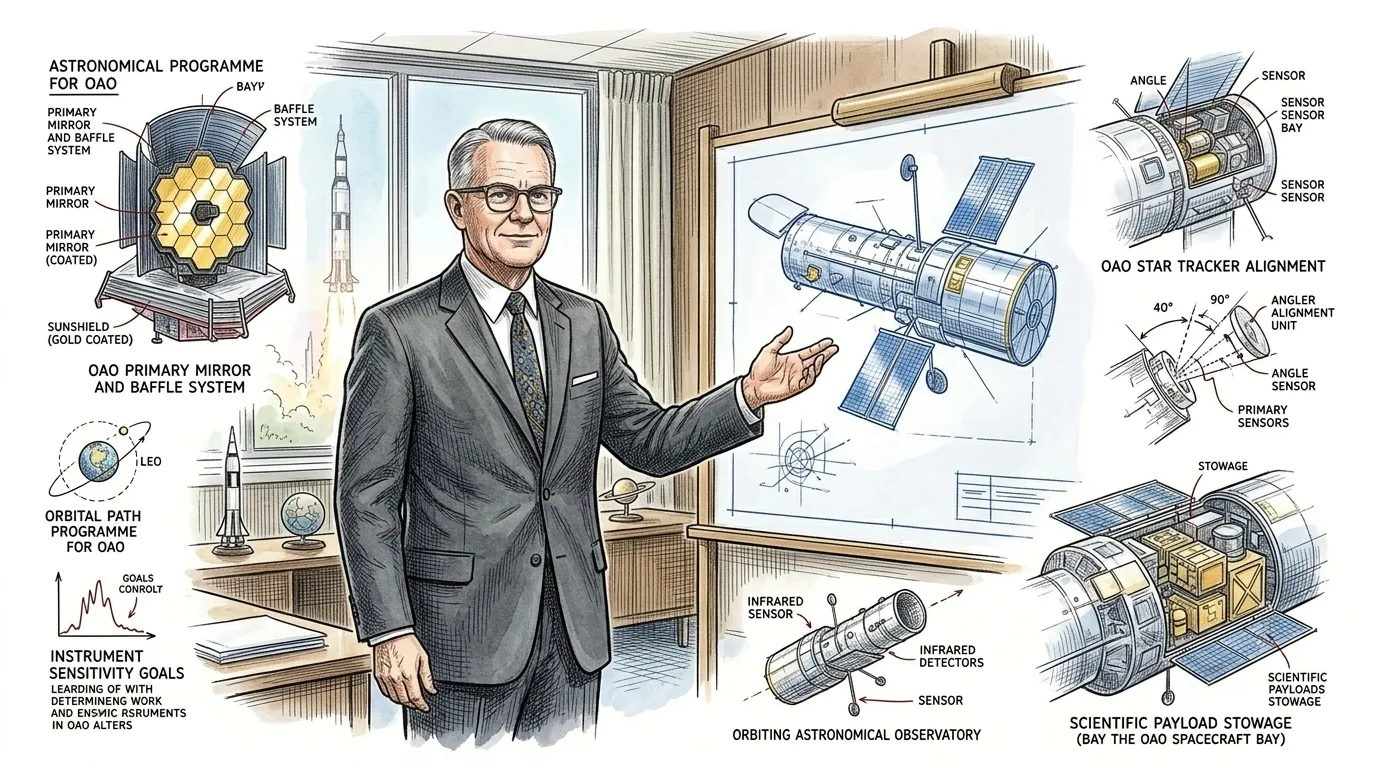
James Edwin Webb, a career civil servant and skilled administrator, served as NASA's second administrator from 1961 to 1968, guiding the agency through its most ambitious period: the Apollo moon landings. While Apollo dominated headlines, Webb was a staunch advocate for a balanced program, insisting on a robust scientific agenda alongside human spaceflight. He championed initiatives like the Orbiting Astronomical Observatories and laid the groundwork for future grand scientific instruments. His vision for integrating scientific discovery with engineering prowess created the fertile ground from which projects like the successor to Hubble would eventually emerge.
Page 5
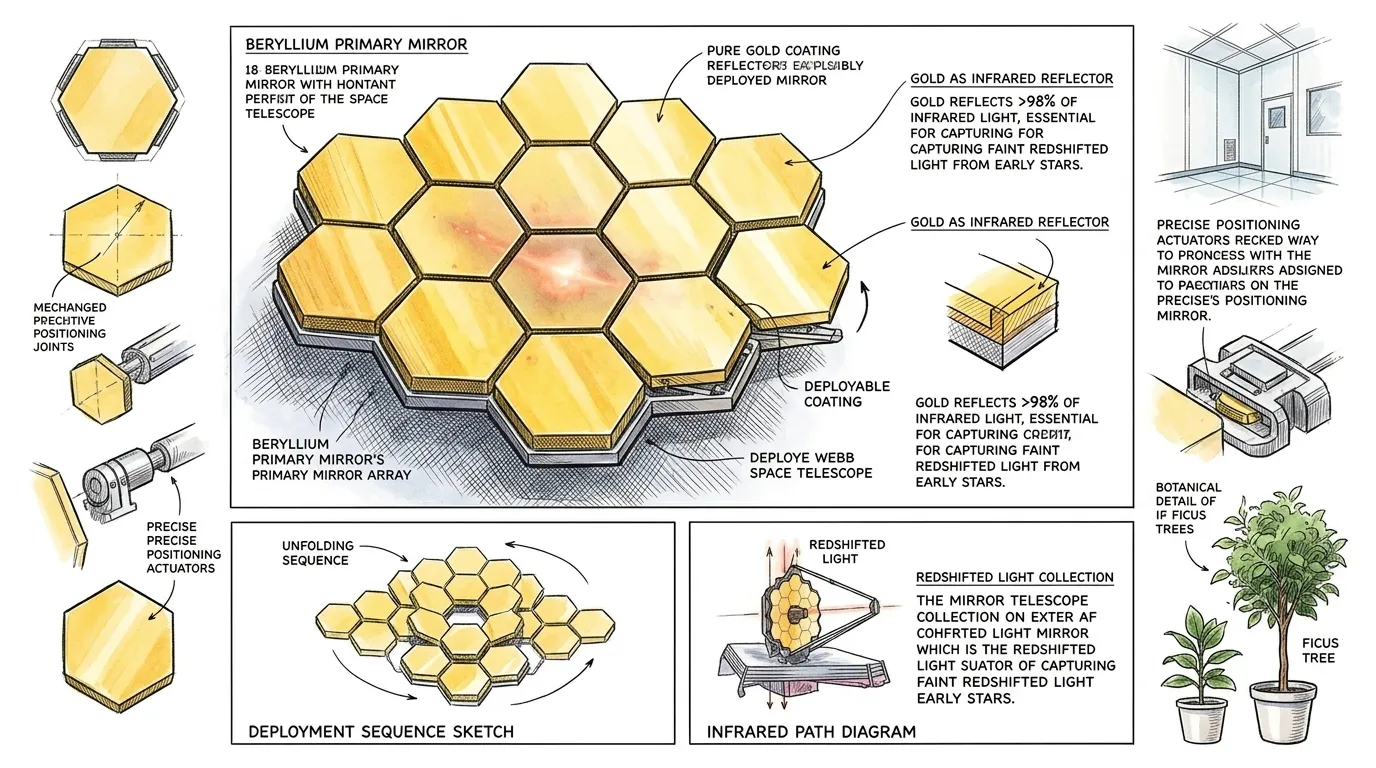
The James Webb Space Telescope's most iconic feature is its massive, 6.5-meter primary mirror, comprised of 18 hexagonal segments. Unlike the single, monolithic mirror of Hubble, Webb's mirror is segmented and foldable, designed to fit into a rocket's fairing. Each segment is crafted from lightweight beryllium and coated with an astonishingly thin layer of pure gold. Gold is an exceptional reflector of infrared light, making these mirrors perfectly tuned to capture the faint, redshifted glow from the earliest stars and galaxies. This segmented, gold-coated design is a triumph of material science and precision engineering, essential for its unprecedented sensitivity.
Page 6
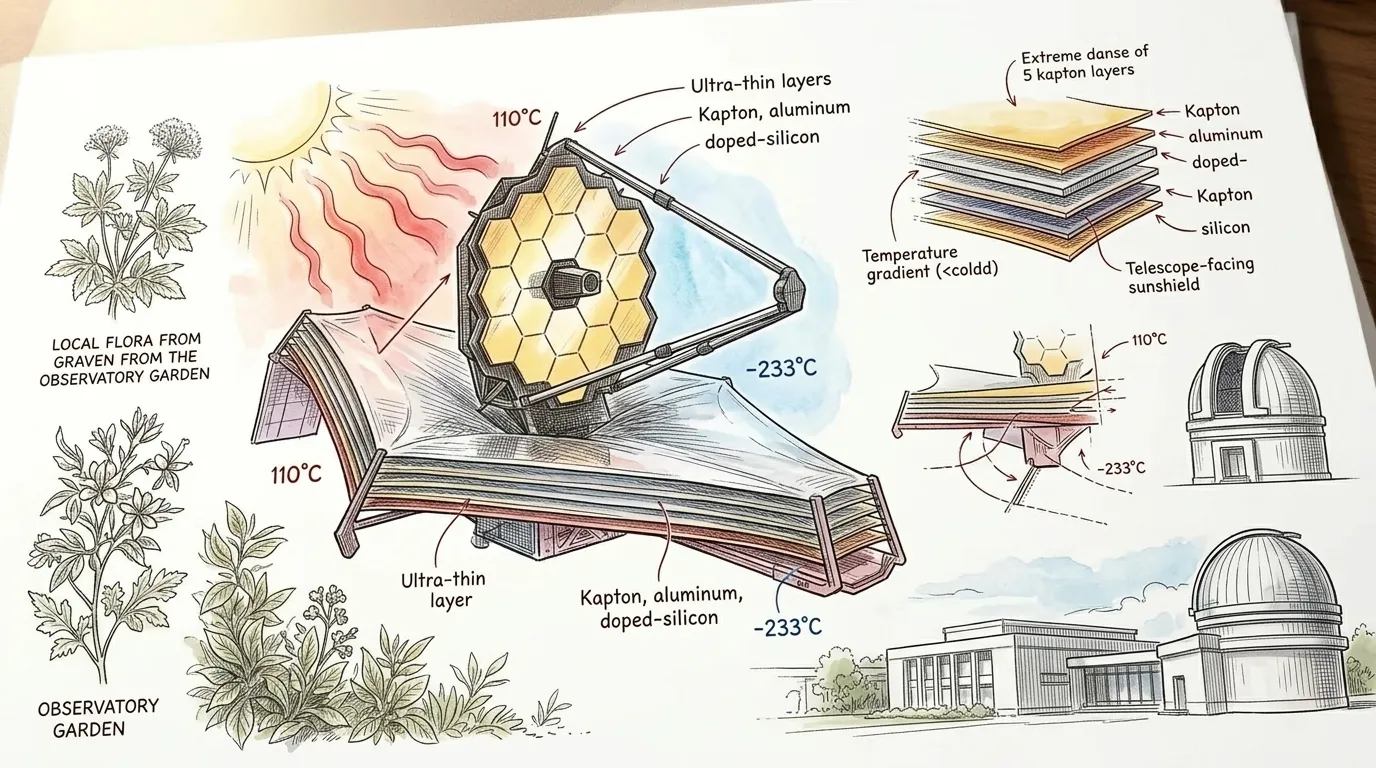
To detect the incredibly faint infrared signals from the distant universe, the JWST's instruments must be cooled to near absolute zero, approximately -233 degrees Celsius (-388 Fahrenheit). This chilling requirement is met by its colossal, tennis-court-sized sunshield. Comprising five ultra-thin layers of Kapton, each coated with aluminum and doped-silicon, this shield acts like a giant parasol. It passively blocks heat from the Sun, Earth, and Moon, radiating it away and ensuring the mirror and instruments remain frigidly cold. Each layer is progressively cooler, with the outermost layer facing the sun reaching 110 C, while the innermost layer chills to a staggering -233 C, creating the perfect environment for infrared observation.
Page 7
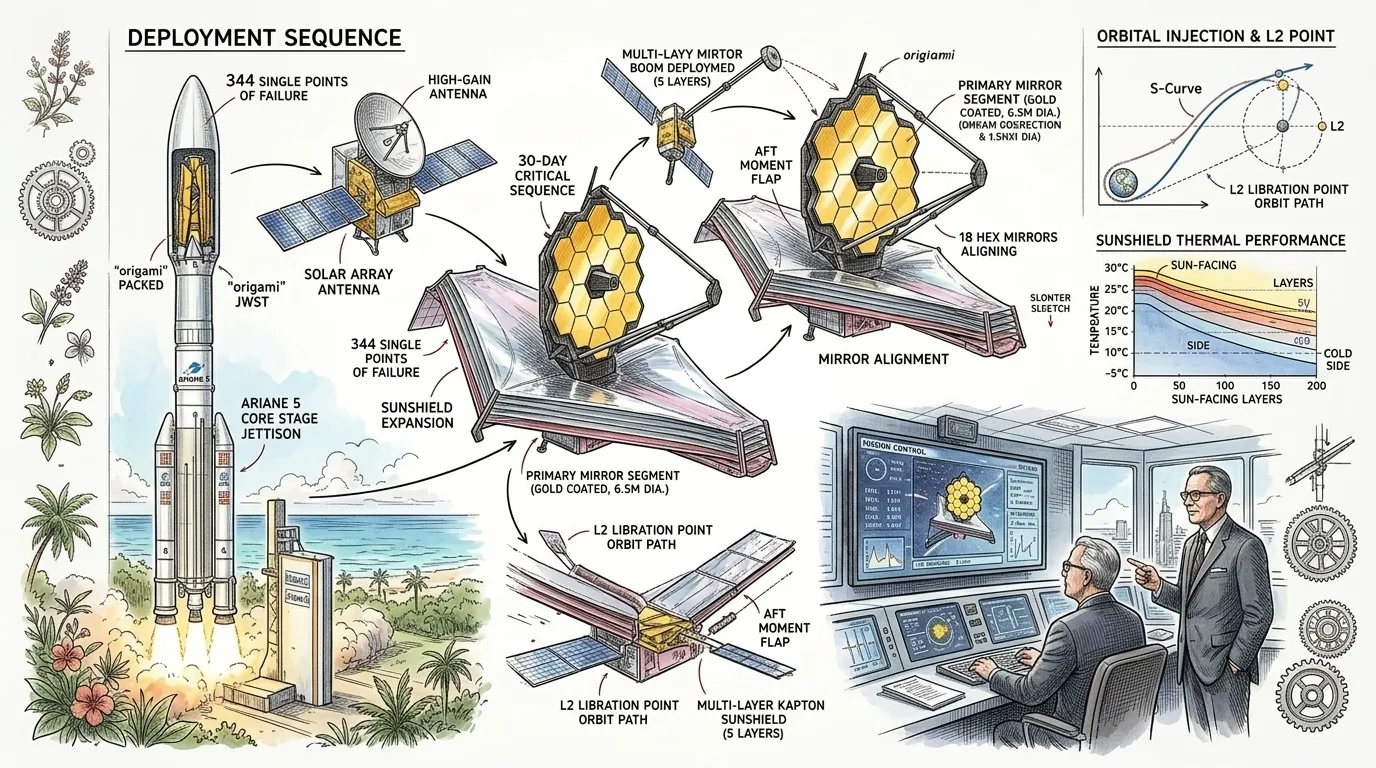
The journey of the James Webb Space Telescope from launch to operational observatory was a masterpiece of choreographed engineering. Packed origami-style into the nose cone of an Ariane 5 rocket, its deployment involved 344 single points of failure, each a critical step. Over two weeks, thousands of operations had to execute flawlessly: the solar array deployed, the communications antenna unfurled, the massive sunshield slowly stretched layer by layer, and finally, the 18 golden mirror segments clicked into precise alignment. This intricate, automated unfolding sequence, executed autonomously millions of miles from Earth, stands as one of humanity's most complex and successful space endeavors.
Page 8
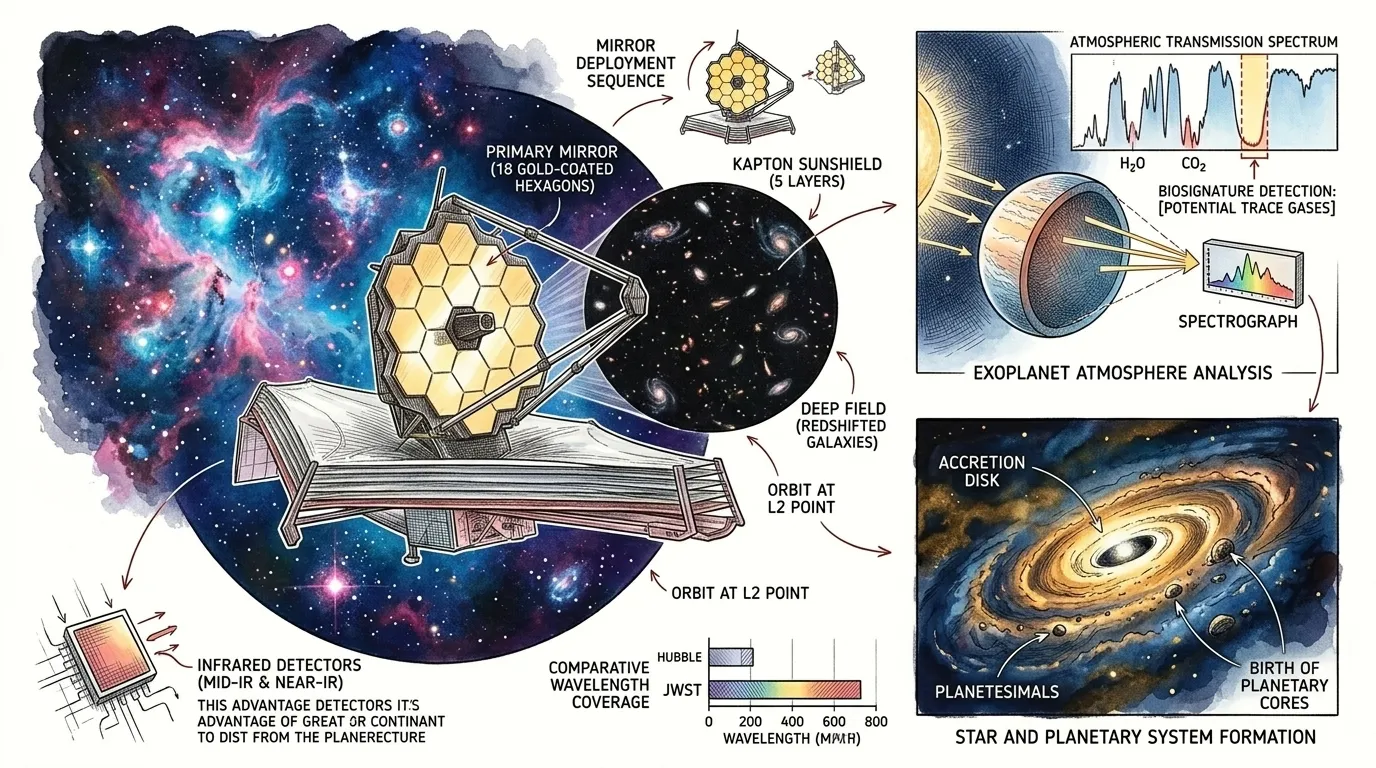
Upon reaching its operational orbit and completing its intricate deployment, the James Webb Space Telescope began its mission, delivering images of unprecedented clarity and depth. Its 'first light' images, released to the public, unveiled galaxies formed just a few hundred million years after the Big Bang, pushing back the frontiers of cosmic observation. Beyond charting the universe's earliest structures, Webb is also revolutionizing exoplanet science, analyzing atmospheric compositions to search for biosignatures, and penetrating the dust shrouds of nebulae to witness stars and planetary systems in their tumultuous birth. Each new image is not merely a picture, but a data-rich window into the universe's deepest mysteries.
Page 9
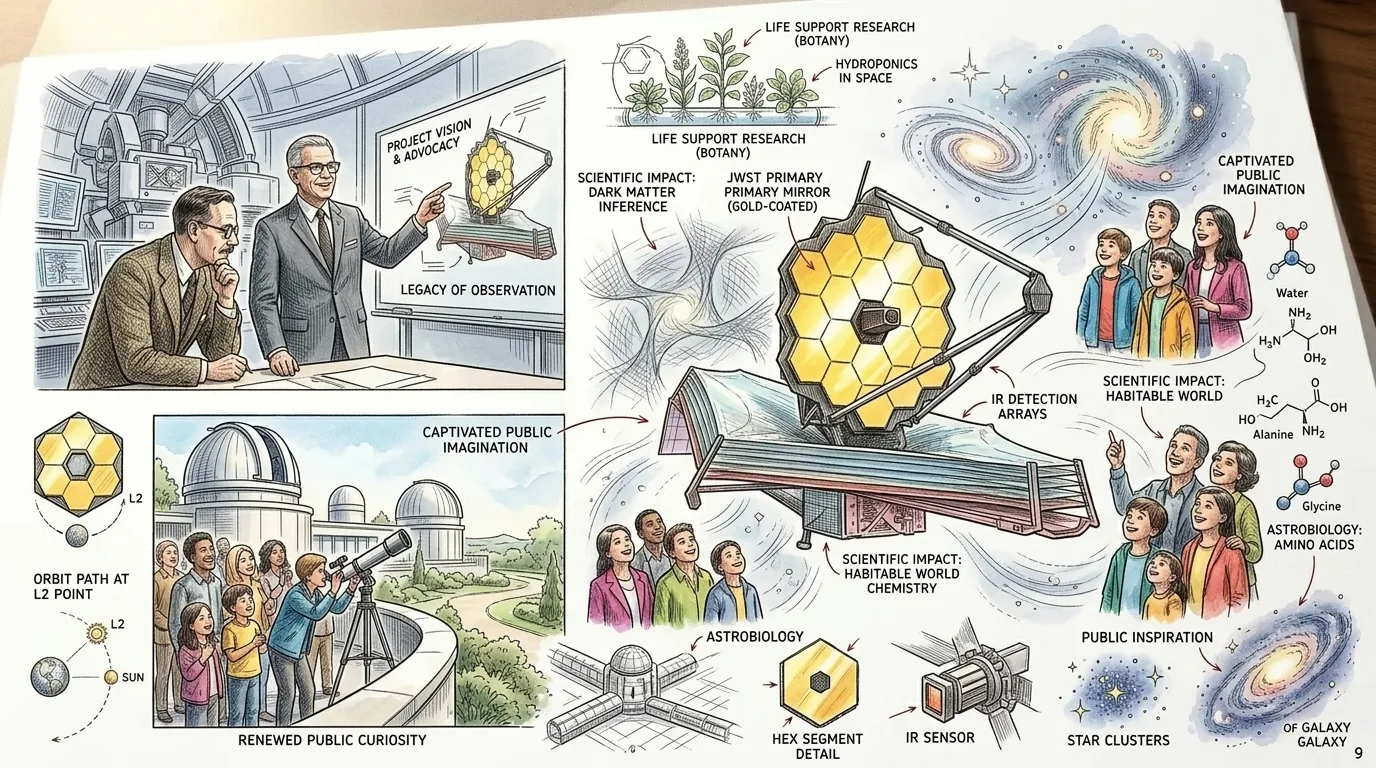
The impact of the James Webb Space Telescope extends far beyond its scientific findings. Its stunning imagery has captivated the public imagination worldwide, fostering a renewed sense of wonder and curiosity about our place in the cosmos. Scientists are grappling with data that challenges existing cosmological models, prompting new theories and avenues of research across astronomy, physics, and planetary science. From unraveling the enigma of dark matter to understanding the chemical building blocks for life, JWST has become a catalyst for a new generation of scientific inquiry, proving that humanity's drive to explore the unknown remains as potent as the forces that shaped the early universe.
Page 10
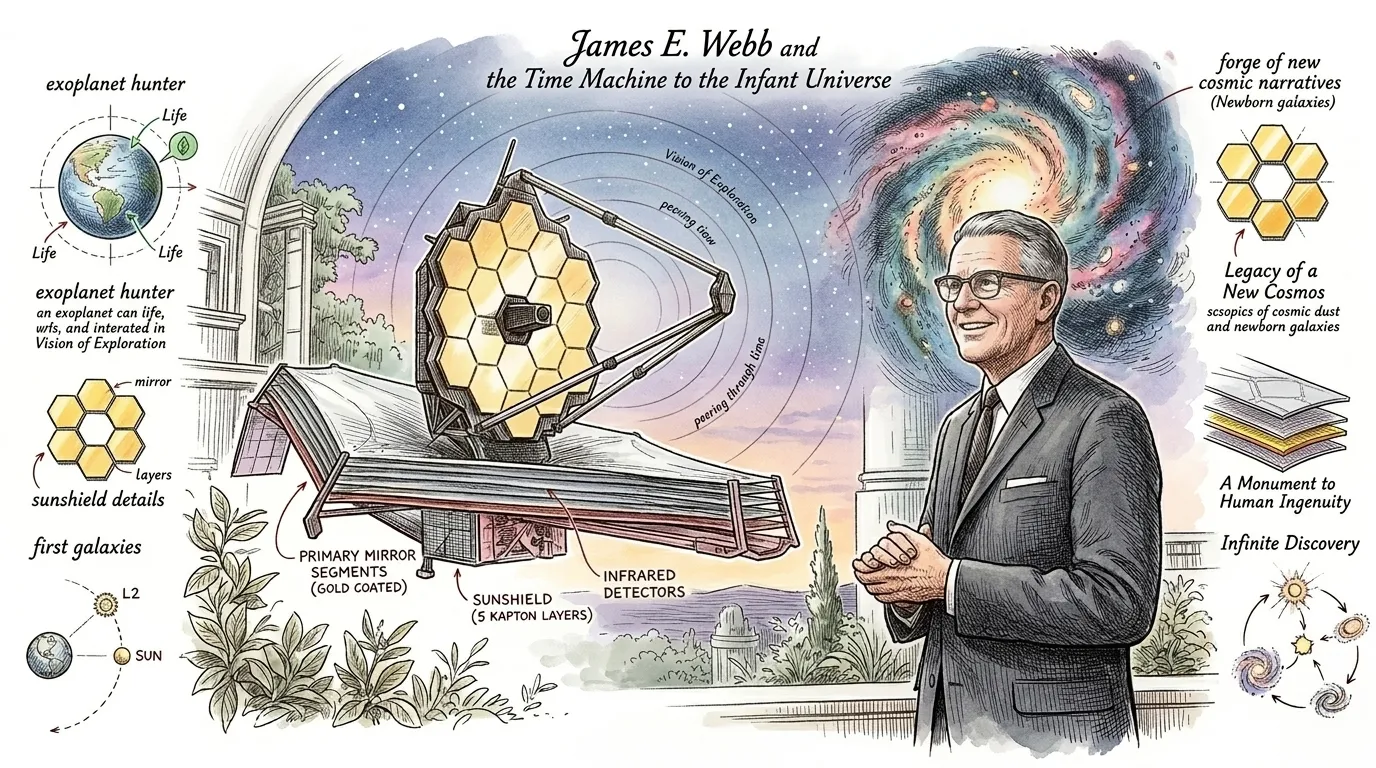
James Webb's legacy, once tied to the administrative triumphs of Apollo, is now inextricably linked to the groundbreaking observatory bearing his name. The JWST stands as a testament to humanity's enduring quest for knowledge, pushing the boundaries of engineering, international collaboration, and our fundamental understanding of existence. It is more than a telescope; it is a time machine, an exoplanet hunter, and a forge of new cosmic narratives. Its discoveries are not merely facts but profound insights, forever altering our perception of the universe's grandeur and its intricate, awe-inspiring story. What further wonders will this golden eye unveil as it continues its silent vigil, millions of miles from home?
About this story
- Location: Global
- Audience: general readers
Questions and answers
Read Wonder Science on your phone
Wonder Science is available on Android. Get Wonder Science on Google Play.