John Bardeen
John Bardeen — an illustrated science story, set in Global. 10 illustrated pages, free to read on Wonder Science.
Page 1
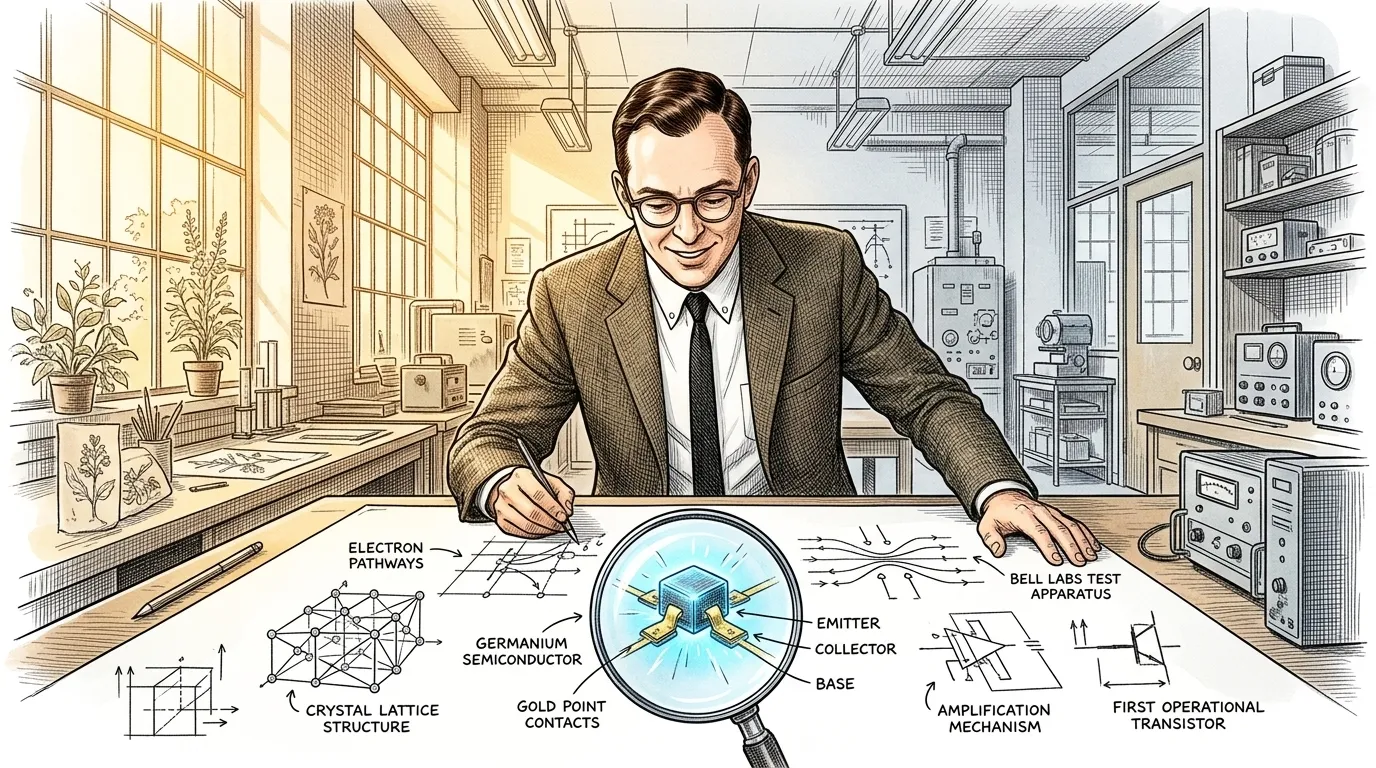
The year is 1947, a pivotal moment in human history, though few realized it at the time. Inside the Bell Telephone Laboratories, a small, unassuming device, barely larger than a human fingernail, hummed into existence. This was the point-contact transistor, a semiconductor marvel that would rapidly replace cumbersome vacuum tubes and ignite the digital revolution. Its birth represented a profound leap in solid-state physics, a direct result of the quiet, yet monumental, theoretical insights of one man: John Bardeen.
Page 2
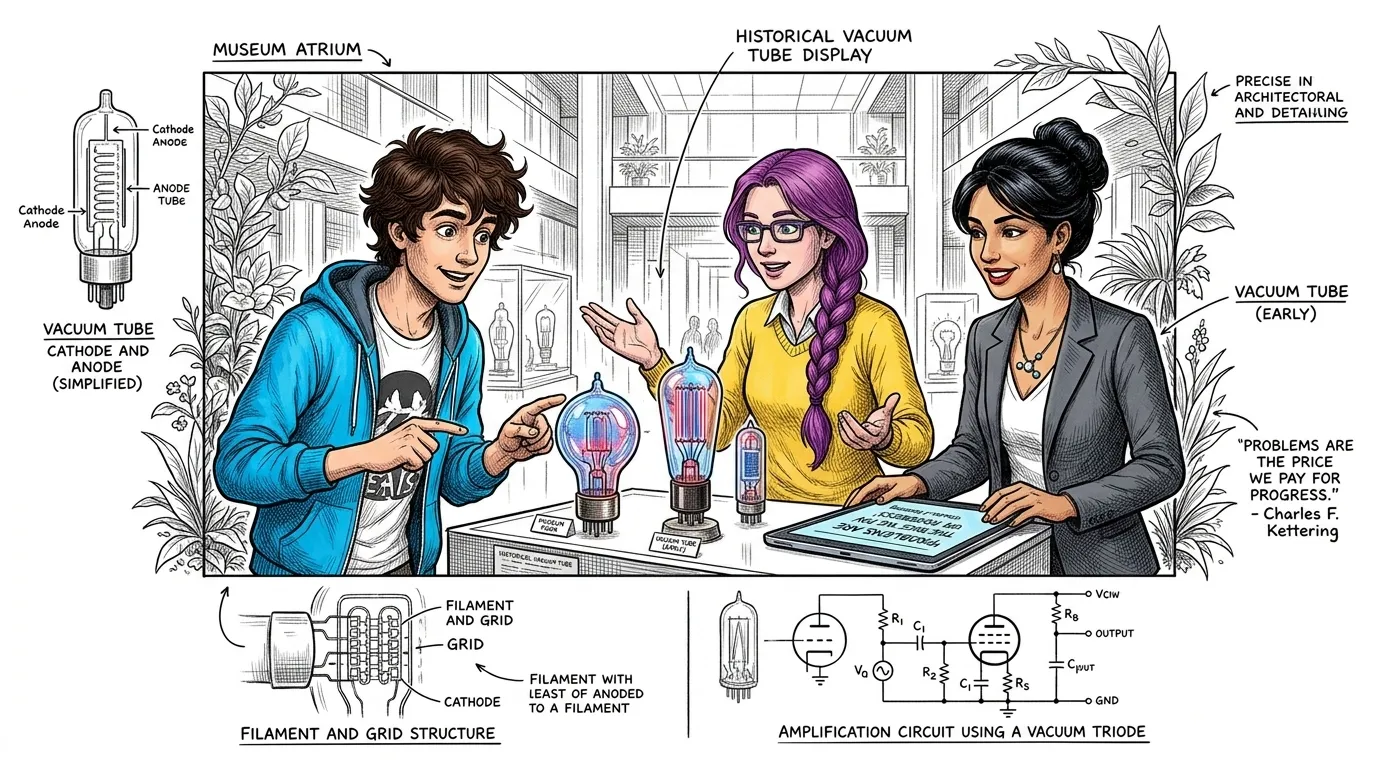
Before the transistor, the world of electronics was dominated by vacuum tubes. These glass bulbs, often as large as light bulbs, controlled electron flow to amplify signals or switch currents. While revolutionary for their time, they were notoriously fragile, consumed vast amounts of power, generated considerable heat, and were prone to frequent failure. This made complex electronic devices, like early computers, enormous, expensive, and unreliable, presenting a critical bottleneck for technological progress. Scientists knew a more robust, efficient solution was desperately needed.
"Rohan asked, 'So, all those old radios and computers used these big, glowing tubes?' Vera added, 'And they broke easily, right? Like tiny glass light bulbs!' Salma nodded, 'Indeed. They were the cutting edge, but fragile. As the American inventor Charles F. Kettering once noted, "A problem well stated is a problem half-solved." The problem of the vacuum tube was certainly well-stated, driving scientists to seek a new path.'"
Page 3
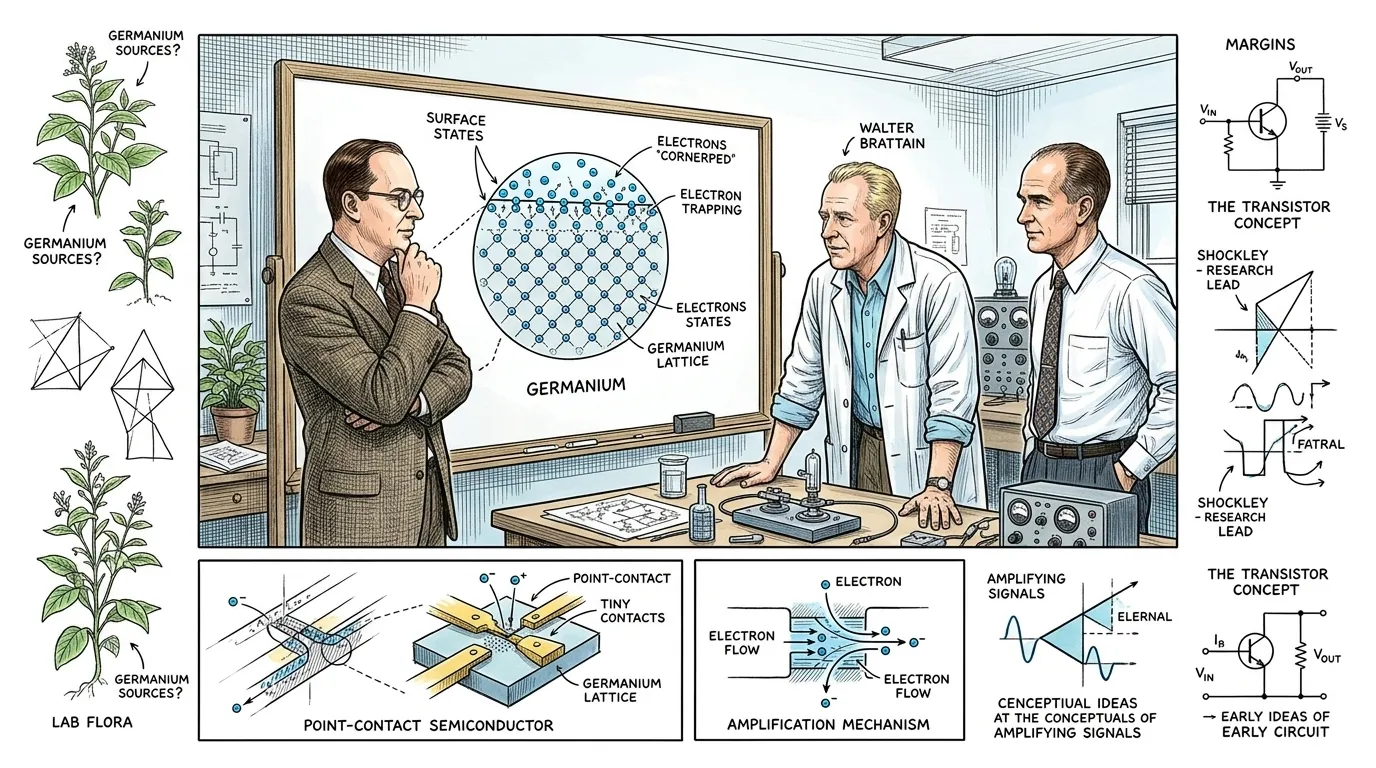
At Bell Labs, a team including physicist John Bardeen, Walter Brattain, and William Shockley, embarked on a quest for a solid-state alternative. Bardeen's genius lay in his theoretical understanding of semiconductor surface states. He proposed that electrons could get 'trapped' at the surface of a semiconductor material like germanium, creating a barrier that prevented electric fields from easily penetrating the material. This was a crucial insight, as controlling these surface electrons held the key to manipulating current within the material itself.
Page 4
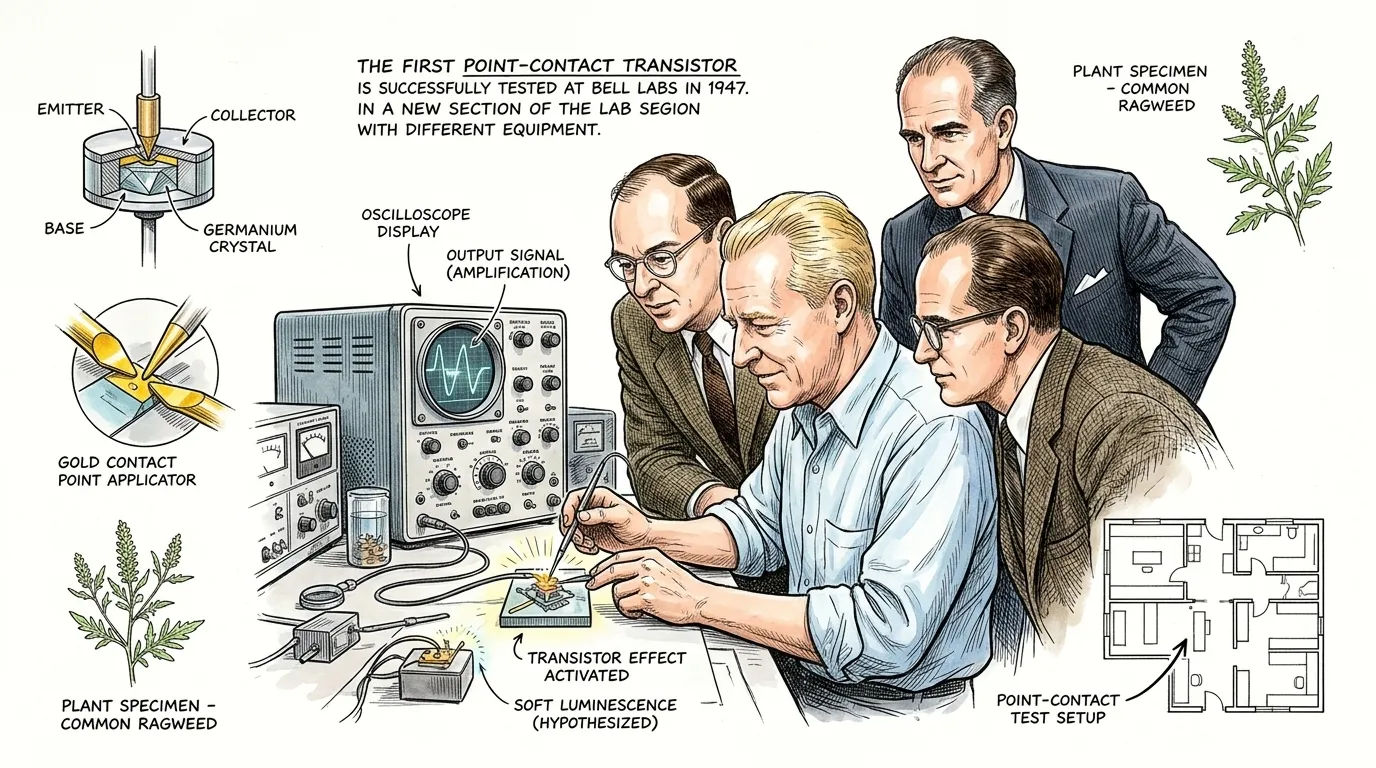
Building on Bardeen's theory, Walter Brattain began experimenting with germanium. On December 16, 1947, Brattain, guided by Bardeen's theoretical understanding, made a critical adjustment: placing a thin layer of gold on the germanium's surface and applying a small voltage. This seemingly minor change allowed him to control the electron flow, achieving amplification. Just days later, on December 23, they publicly demonstrated the first working point-contact transistor, a watershed moment that would earn Bardeen, Brattain, and Shockley the 1956 Nobel Prize in Physics.
Page 5
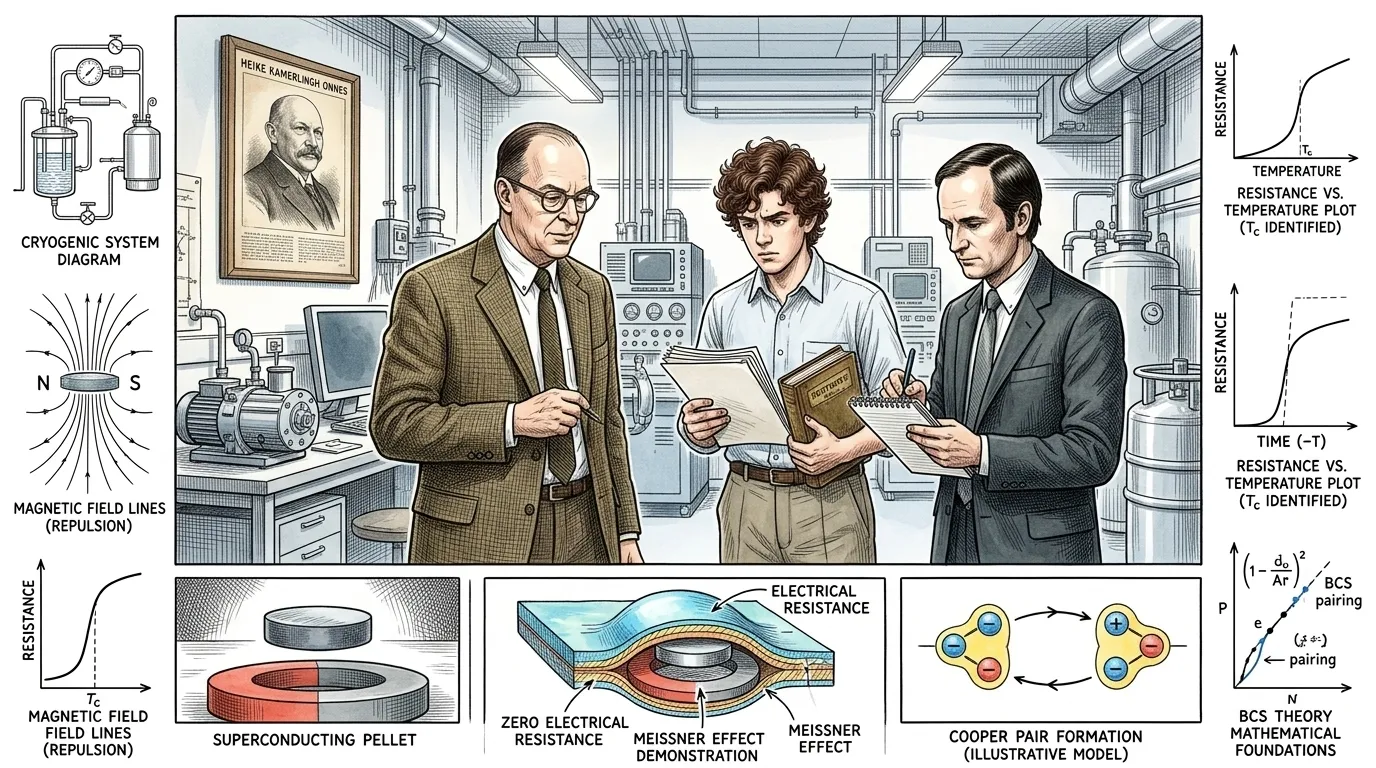
Decades after his transistor triumph, Bardeen turned his attention to another profound mystery: superconductivity. Discovered by Heike Kamerlingh Onnes in 1911, this phenomenon described certain materials losing all electrical resistance when cooled to extremely low temperatures. For half a century, its fundamental mechanism remained unexplained, a significant puzzle in condensed matter physics. Bardeen, alongside Leon Cooper and J. Robert Schrieffer, sought to demystify this elusive quantum state, a challenge that demanded an entirely new theoretical framework.
Page 6
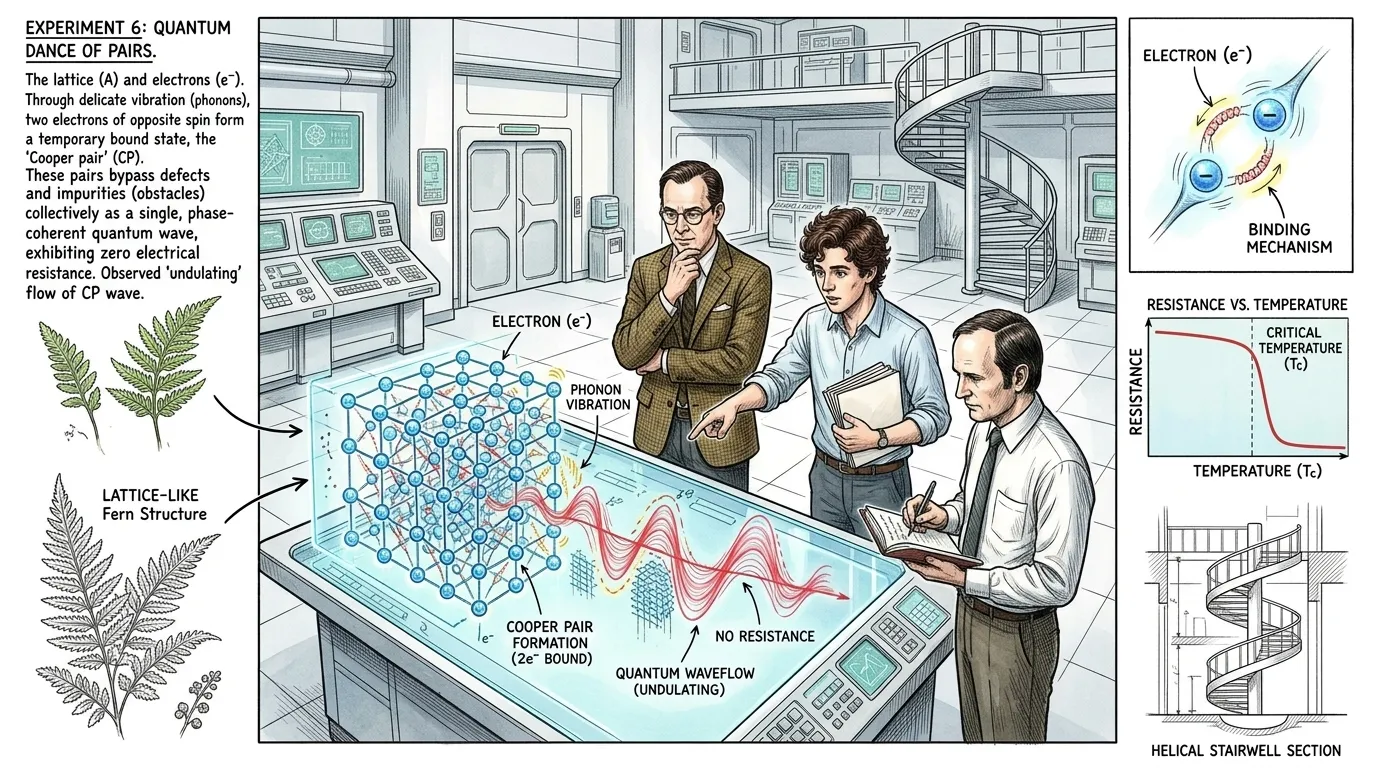
The key to understanding superconductivity, Bardeen and his colleagues discovered, lay in the peculiar 'dance' of electrons. Normally, electrons repel each other. However, at extremely low temperatures, they can interact indirectly through lattice vibrations (phonons) within the material. This subtle interaction causes two electrons to form a 'Cooper pair' – a bound state, despite their individual repulsions. These Cooper pairs then move through the material without encountering resistance, flowing collectively like a single quantum wave, bypassing all obstacles.
Page 7
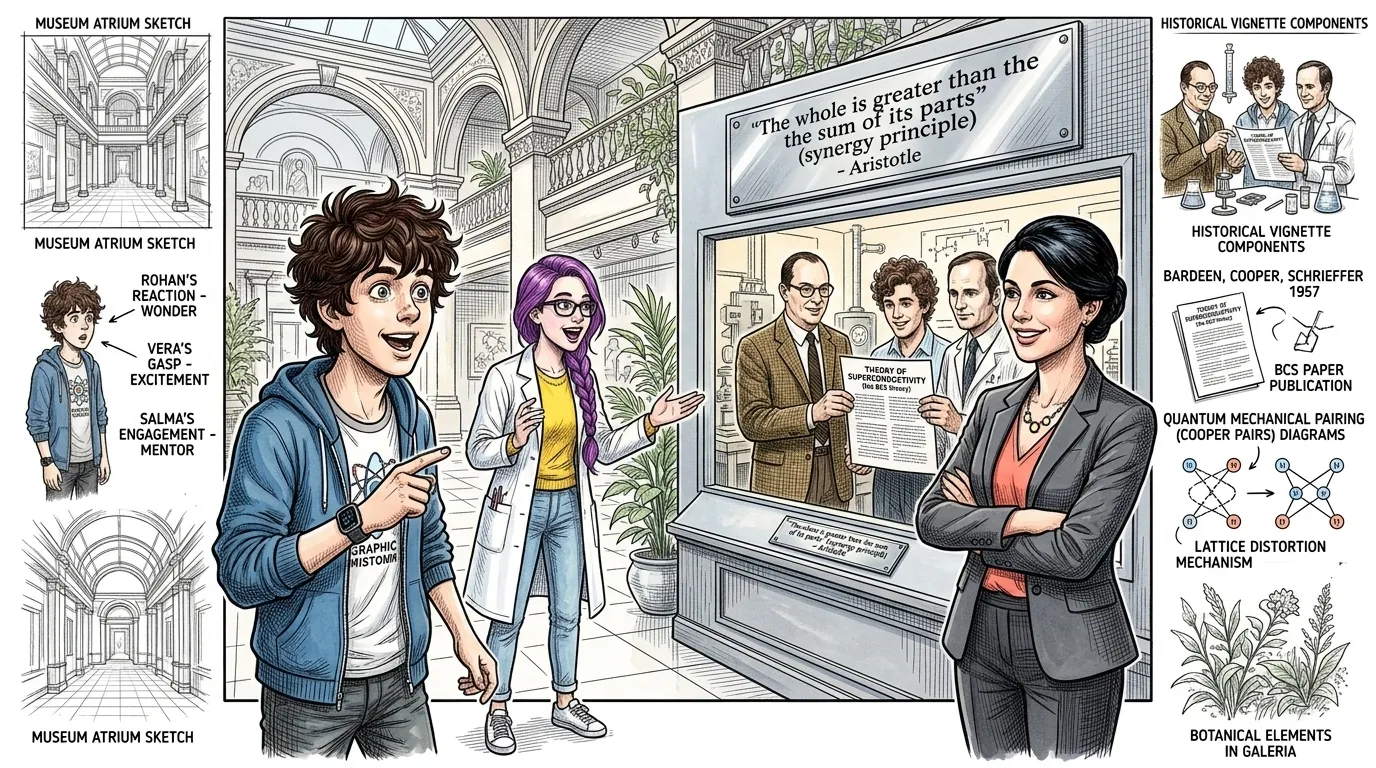
In 1957, Bardeen, Cooper, and Schrieffer published their groundbreaking 'BCS theory' of superconductivity, providing the first comprehensive microscopic explanation for this enigmatic phenomenon. The theory beautifully described how Cooper pairs, formed through electron-phonon interactions, condense into a collective quantum state, allowing them to flow with zero resistance. This profound theoretical achievement, decades after Bardeen's first Nobel, earned him his second Nobel Prize in Physics in 1972, a feat unmatched by any other physicist.
"Rohan exclaimed, 'So, electrons can actually team up and move without any resistance at all?' Vera gasped, 'That's incredible! No lost energy!' Salma added, 'Precisely. Their collaborative effort demonstrates what the ancient Greek philosopher Aristotle might have called synergy—the whole being greater than the sum of its parts. It's a perfect illustration of how complex quantum phenomena can emerge from simple interactions.'"
Page 8
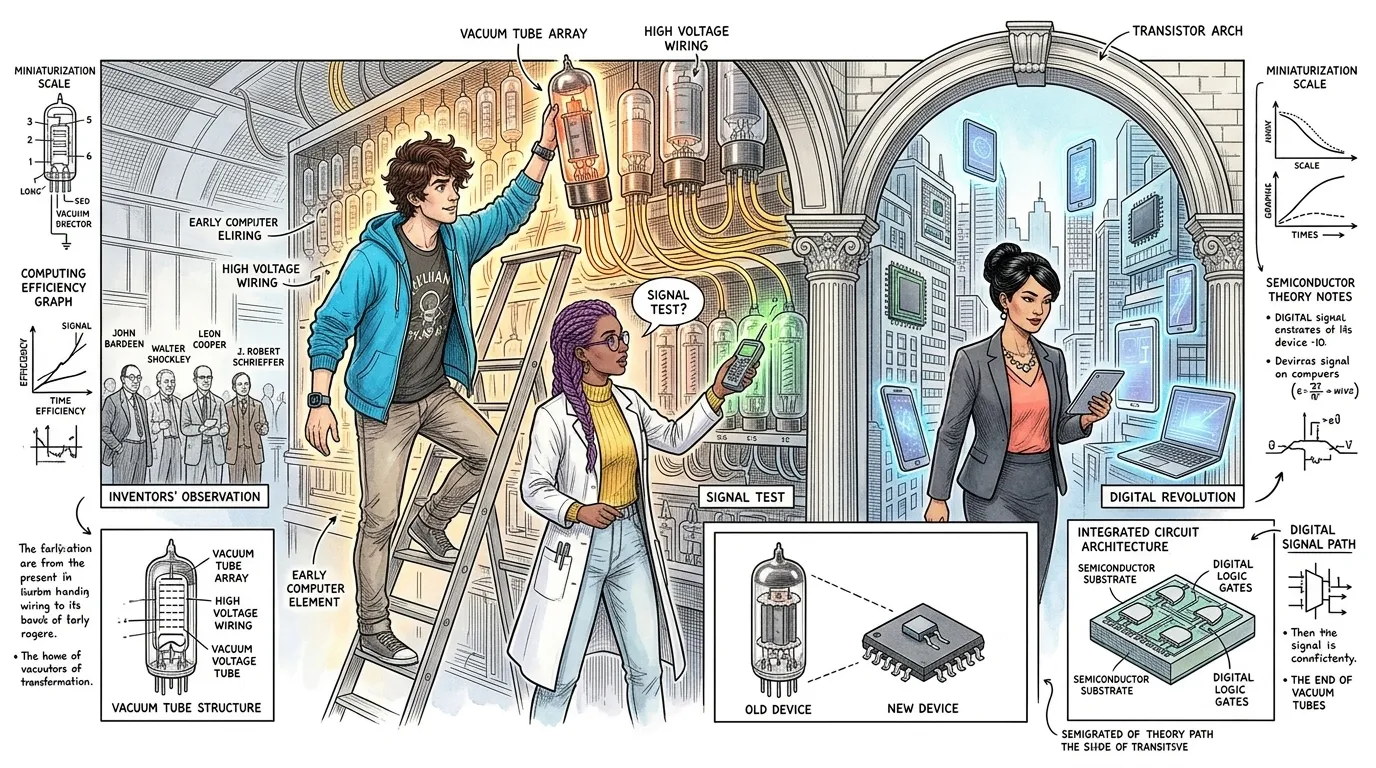
The transistor's impact is immeasurable. From its humble beginnings, it miniaturized electronics, making possible the integrated circuit and microchip. Without the transistor, there would be no personal computers, smartphones, the internet, or the vast array of digital devices that define our modern world. It shrunk entire rooms of vacuum tubes into pockets, democratizing information and communication, and fundamentally reshaping society in ways Bardeen himself could scarcely have imagined.
Page 9
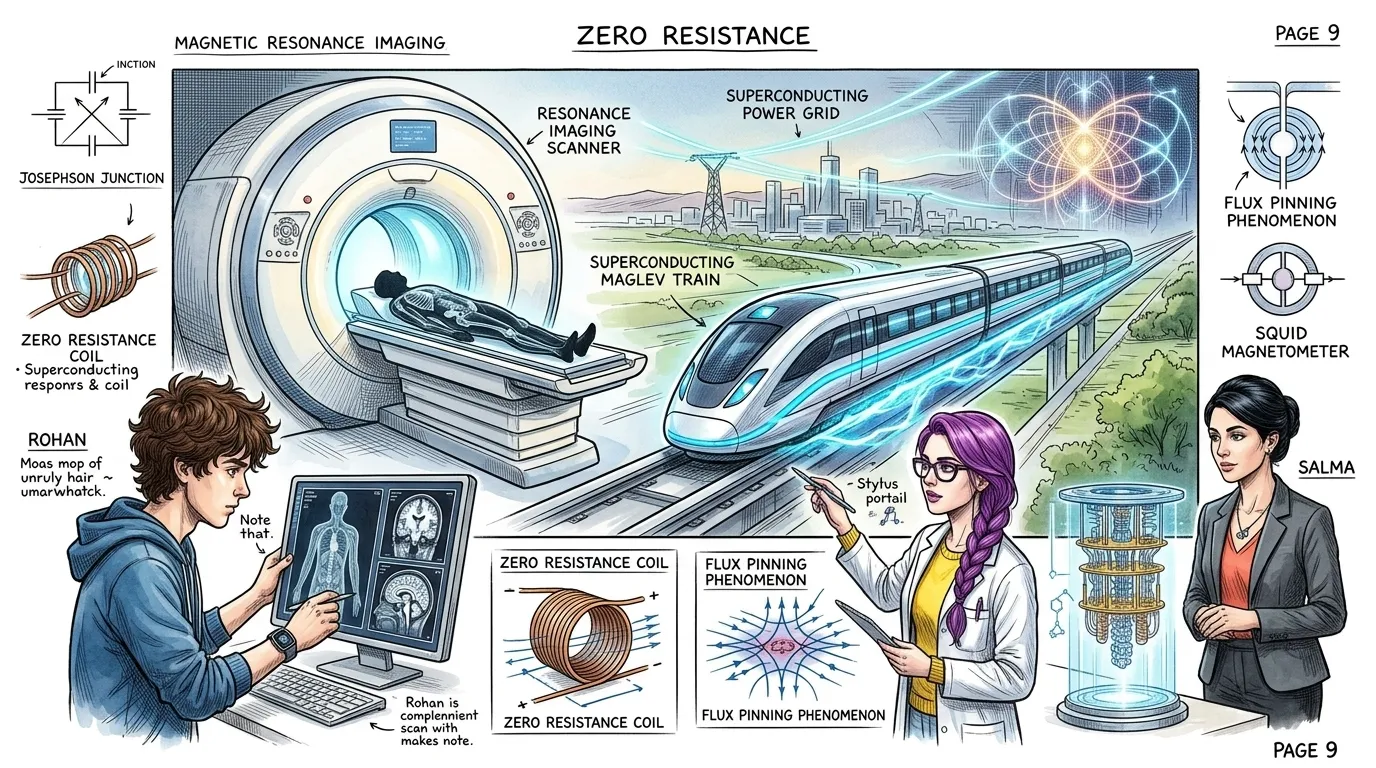
Superconductivity, though requiring extreme cold, offers transformative potential. Its most widespread application is in Magnetic Resonance Imaging (MRI) scanners, where superconducting magnets create powerful, stable magnetic fields for detailed medical diagnostics. Beyond medicine, it powers maglev trains, levitating them above tracks for frictionless, high-speed travel. Future applications range from incredibly efficient power grids to advanced quantum computing, promising an era of unprecedented energy efficiency and technological capability.
Page 10
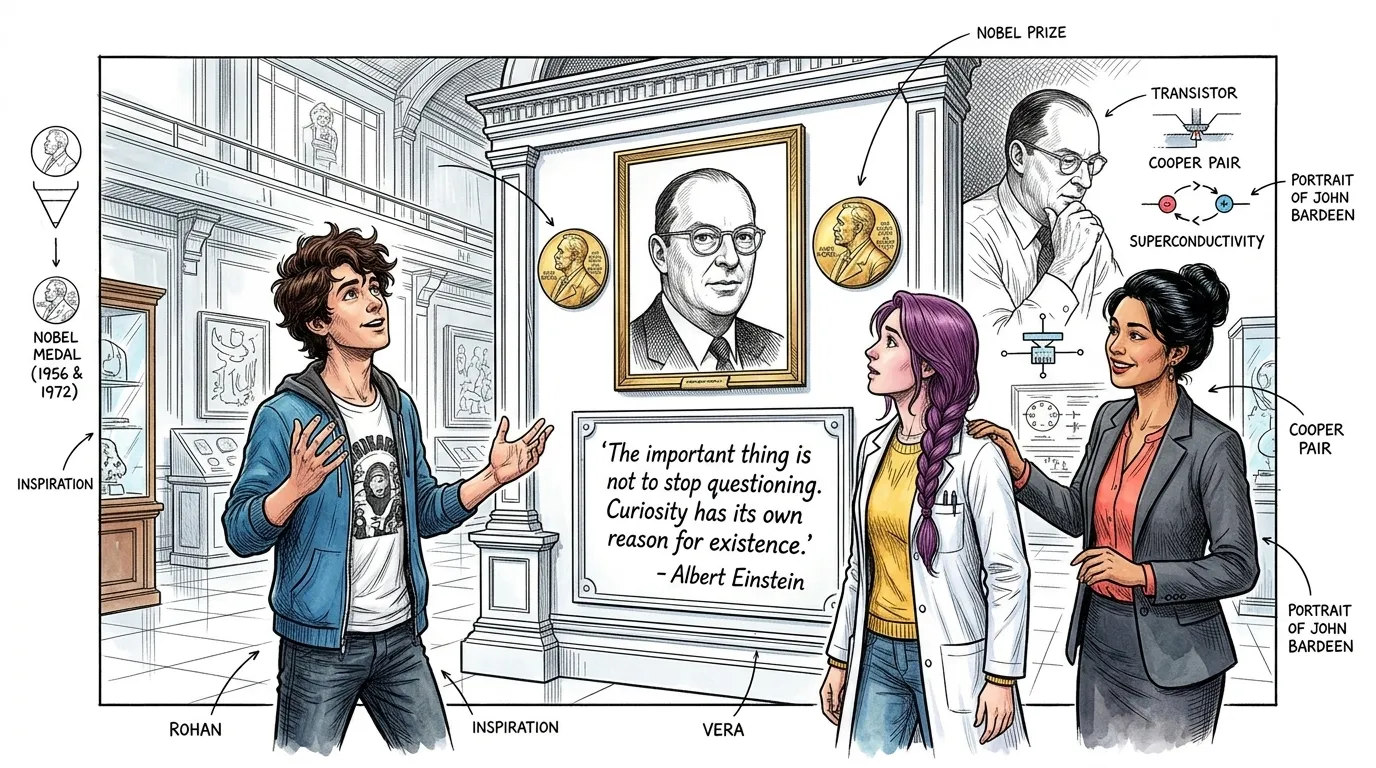
John Bardeen, a man of quiet demeanor and profound intellect, remains the only scientist to have been awarded the Nobel Prize in Physics twice: first for the transistor, and then for his theory of superconductivity. His dual achievements fundamentally reshaped two distinct fields of physics and laid the groundwork for the entire digital age and future energy technologies. Bardeen's legacy is not just in the devices we use, but in demonstrating the immense power of theoretical insight to unlock nature's deepest secrets, pushing the boundaries of what is possible and inspiring generations to come.
"Rohan mused, 'Two Nobel Prizes for physics... that's amazing! Imagine solving two huge mysteries!' Vera added, 'And his work is everywhere, even in our phones!' Salma smiled, 'Indeed. His brilliance wasn't just in discovery, but in the sheer depth of his understanding. His work reminds us that true progress often comes from quietly persistent intellectual courage, proving, as Albert Einstein said, 'The important thing is not to stop questioning. Curiosity has its own reason for existence.' Bardeen embodied that spirit completely."
About this story
- Location: Global
- Audience: general readers
Questions and answers
Read Wonder Science on your phone
Wonder Science is available on Android. Get Wonder Science on Google Play.