Jocelyn Bell Burnell
Jocelyn Bell Burnell — an illustrated science story, set in Global. 10 illustrated pages, free to read on Wonder Science.

Page 1

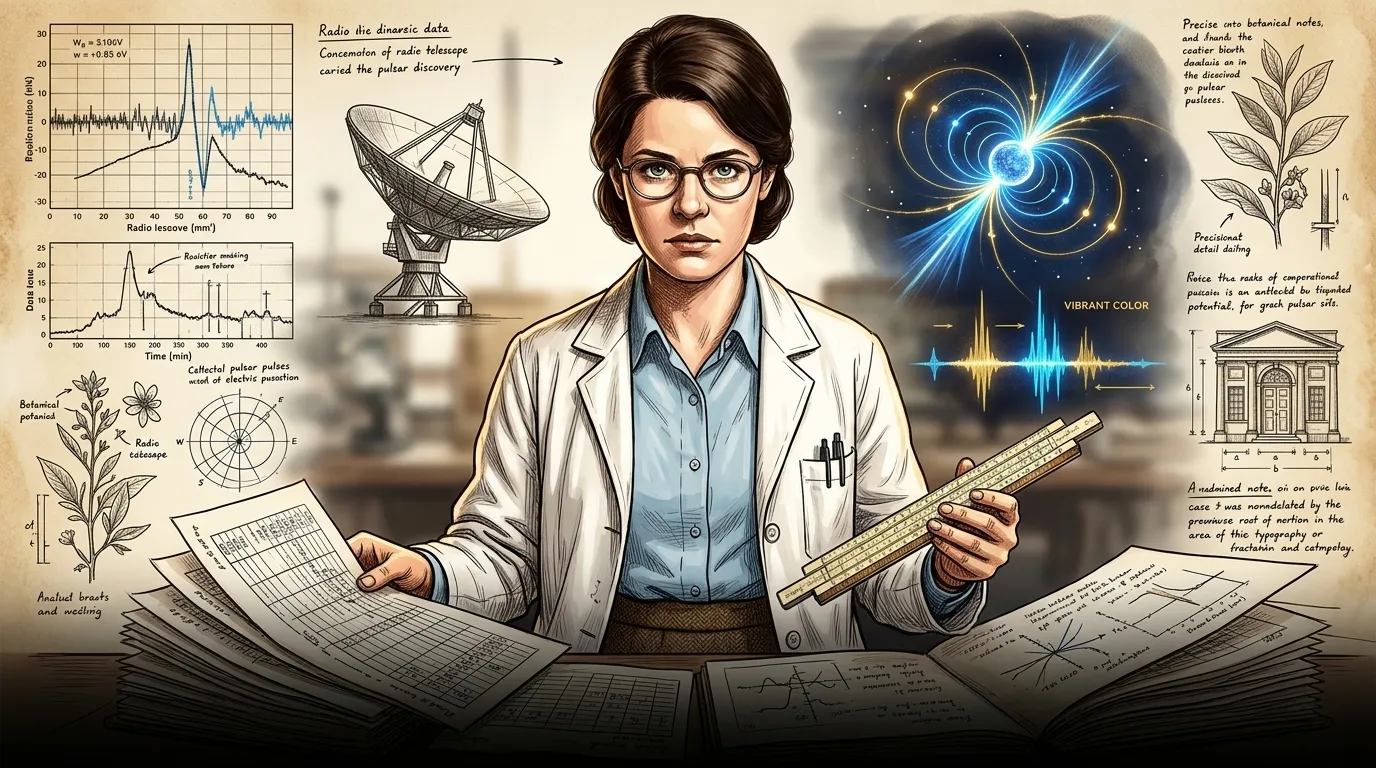
In August 1967, at the Mullard Radio Astronomy Observatory, Jocelyn Bell Burnell, a Cambridge PhD student, meticulously analyzed reams of paper data from a newly built radio telescope. Amidst expected celestial noise, she noticed a peculiar, repeating signal — a tiny, regular 'scruff' that defied explanation, pulsing precisely every 1.3 seconds. This anomaly would challenge established astronomical understanding and rewrite cosmic history, marking the unexpected genesis of an entirely new field of astrophysics.
Page 2

Bell Burnell's persistent observation confirmed the signal was not terrestrial interference. Its incredible regularity, a precise burst of radio waves every 1.3373 seconds, led to playful internal speculation about 'Little Green Men' — a hypothetical alien civilization. As Jocelyn Bell Burnell herself would famously recount, reflecting on those early observations, 'It was totally unexpected. We didn't know what it was. It wasn't in any textbook.' This profound uncertainty marked the beginning of a revolutionary chapter in astronomy.
Page 3

The team soon discovered other similar pulsing sources, confirming their cosmic origin. These objects were not alien signals, but something far more extraordinary: rapidly spinning neutron stars. These incredibly dense remnants are formed from the supernova collapse of massive stars, packing several times the mass of our Sun into a sphere merely 20 kilometers across. This revelation linked the mysterious pulses directly to the cataclysmic deaths of giant stars.
Page 4

Neutron stars possess unbelievably powerful magnetic fields. As they spin, these fields accelerate charged particles, channeling them into concentrated beams of radiation that blast out from the magnetic poles. If one of these energetic beams sweeps across our line of sight, we detect it as a regular pulse of radio waves, much like observing a distant lighthouse whose beam intermittently flashes past an observer.
Page 5

The density of a neutron star is almost unimaginable: a single teaspoonful of its matter would weigh billions of tons – more than every car on Earth combined. This extreme compaction, combined with the conservation of angular momentum during the star's collapse, causes them to spin at phenomenal speeds, often hundreds of times per second, transforming a vast star into a tiny, rapidly rotating cosmic engine.
Page 6

The regularity of these 'pulsar' signals is astonishingly precise, rivaling the accuracy of atomic clocks on Earth. This unwavering timing allows astronomers to use pulsars as natural cosmic chronometers for a myriad of applications, from testing the most extreme theories of gravity to detecting elusive gravitational waves that ripple through spacetime, offering insights into the universe's fundamental forces.
Page 7

Since Bell Burnell's groundbreaking discovery, thousands of pulsars have been cataloged across our galaxy and beyond. They offer unique laboratories for studying extreme physics, probing the interstellar medium, and understanding the life cycles of massive stars. Their very existence confirmed a theoretical prediction and opened a new window into the violent, energetic cosmos, constantly reshaping our understanding of stellar evolution.
Page 8

Pulsars in binary systems, orbiting another compact object, exhibit subtle changes in their pulse timing as they lose energy through gravitational radiation. The meticulous observation of such a binary pulsar by Russell Hulse and Joseph Taylor provided the first indirect evidence for gravitational waves, a prediction of Einstein's General Relativity, earning them the Nobel Prize in Physics in 1993, a testament to the pulsar's role as a cosmic laboratory.
Page 9

While the scientific community quickly recognized the profound importance of Bell Burnell's discovery, the 1974 Nobel Prize in Physics for the discovery of pulsars was awarded to her supervisor, Antony Hewish, and Martin Ryle. This omission sparked decades of debate and raised critical questions about the recognition of contributions from graduate students and women in science, becoming a pivotal moment in discussions of scientific credit.
Page 10

Despite the controversy, Jocelyn Bell Burnell's scientific legacy is undeniable. She continued a distinguished career, becoming a leading astrophysicist and tireless advocate for inclusivity in science. In 2018, she was awarded the Special Breakthrough Prize in Fundamental Physics, using the 2.3 million prize money to establish a fund to help underrepresented groups enter physics research, proving that scientific discovery, at its heart, is a collective human endeavor that thrives on diverse perspectives and contributions.
About this story
- Location: Global
- Audience: general readers