James Chadwick
James Chadwick — an illustrated science story, set in Global. 10 illustrated pages, free to read on Wonder Science.

Page 1
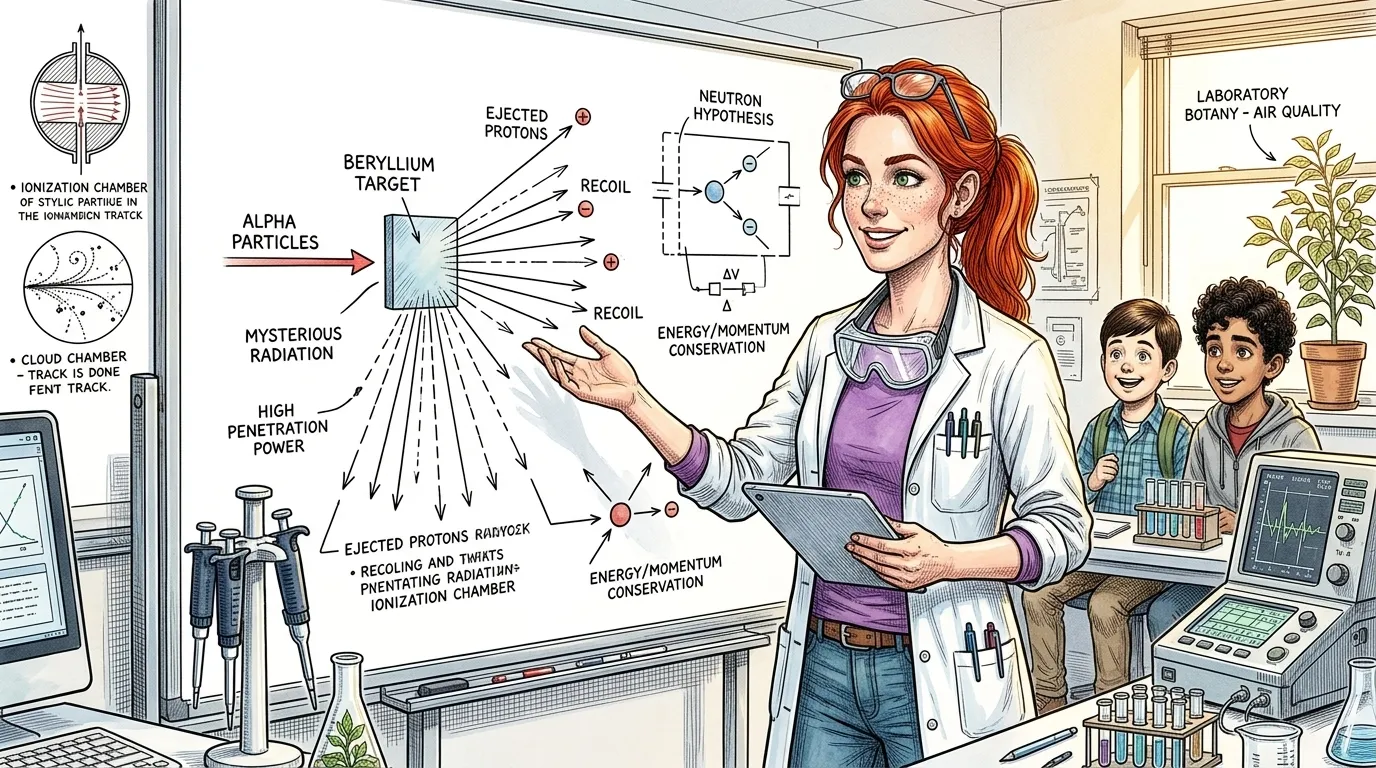
In the early 1930s, the atomic nucleus held a profound secret. Scientists worldwide observed a baffling, highly penetrating radiation emitted when alpha particles struck beryllium. This unseen force was powerful enough to eject protons from matter, yet carried no electric charge, defying all known physics. It was a mystery that demanded an explanation.\n\n"'This chart shows the mysterious radiation scientists were observing back in 1932,' Alexei explained, pointing to a complex diagram. 'It wasn't gamma rays, but something entirely new that could knock out protons! It baffled everyone.'"
Page 2
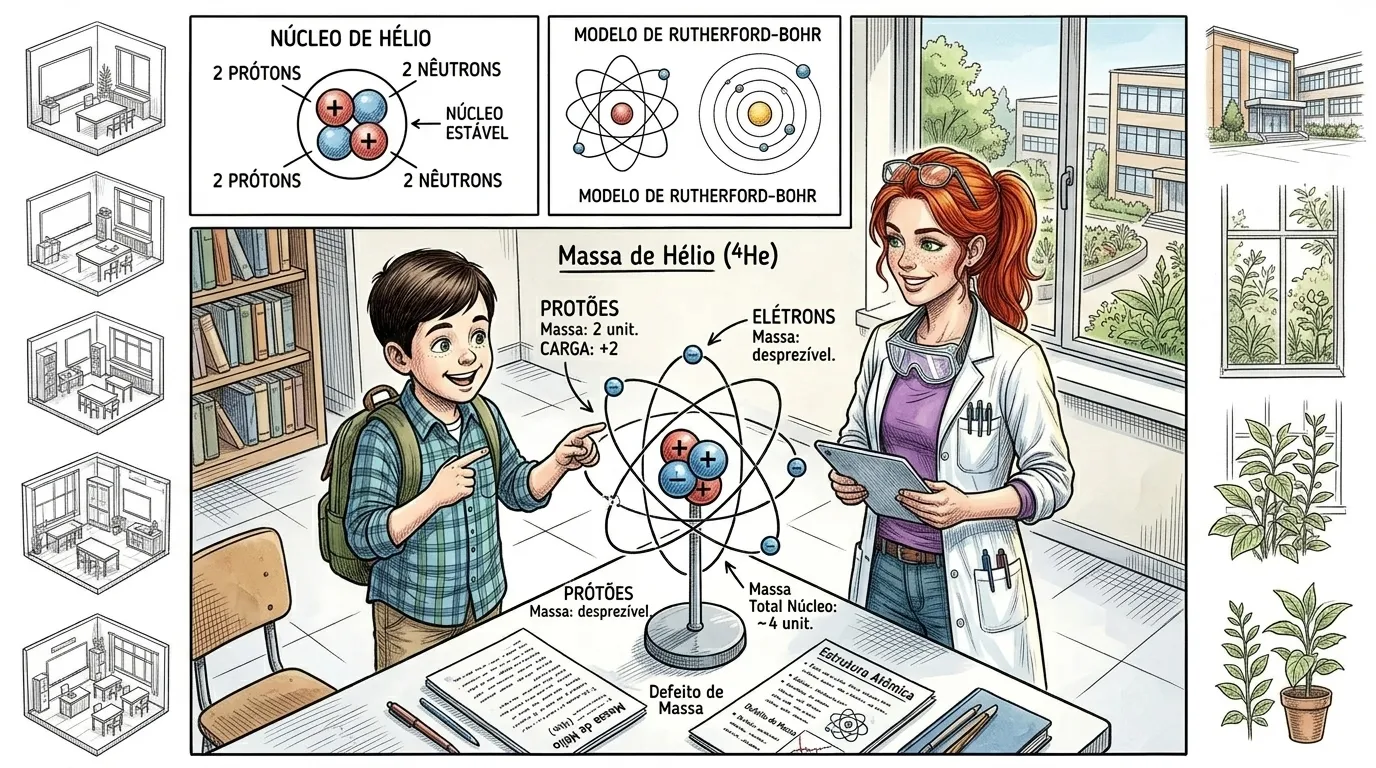
Before this discovery, the atom was thought to consist of a nucleus of protons, orbited by electrons. However, the mass of most atomic nuclei couldn't be accounted for by protons alone; there was a significant, unexplained mass deficit. Scientists knew something else had to be lurking within the atom's core, but its nature remained elusive.\n\n"'Look at this model of a helium atom,' Oscar pointed. 'It has two protons, so it should weigh about two units. But it weighs four! Where's the extra mass coming from?' Alexei nodded. 'Precisely, Oscar. That 'missing mass' was a huge puzzle, suggesting an unknown, neutral particle had to exist, balancing the scales inside the nucleus.'"
Page 3
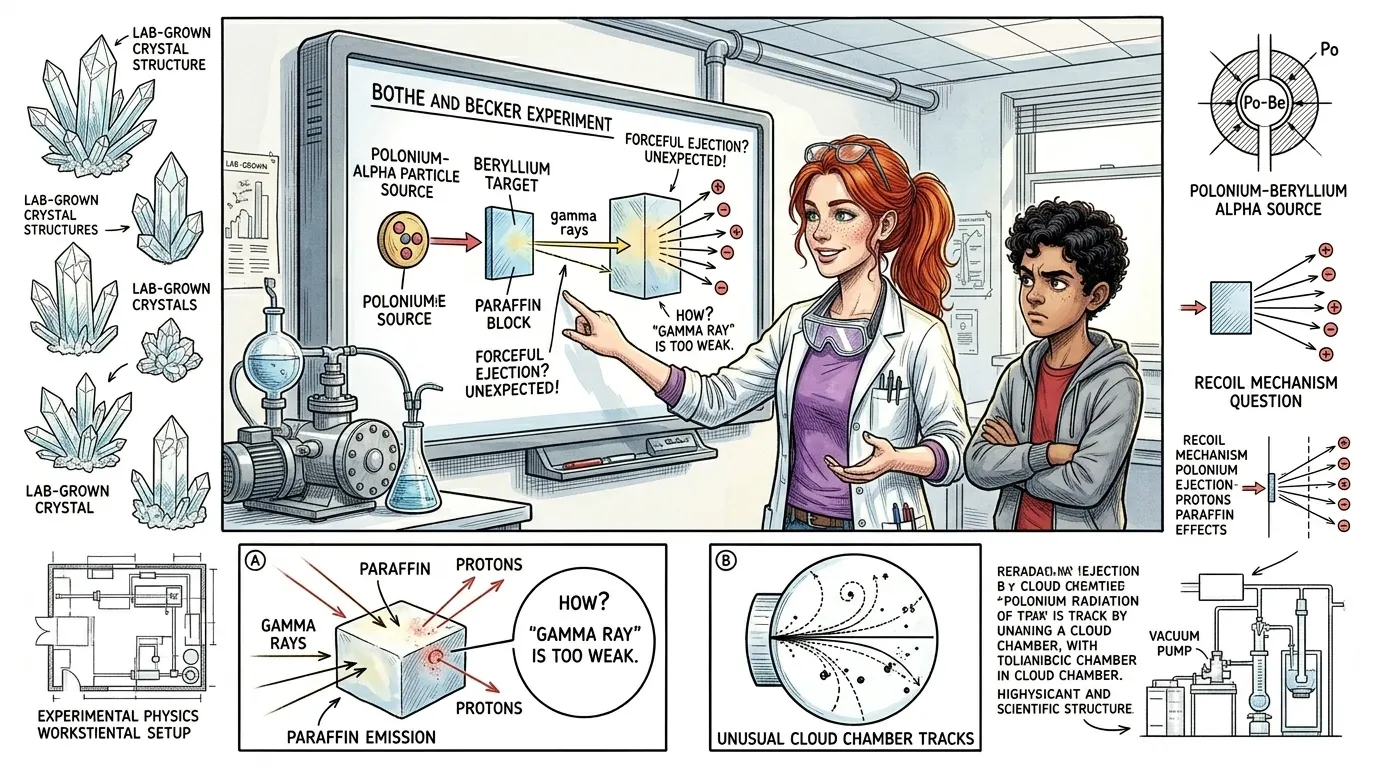
For years, researchers like Walther Bothe and Herbert Becker, followed by Irène and Frédéric Joliot-Curie, observed this penetrating radiation from beryllium. They interpreted it as exceptionally energetic gamma rays. Yet, these 'gamma rays' were uniquely effective at ejecting protons from paraffin, an interaction unprecedented for massless photons.\n\n"Alexei tapped the screen, showing the early experiment. 'They saw the radiation, but called it gamma rays. It was a comfortable explanation.' Dev frowned. 'But gamma rays don't push protons that hard!' 'Exactly!' Alexei affirmed. 'The only thing we have to fear is fear itself,' she mused, recalling what American president Franklin D. Roosevelt once said. 'Sometimes, scientists have to be brave enough to challenge what they think they know.'"
Page 4
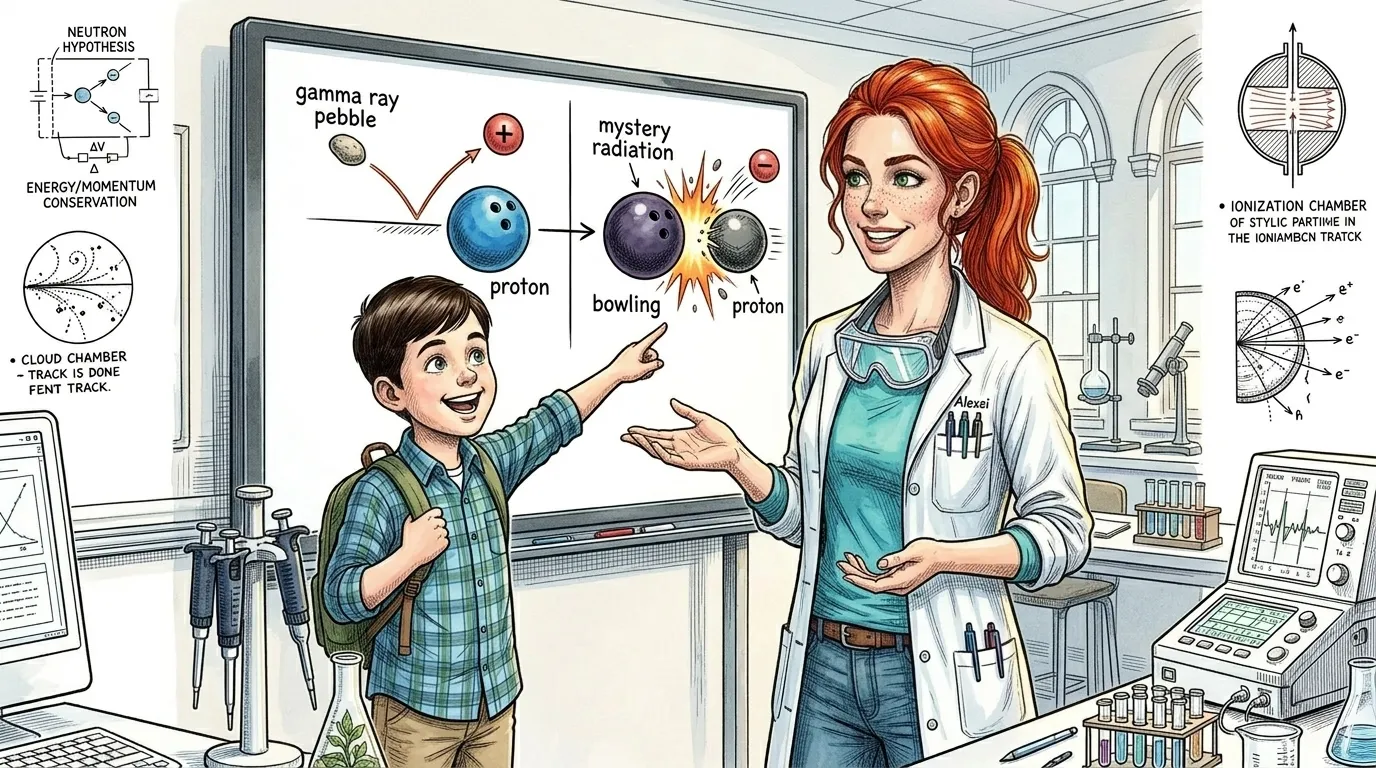
The perplexing ability of this radiation to violently recoil protons, particles far more massive than electrons, posed a direct challenge to the accepted understanding of gamma radiation. If it were truly gamma rays, the energy transfer would be minimal, like a ping-pong ball hitting a bowling ball. This 'radiation' was clearly something else entirely, an unknown entity carrying significant momentum.\n\n"Oscar pointed excitedly at the screen. 'So, if a gamma ray hits a proton, it's like a tiny pebble hitting a big rock?' Alexei nodded. 'Precisely, Oscar. Very little effect. But what they observed was like a bowling ball hitting a cannonball! So much energy transfer that it just couldn't be gamma rays. It forced them to reconsider everything they knew about atomic particles.'"
Page 5
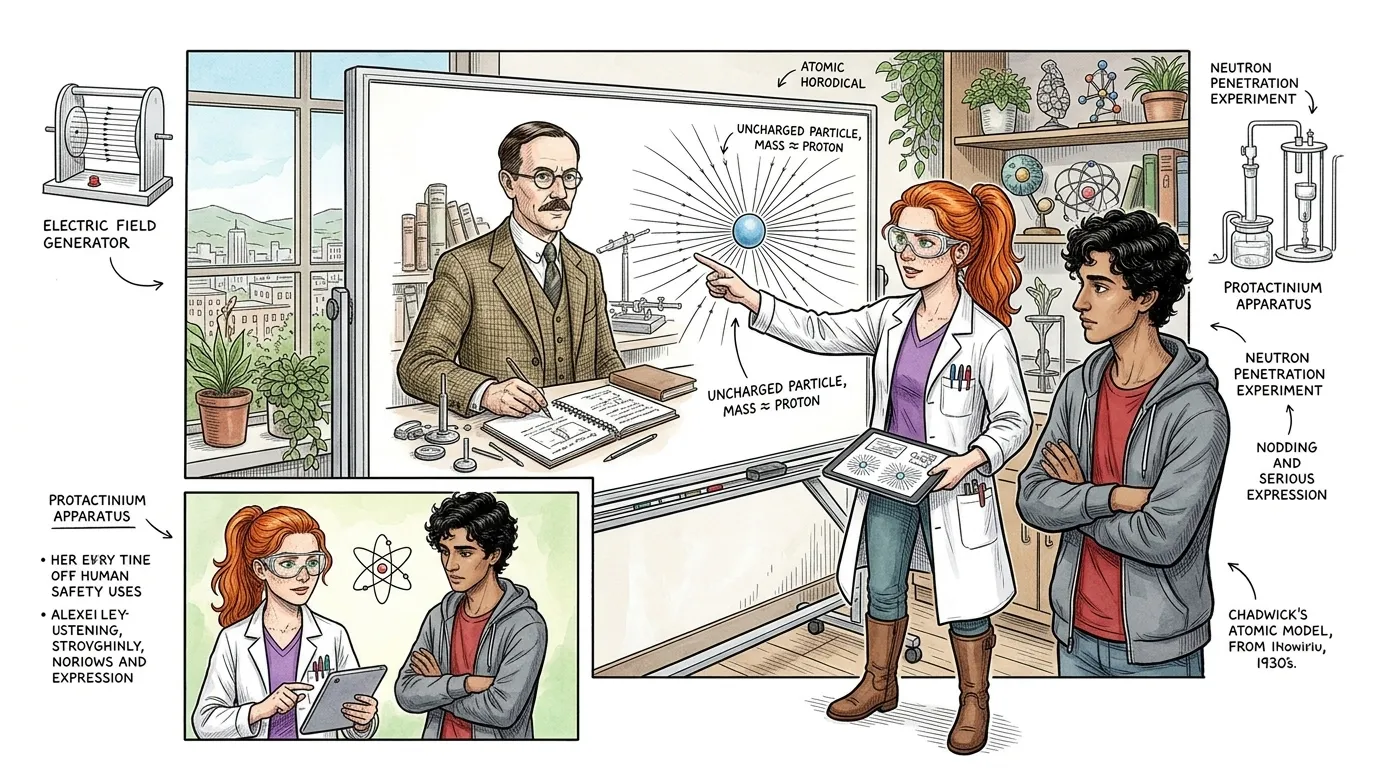
It was James Chadwick, working in Ernest Rutherford's laboratory at Cambridge, who meticulously analyzed the data and proposed a bold new hypothesis. He reasoned that only an uncharged particle, with a mass comparable to a proton, could possibly account for the powerful recoil of atomic nuclei observed in these experiments. He dedicated himself to finding experimental proof of this elusive entity.\n\n"'Chadwick wasn't just guessing,' Alexei emphasized, pointing to a depiction of Chadwick deep in thought. 'He used careful calculations of energy and momentum to figure out what kind of particle had to be there. He realized it couldn't be charged, because it wasn't affected by electric fields.' Dev nodded, 'So, it just went right through things!'."
Page 6
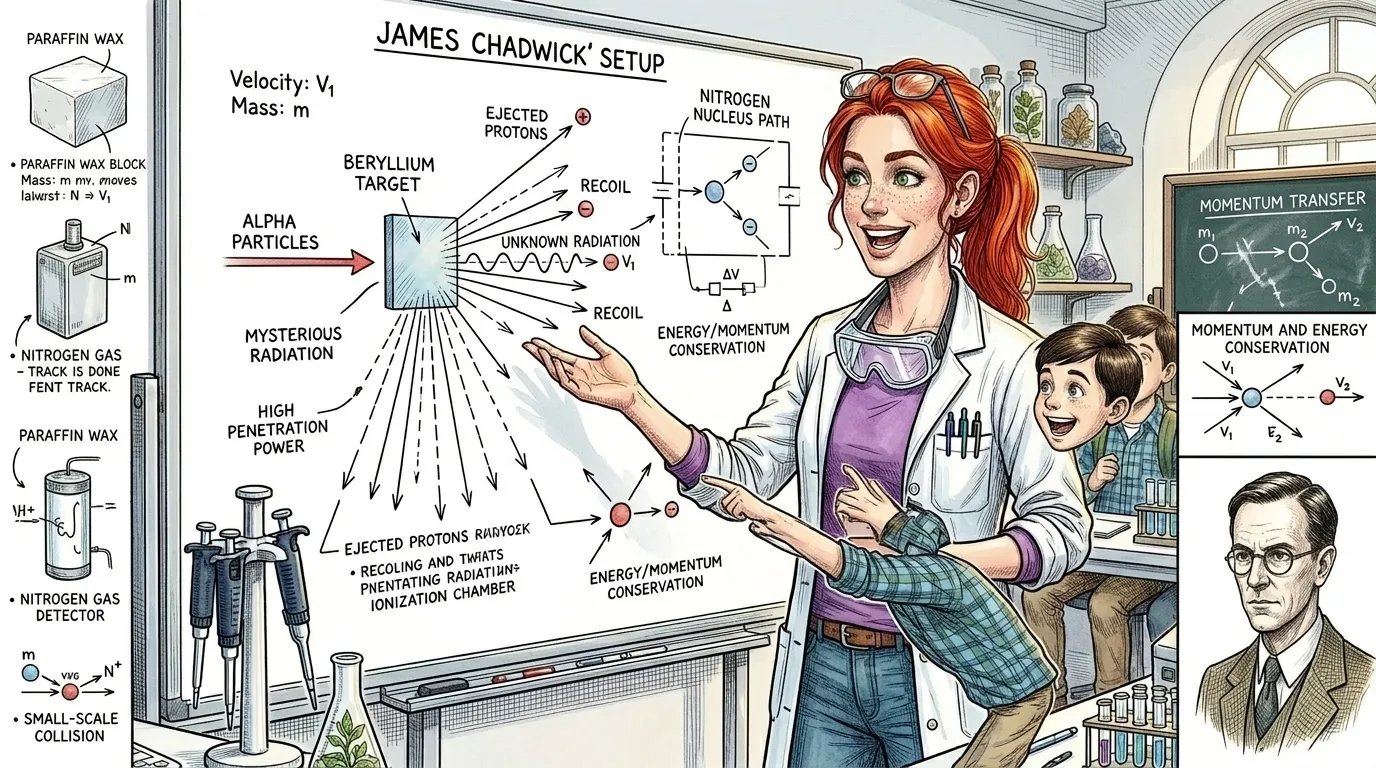
Chadwick's groundbreaking experiment involved bombarding beryllium with alpha particles, as others had done. But critically, he then directed the emitted 'unknown radiation' at targets made of different elements, specifically hydrogen (in the form of paraffin wax) and nitrogen. By analyzing the precise energies of the recoiling nuclei in these targets, he could deduce the properties of the incoming mysterious particles.\n\n"'This is Chadwick's brilliant setup!' Alexei exclaimed, gesturing to a detailed diagram. 'He used alpha particles, then the mystery radiation. But the genius part was seeing how that mystery radiation pushed different atoms.' Oscar leaned in. 'So, by measuring the push, he could tell what was doing the pushing?' Alexei beamed. 'Exactly! It's like solving a cosmic billiard game.'"
Page 7
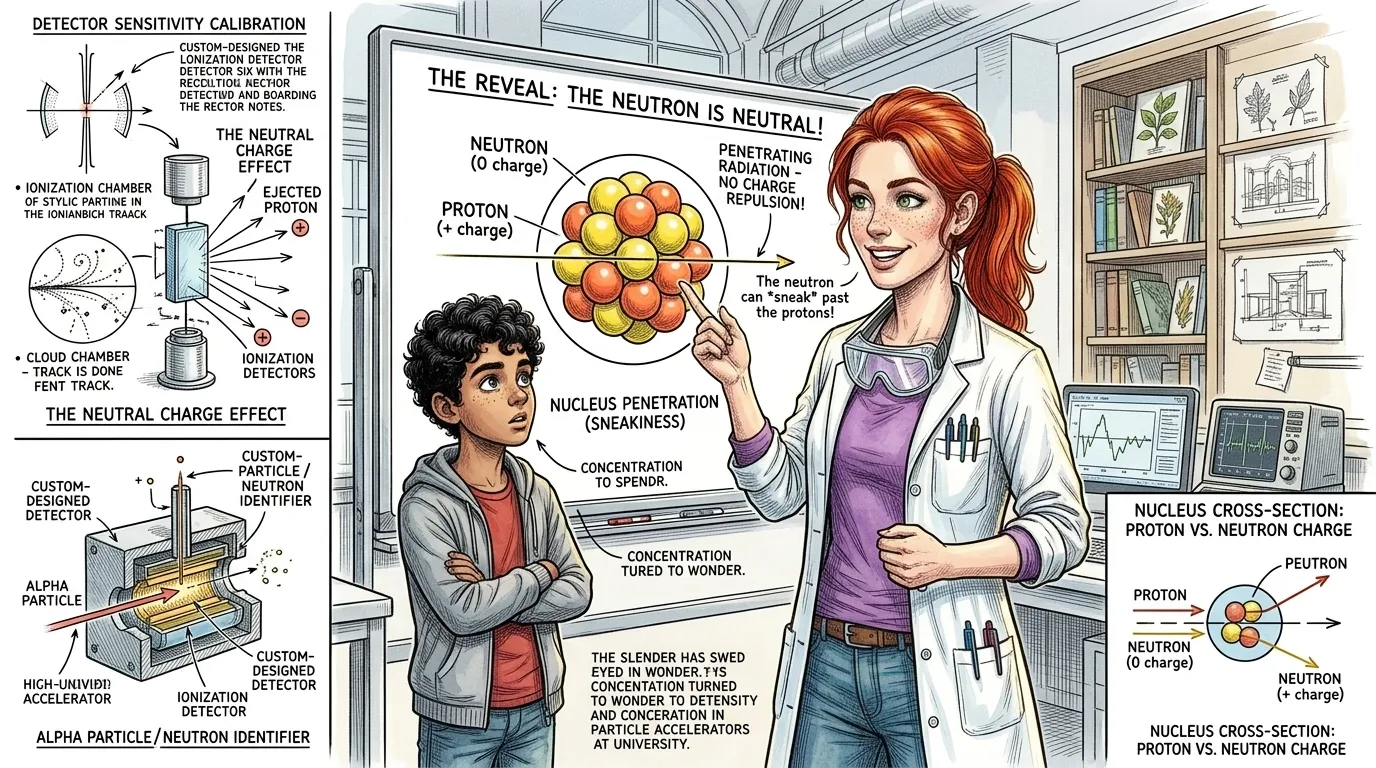
Chadwick's precise measurements and calculations unequivocally demonstrated that the unknown radiation consisted of particles possessing no electric charge, yet with a mass almost identical to that of a proton. He named this newly discovered, fundamental particle the 'neutron.' Its neutrality explained its incredible penetrating power, as it bypassed the electromagnetic forces that repel charged particles, allowing it to delve deep into atomic nuclei.\n\n"Alexei pointed to a clear diagram. 'And here's the big reveal: the neutron!' Dev's eyes widened. 'So, it's like a proton, but without the positive charge?' 'Exactly!' Alexei confirmed. 'That's why it's so sneaky! It can go right into the nucleus without getting pushed away, unlike a proton. That was the key to unlocking the atom.'"
Page 8
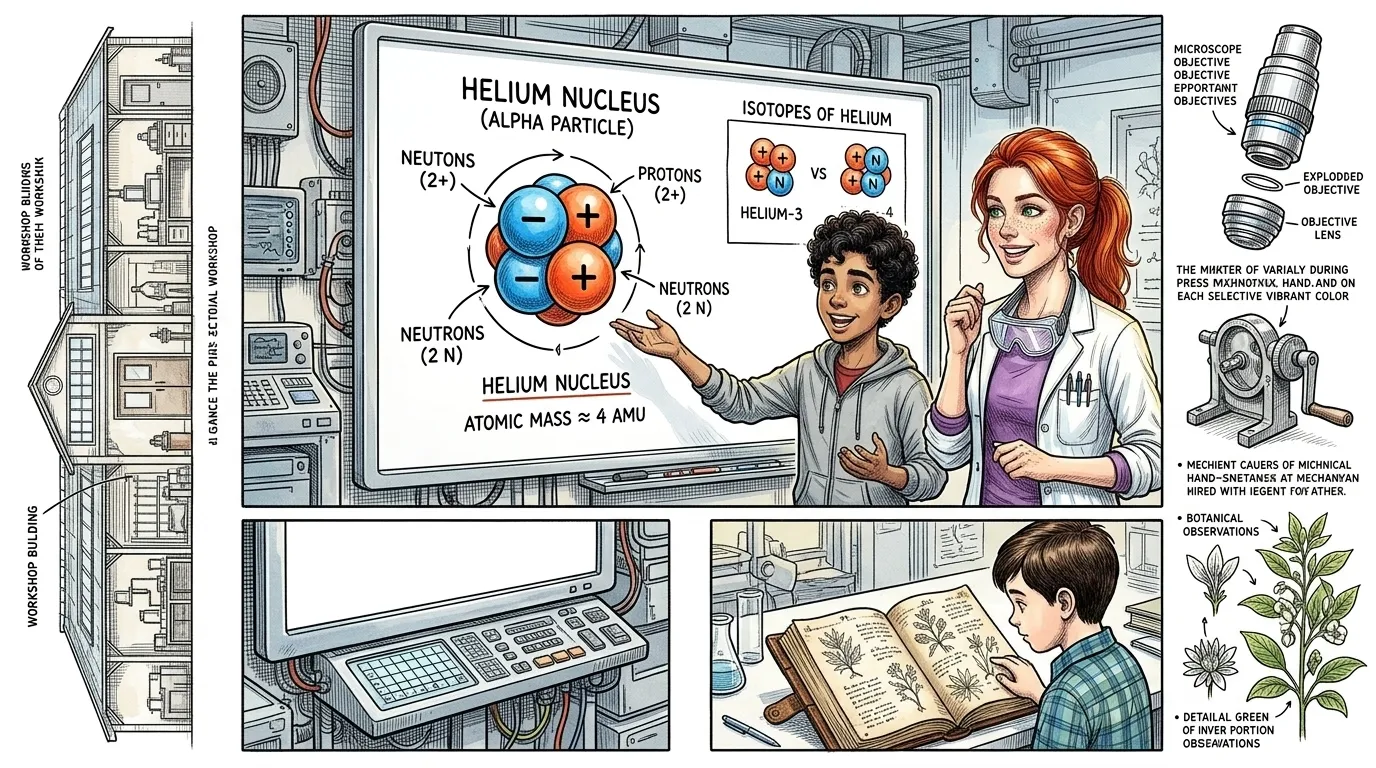
The discovery of the neutron completed the atomic model. The nucleus was now understood as a tightly bound core of both protons and neutrons. This explained the perplexing issue of isotopes—atoms of the same element with identical chemical properties but varying atomic masses due to differing neutron counts. Dev remembered their earlier discussion about the missing mass.\n\n"'So, the neutron was the missing piece for the helium atom too!' Dev exclaimed, pointing to a new atomic diagram showing a helium nucleus with two protons and two neutrons. 'It explains the extra weight!' Alexei smiled warmly. 'Absolutely, Dev! The neutron solved that mystery perfectly. It wasn't just about discovery; it was about finally understanding the atom's true blueprint.'"
Page 9
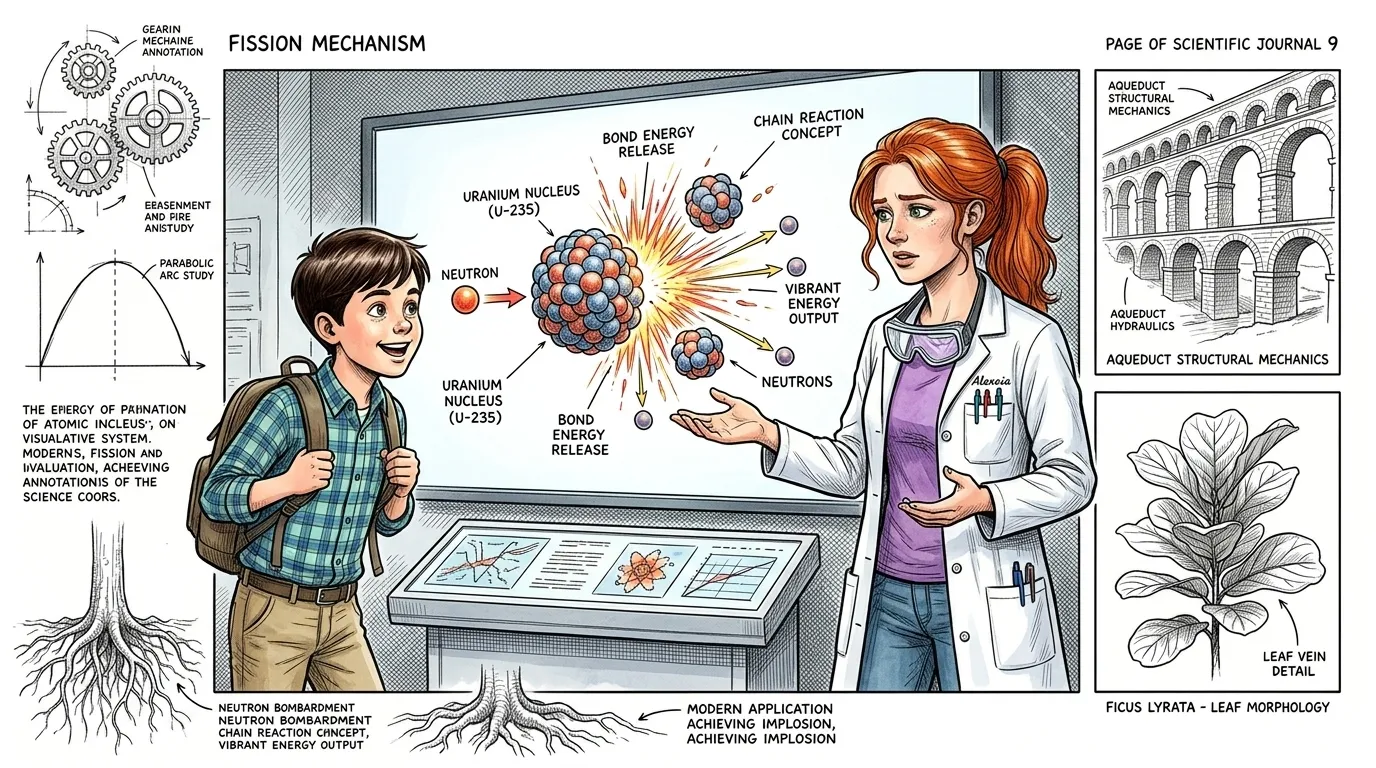
Chadwick's discovery, a testament to scientific rigor, inadvertently ushered in the nuclear age. The neutral neutron proved to be the ideal projectile for splitting heavy atomic nuclei in a process called nuclear fission. A neutron could penetrate a nucleus without repulsion, triggering a chain reaction that released enormous amounts of energy. This fundamental insight became the foundation for both nuclear power and the development of atomic weapons.\n\n"Oscar stared at the visualization of fission. 'So this tiny, invisible neutron can break an atom apart and make huge energy?' Alexei nodded solemnly. 'It can. It's an incredible power, for good and for profound challenge. Chadwick's work paved the way for both nuclear energy and, eventually, the atomic bomb, forever changing human history.'"
Page 10
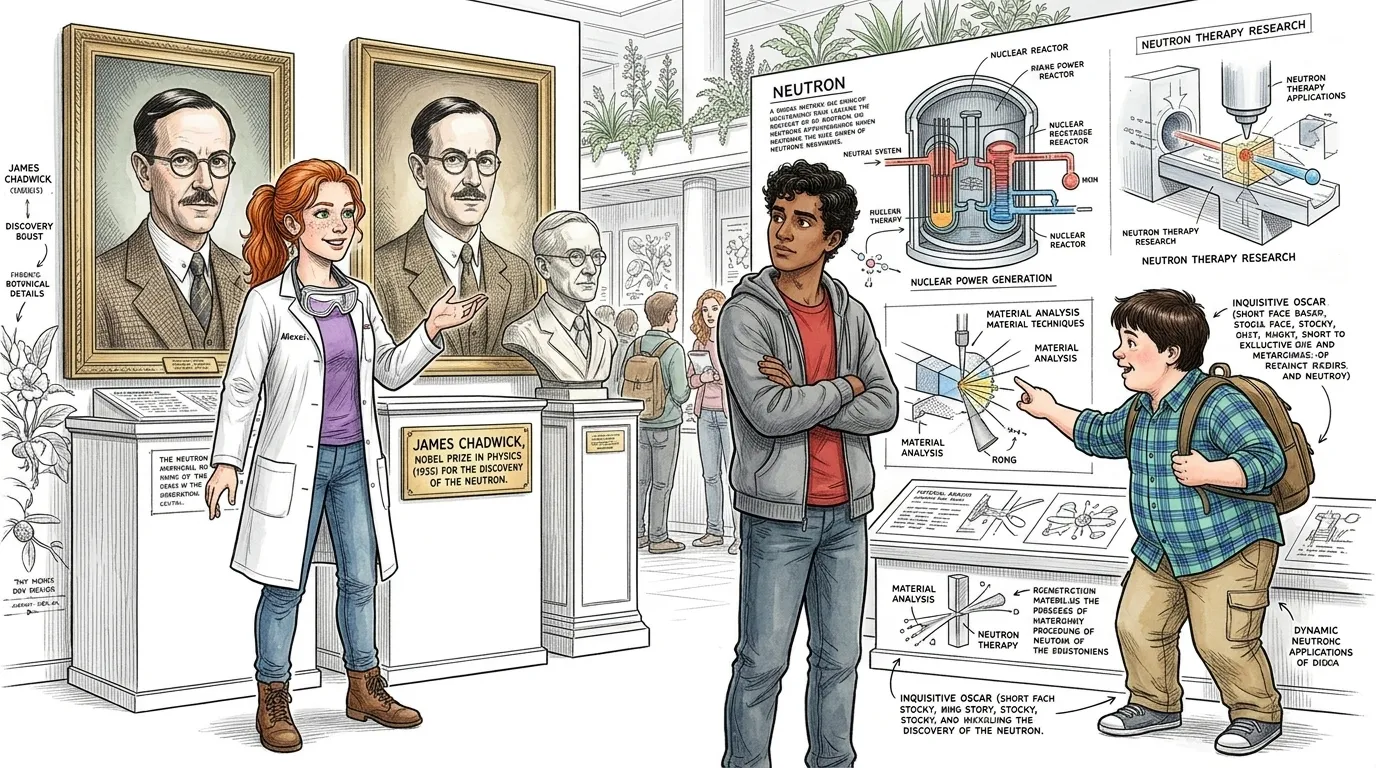
For his pivotal discovery, James Chadwick was awarded the Nobel Prize in Physics in 1935. His quiet determination and meticulous experimentation not only completed the picture of the atom but also unveiled a particle whose existence would dramatically reshape the 20th century. The neutron continues to be an essential tool in research, energy, and medicine, reminding us that even the smallest, most elusive components of matter hold secrets of immense consequence.\n\n"'Chadwick's neutron truly changed everything, didn't it?' Dev observed, looking around the museum hall. Alexei smiled. 'It certainly did, Dev. From understanding the universe to generating electricity, the impact is immeasurable. The quest to understand matter, sparked by curious minds like Chadwick's, never truly ends.'"
About this story
- Location: Global
- Audience: kids (ages 6–12)
Questions and answers
Read Wonder Science on your phone
Wonder Science is available on Android. Get Wonder Science on Google Play.