Newton and the Falling Apple
Newton and the Falling Apple — an illustrated science story, set in United States. 10 illustrated pages, free to read on Wonder Science.
Page 1
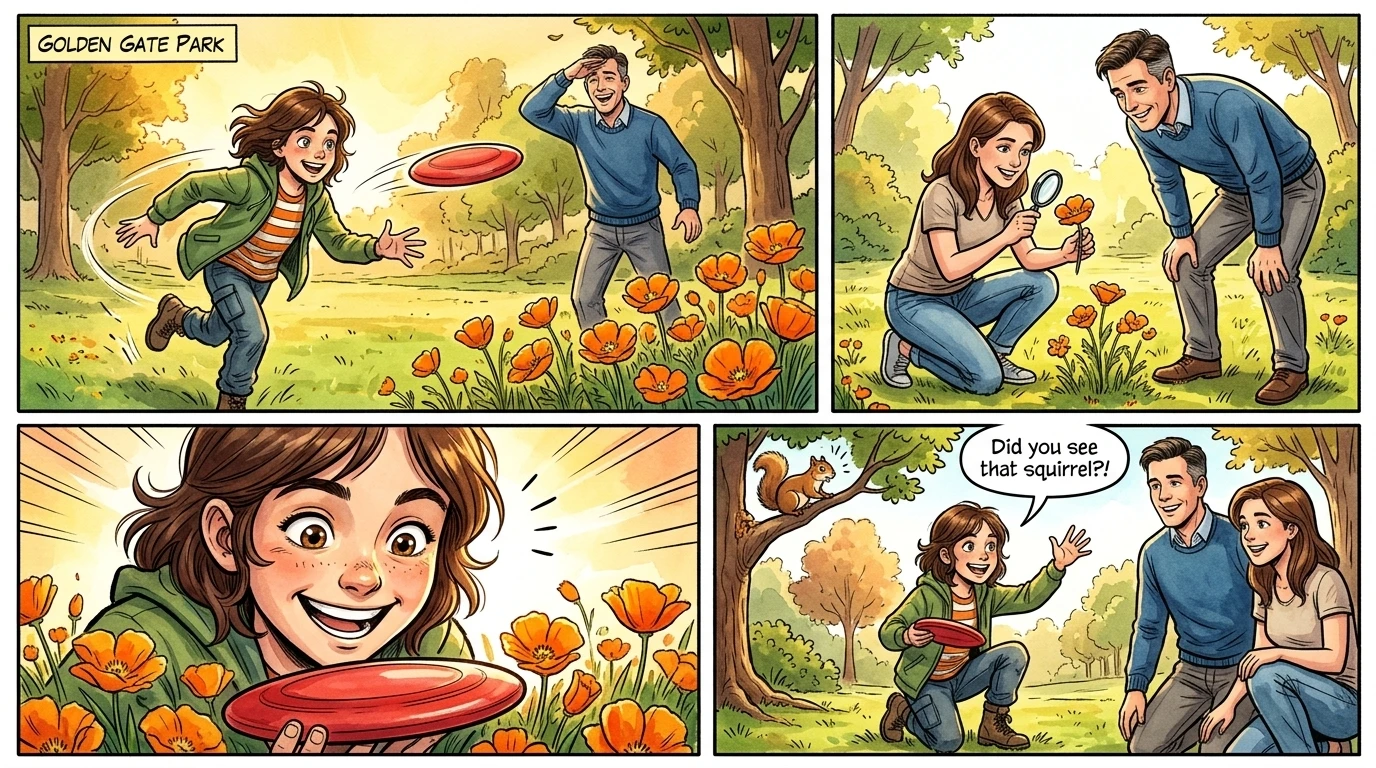
In San Francisco's sunny Golden Gate Park, Greta's father laughed as he launched a red frisbee into the air. "Go get it, Greta!" he called out, shielding his eyes from the sun. The frisbee soared in a perfect arc before curving gracefully back towards the grassy lawn. Greta sprinted, her hands outstretched, but just missed it as it landed softly near a bed of bright orange poppies. "Dad," she panted, picking it up, "why does it always fall down? Why doesn't it just keep flying straight forever?"
Page 2
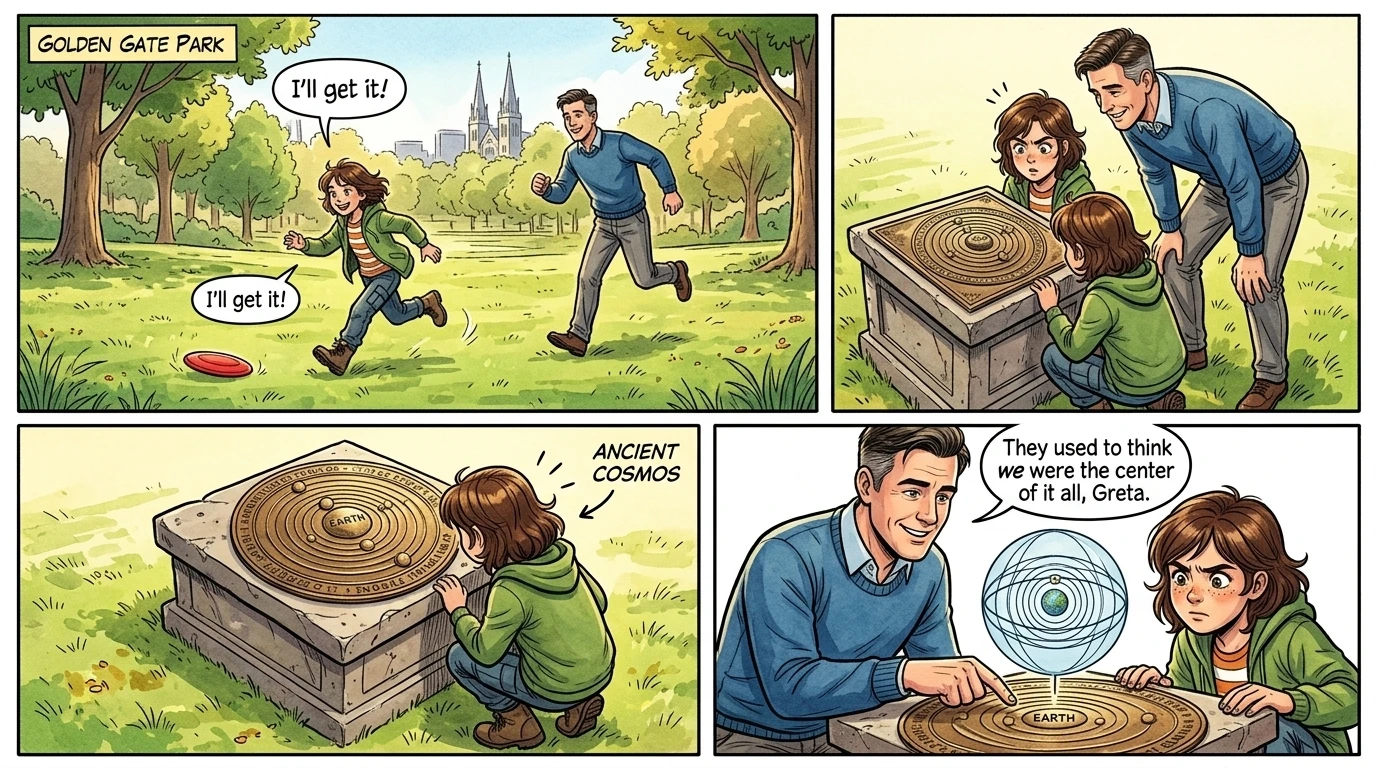
"That's an amazing question!" said her father, jogging over. "There's a force pulling it down, the same one that keeps us from floating into space. It's called gravity." He knelt down beside her, tapping the frisbee. "But you're right to ask why—for thousands of years, people thought the rules on Earth were totally different from the rules for the Moon and stars."
Page 3
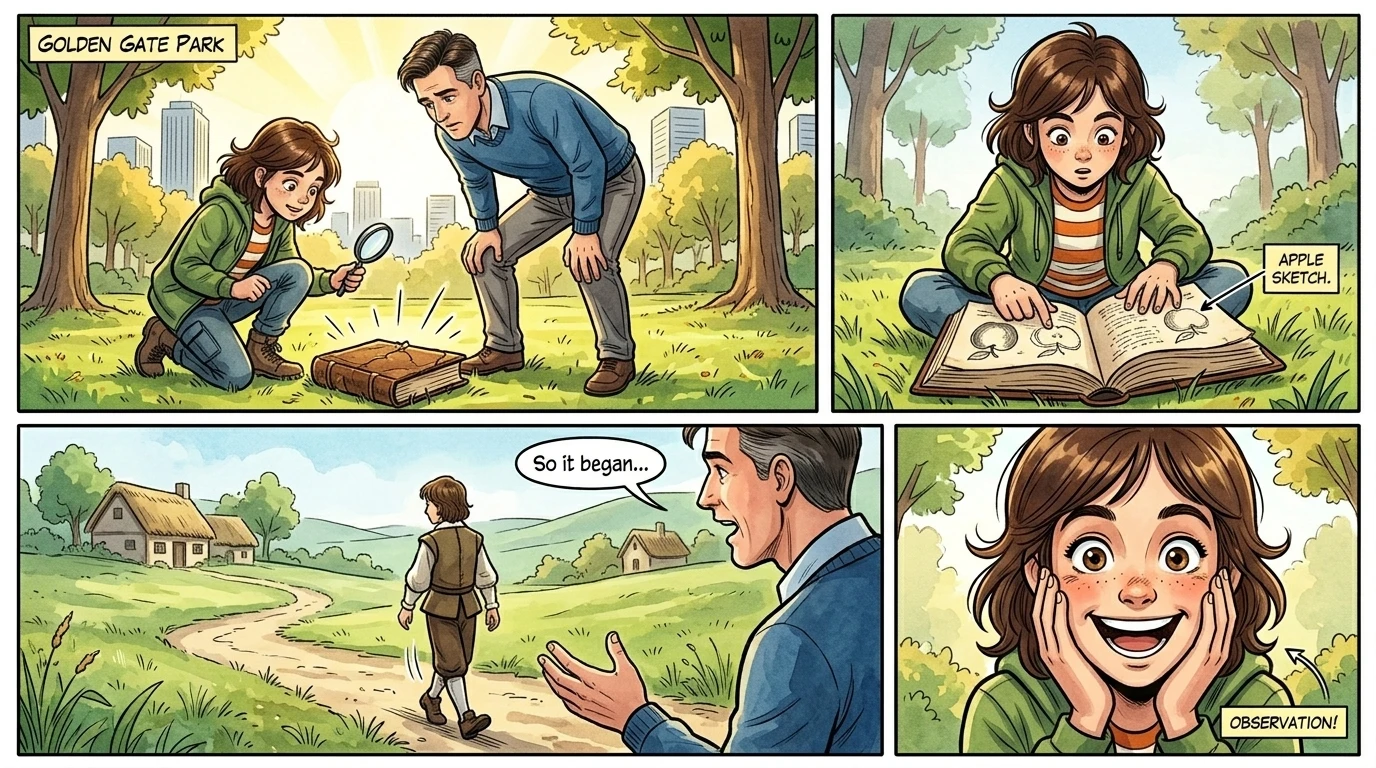
"To understand how we connected them, you have to imagine a different time," her father continued, his voice becoming soft and story-like. "Picture England, way back in 1666. There were no big cities, just quiet countryside, and a terrible plague had forced everyone to stay home." A young student was sent home from his university, with nothing to do but walk, think, and wonder.
Page 4
"That student's name was Isaac Newton," her father explained. "He was incredibly curious and spent his time alone filling notebooks with questions about light, motion, and the universe." In the quiet of his family farm, Newton had the freedom to let his mind wander. He would later say, 'If I have seen further it is by standing on the shoulders of Giants,' giving credit to the scientists who came before him.
Page 5
One afternoon, while sitting in the garden, Newton saw an apple fall from a tree. This wasn't a sudden cartoon moment with a bonk on the head, but a quiet observation that sparked an idea. It was a thought so powerful, it was like a lightning bolt, which can be five times hotter than the surface of the Sun! He watched the apple fall straight down, pulled by the Earth.
Page 6
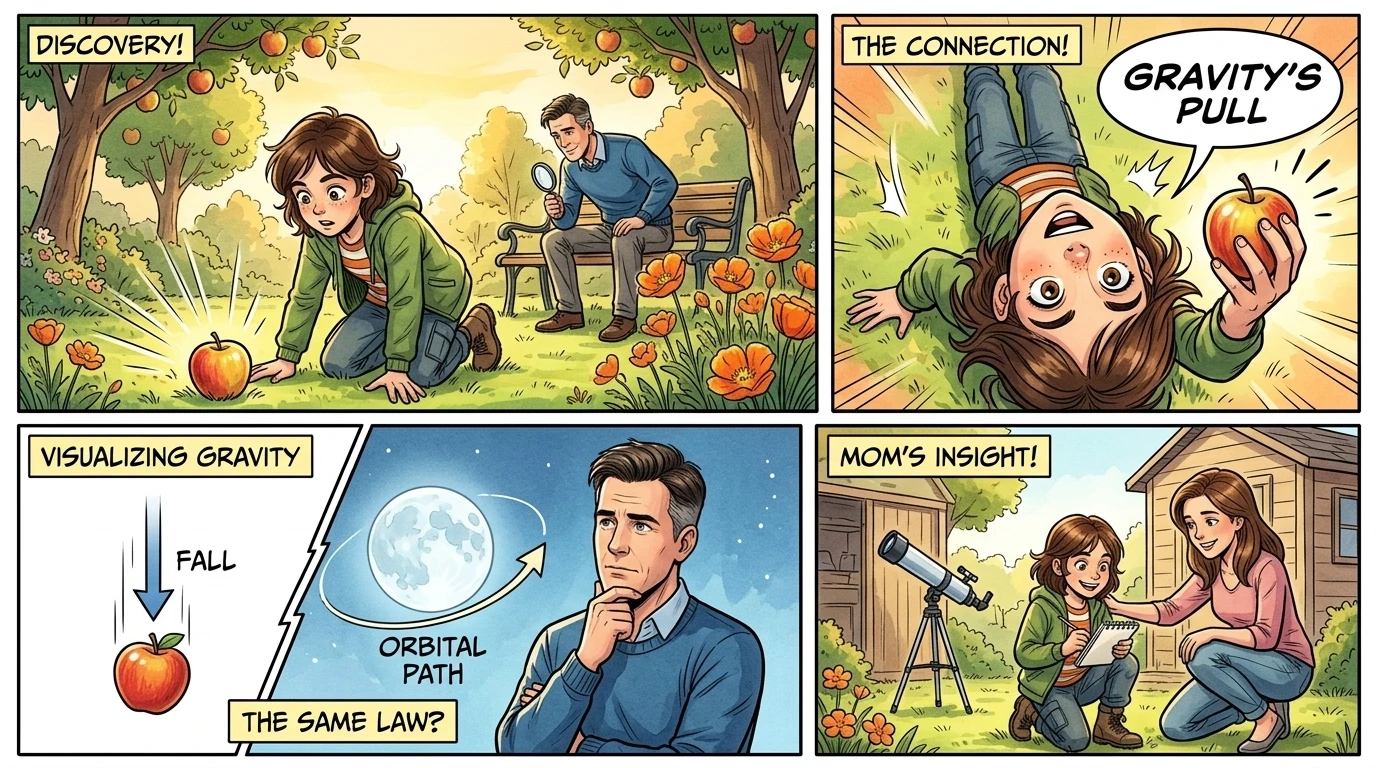
Then, Newton looked up and saw the pale circle of the daytime Moon in the sky. "This was his brilliant question," Greta's father whispered, his voice full of excitement. "He wondered: if the force of gravity can pull an apple from a branch, could that same force reach all the way up to the Moon?" He realized the Moon was also constantly falling toward Earth, but it was moving sideways so fast that it kept missing.
Page 7
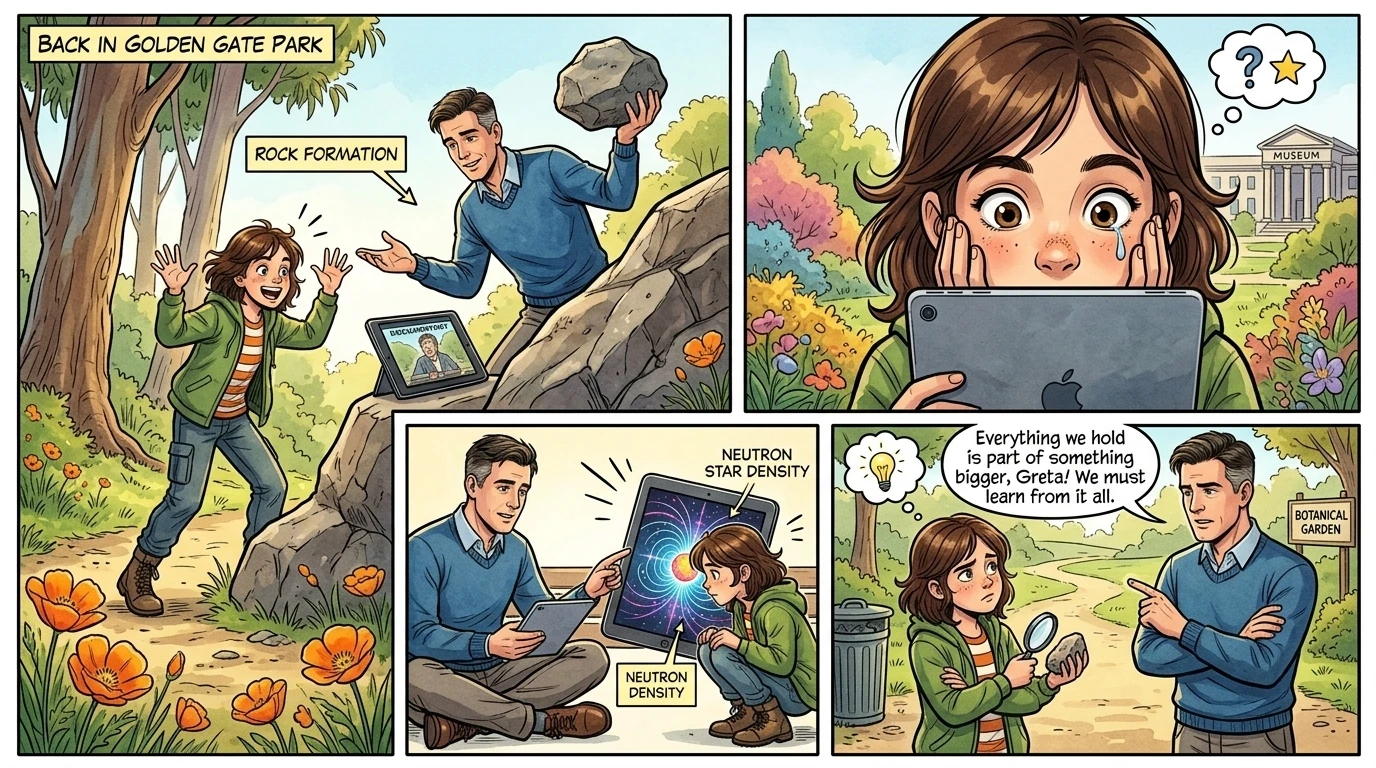
"That one idea changed everything! It's called the Universal Law of Gravitation," her father said. "It let us calculate the orbits of planets, launch satellites for GPS, and even travel to other worlds." He picked up a heavy rock. "Gravity is everywhere, but on a neutron star, it's so strong that a teaspoon of its material would weigh six billion tons—more than all the cars on Earth combined!"
Page 8
Back in the park, Greta's eyes lit up. "Oh! I get it! The frisbee is like a mini-moon!" she exclaimed, holding it up. "Earth's gravity is pulling on it, but when you throw it, it's also moving sideways." Her mother, who had just joined them with a picnic basket, smiled. "But it's not moving fast enough to stay in orbit, right? So it falls back to the ground."
Page 9
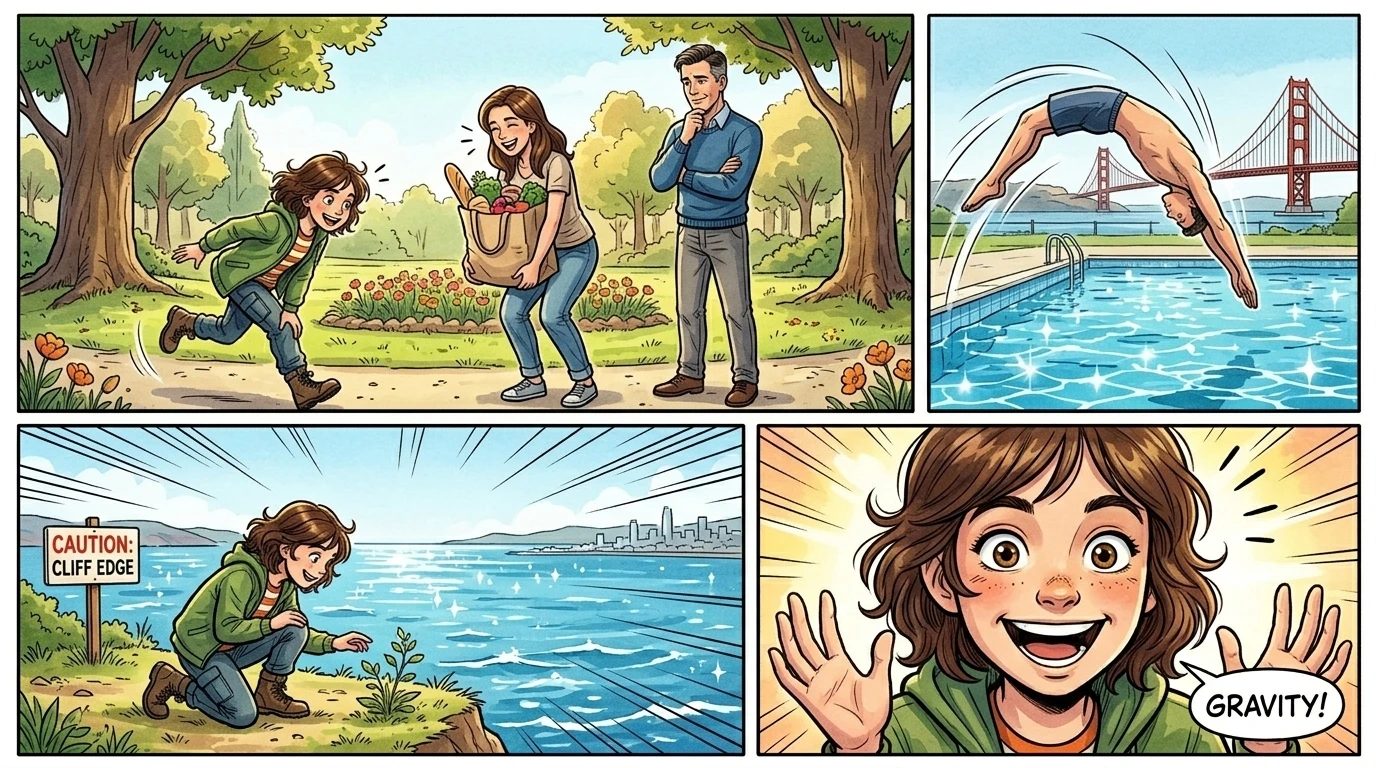
"Exactly!" said her father. "You see gravity everywhere once you know what to look for." Greta looked around. "So it's what makes a diver curve into a pool, and what keeps the water in the bay!" Her mother laughed. "And it's what makes my grocery bags feel so heavy after a trip to the store on 24th Street!"
Page 10
"So gravity is the invisible string that ties the whole universe together," Greta said, writing it down in her notebook. She looked up at her parents with a thoughtful frown. "But if gravity is always pulling everything down so hard," she asked, "how does a giant rocket ever get powerful enough to escape it and fly into space?"
About this story
- Location: United States
- Audience: kids (ages 6–12)
Read Wonder Science on your phone
Wonder Science is available on Android. Get Wonder Science on Google Play.