Niels Bohr
Niels Bohr — an illustrated science story, set in Global. 10 illustrated pages, free to read on Wonder Science.
Page 1
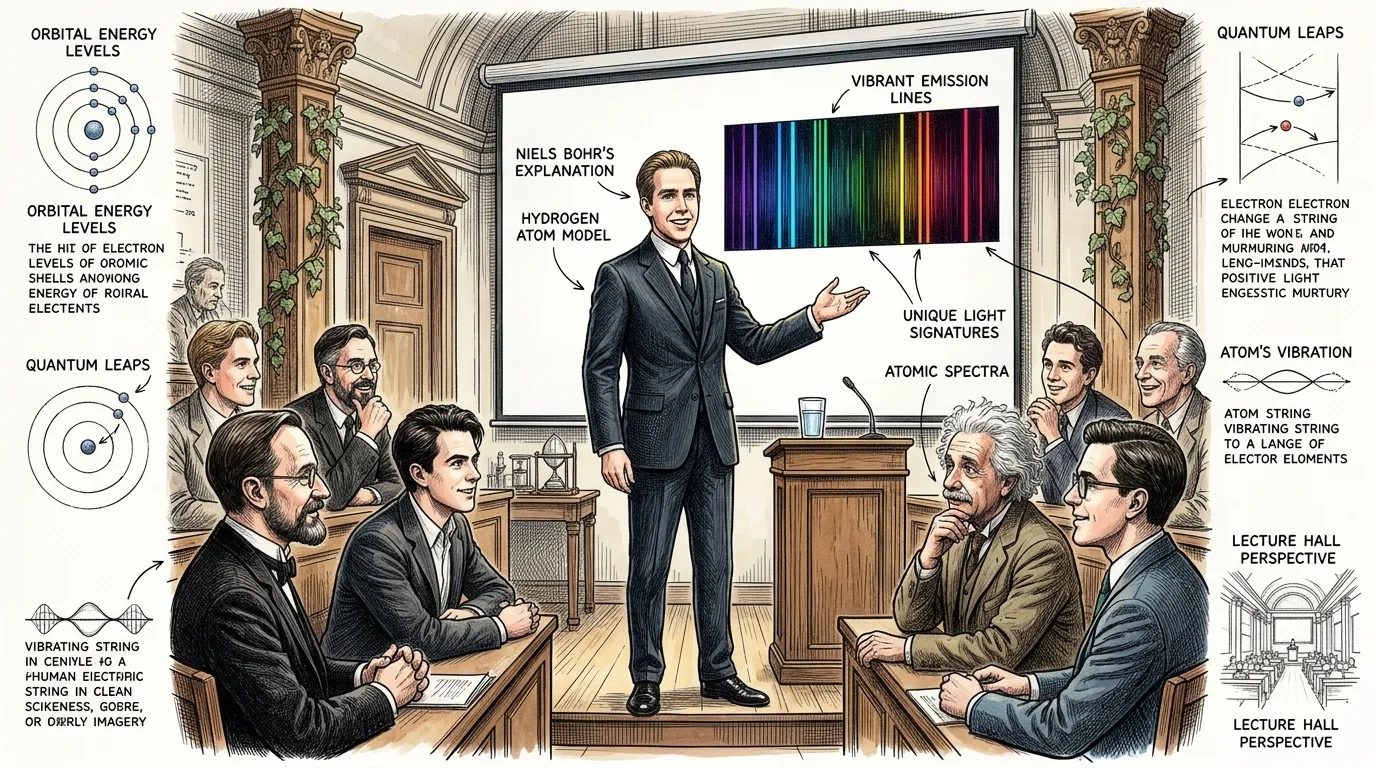
The year is 1913. A palpable tension fills the air of a lecture hall, a crossroads where the established laws of physics were faltering. For years, scientists grappled with the atom's stability: why didn't orbiting electrons, under classical theory, spiral into the nucleus and annihilate matter? The very existence of everything depended on an answer, yet none was forthcoming from the venerable classical physics.
"Niels Bohr, his voice cutting through the expectant silence, declares, "We must be prepared for the fact that the analogy between phenomena in the atom and ordinary mechanical phenomena may be quite misleading." A murmur ripples through the gathered physicists as he gestures to complex spectral lines projected behind him, representing the atom's unique light signatures. "These distinct lines, gentlemen, are not merely data; they are the atom's profound whisper that its inner workings transcend our current understanding.""
Page 2
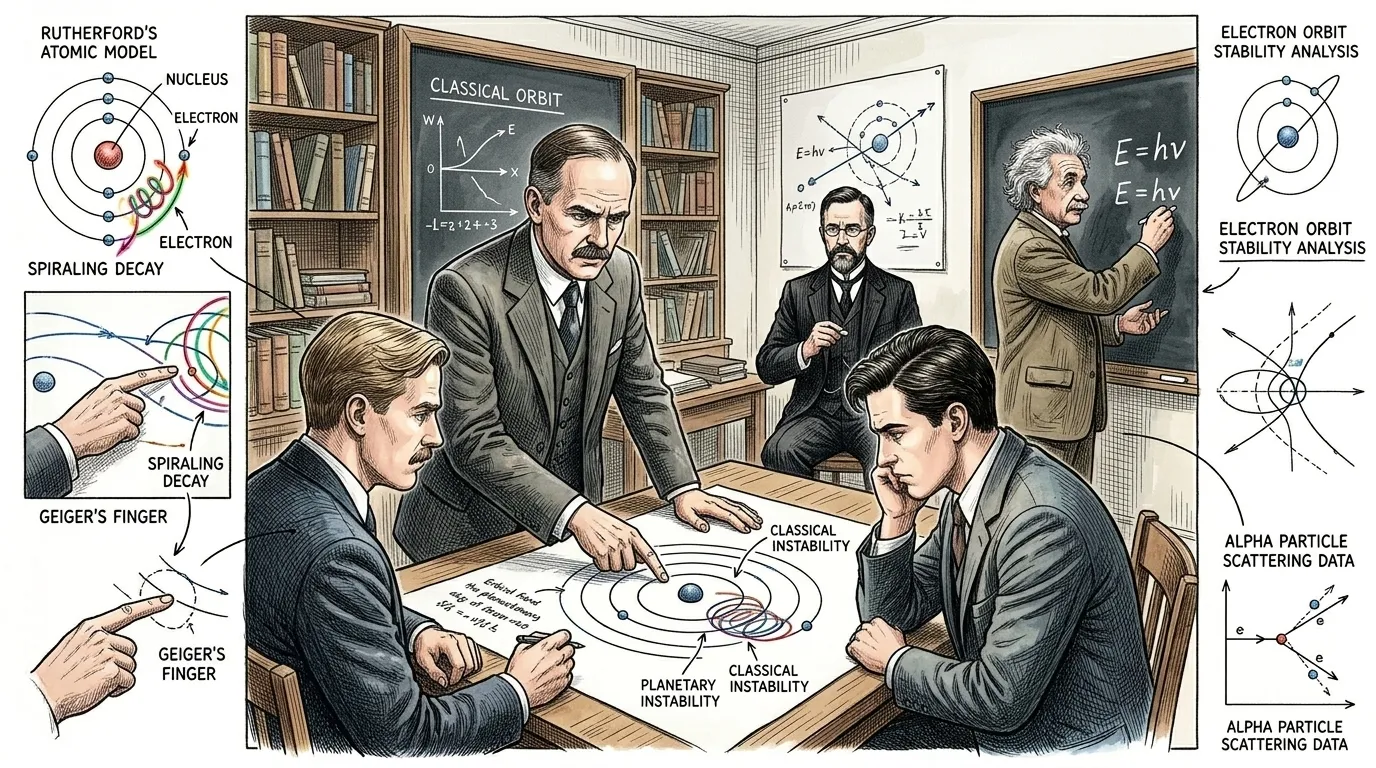
Before Bohr, the prevailing model from Ernest Rutherford depicted a miniature solar system: electrons orbiting a dense, positively charged nucleus. Yet, this elegant construct harbored a fatal flaw. According to classical electromagnetism, an accelerating electron, like one in orbit, must continuously radiate energy, causing it to rapidly lose speed and inevitably spiral inward, collapsing into the nucleus. The predicted lifespan of such an atom was a mere fraction of a second, starkly at odds with the enduring reality of the universe.
"Gathered in a modest university office, a group of physicists scrutinizes a complex diagram. One, Professor Hans Geiger, points to a classical orbital path. "The calculations are unambiguous," he states, a note of frustration in his voice. "A classical electron cannot maintain a stable orbit. It must collapse." Another, Dr. Ernest Marsden, adds with a sigh, "It's as Albert Einstein famously remarked in a different context: 'The most incomprehensible thing about the world is that it is comprehensible.' Yet, the atom, as we understand it, defies all logic.""
Page 3
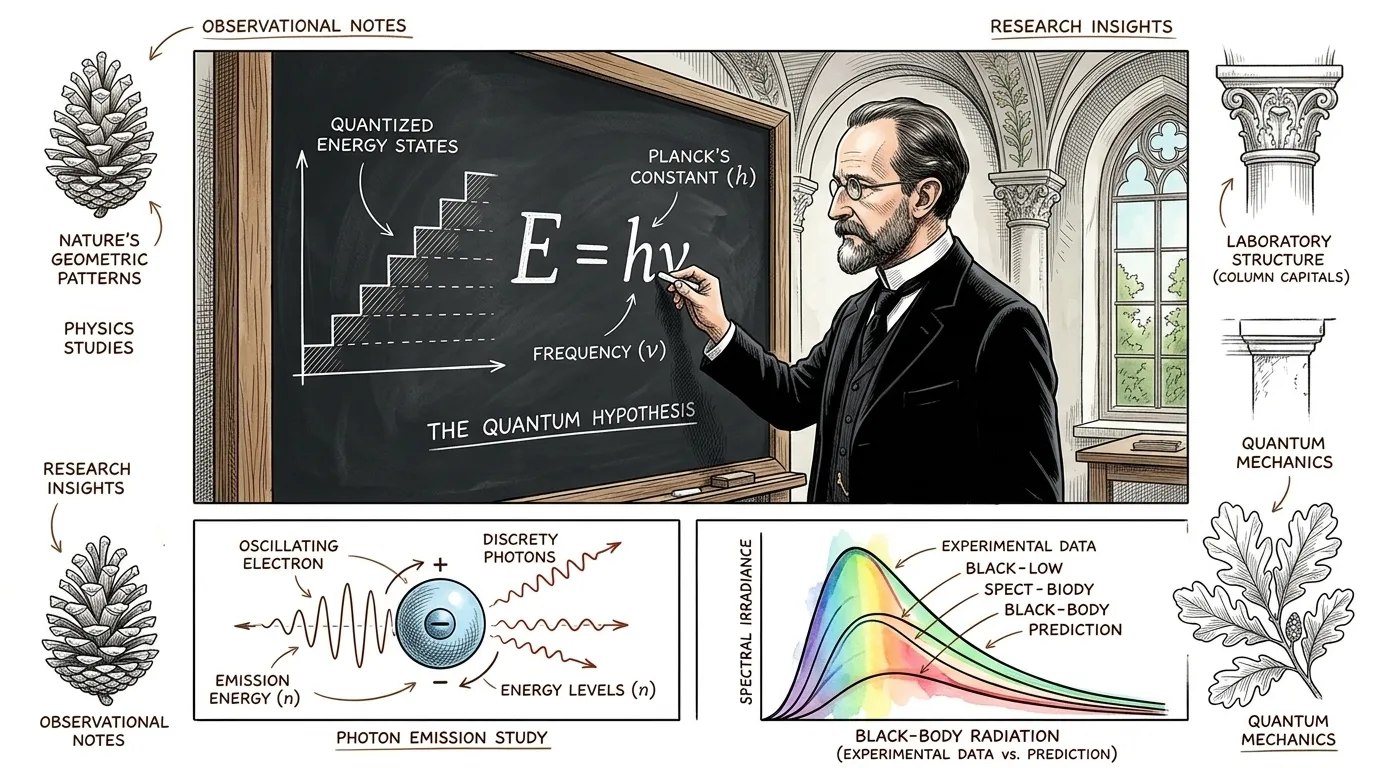
The seeds of a solution were sown over a decade earlier, not in atomic physics, but in the study of blackbody radiation. In 1900, Max Planck introduced a truly revolutionary, albeit initially reluctant, concept: energy is not continuous but exists in discrete packets, or 'quanta.' He called his fundamental constant 'h,' a value so tiny yet so utterly foundational that it would reshape all of physics.
"In a formal address, Max Planck, a dignified man in his early forties with glasses and a neatly trimmed beard, holds up a piece of chalk. "Gentlemen, my analysis of blackbody radiation led me to an inescapable, if unsettling, conclusion." He writes 'E hν' on a blackboard. "Energy is not exchanged smoothly. It is quantized. Like the steps of a staircase, not a ramp. This 'quantum hypothesis' may seem arbitrary, a mathematical trick, but the experimental data demands it. It is a concept that, as I believe, 'will not only be the most significant discovery of the twentieth century, but also the most significant discovery in the history of science'.""
Page 4
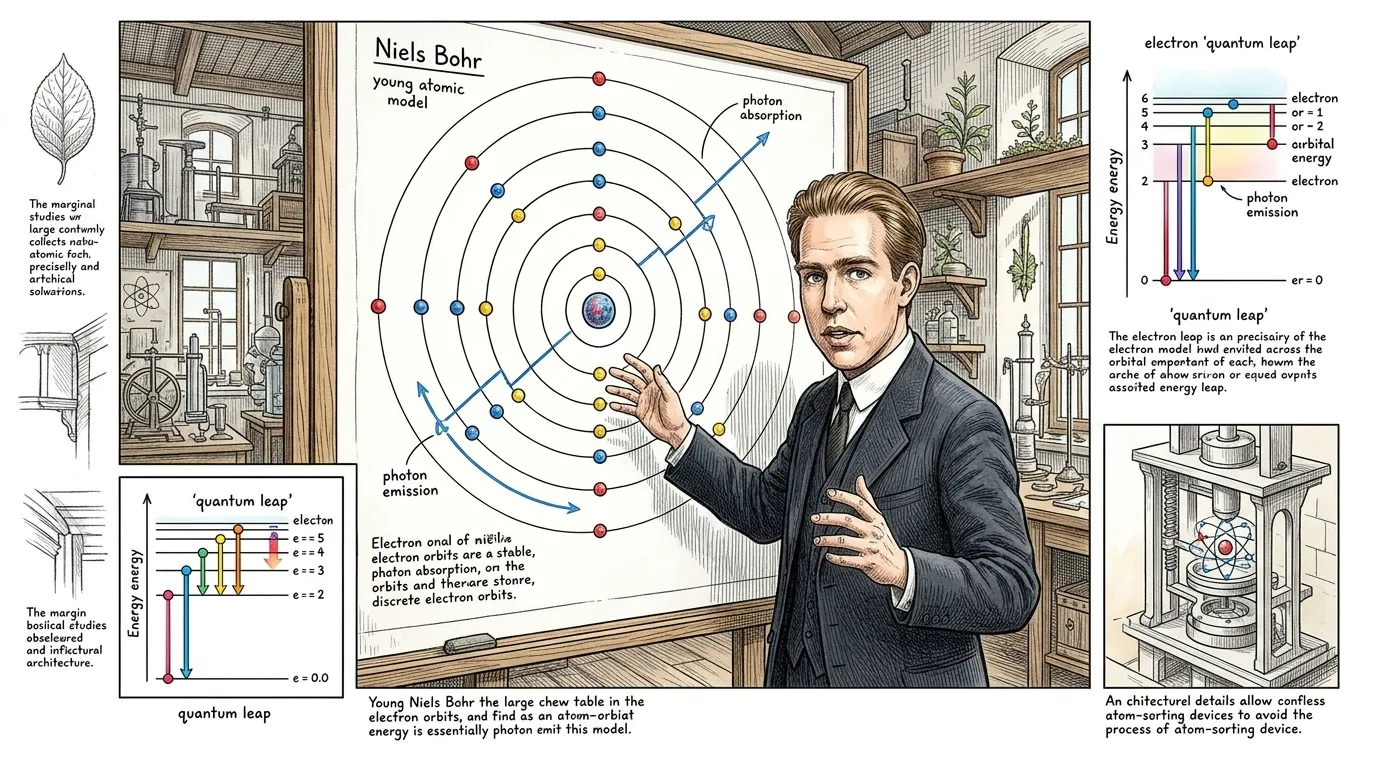
Niels Bohr, a Danish prodigy, recognized the profound implications of Planck's quantum idea. He boldly proposed a set of postulates that directly challenged classical physics. Firstly, electrons exist in stable, discrete orbits without radiating energy. Secondly, they can only 'jump' between these specific orbits by absorbing or emitting a quantum of energy—a photon—of a precise frequency. This explained the puzzling spectral lines emitted by atoms.
"Standing before a complex schematic of his atomic model, Niels Bohr gestures emphatically. "My model, built upon Planck's quantum theory, resolves the atom's stability paradox. Electrons do not spiral; they occupy 'stationary states.' An electron can only transition from one energy level to another by absorbing or emitting a quantum of light, a photon, whose energy is exactly the difference between the two states." He then quotes the philosopher Søren Kierkegaard, a fellow Dane: "'The greatest danger, that of losing oneself, may pass off quite quietly as if it were nothing.' We face such a danger if we cling solely to classical notions.""
Page 5
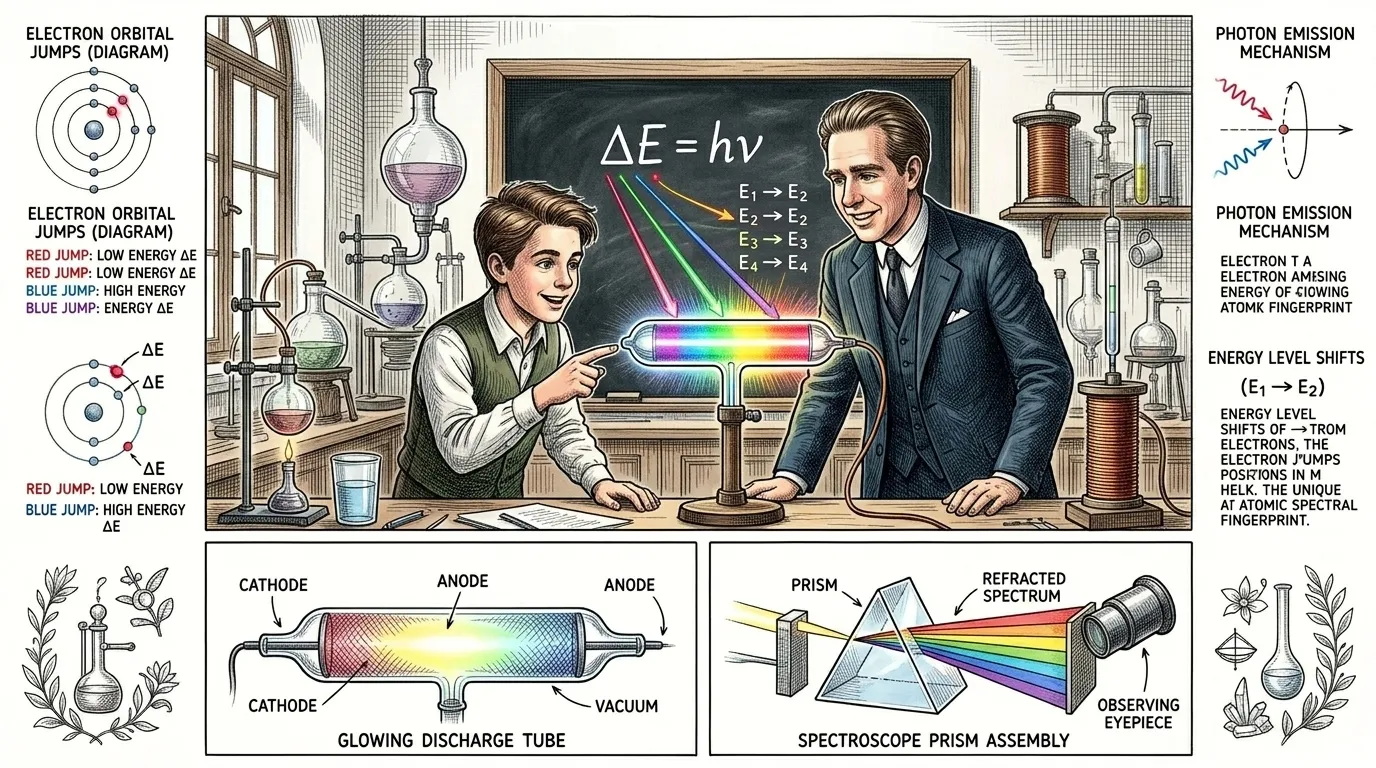
Bohr's model provided a precise, visual mechanism for understanding how atoms interact with light. When an electron absorbs a photon of exact energy, it leaps to a higher, less stable orbit—an 'excited state.' It then quickly drops back to a lower energy level, emitting a photon of characteristic energy and thus a specific color of light. This quantum dance accounts for the unique 'fingerprint' of spectral lines observed for each element.
"In a lively discussion, a student points to a glowing discharge tube. "So, Professor, the light we see, the specific colors, are direct evidence of these electron 'jumps'?" Bohr, standing nearby, nods. "Precisely. Each leap corresponds to a fixed energy difference, ΔE, and thus to a photon of exact frequency, ν, where ΔE hν. It's the atom's way of revealing its quantized structure. Each element's spectrum is as unique as a human fingerprint, and now we understand why.""
Page 6
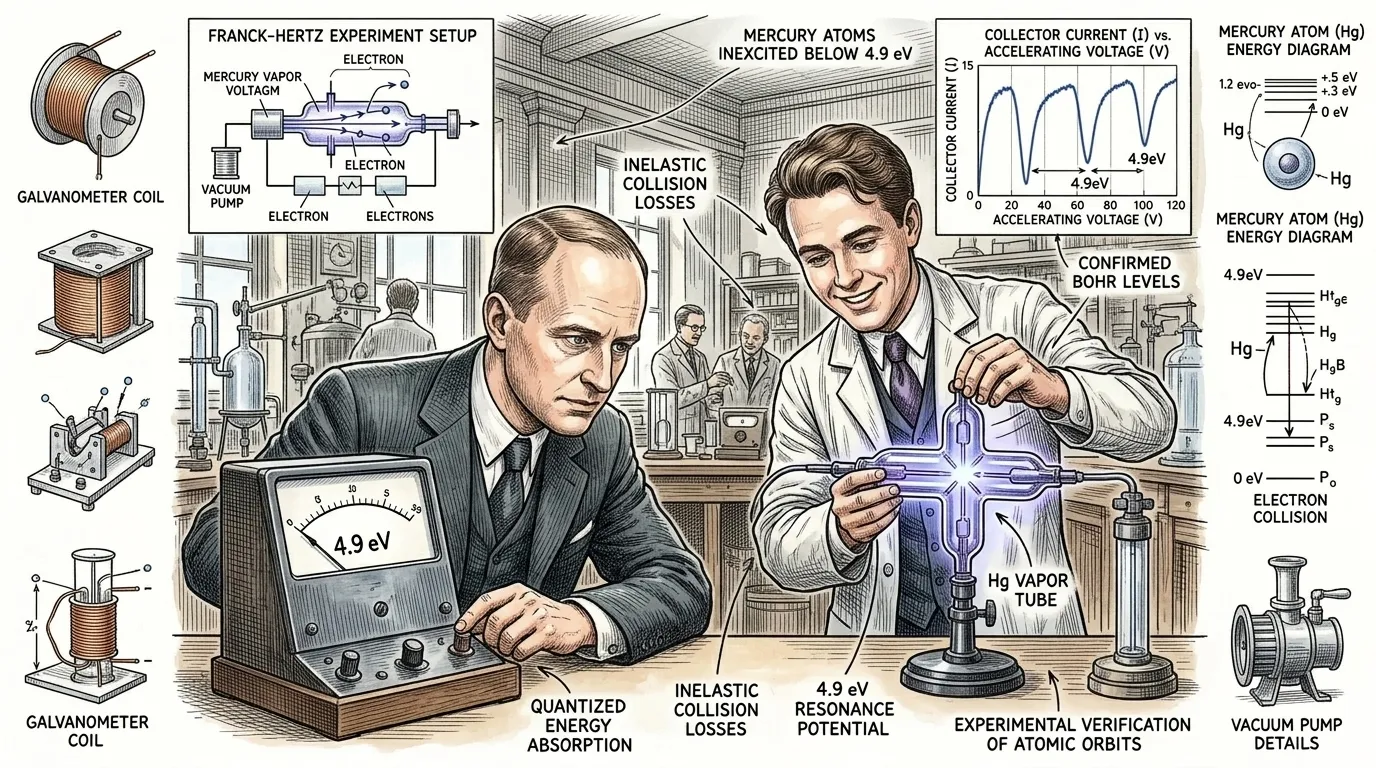
Theory, however elegant, demands empirical validation. In 1914, James Franck and Gustav Hertz conducted a groundbreaking experiment that provided direct evidence for Bohr's quantized energy levels. They fired electrons through mercury vapor and observed that the electrons lost energy only in specific, discrete amounts, precisely matching the energy differences predicted by Bohr for mercury atoms. This was undeniable proof that atoms possess distinct, quantized energy states.
"Inside their meticulously organized laboratory, James Franck, a man in his late 30s with a focused expression, examines a sensitive galvanometer. "Gustav," he calls to Gustav Hertz, a younger man in his early 30s, carefully adjusting a vacuum tube, "the current dips sharply at precisely 4.9 electron volts. The mercury atoms are absorbing energy only in these specific packets!" Hertz replies, a smile of satisfaction spreading across his face, "It confirms it, James. Discrete energy transfers. The quantum nature is undeniable, just as Bohr proposed. The data 'speaks for itself,' as Francis Bacon's empirical method taught us.""
Page 7
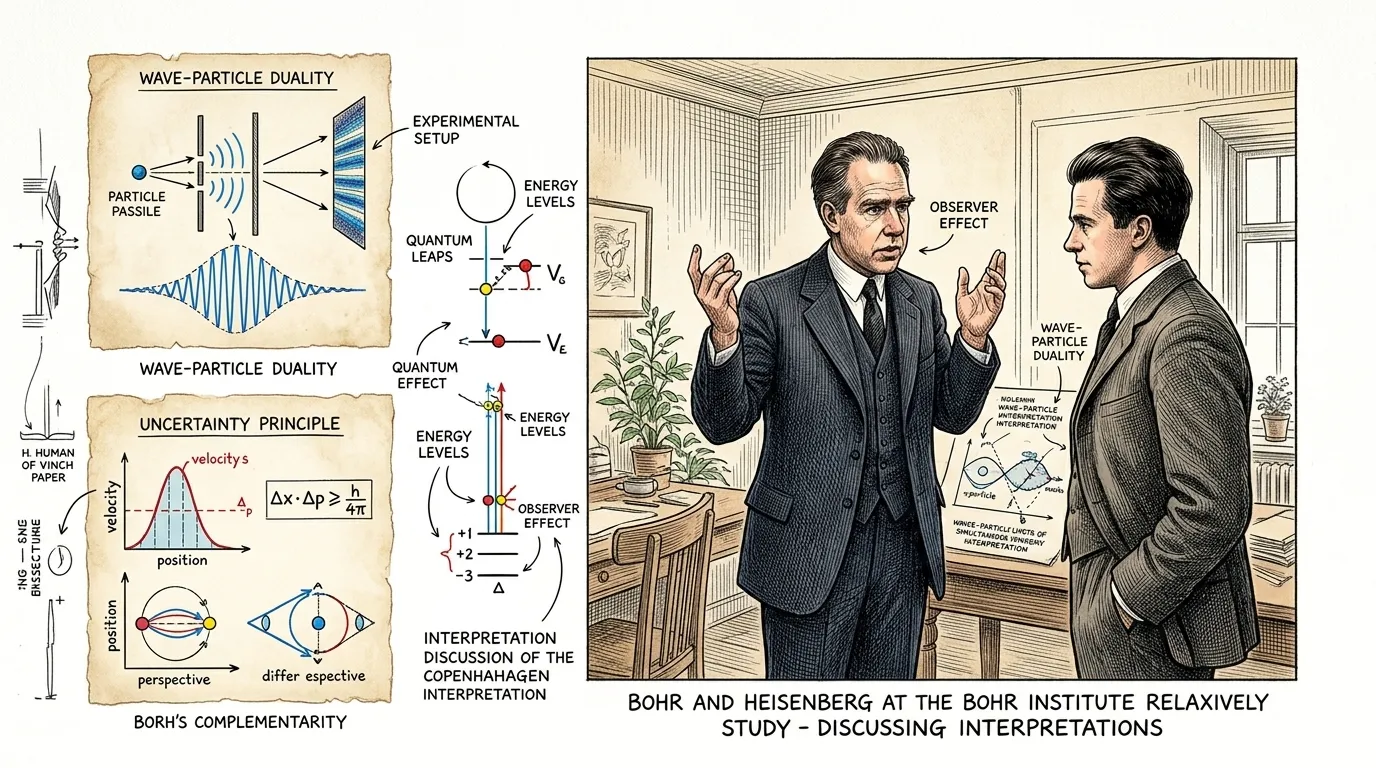
Bohr's model, though successful for hydrogen, encountered limitations for more complex atoms. Yet, its core principle of quantization laid the groundwork for the more comprehensive theory of quantum mechanics. Bohr, along with Werner Heisenberg and others, developed the 'Copenhagen Interpretation,' a philosophical framework for understanding this new, probabilistic reality where particles could exist in multiple states simultaneously until observed. It challenged deeply ingrained notions of causality.
"In the relaxed setting of a small study at the Bohr Institute, Niels Bohr, now in his forties with a more weathered but still intense face, gestures thoughtfully. Werner Heisenberg, a brilliant young man in his early twenties, intently listens. Bohr explains, "We are faced with a fundamental limit to our knowledge. The act of observation is not passive; it irrevocably affects the reality we seek to measure. We cannot simultaneously know with certainty both the position and momentum of a particle. As I've come to believe, 'Physics is not about how the world is, it's about what we can say about the world.'""
Page 8
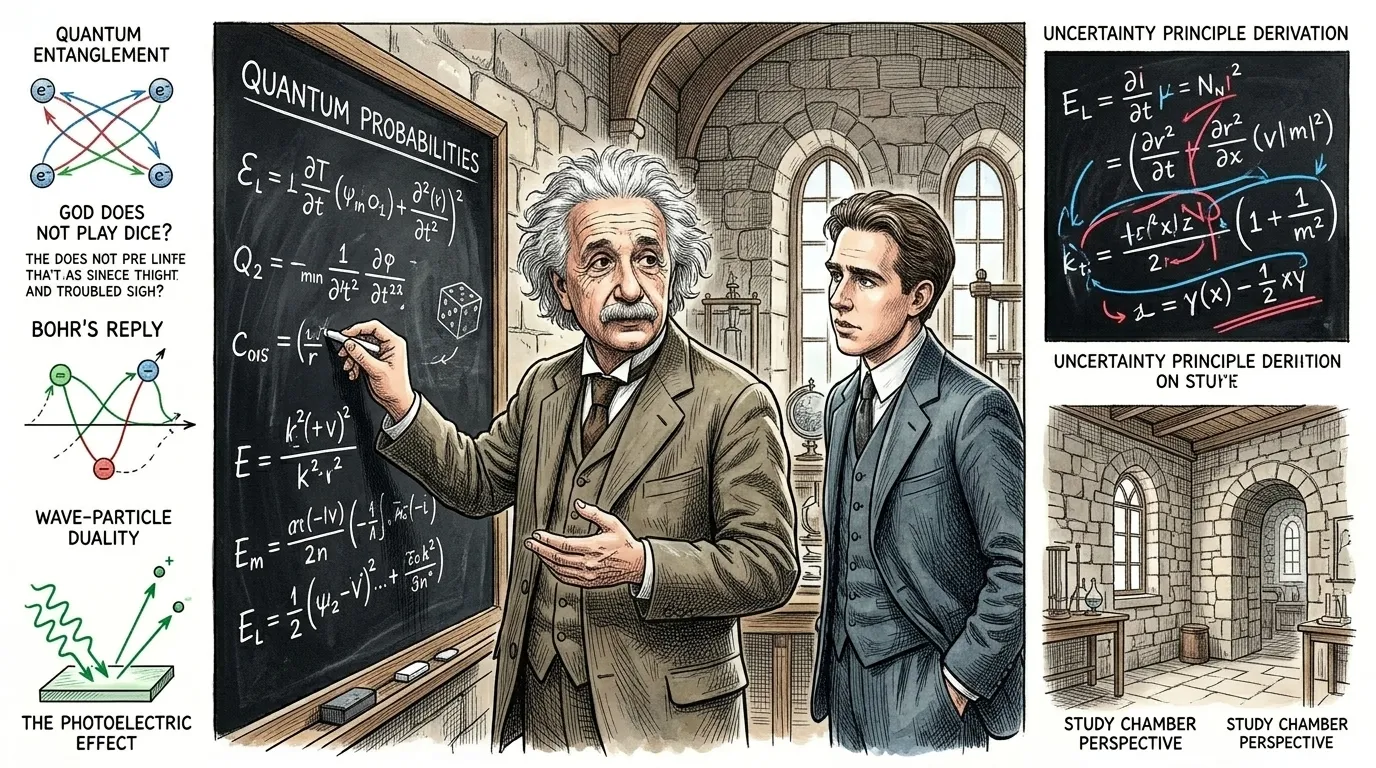
Bohr's revolutionary ideas, initially a 'stop-gap' model, proved to be the indispensable bridge to the full quantum mechanical revolution. His concept of quantized energy levels and electron jumps paved the way for Erwin Schrödinger's wave equation and Werner Heisenberg's matrix mechanics, fundamentally altering humanity's understanding of matter and energy at the most fundamental scale. This quantum framework, born from Bohr's bold postulates, provided the 'solution' to the previously inexplicable stability of the atom and the behavior of light.
"Albert Einstein, a man with iconic wild, grey hair and a deeply contemplative expression, stands at a blackboard, meticulously writing equations. A younger colleague, perhaps a student, looks on with a respectful but questioning gaze. Einstein sighs, then turns to his equations. "This 'quantum jump' of Bohr's... it makes a mockery of all I consider fundamental about the universe. The probabilistic nature, the inherent uncertainty. As I wrote in a letter, 'God does not play dice with the universe.' But Bohr's model, however unsettling, appears to explain the spectral lines, and this new quantum mechanics, built upon it, seems to hold true where classical physics failed. It is a profound, if troubling, triumph.""
Page 9
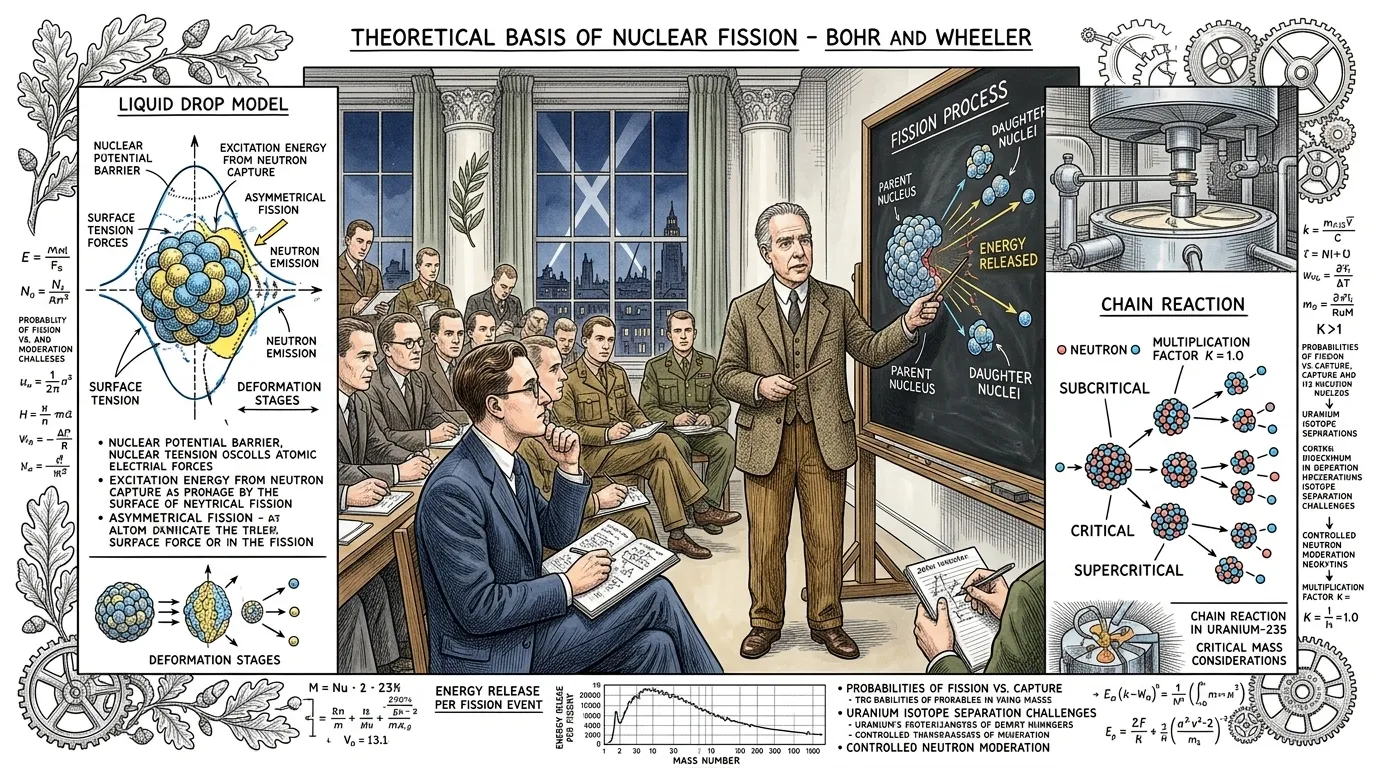
Bohr's contributions extended beyond the atom's electron shell. With John Wheeler in 1939, he developed the 'liquid drop model' of the atomic nucleus, a macroscopic analogy that proved crucial for understanding nuclear fission. This model treated the nucleus like a droplet of incompressible nuclear fluid, successfully explaining how a neutron striking a heavy nucleus could deform it, causing it to split into smaller fragments and release immense energy. This was a critical theoretical step for unlocking the power of the atomic bomb.
"Inside a bustling wartime physics conference room, Niels Bohr, now a seasoned elder statesman of science, points to a chalkboard. John Wheeler, a younger American physicist in his late twenties, listens intently. Bohr declares, "The nucleus, in certain respects, behaves like a liquid drop! Imagine a large drop of water. If it becomes too agitated, it can oscillate, deform, and eventually split apart. This provides a surprisingly accurate analogy for nuclear fission." Wheeler, nodding, adds, "It's a powerful conceptual tool, Professor. This model, much like our understanding of how 'truth emerges from the clash of ideas,' as some might say, explains precisely how the uranium nucleus can be induced to split.""
Page 10
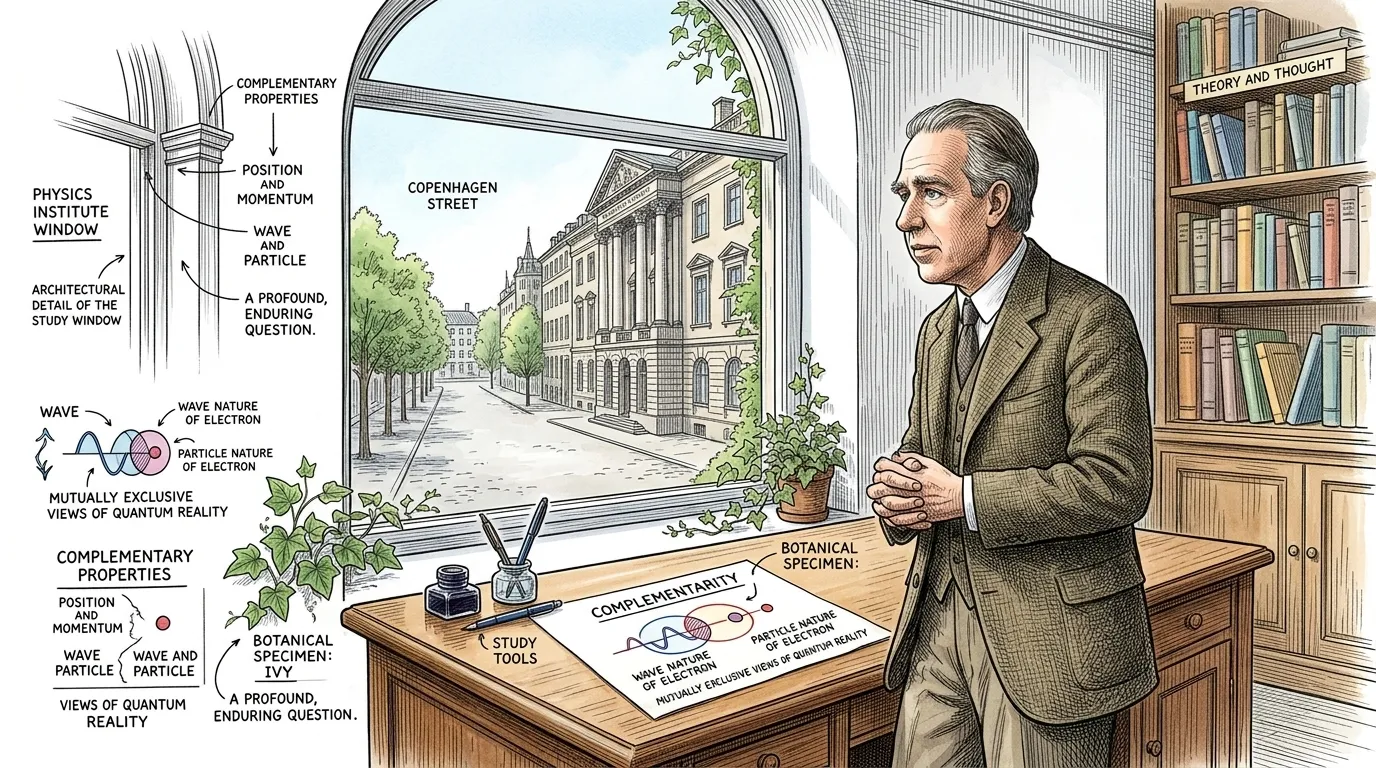
Niels Bohr's legacy is immense, transcending his atomic model. He was a pioneer of quantum mechanics, a philosophical giant who grappled with the implications of a fundamentally uncertain reality, introducing the concept of 'complementarity': that seemingly contradictory descriptions (like wave and particle) are both necessary to fully understand a quantum phenomenon. His institute in Copenhagen became a crucible for quantum physics, a place where the brightest minds debated the very nature of existence. Bohr's unwavering commitment to challenging classical intuition forever changed our understanding of the universe, leaving profound questions that continue to inspire and perplex scientists to this day.
"In the tranquility of his later years, Niels Bohr, a venerable figure with kind eyes and a thoughtful expression, gazes out of a window. He muses aloud, reflecting on his life's work: "Every great and deep difficulty bears in itself its own solution. It forces us to change our thinking in order to find it. The quantum world taught us that. It is not merely about electrons and energy, but about the very limits of human perception and language when confronted with reality itself.""
About this story
- Location: Global
- Audience: general readers
Read Wonder Science on your phone
Wonder Science is available on Android. Get Wonder Science on Google Play.