Otto Stern
Otto Stern — an illustrated science story, set in Global. 10 illustrated pages, free to read on Wonder Science.
Page 1
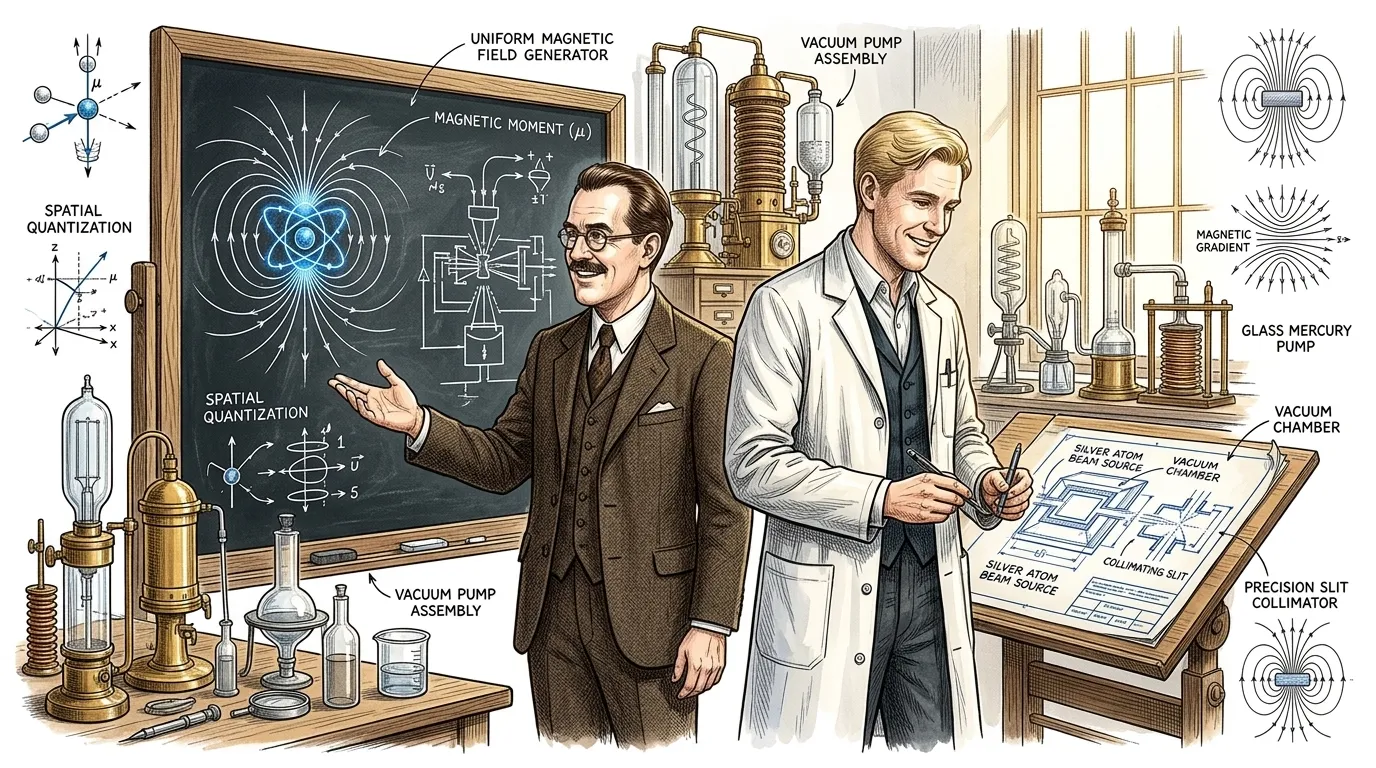
In the early 20th century, physics faced a profound crisis: classical theory failed to explain the inner workings of the atom. Amidst this intellectual ferment, a quiet revolution was ignited in Frankfurt, Germany, where a beam of silver atoms was about to challenge the very foundations of how we understood matter. This audacious experiment, conceived by Otto Stern and realized with Walter Gerlach, aimed to reveal the magnetic properties of individual atoms, an endeavor that would irrevocably alter the landscape of quantum mechanics.
Page 2
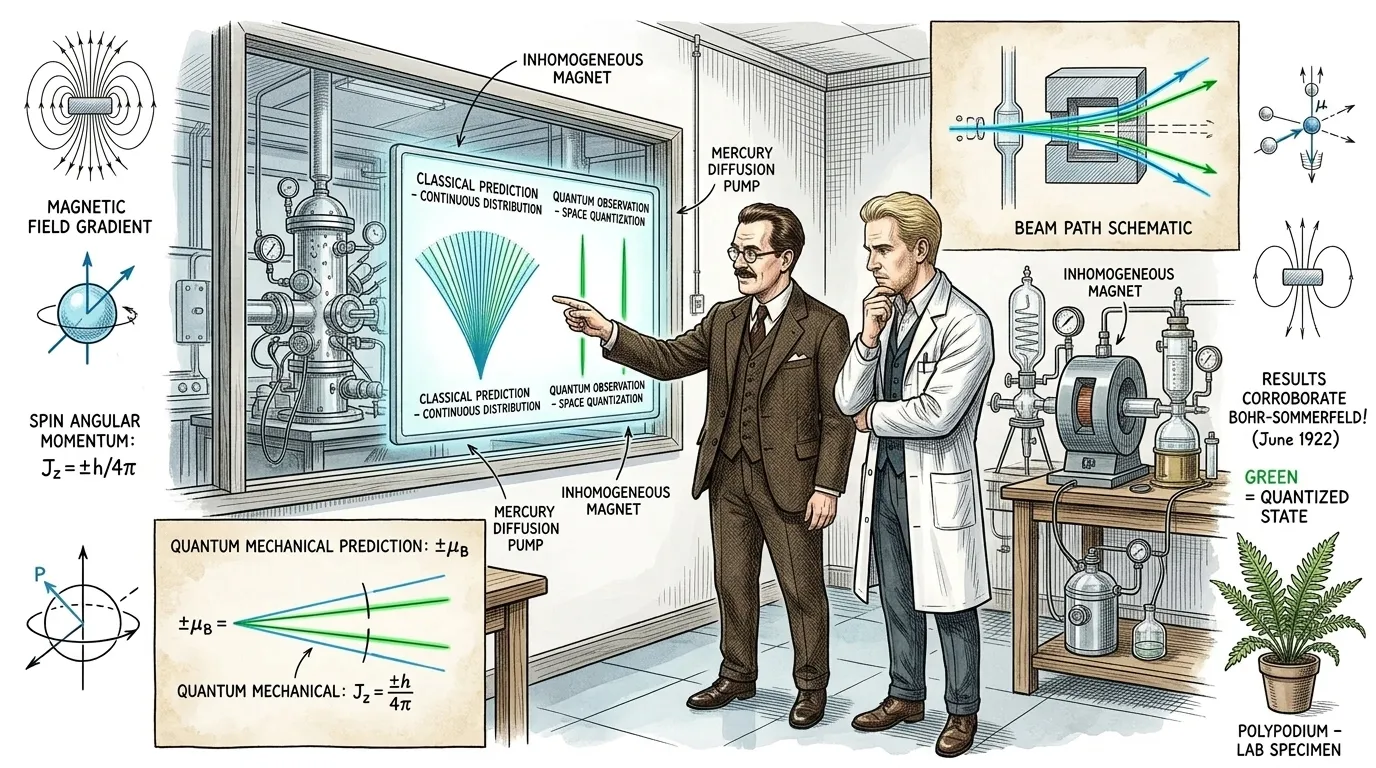
Classical physics predicted that if atoms possessed magnetic moments, they should randomly orient in a magnetic field, resulting in a continuous spread when subjected to a force. Yet, quantum theory hinted at something far stranger: a 'space quantization,' where an atom's magnetic moment could only adopt specific, discrete orientations. This was a direct contradiction, begging for an experimental verdict. The Stern-Gerlach experiment sought to reveal which reality governed the atomic realm.
Page 3
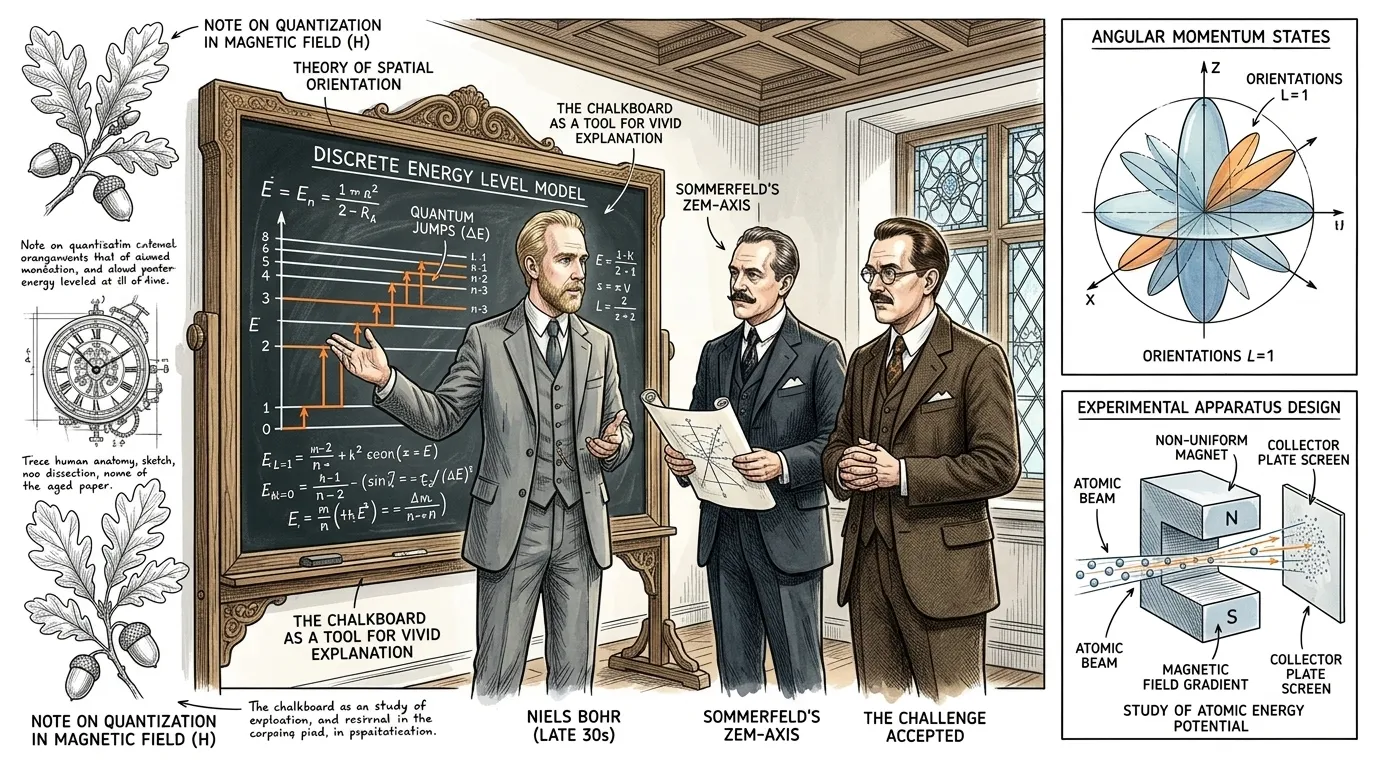
The concept of space quantization, though abstract, suggested a revolutionary truth: the microscopic world did not behave like the macroscopic one. An atom's angular momentum, and thus its associated magnetic moment, was not a continuously variable quantity but was quantized—meaning it could only exist in discrete steps. This idea, championed by early quantum theorists like Niels Bohr and Arnold Sommerfeld, needed empirical proof, a challenge Otto Stern eagerly accepted to bridge theory with observable reality.
Page 4
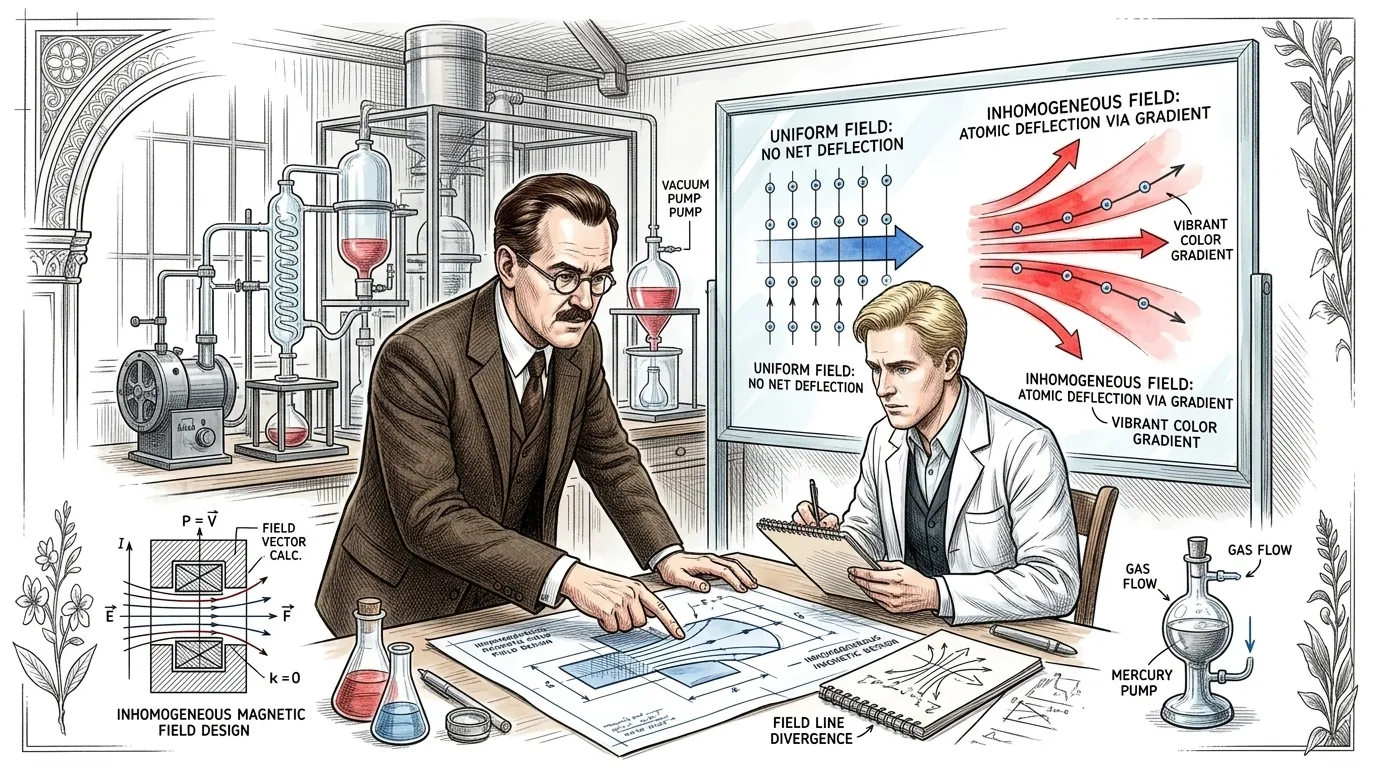
The true stroke of genius in the Stern-Gerlach experiment lay in its use of an inhomogeneous magnetic field. Unlike a uniform field, which only aligns magnetic moments without exerting a net force, a non-uniform field creates a force gradient. This gradient would deflect atoms based on the orientation of their magnetic moments, making it possible to observe discrete quantum states. Without this precise field design, the subtle dance of atomic magnetism would remain hidden, undetectable by classical means.
Page 5
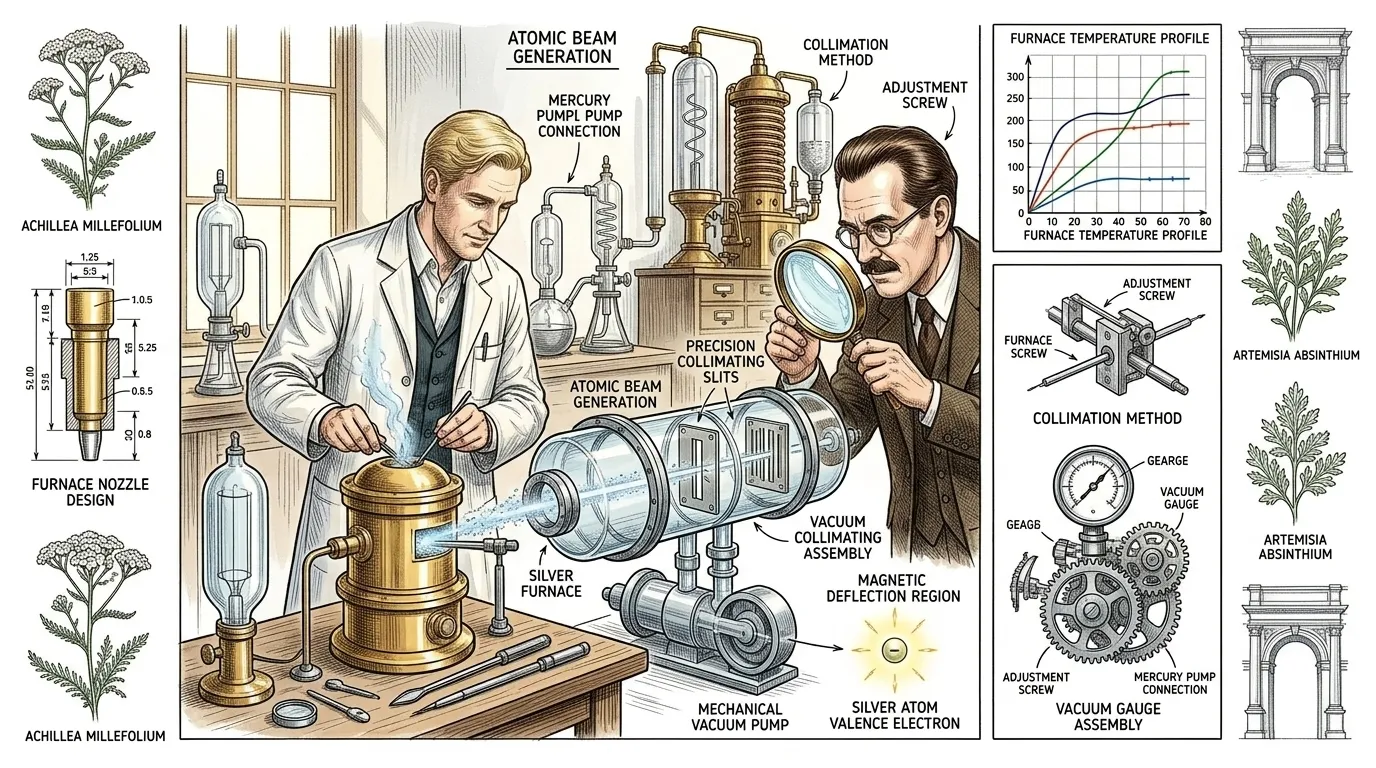
The experimental setup began with a furnace, heating silver to vaporize it into a gas. This silver vapor was then channeled through a series of narrow slits, creating a highly collimated beam of individual silver atoms traveling through a vacuum. Silver was chosen because its single valence electron carries a net magnetic moment, simplifying the atomic structure for initial study. This painstaking preparation ensured that only isolated atoms, unperturbed by collisions, entered the crucial magnetic field region, ready to reveal their quantum secrets.
Page 6
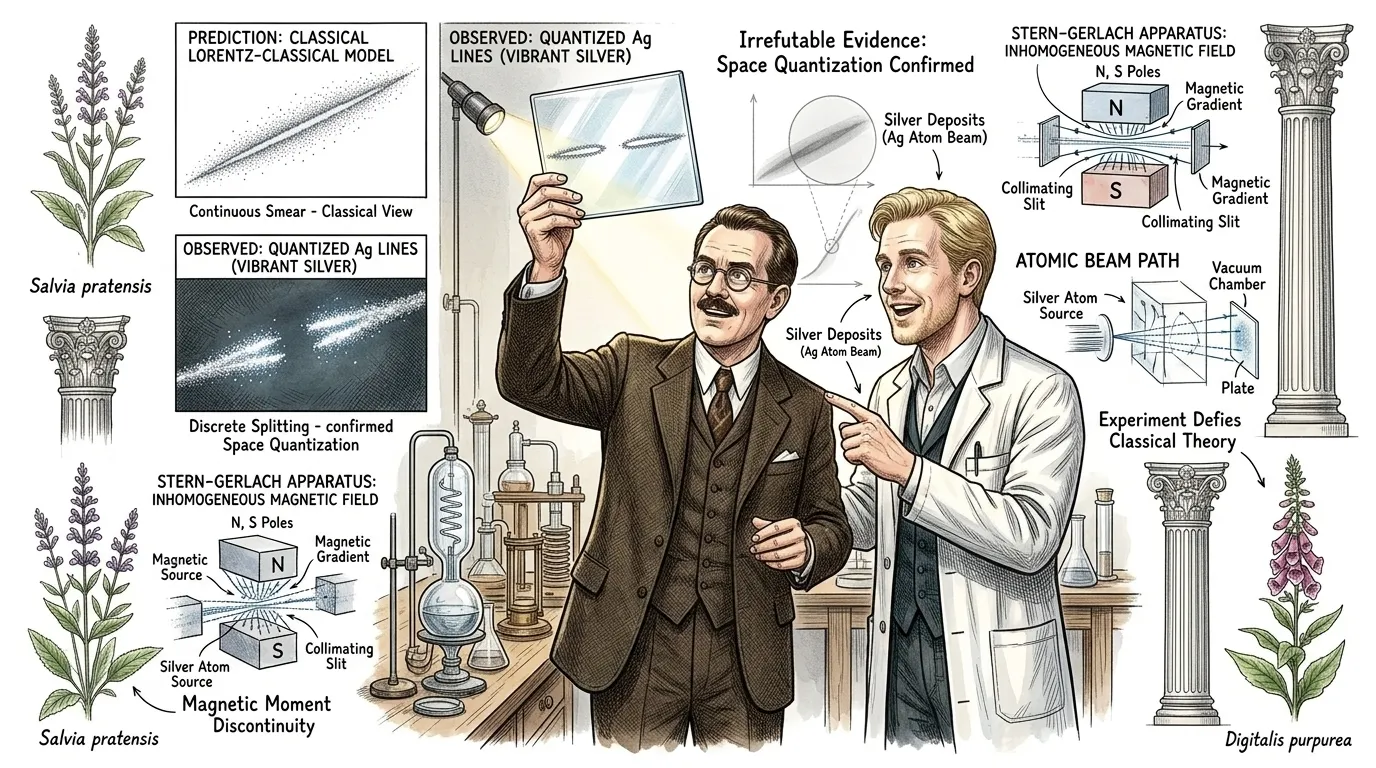
After traversing the inhomogeneous magnetic field, the silver atoms were collected on a glass plate. Classical predictions anticipated a broadened, single smear of silver, reflecting a continuous range of magnetic moment orientations. What Stern and Gerlach observed, however, was astonishing: two distinct, separated lines of silver deposits. This clear bifurcation was irrefutable evidence for space quantization, confirming that atomic magnetic moments could only take on a finite number of orientations, a profound victory for the burgeoning quantum theory.
Page 7
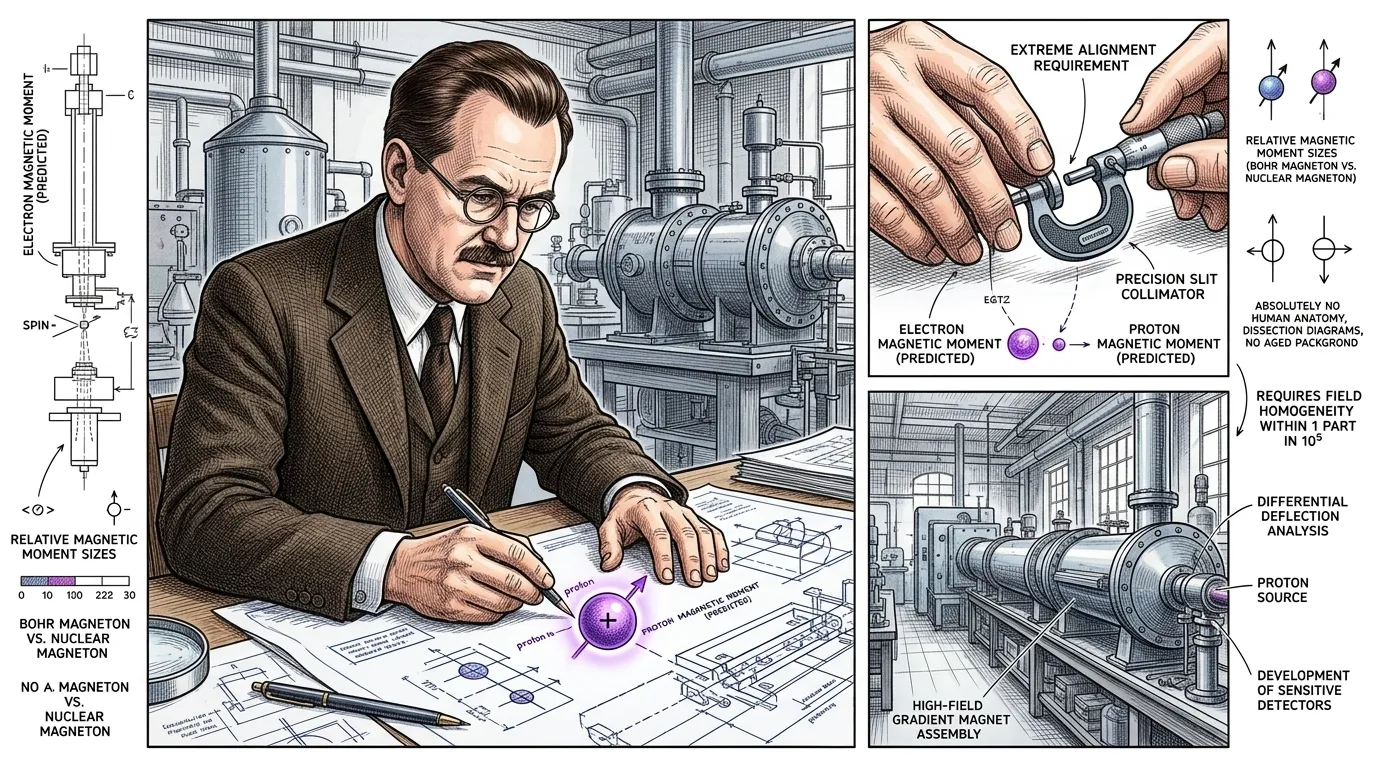
Building upon the foundational insights of atomic beams, Otto Stern embarked on an even more challenging quest in the 1930s: determining the magnetic moment of the proton. The proton, a constituent of the atomic nucleus, was known to carry an intrinsic angular momentum (spin), implying it should also possess a magnetic moment. However, its moment was predicted to be far smaller than that of the electron, making experimental detection incredibly difficult and requiring an even higher degree of precision and sensitivity in molecular beam techniques.
Page 8
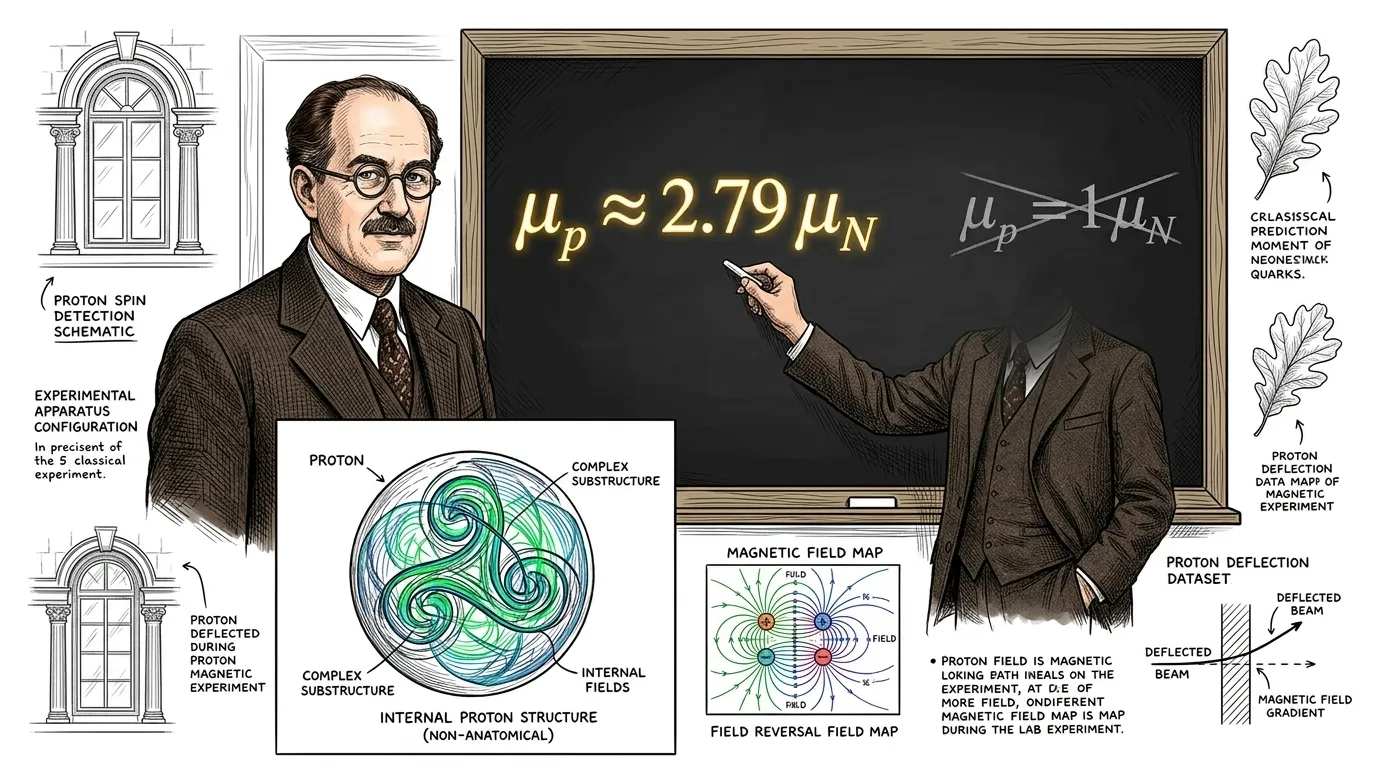
Through painstaking refinement of molecular beam methods, Stern successfully measured the proton's magnetic moment, discovering it was approximately 2.79 nuclear magnetons. This result was revolutionary, deviating significantly from the theoretical prediction of exactly one nuclear magneton if the proton were a simple, point-like Dirac particle. This unexpected value indicated a complex internal structure for the proton, foreshadowing the later discovery of quarks and providing crucial insights into the nature of nuclear forces and fundamental particles.
Page 9
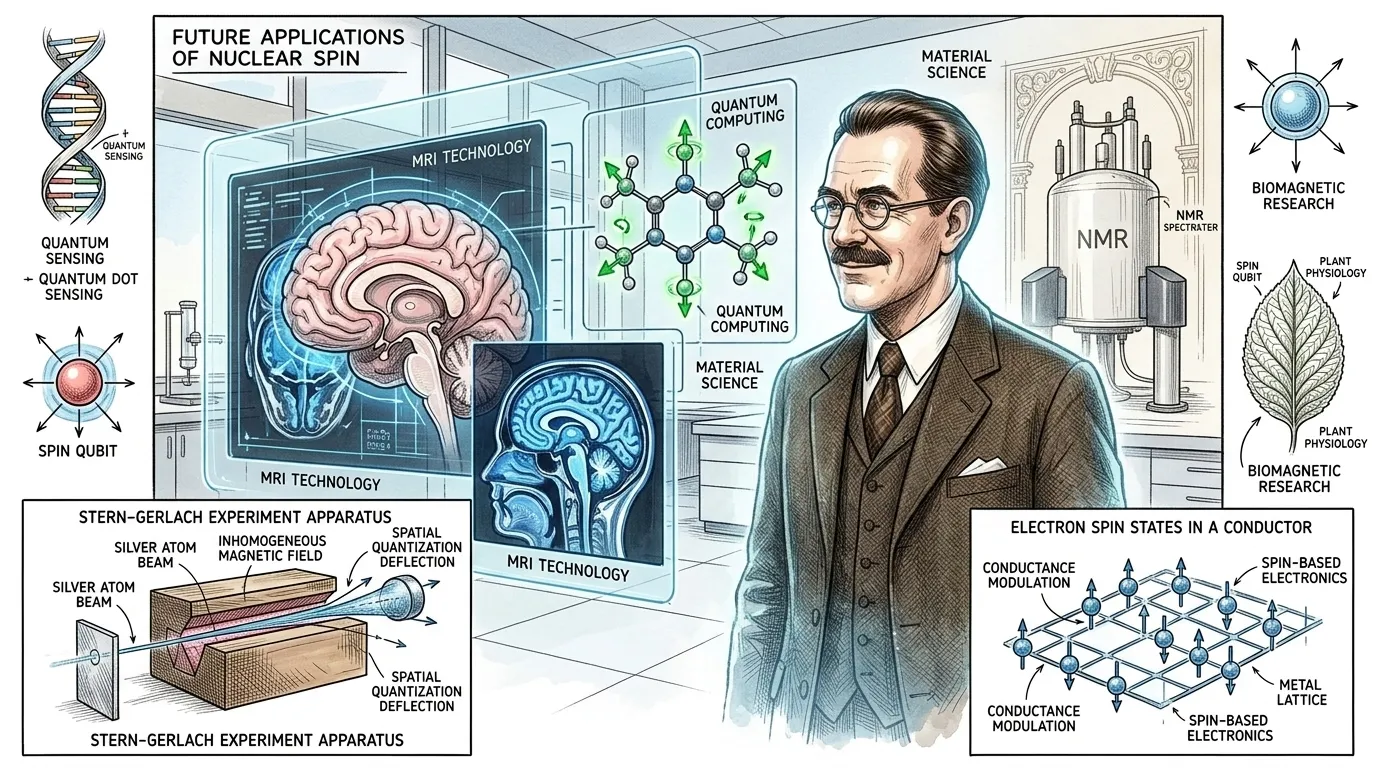
Otto Stern's pioneering work laid critical foundations for understanding the quantum nature of particles. The concept of electron spin, illuminated by the Stern-Gerlach experiment, is fundamental to chemistry, material science, and quantum computing. His precise measurement of the proton's magnetic moment was a direct precursor to the development of Nuclear Magnetic Resonance (NMR) spectroscopy and Magnetic Resonance Imaging (MRI), technologies that have revolutionized fields from analytical chemistry to medical diagnostics, allowing us to peer non-invasively into matter and living tissue.
Page 10
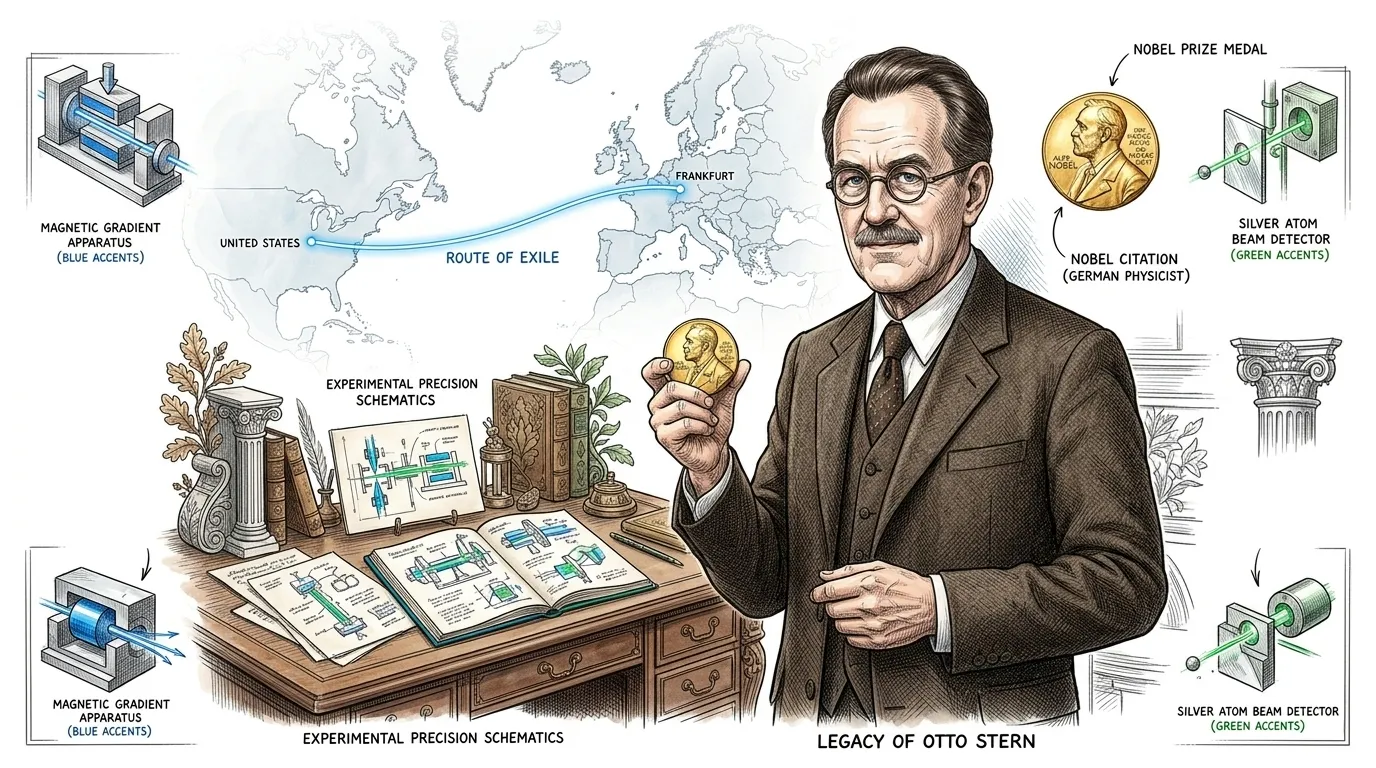
Otto Stern's relentless pursuit of experimental precision, even amidst political turmoil that forced his exile from Nazi Germany, earned him the Nobel Prize in Physics in 1943. His contributions transcended mere observation; they offered empirical proof for revolutionary quantum concepts and opened new avenues of research into the fundamental properties of matter. His legacy endures, a testament to the power of meticulous experimentation to unravel the universe's most elusive secrets and to inspire generations of physicists.
About this story
- Location: Global
- Audience: general readers
Questions and answers
Read Wonder Science on your phone
Wonder Science is available on Android. Get Wonder Science on Google Play.