Stephen Hawking
Stephen Hawking — an illustrated science story, set in Global. 10 illustrated pages, free to read on Wonder Science.
Page 1
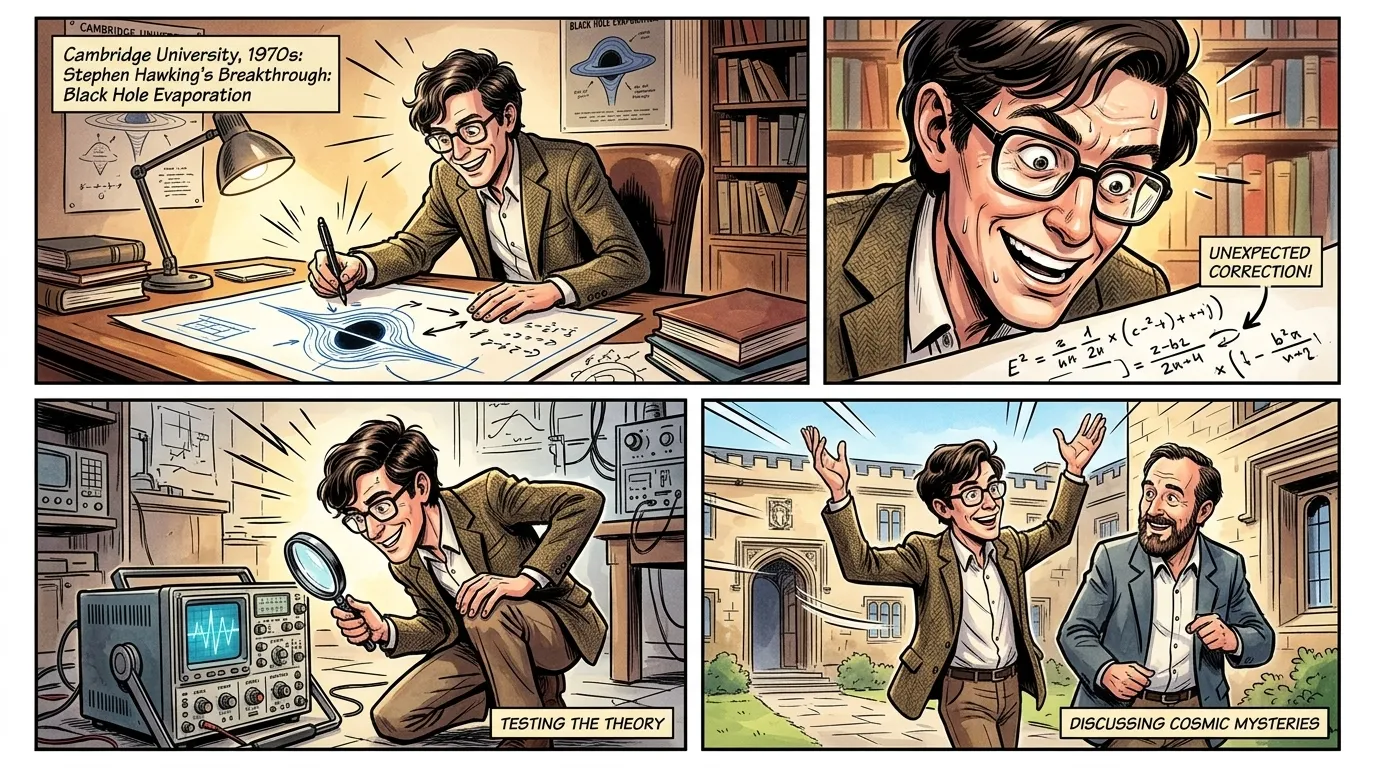
In the hallowed halls of Cambridge, in the early 1970s, a young physicist, Stephen Hawking, grappled with the most enigmatic objects in the cosmos: black holes. These colossal remnants of collapsed stars, once believed to be eternal cosmic prisons, were about to be re-envisioned through the lens of quantum mechanics. Hawking's revolutionary insight would suggest that black holes, far from being absolute, slowly leak energy and eventually evaporate, fundamentally altering our understanding of space, time, and the very nature of reality. This audacious proposition, known as Hawking radiation, bridged the chasm between Einstein's general relativity and the perplexing world of quantum physics.\n\n Fact: Stephen Hawking, Cambridge University, 1970s. Breakthrough: Black Hole Evaporation.
Page 2
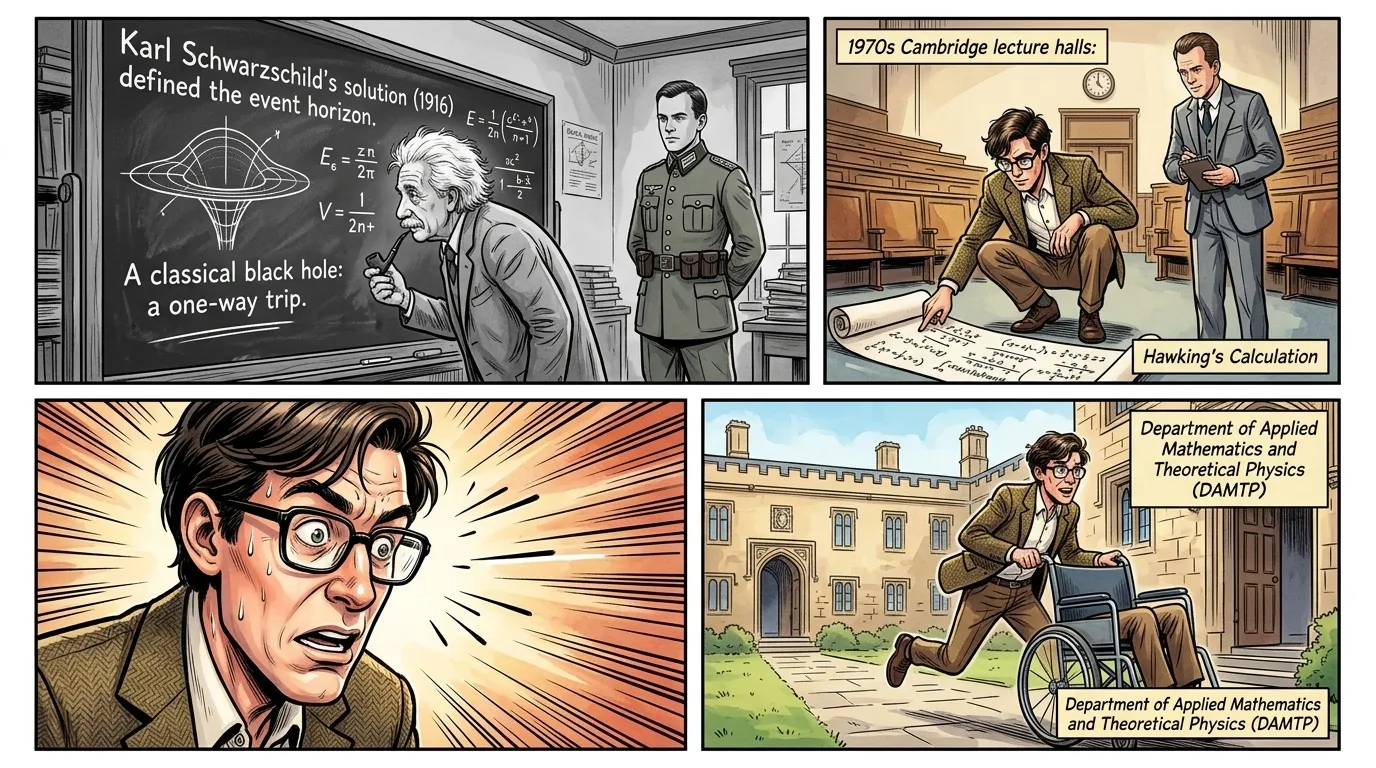
Before Hawking's radical ideas, black holes were understood primarily through the framework of Albert Einstein's General Theory of Relativity, first mathematically described by Karl Schwarzschild in 1916. These celestial bodies are regions of spacetime where gravity is so intense that nothing—not even light—can escape once it crosses a boundary known as the event horizon. For decades, they were regarded as perfect absorbers, cosmic vacuum cleaners that only ever pulled matter in, growing ever larger and more mysterious. This classical understanding presented a stark, one-way journey into oblivion, a point of no return for anything that ventured too close to their crushing gravitational pull.\n\n Fact: Karl Schwarzschild's solution (1916) defined the event horizon. A classical black hole: a one-way trip.
Page 3
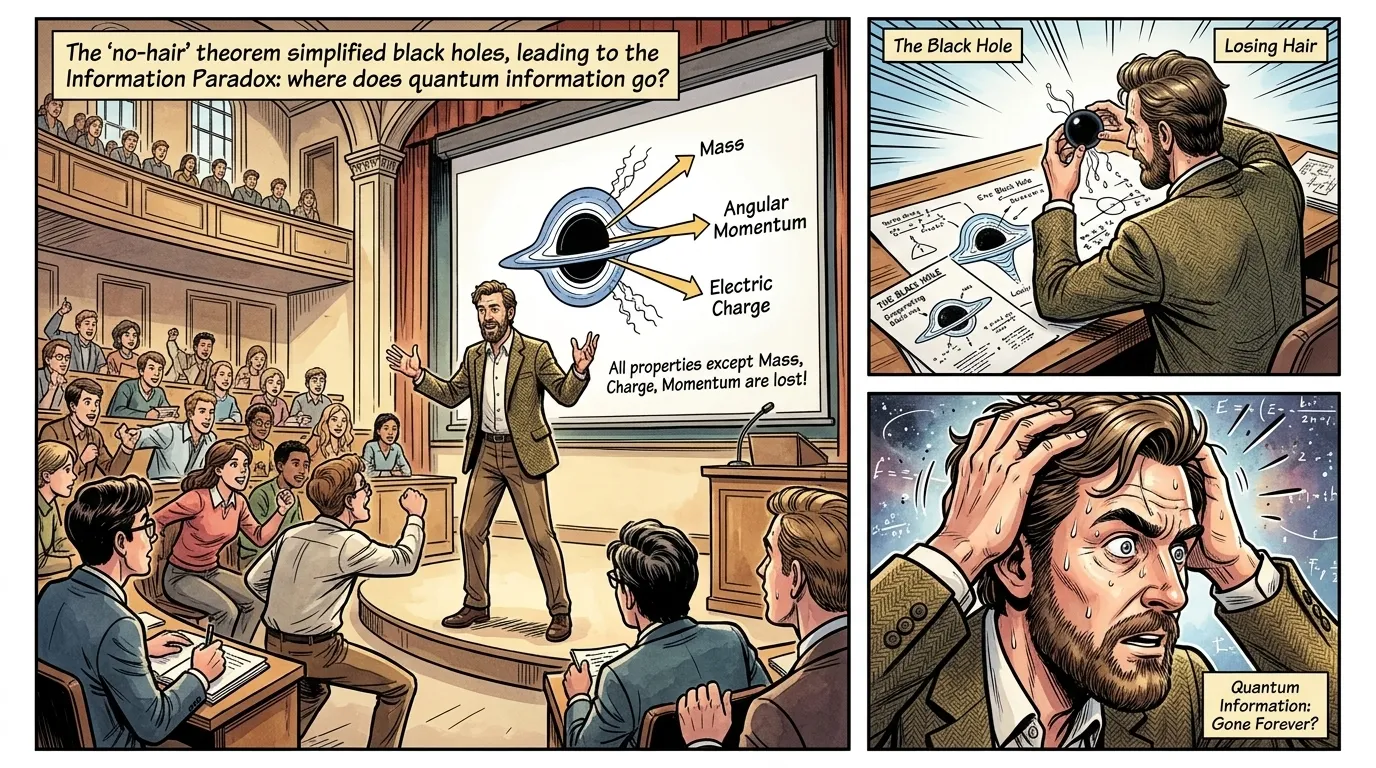
The classical understanding of black holes was further solidified by the 'no-hair theorem,' a concept developed in the 1960s and 70s by physicists like John Archibald Wheeler. This theorem posits that once matter falls into a black hole, almost all information about it is lost, except for three fundamental properties: mass, angular momentum, and electric charge. Any other unique characteristics, or 'hair,' are thought to be irrevocably erased. This simplification, while elegant, created a profound conflict known as the 'information paradox.' If black holes only ever absorbed, and never emitted, how could quantum information, which physics dictates cannot be truly destroyed, simply vanish?\n\n Fact: The 'no-hair' theorem simplified black holes, leading to the Information Paradox: where does quantum information go?
Page 4
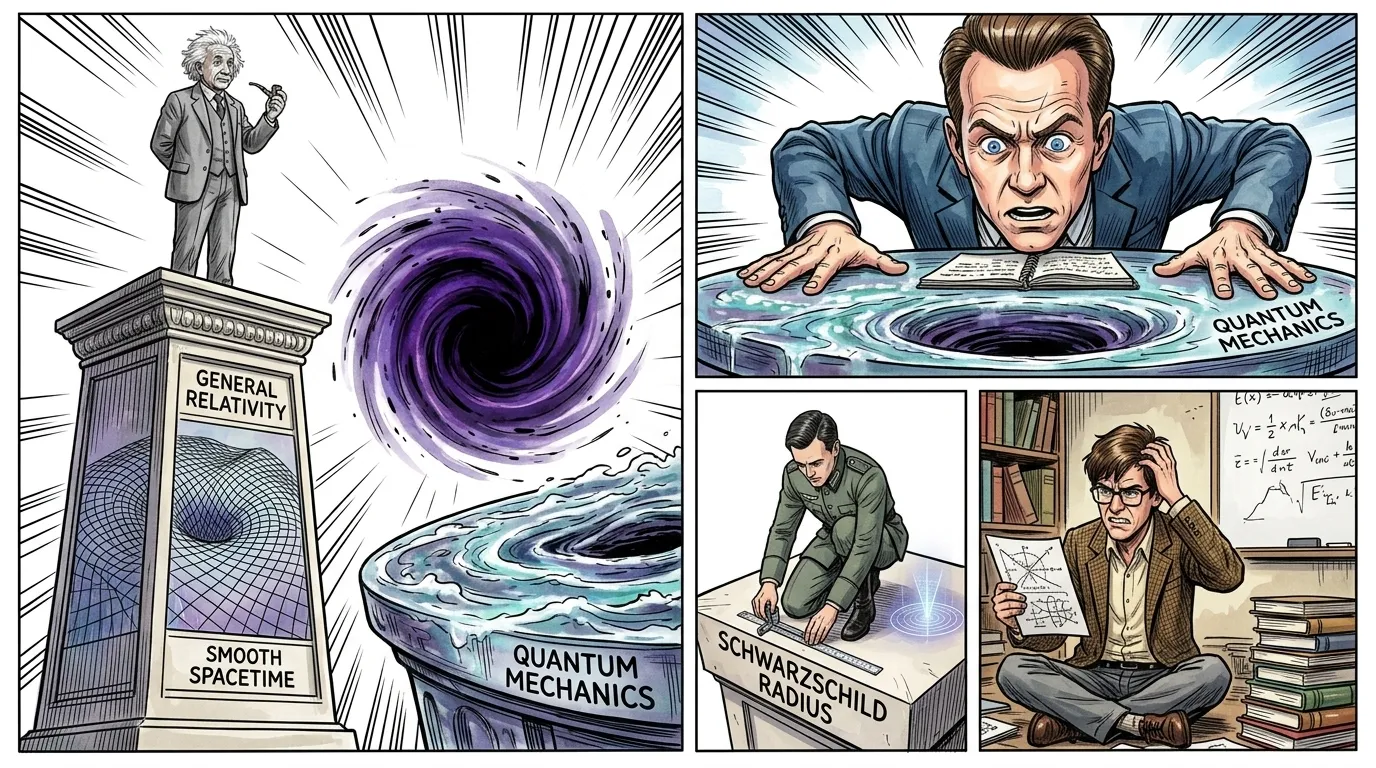
For much of the 20th century, two pillars of modern physics stood in magnificent isolation: Albert Einstein's General Relativity, which describes gravity on cosmic scales, and Quantum Mechanics, which governs the subatomic world. Black holes, with their immense gravity confined to a quantum-sized singularity, represented a profound theoretical battleground where these two theories clashed. Classically, the fabric of spacetime near a black hole was smooth and predictable. However, quantum theory insisted that even 'empty' space was a turbulent sea of fluctuating particles, a concept utterly at odds with the smooth, classical model of black holes. Reconciling these divergent views became an urgent frontier in theoretical physics.\n\n Fact: The theoretical conflict: smooth spacetime (General Relativity) vs. turbulent quantum vacuum (Quantum Mechanics) at the black hole's edge.
Page 5
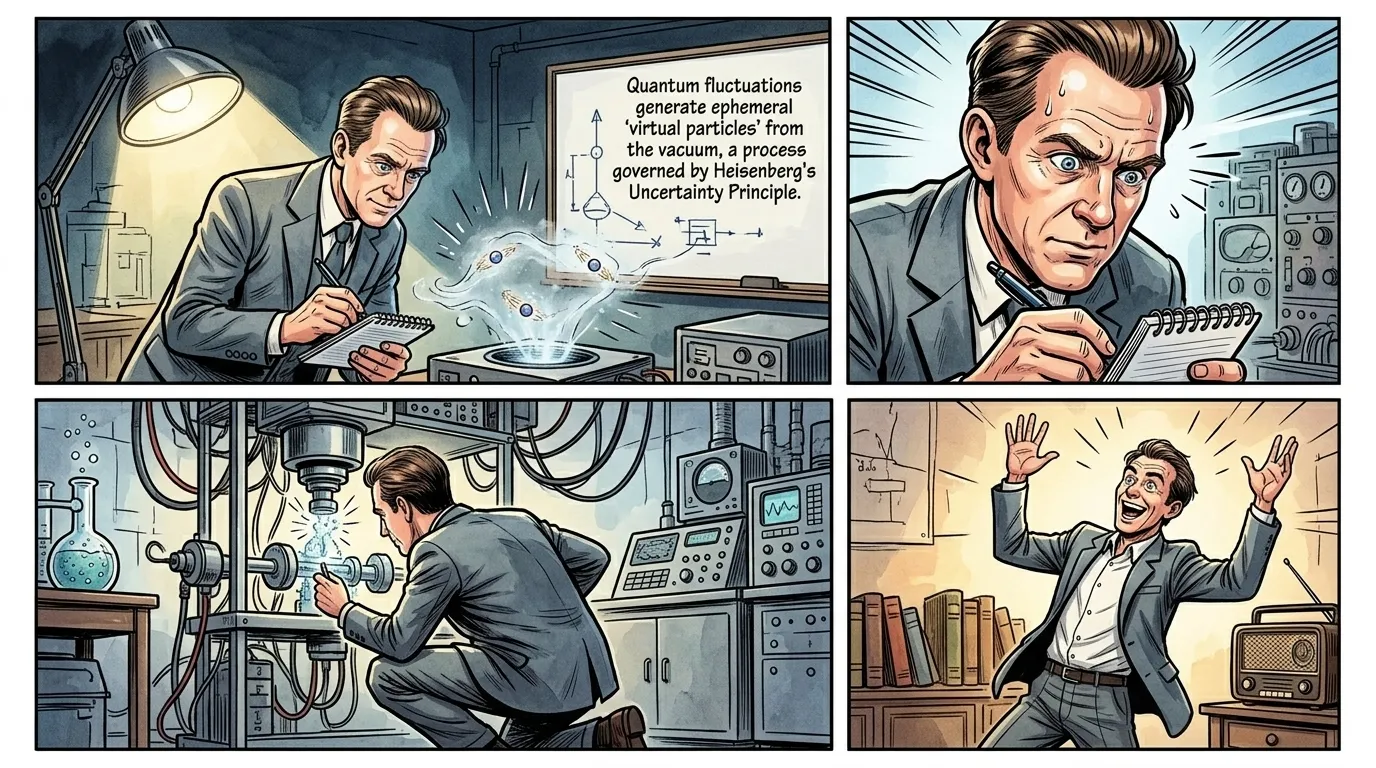
Hawking's groundbreaking insight began with understanding quantum mechanics' prediction of virtual particles. Even in the vacuum of space, particle-antiparticle pairs are constantly popping into existence and annihilating each other almost instantaneously. These 'virtual' particles borrow energy from the vacuum for a fleeting moment, as permitted by Werner Heisenberg's Uncertainty Principle. They are a fundamental aspect of quantum fields, an invisible dance of creation and destruction that pervades all of reality. It was this seemingly innocuous quantum fluctuation, occurring everywhere, that Hawking realized could be profoundly altered by the extreme conditions near a black hole's event horizon.\n\n Fact: Quantum fluctuations generate ephemeral 'virtual particles' from the vacuum, a process governed by Heisenberg's Uncertainty Principle.
Page 6
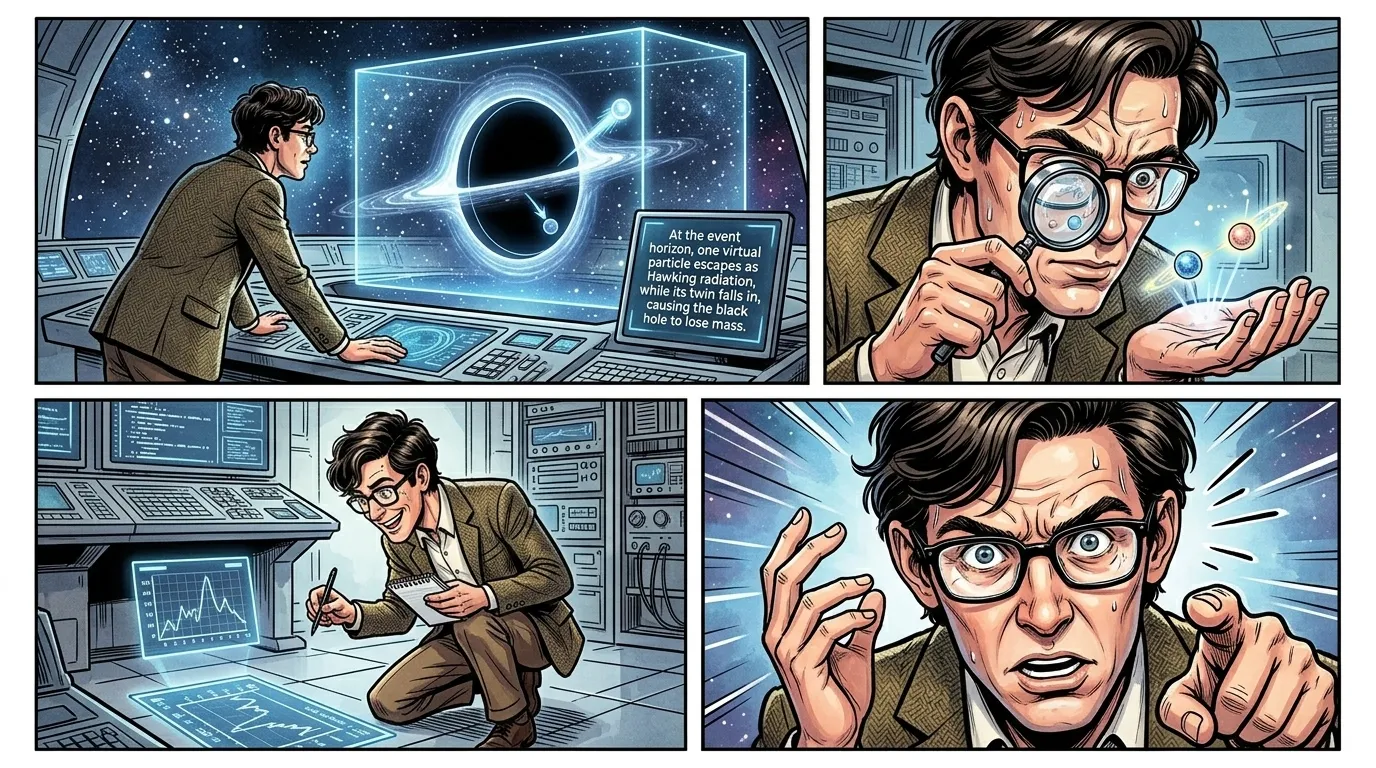
At the precipice of a black hole's event horizon, the chaotic dance of virtual particles takes on a critical new dimension. When a virtual particle-antiparticle pair spontaneously materializes exactly at this boundary, a unique interaction can occur. Instead of annihilating each other, one particle might fall into the black hole, forever trapped by its immense gravity. Its twin, however, having 'borrowed' positive energy, might escape into space, carrying away mass-energy from the black hole. This escaping particle is observed as Hawking radiation. Essentially, the black hole uses its immense gravitational energy to 'pay' the energy debt of the escaping particle, thereby losing a tiny amount of its own mass in the process.\n\n Fact: At the event horizon, one virtual particle escapes as Hawking radiation, while its twin falls in, causing the black hole to lose mass.
Page 7
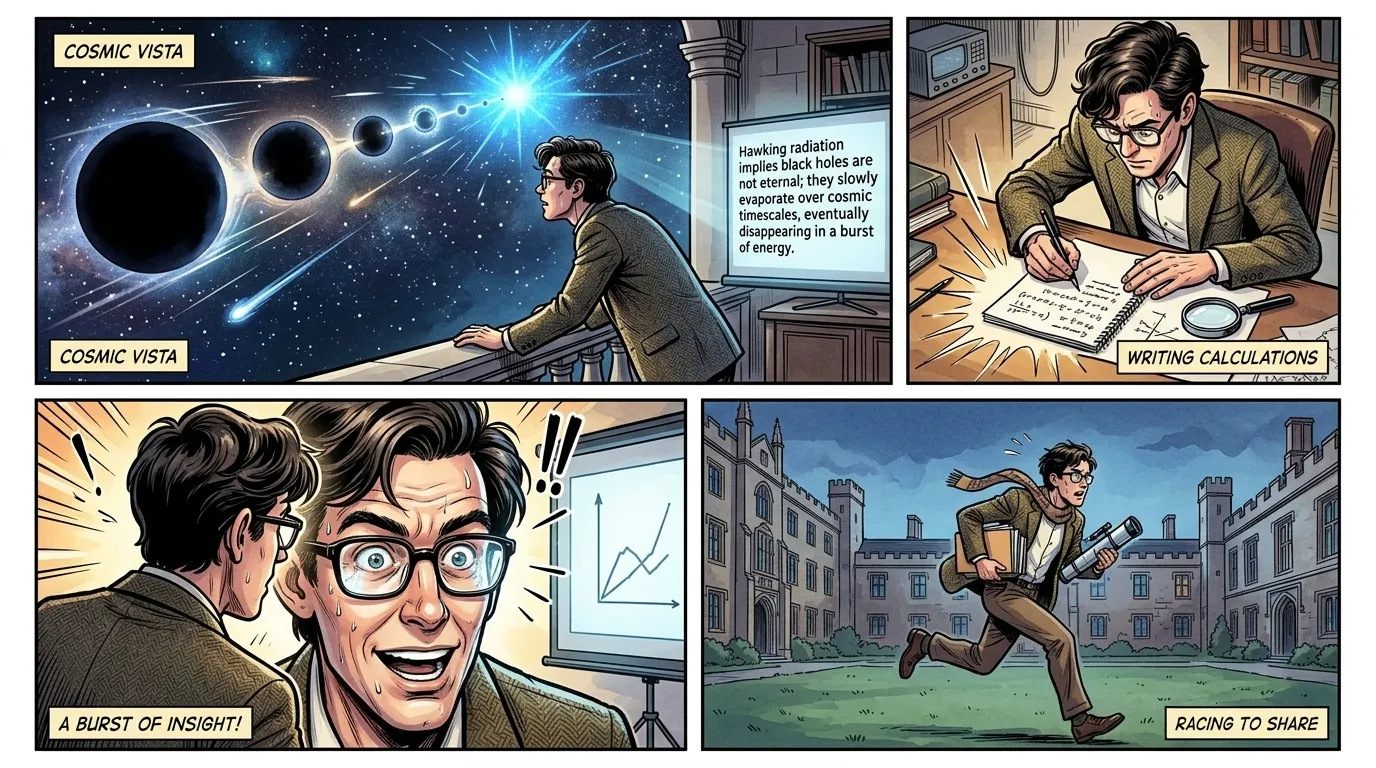
The continuous emission of Hawking radiation has a profound and counter-intuitive consequence: black holes are not eternal. Over timescales far exceeding the current age of the universe for stellar-mass black holes, they slowly lose mass and energy, eventually shrinking and evaporating completely. This process is incredibly slow for large black holes, meaning it would take a black hole with the mass of our Sun approximately 10 67 years to evaporate. However, for microscopic black holes, the evaporation process would be much faster, culminating in a spectacular burst of radiation. This theoretical evaporation implies that black holes have a finite lifespan, a concept that fundamentally revised their role in cosmic evolution.\n\n Fact: Hawking radiation implies black holes are not eternal; they slowly evaporate over cosmic timescales, eventually disappearing in a burst of energy.
Page 8
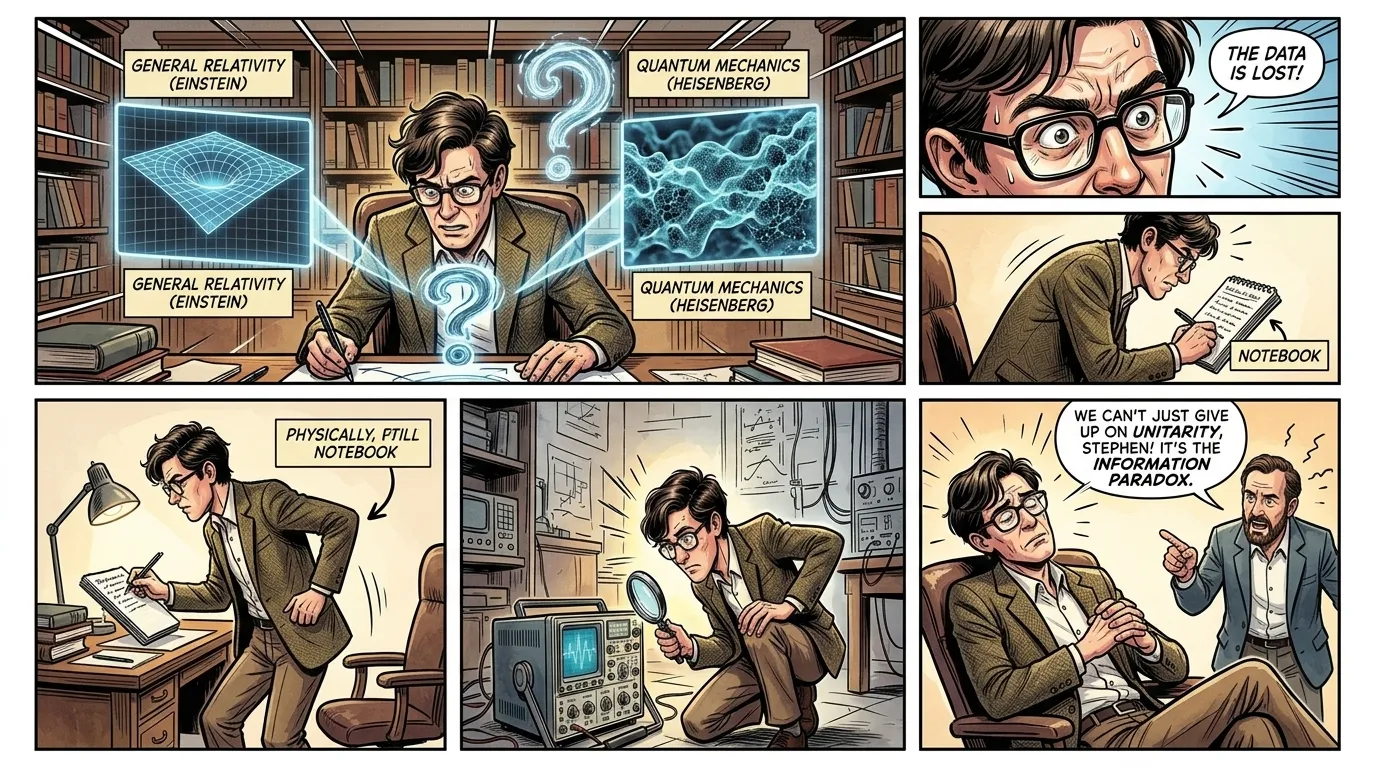
Hawking radiation sent shockwaves through the theoretical physics community. It provided a crucial bridge between General Relativity and Quantum Mechanics, fields previously thought incompatible in extreme gravitational environments. While not a complete 'Theory of Everything,' it offered a tangible connection. Crucially, it reignited the debate surrounding the information paradox. If black holes evaporate, what happens to the information of the matter that fell in? Does it truly vanish, violating quantum mechanics' conservation laws, or is it somehow encoded in the outgoing radiation, albeit in a highly scrambled form? This question continues to drive cutting-edge research in quantum gravity and theoretical cosmology.\n\n Fact: Hawking radiation bridged General Relativity and Quantum Mechanics, reigniting the Information Paradox: is quantum information truly lost?
Page 9
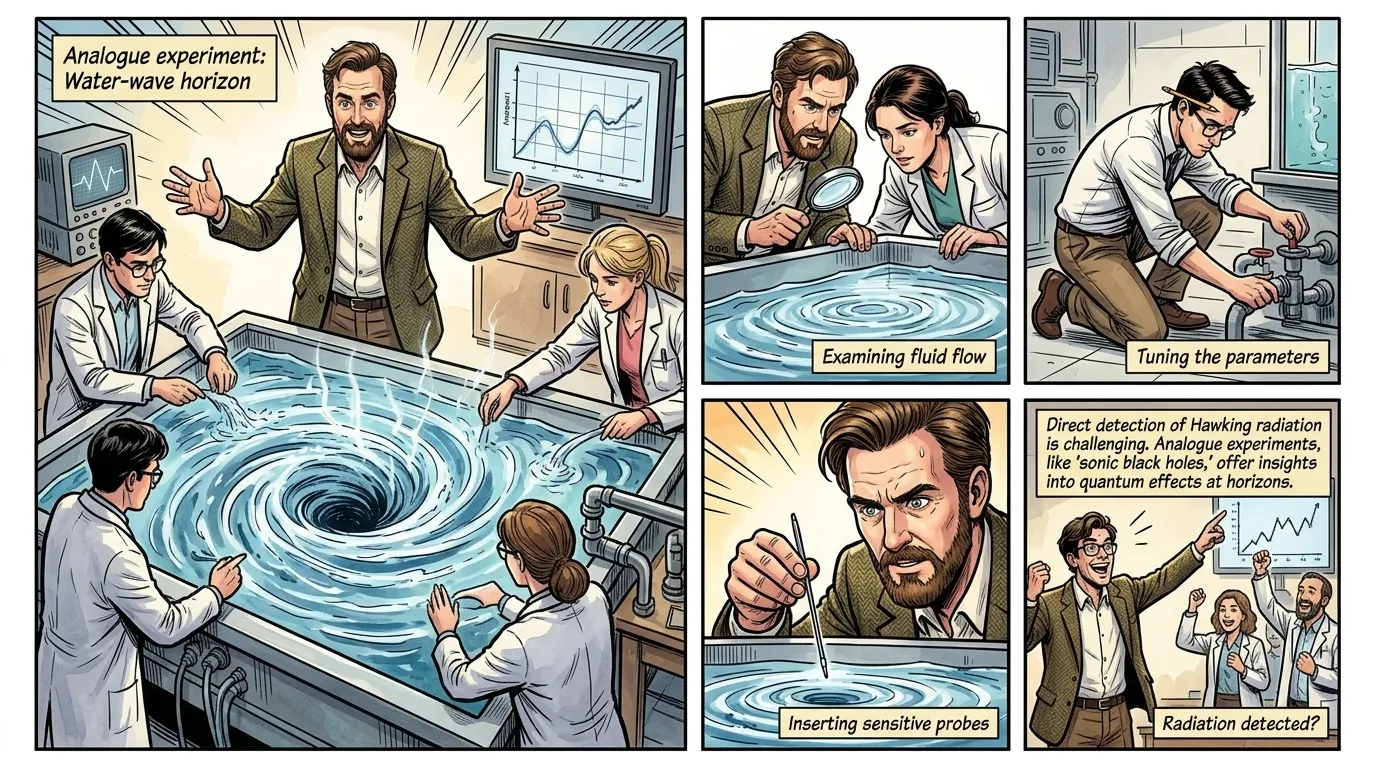
Despite its profound theoretical implications, directly observing Hawking radiation remains one of the greatest challenges in astrophysics. The predicted radiation from stellar-mass black holes is incredibly faint, far weaker than the cosmic microwave background radiation that permeates the universe, making direct detection practically impossible with current technology. This inherent difficulty has led scientists to explore 'analogue gravity' experiments. Researchers create laboratory systems, such as 'sonic black holes' using ultra-cold atoms or water tanks, where sound waves or water waves behave similarly to light near a gravitational event horizon, offering a proxy for studying quantum effects in extreme environments.\n\n Fact: Direct detection of Hawking radiation is challenging. Analogue experiments, like 'sonic black holes,' offer insights into quantum effects at horizons.
Page 10
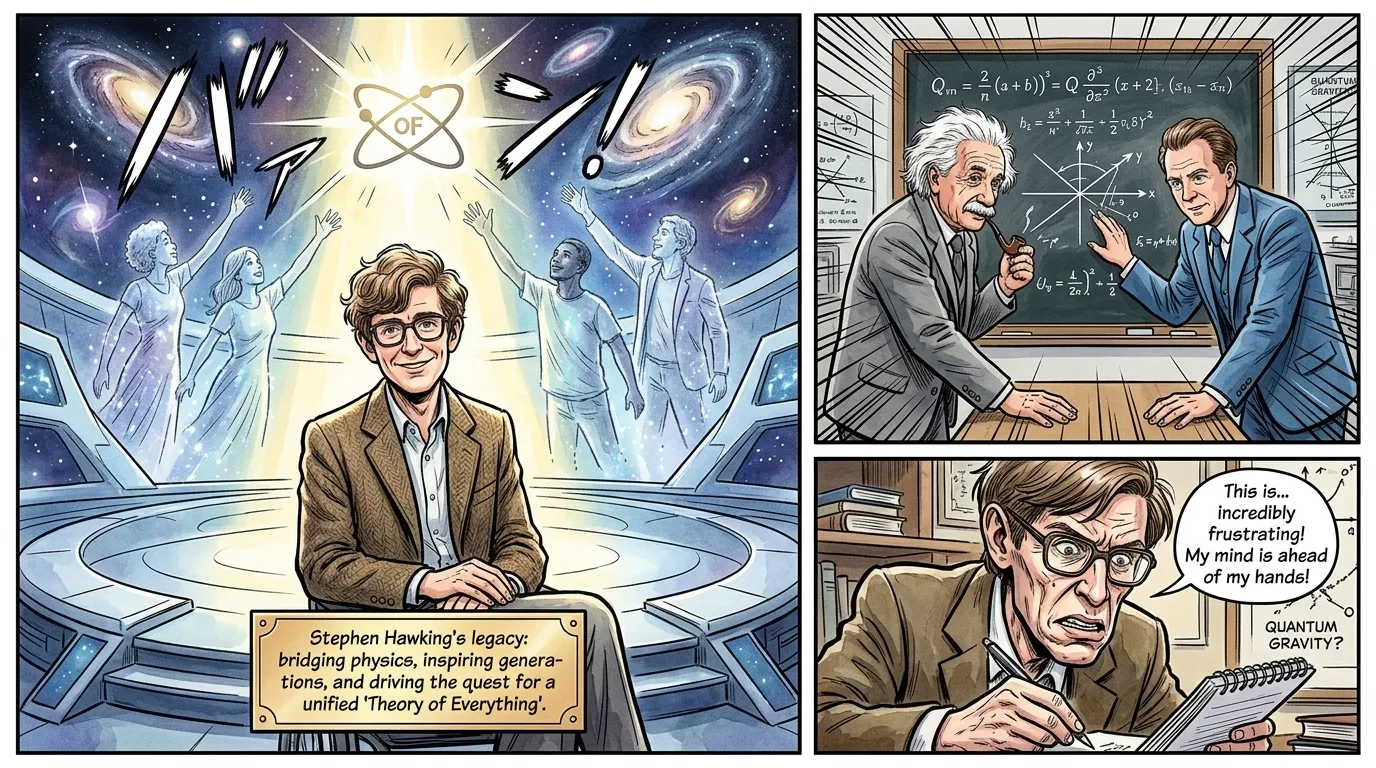
Stephen Hawking's contributions transcended the specific prediction of black hole evaporation. His work, despite the profound challenges of his motor neuron disease, pushed the boundaries of human thought, inspiring generations. He became a global icon, popularizing complex scientific concepts and championing the quest for a 'Theory of Everything' – a single, elegant framework that would unite all the fundamental forces of the universe. Though many questions remain unanswered, particularly regarding quantum gravity and the ultimate fate of information in black holes, Hawking's legacy ensures that the universe's darkest secrets continue to be illuminated by the relentless light of scientific inquiry, driving future generations to ponder the deepest mysteries of existence.\n\n Fact: Stephen Hawking's legacy: bridging physics, inspiring generations, and driving the quest for a unified 'Theory of Everything'.
About this story
- Location: Global
- Audience: general readers
Read Wonder Science on your phone
Wonder Science is available on Android. Get Wonder Science on Google Play.