How Ada Lovelace Imagined Computing a Century Before It Existed
In 1843, Ada Lovelace wrote what is now recognised as the first published computer program — for a machine that was never built, in the one century that made a machine like it conceivable.
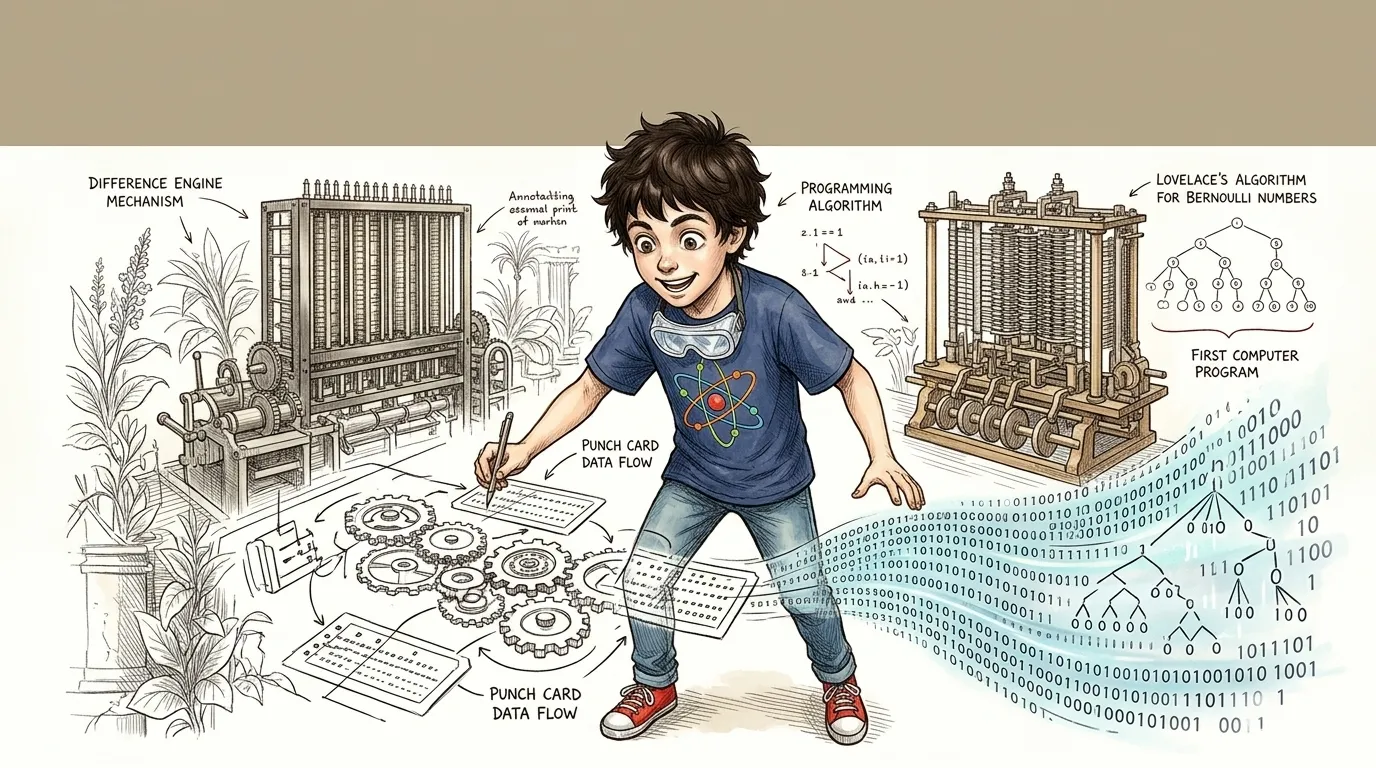
In 1837 the English mathematician Charles Babbage began designing what he called the Analytical Engine — a mechanical device, powered by steam and controlled by punched cards borrowed from the textile industry, capable of carrying out any calculation it was instructed to perform. It was not the first calculating machine he had proposed; an earlier design, the Difference Engine, could only compute fixed mathematical tables. The Analytical Engine was different in kind: general-purpose, programmable, able to be given a different set of instructions and produce a different result. Babbage never secured the funding to build it in full.
Ada Lovelace, a mathematician and the only legitimate child of the poet Lord Byron, translated an Italian engineer's paper on the Analytical Engine in 1843 and added her own notes — which ran three times longer than the original article. Inside them is a step-by-step method for the machine to compute Bernoulli numbers, a sequence used across mathematics. Historians of computing now regard this as the first published algorithm written for a general-purpose computer, a description of software written before there was hardware capable of running it. Lovelace also wrote, more presciently than Babbage himself, that such a machine might one day manipulate more than numbers — music, images, symbols of any kind — an idea that would not be realised for over a century.
None of this happens in isolation from its moment. The Industrial Revolution, running roughly from the mid-18th to the mid-19th century across Britain and Europe, is what made the Analytical Engine conceivable at all: precision metalworking, steam power, and an economy increasingly comfortable with the idea that a machine could do work a room full of people used to do by hand. Babbage's ambitions were, in that sense, entirely of their century — technically premature, but not out of place.
Where the punched cards came from
Babbage did not invent the punched card. He borrowed it directly from the textile industry, from a loom demonstrated in Lyon in 1801 by the weaver Joseph-Marie Jacquard, which used a chain of punched cards to control which threads a mechanical loom lifted — letting a single loom weave elaborate patterns without a skilled operator directing every pass by hand. Babbage adapted the same idea to control calculation instead of cloth: cards would feed both the numbers and the instructions for what to do with them into the Analytical Engine, with a second, repeatable deck able to send the machine back to reuse earlier instructions — the same basic idea behind a loop in software today. Lovelace made the connection explicit in her own notes, writing that the Analytical Engine "weaves algebraic patterns just as the Jacquard-loom weaves flowers and leaves." Even the machine's two main parts borrowed their names from the mills of the era: Babbage called the part that held numbers the Store and the part that acted on them the Mill — direct ancestors of what a modern computer calls memory and a processor.
Proving the design, a century and a half later
Babbage never secured the funding to complete the Analytical Engine, and for well over a century afterward it stayed an open question whether his designs would even have worked, or whether Victorian-era engineering was simply too imprecise to build what he had drawn. In 1985, London's Science Museum set out to answer it directly, building a version of Babbage's earlier, simpler machine — the Difference Engine No. 2 — strictly from his own 1847-49 drawings, using only manufacturing tolerances that would have been achievable in his own lifetime. The calculating section was finished in 1991, in time for the two-hundredth anniversary of Babbage's birth; a printing mechanism he had also designed was added in 2002. It worked. The finished machine, 8,000 parts and five tons of it, still runs today at the Science Museum in London — closing a question that had sat open since the 1830s: not whether Babbage was a visionary, but whether his engineering was actually sound.
Three angles, one library
This story happens to sit across three of the twelve WonderBooks libraries at once — the person, the machine, and the era each get their own illustrated telling, and they can be read in any order or on their own.

Frequently Asked Questions
Did Ada Lovelace ever build a working computer?
No — neither Lovelace nor Babbage built the Analytical Engine in their lifetimes; it existed only as drawings and notes. What Lovelace produced was the algorithm: a detailed, step-by-step method for the machine to compute a sequence of numbers, written years before any machine existed that could run it.
Was Babbage's Analytical Engine ever actually built?
The Analytical Engine itself has never been built, in the 19th century or since. What London's Science Museum completed in 1991 was Babbage's earlier and simpler Difference Engine No. 2, built strictly to his own drawings — proof that his mechanical designs would have worked, though it does not confirm every detail of the more ambitious Analytical Engine.
Why is Ada Lovelace called the first computer programmer?
Her 1843 notes on the Analytical Engine include a detailed method for computing Bernoulli numbers, a real mathematical sequence, written as a precise sequence of operations for the machine to carry out. Historians of computing recognise this as the first published algorithm written for a general-purpose computing machine, even though the machine to run it did not exist yet.