Ada Lovelace
Ada Lovelace — an illustrated science story, set in Global. 10 illustrated pages, free to read on Wonder Science.
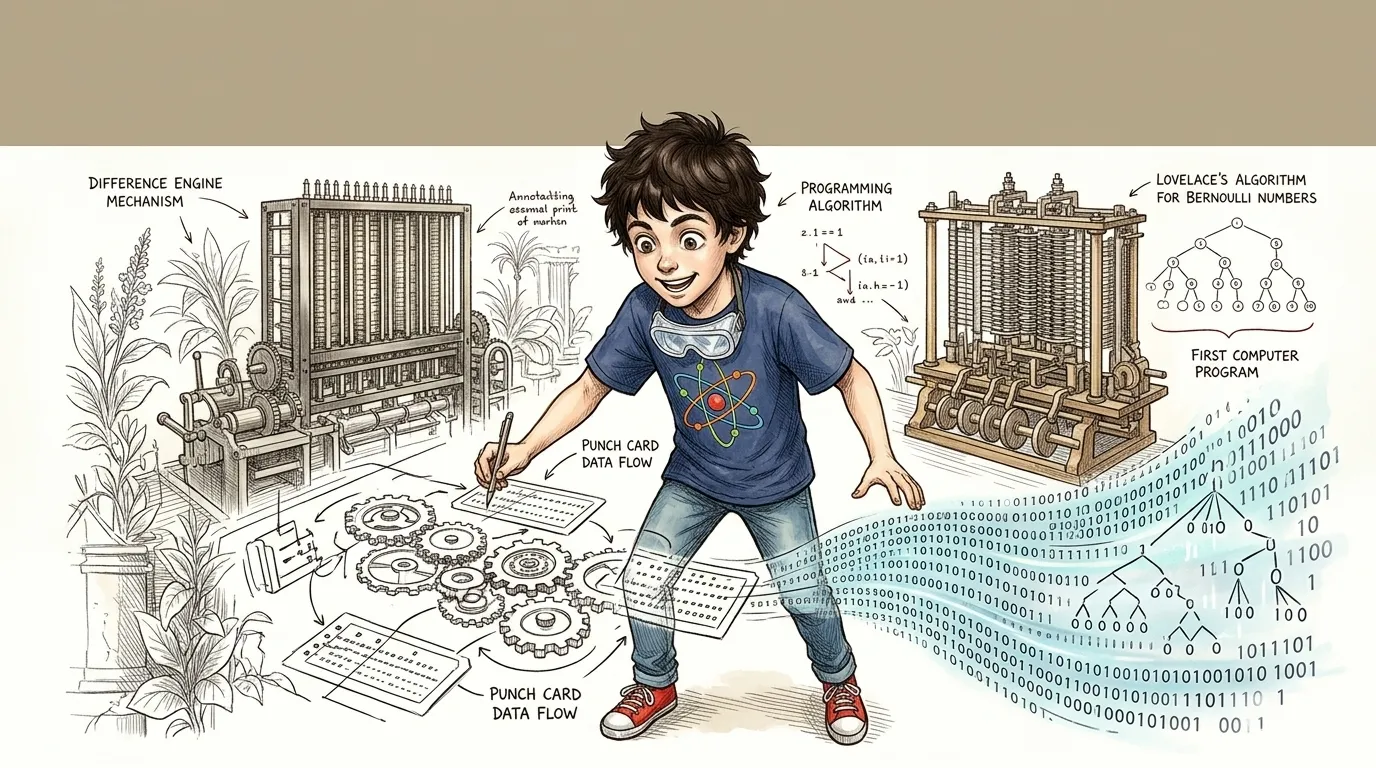
Page 1
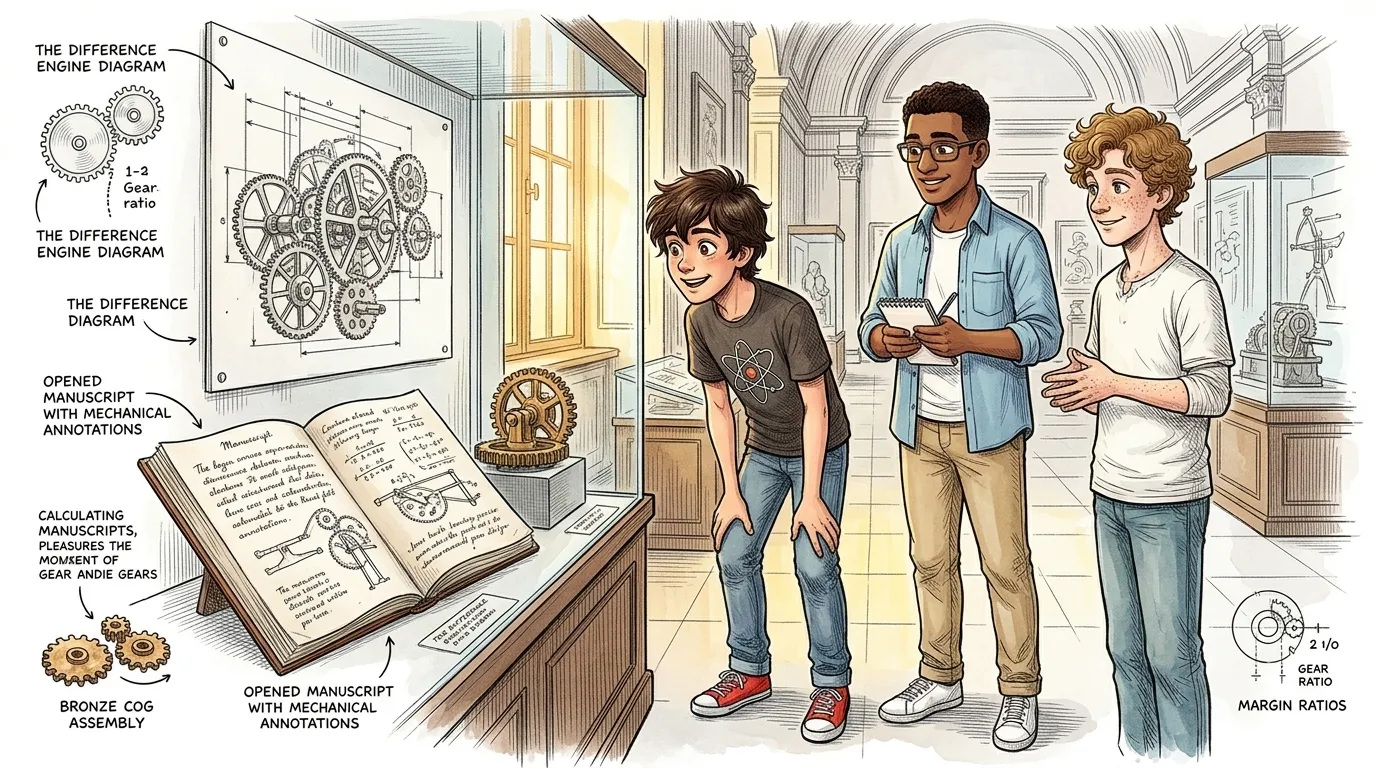
Deep within the hushed halls of a grand museum, Riku, Hassan, and Rami stood before a glass case, captivated. Inside, alongside intricate mechanical gears, a single, handwritten manuscript lay open, its elegant script hinting at a revolution yet to unfold. This was no ordinary document; it was a blueprint for the future, penned by a mind that saw beyond mere arithmetic.\n\n"'Look at this,' Riku whispered, pointing to the delicate drawings of cogs and levers. 'It's like a giant clock, but for numbers!'"
Page 2
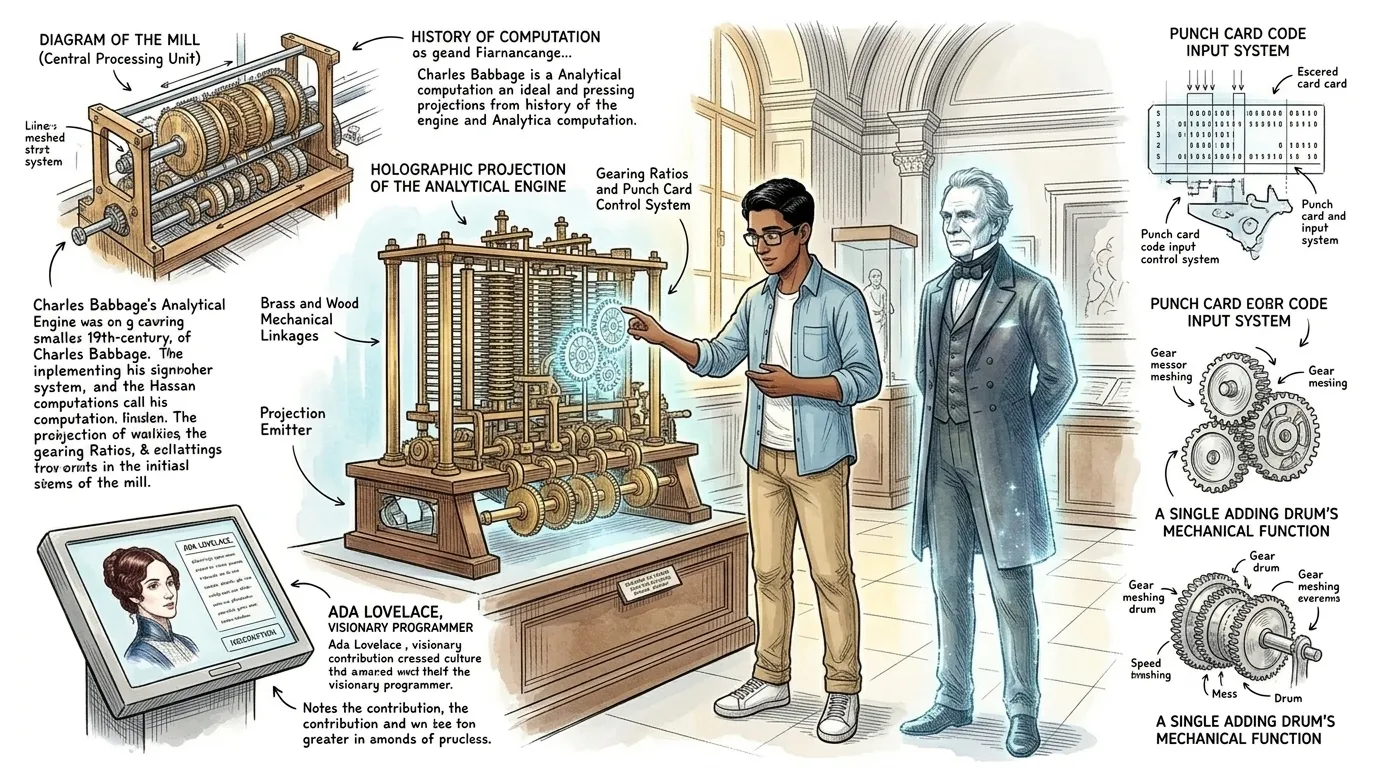
A shimmering holographic projection shimmered to life beside the manuscript, displaying a complex machine of brass and polished wood. It was Charles Babbage's Analytical Engine, a mechanical wonder designed in the 19th century, meant to perform calculations automatically.\n\n"'This isn't just about adding or subtracting,' Hassan explained, tracing a finger over the holographic gears. 'Babbage imagined a machine that could solve incredibly complex math problems, faster than any human!'"
Page 3
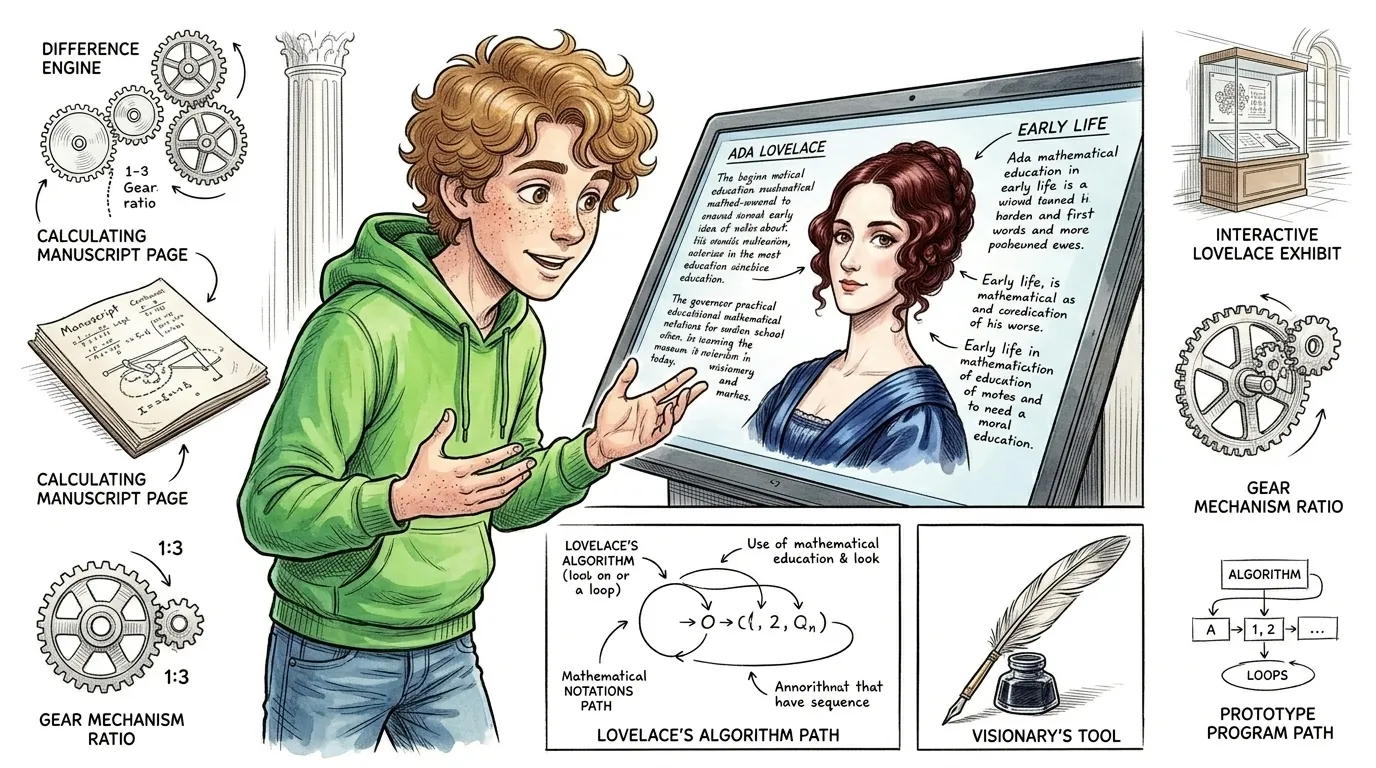
An interactive panel in the exhibit offered a glimpse into the life of the manuscript's author: Ada Lovelace. Born Augusta Ada Byron, daughter of the famous poet Lord Byron, she possessed an extraordinary gift for mathematics, carefully nurtured by her mother. It was this unique background that prepared her to recognize Babbage's machine not just as a calculator, but as something far more profound.\n\n"'She was taught math from a very young age,' Rami observed, reading the display. 'And she met Mr. Babbage when she was only seventeen! Can you imagine discussing giant calculating machines at that age?'"
Page 4
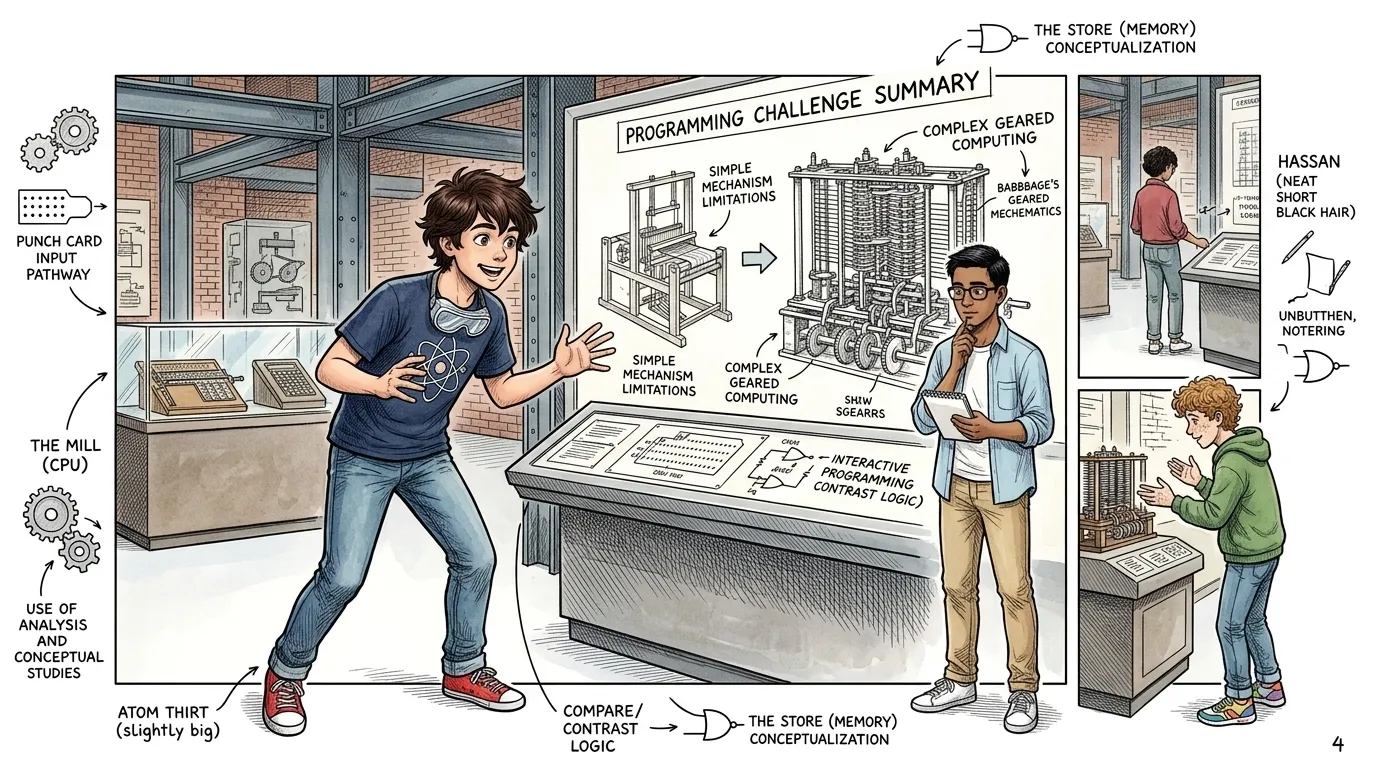
For centuries, machines had performed tasks by following direct, physical instructions. But Babbage's Engine promised to be different, capable of complex sequences. The real challenge wasn't building the gears, but understanding how to tell such a sophisticated machine what to do—how to give it a language beyond simple number crunching. This was the intellectual leap Ada Lovelace would make.\n\n"'So Babbage had the amazing idea for the machine,' Riku summarized, 'but nobody really knew how to make it think, right? Like having a super-fast car but no roads to drive on!'"
Page 5
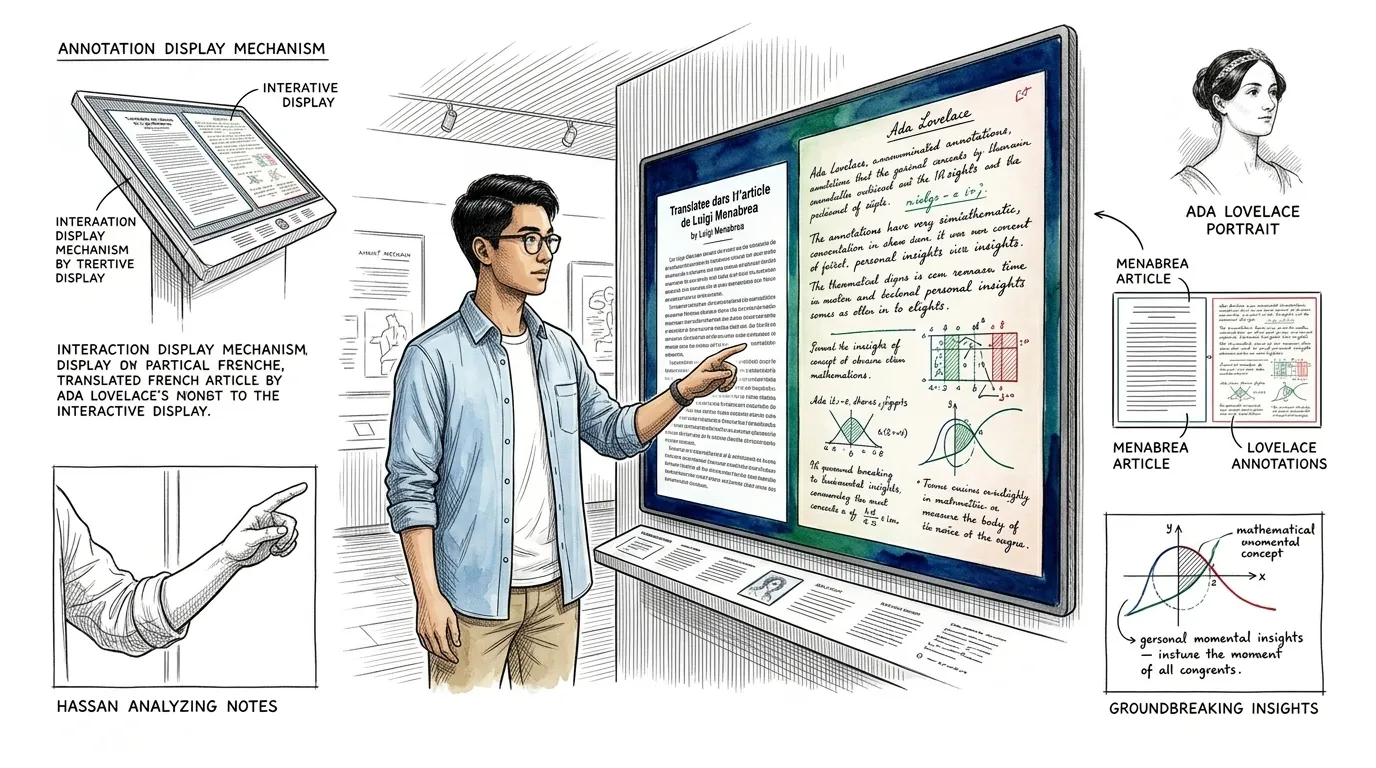
In 1843, Ada Lovelace translated a French article by Luigi Menabrea, an Italian mathematician, describing Babbage's Analytical Engine. But her contribution went far beyond simple translation. Her accompanying 'Notes' were three times longer than the original article, filled with her own original insights and revolutionary ideas about the machine's potential.\n\n"'She didn't just translate words,' Hassan explained, pointing to a replica of Ada's extensive annotations displayed digitally. 'She added her own thoughts, like writing brand new chapters to someone else's book!'"
Page 6
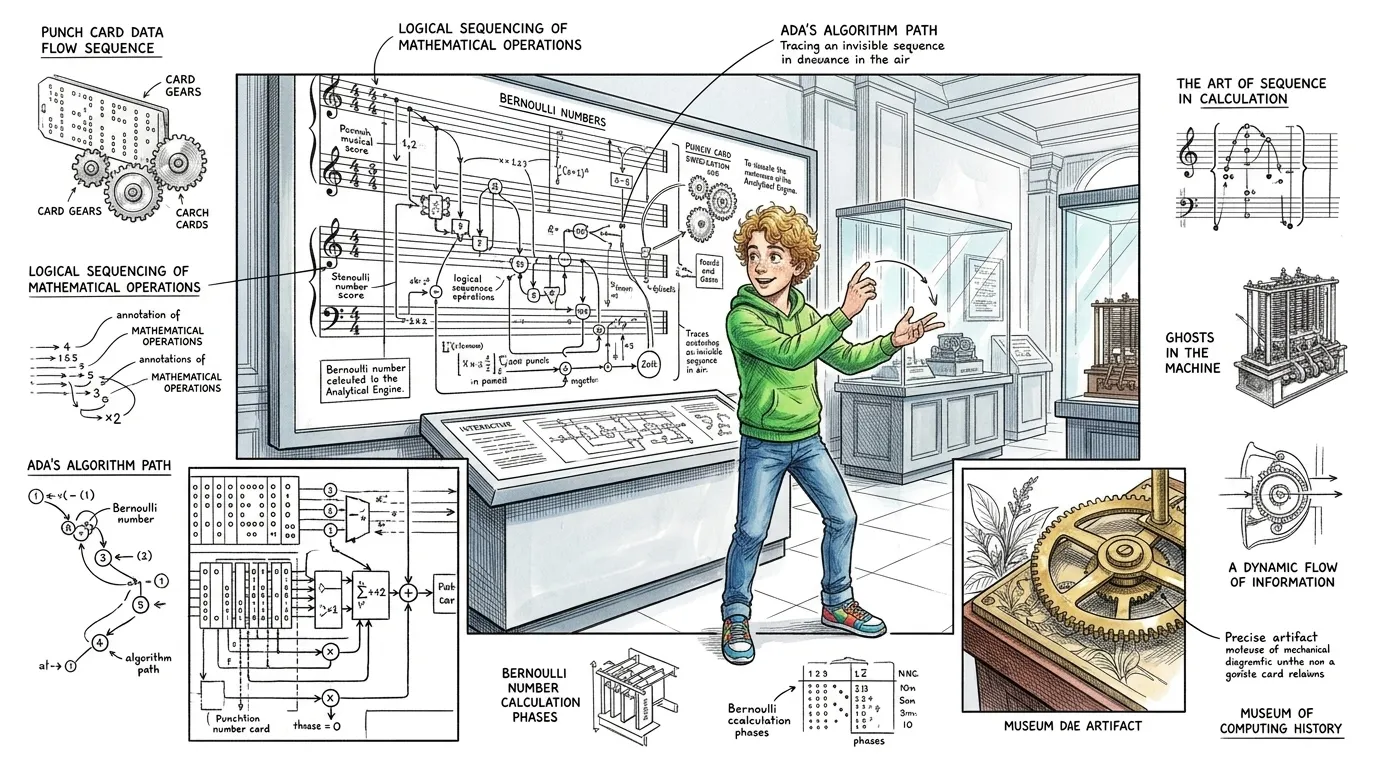
Within these detailed Notes, Lovelace outlined a step-by-step method for the Analytical Engine to calculate a sequence of Bernoulli numbers. This was not just a mathematical formula; it was a precise sequence of operations, a set of instructions designed to be executed by a machine. This intricate sequence, designed for an imaginary future, is now recognized as the world's first computer program, a true marvel of intellectual foresight.\n\n"'So she wrote down exact steps for the machine to follow, like a recipe?' Rami asked, trying to visualize it. 'First, do this, then do that, over and over again?'"
Page 7
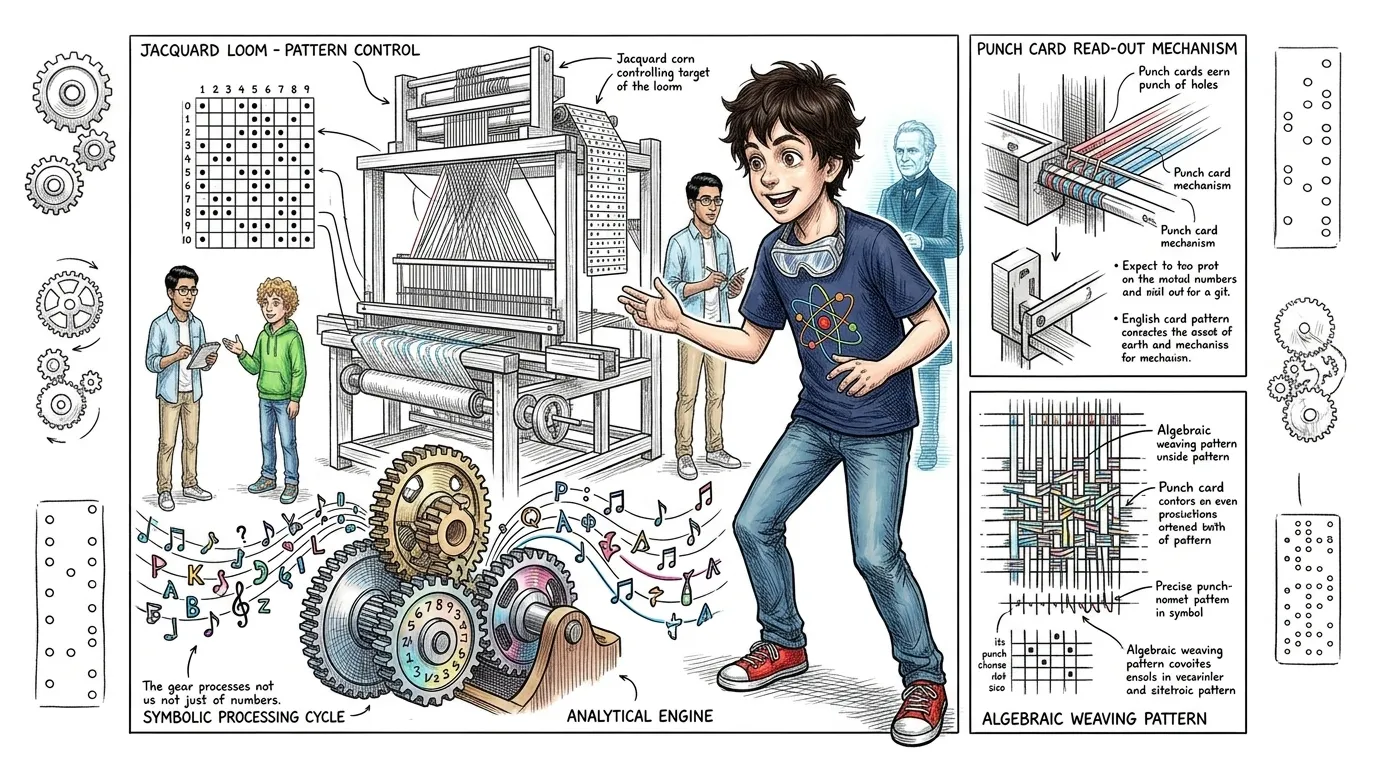
Ada Lovelace grasped that the Analytical Engine could do more than crunch numbers; it could manipulate any symbolic data, like letters, musical notes, or even images, if properly programmed. She envisioned it as a tool for creative expression, not just calculation, a concept centuries ahead of its time. She saw the machine as a collaborative partner, not just a glorified adding machine.\n\n"Riku's eyes lit up. 'Remember the Jacquard loom from earlier? Ada Lovelace herself famously wrote: "The Analytical Engine weaves algebraic patterns just as the Jacquard loom weaves flowers and leaves." She meant it could create anything, not just numbers!'"
Page 8
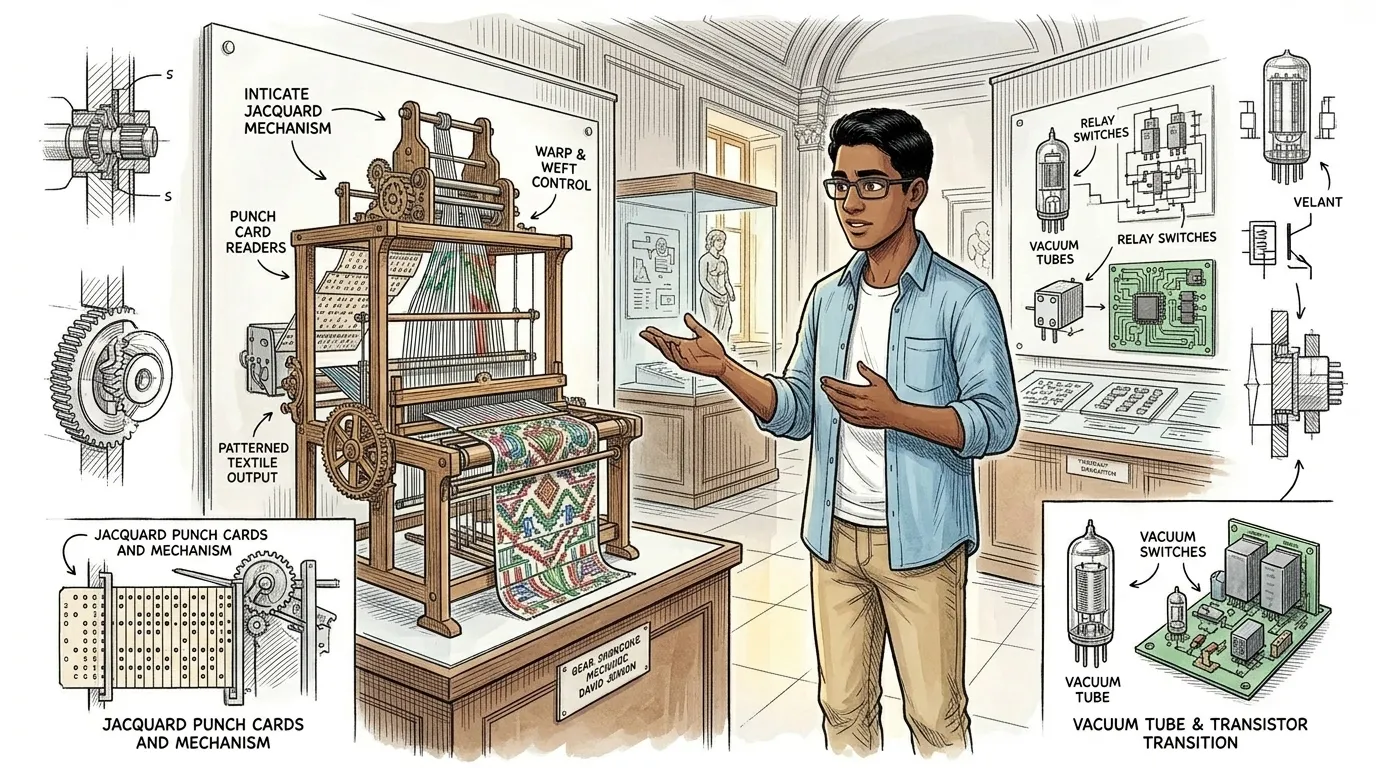
Ada Lovelace's pioneering work on the Analytical Engine and her visionary 'Notes' remained largely unrecognized for decades, tucked away in the annals of history. It wasn't until the mid-20th century, with the dawn of electronic computing, that her foundational insights were truly appreciated. Her idea of a machine manipulating symbols, not just numbers—a concept so elegantly tied to the pattern-weaving of a Jacquard loom—became the bedrock of modern computer science.\n\n"'So her idea of a machine making patterns, like the loom,' Hassan mused, gesturing to the Jacquard loom nearby, 'was actually how our modern computers work with words, pictures, and music?'"
Page 9
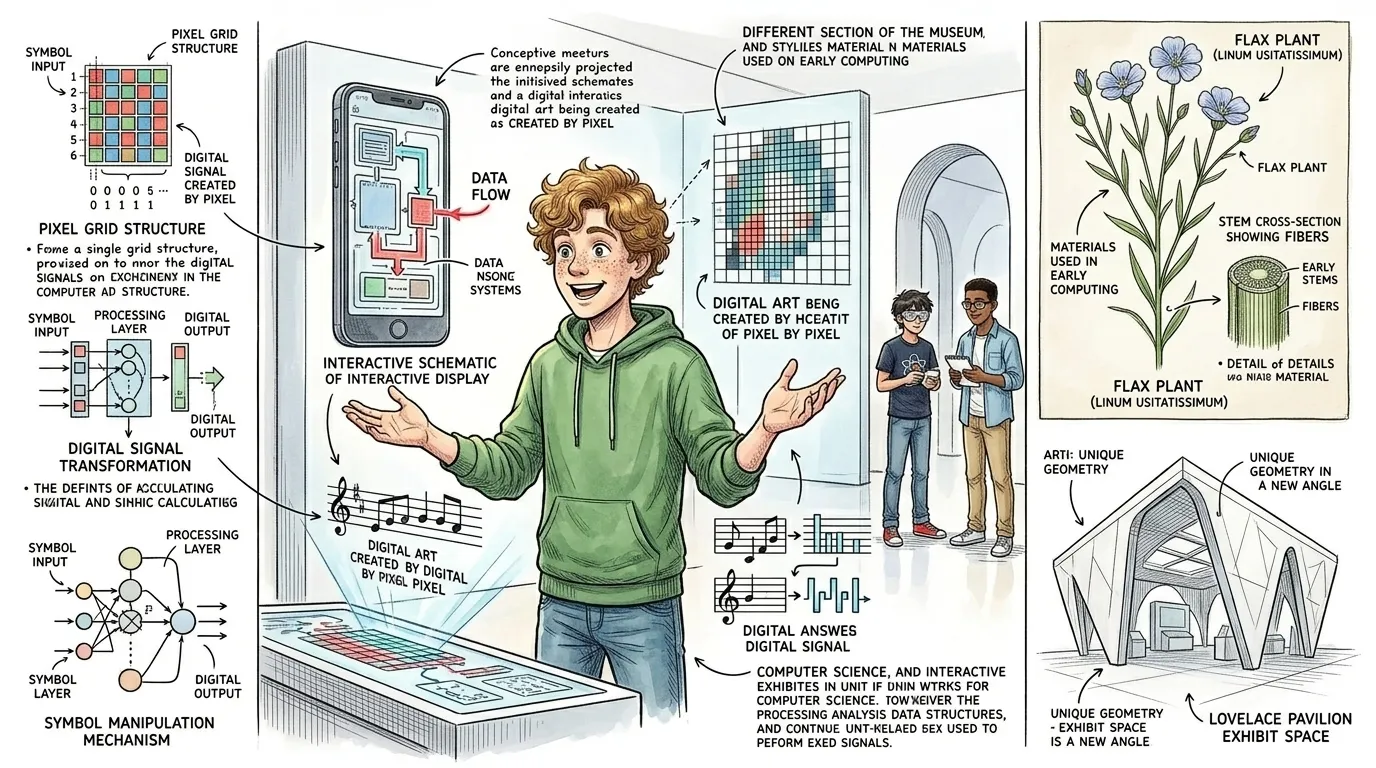
Today, every time we write a line of code, design a website, or create digital art, we are building upon the intellectual edifice Ada Lovelace envisioned almost two centuries ago. Her understanding of computation as a process of symbolic manipulation, rather than just number crunching, cemented her place as the first to truly grasp the potential of the computer beyond its mechanical components. Her insights were revolutionary, paving the way for the digital age we inhabit.\n\n"'It's amazing,' Rami exclaimed, his voice full of wonder. 'Her ideas, from so long ago, are in every phone, every video game, everything we use today!'"
Page 10
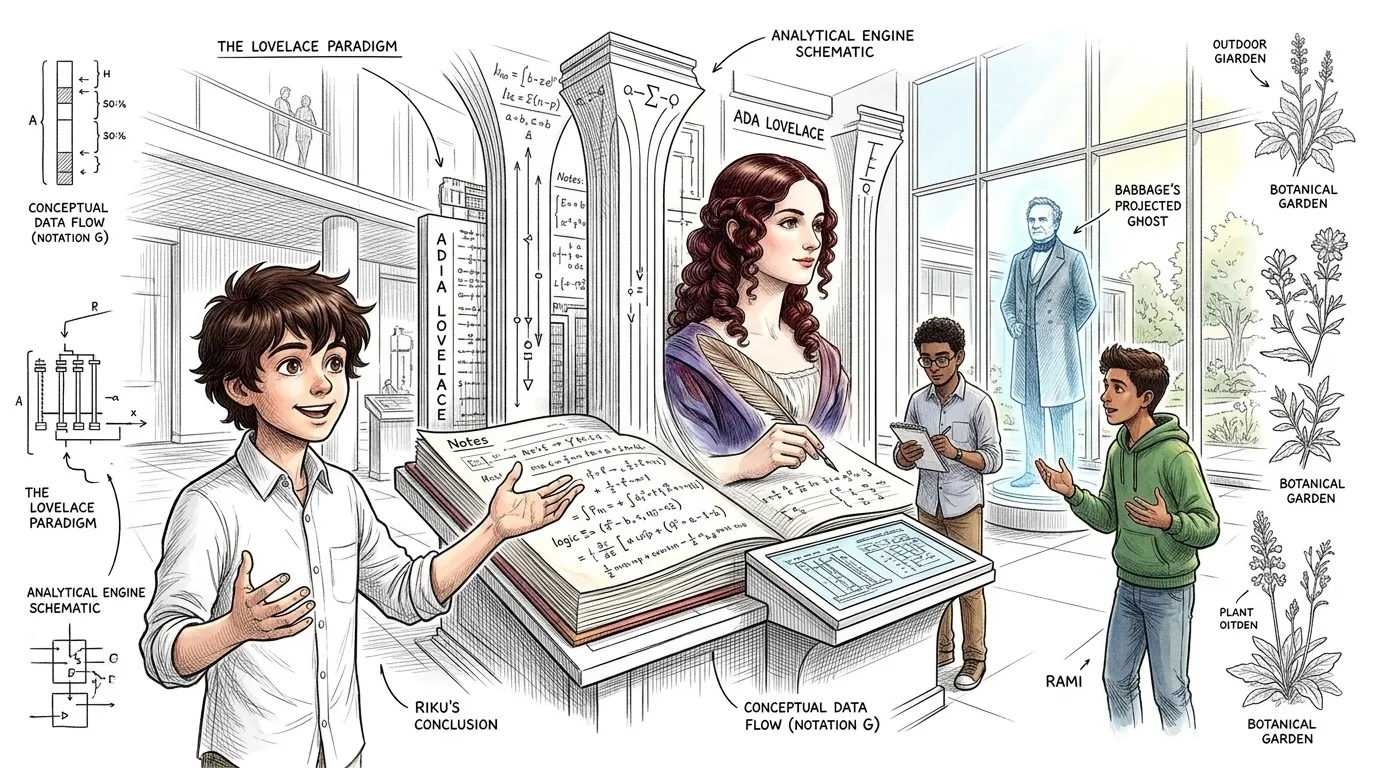
Ada Lovelace stands as a towering figure in the history of science, a true visionary whose mind transcended the limitations of her era. Her 'Notes' illuminated a path forward for computing that Babbage himself hadn't fully articulated. She taught the world that machines could be more than calculators—they could be instruments of logic, art, and even thought. Her legacy continues to inspire, reminding us that true innovation often lies in seeing beyond the immediate, toward the boundless possibilities of the future.\n\n"'Ada Lovelace truly was the world's first programmer,' Riku concluded with a smile. 'She saw the magic in the machine before anyone else did!'"
About this story
- Location: Global
- Audience: general readers
Questions and answers
Read Wonder Science on your phone
Wonder Science is available on Android. Get Wonder Science on Google Play.