How the Printing Press Actually Changed Europe
Before Gutenberg, a single hand-copied Bible could take a scribe a year to complete. Fifty years after his press, an estimated 20 million printed books existed across Europe.
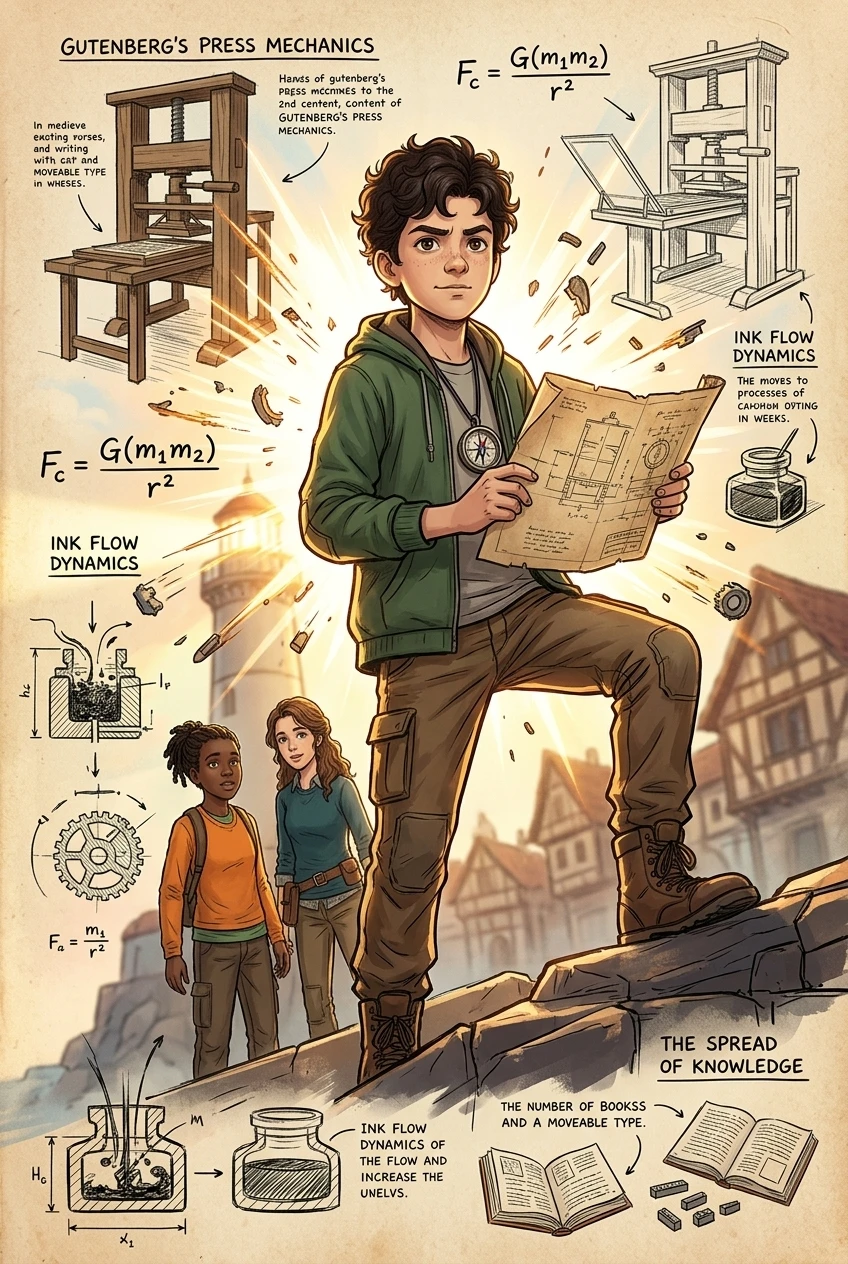
Johannes Gutenberg did not invent printing — woodblock printing existed in East Asia centuries earlier, and movable type had already been developed in Korea using metal characters. What Gutenberg built, around 1440 in Mainz, was a specific combination that worked at European scale: durable metal type cast from a reusable mould, an oil-based ink that would adhere to metal rather than the water-based ink used for wood blocks, and a modified screw press adapted from wine and olive presses.
The effect on cost and speed was immediate and severe. A scribe copying a Bible by hand could take the better part of a year to complete a single copy. Gutenberg's workshop could produce roughly 180 copies of his 42-line Bible in about the same span. Historians estimate that by 1500 — fifty years after his press — printing houses across Europe had produced somewhere in the range of 20 million books, and by 1600 that figure is estimated in the hundreds of millions.
The consequences went well beyond books getting cheaper. Wider, faster circulation of printed material is credited by historians as a major factor in the spread of the Protestant Reformation — Martin Luther's 95 Theses, printed and distributed within weeks of being written in 1517, would have travelled at a fraction of that speed as hand-copied manuscripts. Standardised, mass-produced texts also pushed vernacular languages toward more fixed spelling and grammar, since a printed edition, unlike a hand copy, was reproduced identically thousands of times over.
Printing Existed in Asia First — Why Didn't It Spread the Same Way?
Movable type actually predates Gutenberg by centuries. Korean printers produced Jikji, a Buddhist text, using cast metal type in 1377 — 78 years before Gutenberg's Bible — and it's recognised by UNESCO as the oldest surviving book printed with movable metal type. China had woodblock printing even earlier, from around the 9th century, and experimented with its own movable type during the Song dynasty in the 11th century. Neither approach spread the way Gutenberg's did. Part of the reason is technical: Chinese and Korean writing uses thousands of distinct characters, so cutting and casting a full set of movable type was a far bigger undertaking than casting the two or three dozen letterforms an alphabet needs. Part of it is that Gutenberg paired his type with an oil-based ink and a screw press adapted from wine-making — a complete production system, not just a way of casting metal letters — which let his method scale to hundreds of European workshops within a few decades.
How the Press Powered the Scientific Revolution
Cheaper books changed more than religion and politics. Before print, a scientific diagram or anatomical drawing degraded a little with every hand copy — errors and simplifications crept in the way they do in any process copied by hand. A printed edition reproduced the same diagram identically in every copy, so a discovery made in one city could be checked, argued with, and built on by scholars elsewhere, all working from the same image rather than a slightly different drawing. Historians estimate that European literacy rates roughly doubled each century after the press's introduction, and by 1620 the English philosopher Francis Bacon was already naming print, alongside gunpowder and the compass, as one of the three inventions that had changed the world more than any empire or philosophy.
The invention, illustrated
Frequently Asked Questions
Did Johannes Gutenberg actually invent printing?
No. Woodblock printing was used in China centuries earlier, and Korea had already produced books with cast movable metal type — including Jikji, in 1377 — decades before Gutenberg's press. What Gutenberg invented was a complete system built for an alphabet: durable, reusable metal type, oil-based ink, and a modified screw press, which let his method scale across Europe in a way earlier methods hadn't.
How much cheaper were printed books than hand-copied ones?
A hand-copied book could take a scribe the better part of a year to finish, while Gutenberg's workshop produced around 180 Bibles in roughly the same span. Printed books are generally estimated to have cost around an eighth of a hand-copied equivalent, and by 1500 — fifty years after Gutenberg's press — an estimated 20 million books existed across Europe.
Did the printing press cause the Protestant Reformation?
Historians describe it as an accelerant rather than a sole cause. Martin Luther's 95 Theses spread across Europe within weeks of being printed in 1517, and printed vernacular Bibles supported his argument that ordinary readers should be able to read scripture themselves — but the religious and political tensions behind the Reformation existed independently of the press.