How African Gold Built European Kingdoms
For centuries, most of the gold circulating across Europe, North Africa, and the Middle East started in West Africa. One pilgrimage to Cairo in 1324 proved just how much.
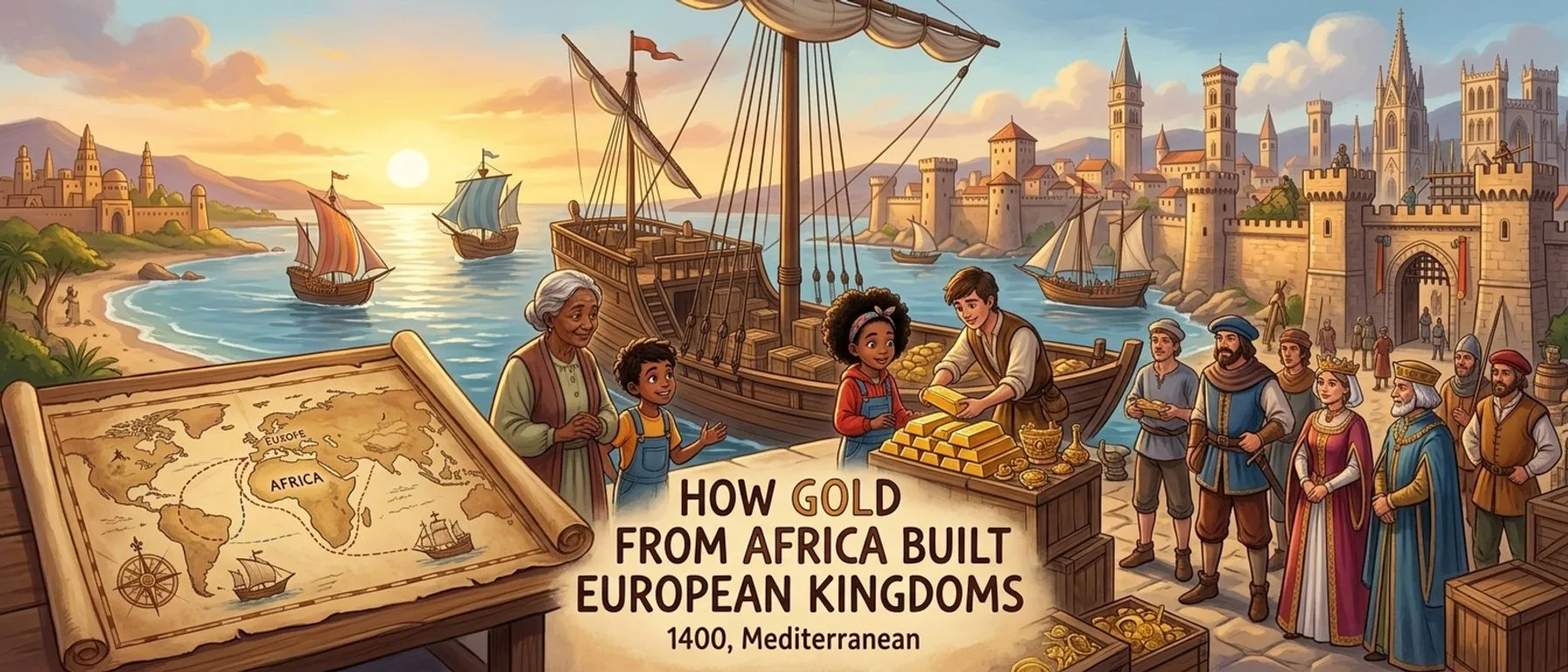
For roughly seven centuries, from around 700 to 1400 AD, camel caravans crossed the Sahara Desert carrying two things in opposite directions: salt heading south, and gold heading north. The gold came from goldfields in West Africa — first around the Bambuk region, later shifting to the richer Bure goldfield as older deposits thinned out — and it didn’t stay in Africa. Merchants carried it across the desert to North African ports, where it entered a trade network that eventually reached Venice, Genoa, and the rest of Europe’s growing commercial cities.
Control of this trade route made empires. The Kingdom of Ghana dominated it first, controlling the goldfields and the caravan towns by the 6th century. By the 13th century, power had shifted to the Mali Empire, founded by Sundiata Keita, which sat at the crossroads of several major trans-Saharan routes along the Niger River. Mali’s capital became a terminus for caravans arriving from Egypt and across North Africa, and control over trading towns like Timbuktu, Gao, and Djenné meant control over a huge share of the gold entering the wider medieval world — historians estimate that at its peak, close to half of all the gold circulating across Africa, Europe, and Asia originated in Mali.
The pilgrimage that crashed a currency
Mali’s wealth became impossible to ignore in 1324, when its ruler, Mansa Musa, undertook the pilgrimage to Mecca. He didn’t travel light — accounts describe a caravan of thousands of people and a huge quantity of gold, some of which Musa gave away freely as he passed through Cairo. The scale of the giving was large enough to flood Cairo’s gold market and crash the metal’s value there; by some accounts the local gold price took roughly twelve years to recover. Word of the wealth travelled with the story: around 1375, a Spanish mapmaker produced one of Europe’s first detailed maps of West Africa, showing Mansa Musa on his throne holding a gold nugget, which helped cement West Africa’s reputation in the European imagination as a source of near-limitless gold.
Where the gold actually ended up
West African societies themselves rarely minted the gold they mined — gold dust and, occasionally, gold wire circulated as currency locally, but there’s no archaeological evidence that Malian or earlier Ghanaian rulers struck their own gold coins. The metal’s real destination was north: merchants carried it across the desert to be minted in cities that did strike coins, feeding the currencies that powered trade across North Africa, the Middle East, and Europe. Venice’s gold ducat and Florence’s gold florin — both introduced in the 13th century and among the most influential coins in medieval European commerce — depended on a steady supply of raw gold, and West Africa was one of the medieval world’s largest sources of it.
That dependence eventually pushed Europe to try bypassing the Sahara entirely. By the 1400s, Portugal, under the sponsorship of Prince Henry the Navigator, was funding expeditions down Africa’s Atlantic coast specifically to reach West African gold directly by sea rather than trading for it secondhand through North African middlemen. That effort led to fortified trading posts like São Jorge da Mina — later known as Elmina Castle — built on the coast of modern Ghana in 1482 to secure a direct sea route to the gold, cutting the trans-Saharan caravan trade out of the transaction altogether. The gold that had financed Malian prosperity for centuries would go on, through this new route, to help finance Portugal’s own age of Atlantic exploration.
Told as an illustrated story
Frequently Asked Questions
Where did most of medieval Europe’s gold actually come from?
A large share came from West Africa, via the trans-Saharan trade routes controlled first by the Kingdom of Ghana and later by the Mali Empire. Merchants carried it across the desert to North African ports, from where it entered European trade — feeding coinages like the Venetian ducat and Florentine florin.
Who was Mansa Musa and why is he remembered for gold?
Mansa Musa was the ruler of the Mali Empire who made a famous pilgrimage to Mecca in 1324, passing through Cairo with a large caravan and giving away enough gold along the way that it crashed the local gold price for roughly a decade. The spectacle made Mali’s wealth famous across the medieval Mediterranean world and even shaped European maps of the era.
Did West African kingdoms mint their own gold coins?
No — there’s no archaeological evidence that Ghana or Mali struck their own gold coinage. Gold typically moved as raw dust or metal, minted only after it reached North African, Middle Eastern, or European cities, which is part of why so much of the wealth is remembered in European and Islamic coin history rather than African coinage.