The Gulf Stream by Winslow Homer (USA — 1899)
The Gulf Stream by Winslow Homer (USA — 1899) — an illustrated arts story, set in United States. 10 illustrated pages, free to read on Wonder Arts.
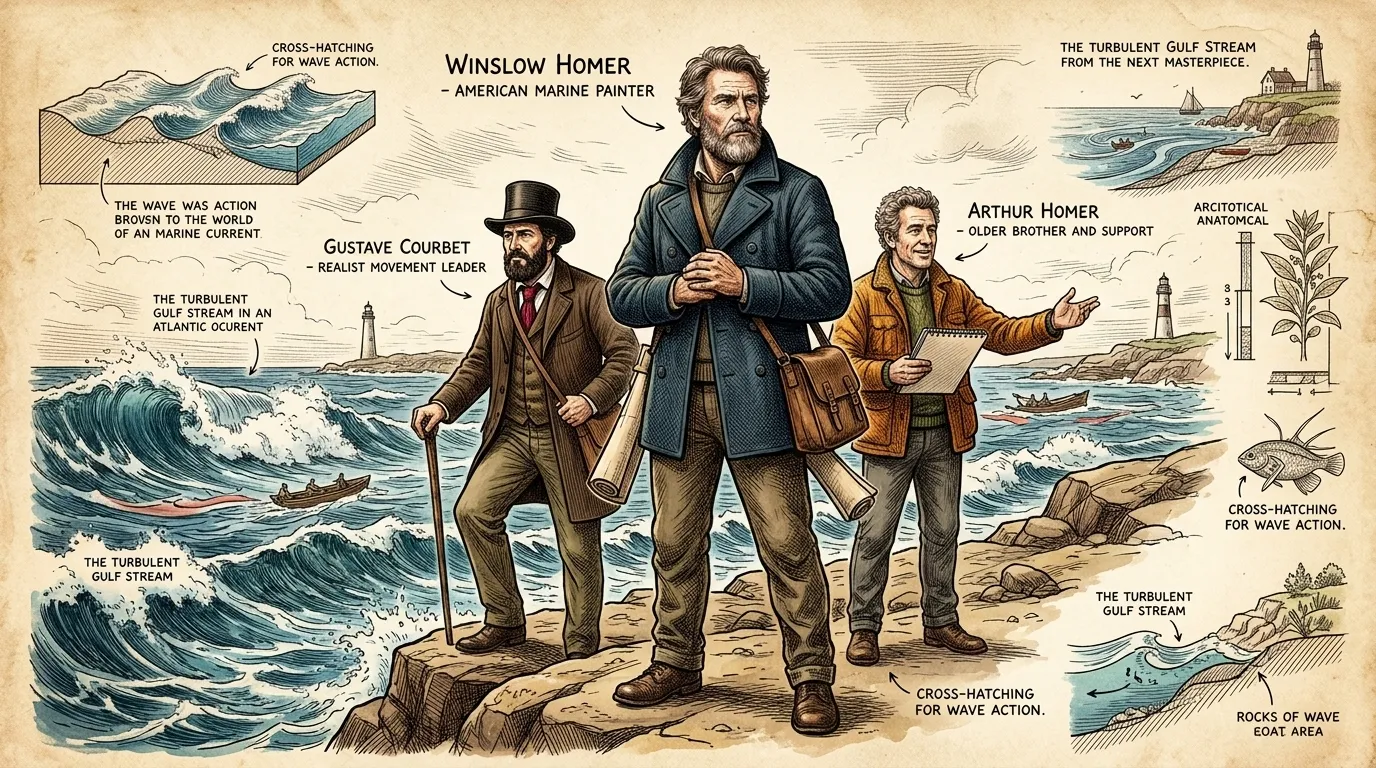
Page 1
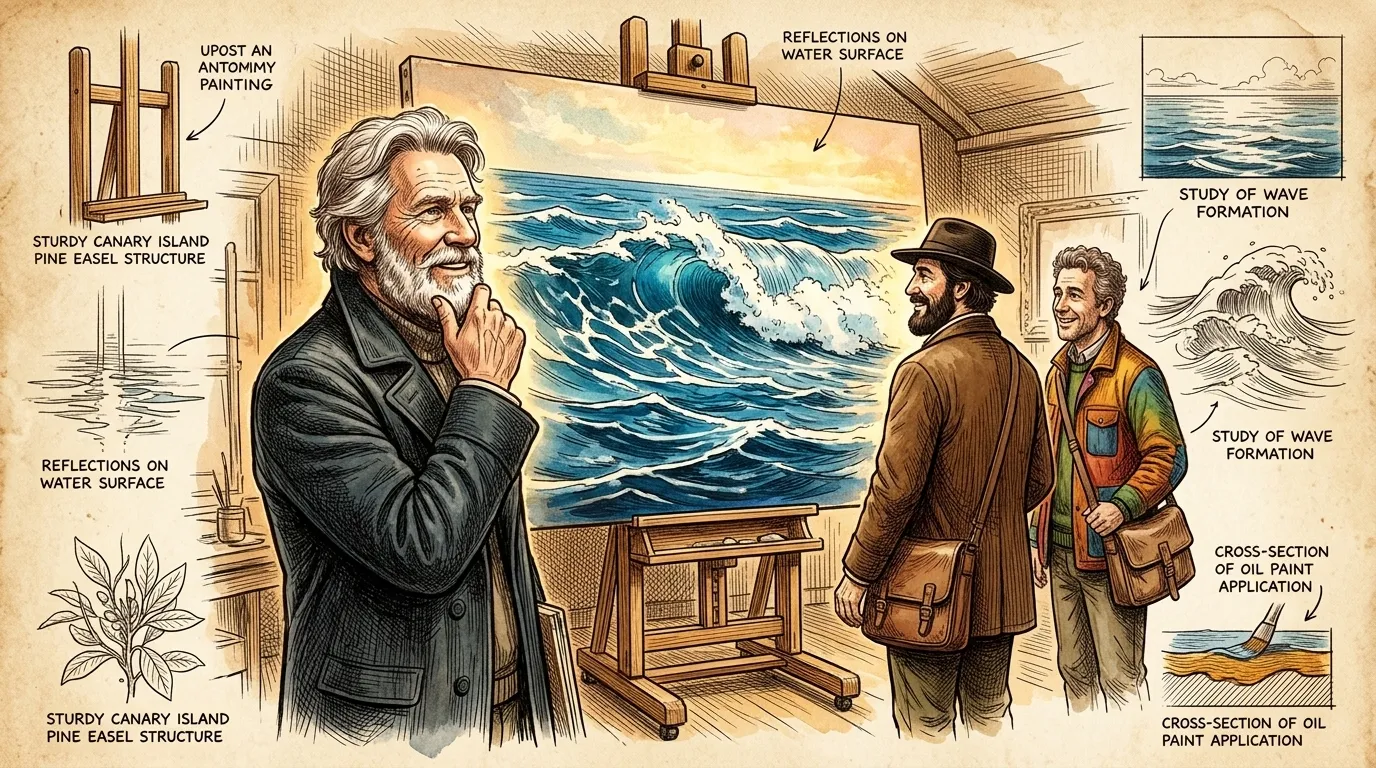
Winslow Homer, a master of American Realism, stands before his completed canvas, 'The Gulf Stream.' The painting, finished in 1899, depicts a lone Black fisherman struggling against the turbulent sea. Its dimensions are 71.4 cm 124.8 cm, and it now resides in The Metropolitan Museum of Art. What's remarkable is the ambiguity surrounding the fisherman's fate, a question Homer never fully answered, fueling endless debate.
""The sea can be a cruel mistress, but also a source of life," Winslow muttered, staring at the waves he had captured."
Art Fact: Winslow Homer (1836-1910), a prominent American painter, is best known for his marine subjects. 'The Gulf Stream' is one of his most iconic and enigmatic works.
Page 2
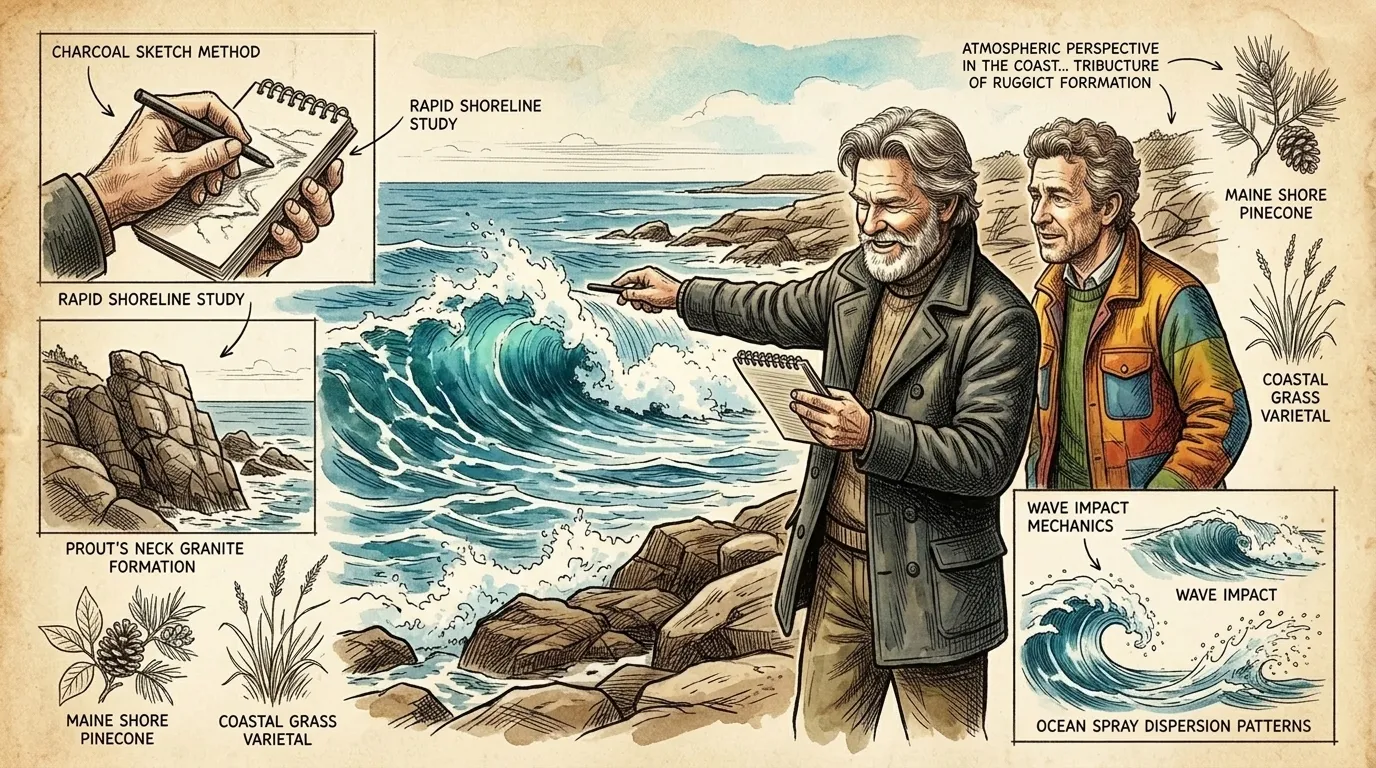
A young Winslow, sketching on the rugged coast of Prout's Neck, Maine, squinted at the crashing waves. The raw power of the Atlantic, the dance between light and water – these captivated him. He realized the sea wasn't just a backdrop, but a character with its own moods and stories. He told his brother, Arthur, of his vision.
""Arthur, look how the light catches the crest of that wave!" Winslow exclaimed, his charcoal sketching rapidly. "It's a force, a drama... I must capture it.""
Art Fact: Prout's Neck, Maine, became Homer's primary residence in 1883. The rugged coastline and powerful Atlantic Ocean deeply influenced his later works.
Page 3
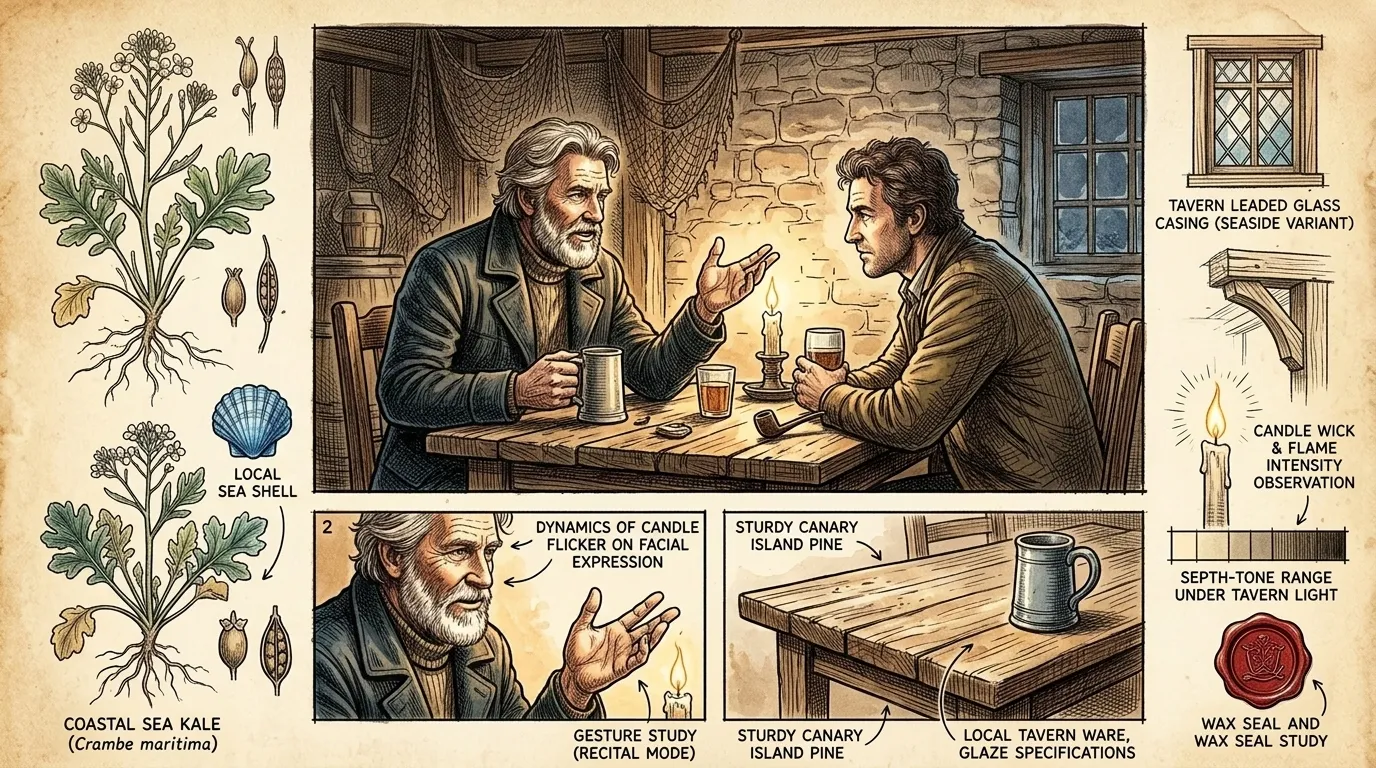
During the American Civil War, Winslow worked as an artist-correspondent for Harper's Weekly. He witnessed firsthand the brutality and hardship endured by soldiers, particularly African Americans. These experiences profoundly impacted his perspective, shaping his later portrayals of resilience in the face of adversity. One evening, he recounted something disturbing to his friend, Nathaniel.
""Nathaniel, I saw a young Black soldier today," Winslow recounted grimly, his face shadowed by the candlelight. "His spirit, even after so much suffering... it's unforgettable.""
Art Fact: Homer's wartime experiences provided him with a unique perspective on the struggles and resilience of African Americans, a theme that would later emerge in 'The Gulf Stream.'
Page 4
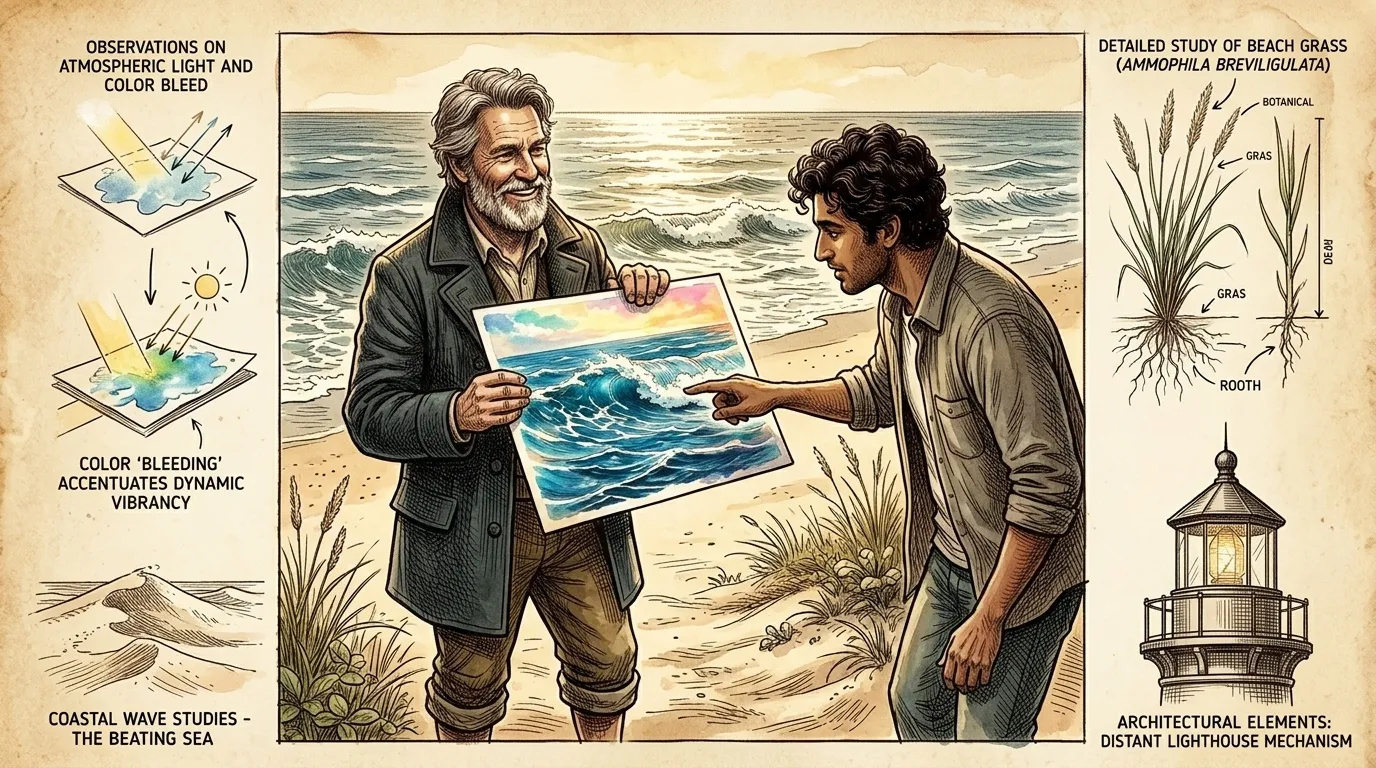
Homer experimented with watercolor, a medium that allowed him to capture the fleeting effects of light and atmosphere. He developed a unique technique, using broad washes and bold strokes to create vibrant and dynamic compositions. He found that the ability to quickly capture light helped him express what oil painting could not. He showed his work to Nikhil, a fellow artist, on the beach.
""Nikhil, look at how the watercolor allows the light to bleed across the paper!" Winslow exclaimed, holding up a painting of waves. "It's like capturing the very essence of the sun.""
Art Fact: Homer is celebrated as one of the foremost American watercolorists. His innovative techniques pushed the boundaries of the medium.
Page 5
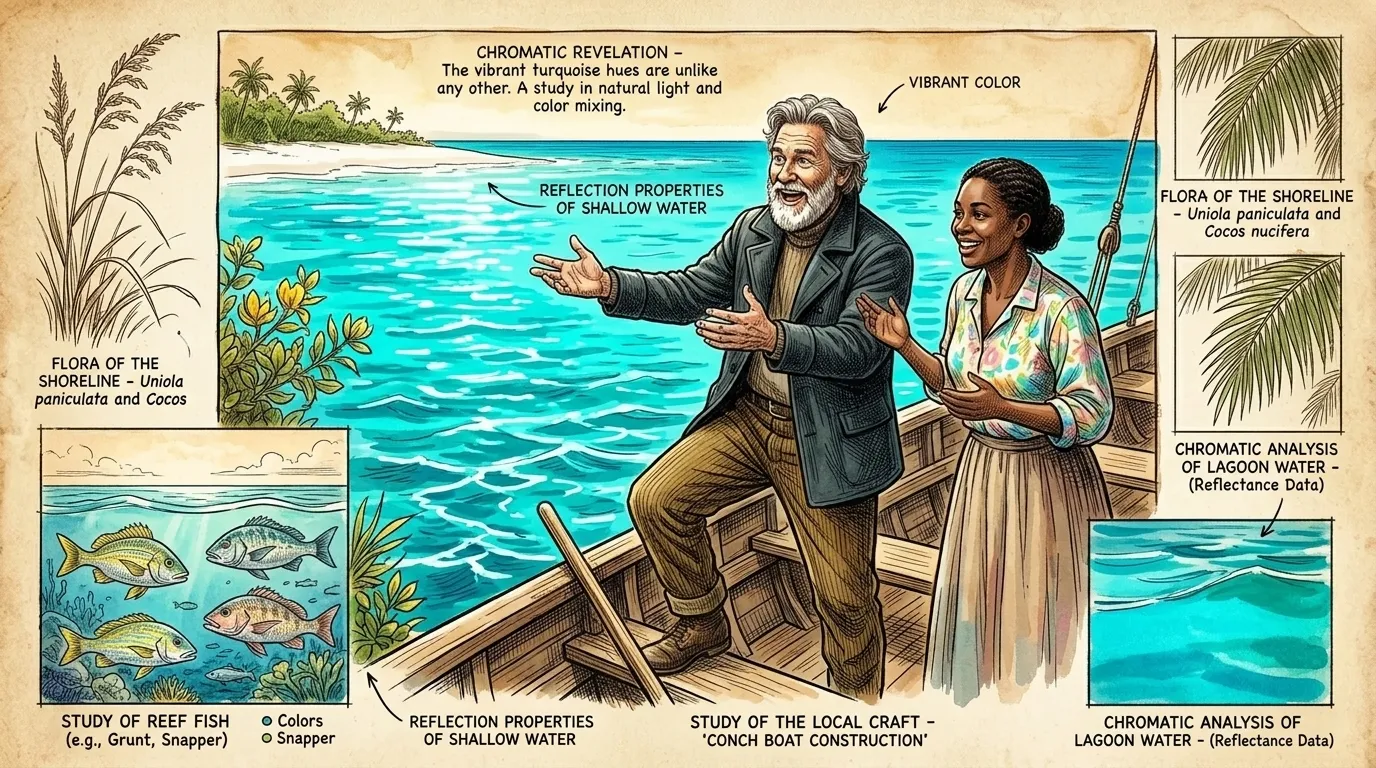
A trip to the Bahamas exposed Homer to a vibrant new palette of colors. The turquoise waters, the brilliant sunlight, and the rich hues of the local culture inspired him to explore a more expressive and evocative style. He saw new possibilities and felt inspired. He shared his excitement with Noor, a local woman.
""Noor, these colors... they sing!" Winslow exclaimed, gesturing to the turquoise sea. "I've never seen anything like it.""
Art Fact: Homer's time in the Bahamas broadened his artistic horizons and infused his work with a newfound vibrancy.
Page 6
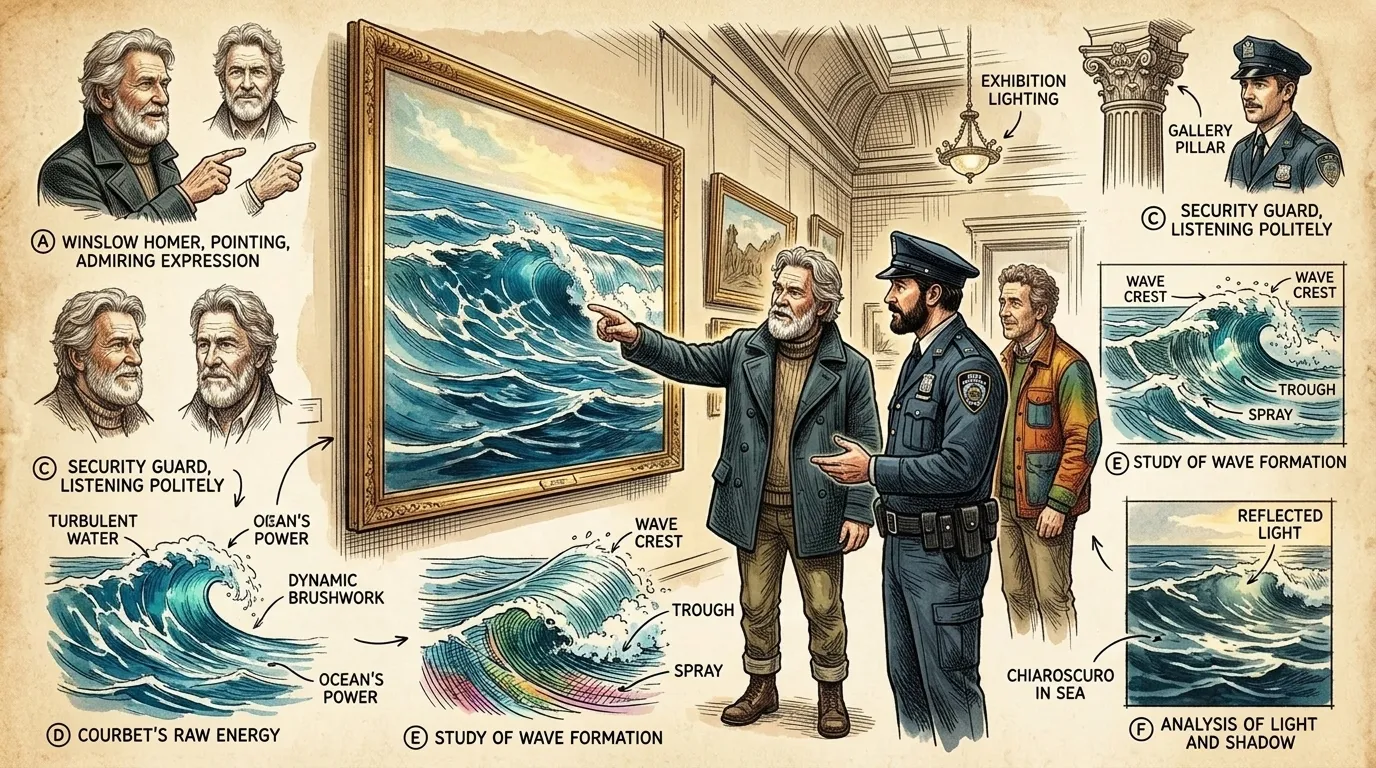
Homer deeply admired the work of Gustave Courbet, the French Realist painter. Courbet's bold depictions of nature and his unflinching portrayals of everyday life resonated with Homer. He saw a similar calling to tell the truth. Winslow was particularly moved by Courbet's sea paintings, which captured the power and grandeur of the ocean. While in the Metropolitan Museum of Art, he commented on Courbet's talent to a security guard.
""Did you see how Courbet captures the raw energy of the waves?" Winslow asked the guard, pointing to the canvas. "It's as if he's wrestling with the sea itself.""
Art Fact: Gustave Courbet's Realist aesthetic influenced Homer's approach to portraying the natural world and the lives of ordinary people.
Page 7
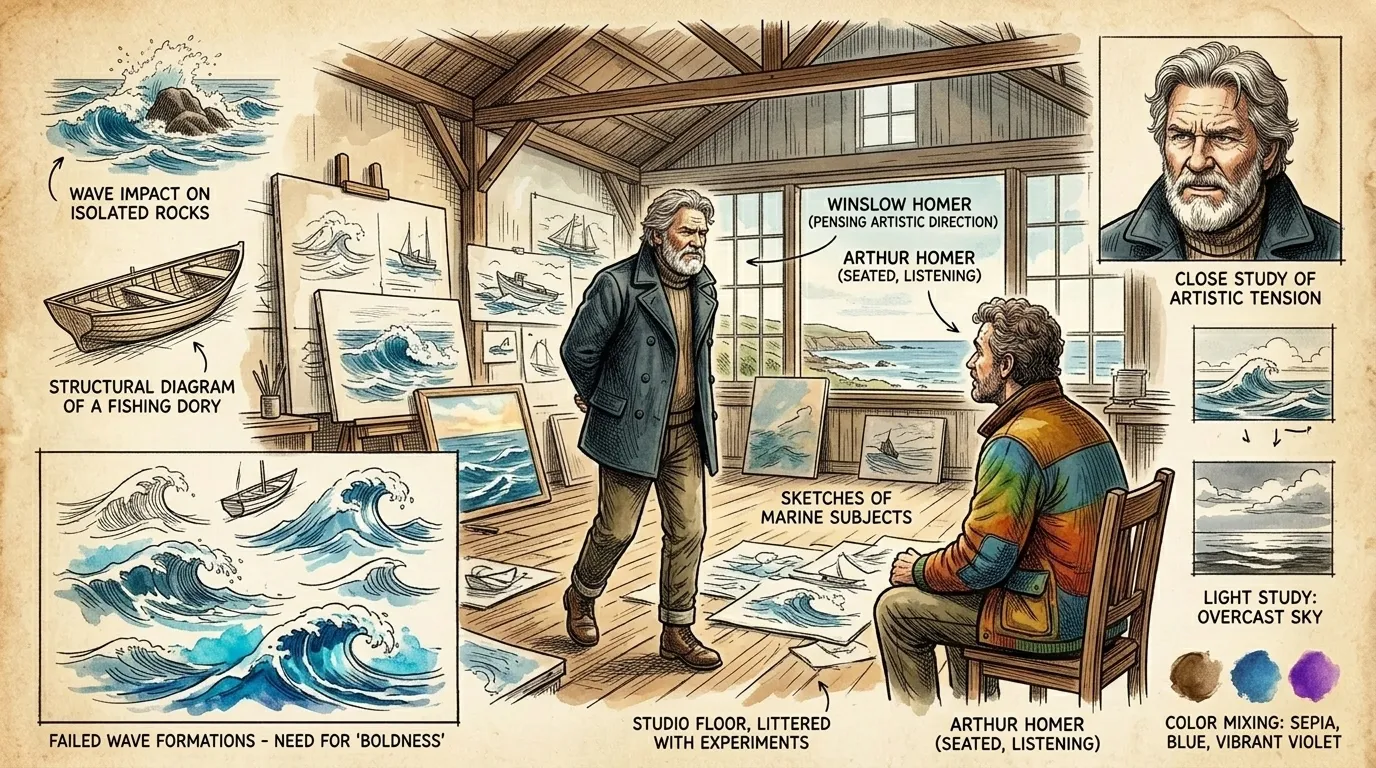
Homer faced criticism for his increasingly stark and unsentimental depictions of the sea. Some critics found his later works too bleak and despairing. He didn't let it dissuade him, though. He knew he had to be true to himself, and his art, regardless of what others thought. One review, in particular, stung. Later, Homer mentioned it to his brother, Arthur.
""They call my work 'melancholy' and 'bleak,'" Winslow sighed, pacing his studio. "Arthur, they want pretty pictures, not the truth of the sea!""
Art Fact: Homer was known for his independent spirit and his willingness to defy conventional artistic expectations, even in the face of criticism.
Page 8
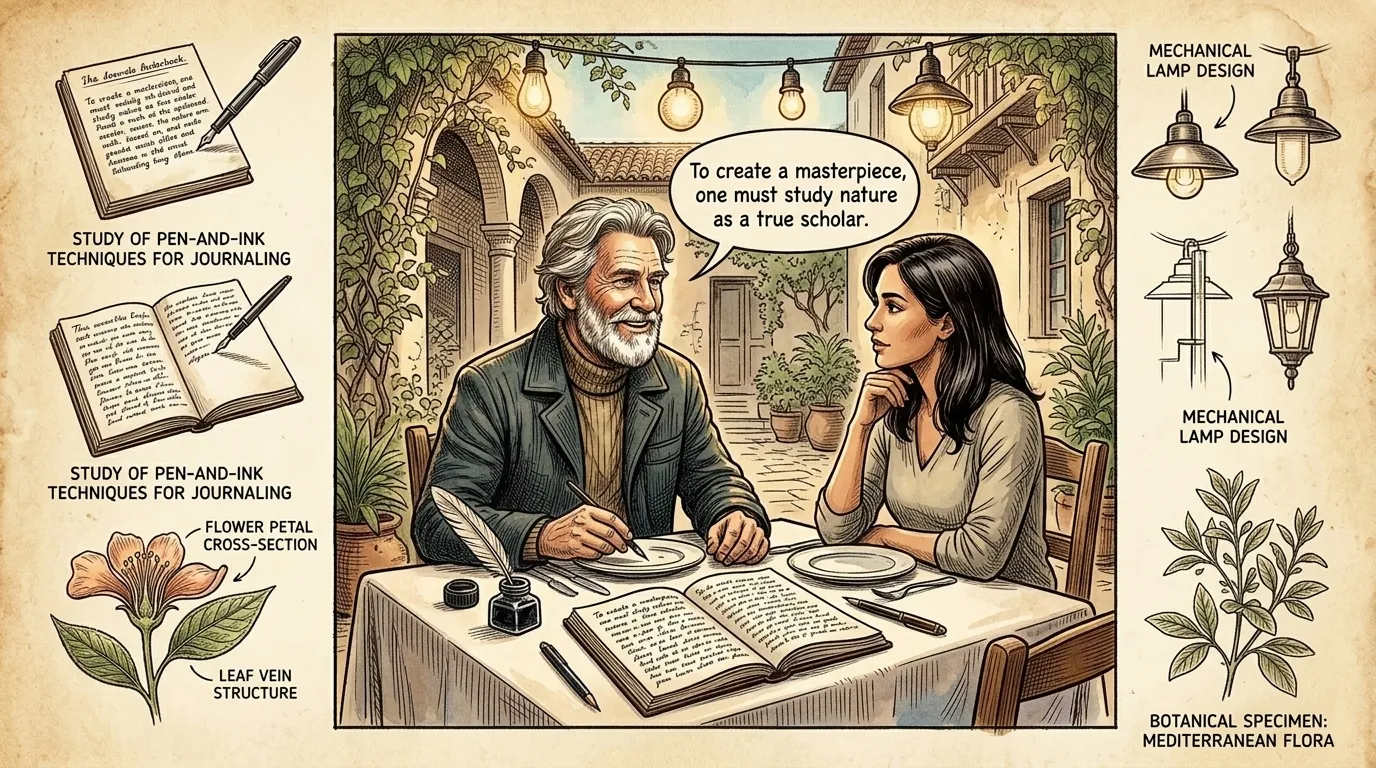
One evening, reading Emerson, Homer found a quote that resonated deeply. He copied it into his notebook. The quote helped crystallize his own artistic vision, that the truth is more than meets the eye. That night he shared it with Noor over dinner.
""As Ralph Waldo Emerson said, 'To be yourself in a world that is constantly trying to make you something else is the greatest accomplishment,'" Winslow shared, looking towards Noor. "It's true; it is about finding your own voice. "
Art Fact: Emerson's words influenced Homer's approach to portraying the natural world and the lives of ordinary people.
Page 9
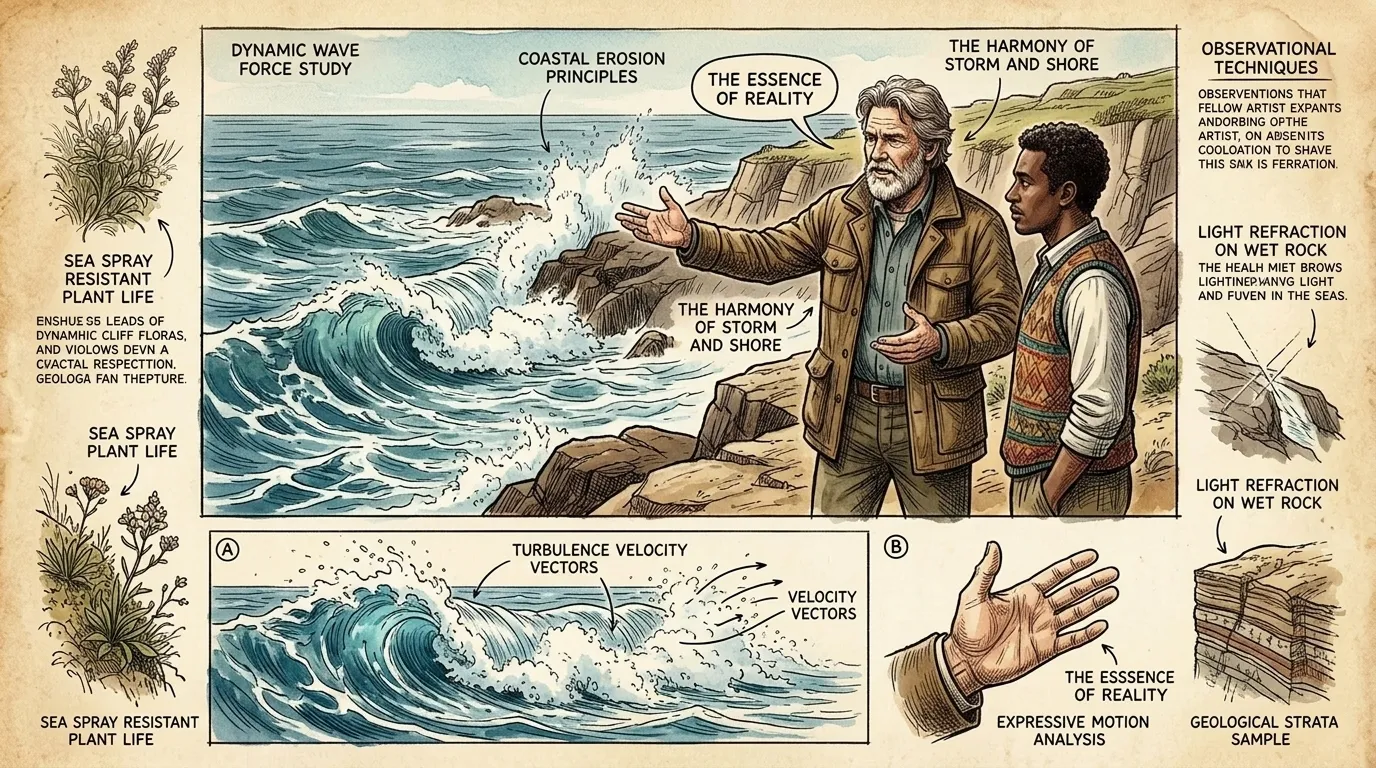
Homer sought to capture the stark realities of life, without sentimentality or romanticism. In 'The Gulf Stream,' he presented the fisherman's struggle in a direct and unflinching manner, leaving the viewer to contemplate his fate. That decision was highly controversial in its day. In the moment, Winslow was undeterred. Winslow once told Nikhil that the sea has to have the most honest reality in his work.
""Nikhil, the sea speaks of isolation; it cannot be sugar-coated. It has to be what it is to become a mirror to us.""
Art Fact: Homer's commitment to Realism set him apart from many of his contemporaries, who favored more idealized depictions of nature and humanity.
Page 10
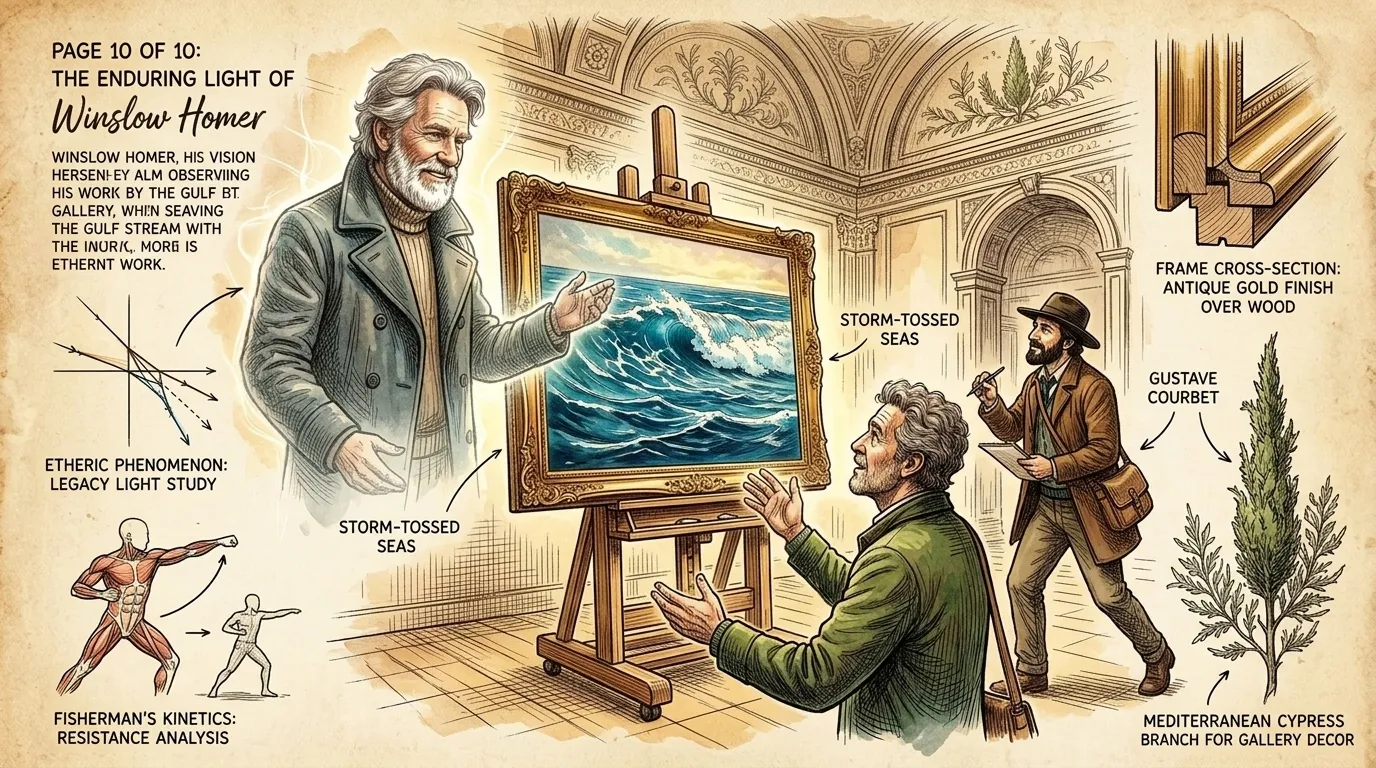
Today, 'The Gulf Stream' continues to resonate with audiences around the world. Its powerful imagery and ambiguous narrative invite viewers to confront the challenges of life and the enduring strength of the human spirit. Homer's ability to find beauty and meaning in the face of adversity ensures that his work will survive forever. For as Winslow knew, and as Vermeer before him, it is the light that remains.
"Winslow's art shows us that 'the sea is everything. It covers seven tenths of the terrestrial globe. Its breath is pure and healthy. It is an immense desert, where man is never lonely, for he feels life stirring on all sides. The Sea is only the embodiment of a supernatural and wonderful existence. It is nothing but love and emotion; it is the 'Living Infinite'.', from Twenty Thousand Leagues Under the Sea by Jules Verne."
Art Fact: 'The Gulf Stream' is considered one of Homer's most important works. It continues to inspire and challenge viewers, prompting them to reflect on the complexities of the human condition.
About this story
- Location: United States
- Audience: general readers
Read Wonder Arts on your phone
Wonder Arts is available on Android. Get Wonder Arts on Google Play.
More Wonder Arts stories
- The Hay Wain by John Constable (London, UK — 1821)
- The Horse Fair by Rosa Bonheur (Paris, France — 1853)
- The Iliad by Homer (Ancient Greece — c. 8th Century BC)
- The Isle of the Dead by Arnold Böcklin (Switzerland — 1883)
- The Just Judges Panel by Jan van Eyck (Ghent, Belgium — 1432)
- The Kiss by Auguste Rodin (Paris, France — 1882)