Ramesses III
Ramesses III — an illustrated history story. 10 illustrated pages, free to read on Wonder Egypt.
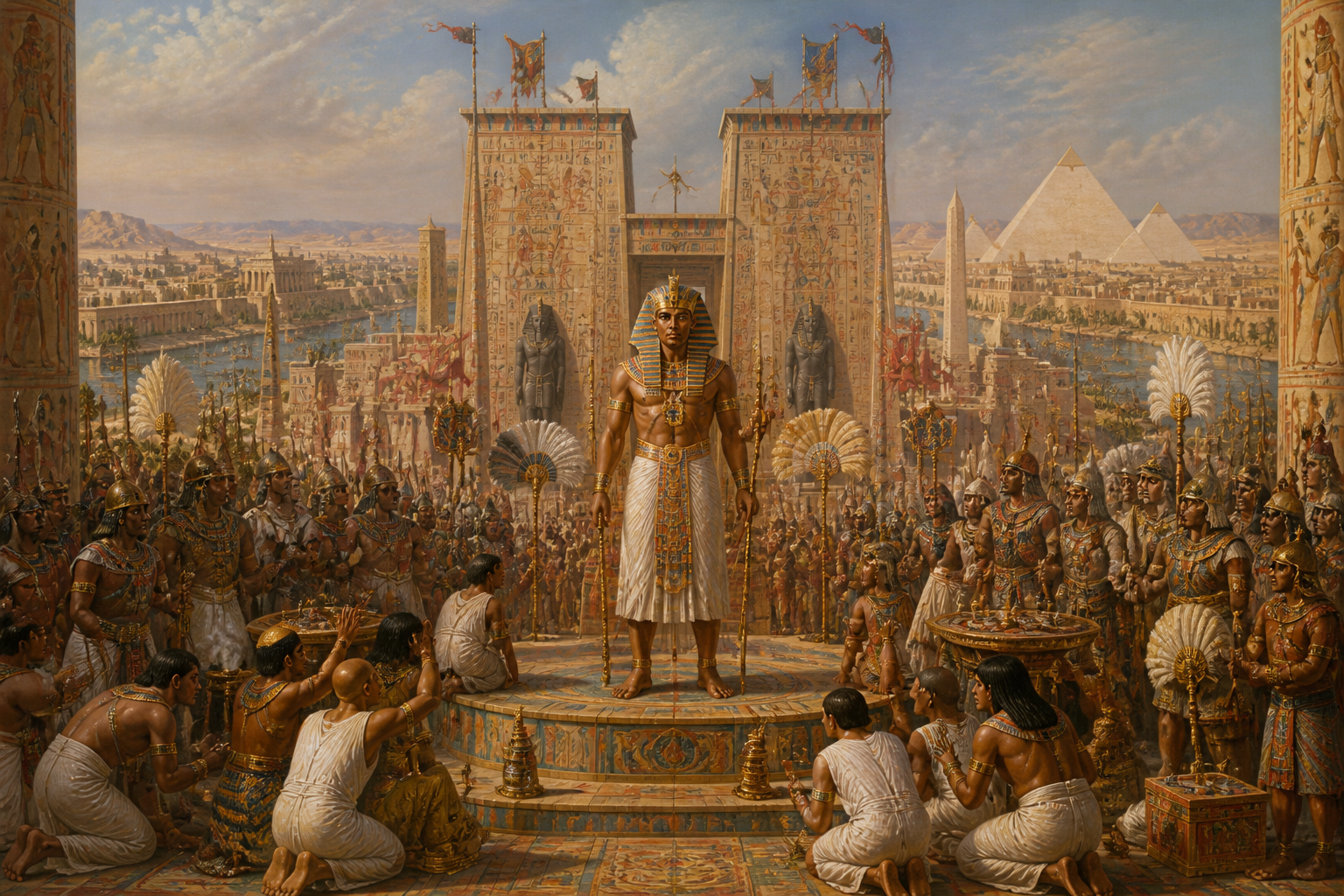
Page 1 — The Ascent of Ramesses III

Emerging from the shadow of his father, Setnakhte, Ramesses III claims the throne of Egypt, determined to restore its former glory. His ascent is marked by an elaborate coronation ceremony within the majestic walls of Medinet Habu. The air is thick with anticipation as courtiers gather, their elaborate garments of finely woven linen and gold accessories reflecting the flickering torchlight. The empire he inherits is still reeling from internal strife and the constant threat of the Sea Peoples, marauders from the north who have ravaged the Mediterranean. Yet, the challenges do not daunt him. With Queen Tiye at his side and his son Ramesses IV in line, he stands ready to defend and expand his domain. Ramesses III's reign marks the last great epoch of Egypt’s imperial power, his victories immortalized in the stone of Medinet Habu. His court teems with advisors and scribes, but hidden among them is a sinister force — the seeds of betrayal sown within his harem, leading to the infamous conspiracy that will ultimately claim his life.
"We shall crush the Sea Peoples and restore Egypt's might," proclaims Ramesses III to his generals in the grand hall.
Page 2 — The Sea Peoples' Invasion

In the year 1178 BC, the formidable Sea Peoples launch a massive assault on Egypt's borders, threatening the very core of its civilization. Ramesses III prepares for a decisive battle at the delta, where the waters of the Nile meet the Mediterranean. With meticulous strategy and sheer force, he orchestrates a grand defense, utilizing both land and naval forces in a synchronized show of military might. The clash is spectacular, with chariots thundering across the sands and ships engaging in fierce combat on the waves. The Pharaoh, clad in the majestic khepresh, a blue war crown with a golden cobra, personally commands his forces from a chariot, rallying his troops with unwavering resolve. His generals stand by his side, coordinating the complex maneuvers that will decide the fate of Egypt and its people. The battle rages for days, a cacophony of clashing metal and the cries of warriors filling the air, but Ramesses III's leadership turns the tide, securing a monumental victory that echoes across the ages.
"Hold the line! For Egypt and the great Pharaoh!" shouts a general as he charges into the fray.
Page 3 — The Splendor of Medinet Habu

As a testament to his power and divine favor, Ramesses III commissions the construction of the magnificent temple complex at Medinet Habu. Within this sprawling bastion of stone and piety, the ambitions of a Pharaoh are etched into eternity. The site becomes a vibrant hub of activity, teeming with hundreds of skilled artisans, each dedicating his craft to immortalizing the Pharaoh's unmatched prowess. They labor with tools that shine under the merciless Egyptian sun, chiseling the Pharaoh's victories into stone with painstaking detail, ensuring each hieroglyph and relief conveys the intended message of dominance and divine sanction. Under the scorching sun, workers labor tirelessly, dressed in simple linen garments, their skin bronzed by the relentless heat, heeding the commands of the chief architect who surveys the project with a discerning eye, holding a rod and sketch, ensuring his vision aligns with the Pharaoh’s. Each relief and statue aims to immortalize the triumph over chaos, depicting scenes of the Sea Peoples' defeat and the Pharaoh's divine might. Within the bustling courtyard, priests conduct rituals to honor the gods, their chants rising in harmonious reverence, carefully timed to echo through the arches, while scribes, seated on low stools, document the achievements for future generations, the papyrus scrolls rolling slowly under their steady hands. The colossal stone walls echo with the sounds of hammers and chants, as the scent of incense, thick and pungent, fills the air, mixing with the dust of the carved rock, creating an atmosphere heavy with purpose and piety, a sensory tapestry that bespeaks the might and spirituality of a civilization at its pinnacle.
"Let it be known that Pharaoh Ramesses III conquers all who oppose Egypt," declares a scribe, inscribing tablets with deliberate strokes, each character a testament to the Pharaoh's enduring legacy.
Page 4 — The First Strike

The workers at Deir el-Medina, tasked with building the royal tombs and securing the Pharaohs' passage to the afterlife, reach a breaking point in an unprecedented moment of social upheaval. Unpaid wages spark unrest, leading to history's first recorded labor strike in 1155 BC. The laborers, whose skilled hands are essential to the afterlife preparations of all pharaohs, lay down their tools in protest. In a tense meeting at the necropolis, representatives of the workforce confront the overseers, voicing their grievances with determination and a mix of desperation and defiance in their pleas for overdue grain rations. The scribe records these moments, immortalizing the voices of those who dared to challenge the status quo. The stifling desert heat hangs heavy as they voice grievances, underscoring the urgency of their demands. The overseers, caught between duty and empathy, must relay the workers' demands to the court, navigating the delicate balance of power and responsibility in a society built on order and tradition. The strike forces a reluctant but essential reevaluation of the labor conditions within the kingdom, a pivotal moment in the ongoing saga of power and the human spirit.
"We can no longer work under these conditions," states a laborer, firm and resolute.
Page 5 — Conspiracy in the Harem

Within the opulent yet cloistered confines of the harem, a dangerous plot brews, cloaked in secrecy and ambition. Queen Tiye, a formidable presence in Ramesses III's court, becomes embroiled in a conspiracy that seeks to place her son, Pentawer, on the throne of Egypt. Behind the intricate latticed windows, whispers of discontent and promises of power circulate among the women and trusted officials, their murmurs carried away by the perfumed air thick with incense and intrigue. The conspirators meet in secret, crafting their plans with meticulous care, the scent of rich oils and the rustle of silk underscoring their clandestine activities. Tiye, draped in finery that reflects her status, faces the ultimate dilemma of loyalty versus ambition, her every move observed by eyes both curious and calculating. The conspiracy, fueled by ambition and jealousy, threatens to unravel the very fabric of the royal household, posing a threat not only to the throne but to the stability of Egypt itself as it teeters on the brink of internal strife.
"For the good of Egypt, we must act swiftly," urges a co-conspirator, eyes gleaming with intent.
Page 6 — The Fall of a Dynasty

The conspiracy reaches its climax in a darkened chamber, where the fate of Egypt hangs precariously in the balance. Ramesses III, weakened by the weight of years and unaware of the full scope of betrayal within his trusted circle, is attacked in a meticulously planned act of treason. The once-mighty Pharaoh, dressed in simple linen that belies his royal status, remains dignified even in the face of treachery, his presence commanding respect despite the imminent threat. His trusted allies, either powerless or complicit in the unfolding events, stand by, their silence a damning testament to the complexity of court politics and the fragility of power. The atmosphere is tense, the flickering oil lamps casting shadows that dance eerily on the walls, creating an aura of foreboding. As the attack unfolds, the future of Egypt hangs in the balance, the empire's stability threatened from within. The assassination attempt, though not immediately successful, marks the beginning of the end for a ruler who once stood as a bastion of strength against external threats, a poignant reminder of the duality of power and mortality.
"You betray your own blood for naught," whispers the Pharaoh, eyes steely with defiance.
Page 7 — Ramesses IV: The Heir's Challenge

Amidst the turmoil of his father's final days, Ramesses IV ascends to a precarious throne, his ascent signaling a new era fraught with challenges and responsibilities. The new Pharaoh, a young man with a resolute demeanor, immediately faces the daunting task of restoring stability to a kingdom shaken by internal conflict and external threats. In the heart of Thebes, the seat of power and history, he calls upon his closest advisors and allies to strategize, their faces a mix of hope and wariness. The room is alive with the rustling of papyrus and the scent of ink as scribes record decrees, their presence a reminder of the enduring bureaucracy that underpins Egypt's governance. Ramesses IV, donning a uraeus headband that symbolizes his divine right to rule, exudes determination and commands authority. His regents and generals, clad in official garb of finely woven linen and adorned with emblems of rank, look to him for direction, their loyalty a crucial support in these uncertain times. With the weight of his father's legacy upon him, Ramesses IV vows to quell dissent and strengthen Egypt's borders once more, his words resonating within the chamber and beyond, as he seeks to secure a future for his troubled nation.
"We must honor my father's legacy and secure Egypt's future," declares Ramesses IV with conviction.
Page 8 — The Legacy of War

The temples of Thebes stand as silent witnesses to the legacy of Ramesses III, his victories carved into their stone facades with meticulous care and devotion. The towering columns and statues, testaments to the architectural prowess and artistic achievements of ancient Egypt, draw pilgrims and tourists alike, who stroll among the sacred edifices, their footsteps echoing the footsteps of those who came before. The air is filled with the scent of blooming lotuses, their fragrance mingling with the incense burned by priests who conduct rituals to honor the gods, their chants rising in a haunting echo of promises made to maintain ma'at, the divine order that sustains the universe. Amidst the throngs, a young scribe diligently copies the stories of battles into scrolls for posterity, his reed pen scratching softly against the papyrus. The enduring symbols of power and faith are reminders that, despite internal strife, Egypt's heart beats timelessly. Ramesses III's ambition and achievements linger as whispers in the wind, a complex legacy in a land of gods and men, where history is both preserved and lived anew with each passing day.
"These walls speak of a powerful Pharaoh's triumphs," remarks a priest, gesturing to the inscriptions.
Page 9 — The Aftermath of Power

Years after his death, the influence of Ramesses III continues to reverberate through ancient Egypt, his impact felt in both tangible and intangible ways. The economic strains of war and inner conflict leave their mark on the kingdom, casting long shadows over its prosperity. Courtiers gather in the treasury chambers, their discussions hushed as they account for dwindling resources and strategize to maintain the empire's wealth. The walls are lined with papyrus records, testaments to the struggles of maintaining an empire's wealth in an era of changing priorities and scarce resources. The Pharaoh's successors strive to emulate his achievements, yet the challenges of a changing world loom large, demanding new strategies and alliances. Despite the uncertainties, the memory of Ramesses III endures, a beacon of fortitude in Egypt's storied history, prompting both retrospection and future planning. The court’s focus shifts towards preserving what remains, a precarious balance between the glory of yesteryears and the exigencies of the present, as they seek to navigate the complexities of power and responsibility in a world that tests the limits of human endurance.
"Our resources are stretched thin, but Egypt endures," assures a treasurer, rolling a papyrus scroll.
Page 10 — A Dynasty's Echo

The years flow like the eternal Nile, carrying with them the echoes of Ramesses III's reign, his legacy both a subject of reverence and inquiry. Within Alexandria's grand library, a beacon of knowledge and culture in the ancient world, historians and scholars gather to study and debate the complexities of his rule. The air hums with intellectual energy as scrolls are unfurled, their contents sparking lively debates about the Pharaoh's impact and the lessons of his tenure. The library's shelves, filled with works from across the known world, frame the discussions, a testament to the interconnectedness of the ancient world. A sense of awe pervades the space, fueled by the weight of Egypt's past and the potential of its future, the scholars' discourse a bridge between eras. Ramesses III, the last great warrior Pharaoh, remains a figure of fascination, his life a testament to both the power and vulnerability of leadership, his story told and retold as a cautionary tale and a source of inspiration. As the sun sets, casting golden light through the arched windows, the scholars' debate continues, breathing life into the ancient words, ensuring that the legacy of the past informs the decisions of the future.
"His was a reign of contrasts, both triumphant and tragic," reflects a scholar, adjusting his scroll.
About this story
- Audience: general readers
Read Wonder Egypt on your phone
Wonder Egypt is available on Android. Get Wonder Egypt on Google Play.