Taharqa
Taharqa — an illustrated history story. 10 illustrated pages, free to read on Wonder Egypt.
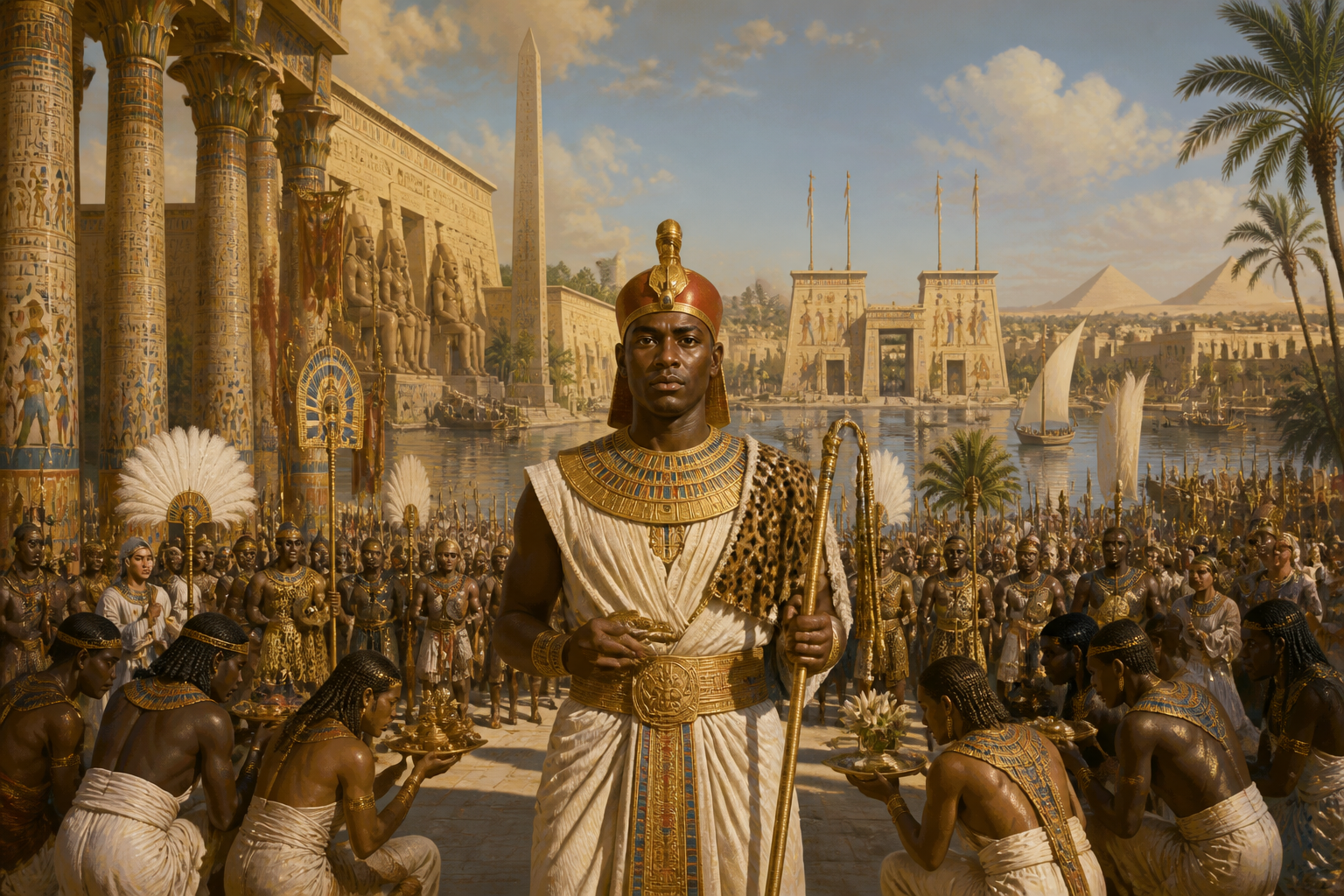
Page 1 — The Reign of Taharqa Begins
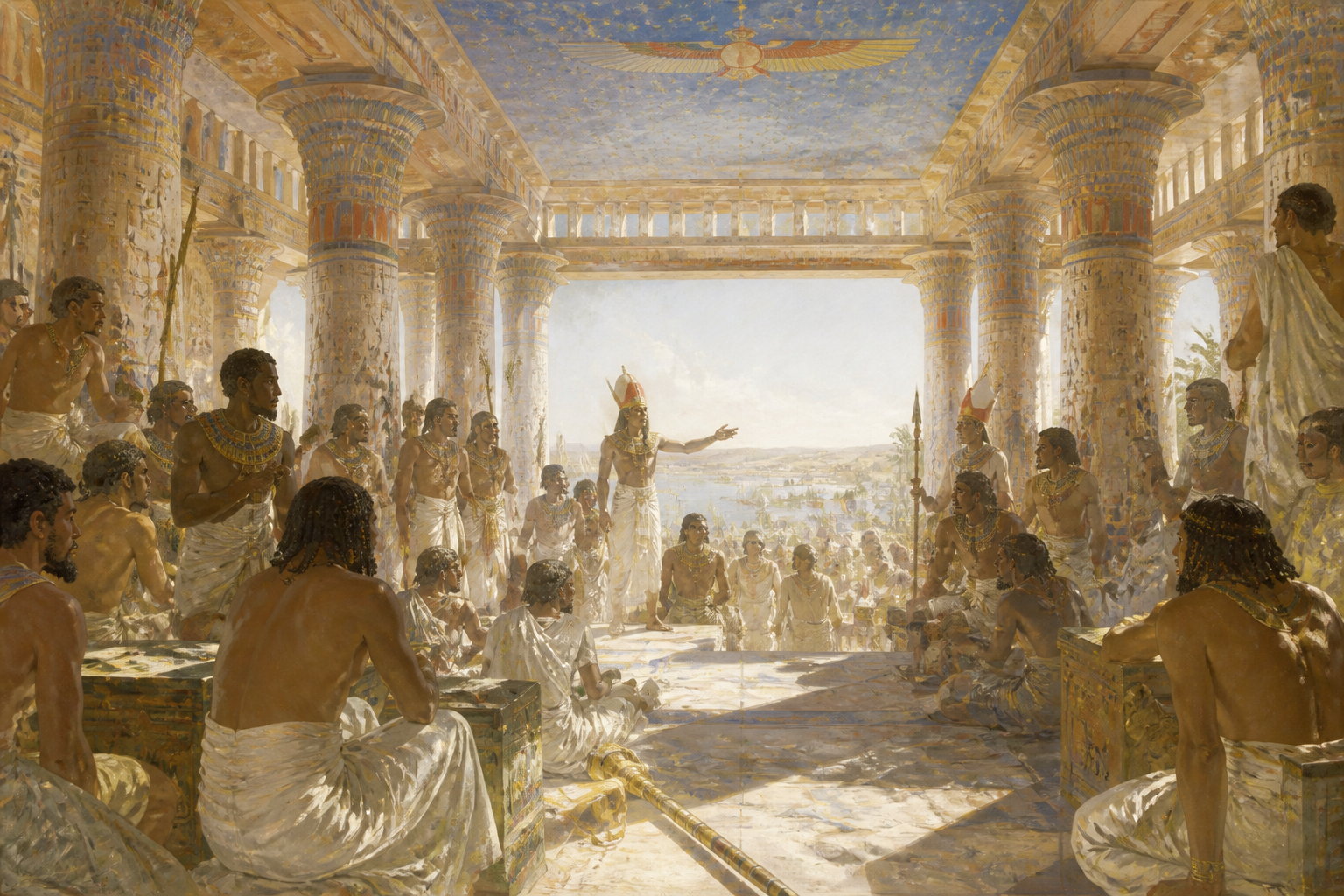
Taharqa ascends the throne of two great kingdoms, Egypt and Kush, around 690 BC. His reign begins in the grand city of Thebes, where the colossal statues of ancestors loom over the court. A descendant of Piye and Shabaka, Taharqa inherits not only their kingdom but also their ambitious vision of uniting the lands under the banner of the Kushite dynasty. His advisors gather in the vast audience hall, the echoes of their voices merging with the distant hum of the Nile. Among them stands Tantamani, a loyal confidant and future successor, whose counsel will one day guide the fate of these lands. Taharqa's reign is marked by a dual legacy of construction and conflict. While his stonemasons raise obelisks and his architects design temples, across the deserts, the threat of Assyrian might looms, embodied by their king, Esarhaddon. This page sets the stage for a reign defined by grandeur and struggle, a time when the prosperity of Egypt and Kush reached remarkable heights, only to be tested by the encroaching shadow of Assyrian ambitions.
"We must build not only monuments of stone but monuments of legacy," Taharqa declares, his voice resonating through the hall.
Page 2 — Building the Legacy
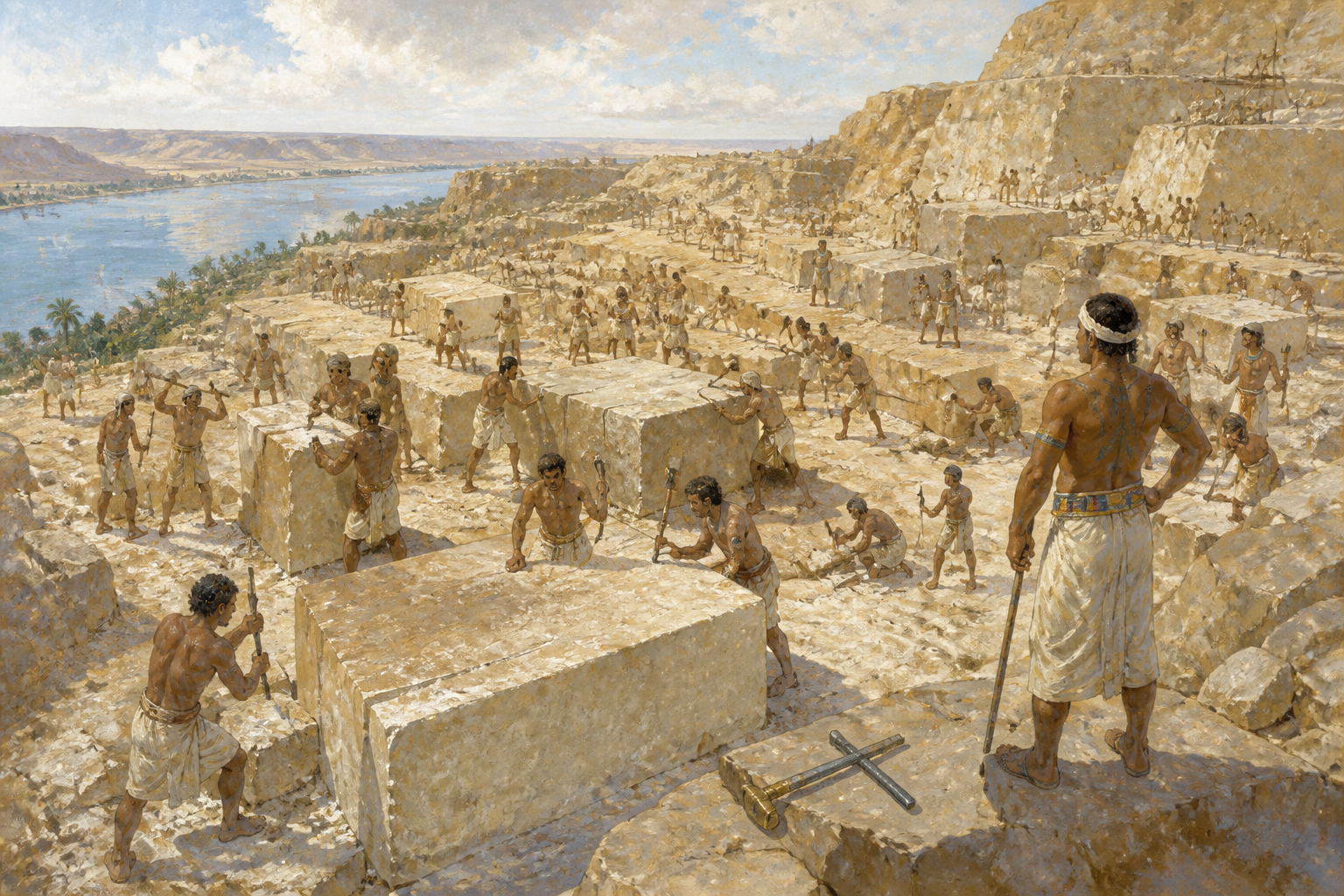
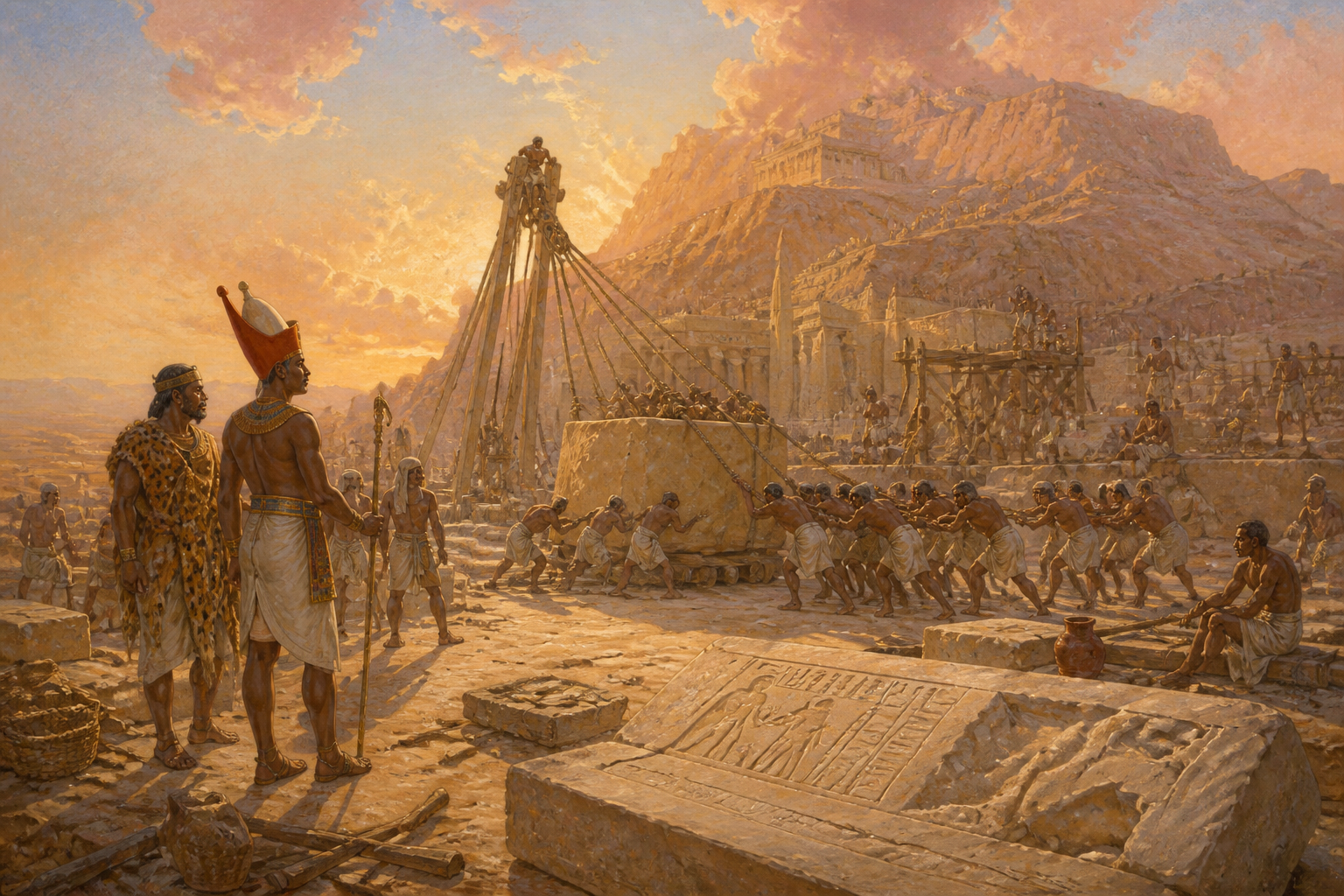
Taharqa's vision for his kingdom is as enduring as the stone structures he commissions. In the quarry at Aswan, the air is filled with the sharp sound of chisels striking granite, the laborers sweating under the relentless sun. Here, under his directive, the stones are quarried for the temples and monuments that will stand as eternal symbols of his reign. Among the laborers, the chief architect oversees the operations, ensuring that every block is cut to perfection. His ambition is no less than that of the pharaoh himself. In the distance, the noble figure of Piye's spirit seems to watch over the works, a reminder of the dynasty's foundational achievements. These stones will become part of Karnak's new pylons and sanctuaries, their surfaces soon to be adorned with hieroglyphs praising the king and the gods. This page captures the industrious spirit of Taharqa's reign, a time when Egypt's architectural legacy was expanded under his watchful eye.
"Each stone bears the weight of our history; carve it with precision," instructs the chief architect to his workers.
Page 3 — The Court of Memphis
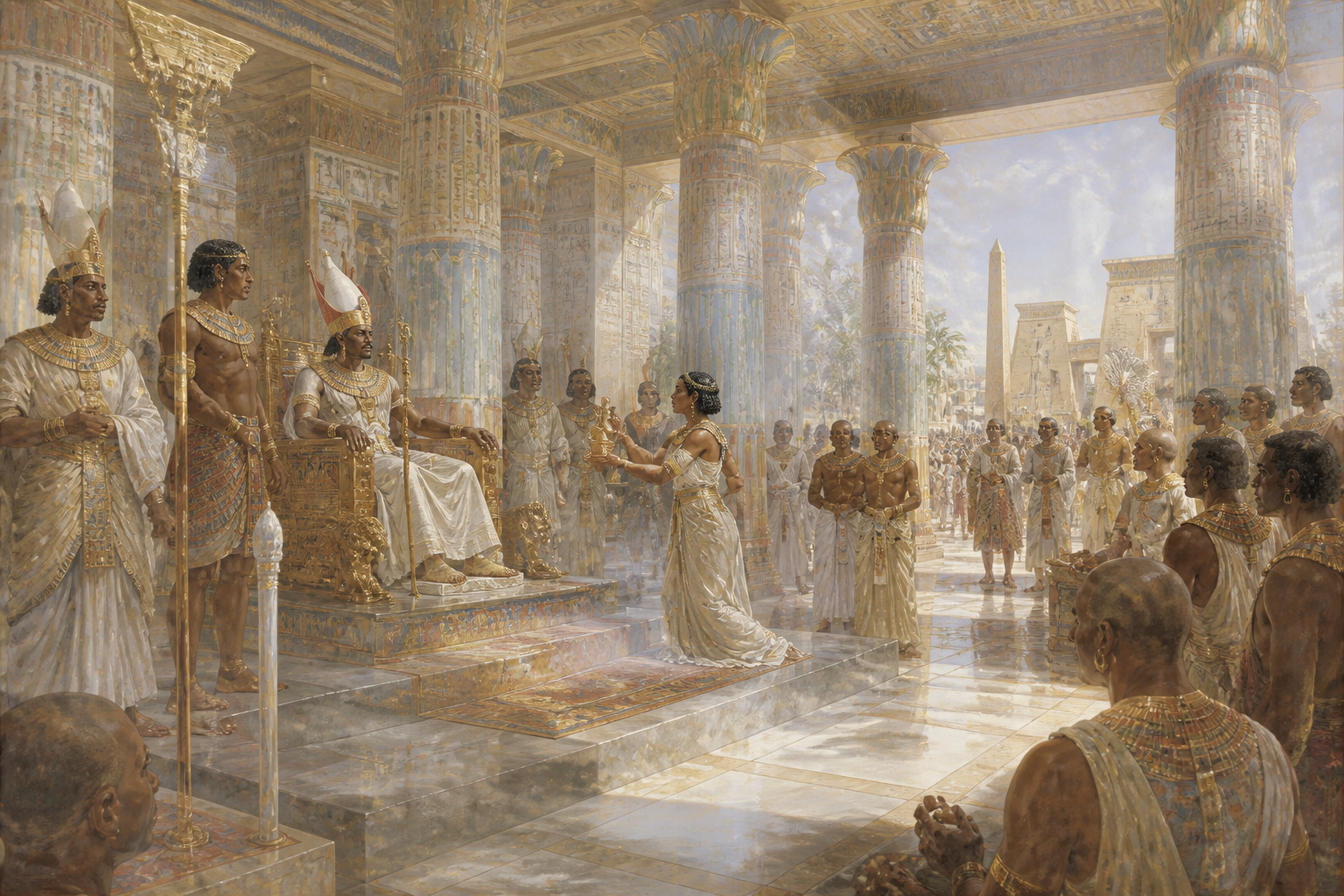
In Memphis, the heart of Egyptian power, Taharqa gathers his court. The city buzzes with political intrigue and the chatter of diplomats from distant lands. Inside the throne room, the pharaoh sits upon a gilded throne flanked by imposing lion statues. His court is a tapestry of nobility and officials, each vying for favor or whispering plans to further the kingdom’s influence. Esarhaddon, the king of Assyria, is ever a shadow in distant lands, plotting his northern advance. Taharqa confers with his chief advisor, a man of profound wisdom whose insights are indispensable in navigating the treacherous waters of diplomacy and war. As emissaries from foreign territories present their tributes, the throne room becomes a stage for the complex interplay of alliances and rivalries. This page highlights the nexus of power and politics in Taharqa's reign, where decisions made in a single chamber ripple across continents.
"Diplomacy is our strongest shield, yet our sword must never dull," advises the chief advisor, as he stands close to Taharqa.
Page 4 — The Temples of Napata
Taharqa's eyes turn toward Napata, the spiritual heart of the Kushite dynasty. Here, at the foot of the sacred mountain Jebel Barkal, he presides over the construction of magnificent temples. The site is alive with the sound of hammers and the prayers of priests. The air is thick with incense and the distant call of ibis birds. In these holy precincts, the pharaoh consults with his chief priest, a venerable figure clad in a leopard skin vestment, who interprets the will of the gods. Together they plan the sanctification of this sacred land, ensuring that the temples not only serve earthly power but celestial favor. This page illustrates Taharqa’s commitment to the divine and cultural heritage of his people, a legacy carved in stone and spirit.
"This land is sacred; our temples must honor the gods and our forebears," says the chief priest, gesturing toward the rising structures.
Page 5 — War Shadows Gather
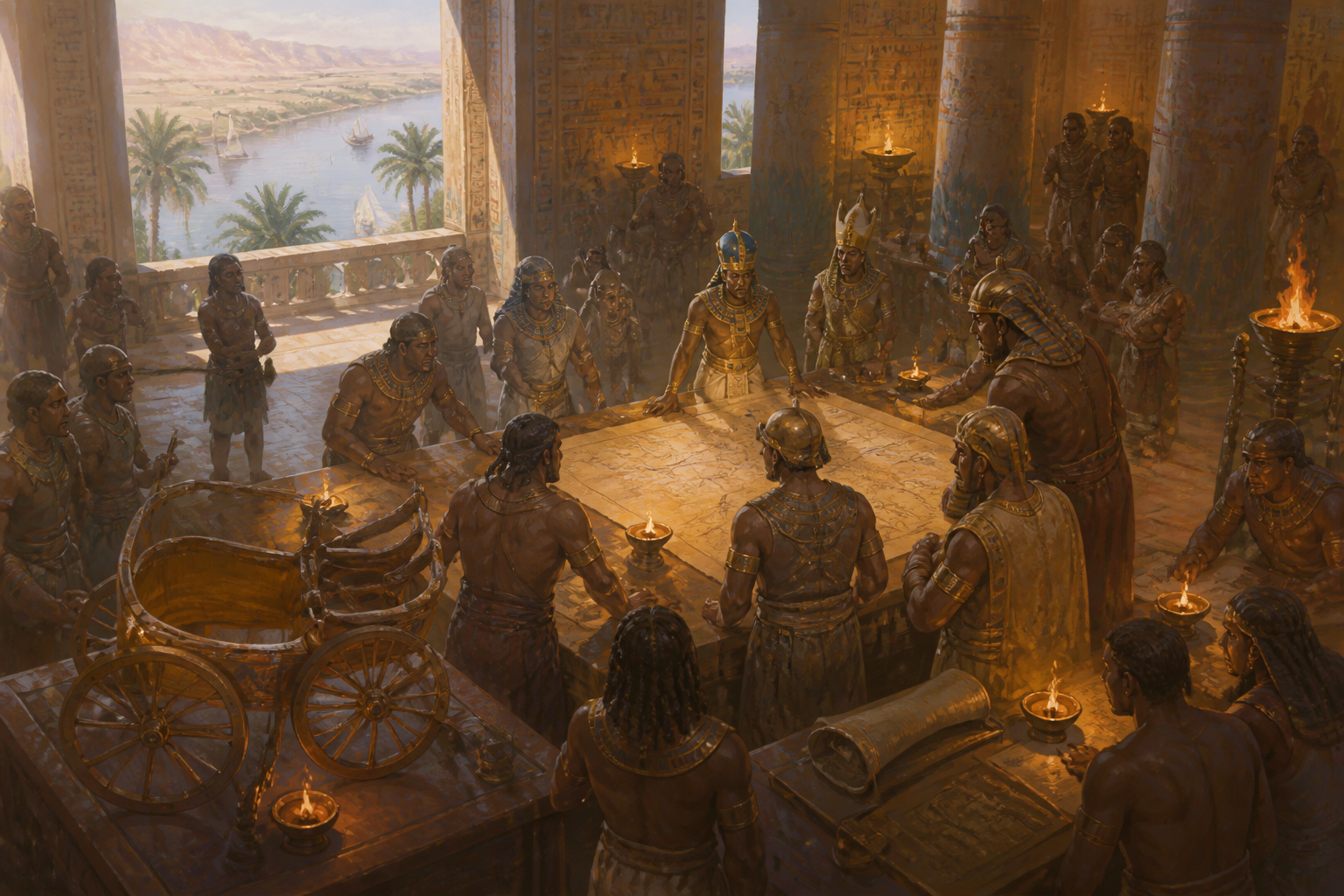
Taharqa's reign, though marked by prosperity, becomes increasingly overshadowed by the threat of Assyrian aggression. In Memphis, as the sun rises over the ancient city, the pharaoh meets with his generals in the war room. The air is tense with the murmur of strategy, the rustle of papyrus maps marking the expanse from Kush to the outskirts of Assyria. Taharqa stands, hands planted on a massive cedar table, his eyes tracing the route of the Assyrian army under Esarhaddon. His generals argue fiercely over tactics, some advocating for direct confrontation, others for a defensive stance. The room is filled with the scent of myrrh-burning lamps and the metallic tang of war gear. This page captures the critical moment before the storm of war, where decisions and alliances will shape the destiny of nations. It depicts the gravity of leadership, the burden of choice that Taharqa bears.
"We must be both lion and fox, striking where they least expect," Taharqa declares, as he considers the options laid before him.
Page 6 — First Clash at the Nile
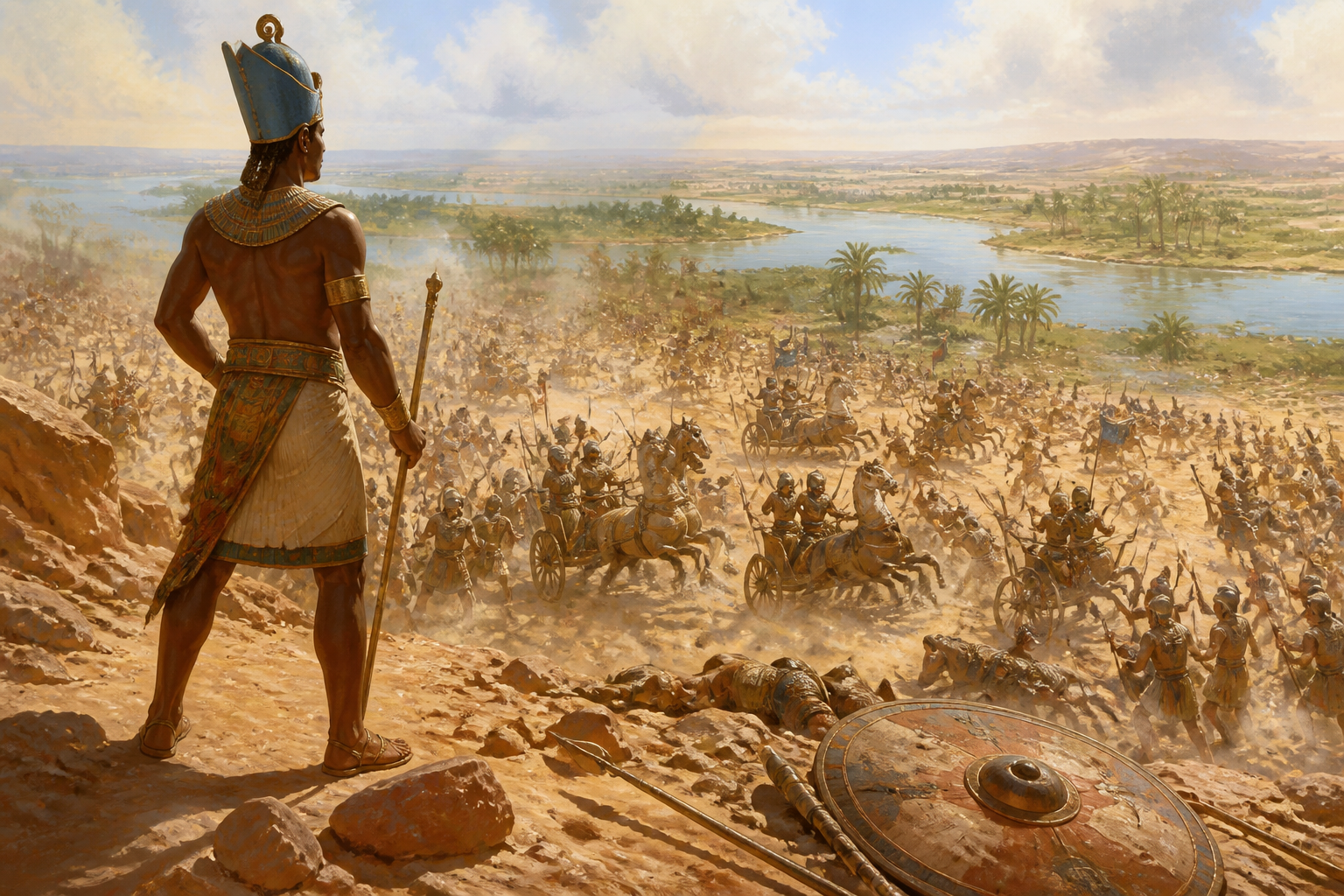
The armies of Egypt and Assyria clash along the banks of the Nile. It is a ferocious encounter under the blazing Egyptian sun. Taharqa stands atop a ridge, observing the battlefield through the dust and chaos. Below, the Egyptian chariots charge, their horses adorned with brightly colored feather plumes. The clash of bronze against bronze and the cries of men fill the air. Ashurbanipal, the Assyrian king's general, directs his forces from across the river, his soldiers in tight phalanxes. Taharqa's strategy is one of maneuver and speed, attempting to break the Assyrian lines with swift, decisive strikes. This page captures the intensity and brutality of ancient warfare, where the fate of empires is determined by moments of courage and sacrifice. It is a vivid portrayal of the physical and emotional toll of battle on both leaders and soldiers.
"Hold the line! We fight for our ancestors and our children!" Taharqa shouts to his troops, urging them on.
Page 7 — Retreat to Napata
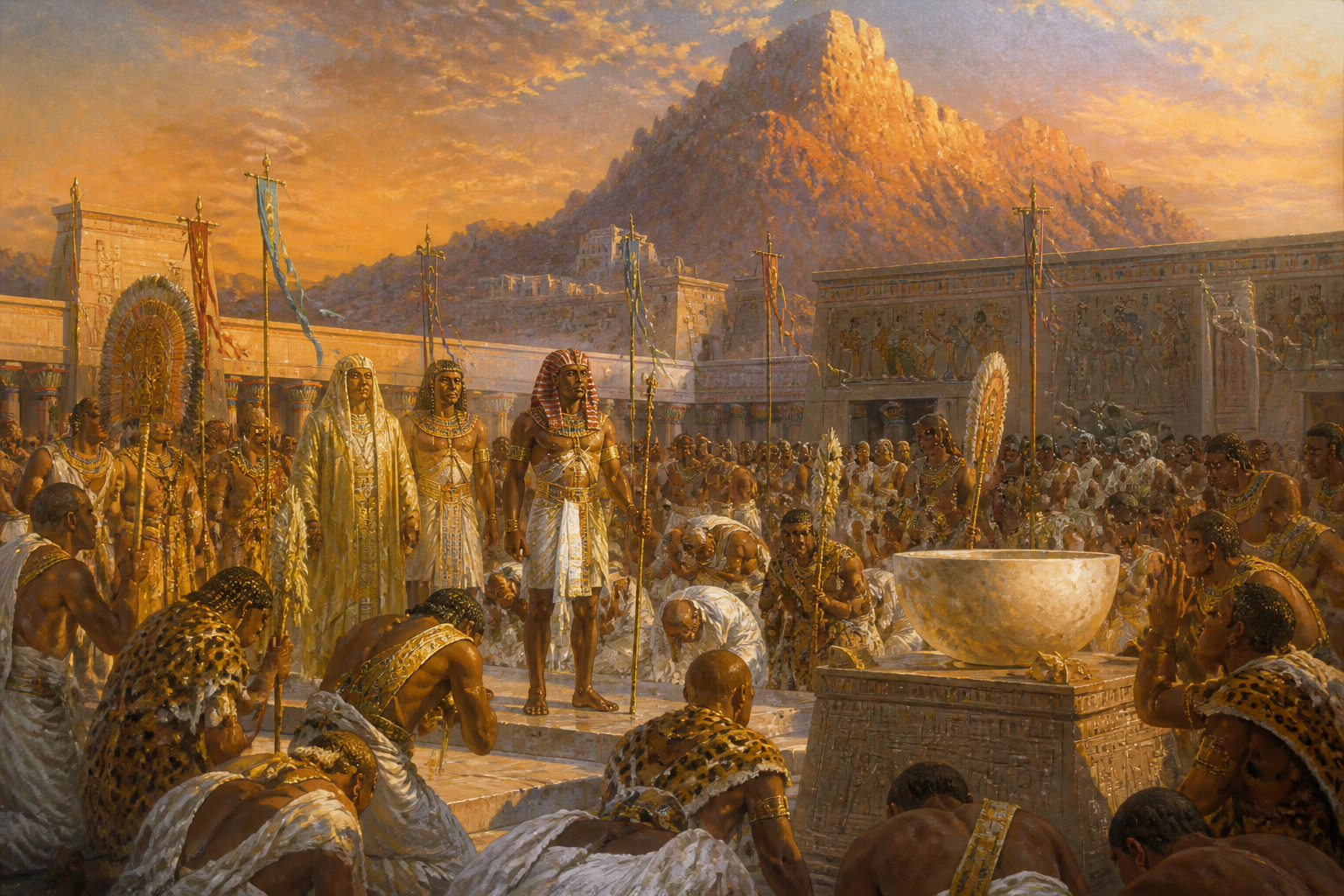
The relentless advance of the Assyrian forces forces Taharqa to retreat to the sanctuary of Napata. In a court assembled beneath the shadow of Jebel Barkal, he stands among his most trusted advisors and generals. The mood is somber, the gravity of their situation evident in the silent contemplation of their defeat. Despite the setback, the pharaoh’s resolve burns as brightly as ever. He speaks of regrouping, of rallying the strength of their people to resist the Assyrian onslaught. The priests chant prayers to the gods, seeking divine intervention in their time of need. This page captures the resilience and spirit of Taharqa, a king determined to fight for his kingdom's freedom amidst adversity.
"We may have lost a battle, but our spirit remains unbroken," Taharqa asserts, his voice echoing off the cliffs.
Page 8 — The Assyrian Tide
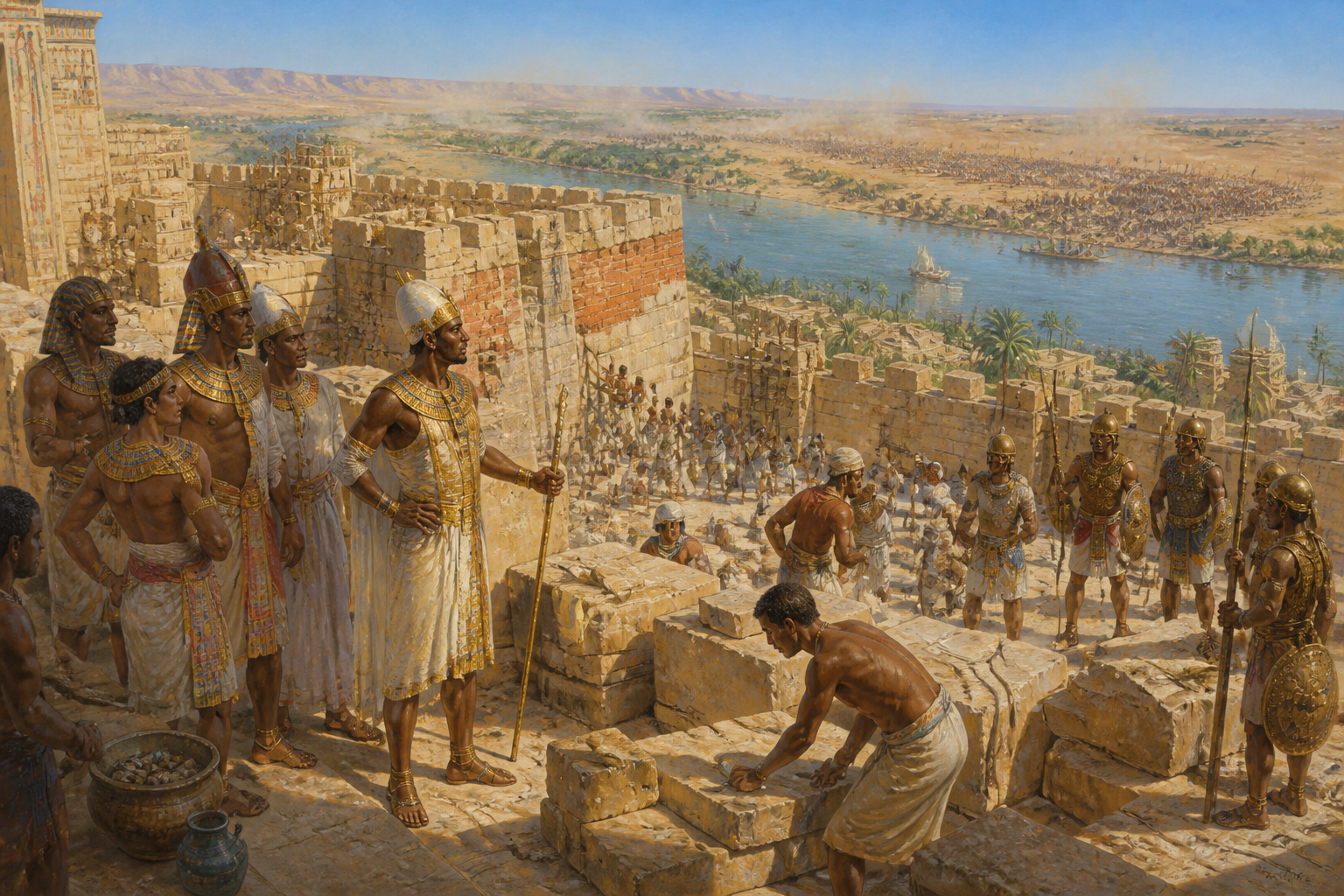
The Assyrian approach grows ever more menacing as their forces continue their inexorable push southward. In the fortified city of Thebes, Taharqa oversees the strengthening of defenses, preparing for the inevitable siege. The city is alive with the sounds of construction: the clatter of masonry, the hum of saws, and the barked orders of foremen. Artisans and laborers labor tirelessly, reinforcing walls, crafting weapons, and preparing for the defense. The queen, an elegant figure in a flowing white sheath dress, moves among the people, offering words of encouragement and support. Taharqa stands on the city walls, gazing toward the horizon where dust and smoke signal the approach of the enemy. This page is a testament to the indomitable will of a city and its ruler, determined to hold fast against overwhelming odds.
"Every stone we lay is a testament to our defiance; every weapon crafted, a pledge to fight," Taharqa declares to the gathered workers.
Page 9 — Fall of Memphis
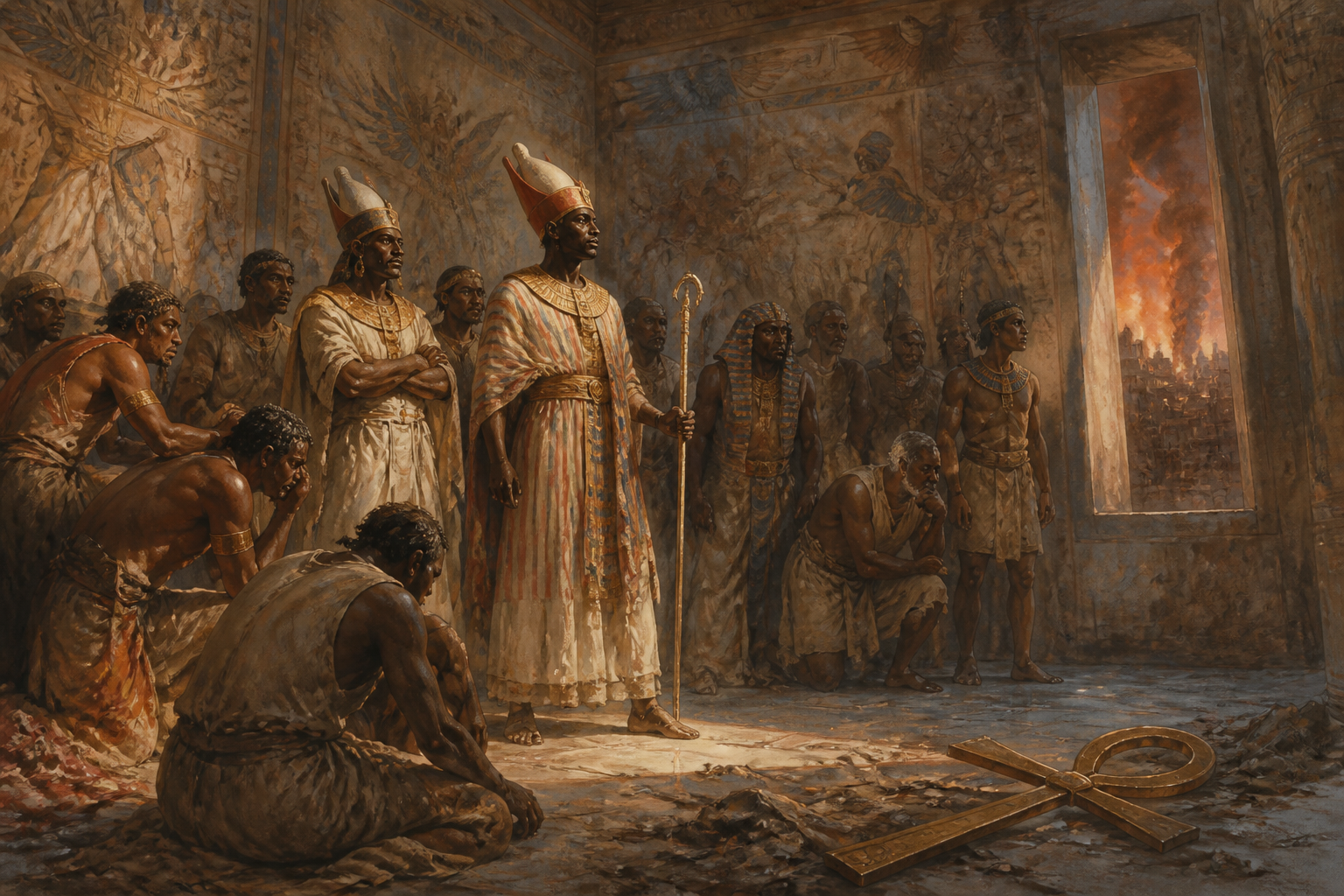
Memphis falls under the weight of Assyrian siege engines and relentless cavalry, a defeat that reverberates through the kingdom like a thunderbolt. In the aftermath, the city's once bustling streets are eerily quiet, marked by the smoldering ruins and the cries of the wounded. Taharqa, retreating to the inner sanctum of the palace, gathers those loyal to him. The room is heavy with the scent of burnt incense, a symbolic gesture to ward off evil spirits. His generals, faces etched with fatigue, report the extent of the loss and the capture of vital strongholds. Despite the desperation, a fire burns in Taharqa’s eyes. He speaks of regrouping in the southern lands, of not surrendering to despair. This page is a poignant look at the resilience of a leader who refuses to succumb, even as the kingdom crumbles around him.
"We have lost a city, but not our spirit," Taharqa insists, his voice defiant, "We shall rise again."
Page 10 — The End of an Era
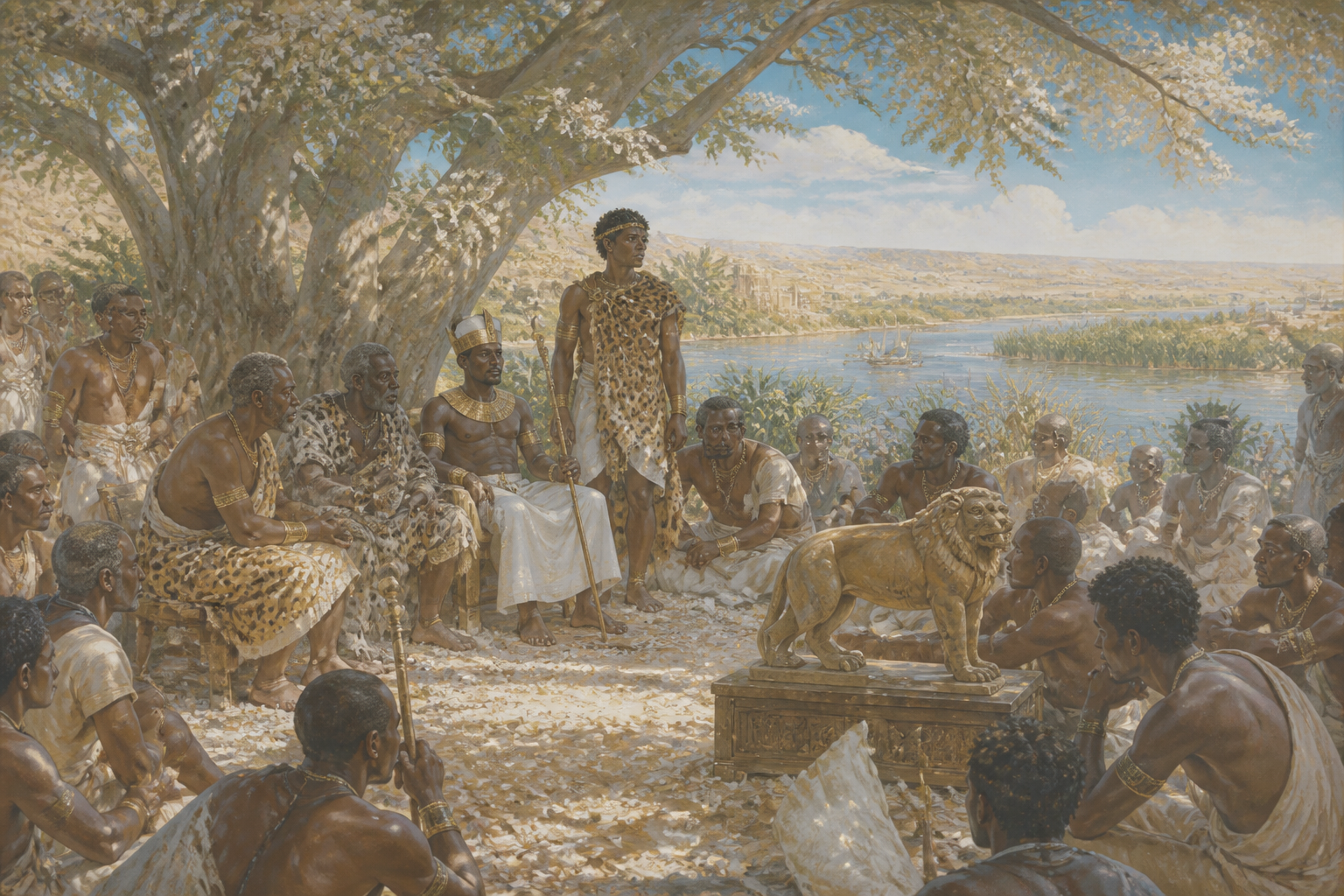
Taharqa retreats to Nubia, where the spirit of the Kushite kingdom still endures. In the serene embrace of his ancestral homeland, he reflects on a reign filled with triumphs and trials. The air here carries the perfume of acacia blossoms and the distant song of the Nile. In a council gathered under the flaming acacia trees, Taharqa speaks to his loyal followers, acknowledging their sacrifices and urging them to hold on to their cultural legacy. Tantamani, loyal to the end, pledges to continue the fight, even as the last vestiges of Kushite rule in Egypt slip away. Taharqa's final days are filled with the peace of the land he holds dear. This page captures the enduring legacy of a reign that, despite its end, set a precedent for future generations of rulers who would learn from his resilience and vision.
"Our kingdom may be lost, but our legacy endures," Taharqa states serenely, looking over the verdant Nile valley.
About this story
- Audience: general readers
Read Wonder Egypt on your phone
Wonder Egypt is available on Android. Get Wonder Egypt on Google Play.