Reading the Rosetta Stone
Reading the Rosetta Stone — an illustrated history story. 10 illustrated pages, free to read on Wonder Egypt.
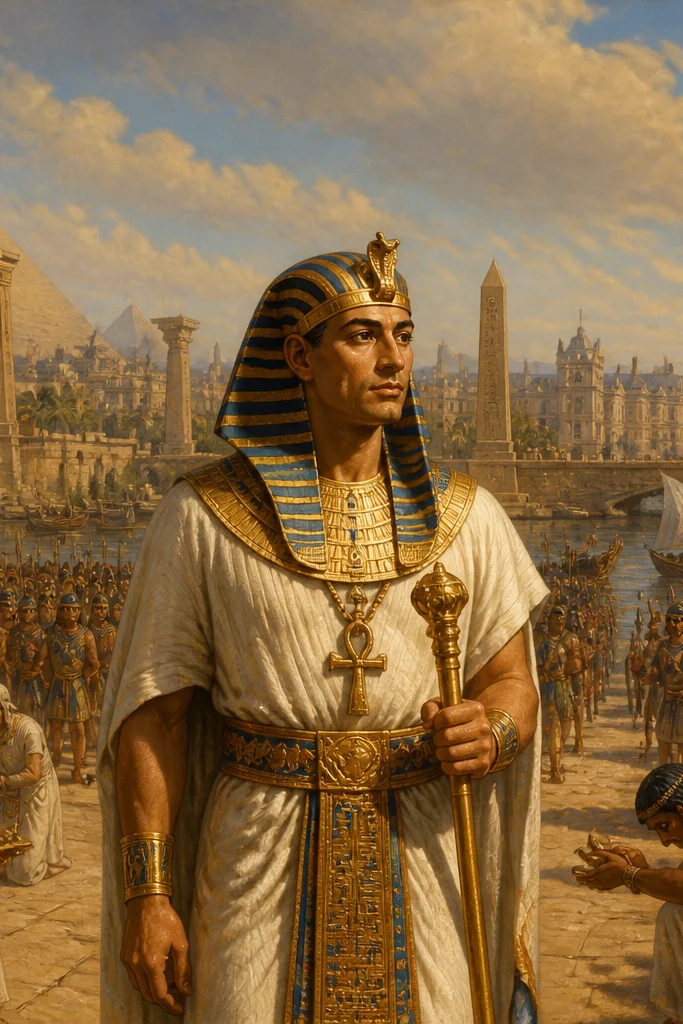
Page 1 — The Unveiling of Rosetta

In the relentless heat of an Egyptian summer in 1799, the ancient earth reluctantly reveals its secrets. A French officer, eyes wide with wonder, observes as the laboring Egyptian workmen expertly dismantle a fort wall near Rosetta. Among the debris, a peculiar stone is uncovered—a slab weathered by time but sacred in the intricacy of its inscriptions. It bears the enigmatic scripts of Greek, Demotic, and Hieroglyphic, a triad of languages that hold the promise of unlocking ancient mysteries. Soldiers and scholars, drawn by the tantalizing whispers of discovery, gather to witness history unfold. The air is thick with dust, anticipation, and the unspoken acknowledgment that this stone is poised to revolutionize Egyptology, igniting a scholarly rivalry that promises to unravel its deepest secrets.
"This could change everything," the French officer murmurs, tracing the carved symbols. "Inform the scholars immediately."
Page 2 — Scholarly Rivalry Begins

The discovery of the Rosetta Stone sends ripples of excitement through the learned circles of Europe. In London, Thomas Young, a polymath of considerable repute, scrutinizes the inscriptions with meticulous care. His discerning eyes navigate the intricate Demotic script as he compares it with the familiar Greek. Meanwhile, across the Channel in Paris, Jean-François Champollion, a fervent and ambitious scholar, delves into the mysteries of the hieroglyphs with unyielding vigor. The race to decipher these ancient texts begins in earnest, fueled by both academic pride and a fervent sense of nationalistic competition. Each scholar is driven by an insatiable curiosity and an intense rivalry, determined to be the first to unlock the language of the pharaohs, long buried beneath the sands of time.
"The key lies in the cartouche," Champollion insists, his voice filled with determination. "Names, not symbols."
Page 3 — The Stone in Transit

The journey of the Rosetta Stone from Egypt to Europe is fraught with political complexities and anticipation. Aboard a British ship, the precious stone is carefully encased, bound for its new home at the British Museum. In the dimly lit hold, the air is heavy with the mingling scents of brine and an unspoken anticipation of the cargo's profound significance. At the bustling docks of London, onlookers gather to witness the stone's arrival, an emblem of both conquest and insatiable curiosity. As it is unloaded, the stone represents the dawning of a new intellectual era, poised to become the centerpiece of an ongoing scholarly battle. Its presence in Europe heralds a transformative moment in the field of Egyptology, a testament to the enduring allure of ancient mysteries.
"Guard it well," orders the ship's captain, his voice firm, "This stone is more valuable than gold to the scholars."
Page 4 — The Hall of Secrets

Within the revered halls of the British Museum, the Rosetta Stone claims its place of prominence, encased in a protective glass display. The gallery is thronged with visitors, a blend of eager scholars and intrigued laypeople, each drawn by the artifact's legendary renown. The room buzzes with hushed whispers and the soft rustle of clothing, as eyes trace the intricately carved inscriptions. Overhead, the glow of chandeliers casts a warm light, illuminating the enigmatic scripts with mesmerizing clarity. This stone, once an ordinary decree repurposed as mere building material, ascends to become the focal point of a cultural renaissance, drawing intellectual minds from across the globe to ponder the ancient secrets it might unveil.
"This stone will open the gates of history," a scholar exclaims to a companion, awed by the stone's presence.
Page 5 — The French Counterattack

In Paris, Champollion's study buzzes with a fervor akin to that of a battlefield, a sanctuary of intellect and ambition. The room is an organized chaos, with wooden shelves towering to the ceiling, crammed with leather-bound volumes and yellowed scrolls. Dust motes dance in the golden shafts of light streaming through large windows, accentuating the seriousness that hangs in the air. Scholars, clad in waistcoats and long flowing dresses, engage in intense discussions, their eyes alight with determination. Each document they handle is a skirmish in a contest of wit against their British counterparts, all driven by Champollion’s singular vision to restore French scholarly prestige.
"We must not be outdone," declares Champollion, his voice carrying resolve. "Let us show them what the sons of France can achieve!"
Page 6 — The Breakthrough Moment

It is 1822, and the air in Champollion's study is thick with the promise of revelation. The moment is pivotal, as he stands, heart pounding, before the cartouche that holds the key to a linguistic enigma. His eyes widen with the realization that these ancient symbols are not mere pictographs but phonetic components of a once-mighty script. He exclaims, shattering the stillness, and the room reverberates with the sound of discovery. Amidst the scattered pages and ink-stained sketches, history unfolds. Outside, the Parisian streets remain blissfully unaware that the echoes of ancient Egypt are being reignited within these four walls.
"I have done it! It spells Ptolemy!" Champollion cries, the realization cascading over him like a revelation.
Page 7 — A Language Reborn

With Champollion's remarkable decipherment, the long-silent language of the pharaohs is revitalized, breathing life into ancient Egypt's stories. Across European academies, scholars dive into this newfound linguistic treasure, eager to unravel the mysteries preserved in stone and papyrus. The lecture halls, where oak benches and gilded railings witness eager minds, vibrate with anticipation. Scrolls are unfurled, notes exchanged, and hieroglyphs, once cryptic, now speak of divine decrees and royal conquests. The Rosetta Stone, now an icon of scholarly triumph, stands as a beacon of human curiosity, a testament to the relentless pursuit of knowledge that bridges past and present.
"We have unlocked the past," a scholar announces to a captivated audience, "The pharaohs speak once more through these symbols."
Page 8 — The Legacy of Discovery

The decipherment of the Rosetta Stone leaves an indelible mark on the world, transforming silent relics into storytellers of ancient Egypt. Museums, once echoing with whispers, now resonate with voices from a bygone era, captivating visitors and scholars alike. In Egypt, under a relentless sun, archaeologists, driven by newfound insights, unearth the remains of a civilization long buried. The atmosphere at dig sites is electric, with the rhythm of chisels on stone and animated discussions among tents and exposed ruins. The Rosetta Stone, enshrined in the British Museum, transcends its physical form, symbolizing an insatiable quest for understanding that links yesterday's whispers to today's discoveries.
"The stone has given us the keys to the kingdom," an archaeologist remarks, surveying a dig site with a sense of awe and anticipation.
Page 9 — A Stone's Journey

Despite its monumental significance, the journey of the Rosetta Stone remains a labyrinth of historical layers and geopolitical intricacies. The stone, central to deciphering ancient Egyptian hieroglyphs, is now at the heart of an intense international debate. In Cairo, the negotiation room buzzes with animated discussions. Diplomats and scholars, dressed in tailored suits and traditional robes, discuss cultural restitution amidst the ambiance of aged wood and leather-bound books. The Egyptian sun, relentless and fierce, streams through large windows, casting elongated shadows that dance across the floor, mirroring the complex dialogue within. Each argument presented considers historical ownership, legal precedents, and cultural identity, making the room a microcosm of global diplomacy grappling with historical justice.
"This stone belongs to Egypt," a diplomat insists, his voice firm with conviction. "It is a part of our soul."
Page 10 — Secrets Beneath the Sands

Though much has been uncovered, Egypt's vast deserts continue to guard countless enigmas beneath their shifting sands. The groundbreaking work of Jean-François Champollion, who deciphered the Rosetta Stone, sparked an era of fervent exploration and discovery. Yet, each unearthed artifact poses new riddles, challenging the perceptions of ancient civilizations. Archaeologists, in their khaki attire and wide-brimmed hats, traverse the expansive desert, attuned to subtle cues from the landscape. The sound of the wind carries with it the resonance of history's mysteries. The Rosetta Stone, though a breakthrough, marks merely the onset of an unending quest. Beneath the sands, the faint echoes of ancient Egypt beckon those bold enough to unravel them.
"The past is never truly gone," muses an archaeologist, gazing across the desert expanse, "It lives below the sands, waiting for us."
About this story
- Audience: general readers
Read Wonder Egypt on your phone
Wonder Egypt is available on Android. Get Wonder Egypt on Google Play.