The Mask of Tutankhamun
The Mask of Tutankhamun — an illustrated history story. 10 illustrated pages, free to read on Wonder Egypt.
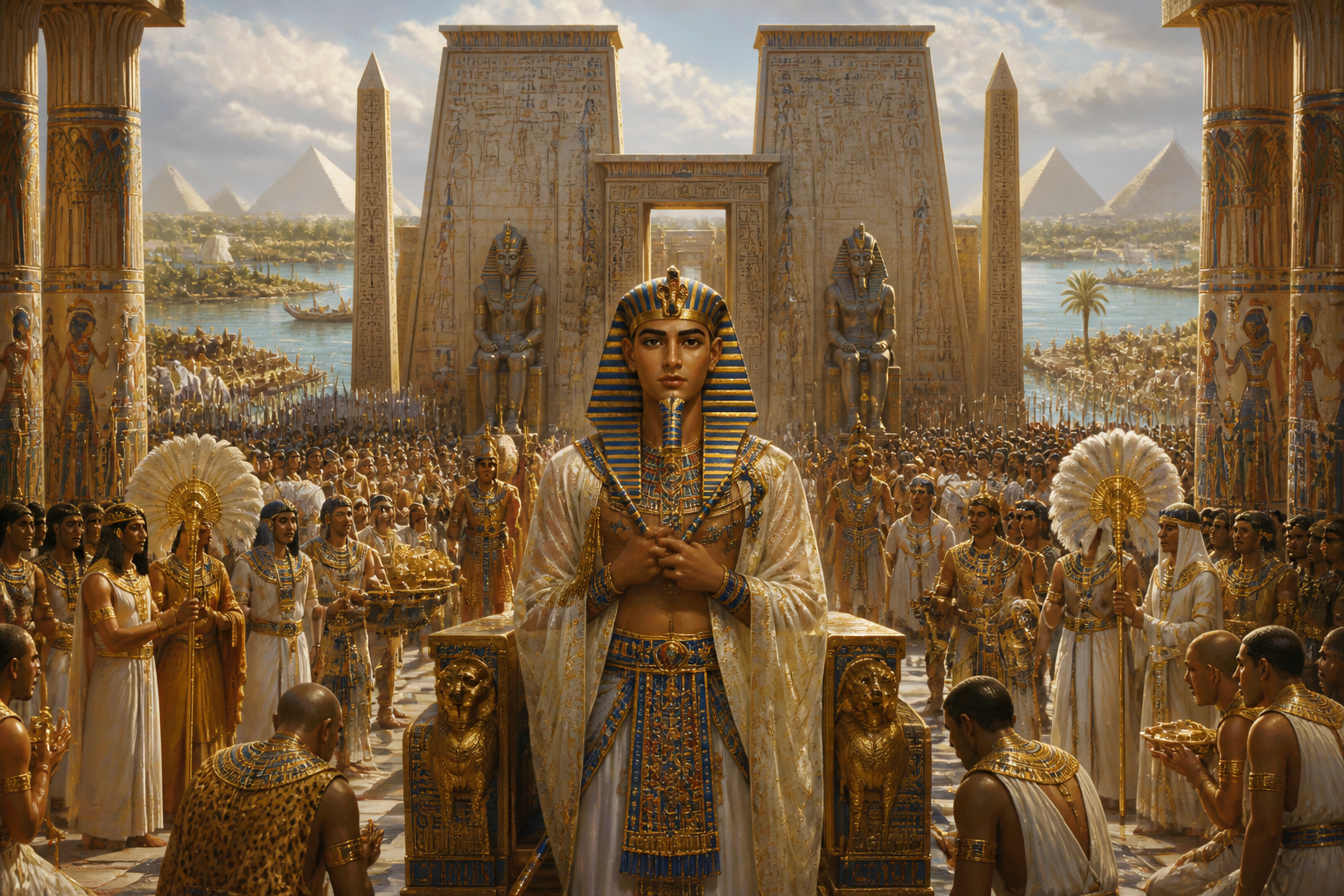
Page 1 — Face of Eternity

The gold mask of Tutankhamun, a marvel of ancient craftsmanship, sits within the glass confines of the Grand Egyptian Museum in Giza, bathed in a soft luminescent glow. At once magnificent and solemn, this iconic visage, molded from eleven kilograms of weighty gold, is designed to convey an everlasting serenity. The intricate inlays of lapis lazuli, carnelian, and obsidian form the regal countenance of a once youthful king, intended to guide him in the afterlife. Its size, slightly larger than life, would sit directly upon the wrapped head of the pharaoh, hidden within layers of the sarcophagi, never meant for mortal eyes to see again. It is a potent symbol, not of royalty, but rather of the eternal journey beyond death.
"Let his face shine through eternity, untouched by time." - The goldsmiths of the royal workshop
Page 2 — Layers of Gold

Within the hallowed halls of the Grand Egyptian Museum, the innermost coffin of Tutankhamun stands as a testament to the opulence and artistry of the New Kingdom. Crafted from over 110 kilograms of solid gold, this final cocoon encased the young king, safeguarding his journey through the afterlife. The outer surface glimmers under museum lights, its meticulous engravings hinting at sacred texts and protective spells meant to guide him in the hereafter. Each line, each curve, speaks to the skill and dedication of the artisans who poured their devotion into its creation, laboring to ensure that the pharaoh's passage to eternity was secure. Encapsulated within two other coffins, it is a fortress of wealth, yet one meant to be hidden forever in the silence of the earth, never to be glimpsed by living eyes until its discovery millennia later. The presence of this coffin not only reflects ancient Egyptian craftsmanship but also their deeply held beliefs in immortality and divine protection for their rulers.
"May the gold shield his spirit and lead him safely." - The master of the royal workshop
Page 3 — The Golden Throne

In the golden glow of the museum's gallery, the throne of Tutankhamun sits resplendent, a masterpiece of divine kingship. It is more than a seat; it is a symbol of power, devotion, and the intimate bond between the young pharaoh and his queen, Ankhesenamun. The throne, constructed of wood but sheathed in glistening gold and silver, depicts a tender scene: the queen anointing her husband, a gesture both intimate and political, encapsulating their partnership in both personal and state affairs. Radiant imagery of gods graces its sides, their divine forms interwoven with the mortal, while the delicate chasing and inlays of colored glass and semi-precious stones complete the spectacle, each element painstakingly selected to enhance the throne's sanctity. This was not merely a display of wealth but a declaration of divine favor and eternal reign, designed to proclaim the young king's celestial endorsement to all who would behold it, both in life and throughout eternity.
"With this throne, we affirm his place among the gods." - Ankhesenamun to the artisans
Page 4 — A Pharaoh's Health

Within the bustling quarters of the Theban palace, the young pharaoh Tutankhamun navigates his regal duties with an air of inherited dignity. His slight frame is adorned in traditional pleated linen, a golden wesekh collar encircling his neck, a visible sign of his regal status. Despite his noble attire, the pharaoh's clubfoot requires the aid of a walking stick, a constant reminder of his frail health and the physical burdens he carries. This stick, always within reach, bears both practical and symbolic value, grounding him in the reality of his reign amidst divine expectations and the grand vision others hold for him. Surrounded by seasoned advisors like Ay and Horemheb, whose guidance he often seeks, and always under the watchful eye of his wife Ankhesenamun, Tutankhamun bears his responsibilities with a quiet dignity, his youth and ailments juxtaposed against the immense weight of his crown and the expectations of an ancient civilization that sees him as a living god.
"Even the most divine needs a steady hand." - Ay to Tutankhamun
Page 5 — Restoring the Faith

Amidst the commanding stone structures of the Karnak Temple, Tutankhamun stands, overseeing the restoration of these sacred sites with a sense of duty that belies his years. The air is thick with anticipation and the sounds of labor as builders and priests alike toil with renewed purpose to reinstate the old gods, their efforts a response to the spiritual upheaval caused by Akhenaten's Aten experiment. The tumult of this religious revolution still echoes through the kingdom, but with his advisors Ay and Horemheb by his side, the young king seeks to mend the social and spiritual fabric of Egypt, stepping back towards the traditions that had long sustained the land. His presence, albeit frail, is a beacon of hope for his people, promising a return to the familiar worship of deities such as Amun, Osiris, and Ra. The priests intone ancient prayers, their voices rising in harmony with chisels striking stone, creating a symphony of renewal that reverberates through the great stone edifices, a testament to the resilience and continuity of Egyptian culture and faith.
"We rebuild not just temples, but the hearts of our people." - Horemheb to Tutankhamun
Page 6 — Whispers of Diplomacy

Within the opulent chambers of the Theban palace, diplomatic envoys from distant lands gather, their presence a testament to Egypt's renewed influence under the young pharaoh Tutankhamun. Seated on a ceremonial dais, the pharaoh listens intently to the gifts and greetings brought by foreign dignitaries, their silken garments shimmering under the ambient light that spills from high windows. The room is alive with the sounds of translators articulating the nuances of foreign languages, their voices a harmonious flow blending with the rustle of papyrus as scribes take careful note of these interactions. Tutankhamun, though young and frail, exudes a calm authority, his composed demeanor a symbol of stability in a previously fractured land. His advisors, especially the politically astute Horemheb, stand nearby, ready to guide the proceedings with a keen awareness of diplomatic subtleties. This resurgence of diplomatic relations marks a crucial step in re-establishing Egypt's prominence, as foreign nations seek alliances with a civilization that remains a symbol of cultural and political power in the ancient world.
"The world watches the Nile, and it watches you." - Foreign envoy to Tutankhamun
Page 7 — The Final Days

In the quiet solitude of his chamber, Tutankhamun faces the twilight of his reign with introspection, a pharaoh yet a young man burdened by his looming mortality. His health, always a shadow cast over his days, now dominates them, the pharaoh relying heavily on his cane as his physical strength wanes. Beside him, ever devoted, Ankhesenamun remains a steadfast presence, offering her support through quiet companionship and unspoken understanding. The room is filled with the scent of incense, a comfort and a reminder of the sacred, and the soft murmur of whispered prayers that float like an auditory balm. Advisors like Ay and Horemheb maintain a respectful distance, aware of the fragility of both king and kingdom, their devotion ever unwavering even in the face of the inevitable. The weight of unfinished reforms and the hope of a strengthened Egypt weigh heavily on his mind, the knowledge that his reign will soon conclude as irreversible as the march of time. In these last moments, the young king reflects upon the legacy he’ll leave behind, aware that the sands of time are slipping swiftly away, carrying with them the dreams of a brighter future for his people and the land he loves.
"My love, even the end is a beginning." - Ankhesenamun to Tutankhamun
Page 8 — Discovery of the Tomb

In the blistering heat of the Valley of the Kings, November 1922, the British archaeologist Howard Carter stands at the threshold of an unprecedented find, a moment that will forever alter the course of Egyptology. Dust clings to his clothes as he intently peers into the dim corridor leading to Tutankhamun's resting place, the air thick with anticipation and the weight of history. Behind him, Lord Carnarvon, filled with eager anticipation and the thrill of discovery, waits for the signal to enter, his presence a testament to the support that has made this moment possible. After years of meticulous excavation, Carter has uncovered the sealed door of an untouched tomb, a discovery that will soon captivate the world by unveiling the mysteries of an ancient era. The silence of centuries is broken as Carter chisels through the barrier with tenuous excitement, and, with trembling hands and bated breath, holds a candle through the small opening to reveal the glint of gold and the promise of history waiting to be rewritten, a sight so magnificent it defies imagination and ignites a passion for exploration that resonates through the ages.
"Yes, wonderful things!" - Howard Carter upon first glimpse of the tomb
Page 9 — A King's Return

Decades have passed since the tomb's discovery, and the treasures of Tutankhamun, including his iconic mask, now reside in the Grand Egyptian Museum. In a ceremony attended by dignitaries and scholars from around the world, these artifacts are returned to their homeland amid celebration and reflection, a testimony to the enduring allure of ancient Egypt and its cultural significance. Each piece, meticulously cataloged and studied, symbolizes not just the wealth of ancient Egypt, but its enduring influence on human history and the collective imagination of people across continents. Tutankhamun's mask, admired by millions, is finally home, its journey from the tomb to museums around the world and back capturing the imagination and respect of generations. As the exhibit opens to the public, the young king's silent, gilded face once again watches over the people of Egypt, a bridge between ancient glory and modern appreciation. Visitors ponder the journey these artifacts have taken, reflecting on the history and the legacy that has been preserved for future generations to marvel at and learn from.
"It is not just a return; it is a restoration of heritage." - An Egyptian official
Page 10 — Legacy in Gold

In the quiet reverence of the museum exhibit, the mask of Tutankhamun stands as the centerpiece, a lasting legacy crafted in gold that draws admiration from all who encounter it. Visitors pause before it, contemplating the life of a king who ruled millennia ago and the artisans whose hands shaped this symbol of eternity, their work transcending time to speak to the values and beliefs of an ancient civilization. This mask, along with the coffin and throne that accompany it, is not just treasure but equipment of the afterlife, reflecting a civilization's profound beliefs about death, rebirth, and the eternal quest for immortality. As the tour concludes, the grandeur of the mask lingers in the minds of all who behold it, its silent testament to the enduring allure of ancient Egypt an invitation to explore further. This journey through time closes, yet the questions and wonder it inspires live on in the minds and hearts of those who seek to unravel the mysteries of the past and uncover the truths that lie beneath the sands of history.
"May his visage remain eternal, a reminder of Egypt's glory." - A modern-day Egyptologist
About this story
- Audience: general readers
Read Wonder Egypt on your phone
Wonder Egypt is available on Android. Get Wonder Egypt on Google Play.