The Narmer Palette
The Narmer Palette — an illustrated history story. 10 illustrated pages, free to read on Wonder Egypt.
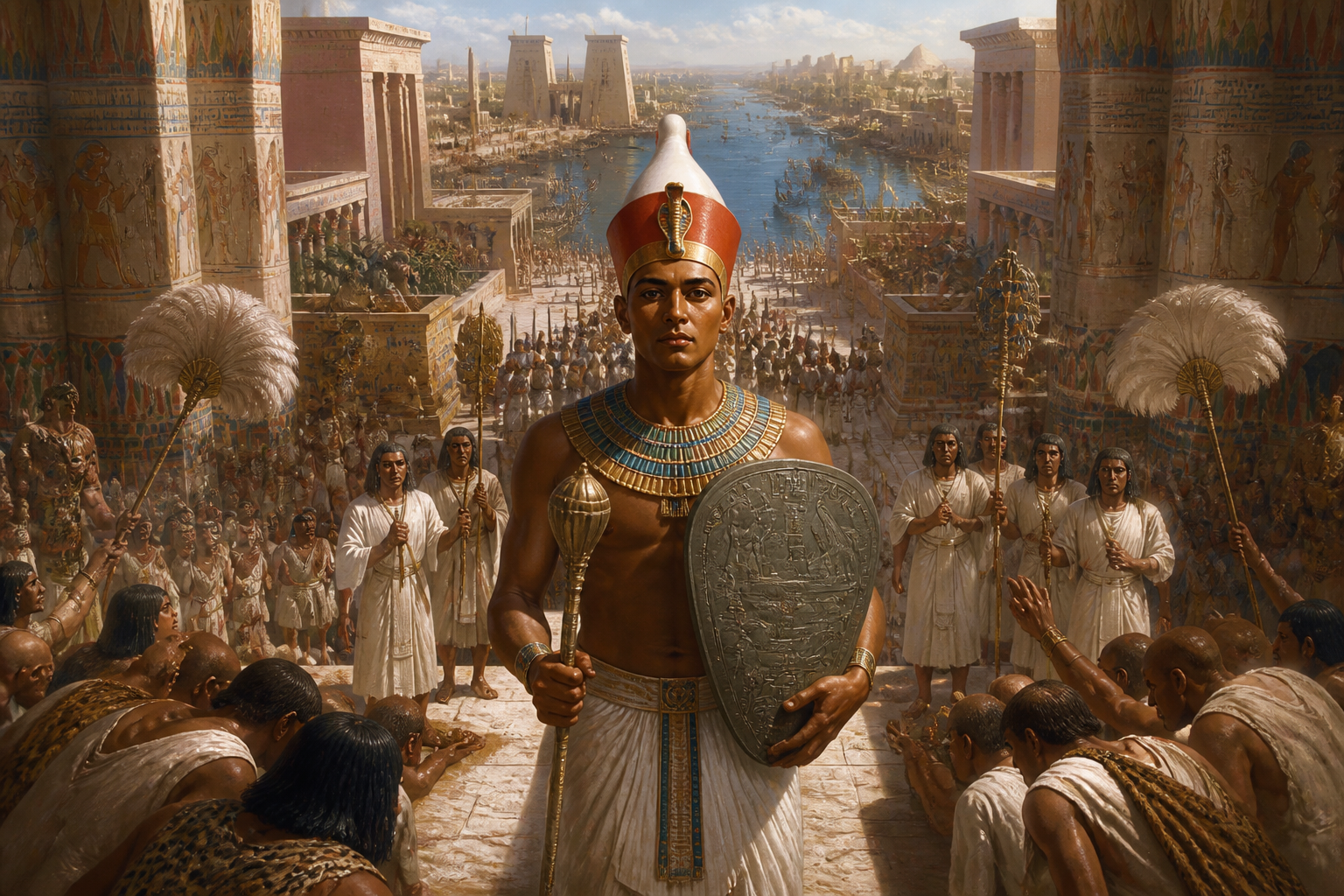
Page 1 — The Narmer Palette: Gateway to History

In the hushed, climate-controlled chamber of the Egyptian Museum in Cairo, the Narmer Palette stands as a sentinel of history, a relic from over five thousand years ago. Crafted from robust siltstone, its 64 cm height looms as a silent testament to the dawn of a civilization. Visitors gaze at its intricately carved surfaces, one side depicting Narmer wearing the white crown of Upper Egypt, the other illustrating the red crown of Lower Egypt. The palette's function as a ceremonial object, too large for practical use, hints at its role in a ritualistic union, uniting two lands under one ruler. Positioned near the palette is a plaque that details its discovery in 1898, captivating the curious with tales of its journey from a temple pit to this esteemed gallery. The ambiance of this sacred space is one of reverence and awe, where the whispers of ancient Egypt seem to linger in the air, reminding all who gaze upon the palette of the momentous unification it symbolizes.
None
Page 2 — King Narmer's Declaration

In the heart of ancient Egypt, c. 3100 BC, the unification of Upper and Lower Egypt was more than a mere act of conquest; it was a declaration captured in stone. Narmer, a figure shrouded in the mists of pre-dynastic history, emerges as a resolute ruler striving to forge a singular nation. On the banks of the Nile, the art of his kingdom burgeoned, mirroring the monumental political shift. His artisans carved a triumph on the Narmer Palette, one side portraying him as a warrior king, the other as a unifier in a ceremonial procession. In this land of shifting sands, the palette stands as a commemoration of a legacy wrought from the course of the Nile. The sounds of the river, the calls of waterfowl, and the voices of artisans create a vibrant backdrop to this formative moment in history.
"Let the lands bear witness to our unity," Narmer is heard to proclaim, his voice echoing through the ages.
Page 3 — The Temple Cache

Decades and centuries passed, yet the Narmer Palette endured, its ceremonial role evolving within temple confines. Through offerings and rituals, the people invoked the power and unity symbolized by Narmer's visage. Buried within a temple pit, it lay forgotten among other sacred artifacts. Time's relentless march saw the temple fall into disuse, its grandeur swallowed by the sands. Yet, the palette, alongside the Narmer mace-head, remained cocooned in history's embrace. Their discovery by James Quibell and Frederick Green in 1898 marked the end of one journey and the beginning of another, as these artifacts would soon travel to the eyes of the modern world, offering glimpses into the ancient past. The temple site, with its broken columns and scattered relics, whispered secrets of an age where gods and kings ruled in unison.
"We have uncovered something extraordinary," whispers Green, dusting the precious find.
Page 4 — The Mace-Head and the War Room

In the hallowed corridors of power, the Narmer mace-head tells another tale. Crafted from limestone, its spherical form captures scenes of royal ceremonies and a tally of captives, an emblem of dominion. Inside a grand stone chamber, advisors gather around Narmer. The air is tense with the weight of decisions, as the fate of realms hinges on whispered counsel. The king's sandal-bearer, a figure immortalized on the palette, stands ready to serve. Narmer's gaze is like iron, weighing the counsel of his advisers, his resolve as enduring as the stone that bears his image. Here, strategies are etched in the sands of time, and the mace-head becomes a piece of the narrative that chronicles the early state's power. The chamber's air is thick with incense, a symbol of divine favor.
"This symbol shall extend our reach," Narmer declares, his fingers brushing the mace-head.
Page 5 — The Scorpion King's Legacy

Before Narmer, another figure known only as the Scorpion King wielded power in early Egypt. His limestone mace-head, found alongside Narmer's, reveals scenes of irrigation and conquest, underscoring the essential bond between water and power. On sun-scorched fields, workers toil under a relentless sun, guided by the Scorpion King. His mace-head captures the nascent kingdom's reliance on the Nile's lifeblood. The image of the Scorpion King cutting an irrigation ditch speaks of the enduring struggle to harness nature, a struggle echoed in the agricultural heart of Egypt. These artifacts, preserved together, illuminate the ties between successive rulers and the land they commanded. The landscape of cultivated fields and flowing water defines the nation's heart.
None
Page 6 — Unearthing a Legend

Inside the Egyptian Exploration Society's tent near Hierakonpolis, the year is 1898. James Quibell and Frederick Green meticulously catalog their finds, each artifact a piece of a grand narrative. Amidst the dust and relics, the Narmer Palette and mace-heads stand out, their carvings whispering secrets of antiquity. The pair, well-versed in ancient symbology, recognize the magnitude of their discovery, their expressions a blend of scholarly excitement and reverent awe. The artifacts, long submerged in time's sands, now poised to reshape narratives of early Egyptian kingship. Their journey from earth to museum glass marks a pivotal moment in understanding dynastic Egypt's nascent steps. As these fragments of history see daylight, they offer tangible links to a civilization's dawn, a testament to the enduring allure of discovery.
"We have found the dawn of Egyptian history," Quibell notes, his voice a mix of awe and excitement.
Page 7 — The Scholars' Debate

In the sunlit halls of Oxford's Ashmolean Museum, scholars gather to discuss these remarkable artifacts. The Narmer and Scorpion mace-heads, now housed here, incite debate over their rich symbolism and historical significance. Were they mere ceremonial objects, or did they convey a unification far more symbolic than actual? This academic discourse, filled with animated gestures and earnest exchanges, honors the enduring mystery of these relics. Questions persist: Did Narmer truly conquer and unify by force, or does the palette illustrate a more allegorical triumph? The truth remains elusive, alive in the scholarly air, echoing through these dignified halls, where each theory is another thread in the tapestry of history.
"These pieces hold more than stone and art; they hold meaning," insists one scholar.
Page 8 — The Palette's Journey Continues

Transported from the Ashmolean to the Egyptian Museum, the Narmer Palette reclaims its place in the heart of Egypt. Its journey reflects a broader story of cultural heritage and repatriation. As the palette arrives in Cairo, the streets are abuzz with talk of this ancient treasure returning to its homeland, a story that resonates deeply with the Egyptian people. Within the museum's grand entryway, staff carefully position the artifact, ensuring its legacy endures. Under the watchful eyes of curators, the palette is secured in its glass case, amidst whispers of the past. It stands as a bridge between the ancients and the modern era, a keystone of Egyptian identity, reminding all of the nation's illustrious history and its enduring cultural heritage.
"A piece of Egypt has come home," a curator remarks, her voice filled with pride.
Page 9 — The Palette and the People

In the bustling heart of Cairo, the Narmer Palette has become more than an artifact; it is a symbol of national pride. School groups, tourists, and scholars alike gather around its case. The conversations it inspires are as varied as its audience, from the awe of schoolchildren to the deep, reflective musings of historians. In the museum's atrium, the air is alive with echoes of the past and hopes for the future. As visitors leave with a deeper understanding, the palette connects them to the ancient narrative of unity and power, a story as enduring as the siltstone itself. The palette's presence is a constant reminder of the nation's rich history and its ongoing story of identity and resilience.
"It tells us where we come from," a teacher explains, holding a group of students' attention.
Page 10 — The Narmer Palette: A Legacy Preserved

Returning before the Narmer Palette, its presence is more profound after exploring its journey and significance. In this serene corner of the Egyptian Museum, its carvings reverberate with the echoes of kings and scholars alike. The palette's ancient stone has weathered time yet remains integral to the narrative of identity. The curator's final nod acknowledges the continuity it represents. As visitors stand before it, the weight of history is felt, an invitation to ponder the legacy of a nation forged in the sands of time. This piece of history endures, a testament to unity, resilience, and the enduring power of story, inviting reflection on what has been and what is still to come.
None
About this story
- Audience: general readers
Read Wonder Egypt on your phone
Wonder Egypt is available on Android. Get Wonder Egypt on Google Play.