Alphabet
Alphabet — an illustrated inventions story, set in Global. 10 illustrated pages, free to read on Wonder Inventions.
Page 1
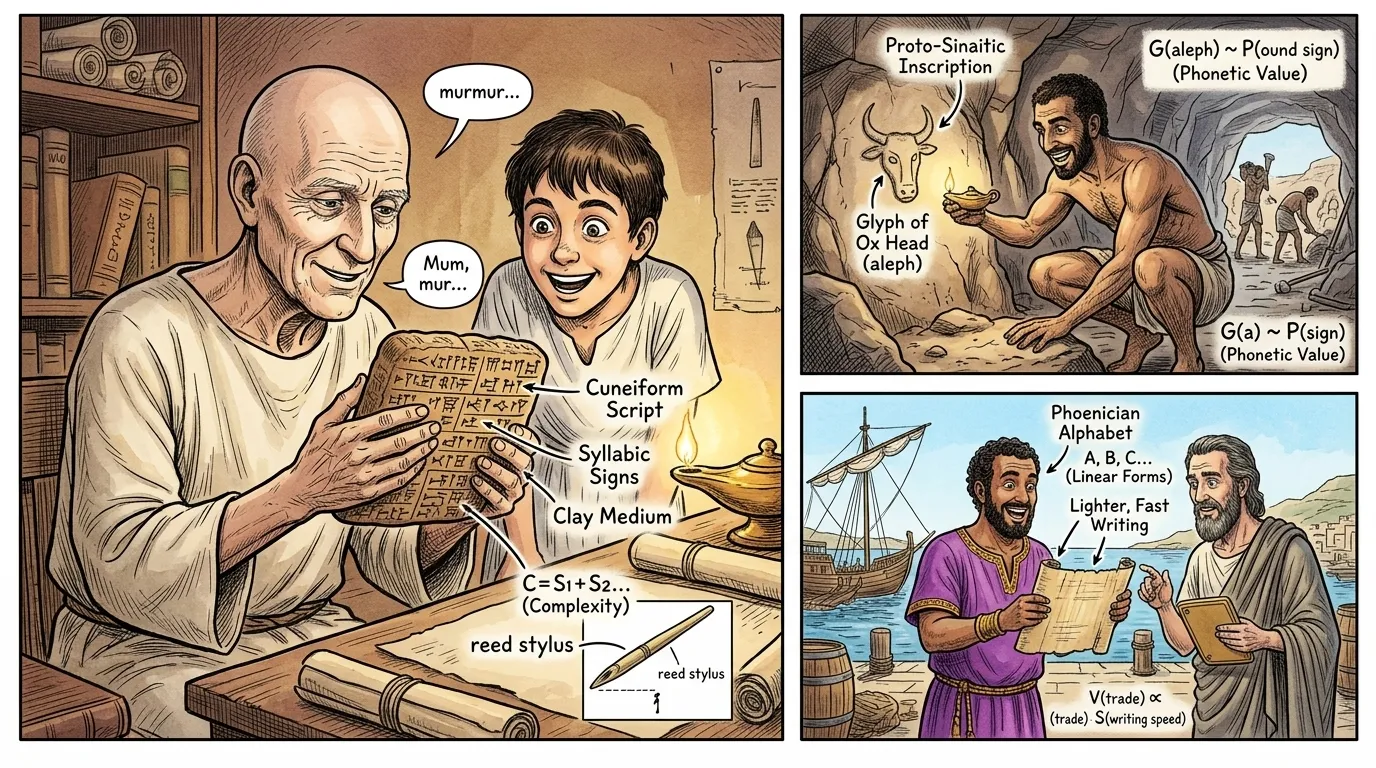
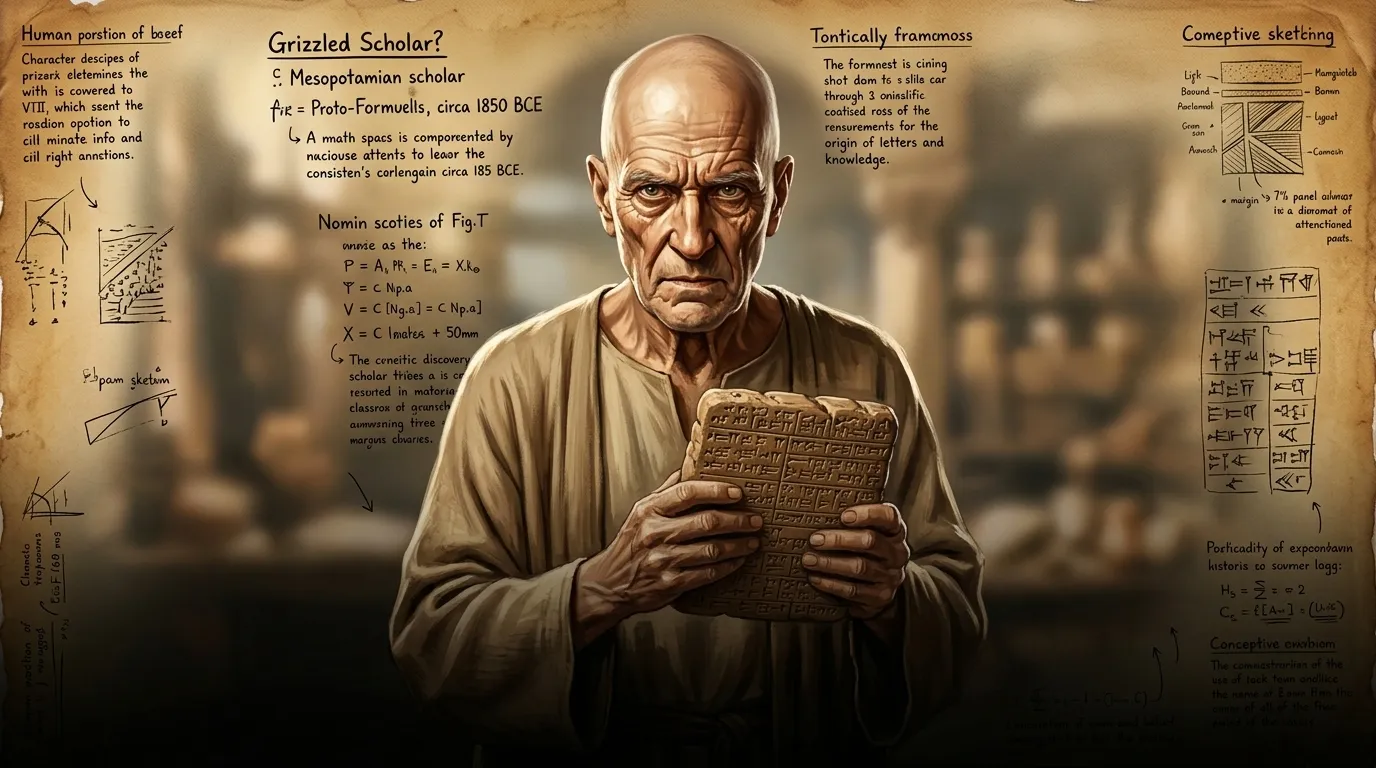
For millennia, human civilization grappled with the immense challenge of recording and transmitting complex thought. Before the advent of the alphabet, elaborate writing systems like hieroglyphs and cuneiform demanded years of dedicated study, effectively locking literacy within a privileged class of scribes and priests.
"A grizzled scholar, his face etched with the wisdom of years, carefully examined a clay tablet. 'Each symbol, a word, a concept,' he murmured to a younger apprentice. 'Thousands to master, a lifetime to perfect. How can knowledge truly spread when its very vessel is a labyrinth?'"
Page 2
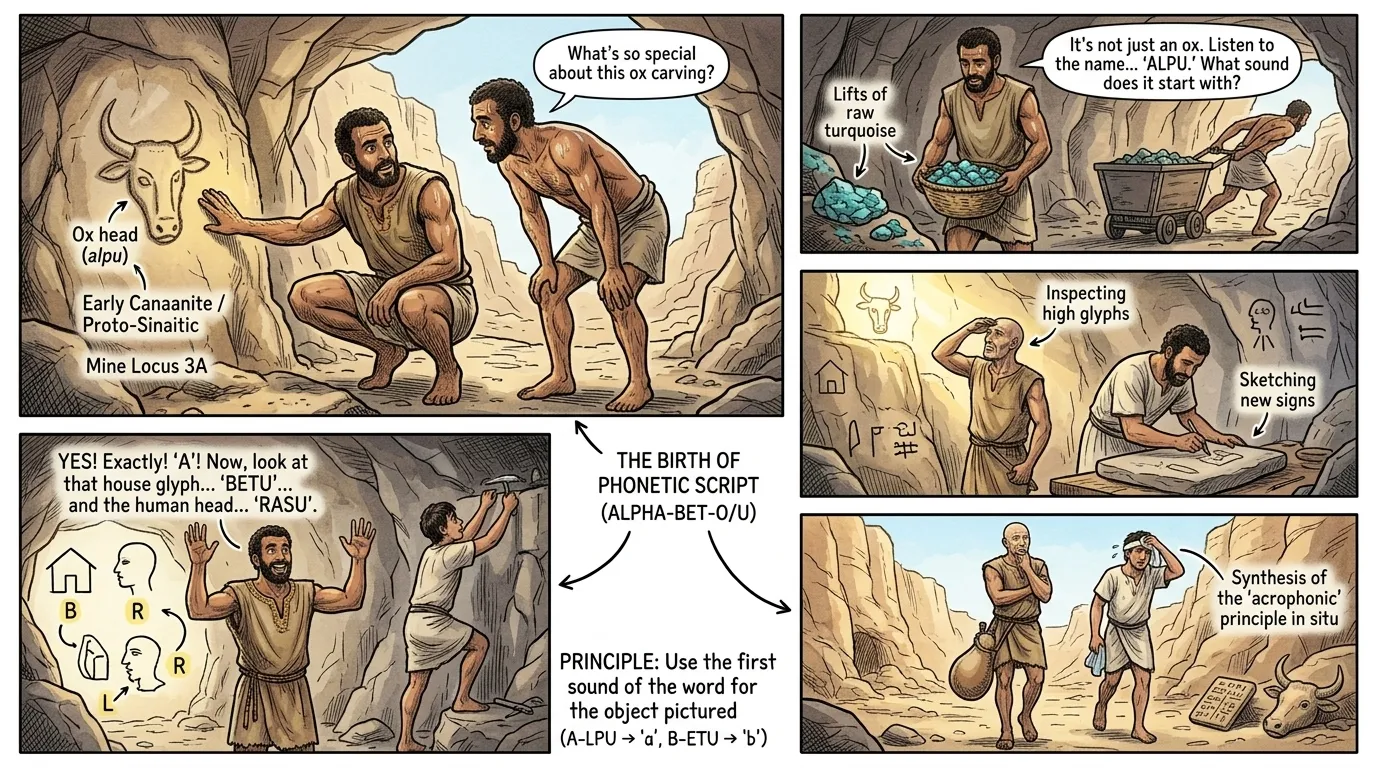
Around 1850 BCE, a transformative idea began to emerge among Semitic-speaking miners in the turquoise mines of Serabit el-Khadim in the Sinai Peninsula. Faced with the cumbersome Egyptian hieroglyphic system, these workers needed a simpler way to record their activities and names.
"One miner, wiping sweat from his brow, pointed at a carved symbol on the rock face. 'This is 'alpu, our ox, but it sounds like 'A' for us,' he explained to a fellow worker. 'Why draw the whole ox when we only need the sound? This acrophonic principle could change everything.'"
Page 3
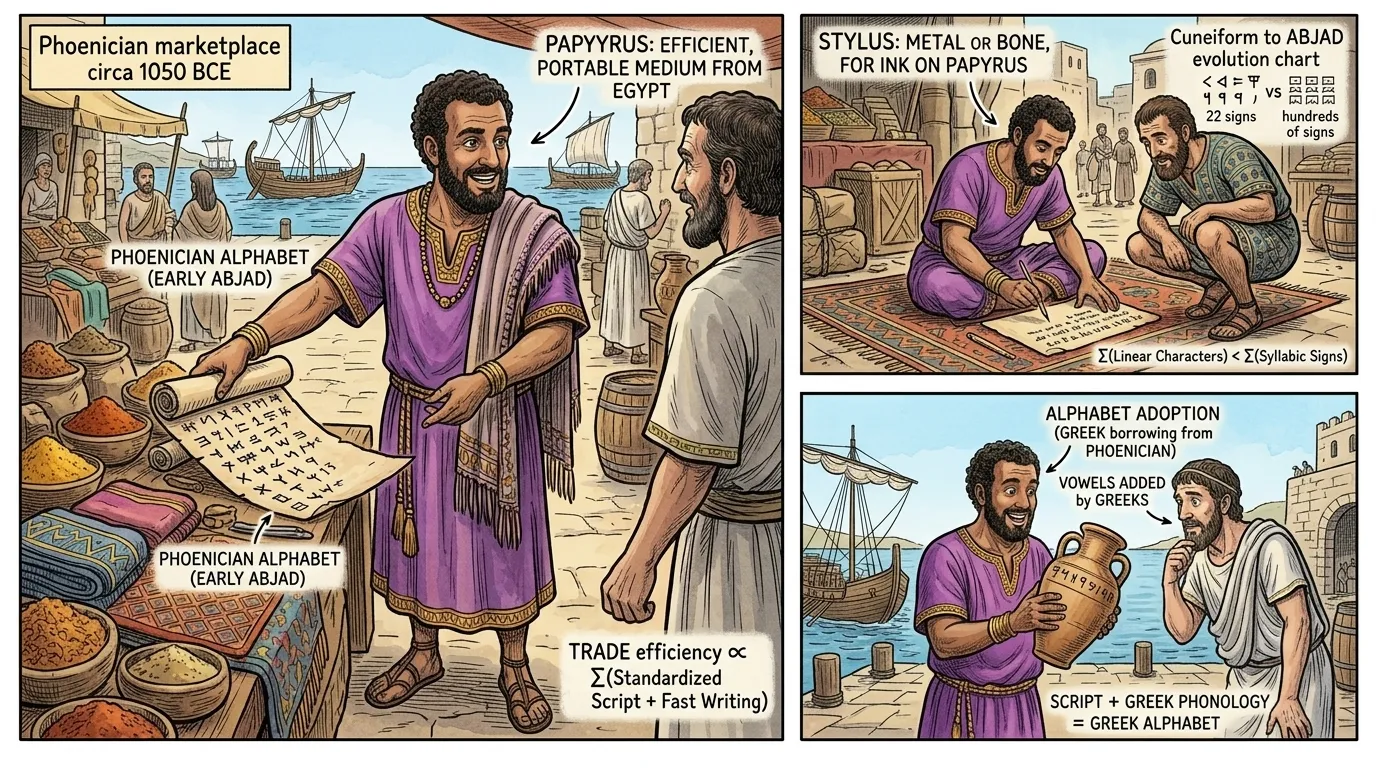
Building upon the Proto-Sinaitic concepts, the seafaring Phoenicians, renowned traders of the ancient world, recognized the immense commercial potential of a simplified writing system. By stripping away all but the essential consonantal sounds, they created a highly efficient script around 1050 BCE, perfect for swift record-keeping and cross-cultural communication.
"A Phoenician merchant, his hand sweeping over a roll of papyrus, declared to a trade partner, 'No longer bound by countless symbols! This new script, my friend, represents only sounds. We can now document every trade, every journey, with speed and clarity, reaching any port, any market.'"
Page 4
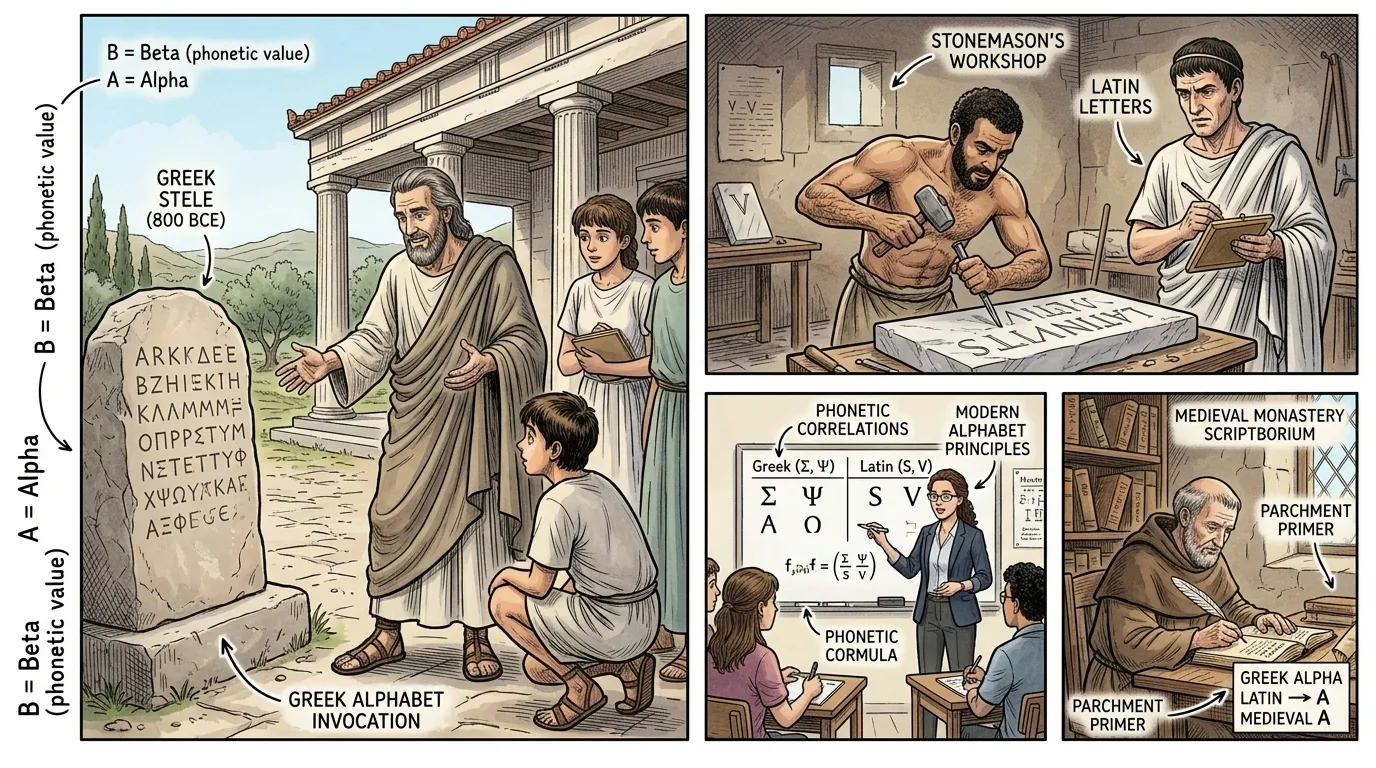
While remarkably efficient for Semitic languages, the Phoenician consonantal alphabet posed a challenge for Indo-European languages like Greek, which rely heavily on vowels for meaning. Greek scholars, encountering this system around 800 BCE, ingeniously adapted several Phoenician consonant symbols representing sounds not present in Greek to represent vowel sounds instead.
"A thoughtful Greek philosopher, gesturing towards an inscription, explained to his students, 'The Phoenicians gave us the bones, but we have given them breath. By assigning sounds like 'alpha' and 'epsilon' to what were once only consonants, we unlock the full expressive power of our language, making speech visible.'"
Page 5
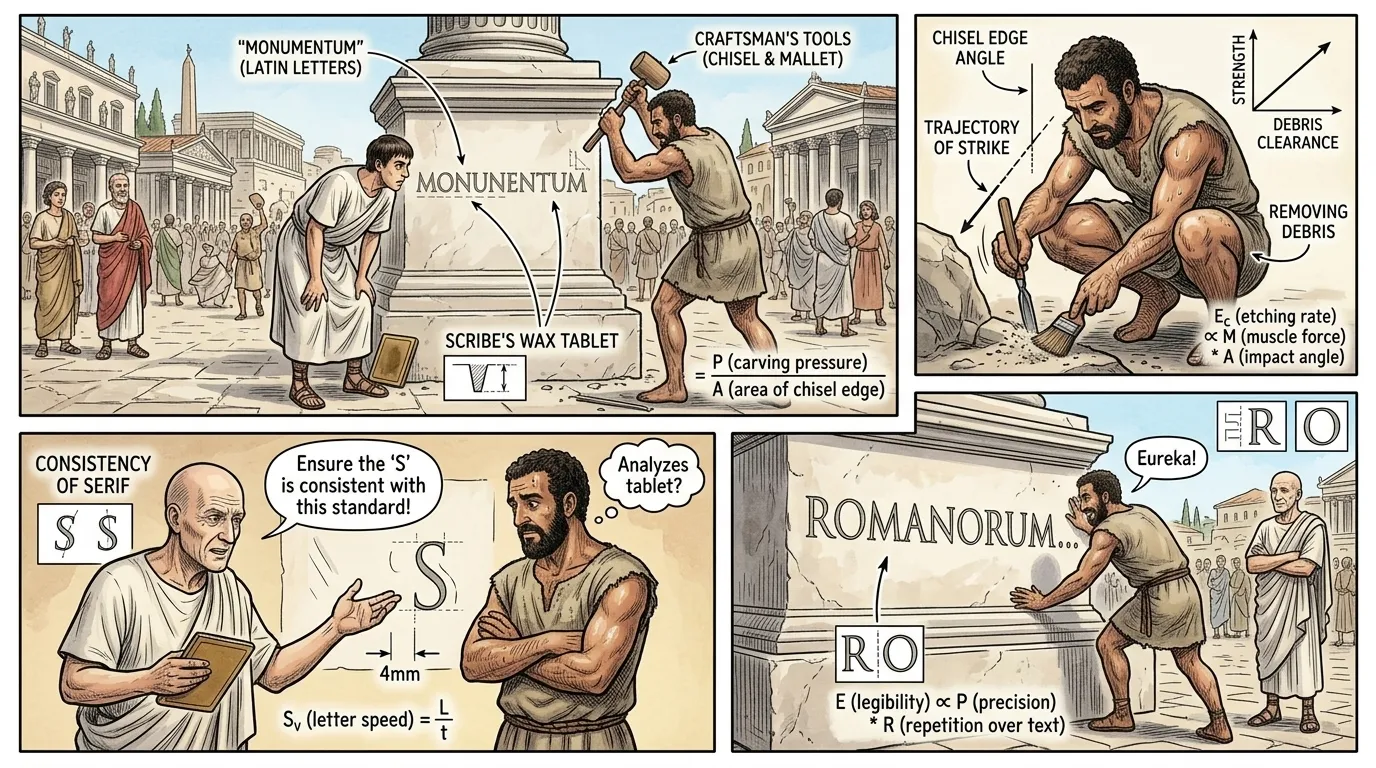
The Greek alphabet found its way to the Italian peninsula, first adopted by the Etruscans, who modified it to suit their own language. Subsequently, the nascent Roman civilization inherited and further refined this Etruscan script, establishing the foundational Latin alphabet around 700 BCE, which would eventually dominate much of the Western world.
"A stern Roman scribe, overseeing an inscription on a stone monument, instructed a stonemason, 'Each letter must be precise, symmetrical. The Etruscans showed us the path, but our 'A', 'B', 'C' will be the enduring symbols of our empire, carving our laws and history into stone for eternity.'"
Page 6

The genius of the alphabet lies in its remarkable efficiency: representing the discrete sounds of spoken language, or phonemes, with individual symbols. This 'one symbol, one sound' principle (or close approximation) drastically reduces the number of characters required to express any word, making literacy attainable for far more people.
"A modern linguist, tracing lines on a whiteboard, explained to her class, 'Consider the efficiency. Instead of thousands of complex ideograms, we distill speech into a manageable set of phonetic building blocks. This radical simplification is the engine of its power.'"
Page 7
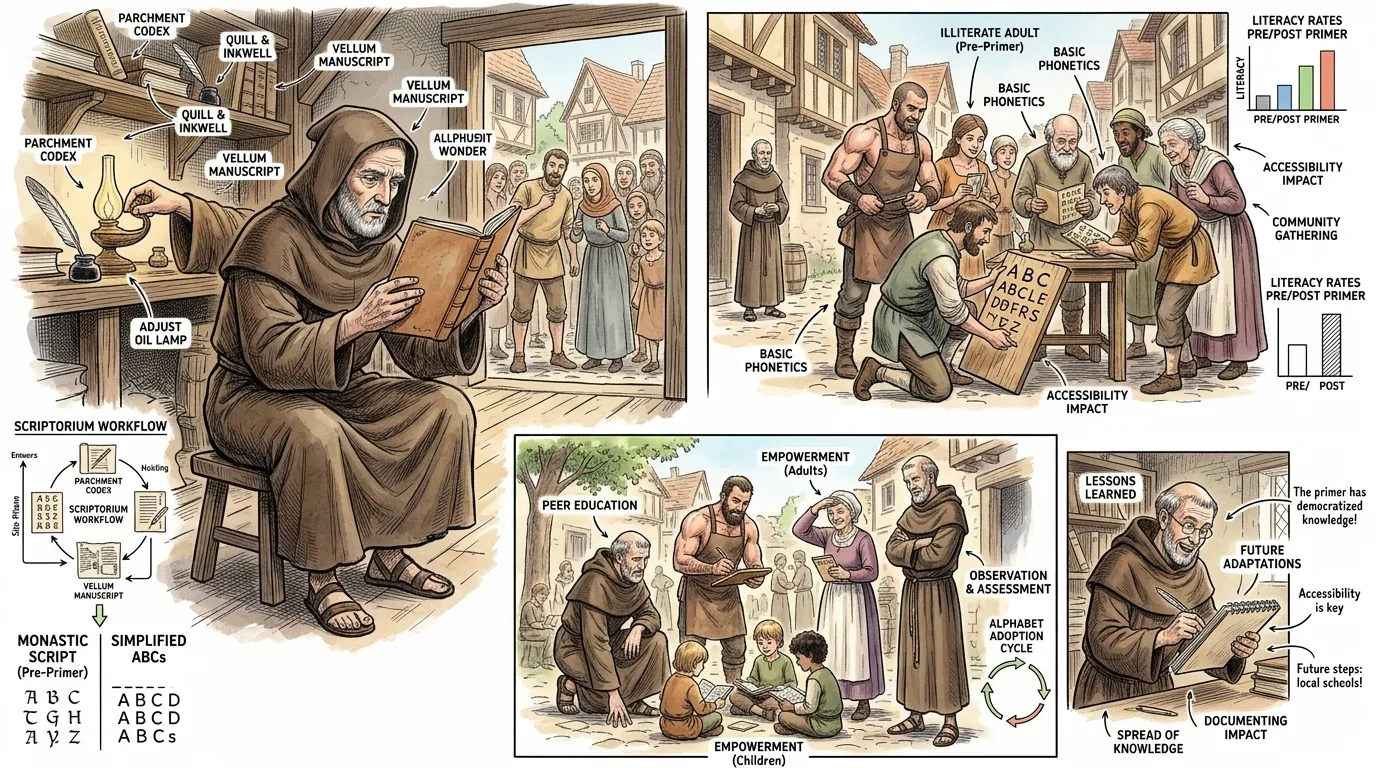
Unlike earlier writing systems that required mastery of thousands of characters, the typical alphabet, with its mere 20-40 symbols, opened a gateway to widespread literacy. This drastically reduced learning curve meant that ordinary citizens, not just a specialized elite, could learn to read and write, fundamentally democratizing access to information and knowledge.
"A historian, holding up a simplified primer from the medieval period, observed, 'The alphabet wasn't just a writing system; it was a social revolution. Before, books were for temples; now, with this accessible tool, the common person could engage with ideas, laws, and stories directly.'"
Page 8
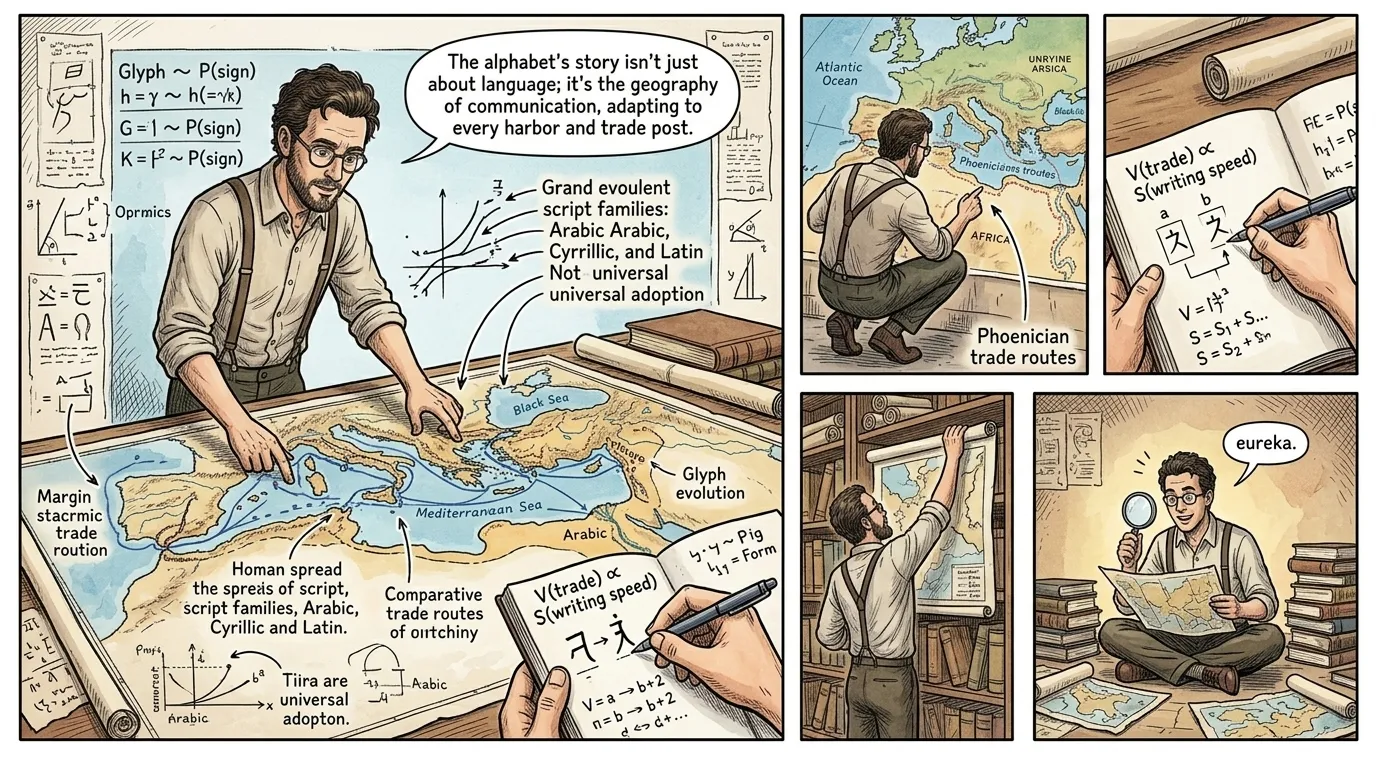
From its Phoenician and Greek roots, the alphabetic principle journeyed across continents, adapting to countless languages and cultures. Through trade, conquest, and religious missions, the concept of phonetic writing, born in the ancient Near East, sprouted into a vast family of scripts, including Arabic, Cyrillic, and Latin, fundamentally shaping global communication.
"A cartographer, tracing ancient trade routes on a large map, remarked, 'Just as Aristotle once said, 'The roots of education are bitter, but the fruit is sweet,' and the alphabet, initially a challenging innovation, certainly bore sweet fruit. Its simplicity allowed it to be adopted and transformed by diverse cultures, from Semitic traders to Slavic monks, proving its universal appeal.'"
Page 9

The alphabet's revolutionary efficiency laid the groundwork for an explosion of recorded knowledge. It became the indispensable tool for codifying laws, preserving philosophical treatises, documenting scientific discoveries, and creating vast literary traditions, enabling complex thought to be organized, disseminated, and built upon across generations.
"An elder historian, amidst towering bookshelves, declared to a group of young scholars, 'Think of what this simple innovation allowed: the comprehensive legal codes, the deep philosophical inquiries, the intricate scientific observations. Without the alphabet, our accumulated wisdom would be scattered whispers, not enduring testaments.'"
Page 10
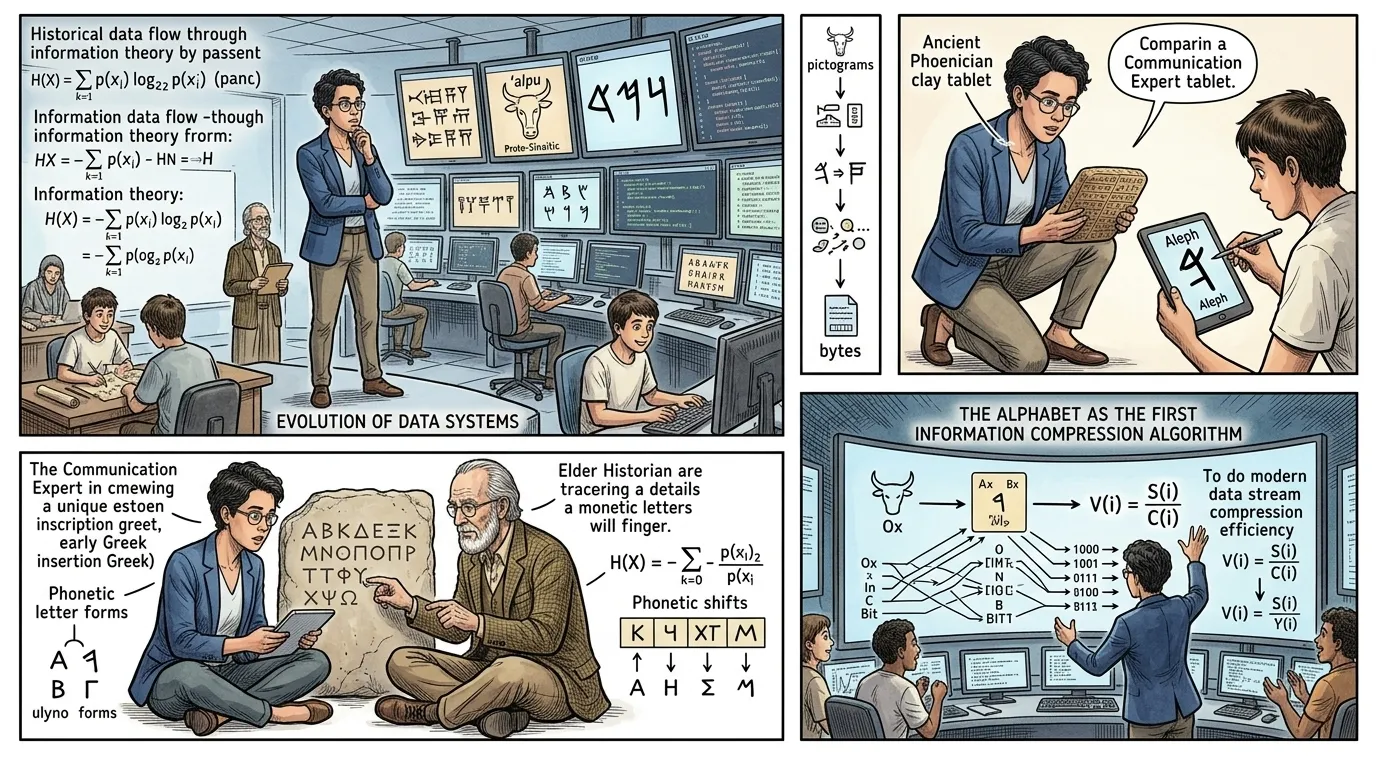
From its humble beginnings on ancient rock faces, the alphabet has remained the cornerstone of human communication, enduring and evolving through millennia. It continues to underpin nearly every form of written expression, from printed books and newspapers to the complex digital interfaces that define our modern world, a testament to its unparalleled ingenuity.
"A contemporary communication expert, sitting amidst screens, reflected, 'Though the mediums change drastically – from clay to code – the fundamental principle remains. The alphabet, a timeless invention, continues to empower us, linking ancient scribes to modern programmers, ensuring the continuous flow of information across all civilizations.'"
About this story
- Location: Global
- Audience: general readers
Read Wonder Inventions on your phone
Wonder Inventions is available on Android. Get Wonder Inventions on Google Play.