Analytical Engine
Analytical Engine — an illustrated inventions story, set in Global. 10 illustrated pages, free to read on Wonder Inventions.
Page 1
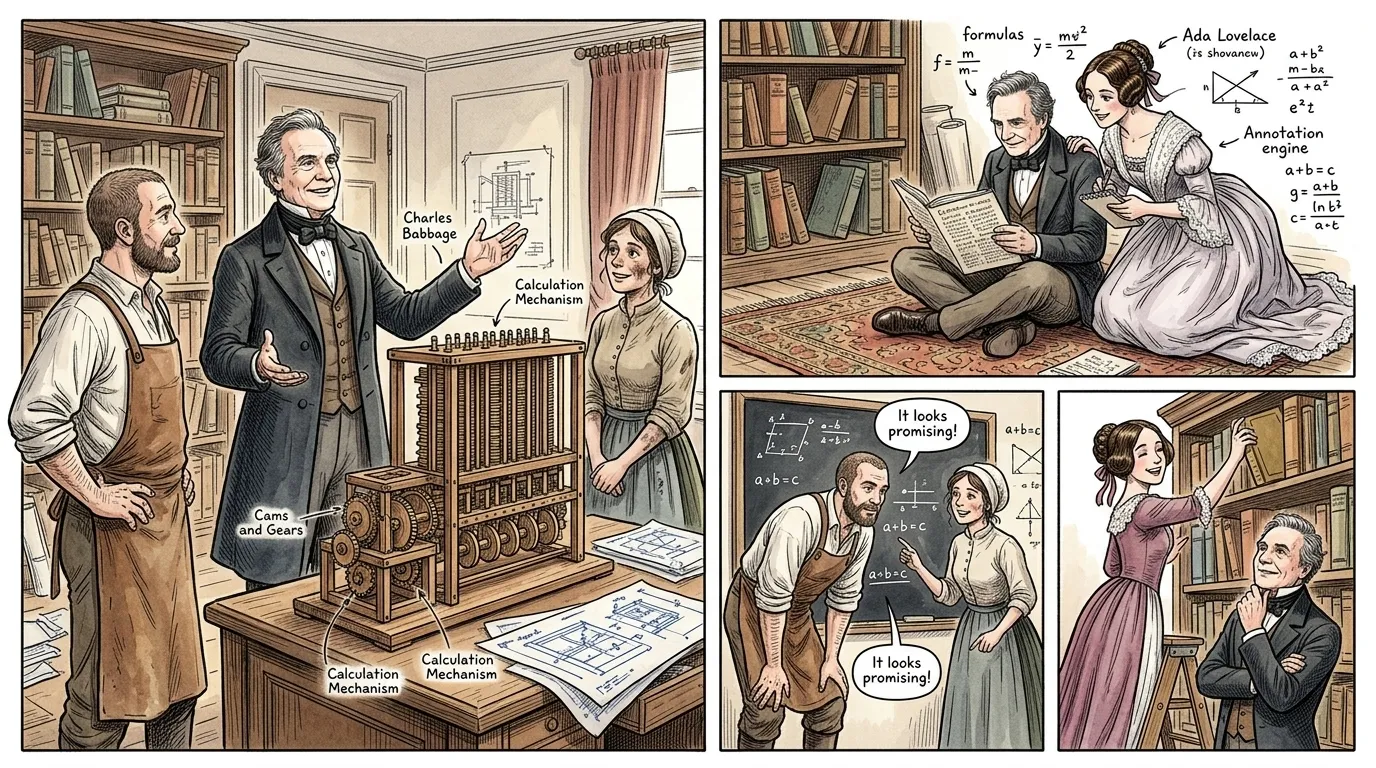
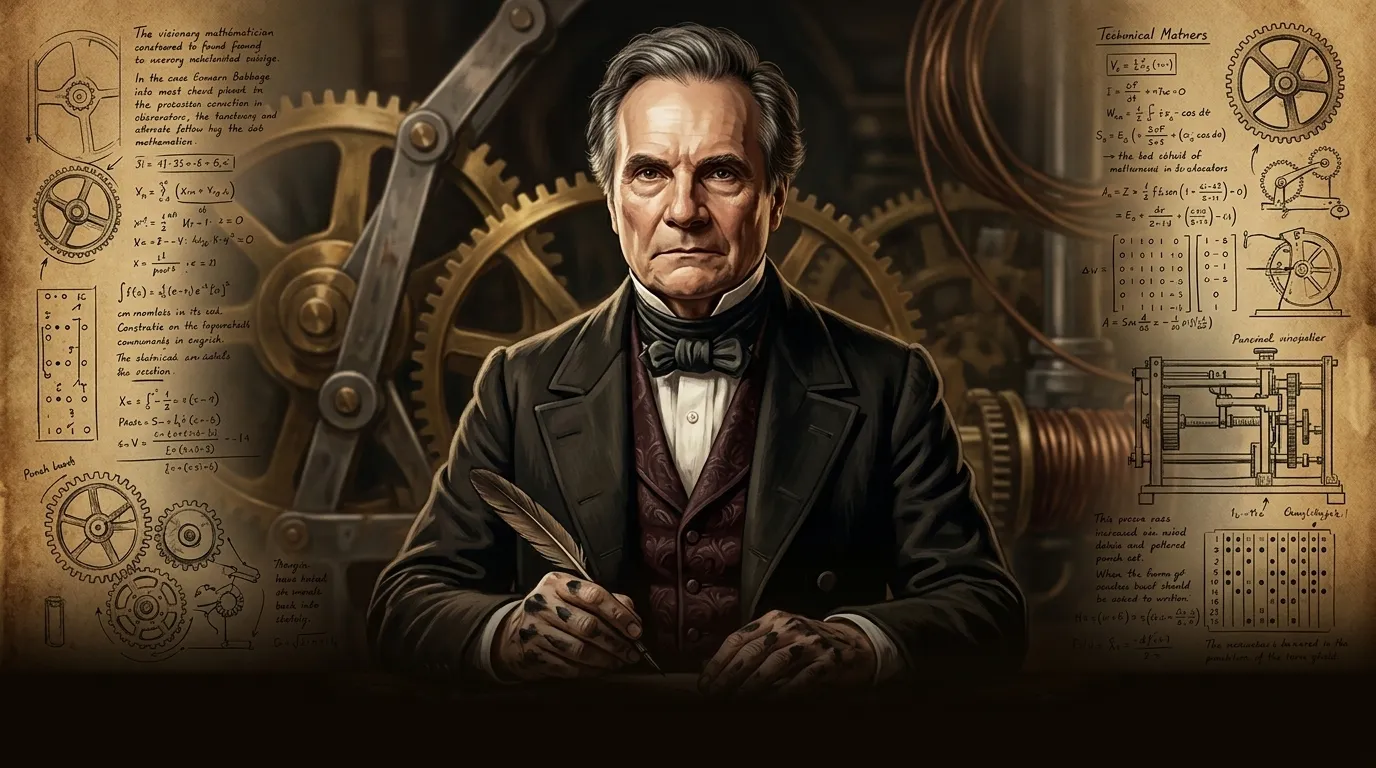
Before the digital age, the world grappled with an intractable problem: the ceaseless demand for accurate calculations. This era of manual computation, rife with human error, created significant bottlenecks in science, engineering, and commerce. It was into this landscape, in London, England, that Charles Babbage, a visionary mathematician, conceived of a machine that would not merely calculate, but think in sequences, laying the groundwork for every computer that followed.
""The drudgery of calculation has consumed minds and cost fortunes," Charles Babbage declared, his voice resonating with conviction. "We need a machine capable of executing any calculation with unfailing precision, not just a few specific types.""
Page 2
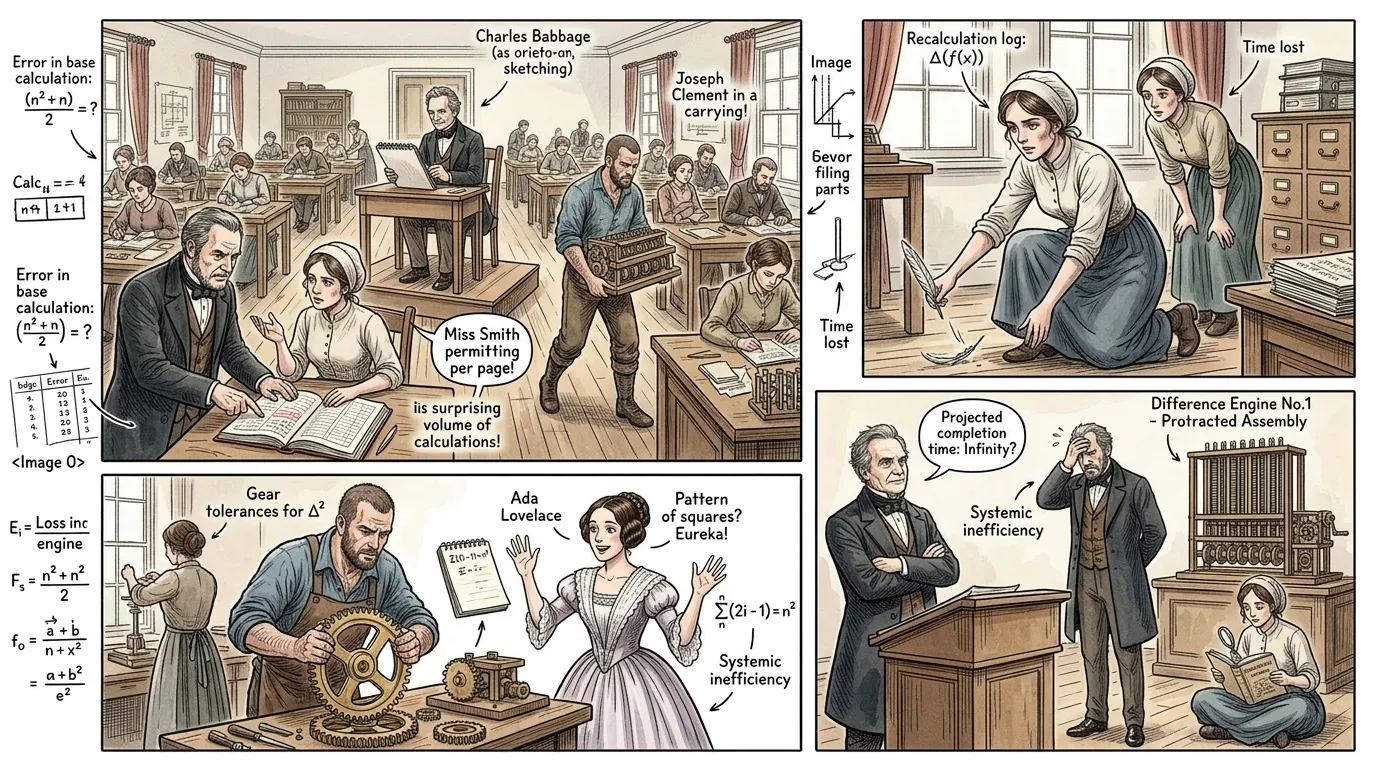
Across Britain and Europe, rooms teemed with 'computers'—people, often women, laboriously calculating tables for navigation, astronomy, and insurance. This monumental effort was a necessary evil, yet perpetually undermined by human fallibility. A single mistake could send a ship off course or compromise a scientific expedition.
""Another error, Miss Smith!" a stern supervisor sighed, pointing to a ledger. "Our latest nautical tables show an unacceptable discrepancy. The manual verification alone takes weeks." Miss Smith, a young woman with her hair pulled back under a cap, her face smudged with ink, replied, "Sir, the sheer volume of calculations is overwhelming. Even with the utmost care, exhaustion leads to oversight. The current method of fixed, sequential computation is inherently fragile.""
Page 3
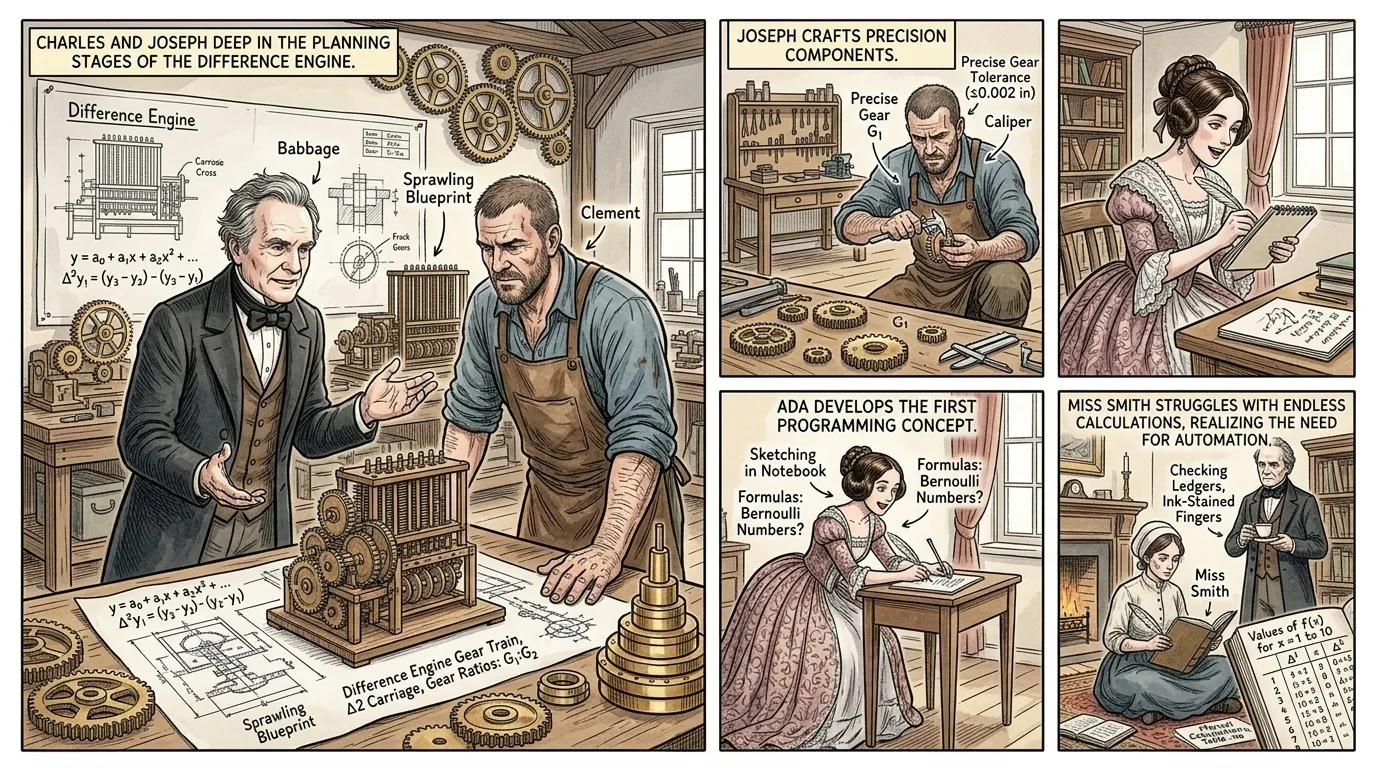
Babbage's initial foray into mechanical computation was the Difference Engine. Designed to tabulate polynomial functions using a method of finite differences, it promised to eliminate errors in specialized calculations. However, while ingenious, the Difference Engine was limited to one type of problem, revealing the need for a more versatile, general-purpose machine.
""The Difference Engine, while a marvel, ultimately became a specialized instrument," Babbage explained to his chief engineer, Joseph Clement, gesturing over a detailed blueprint spread across a vast workbench. "It is elegant for polynomials, but lacks the universality required for truly diverse mathematical problems. I realized that a machine must not only calculate, but be capable of adapting its sequence of operations—the very definition of true programmability." Clement, a robust man with practical work clothes, nodded thoughtfully, "Indeed, sir. To shift from a fixed process to a flexible one is a monumental leap.""
Page 4
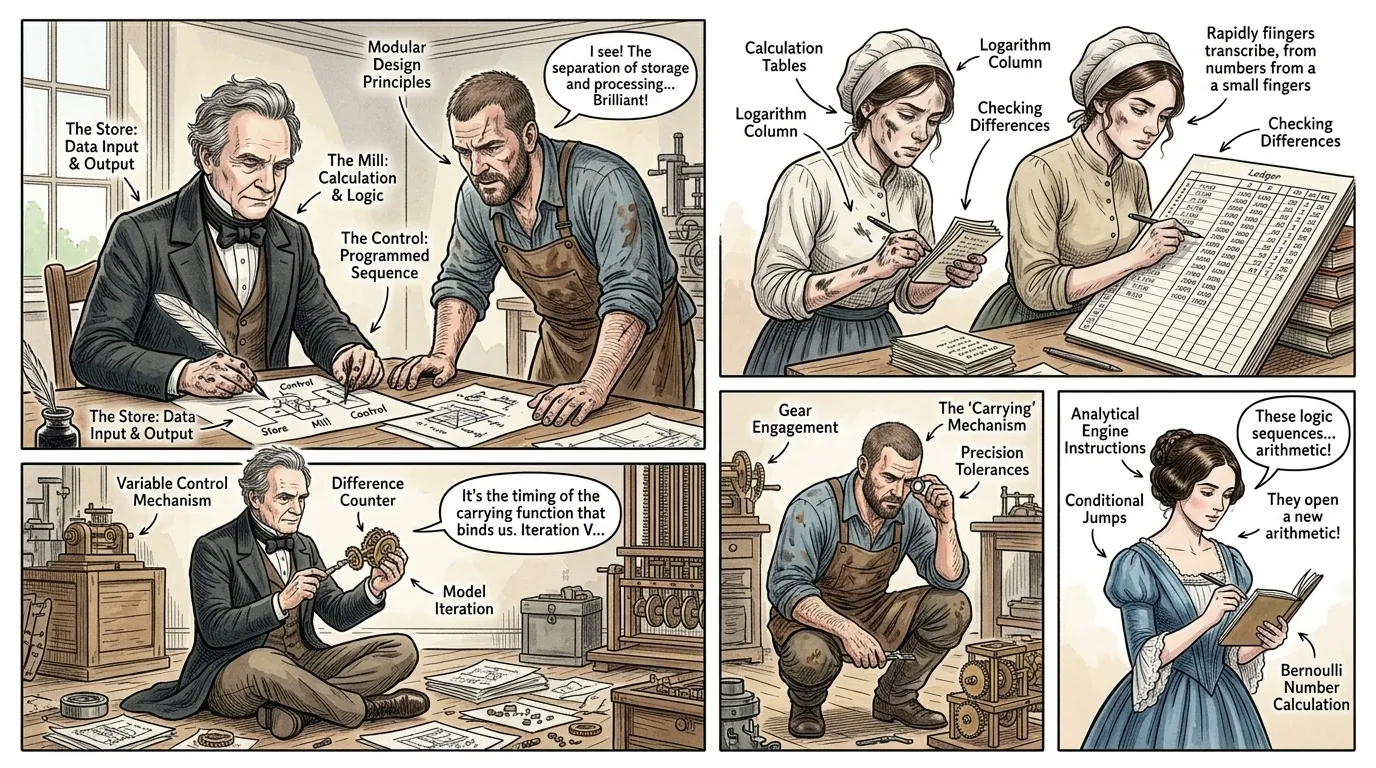
The Analytical Engine represented Babbage's profound conceptual leap. Instead of a single, monolithic calculator, he envisioned a machine with distinct, modular components: a 'Store' for memory, a 'Mill' for performing arithmetic, and a 'Control' unit to direct the flow of operations and data. This separation of concerns mirrored the architecture that would define computing centuries later.
""Imagine, Joseph," Babbage elaborated, sketching furiously on a fresh sheet of paper, "the machine needs a dedicated 'Store' to hold all numbers, both initial values and intermediate results, much like our ledgers. Then, a 'Mill' – our arithmetic engine – to perform the actual sums, differences, and multiplications. But crucially, a 'Control' unit to orchestrate the movement of numbers between them and dictate the sequence of operations. This modularity is the key to its universal nature." Clement responded, "So, it's not merely a calculator, but an assembler of calculations, following instructions. A true mechanical brain.""
Page 5
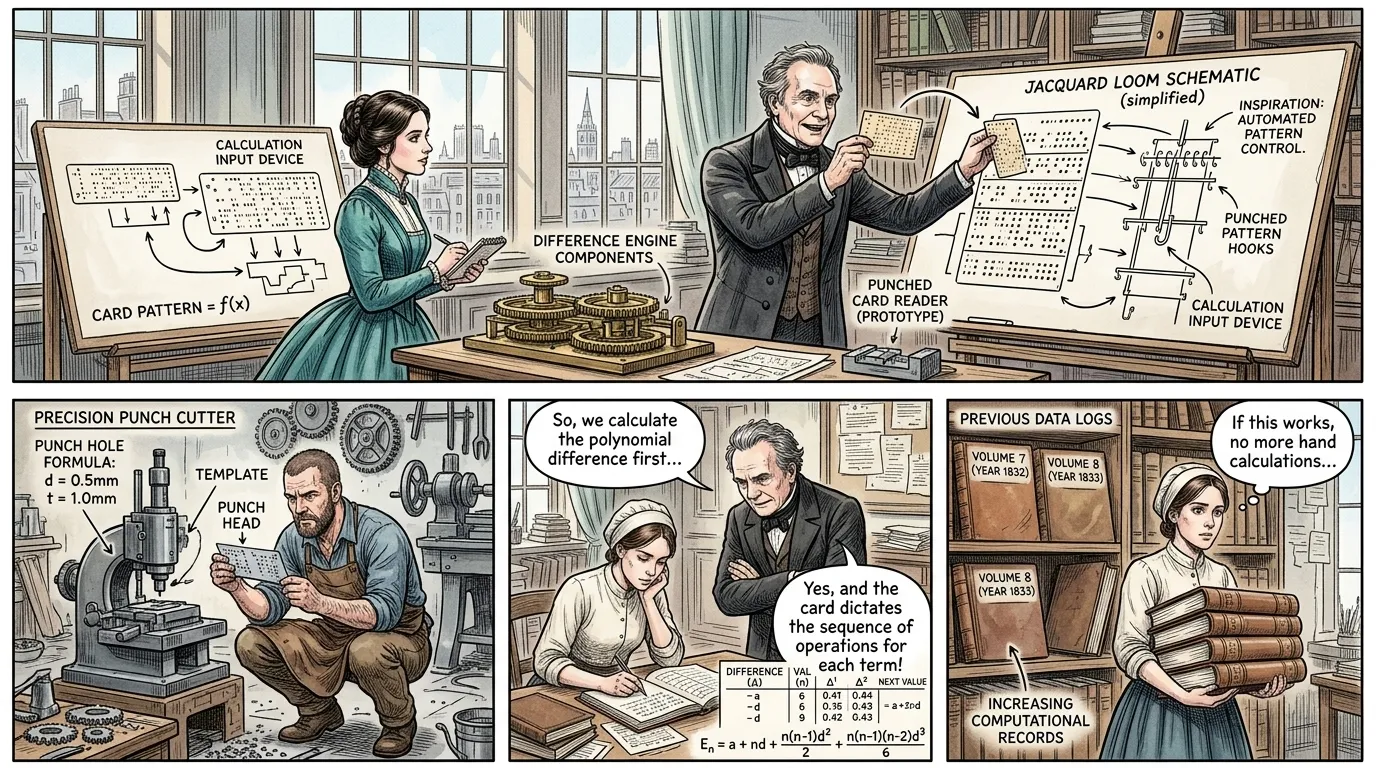
To feed instructions and data into his complex creation, Babbage turned to a then-revolutionary technology: punch cards, borrowed from Joseph Marie Jacquard's automatic loom. These cards, with their precisely patterned holes, would serve a dual purpose, dictating both the numerical inputs and the operational sequence of the Analytical Engine—the very first form of computer programming.
""The brilliance lies in adapting Jacquard's invention," Babbage explained, holding up a sturdy, rectangular punch card, its surface dotted with small, circular perforations. "These cards, much like those that weave intricate patterns, can instruct the engine. One set for the numbers, another for the operations. This means we can change the program simply by changing the cards." Clement, examining the card, remarked, "So, the machine's logic, its very purpose, becomes programmable, not hardwired. This is truly remarkable, sir, a profound abstraction.""
Page 6
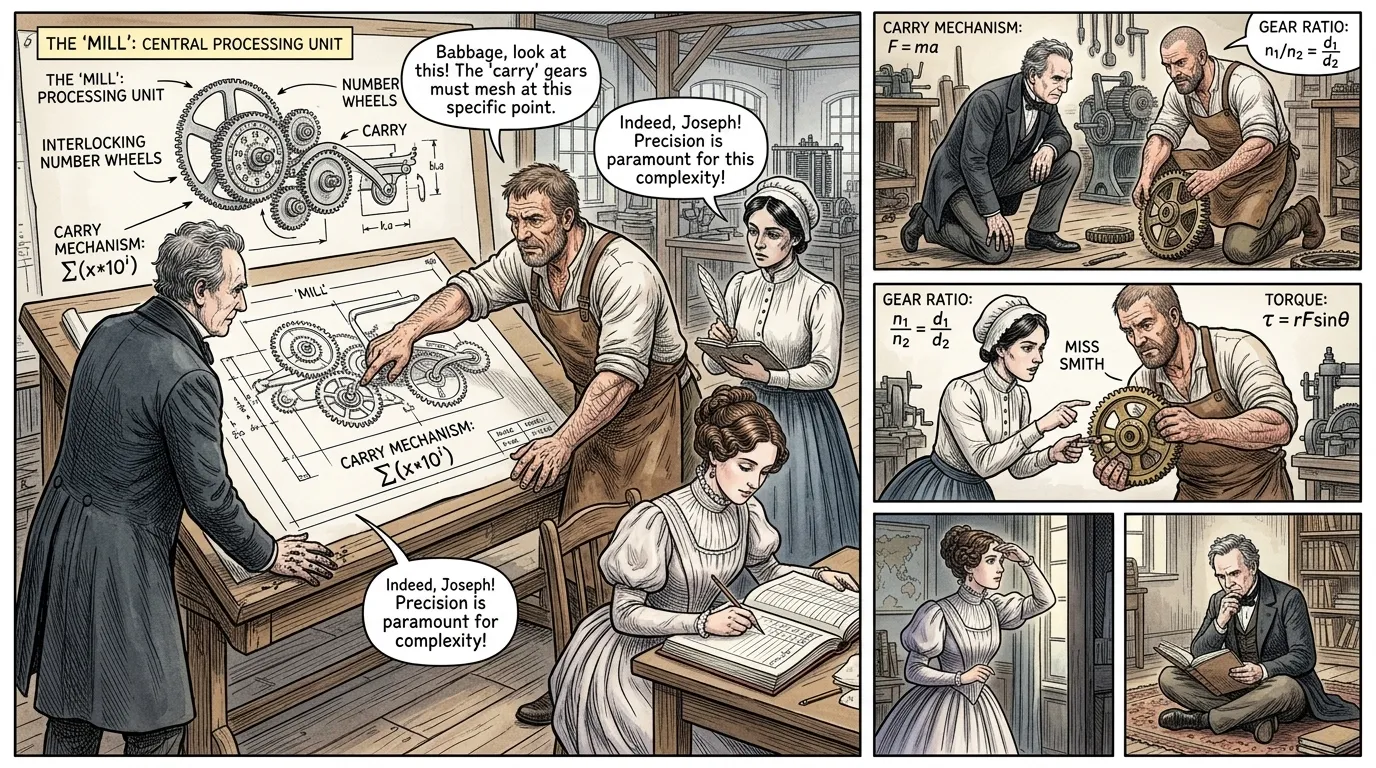
The 'Mill,' the Analytical Engine's arithmetic unit, was a masterpiece of mechanical engineering. It performed addition, subtraction, multiplication, and division not through electrical pulses, but through precisely interlocking gears. Numbers were represented by the rotational positions of wheels, and complex operations were executed by a choreographed dance of cogs, cams, and levers, including sophisticated 'carry' mechanisms for arithmetic overflows.
""Within the Mill," Babbage elaborated, pointing to a section of a detailed blueprint, "each number wheel can rotate through ten positions, representing digits zero through nine. When a wheel completes a rotation past nine, a small lever activates, mechanically adding a 'carry' to the next wheel, just as we do with pen and paper." Clement, tracing the gears on the diagram, commented, "The intricacy of this carry mechanism, sir, is where the true genius lies. It ensures accuracy across multiple orders of magnitude, a critical element for complex computations.""
Page 7
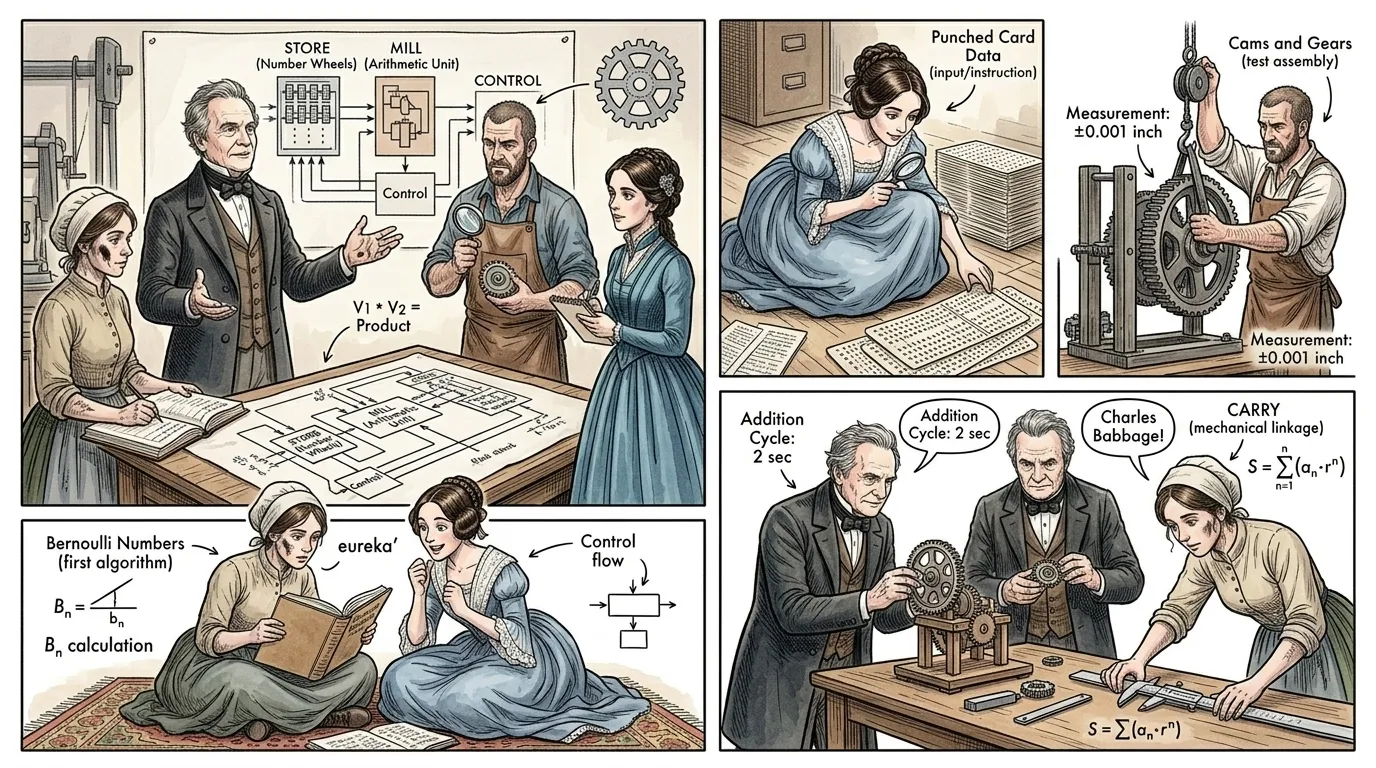
The 'Store' comprised columns of geared wheels, each capable of holding a single number—the engine's mechanical memory. The 'Control' unit, interpreting the punch cards, acted as the conductor, directing the movement of these numbers between the Store and the Mill, and sequencing the specific arithmetic operations. This dynamic interplay allowed for complex, multi-step calculations to be executed automatically.
""The 'Store' holds our numerical values," Babbage explained, gesturing towards a schematic displaying numerous vertical columns of number wheels. "But it is the 'Control' unit, guided by the operational punch cards, that orchestrates everything. It will tell the Mill which numbers to fetch from the Store, what operation to perform, and where to send the result back. It's a continuous, automated feedback loop." Clement nodded, "So, the Mill calculates, the Store remembers, and the Control directs. A truly symbiotic mechanical system.""
Page 8
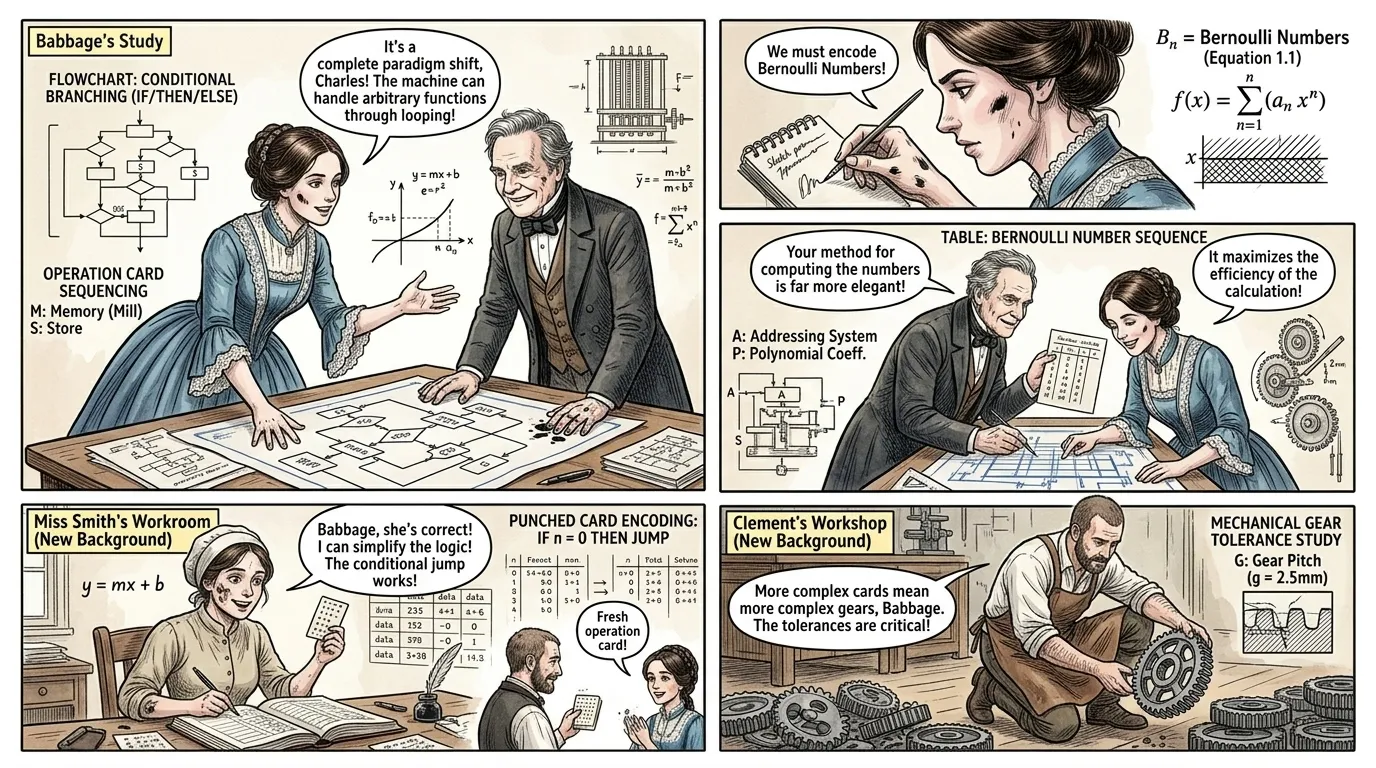
The Analytical Engine's most profound innovation was its capacity for 'conditional branching'—the ability to alter its own sequence of operations based on intermediate results. This meant the machine could make decisions, performing different calculations depending on whether a number was positive or negative, or if a result was zero. It was the birth of true algorithmic logic, moving beyond fixed calculations to adaptive intelligence.
""The Analytical Engine weaves algebraic patterns just as the Jacquard-loom weaves flowers and leaves," Ada Lovelace observed, her gaze alight with intellectual fervor. She turned to Babbage, a profound realization evident in her expression. "This capability for conditional branching—for the machine to 'choose' its path based on the very numbers it computes—means it can do more than merely calculate. It can follow a logical argument, adapting its operations, which is truly unprecedented. It's the dawn of the logical machine, not just a numerical one." Babbage beamed, "Precisely, my dear Ada, precisely. This is where true algorithmic power lies.""
Page 9
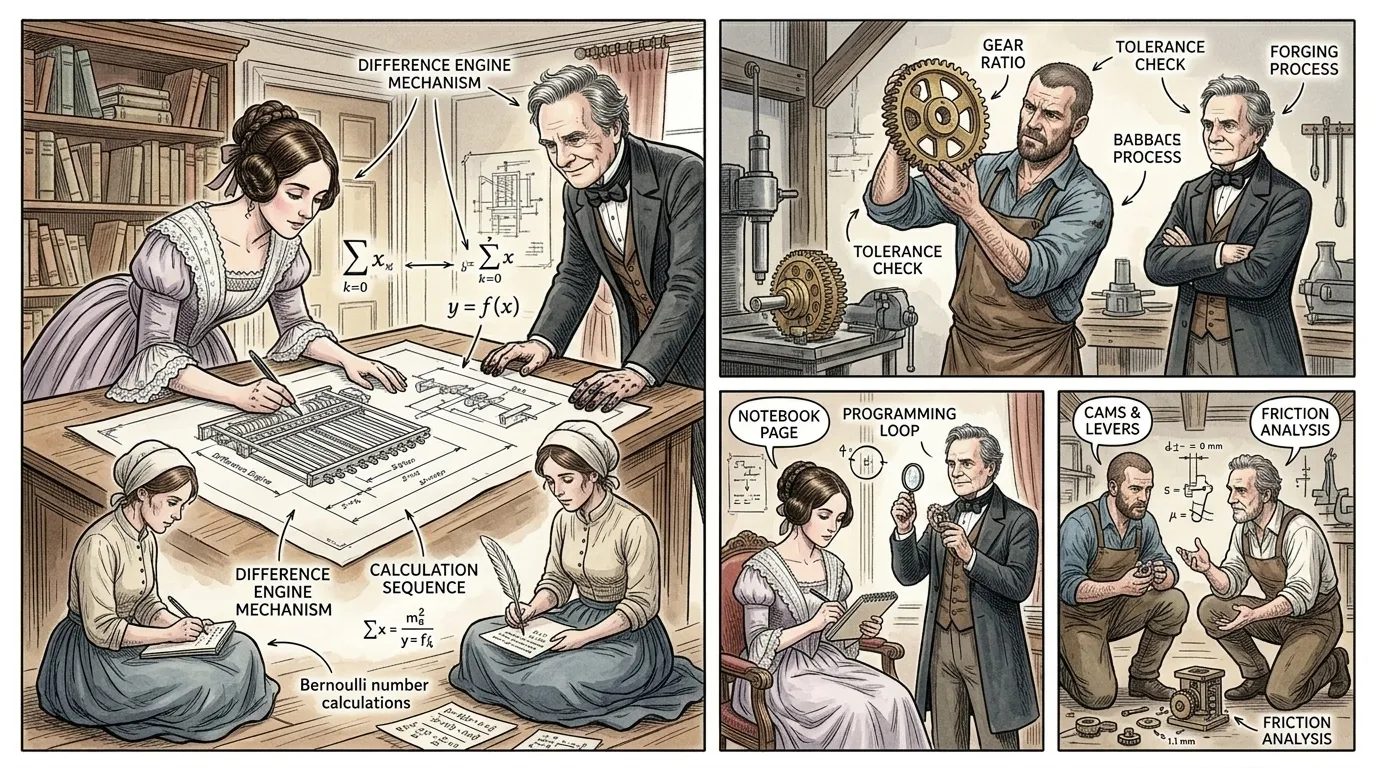
While Babbage conceived the hardware, it was Ada Lovelace, Lord Byron's daughter, who truly grasped the Analytical Engine's full potential. Her extensive notes on Babbage's papers included what is now recognized as the world's first computer algorithm, designed specifically for the Analytical Engine to calculate Bernoulli numbers. She articulated concepts like loops and subroutines, envisioning a machine capable of much more than just numbers.
""The Engine's potential extends far beyond arithmetic, into the realm of symbol manipulation," Ada Lovelace mused, her pen scratching across a page filled with intricate mathematical notations and flowcharts. She looked up, addressing Babbage. "If we can devise sequences of operations—algorithms—that the machine can execute repeatedly, or call upon as subroutines, then its applications are limitless. We can instruct it to perform a series of steps not just once, but over and over, adapting each cycle. I have outlined a method for calculating Bernoulli numbers using such a recursive process; it is the first true program." Babbage nodded, admiring her work, "Your insights, Ada, illuminate its true intellectual depth.""
Page 10
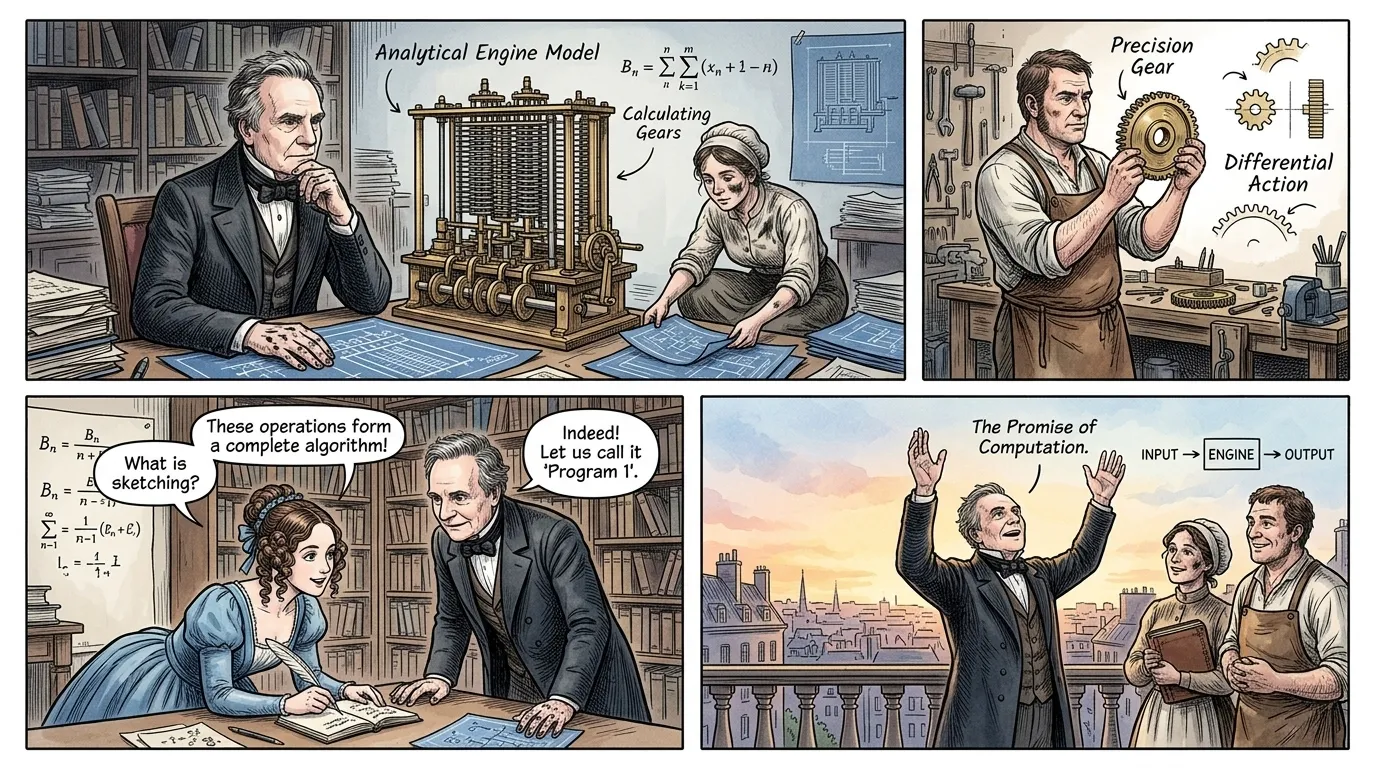
Despite the groundbreaking vision and relentless efforts of Babbage and Lovelace, the Analytical Engine was never fully constructed in their lifetimes. Engineering limitations of the era, coupled with Babbage's incessant desire for refinement and political funding challenges, meant that the physical machine remained largely a blueprint. Yet, its conceptual framework—the 'Store' and 'Mill,' conditional branching, and programmability via punch cards—became the enduring foundation of computing. Every modern digital device, from supercomputers to smartphones, echoes Babbage's original architectural genius.
""Even though my Analytical Engine remains a dream in brass and steel," Babbage reflected, late in his life, "its principles, its very logic, will one day transform the world. As the poet Alfred Lord Tennyson once wrote, 'The old order changeth, yielding place to new.' This new order, I believe, will be built on the bedrock of mechanical thought." His words, uttered in Victorian solitude, foretold a revolution he would not live to see."
About this story
- Location: Global
- Audience: general readers
Questions and answers
Read Wonder Inventions on your phone
Wonder Inventions is available on Android. Get Wonder Inventions on Google Play.