Alternating Current System
Alternating Current System — an illustrated inventions story, set in Global. 10 illustrated pages, free to read on Wonder Inventions.
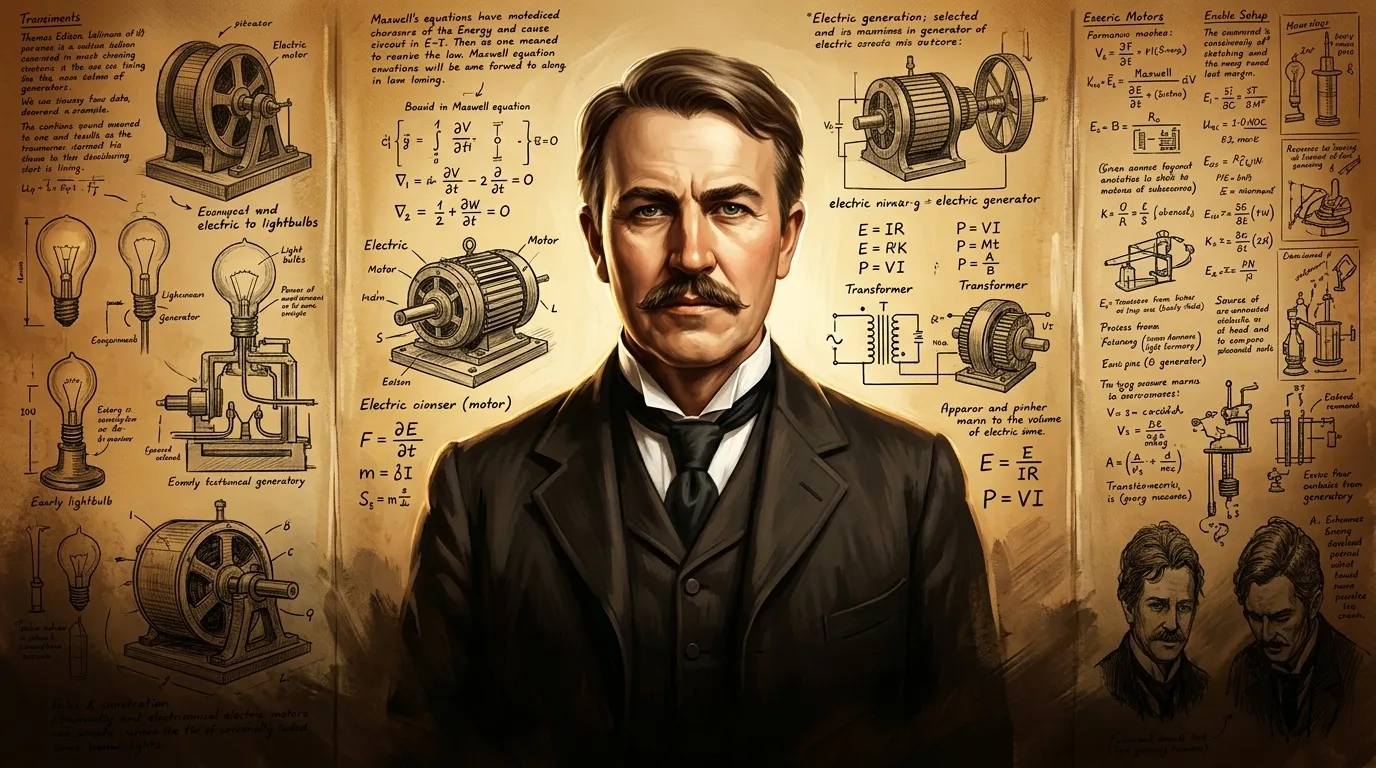
Page 1
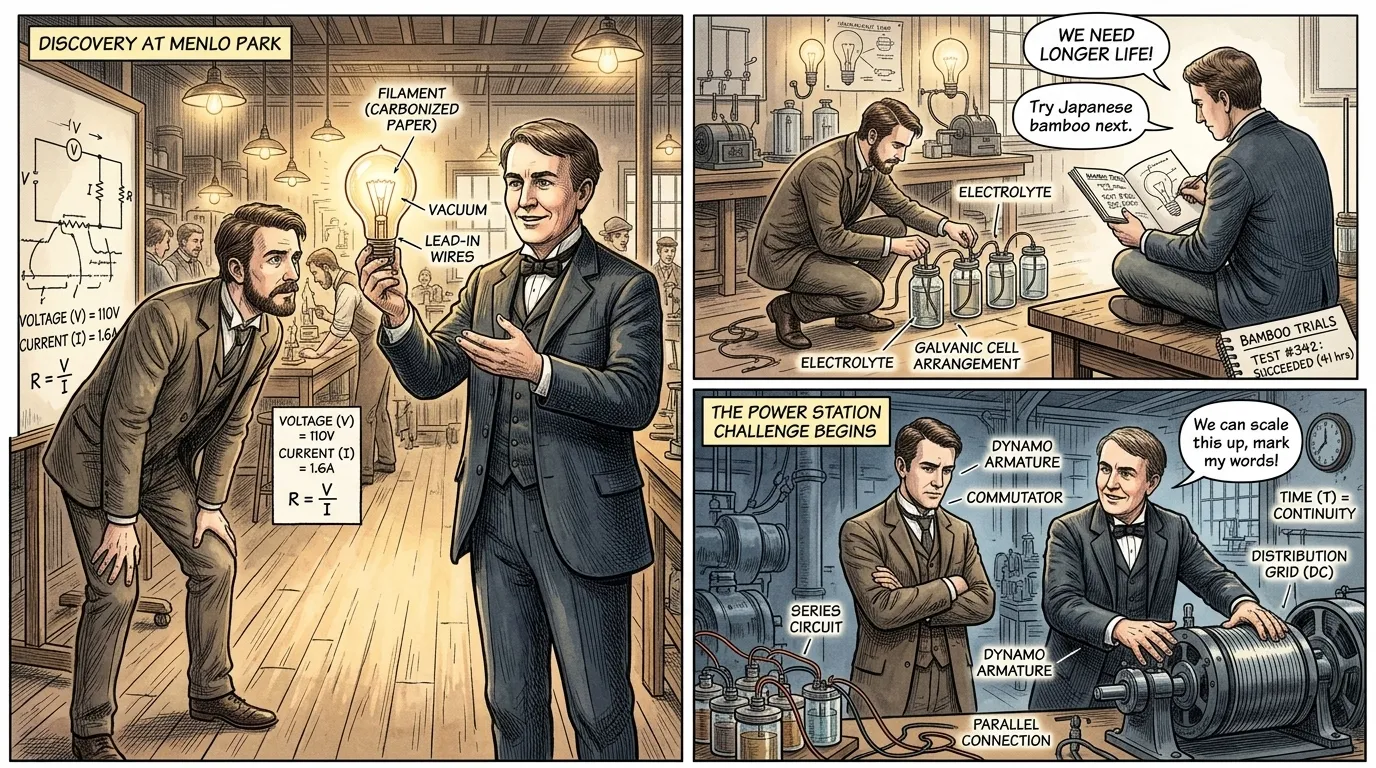
In the burgeoning late 19th century, the promise of electric light and power began to transform urban centers. However, the prevailing Direct Current, championed by Thomas Edison, faced a formidable challenge: its inherent inefficiency over long distances. Electricity's reach was limited, necessitating power plants every few city blocks, making widespread, affordable distribution a complex and costly endeavor.
""Our incandescent lamps illuminate the streets of New York, Mr. Johnson," Thomas Edison declared, gesturing towards a glowing bulb. "Direct Current provides stable power, but we require a plant every mile. Expanding further is a monumental task." A seasoned engineer nodded, adding, "Indeed, Mr. Edison. The resistance in our wires dissipates too much energy; voltage drops severely with distance.""
Page 2
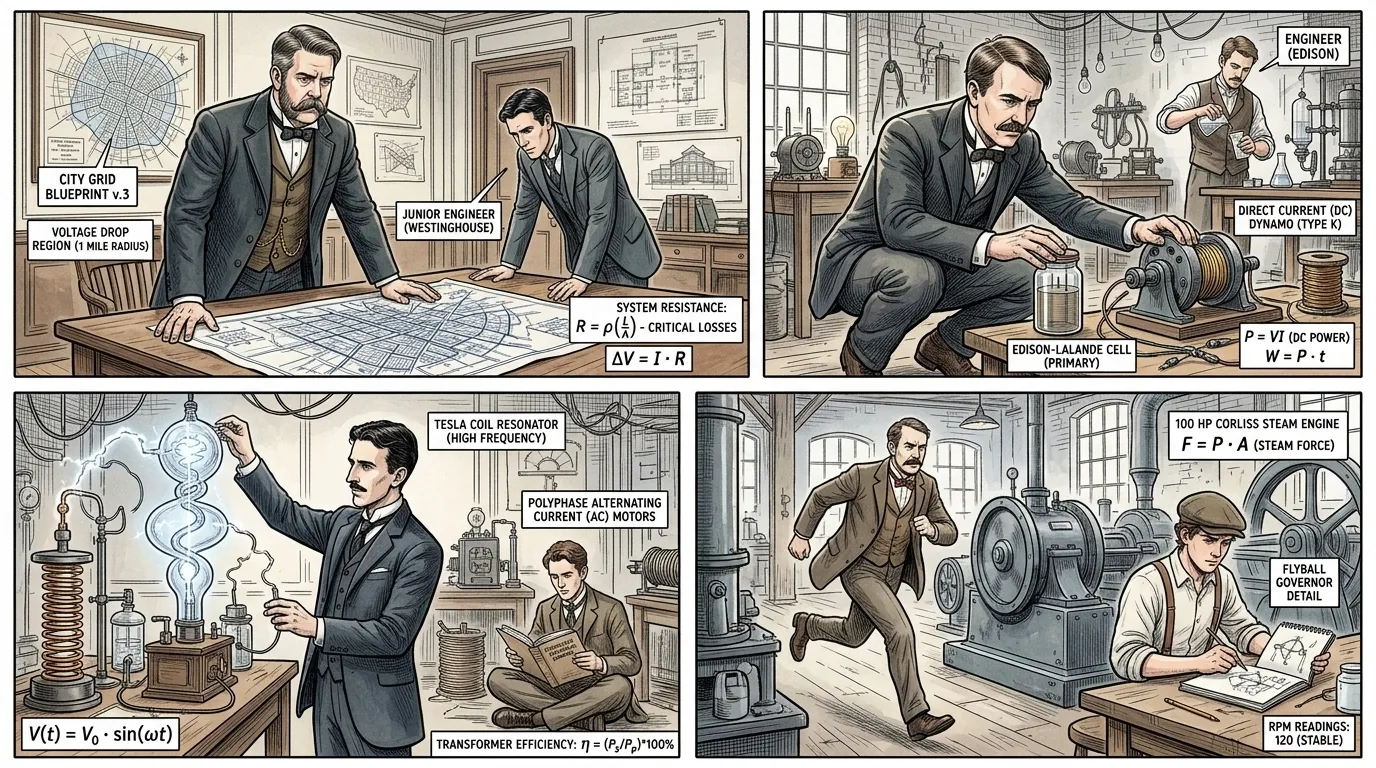
The limitations of Direct Current soon became apparent as cities grew and demand for electricity surged beyond localized grids. The inability to efficiently transmit power over significant distances created an intricate, sprawling web of small power stations, each serving only a small radius. This fragmented infrastructure was not only inefficient but also hindered the true potential of electrification.
""The urban landscape dictates our infrastructure, gentlemen," George Westinghouse observed, studying a blueprint. "Edison's DC system forces us to place generating stations too close to consumers, leading to an uneconomical density. The copper wire alone for such widespread short-range distribution is prohibitive." A junior engineer pointed to a shaded area on the map. "And beyond this radius, the voltage loss makes reliable power delivery impossible. We need a way to send electricity further, with less waste.""
Page 3
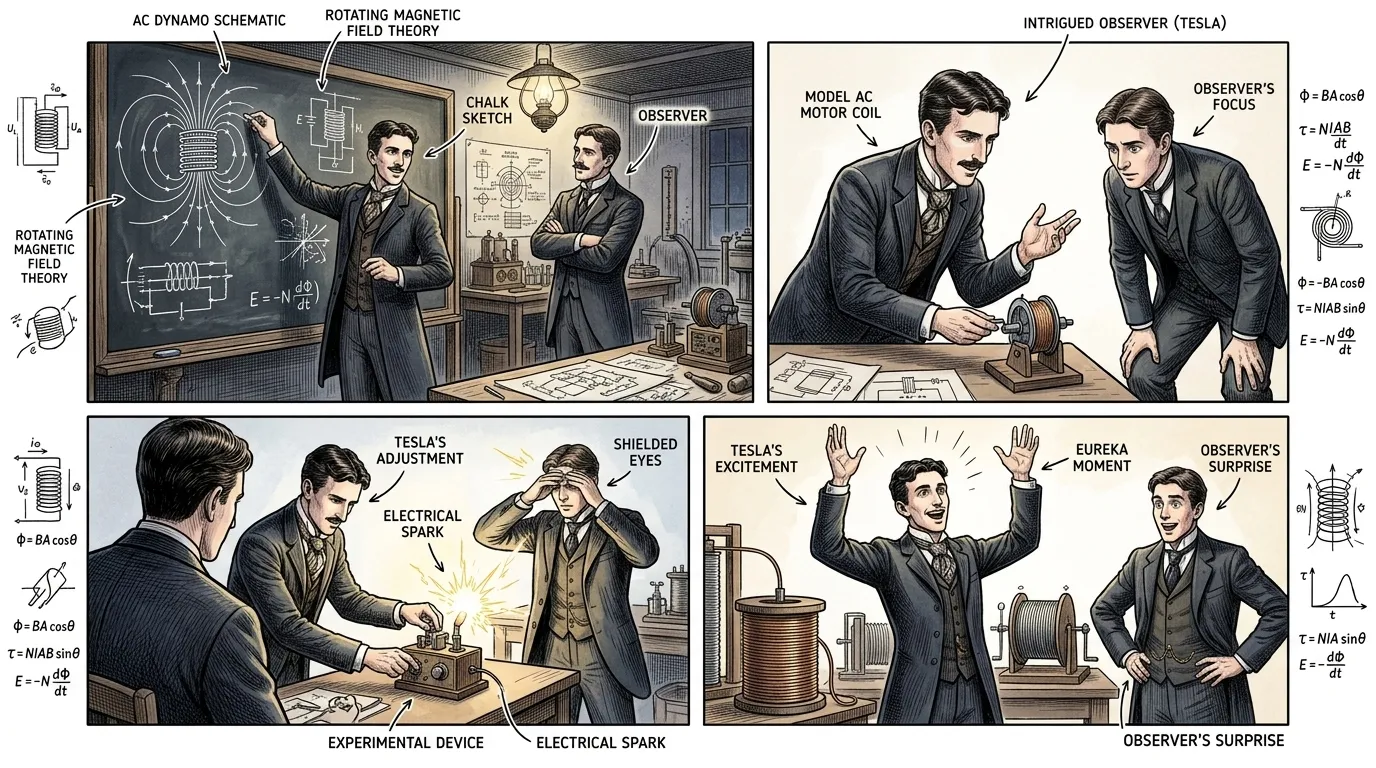
Far from the immediate pragmatic constraints of DC, a brilliant visionary named Nikola Tesla began to conceive a radically different approach. His mind wrestled with the principles of electromagnetism, envisioning a system where electric current could reverse direction rhythmically, creating a dynamic, pulsating force. This groundbreaking idea promised to unlock electricity's true potential for long-distance transmission and versatile application.
""Imagine a force that rotates without a single moving part touching another," Nikola Tesla mused, his eyes bright with conviction as he sketched furiously on a large blackboard in his laboratory. "By shifting the phase of multiple alternating currents, we can create a continuous rotating magnetic field. This principle, gentlemen, is the key to both generating and driving power more efficiently than anything direct current can offer." An intrigued observer, a man of science, nodded slowly. "So, you propose a system where magnetism itself becomes the engine of motion and transmission?""
Page 4
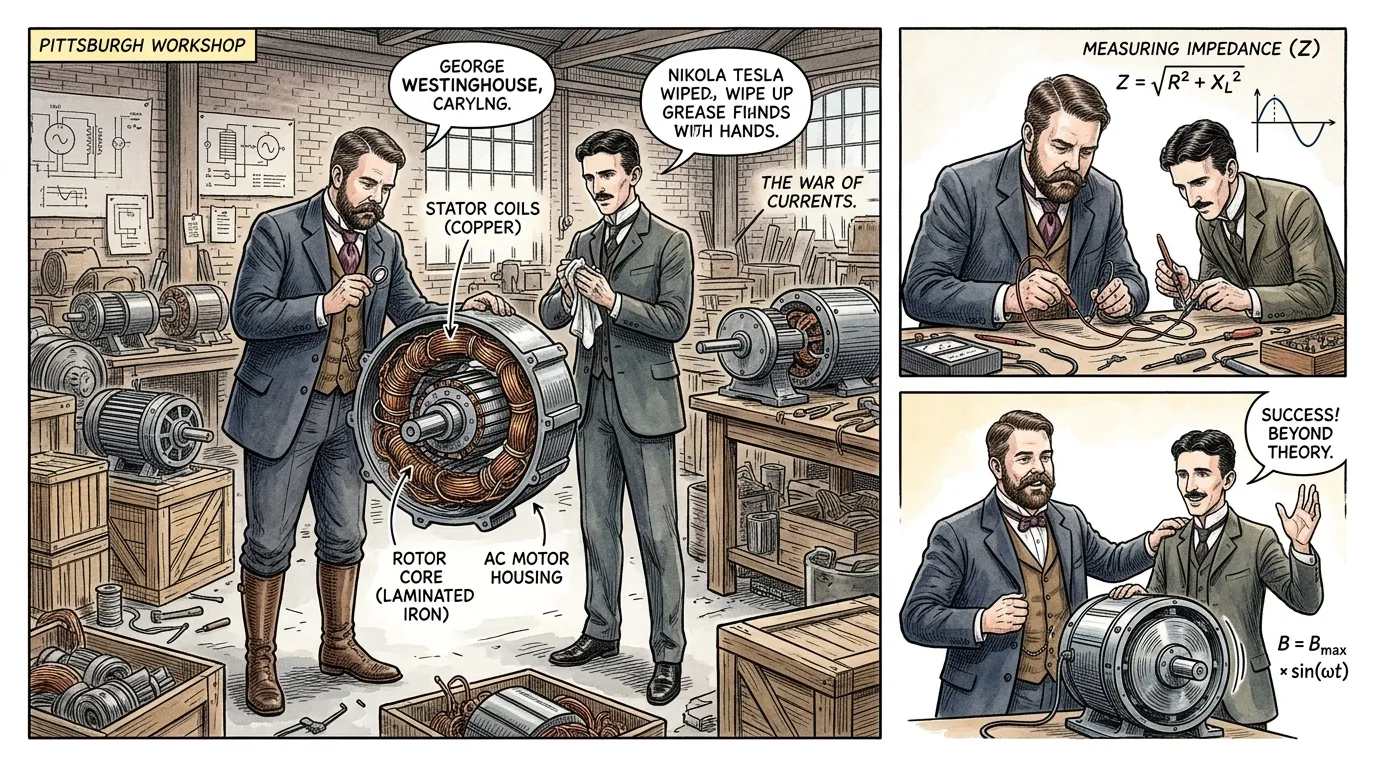
Tesla's revolutionary concepts, particularly his polyphase alternating current system and induction motor, faced immense technical hurdles. Transforming theoretical elegance into robust, practical machinery required relentless experimentation. His initial prototypes were intricate, prone to issues with insulation, overheating, and synchronization, demanding a monumental effort in engineering refinement and industrial scaling.
""The efficiency of this polyphase system is undeniable in theory," Westinghouse stated, examining a complex assembly of copper coils in a workshop. "However, realizing it on an industrial scale presents novel challenges. Insulating these higher voltages effectively, and ensuring precise phase synchronization across multiple generators, demands entirely new engineering approaches." Tesla, wiping grease from his hands, agreed. "Indeed, Mr. Westinghouse. Our initial designs, while promising, reveal the practicalities. Overcoming these hurdles—from rotor design to material science—is where true progress lies.""
Page 5
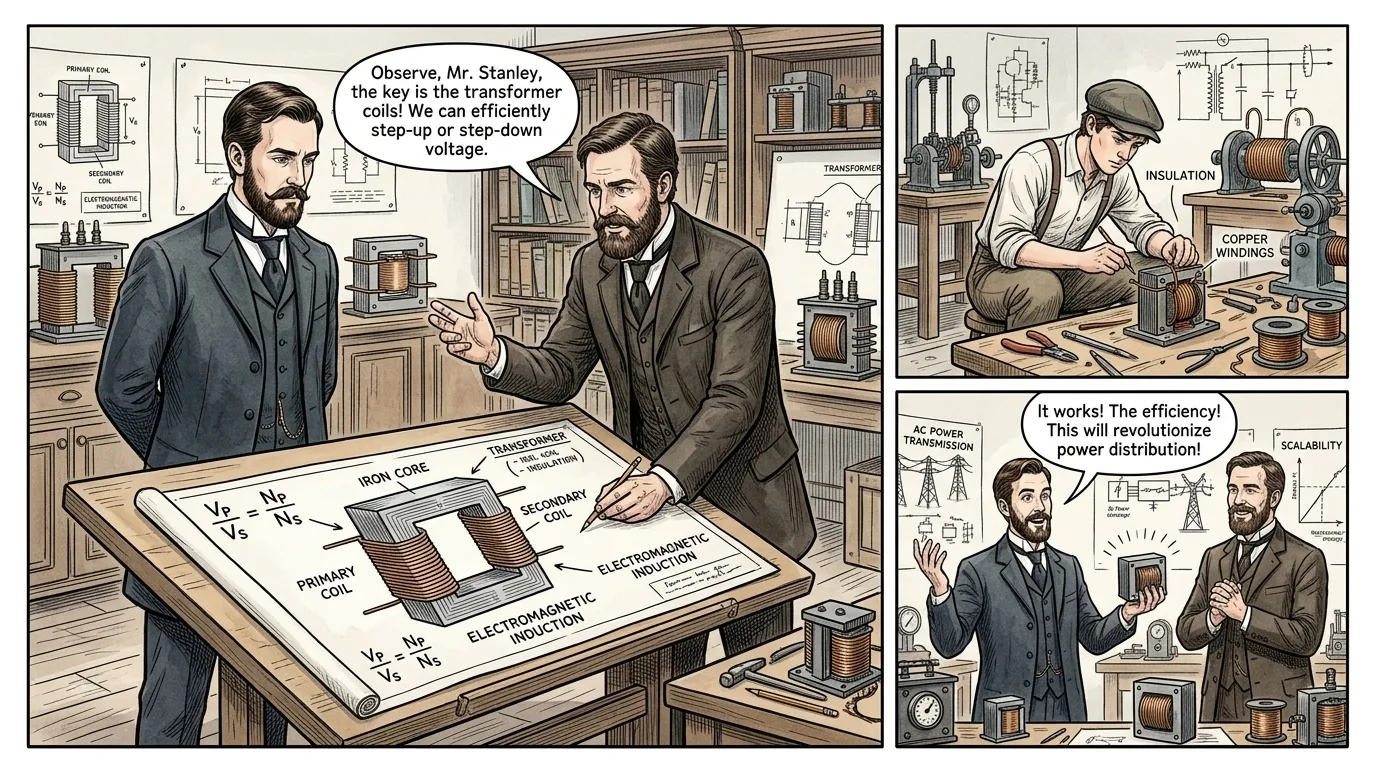
While Tesla perfected his polyphase motors and generators, the commercial viability of Alternating Current hinged on another crucial innovation: the transformer. Building on the work of inventors like Gaulard, Gibbs, and Stanley, the transformer provided a simple, elegant solution to the greatest impediment of electric transmission. It allowed voltage to be stepped up for efficient long-distance travel and then stepped down for safe, practical use in homes and factories.
""The genius of the transformer, Mr. Stanley," an engineer explained, pointing to a diagram, "lies in its ability to change voltage without any moving parts. We can transmit power at extremely high voltage, minimizing current and thus, energy loss, over hundreds of miles." William Stanley Jr., a thoughtful man in his 30s with a neatly groomed beard, nodded. "Precisely. By wrapping two coils around a shared iron core, the changing magnetic field of the primary coil induces a current in the secondary. The ratio of turns dictates the voltage transformation, making long-distance AC distribution economically feasible.""
Page 6
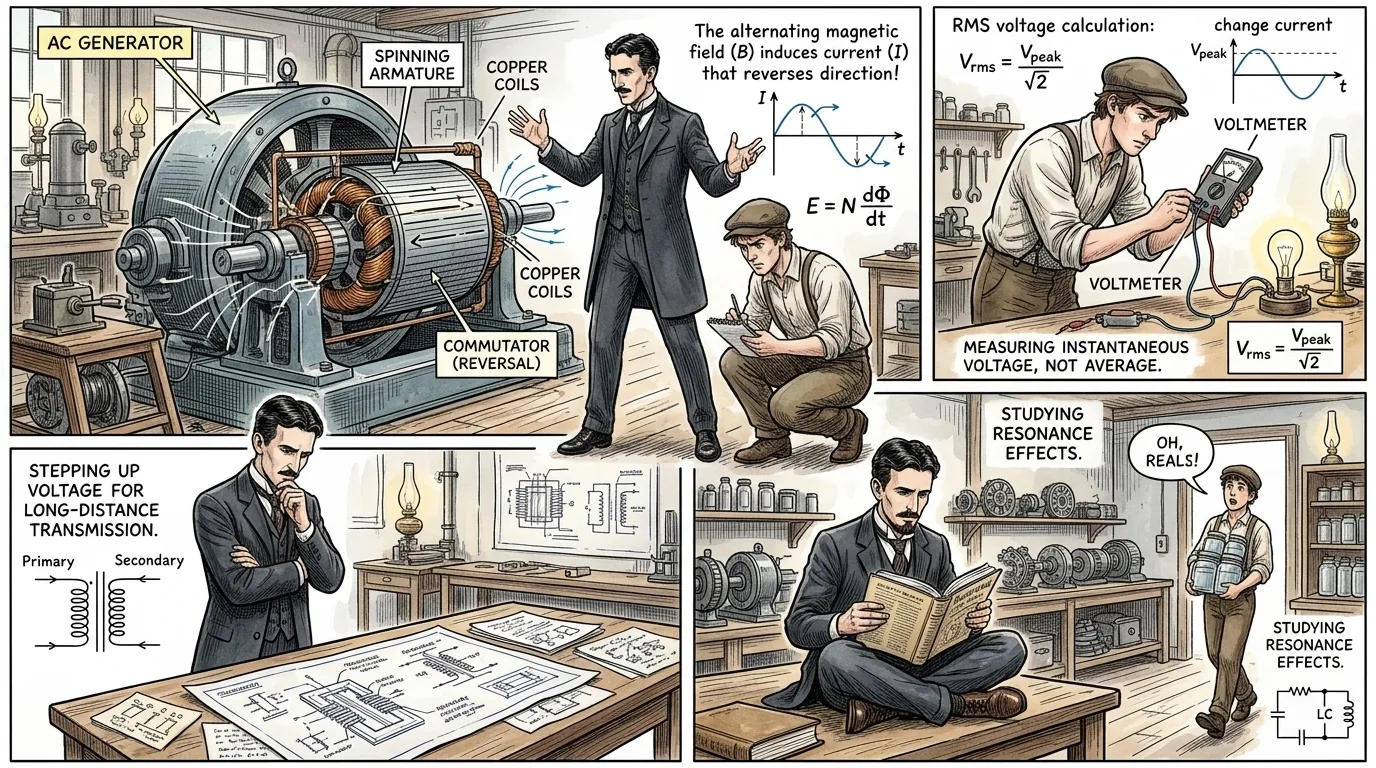
The heart of the Alternating Current System lies in its generator, a marvel of engineering that harnesses mechanical energy to produce electricity. Unlike its DC counterpart, the AC generator continuously reverses the direction of current flow. This is achieved through the ingenious interplay of rotating magnetic fields and stationary coils, generating the characteristic sinusoidal waveform that defines alternating current.
""Observe, the core principle is continuous change," Tesla explained, gesturing to a large, spinning armature inside an AC generator. "As the magnetic field sweeps across these copper coils, it induces an electromotive force. Crucially, the direction of this induced force reverses with each half-rotation, creating our alternating current." An apprentice engineer, taking notes, asked, "So, the current flows one way, then the other, in a regular cycle?" Tesla affirmed, "Exactly. This rhythmic reversal is what makes AC so adaptable, ready for transformation and efficient transmission.""
Page 7
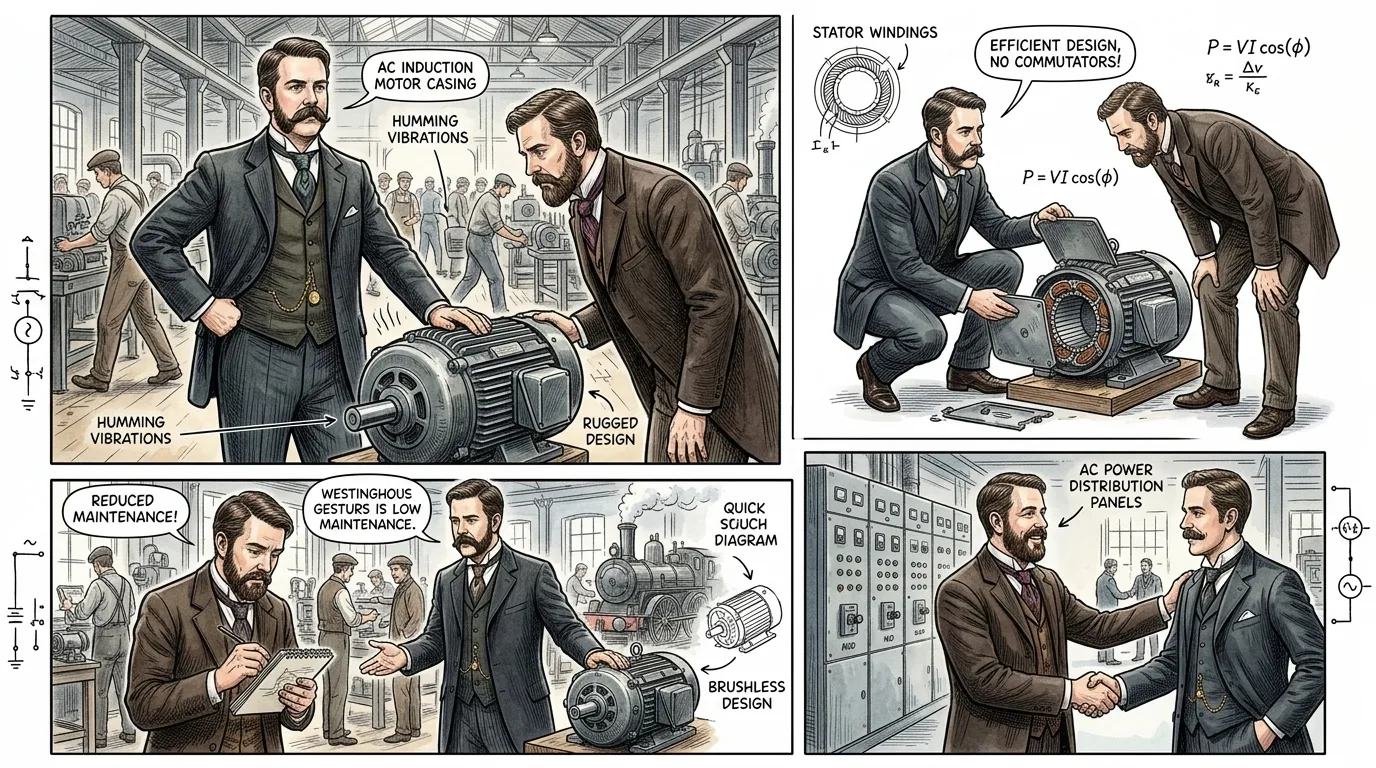
Beyond generation, Tesla's most impactful contribution was the practical application of the rotating magnetic field to create highly efficient AC motors. The polyphase induction motor eliminates the need for brushes and commutators, which were constant sources of maintenance and inefficiency in DC motors. This simplified, robust design allowed AC to power heavy machinery reliably and continuously, cementing its place in the industrial future.
""This is where the rotating magnetic field truly shines," Westinghouse emphasized, placing his hand on the casing of a powerful AC induction motor. "Multiple alternating currents, slightly out of phase, create a magnetic field that literally rotates, pulling the rotor along with it. No physical contact, no sparks, no wear on moving electrical connections." A factory owner, inspecting the motor, remarked, "A motor that requires minimal maintenance, delivers consistent power, and can be easily scaled? This changes everything for manufacturing. The efficiency is astounding.""
Page 8
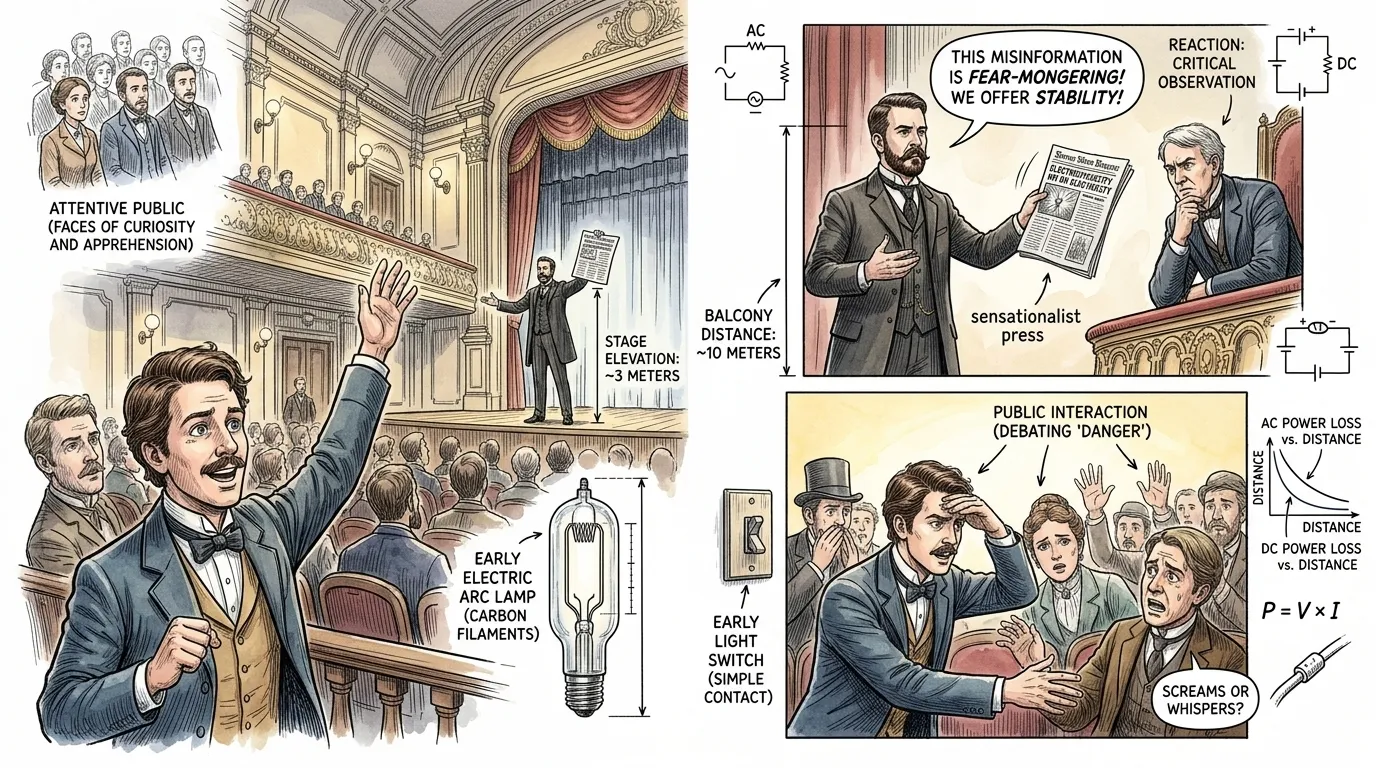
The introduction of the Alternating Current System sparked a fierce commercial and ideological conflict known as the "War of the Currents." Thomas Edison's formidable lobbying efforts against AC, often involving public demonstrations of its perceived dangers through electrocution experiments, aimed to discredit the new technology. Despite this intense opposition, the undeniable advantages of AC—its ability to transmit power efficiently over vast distances thanks to voltage transformation—began to sway public opinion and investors.
""The resistance to innovation is often proportional to its potential disruption," Westinghouse declared in a public address, holding a newspaper with a sensational headline. "We face a campaign of fear, Mr. Edison seeking to undermine a superior system with misinformation. But as Ralph Waldo Emerson once said, 'Do not go where the path may lead, go instead where there is no path and leave a trail.' We are blazing a new trail, one that offers truly universal power." An audience member in the crowd shouted, "But is it safe?" Westinghouse responded, "With proper engineering, it is far safer and more effective than the cumbersome alternative.""
Page 9
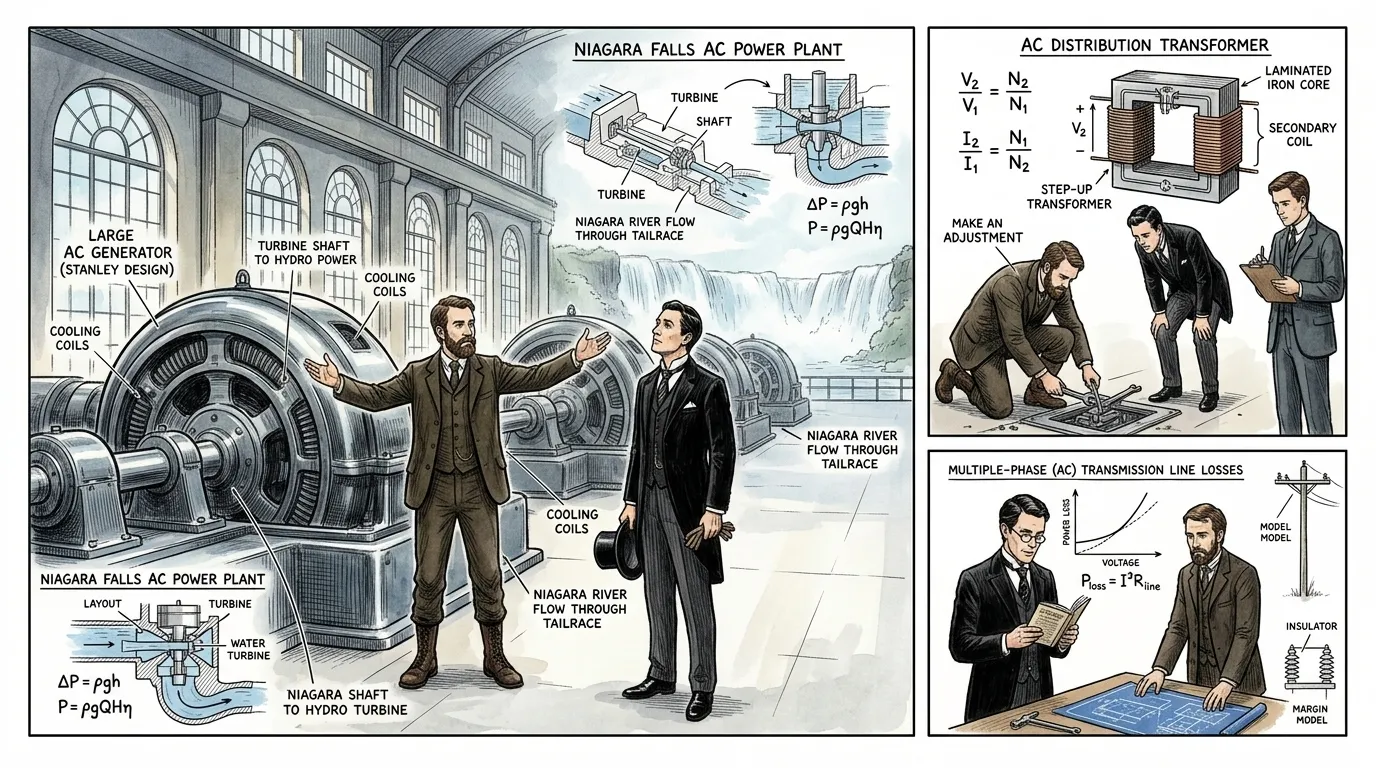
The monumental project to harness the power of Niagara Falls for electricity generation became the ultimate proving ground for Alternating Current. With Tesla's designs and Westinghouse's industrial prowess, colossal AC generators were installed, capable of producing unprecedented amounts of power. This energy was then transmitted efficiently to Buffalo, over twenty miles away, unequivocally demonstrating AC's superiority for large-scale electrification and long-distance distribution. It was a victory that reshaped the world.
""The roar of Niagara Falls now echoes the silent hum of progress," a proud engineer announced to a visiting dignitary inside the vast power plant. "Our colossal AC generators, operating on Mr. Tesla's polyphase principles, transform the raw force of the falls into a clean, inexhaustible supply of electricity." The dignitary, gazing at the immense machinery, remarked, "To transmit this power twenty miles to Buffalo, enabling industry and lighting an entire city, is a testament to the ingenuity of the alternating current system. This truly is a marvel of the modern age.""
Page 10
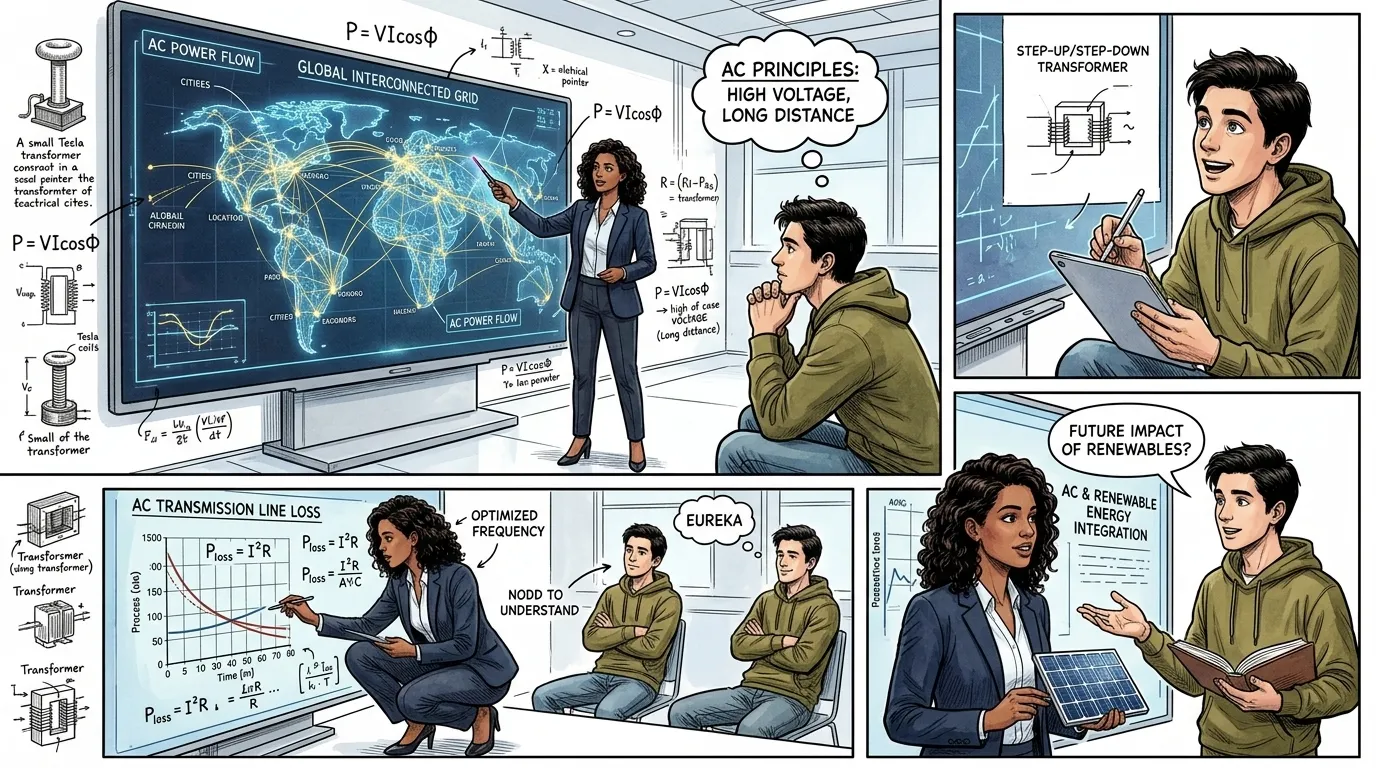
The triumph of the Alternating Current System laid the foundation for the global electrical grid we rely on today. From powering massive industries and illuminating entire cities to energizing the most intricate computing devices, AC became the invisible force driving modern civilization. Its principles of efficient generation, transmission, and versatile use continue to underpin nearly every aspect of our electrified world, a testament to the visionary minds who dared to challenge the status quo.
""The principles forged in those early electrical battles define our modern world," a contemporary energy expert explained during a presentation. "Alternating Current is not merely a historical footnote; it is the silent, ubiquitous backbone of our technological existence. Every flicker of a screen, every hum of a server, every rotation in a factory — it all traces back to the elegant efficiency of AC." An audience member reflected, "It's incredible how foundational these past innovations remain for our future advancements.""
About this story
- Location: Global
- Audience: general readers
Questions and answers
Read Wonder Inventions on your phone
Wonder Inventions is available on Android. Get Wonder Inventions on Google Play.