Ambulance
Ambulance — an illustrated inventions story, set in Global. 10 illustrated pages, free to read on Wonder Inventions.
Page 1
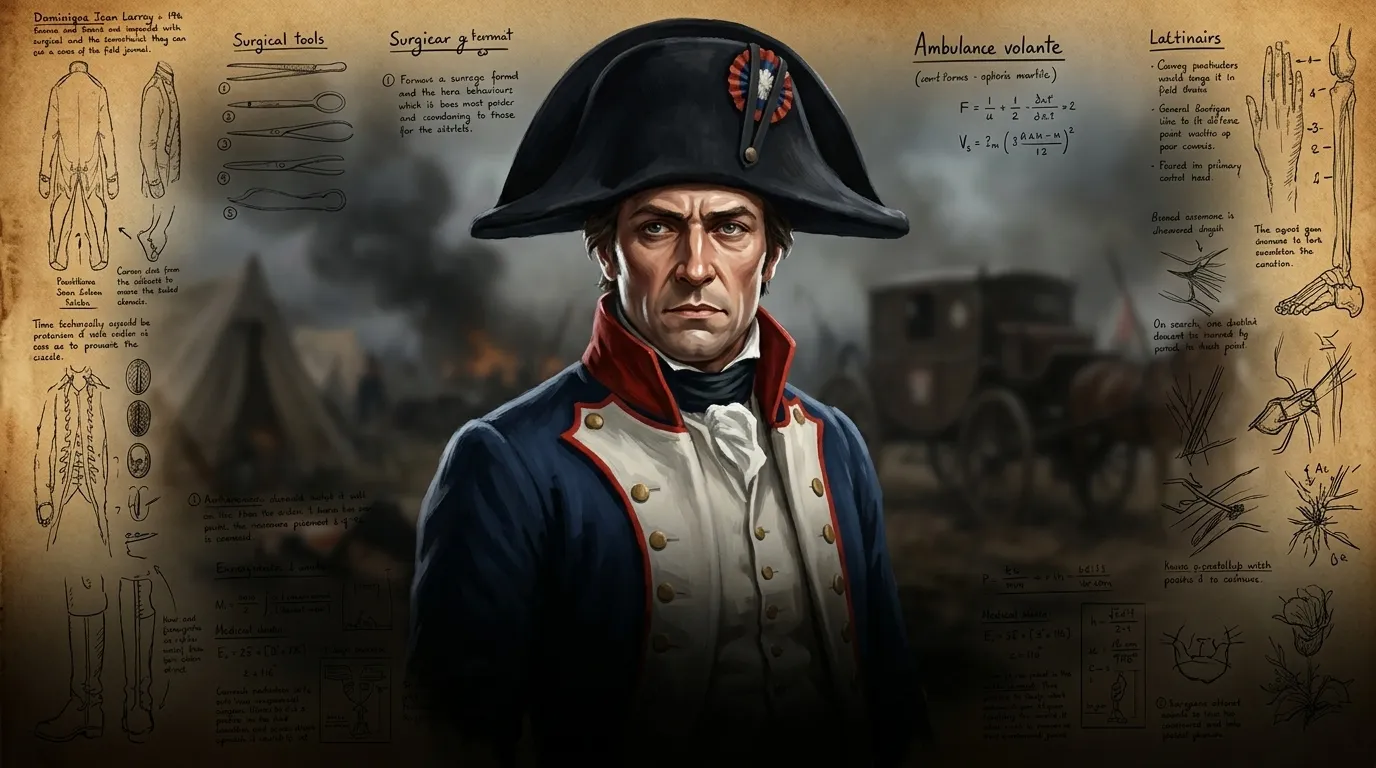
Across the battlefields of late 18th-century Europe, the scene was one of immense suffering. Wounded soldiers, often left for hours or even days, faced agonizing delays for evacuation. French military surgeon Dominique Jean Larrey witnessed this brutal reality during the French Revolutionary Wars, understanding that survival often hinged on immediate action.
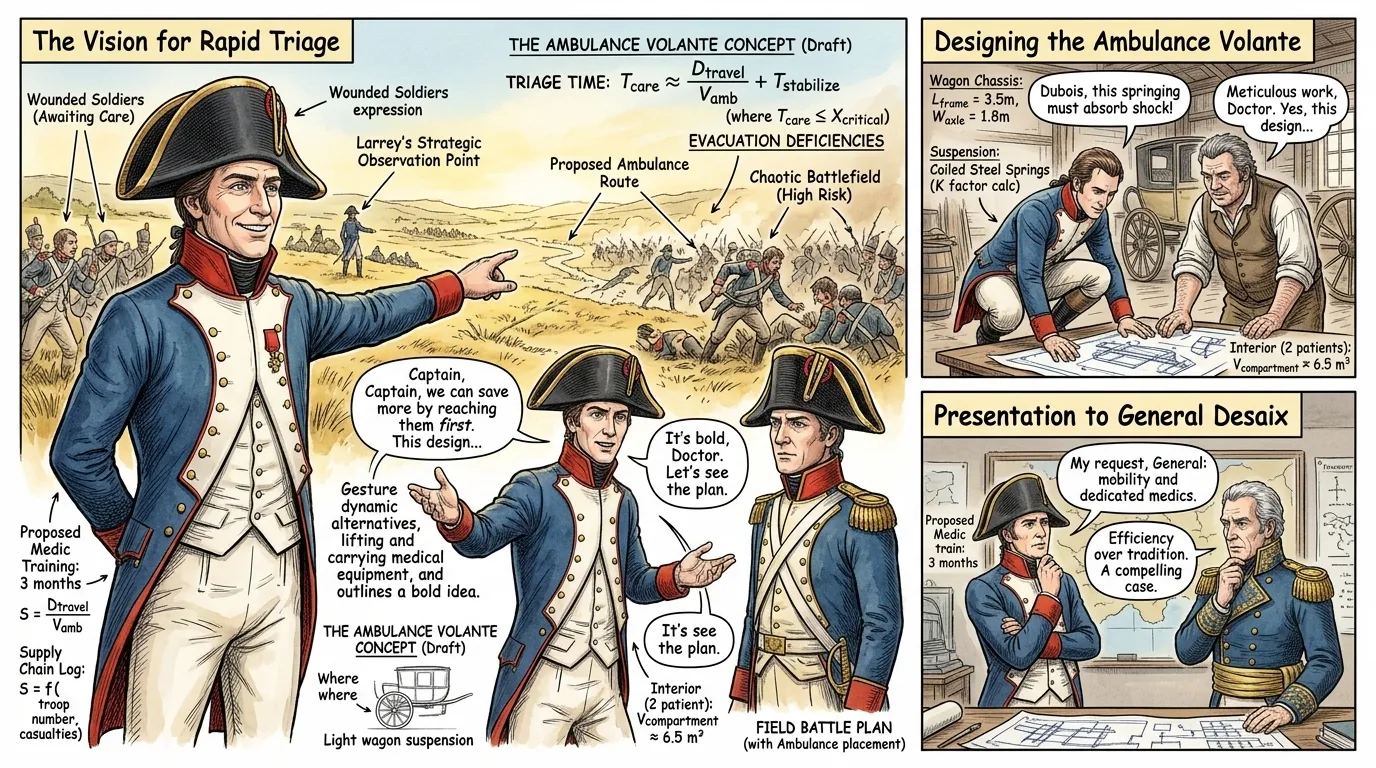
"'General, the current system is barbaric,' Surgeon-in-Chief Larrey declared, his voice tight with urgency. 'Leaving the fallen to languish until after the engagement, then transporting them in slow, jostling wagons... it's a death sentence for too many.' Another officer, Captain Moreau, nodded gravely, 'Casualties mount not just from the initial injury, but from the brutal journey to rudimentary aid stations.'"
Page 2
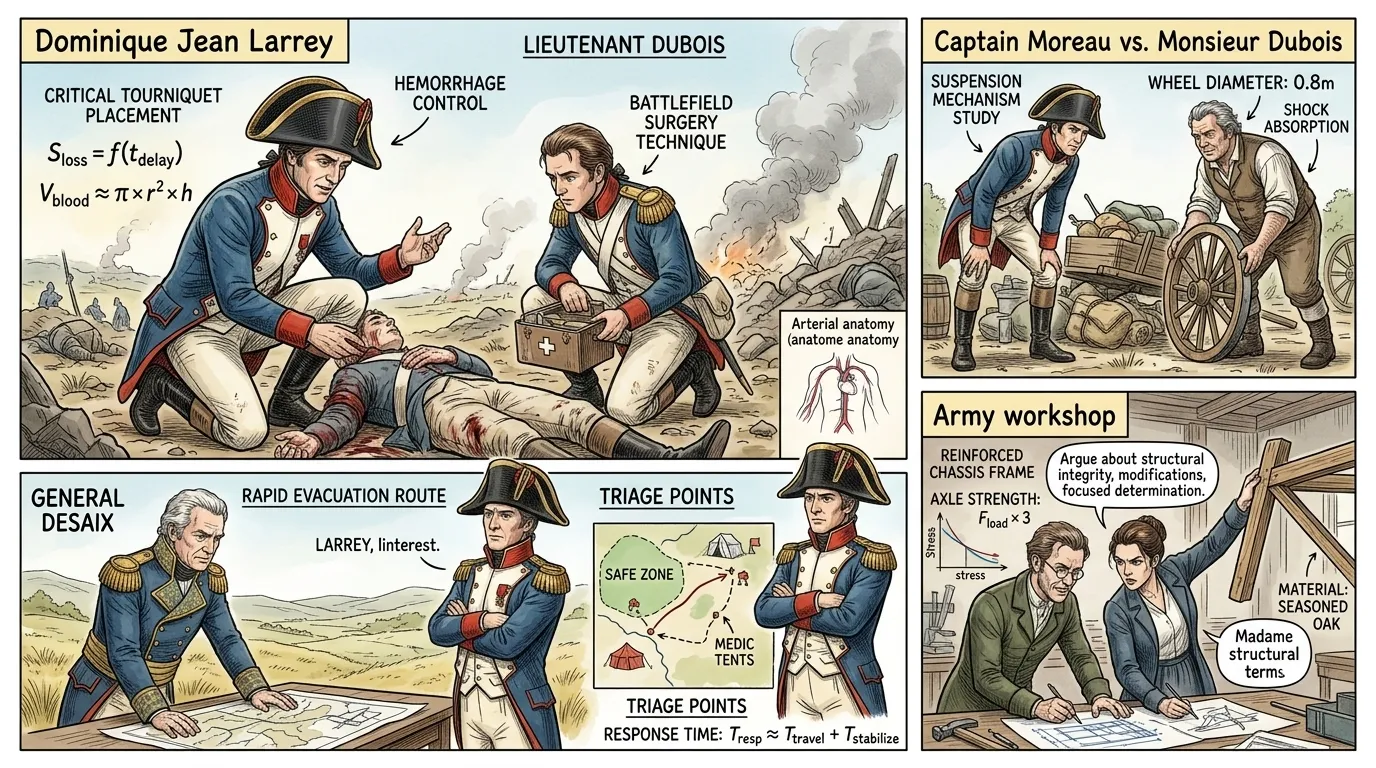
Larrey's extensive experience as a field surgeon taught him a crucial, yet often overlooked, principle: the speed of medical intervention directly correlated with patient survival rates. Delay was not merely inconvenient; it was fatal. This understanding would become the foundational knowledge for his revolutionary invention.
"'We observe time and again that a mere few hours can dictate a man's fate,' Larrey explained to a junior surgeon, Lieutenant Dubois, as they knelt over a fallen soldier. 'Immediate hemorrhage control, stabilization of fractures—these critical first steps are nullified by transport delays.' Lieutenant Dubois, a younger man with earnest eyes, responded, 'But what choice do we have, sir? The conventional wisdom dictates we wait for the battle's conclusion.'"
Page 3
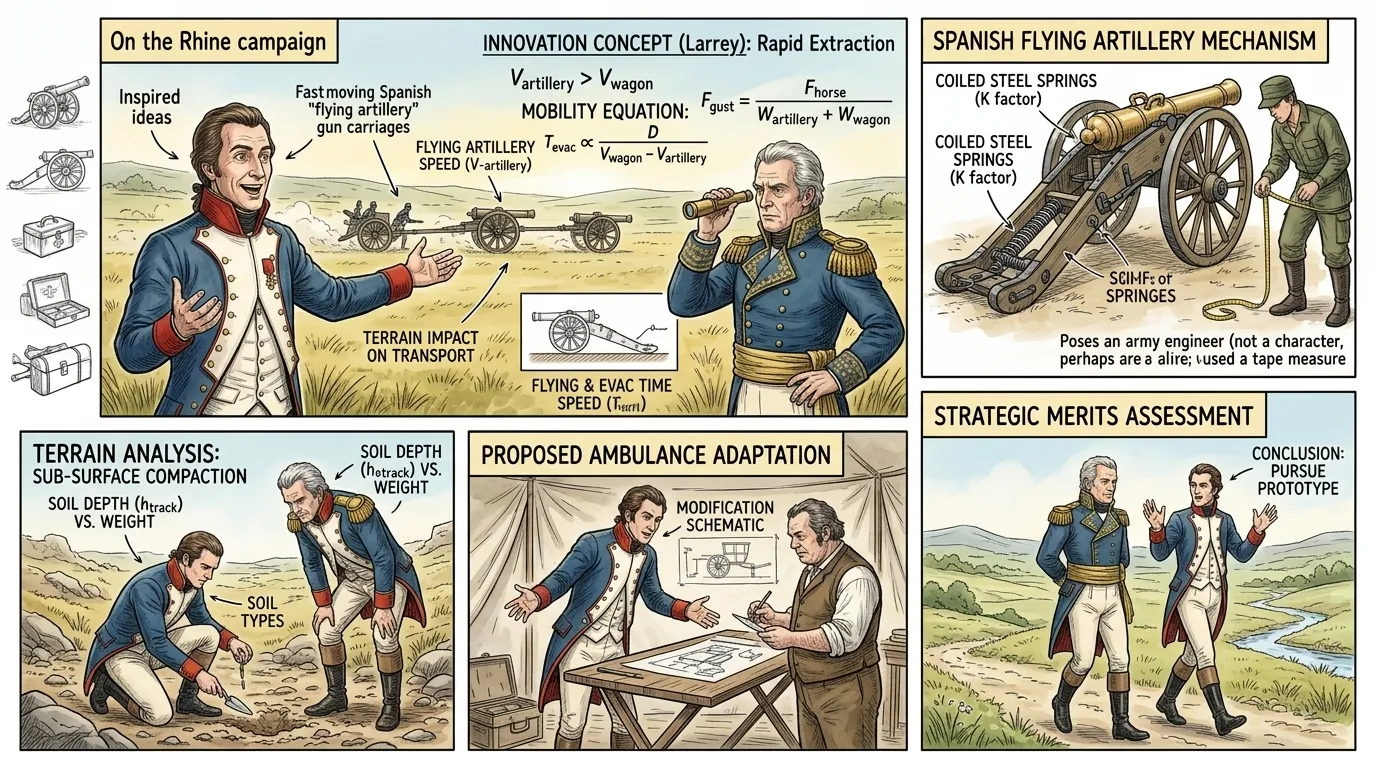
During the Rhine campaign, Larrey observed the Spanish military's rapid artillery carriages, known as 'flying artillery.' These lightweight, horse-drawn vehicles could maneuver quickly across rough terrain. This innovation sparked an idea: if artillery could be mobilized with such agility, why not medical transport?
"'See how their 'flying artillery' moves?' Larrey pointed across a field to fast-moving Spanish gun carriages, speaking to his companion, General Desaix, a distinguished officer with a keen strategic mind. 'That speed, that responsiveness—it is what our medical corps desperately lacks.' General Desaix, a man of solid build with greying temples and a thoughtful expression, considered this. 'You propose to adapt such vehicles for the wounded, Larrey? A bold notion, indeed, but one that could save lives if executed effectively.'"
Page 4
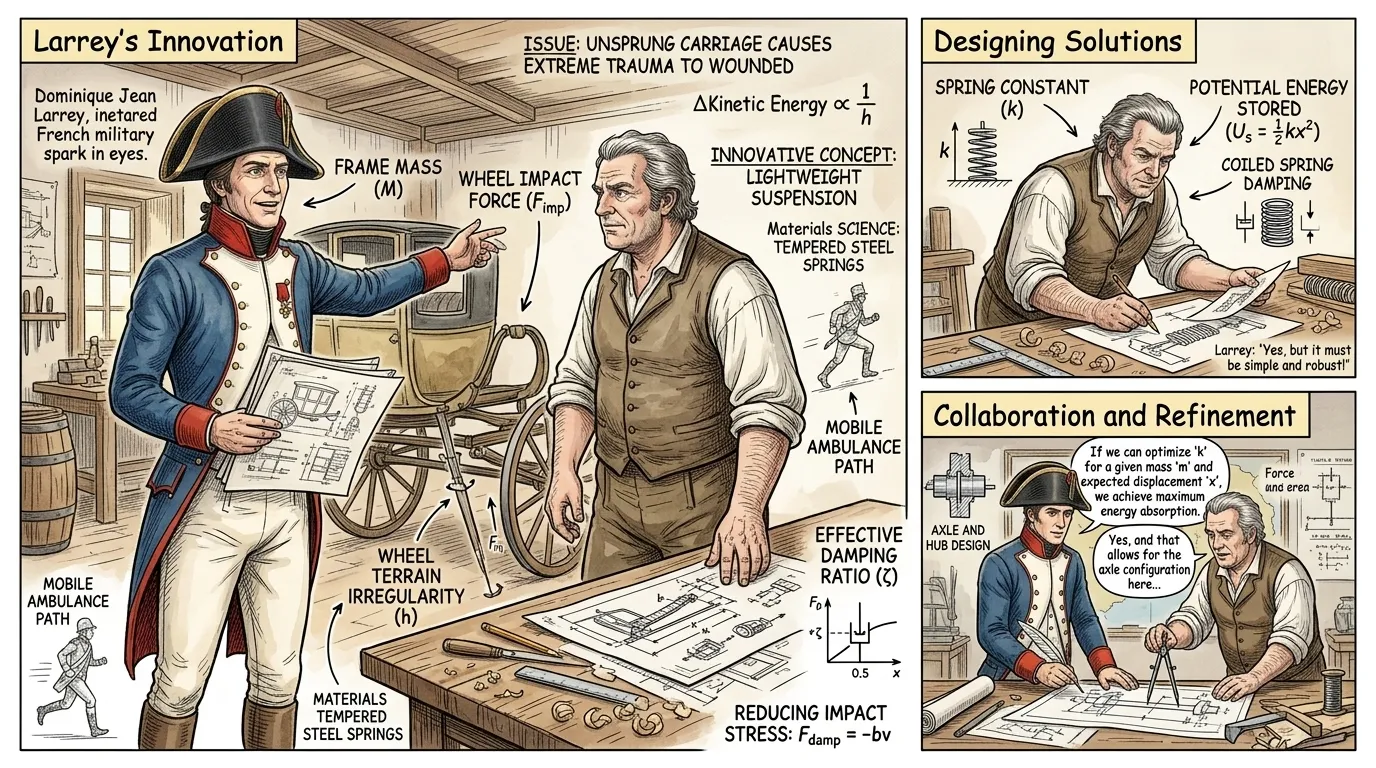
Inspired by the Spanish artillery, Larrey began to conceptualize a purpose-built medical carriage. His design focused on speed, stability, and immediate accessibility. He proposed a lightweight, two-wheeled vehicle, specifically sprung to reduce jarring, capable of carrying two to three wounded soldiers directly from the battlefield.
"'The critical factor is suspension,' Larrey explained to a master carriage maker, Monsieur Dubois, in his workshop, gesturing at a rudimentary carriage frame. 'Early prototypes were too rigid, causing immense pain.' Monsieur Dubois, a stout man with calloused hands and a practical demeanor, examined Larrey's sketches. 'Leaf springs, perhaps? We can adapt the design used for lighter market carts, but reinforced for battlefield stresses.' Larrey added, 'And ease of loading, Monsieur. Every second counts.'"
Page 5
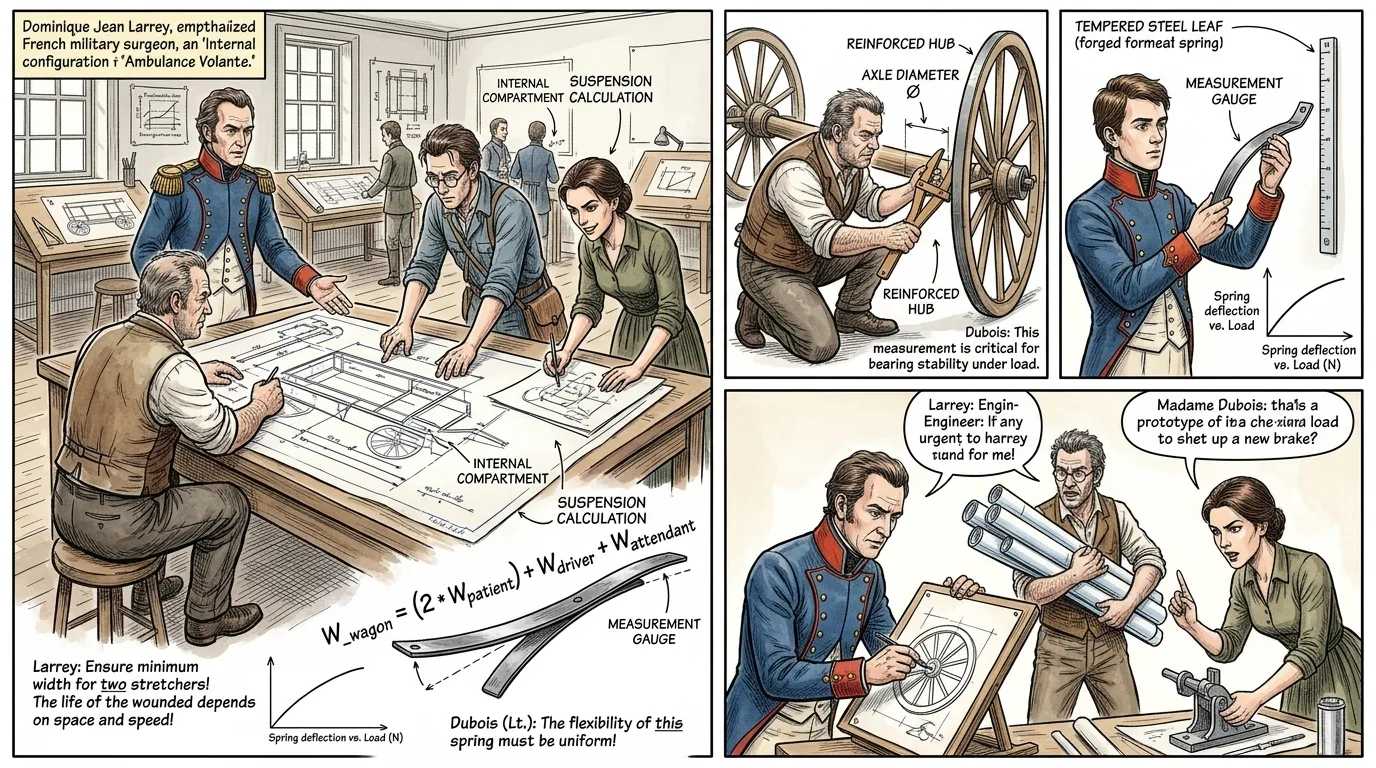
Larrey's 'Ambulance Volante' wasn't just fast; it was engineered for the specific demands of battlefield medicine. He envisioned a small team of trained medical orderlies accompanying each ambulance, capable of providing initial first aid at the point of injury before rapid transport to a field hospital.
"'The internal configuration is as vital as the chassis,' Larrey emphasized to a group of army engineers, indicating a detailed blueprint. 'Securing the stretcher, storing basic surgical tools—these are not afterthoughts.' Engineer Leclerc, a meticulous man with spectacles perched on his nose, traced a finger along the diagram. 'We can integrate hinged side panels for quick access and robust anchor points to prevent jostling. The design must accommodate swift ingress and egress, even under fire.' Another engineer, Madame Dubois, a sharp-featured woman sketching her own modifications, added, 'And a durable canopy, of course, to shield from elements.'"
Page 6
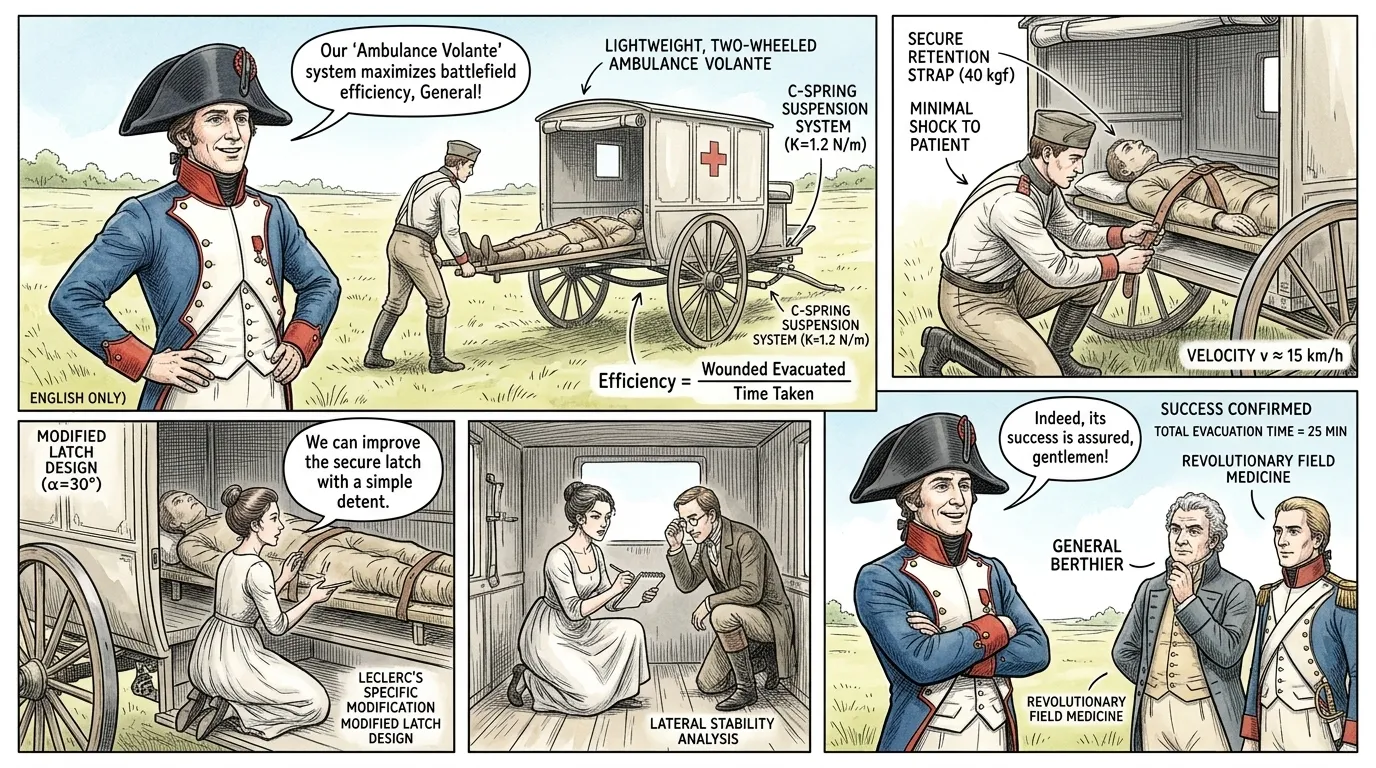
The 'Ambulance Volante' operated on a clear, three-stage mechanism. First, rapid deployment: lightweight vehicles, often pulled by two horses, could follow troops into battle. Second, immediate retrieval: orderlies would locate and load the wounded. Third, swift transport: patients were moved quickly to advanced aid stations, minimizing travel time and stabilizing injuries.
"'Imagine the efficiency,' Larrey explained, overseeing a demonstration of the prototype. 'No longer waiting. The moment a man falls, our crews move in.' A medical orderly, Sergeant Moreau, demonstrated securing a 'patient' onto the stretcher, which then slid smoothly into the carriage. 'The spring system significantly reduces the jolting, sir, as you specified. It's a marked improvement from the old wagons.' Larrey affirmed, 'Precisely. Speed and comfort, married together for the first time on the field.'"
Page 7
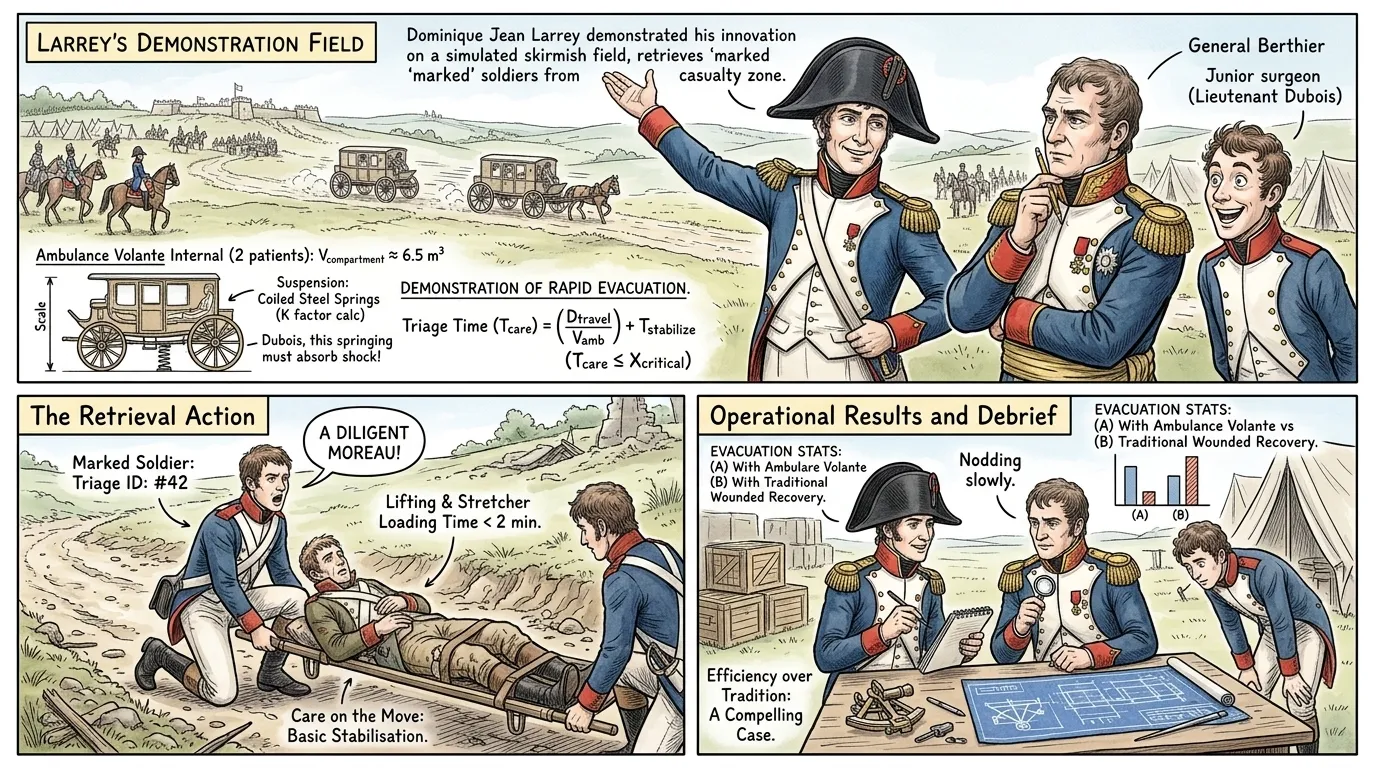
The introduction of the 'Ambulance Volante' dramatically altered battlefield medical practice. For the first time, systematic and rapid evacuation became possible. This proactive approach significantly reduced mortality rates by ensuring that critical care could begin sooner.
"'The psychological impact alone is immense,' observed General Berthier, watching Larrey's ambulances swiftly retrieving wounded during a simulated skirmish. 'Soldiers fight with greater resolve, knowing they won't be abandoned.' Larrey nodded. 'Indeed, General. But the tangible results are even more striking. We've seen a measurable increase in survival for severe injuries, simply by reducing the time to definitive treatment.' A junior officer nearby remarked, 'This changes everything for our wounded. The men speak of it with gratitude.'"
Page 8
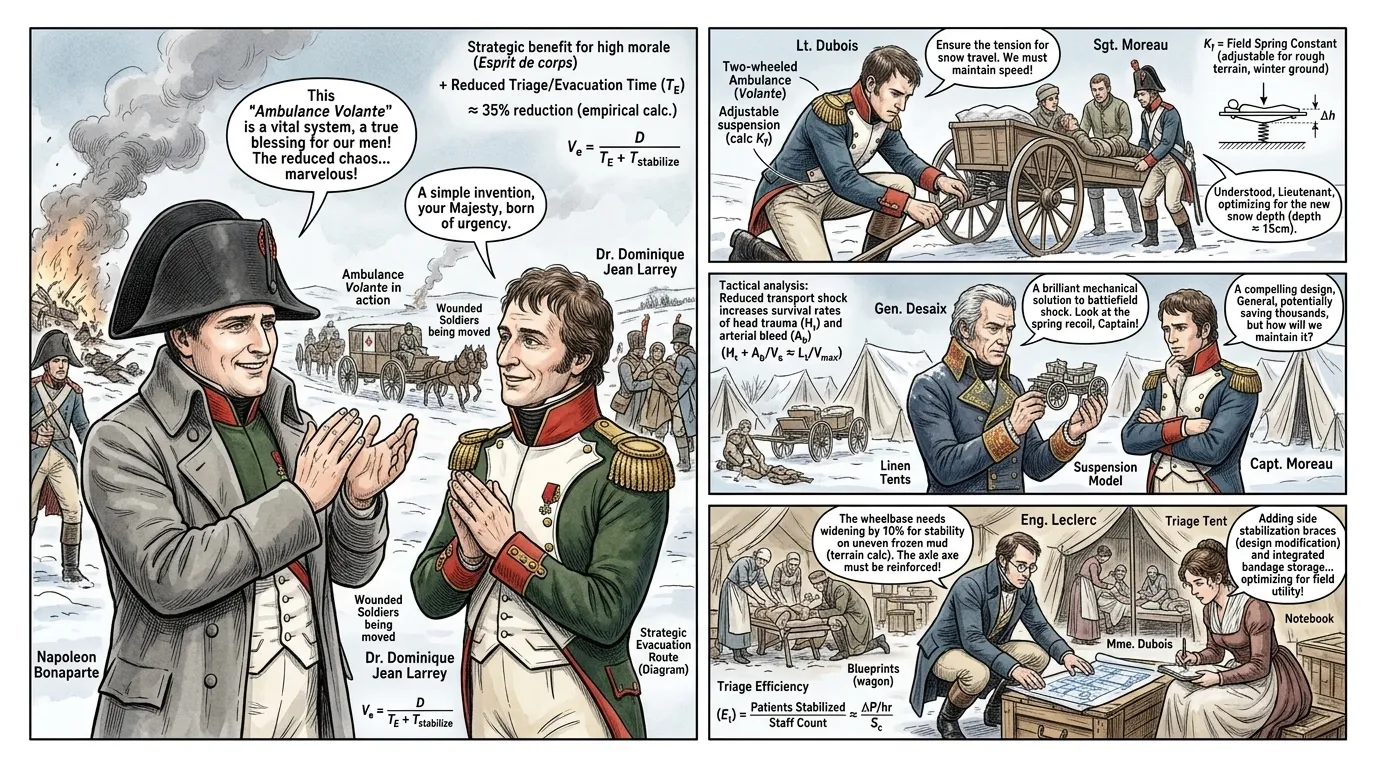
Napoleon Bonaparte himself, recognizing the critical value of Larrey's innovation, became a strong proponent. He ordered the full implementation of the 'Ambulance Volante' system throughout his armies. This endorsement cemented the ambulance's place in military history and paved the way for its eventual civilian adoption.
"'This system, Larrey, is as vital as my artillery!' Napoleon Bonaparte exclaimed to Larrey, observing the swift operation of the ambulances at the Battle of Eylau. Napoleon, a compact man with a formidable presence, wearing his iconic bicorne hat and grey overcoat, surveyed the scene with a rare look of approval. Larrey, humble yet proud, replied, 'Your Majesty, it merely actualizes what Hippocrates, the father of medicine, said centuries ago: 'The natural force within each one of us is the greatest healer of disease.' Our task is to give that natural force the greatest chance to act, and speed is paramount.' An aide nearby noted the reduced chaos and improved outcomes."
Page 9
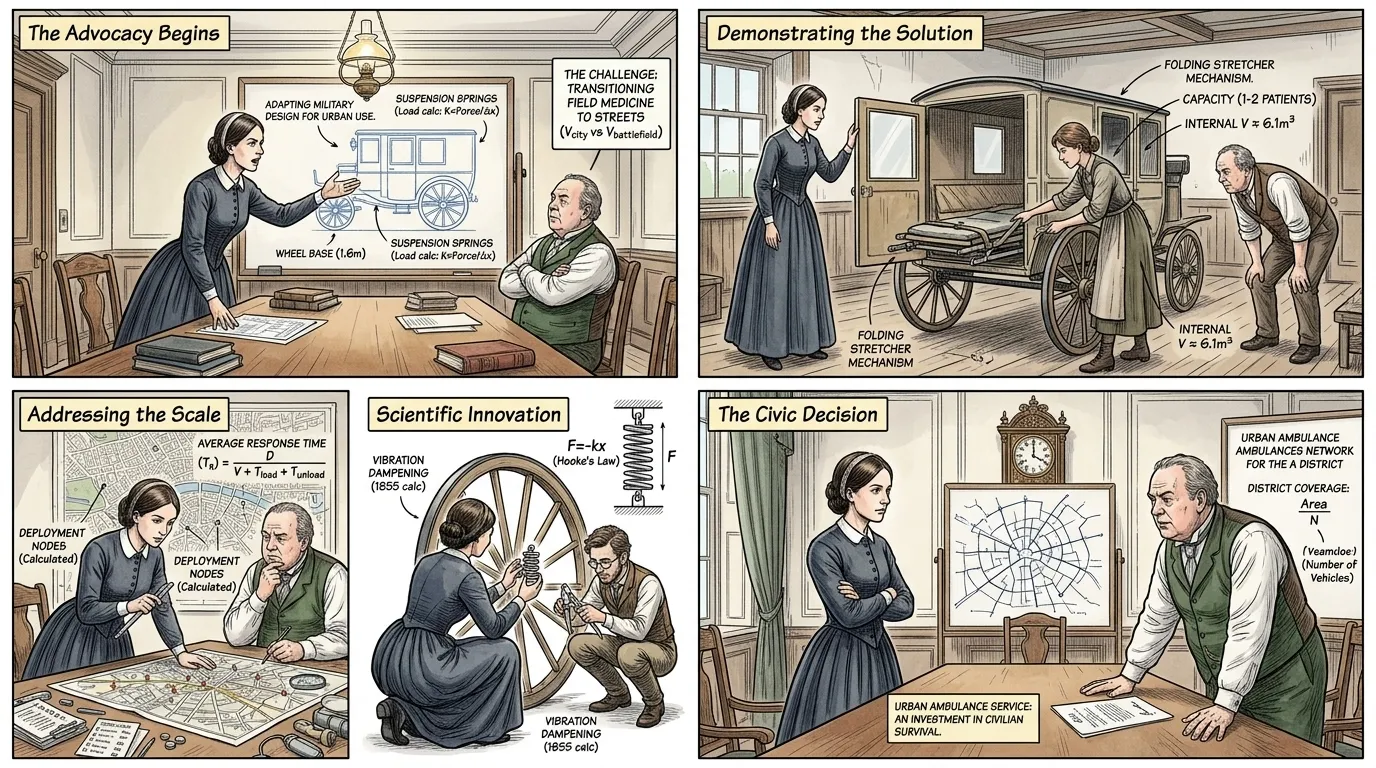
While military ambulances had existed in various forms, Larrey's 'Ambulance Volante' established the principles of rapid, dedicated, and organized pre-hospital care. Post-Napoleonic era, cities began to adapt these concepts for civilian emergencies, particularly during epidemics and urban accidents.
"'The lessons learned from the battlefield are now vital for our growing cities,' stated Florence Nightingale, during a meeting in London in the mid-19th century, advocating for structured civilian ambulance services. Nightingale, a resolute woman with her hair pulled back, wearing a modest but elegant dark dress, addressed a municipal councilor, Mr. Davies. 'The principles Larrey pioneered—swift transport and initial care—must be applied to civilian casualties. Every minute saved in transport from an accident site to the infirmary can be the difference between life and death.' Mr. Davies, a portly man in a waistcoat, stroked his chin thoughtfully. 'A dedicated corps, you say? It demands significant resources.'"
Page 10
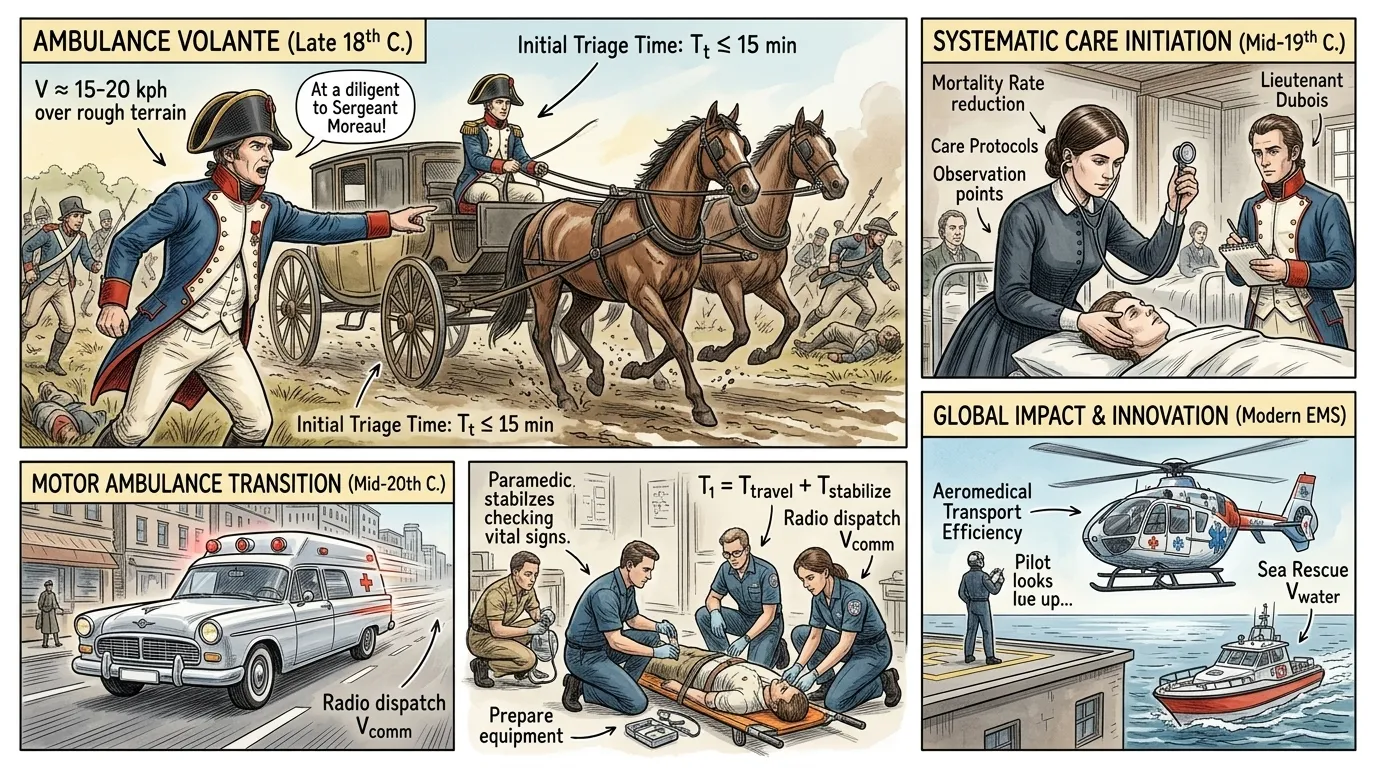
The 'Ambulance Volante' laid the groundwork for modern Emergency Medical Services. From horse-drawn carriages to sophisticated motor vehicles, helicopters, and even specialized boats, the fundamental principle remains: bringing rapid medical care to the patient, wherever they are, to maximize their chance of survival. Larrey's vision, born on a chaotic battlefield, has transformed global healthcare.
"This page focuses on the visual impact and consequence, with minimal, impactful narration rather than direct character dialogue to cover broad historical sweep. No dialogue appears here."
About this story
- Location: Global
- Audience: general readers
Questions and answers
Read Wonder Inventions on your phone
Wonder Inventions is available on Android. Get Wonder Inventions on Google Play.