Bluetooth
Bluetooth — an illustrated inventions story, set in Global. 10 illustrated pages, free to read on Wonder Inventions.
Page 1
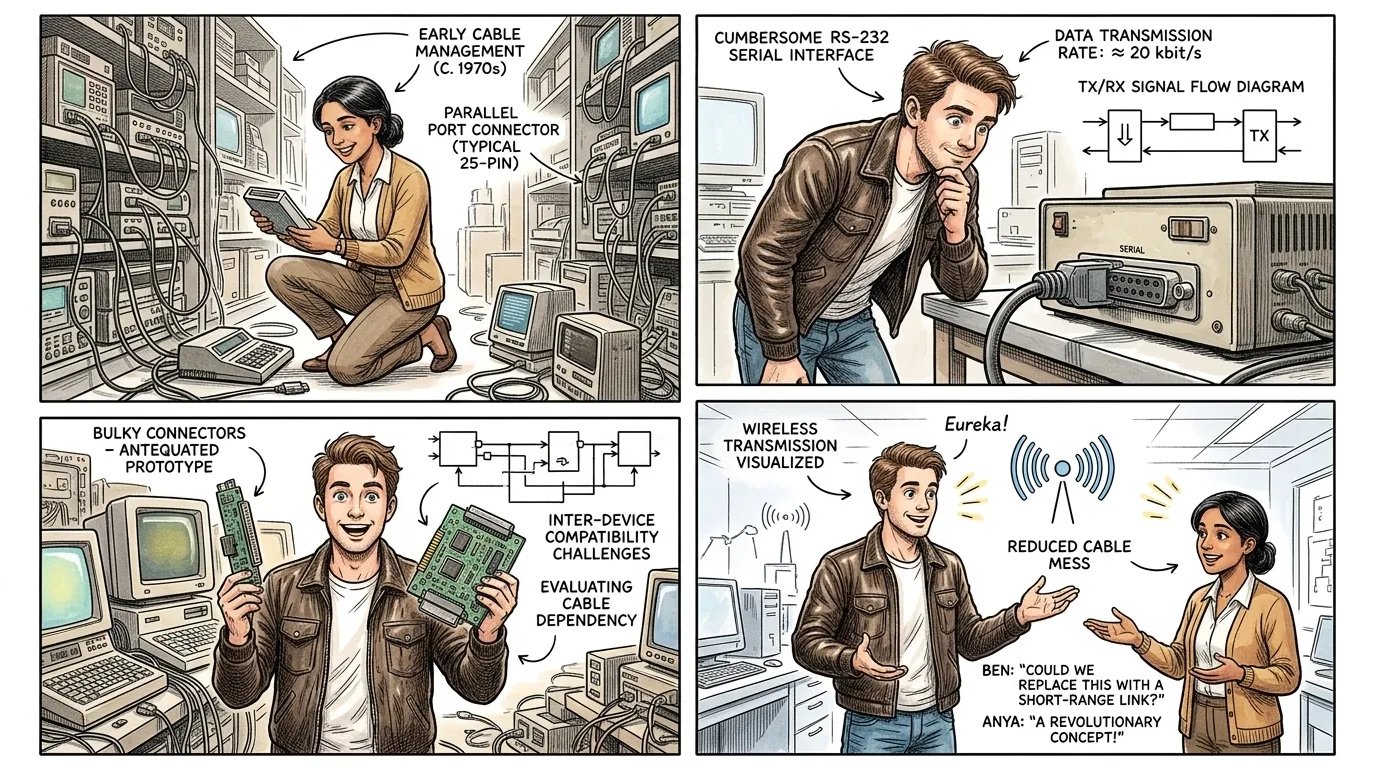
Dr. Anya Sharma meticulously cataloged the sprawling array of vintage electronics, each device tethered by a thick, tangled cable. Dr. Ben Carter, leaning over a desk laden with obsolete connectors, sighed. "Before the late 20th century, digital connections were a literal maze of wires, proprietary ports, and frustrating incompatibilities," he observed, gesturing towards a cumbersome serial port.
""Indeed," Anya replied, her brow furrowed. "Imagine trying to coordinate multiple peripherals – a mouse, a printer, a modem – all within a confined workspace, each demanding its own unique, often clunky, physical link. It was a testament to inconvenience." Ben picked up a discarded prototype circuit board with strangely bulky connectors. "These early designs, before 1994, were often limited by physical constraints, demanding direct, often inflexible, lines of communication.""
Page 2
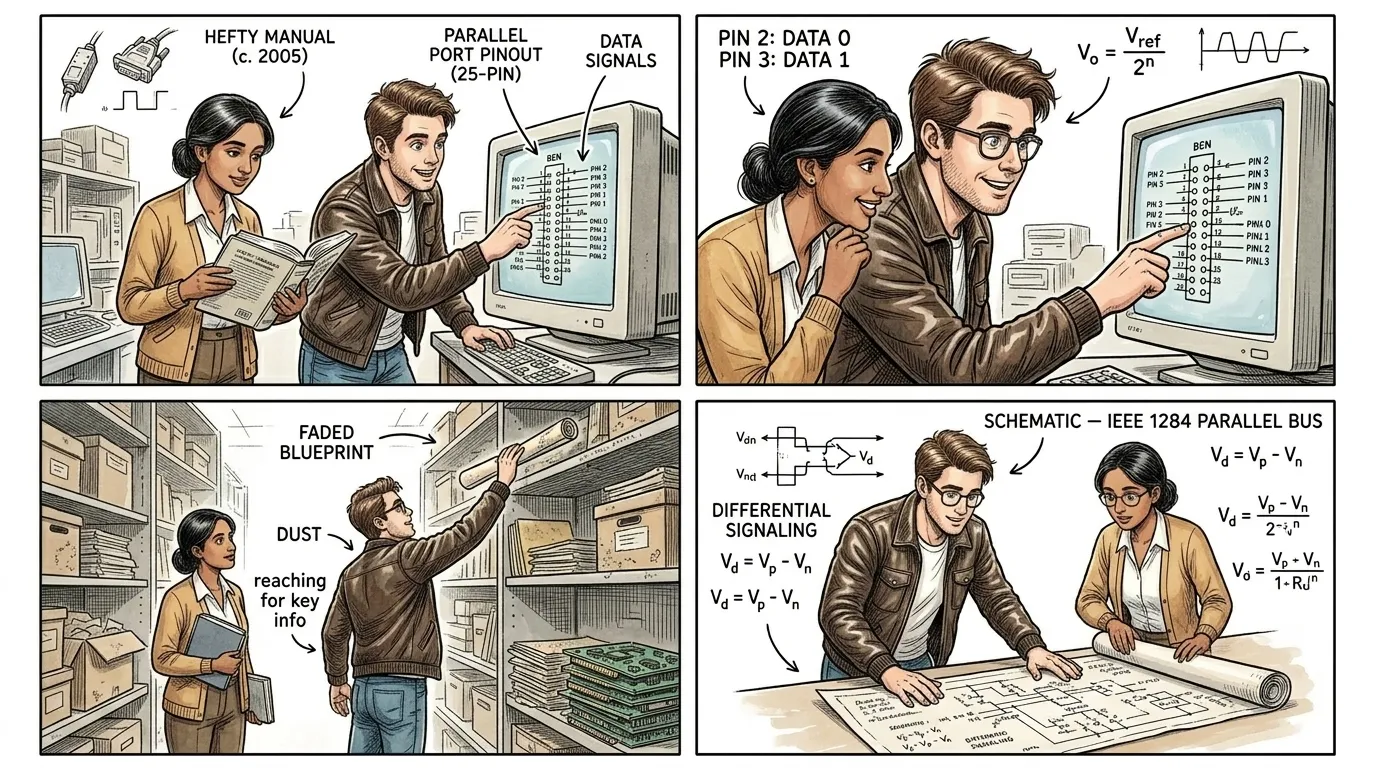
The challenge wasn't just physical clutter; it was the lack of a universal standard that plagued computing. Every manufacturer had their own cable, their own plug, and their own data protocol. This fragmented landscape severely hindered seamless device interaction, creating digital islands rather than a connected ecosystem. Anya picked up a hefty instruction manual for a decade-old printer.
""The fundamental desire was for a universal standard, a way for devices to communicate without proprietary restrictions," Ben explained, pointing to a diagram of a complex parallel port. "These connectors, while functional, were barriers. They were slow, expensive to manufacture, and required precise alignment, making connection a frustrating chore." Anya nodded. "Imagine," she added, "trying to network a dozen devices in a single office room with this level of chaos – a true impedance to productivity and innovation." Ben then spotted an old, faded blueprint rolled up on a shelf, covered in dust. "Look at this, Anya. 'Project Haraald: Wireless Link Protocol, preliminary designs.' It seems incomplete, but intriguing.""
Page 3
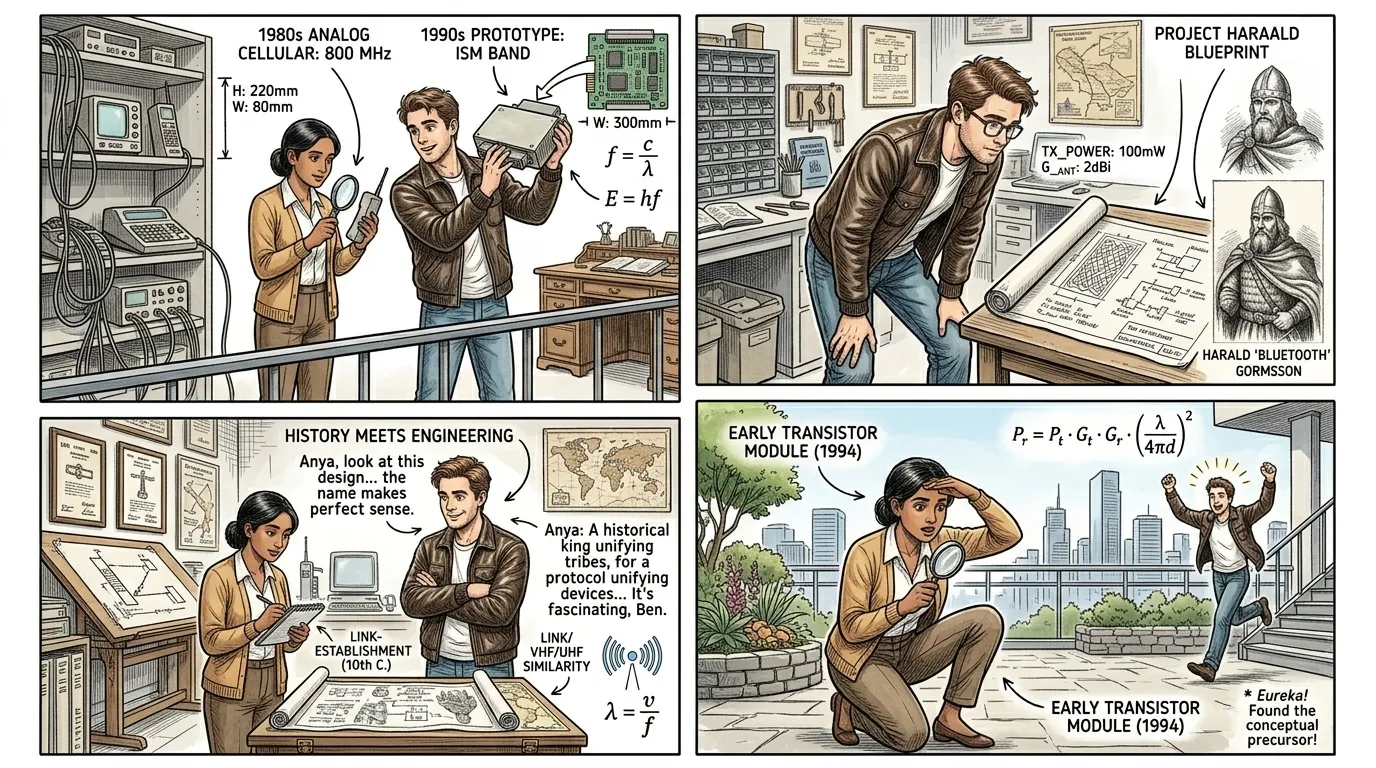
Before Bluetooth, early attempts at short-range wireless communication were often rudimentary, plagued by inefficiency and interference. These systems typically operated on single frequencies, making them susceptible to jamming and limiting their practical application. The vision for a truly robust, versatile wireless standard remained elusive.
"Anya unrolled the 'Project Haraald' blueprint. "These early radio communication attempts for short-range data were fascinating, but so unreliable," she observed. "Many were power-hungry and suffered terribly from signal interference, especially in crowded radio environments." Ben leaned closer to the blueprint. "Precisely. And the naming of 'Bluetooth' itself is quite poetic, isn't it?" He gestured to a historical etching on the blueprint margin. "It's a direct nod to the 10th-century Viking king, Harald 'Bluetooth' Gormsson, who was known for uniting disparate Scandinavian tribes.""
Page 4
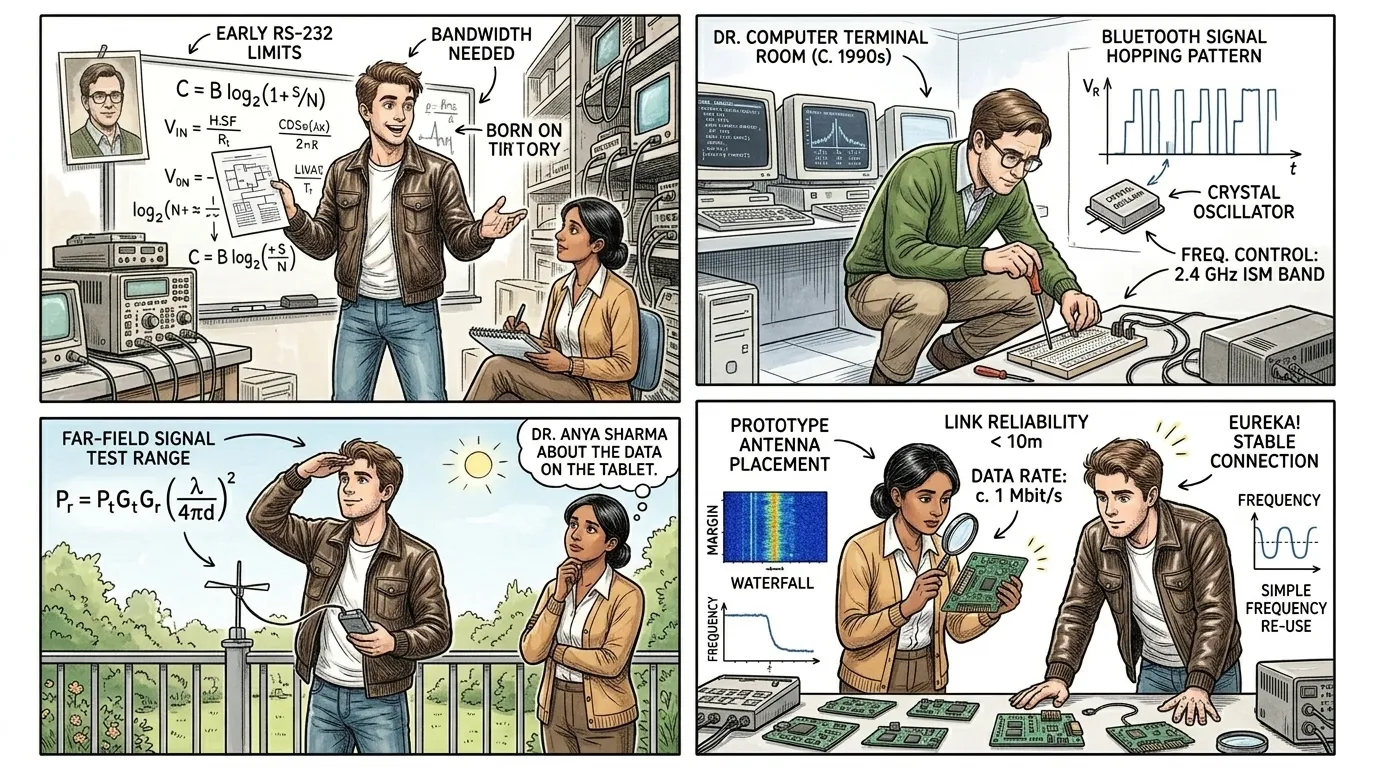
The imperative to create a low-cost, low-power, and globally compatible short-range radio standard became a critical objective for telecommunications giant Ericsson in the early 1990s. This challenging task was assigned to a brilliant Dutch electrical engineer, Dr. Jaap Haartsen, working at Ericsson's research facility in Lund, Sweden.
""Dr. Jaap Haartsen at Ericsson was the key figure," Ben explained, pointing to an old photo of Haartsen on a monitor. "His mandate was clear: develop a universal wireless interface that could replace cables, consume minimal power for battery-operated devices, and coexist gracefully with other radio signals in the 2.4 GHz industrial, scientific, and medical, or ISM, band. It was an ambitious technical tightrope walk." Anya nodded, examining schematic diagrams of radio frequencies. "It wasn't just about sending data; it was about doing it cleanly and efficiently without causing or succumbing to widespread interference – a complex engineering puzzle for the time.""
Page 5
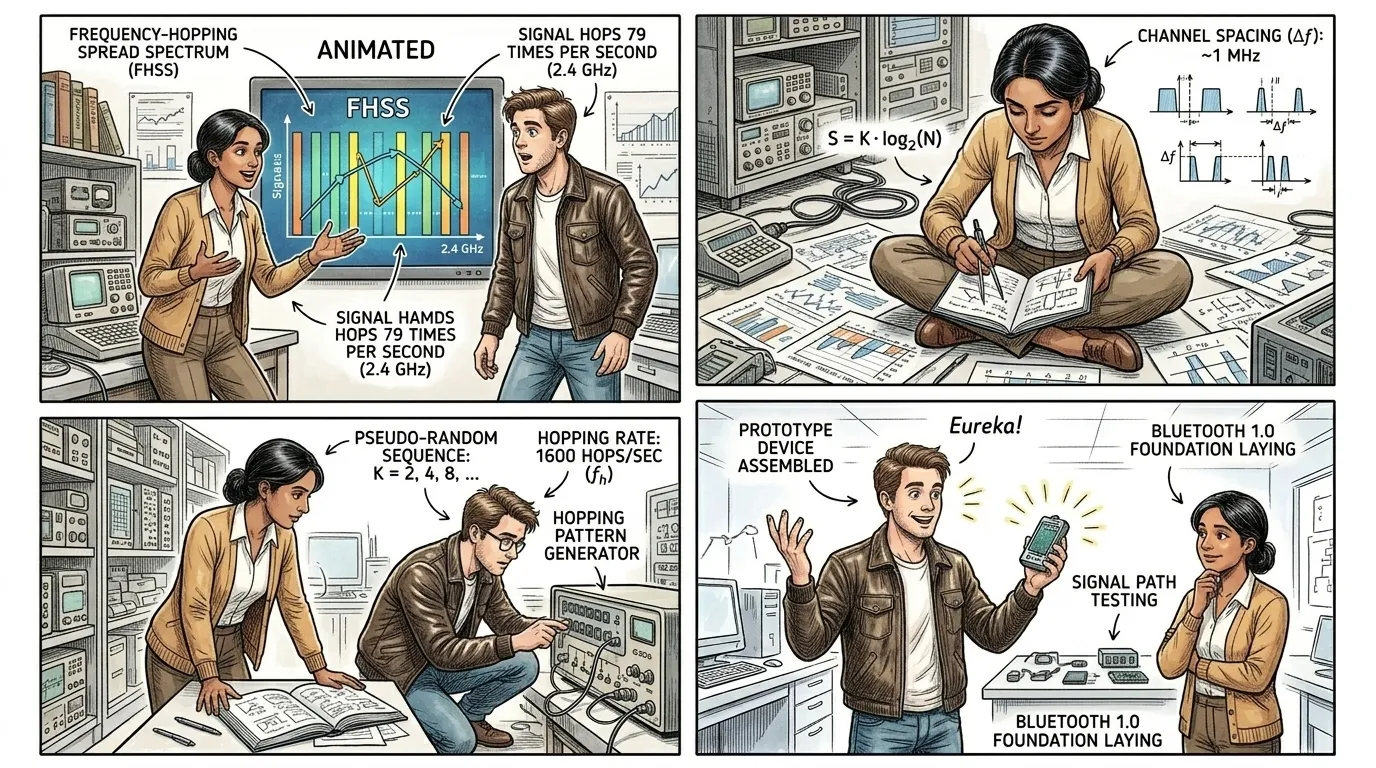
The central challenge lay in enabling reliable communication within the crowded 2.4 GHz ISM band, a public, unregulated frequency space also used by Wi-Fi, cordless phones, and microwave ovens. Haartsen's breakthrough was a deceptively simple yet profoundly effective technique: frequency hopping spread spectrum (FHSS). This ingenious method circumvented interference by not relying on a single, continuous channel.
""Haartsen's elegant solution was to implement frequency hopping spread spectrum," Anya explained, pointing to a dynamic diagram on a large display. "Instead of transmitting on one static frequency and risking jamming, the Bluetooth radio rapidly switches frequencies many times per second – precisely 1,600 times a second, across 79 different channels within the 2.4 GHz band!" Ben added, his eyes wide. "It's like having a secret, synchronized code. Two paired devices constantly jump between frequencies together, making it incredibly difficult for other signals to continuously interfere or for unwanted eavesdroppers to track the communication. This 'hopping' effectively spreads the signal's energy across a wider spectrum, enhancing robustness.""
Page 6
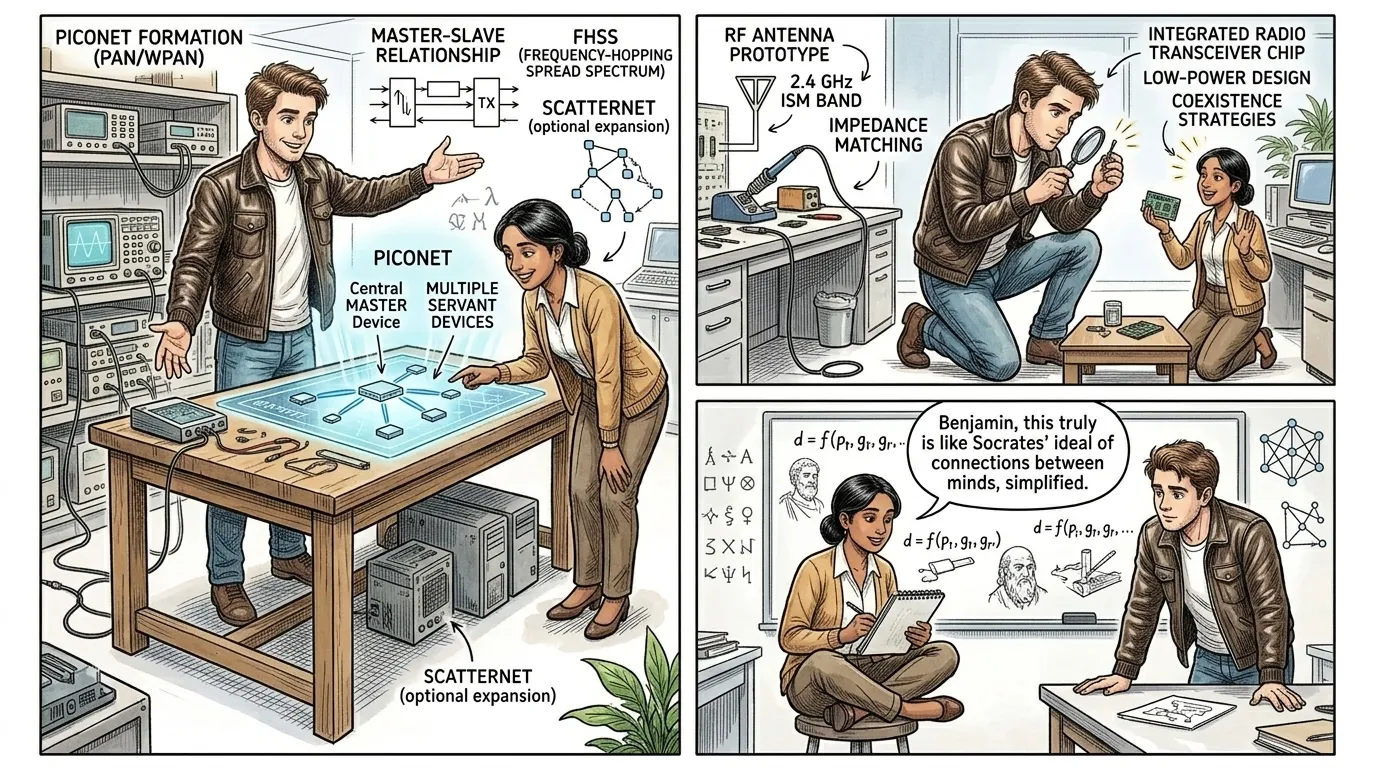
The foundation of Bluetooth's operational structure is the 'piconet,' a small, ad-hoc network formed between connected devices. This master-slave relationship enables efficient, localized communication without the need for complex network configurations. The piconet concept was pivotal in realizing the vision of seamless device interoperability.
""The real genius also lies in the piconet concept," Ben elaborated, gesturing to a holographic diagram that appeared on the workbench. "When two Bluetooth devices first connect, one automatically assumes the role of 'master,' initiating the connection. Up to seven other devices can then become 'slaves,' all synchronized to the master's unique frequency hopping sequence." Anya chimed in, "They essentially create a tiny, self-contained, and secure network. This synchronization is crucial; all devices within that piconet jump frequencies together, maintaining their communication link amidst the radio noise." She added thoughtfully, referencing an ancient philosopher: "'The only true wisdom is in knowing you know nothing,' as Socrates once said. Haartsen embraced this principle of continuous learning and refinement, iterating on his approach to find such an elegant solution.""
Page 7
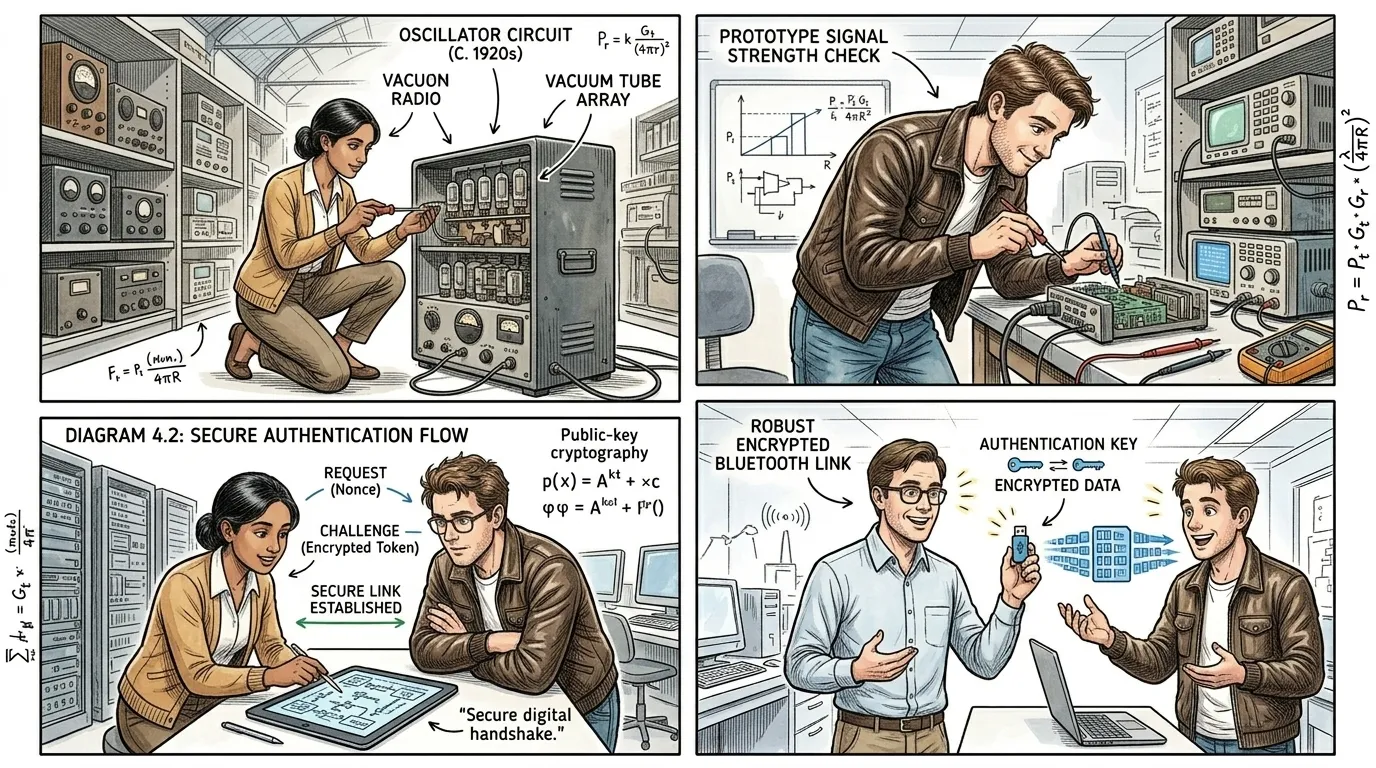
Beyond establishing a piconet, robust security and reliable data transfer were paramount. Bluetooth engineers devised a sophisticated pairing process to ensure secure communication, employing encryption and authentication mechanisms that protect transmitted data. This digital 'handshake' ensures that only authorized devices can exchange information.
"Anya explained the critical pairing process. "Before devices can communicate, they undergo a digital handshake – pairing. This involves exchanging authentication keys and establishing an encrypted link," she clarified, pointing to a diagram showing data packets securing themselves. "It's a foundational step to establishing trust and ensuring that only authorized devices can send and receive information securely." Ben added, watching a visual representation of data packets. "Once paired, small packets of data – whether it's audio, control commands, or other digital information – can be sent wirelessly. Bluetooth incorporates robust error correction protocols, ensuring the reliability of these transmissions even in challenging environments. This sophisticated yet low-power operation was key to its widespread adoption.""
Page 8
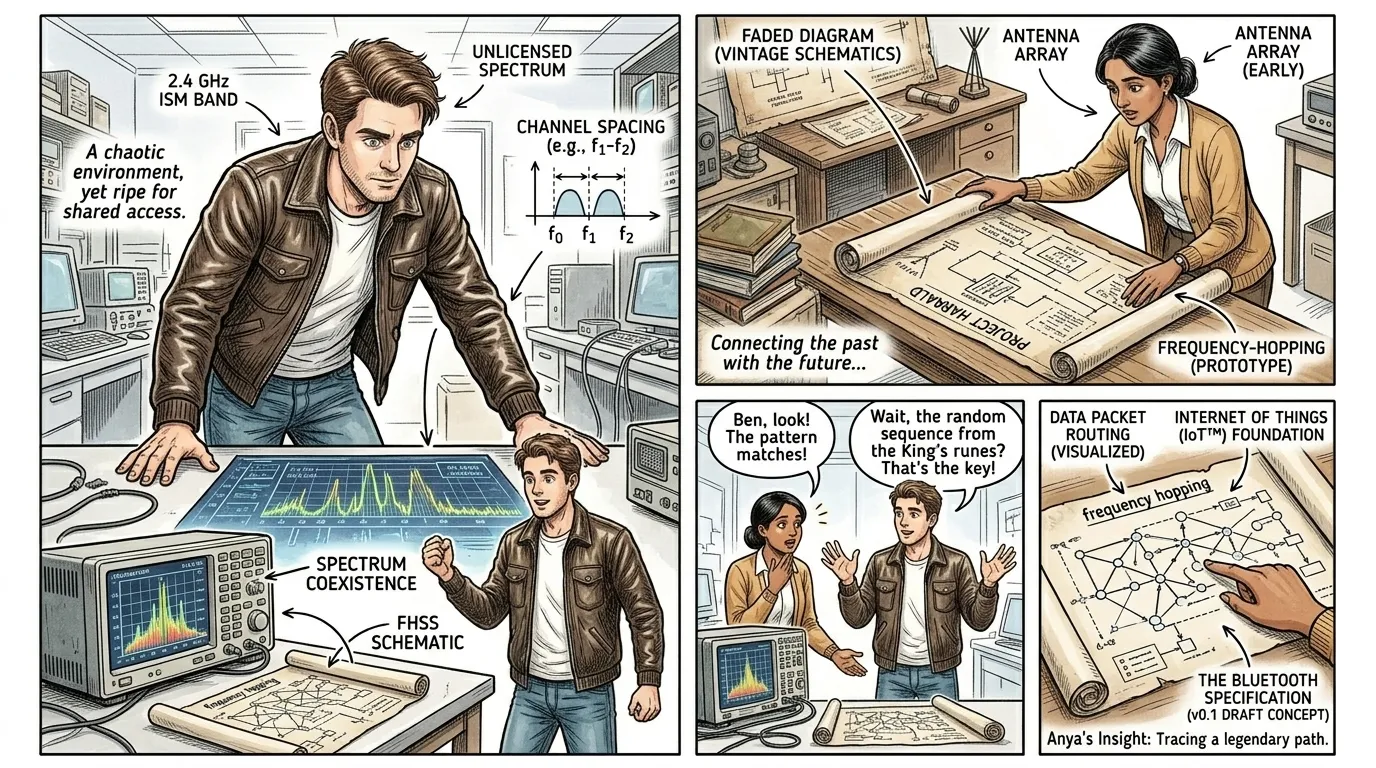
One of Bluetooth's most significant challenges was its operation within the shared and often crowded 2.4 GHz ISM band. Engineers had to devise strategies to minimize interference with other technologies like Wi-Fi while simultaneously ensuring low power consumption, crucial for battery-powered mobile devices. This intricate balance of coexistence and efficiency defined its practical viability.
"Ben pointed to a complex spectrum analyzer display. "The clever engineering truly allowed Bluetooth to operate effectively in the incredibly crowded 2.4 GHz ISM band, where Wi-Fi, cordless phones, and even microwave ovens also reside," he explained. "The rapid frequency hopping, combined with short, bursty packet transmissions and adaptive power control, became paramount. These techniques minimize interference and, crucially, conserve energy, making it ideal for battery-powered devices." Anya picked up the old 'Project Haraald' blueprint again, carefully unrolling it to the 'frequency hopping' section. "Remember this 'frequency hopping' section we found in the old blueprint?" she asked, tracing a finger over the faded diagram. "It was the core idea, but the real genius lay in how they adapted it—with precision timing, burst transmissions, and adaptive power—to coexist with other signals and manage power. That was the engineering triumph that turned a concept into a usable, low-power standard!""
Page 9
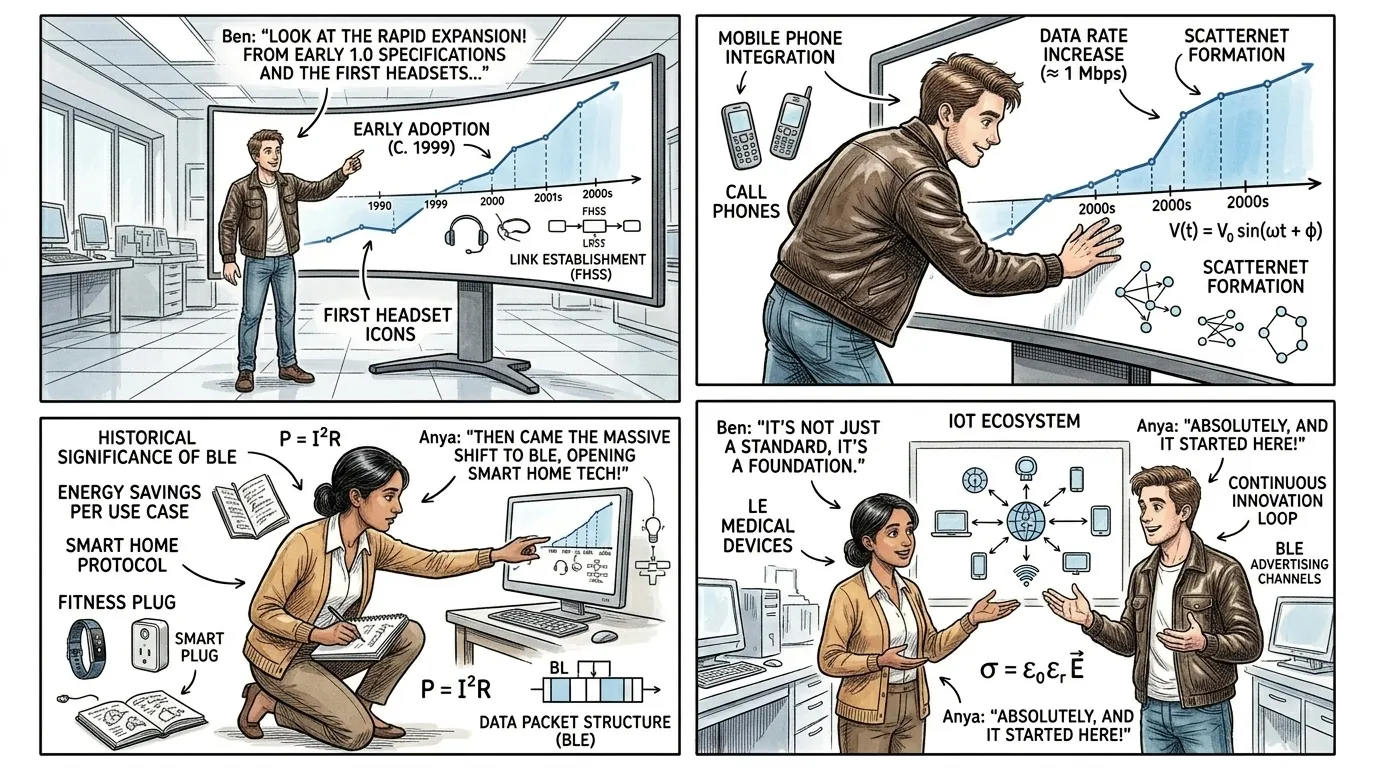
Bluetooth's journey from a technical concept to a pervasive standard was not instantaneous. After its initial release in 1999, adoption was gradual, but a tipping point was reached in the early 2000s as mobile phones became ubiquitous. Its continued evolution, particularly with Bluetooth Low Energy (BLE), cemented its role in the burgeoning Internet of Things.
""Bluetooth's commercial adoption initially moved at a measured pace, but its growth became explosive in the early 2000s, especially with the rise of feature phones and smartphones," Ben explained, pointing to a timeline. "Wireless headsets, keyboards, and mice became commonplace. It truly became the invisible thread connecting our personal electronics, quietly enabling new functionalities." Anya added, "And its evolution hasn't stopped. From early versions like Bluetooth 1.0 to Bluetooth Low Energy, or BLE, it continues to adapt. BLE dramatically extended battery life, opening doors to fitness trackers, smart home devices, and countless other applications, demonstrating incredible foresight in its ongoing development.""
Page 10
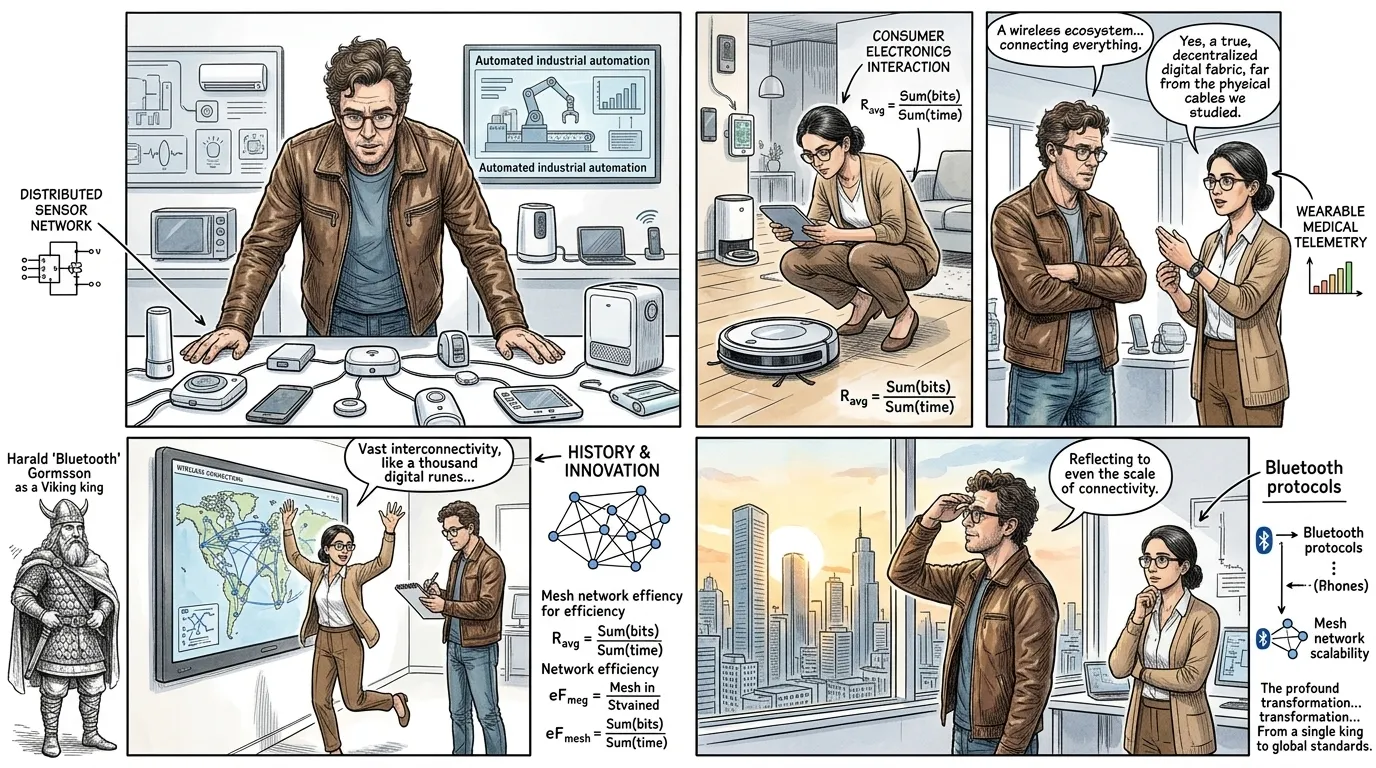
Today, Bluetooth is an invisible, indispensable layer of our digital infrastructure, connecting billions of devices worldwide. Its impact spans far beyond personal electronics, reaching into healthcare, industrial automation, and smart cities. The once complex problem of tangled wires and incompatible devices has been elegantly resolved, transforming daily interactions.
"Dr. Ben Carter looked around the lab, a look of quiet satisfaction on his face. "Bluetooth truly fulfilled the vision hinted at by Harald Bluetooth's legacy," he mused, "unifying disparate devices into a seamless, personal network that has become almost entirely transparent to the user." Dr. Anya Sharma nodded, her gaze reflecting on the profound transformation. "From enabling hands-free communication in cars to precise medical sensors monitoring vital signs, and from connecting industrial sensors for predictive maintenance to syncing our daily fitness trackers, this simple short-range radio protocol has profoundly redefined how we interact with technology. It has, without fanfare, made our digital lives simpler, more efficient, and undeniably more connected, demonstrating the enduring power of foundational engineering innovation.""
About this story
- Location: Global
- Audience: general readers
Questions and answers
Read Wonder Inventions on your phone
Wonder Inventions is available on Android. Get Wonder Inventions on Google Play.