Bridge Suspension System
Bridge Suspension System — an illustrated inventions story, set in Global. 10 illustrated pages, free to read on Wonder Inventions.
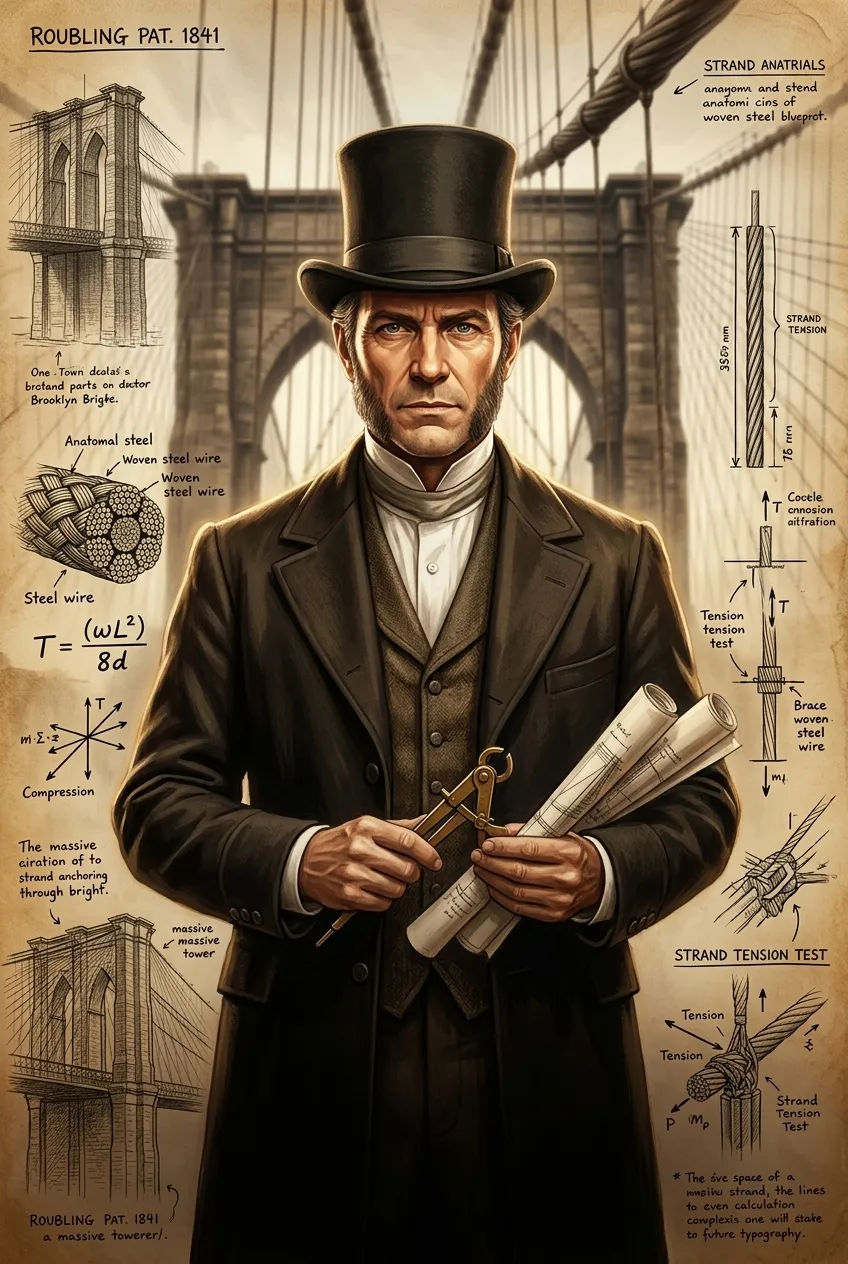
Page 1
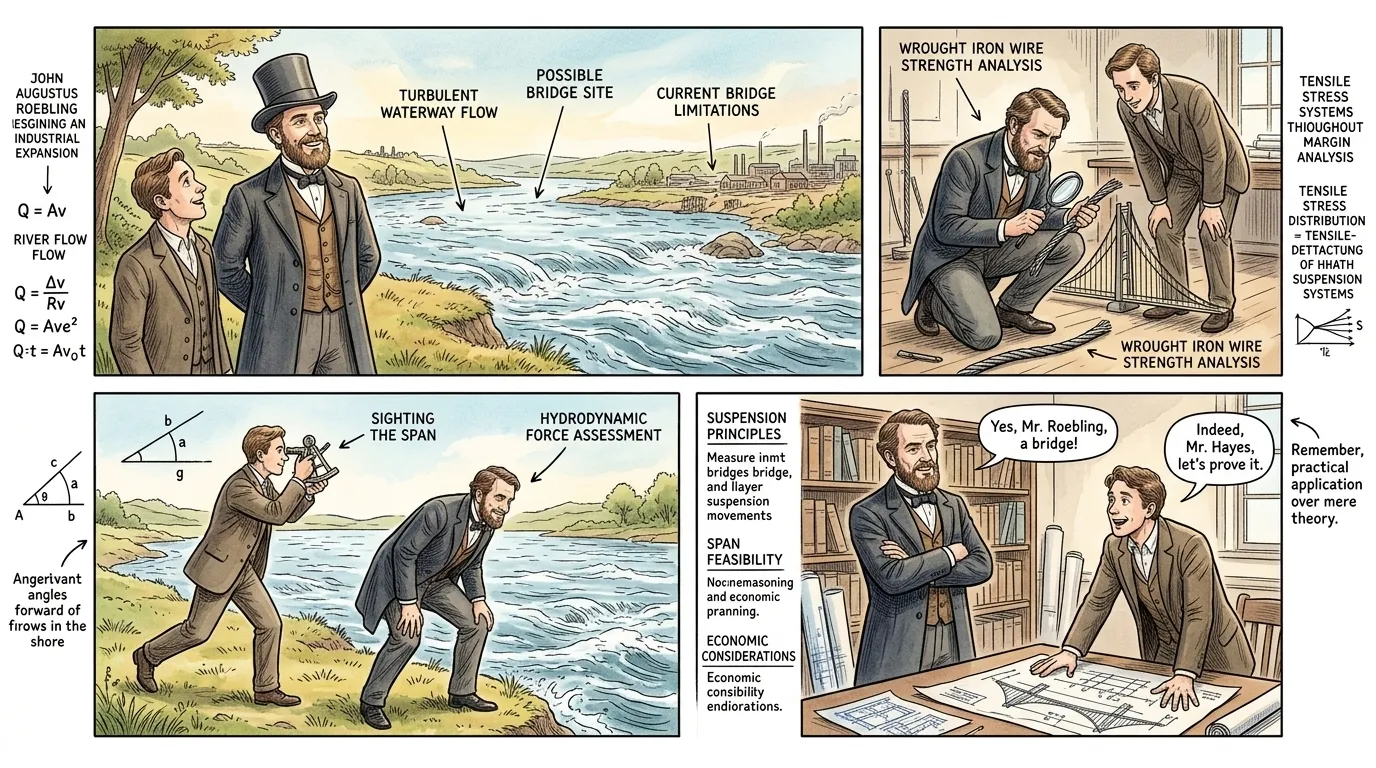
For centuries, humanity dreamed of crossing impossible chasms and vast rivers, but traditional bridge designs had inherent limitations. Heavy stone arches and rigid timber beams struggled to span distances over deep water or volatile terrain, constantly threatened by nature's immense power. The need for a radical new approach grew more urgent with the dawn of industrial expansion.
"'The sheer scale of these rivers often defeats our best efforts,' engineer John Augustus Roebling once remarked to an assistant, gazing at a wide, turbulent waterway. 'Our current methods are simply inadequate for the spans required by this new age of commerce and travel.' He envisioned a daring solution that would redefine engineering."
Page 2
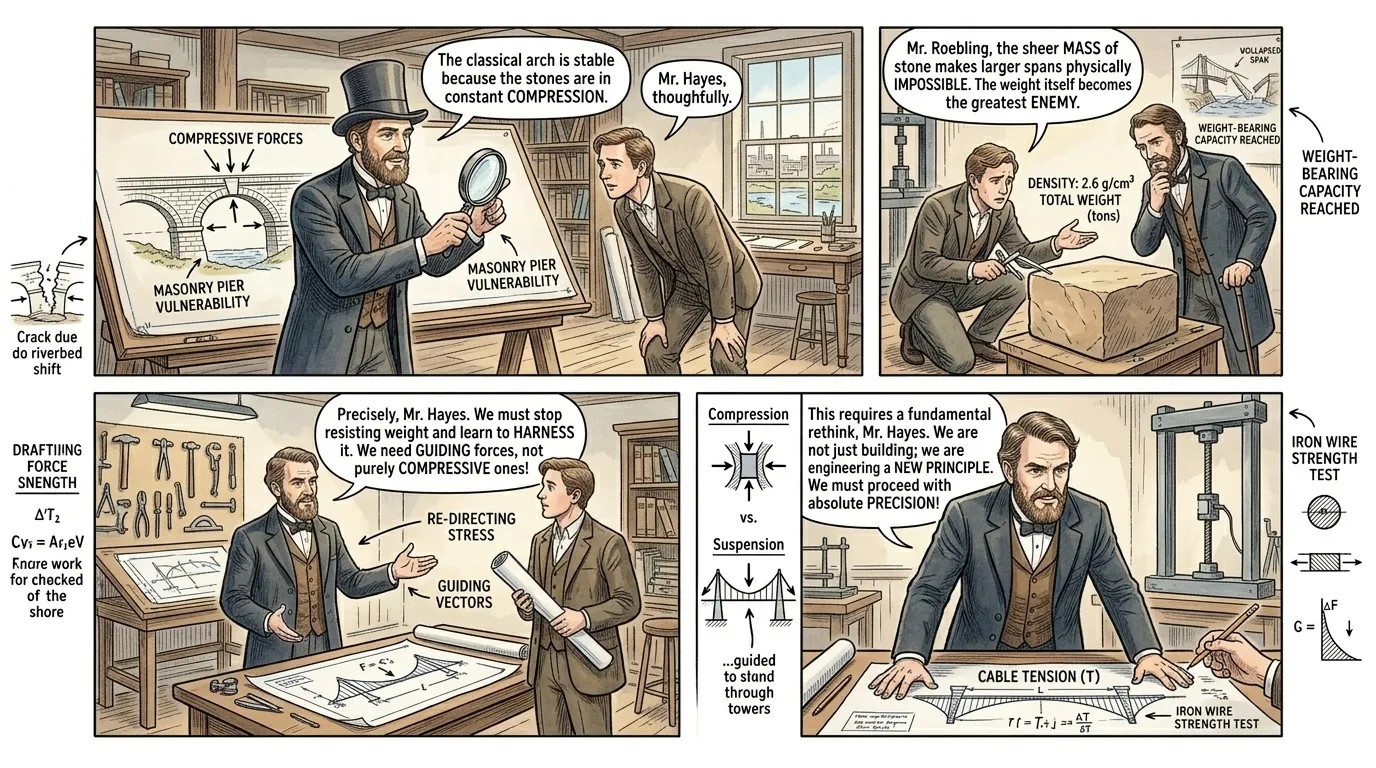
Before the advent of suspension technology, engineers grappled with the fundamental constraints of materials like stone and wood, which excelled under compression but failed miserably under tension. Building ever-larger bridges meant heavier structures, creating a vicious cycle where the bridge's own weight became its greatest enemy, especially for the immense spans needed. The critical challenge was to distribute weight and withstand powerful external forces without collapsing.
"Roebling explained, 'An arch bridge relies on pushing forces, compressive strength, to hold itself up, sending the load down into its foundations.' His assistant, Mr. Hayes, nodded, adding, 'But for truly great distances, the sheer weight of the stone necessary becomes insurmountable, and any shift in the riverbed can spell disaster for the piers.' Roebling then emphasized, 'We need to harness pulling forces – tensile strength – to achieve what compression alone cannot.'"
Page 3
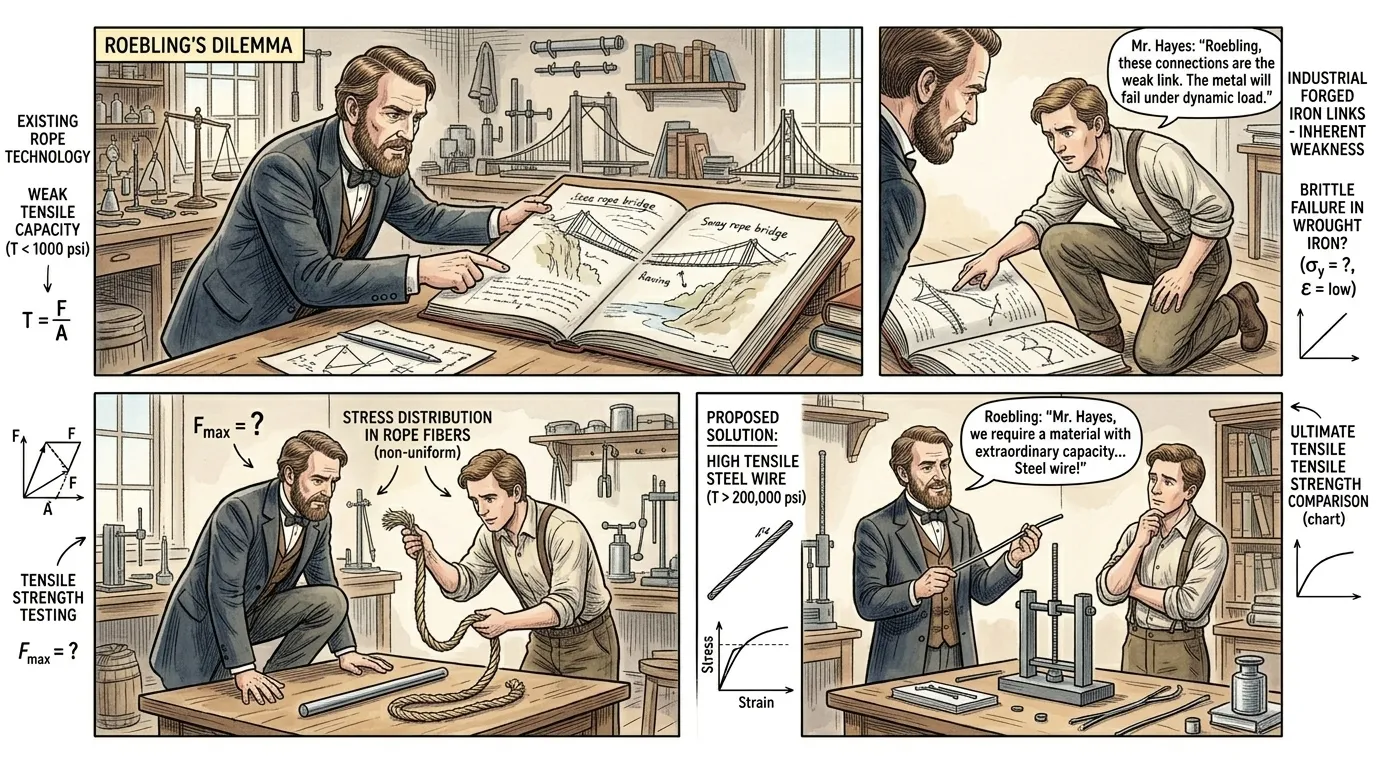
The concept of suspending a walkway from above was not entirely new, with rudimentary rope and chain bridges existing in various cultures for centuries. However, these early attempts, often crude and perilous, primarily used natural fibers or basic iron chains that lacked the necessary strength, durability, and uniformity for long-term, heavy-duty applications. They swayed wildly and often failed under heavy loads or severe weather.
"'Look at these examples from ancient times,' Roebling pointed to sketches in his ledger, illustrating a swaying rope bridge over a ravine. 'They utilize tension, yes, but the materials are inherently weak and prone to decay, offering no true stability.' Mr. Hayes commented, 'The tensile strength of mere ropes or even forged iron chains is simply too low to support the weight of industrial traffic, let alone wind and dynamic loads.' 'Exactly,' Roebling affirmed, 'We must find a way to create a material with extraordinary tensile capacity, far beyond what single rods or natural fibers can provide.'"
Page 4
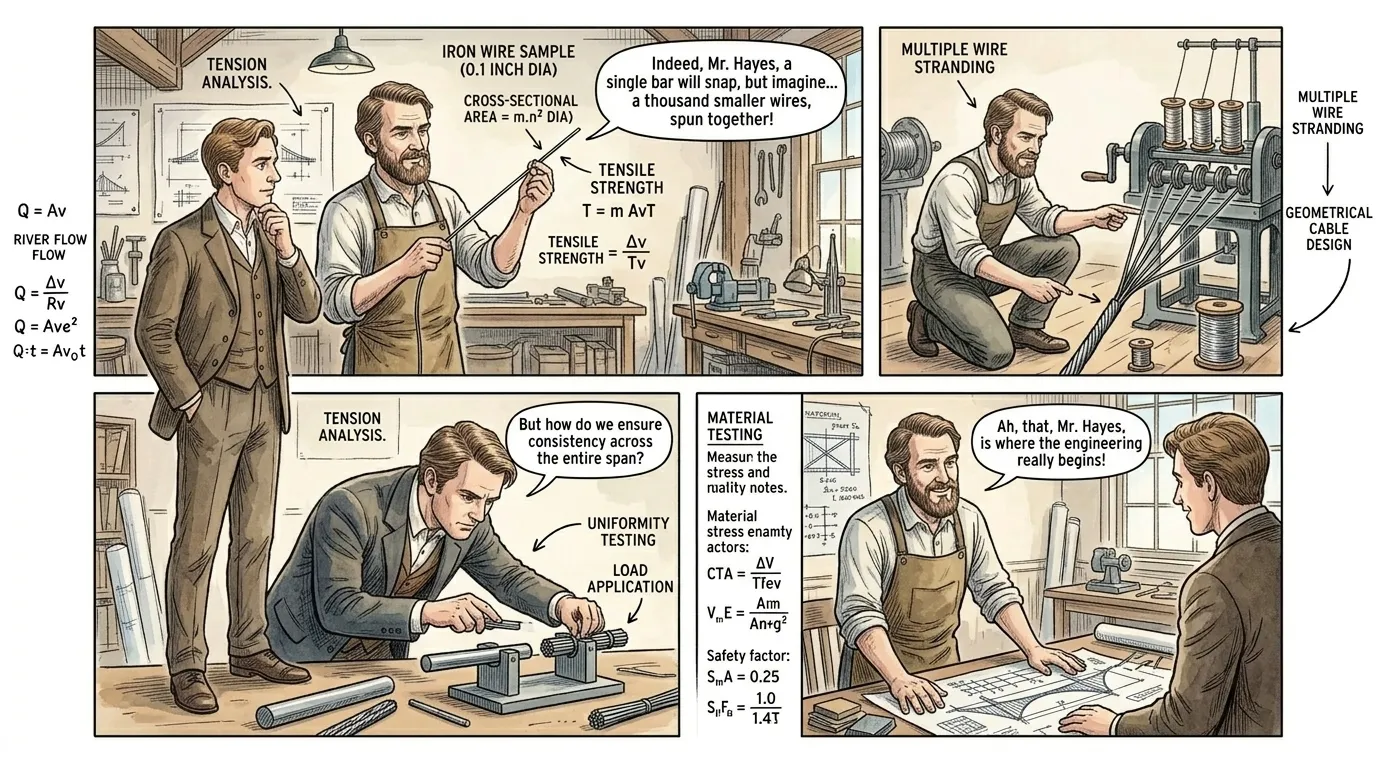
Born in Prussia in 1806, John Augustus Roebling was a brilliant engineer who emigrated to the United States, bringing with him a deep understanding of civil engineering and a profound vision. He saw beyond the limitations of existing materials and realized that the future of long-span bridges lay not in bulk, but in the elegant distribution of extreme tensile strength. His revolutionary idea centered on the use of wire rope.
"'My studies in Prussia taught me that strength isn't just about mass, but about the intrinsic properties of materials,' Roebling articulated to Mr. Hayes in his workshop, gesturing towards a sample of thin iron wire. 'If we can produce incredibly strong, consistent wires and bind them together, their combined strength could be far greater than any single bar.' Mr. Hayes inquired, 'But how do you ensure such uniformity and prevent individual wire failures from compromising the whole structure?' Roebling smiled, 'That, my friend, is where the true engineering challenge begins.'"
Page 5
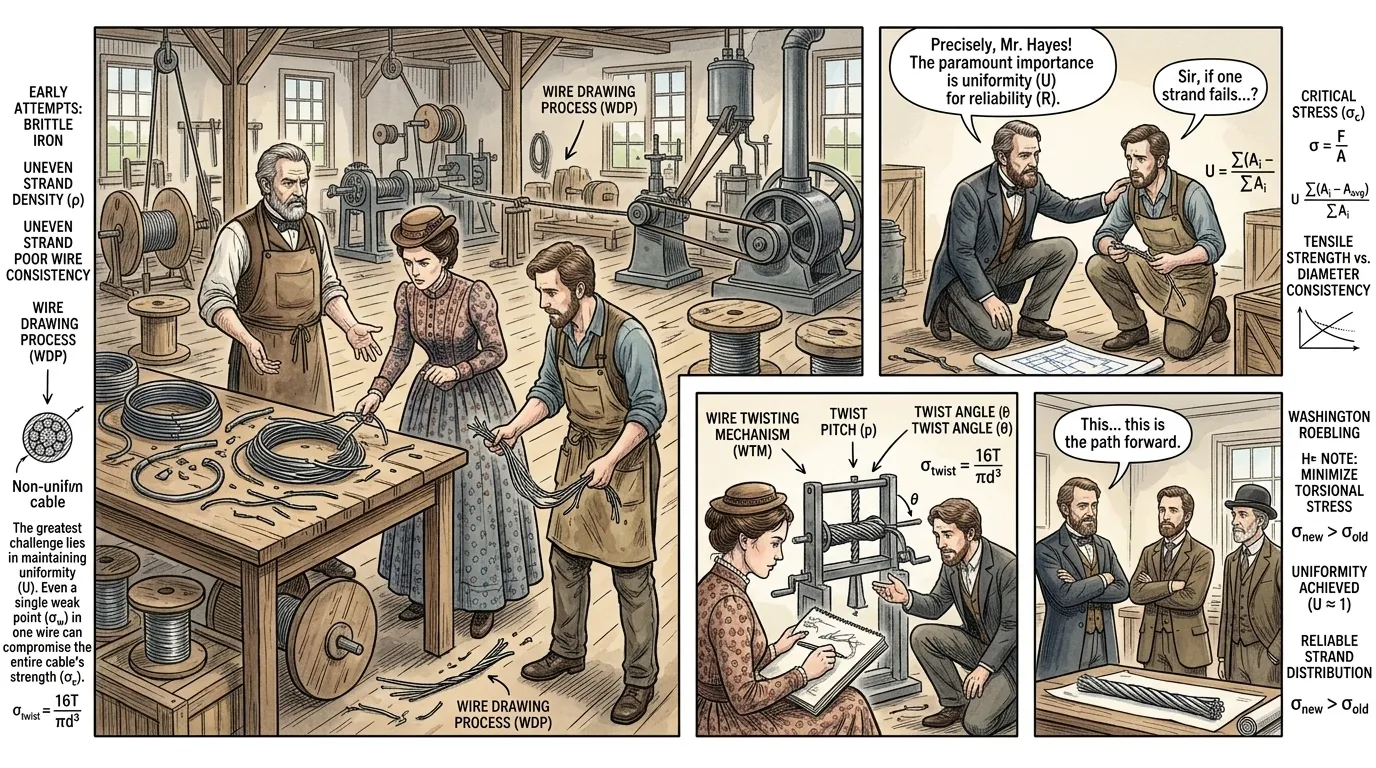
Roebling's initial challenge was to create wire rope itself. At the time, all major rope was made from hemp, and iron chains were heavy and prone to breakage. He began experimenting with drawing iron wire into much finer strands and then twisting these strands into incredibly strong, flexible cables. This process was complex, requiring precision machinery and an innovative approach to material science, often leading to failures during early trials.
"'Early attempts often resulted in brittle wires or uneven strands, which compromised the entire rope's integrity,' Roebling explained, gesturing to a broken coil of wire. 'We learned that even a single weak point can propagate failure throughout the entire length under tension.' Mr. Hayes examined the broken wire. 'So the uniformity of each individual wire and the consistency of the twisting process are paramount for reliability?' Roebling confirmed, 'Precisely. Each wire must share the load equally, a principle that became foundational to our design, because, as the philosopher Seneca once said, 'Every new beginning comes from some other beginning's end.''"
Page 6
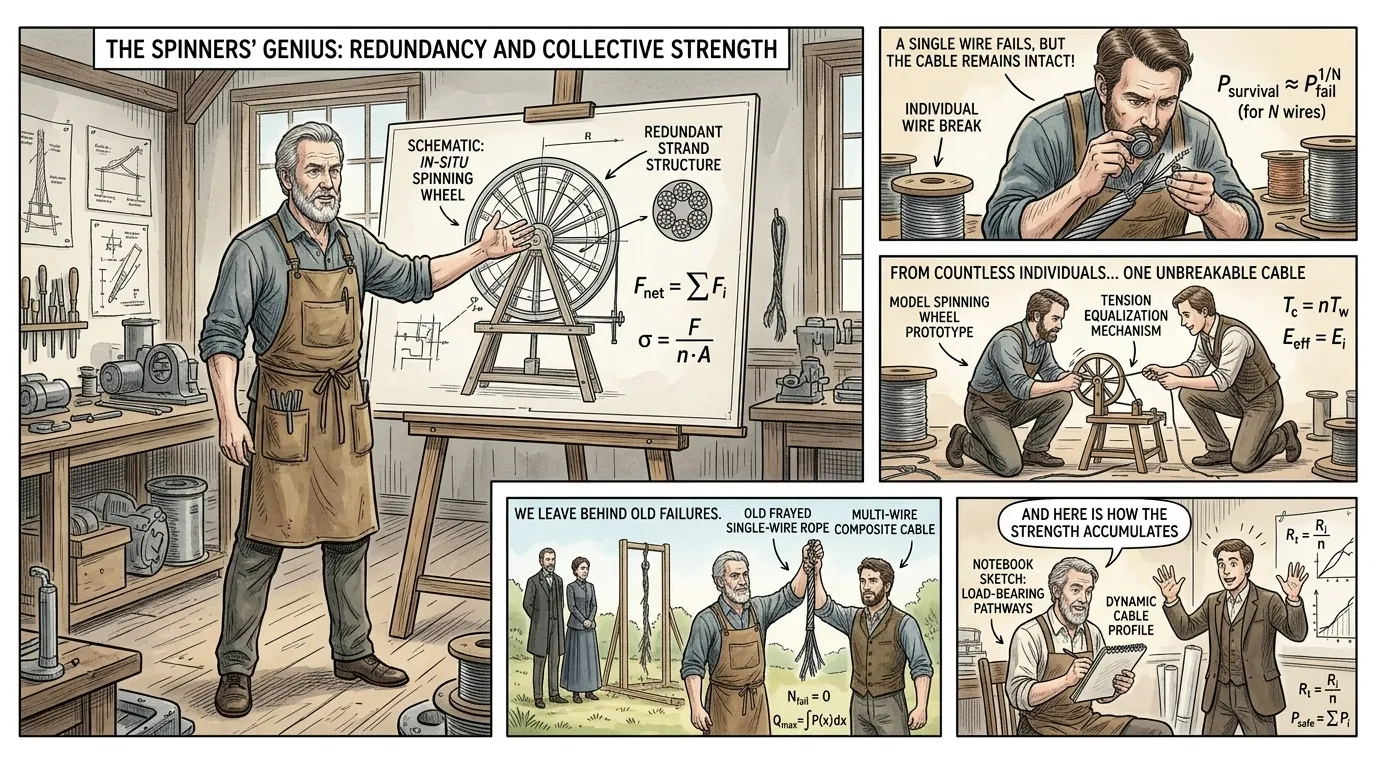
Roebling's genius lay in perfecting the 'in-situ' (on-site) method of constructing bridge cables. Instead of transporting massive pre-fabricated cables, he developed a system to spin hundreds, then thousands, of thin, high-tensile steel wires directly across the river, bundling them into compact, incredibly strong main cables. This innovation allowed for much larger and more robust cables than previously imagined, overcoming the logistical and material limits of earlier methods.
"'The key is not merely strength in a single wire, but the collective strength of countless wires acting as one,' Roebling elaborated, pointing to a schematic of a spinning wheel. 'By precisely laying each wire and compacting them, we create a cable that is immensely strong yet flexible, distributing the load uniformly.' Mr. Hayes, now holding a sample of the completed multi-wire cable, marveled, 'So, the failure of a single wire is absorbed by the thousands of others, maintaining the cable's overall integrity? This is truly remarkable, a self-correcting system.'"
Page 7
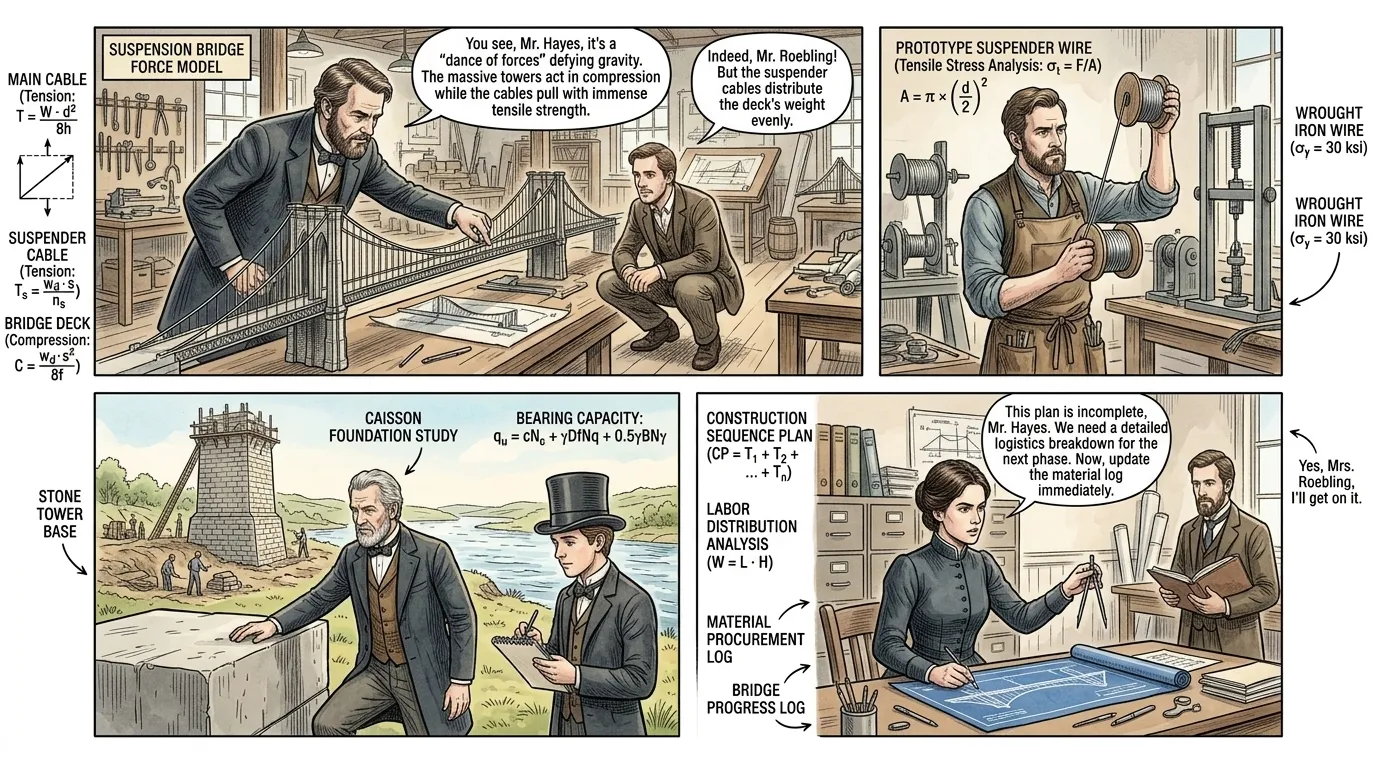
A suspension bridge operates on principles of tension and compression in elegant harmony. Massive towers, anchored firmly, bear the compressive load of the main cables. These main cables, composed of thousands of steel wires, are draped across the towers, transferring the weight of the bridge deck through vertical suspender cables. The deck itself, though stiffened, is primarily supported by the powerful tensile forces within the main cables, allowing for incredibly long, clear spans.
"'The towers act in compression, pushing downwards into the earth,' Roebling explained, tracing a finger over a model of a suspension bridge. 'But the main cables, they pull with immense tensile strength, like giant sinews holding the entire structure aloft.' Mr. Hayes pointed to the deck. 'And the suspender cables distribute the deck's weight evenly along the main cables, preventing localized stress?' Roebling affirmed, 'Precisely. It's a dance of forces, balancing pull and push to defy gravity and span distances previously deemed impossible.'"
Page 8
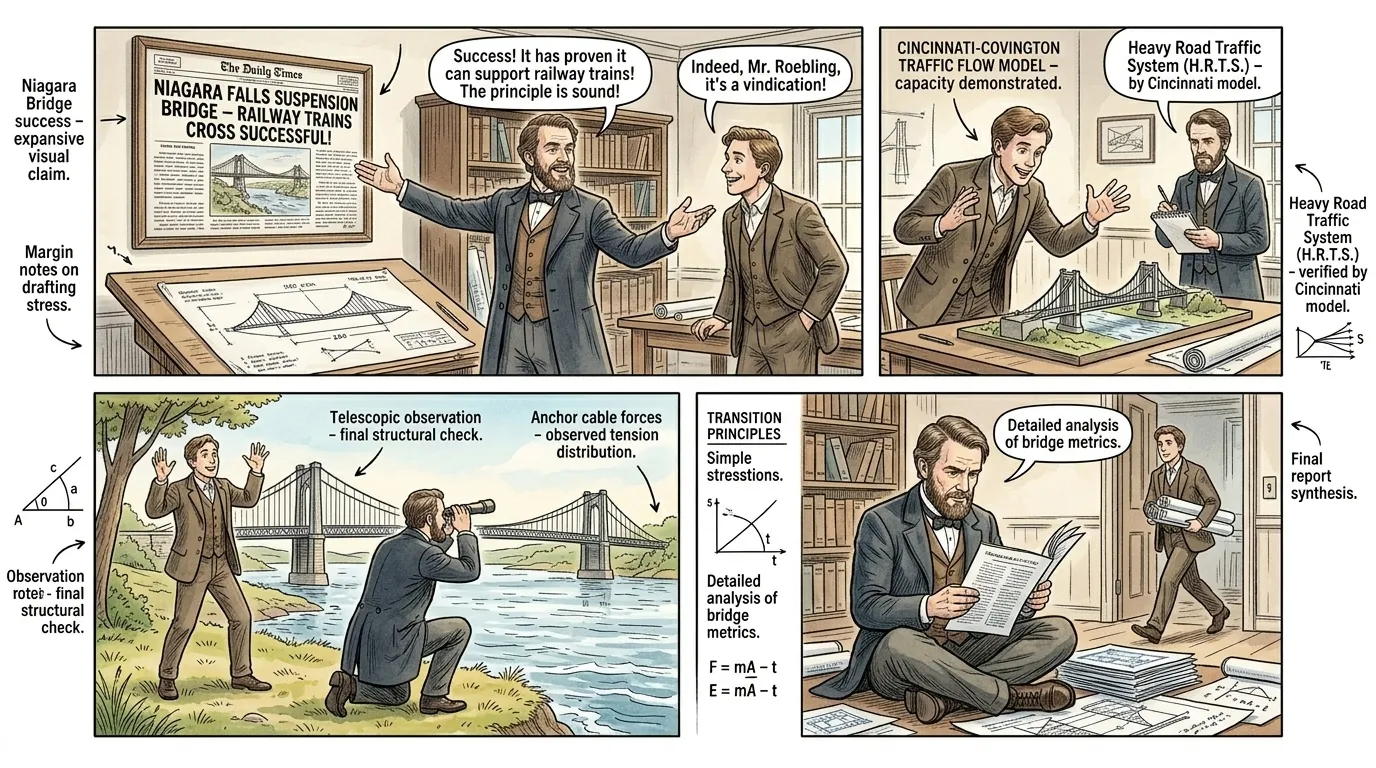
Roebling's innovative wire rope system found its first major applications in the Niagara Falls Suspension Bridge (completed 1855) and the John A. Roebling Suspension Bridge in Cincinnati (completed 1866). These daring constructions proved the viability and safety of the suspension principle for railway and road traffic, respectively, demonstrating that carefully engineered multi-wire cables could withstand immense loads and dynamic forces. The success was undeniable.
"'The Niagara bridge proved that our wire cables could support the tremendous weight of railway trains, even over the churning gorge,' Roebling exclaimed, gesturing proudly at a newspaper clipping. Mr. Hayes added, 'And the Cincinnati bridge showcased its capacity for heavy road traffic, inspiring public confidence in these new giants of steel.' 'Indeed,' Roebling replied, 'Its very existence declared that no chasm was impassable, confirming what the great poet Ralph Waldo Emerson expressed: 'Do not go where the path may lead, go instead where there is no path and leave a trail.''"
Page 9
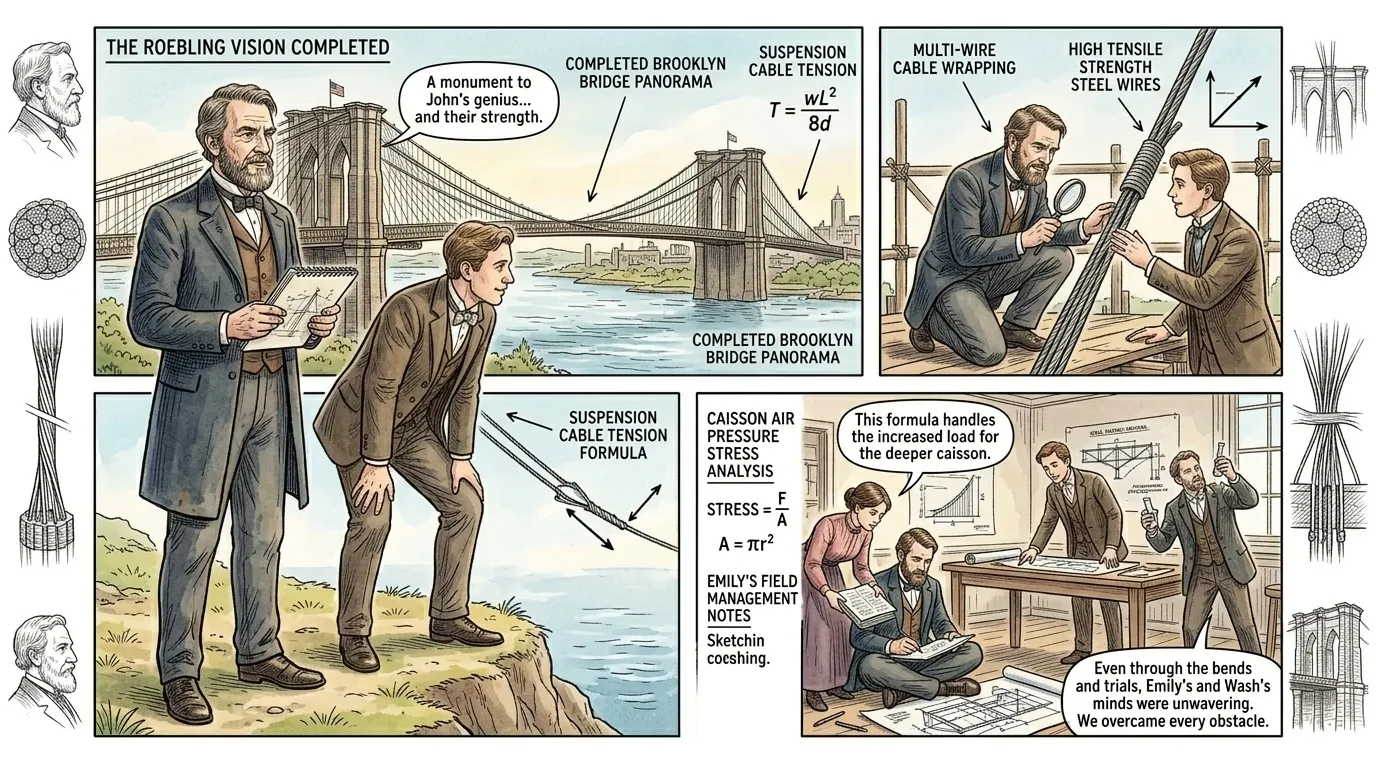
Roebling's ultimate vision materialized in the Brooklyn Bridge. Though he tragically died before its completion, his son Washington Roebling and his daughter-in-law Emily Warren Roebling continued his work, overcoming immense challenges including caisson disease, political obstacles, and engineering novelties. The bridge's monumental success, opening in 1883, solidified the suspension system as the pinnacle of long-span engineering, demonstrating unprecedented scale and resilience.
"Mr. Hayes, now an older, grizzled engineer, stood gazing at the completed Brooklyn Bridge. 'They said it couldn't be done after John's passing, but Washington and Emily carried the torch, ensuring the tensile strength of every wire bundle.' A younger engineer beside him, observing the structure, added, 'And it was that foundational understanding—how thousands of individual, high-tensile wires collectively achieve unparalleled strength—that allowed them to face down every obstacle, from the depths of the caissons to the politics of the city.' 'A testament to meticulous design and unwavering perseverance,' Mr. Hayes concluded."
Page 10
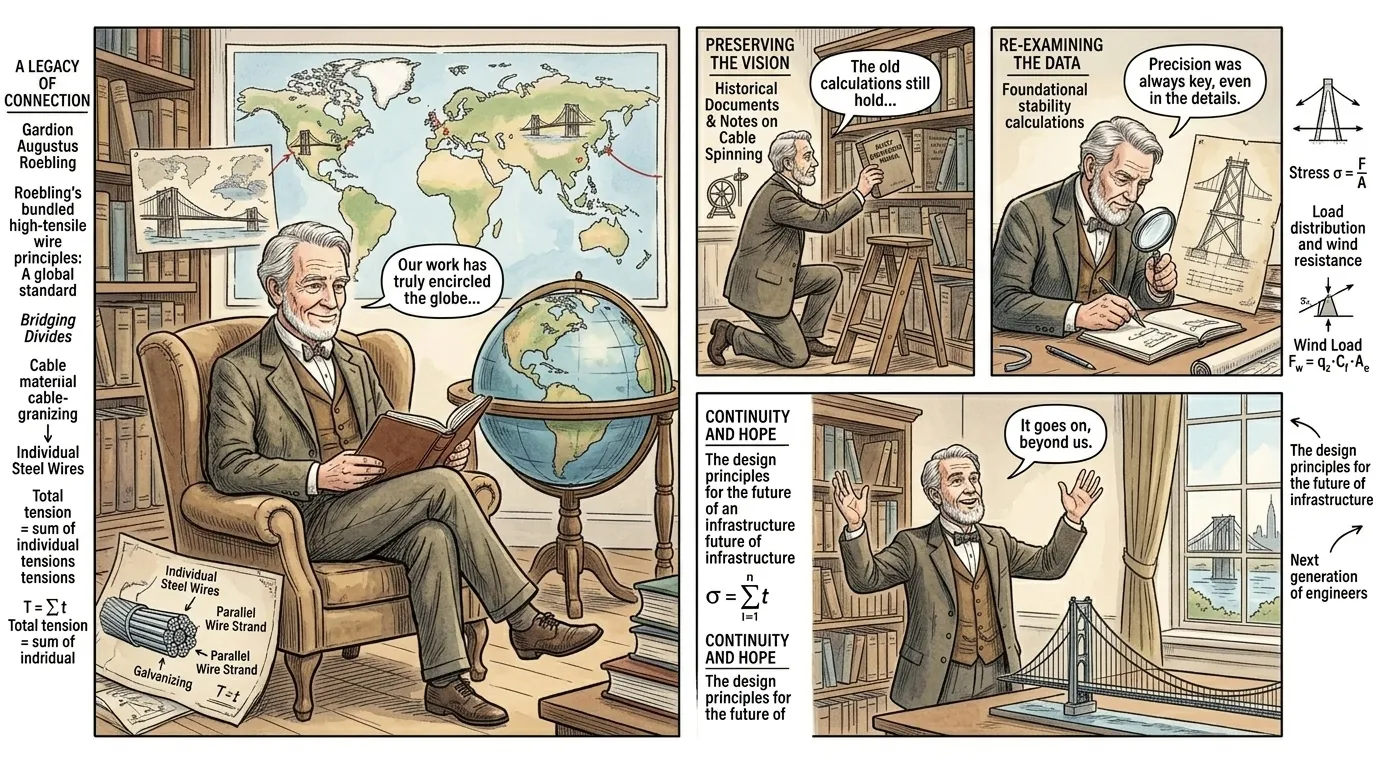
The bridge suspension system forever transformed human connectivity, enabling the construction of monumental crossings over previously impassable waterways and terrains worldwide. From the iconic Golden Gate Bridge to countless modern marvels, Roebling's principles of bundled high-tensile wire cables remain fundamental. This innovation facilitated global trade, accelerated transportation, and reshaped urban landscapes, connecting communities and cultures across vast distances, a testament to enduring human ingenuity.
"Mr. Hayes, in his old age, sat in a quiet library, reflecting. 'Imagine a world without these crossings now. Roebling's vision has literally woven the fabric of modern civilization together, enabling commerce, travel, and communication on an unprecedented scale.' He continued, 'His insistence on the strength of bundled wires, on understanding tension, was not just about building bridges, but about bridging divides in every sense.' He smiled, 'It simply unlocked a new way for us to connect across the world.'"
About this story
- Location: Global
- Audience: general readers
Questions and answers
Read Wonder Inventions on your phone
Wonder Inventions is available on Android. Get Wonder Inventions on Google Play.