Diesel Engine
Diesel Engine — an illustrated inventions story, set in Global. 10 illustrated pages, free to read on Wonder Inventions.
Page 1
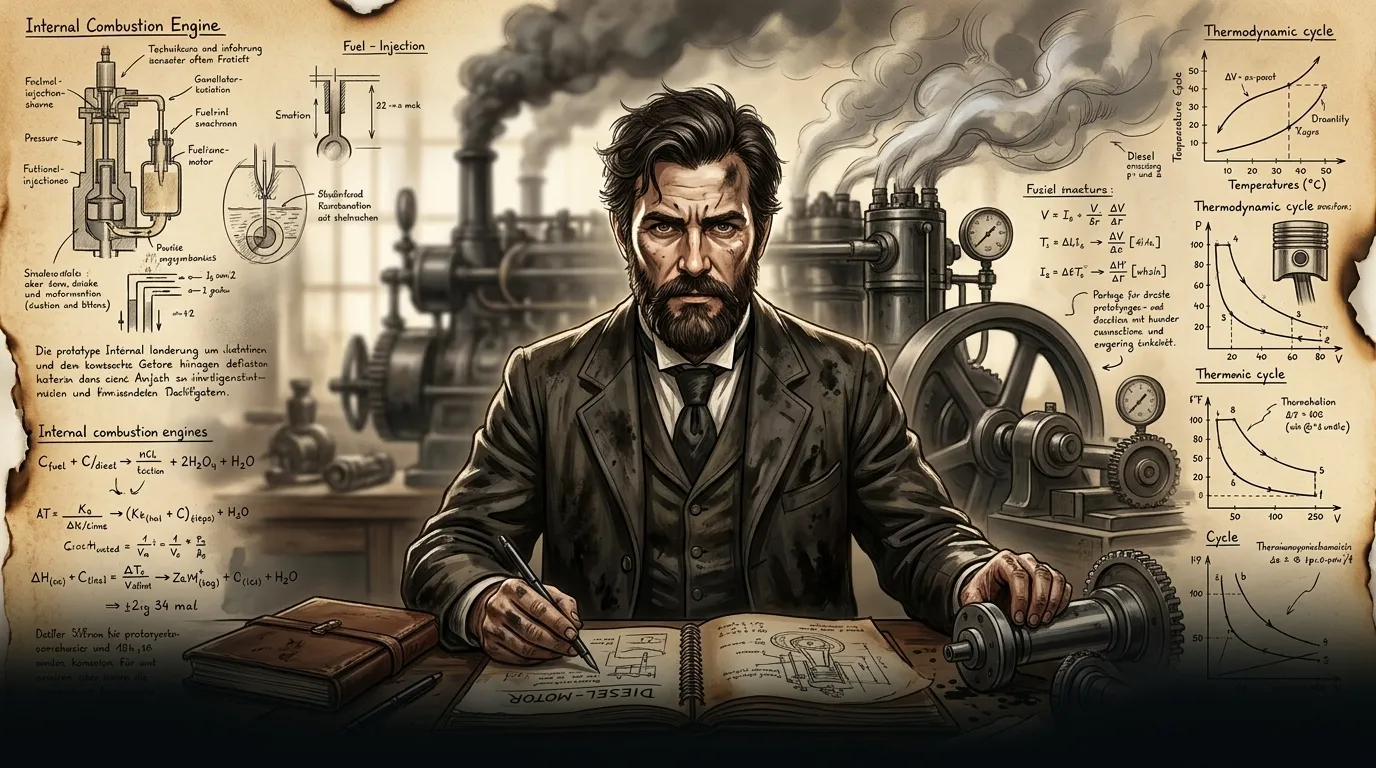
By the late 19th century, the burgeoning industrial world desperately sought a more efficient, robust power source than the dominant steam engine. Steam, while powerful, was inherently heavy, slow to start, and consumed vast quantities of fuel for often modest thermal efficiency. The limitations of coal-fired boilers and the need for constant maintenance hindered progress in numerous industries. A new vision of power was needed.
"Dr. Rudolf Diesel, a German engineer, meticulously recorded his observations in his workshop, 'The steam engine's era of supremacy is challenged. We require an engine free from boilers and igniters, one that extracts maximum work from minimal fuel.'"
Page 2
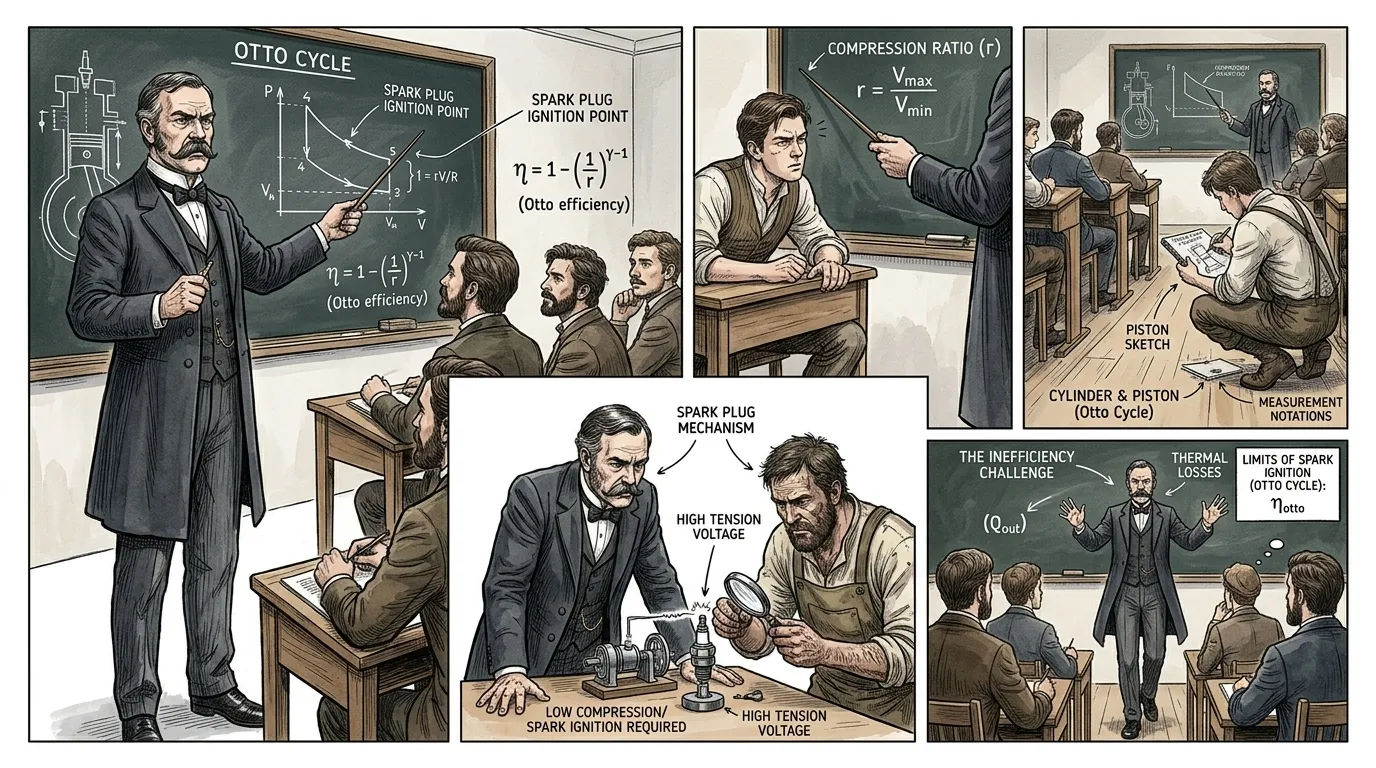
Existing internal combustion engines, like the Otto cycle, relied on an external spark to ignite a fuel-air mixture, a process with inherent thermal losses and specific fuel requirements. This method, while a significant advance over steam, still fell short of theoretical maximum efficiency. Engineers yearned for an engine that could self-ignite its fuel, unlocking greater power and versatility.
"In a dimly lit lecture hall, a colleague of Diesel, a stern-faced professor with a thick mustache, addresses his students, 'Gentlemen, as the great physicist Hermann von Helmholtz once stated, "The greatest good a man can do is to make two blades of grass grow where only one grew before." We must strive for engines that make two units of power from one unit of fuel.' He taps a chalkboard diagram illustrating an Otto cycle engine, highlighting the spark plug. 'The challenge lies in achieving ignition without a spark, truly harnessing the laws of thermodynamics.'"
Page 3
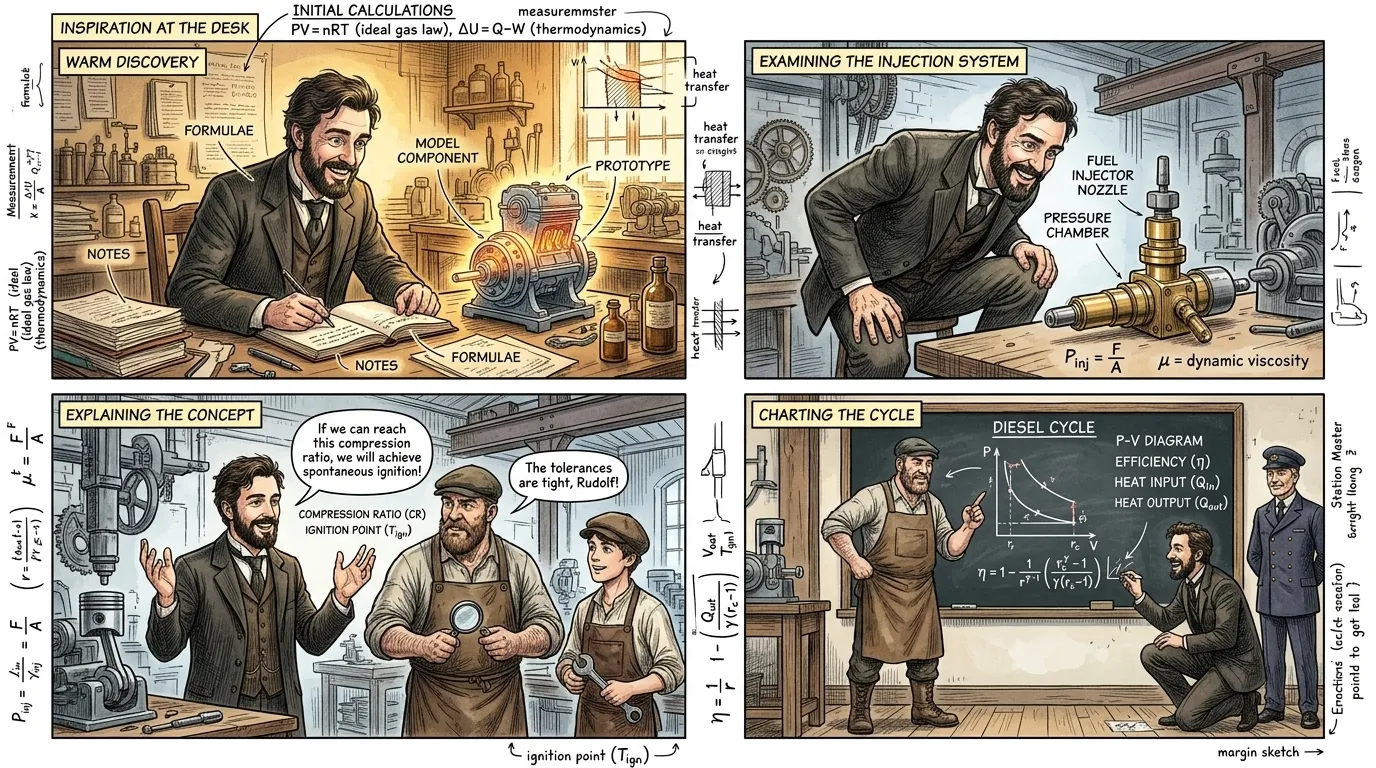
Rudolf Diesel, educated in thermodynamics, envisioned an engine where fuel ignited not by spark, but by the intense heat generated from compressing air within the cylinder. He meticulously studied Carnot's cycle and the adiabatic compression principle, where gas temperature rises significantly when rapidly compressed without heat exchange with the outside. This theoretical elegance became the bedrock of his revolutionary design.
"Alone in his study, surrounded by stacks of scientific papers and engineering texts, Rudolf Diesel, with his dark beard slightly disheveled, points to an equation in his notebook. 'The key, I believe, lies in adiabatic compression,' he murmurs, his brow furrowed in concentration. 'As the gas laws dictate, compressing air to a sufficient degree will elevate its temperature beyond the ignition point of fuel. The precise knowledge of this principle, as outlined in thermodynamics, will be our guide. This knowledge,' he emphasizes, 'is the foundation upon which this engine will run.'"
Page 4
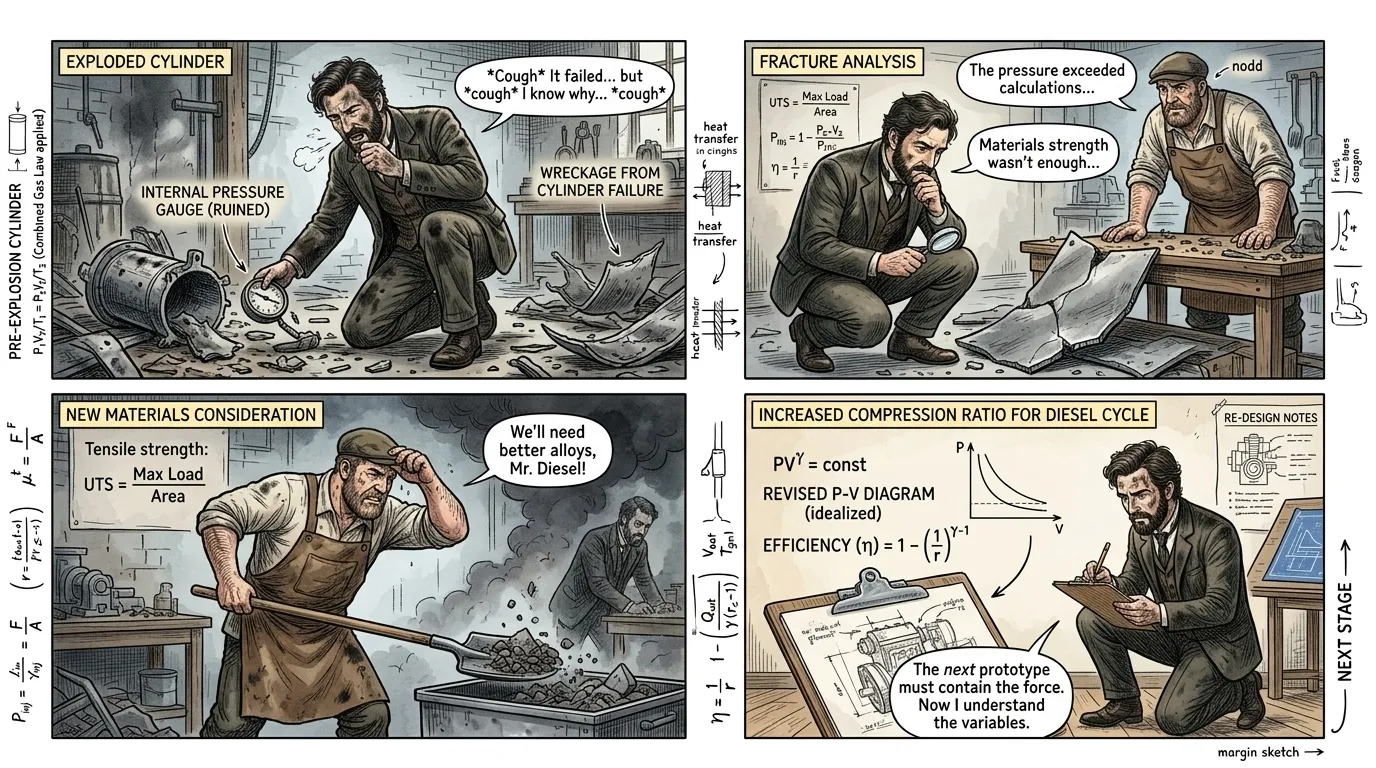
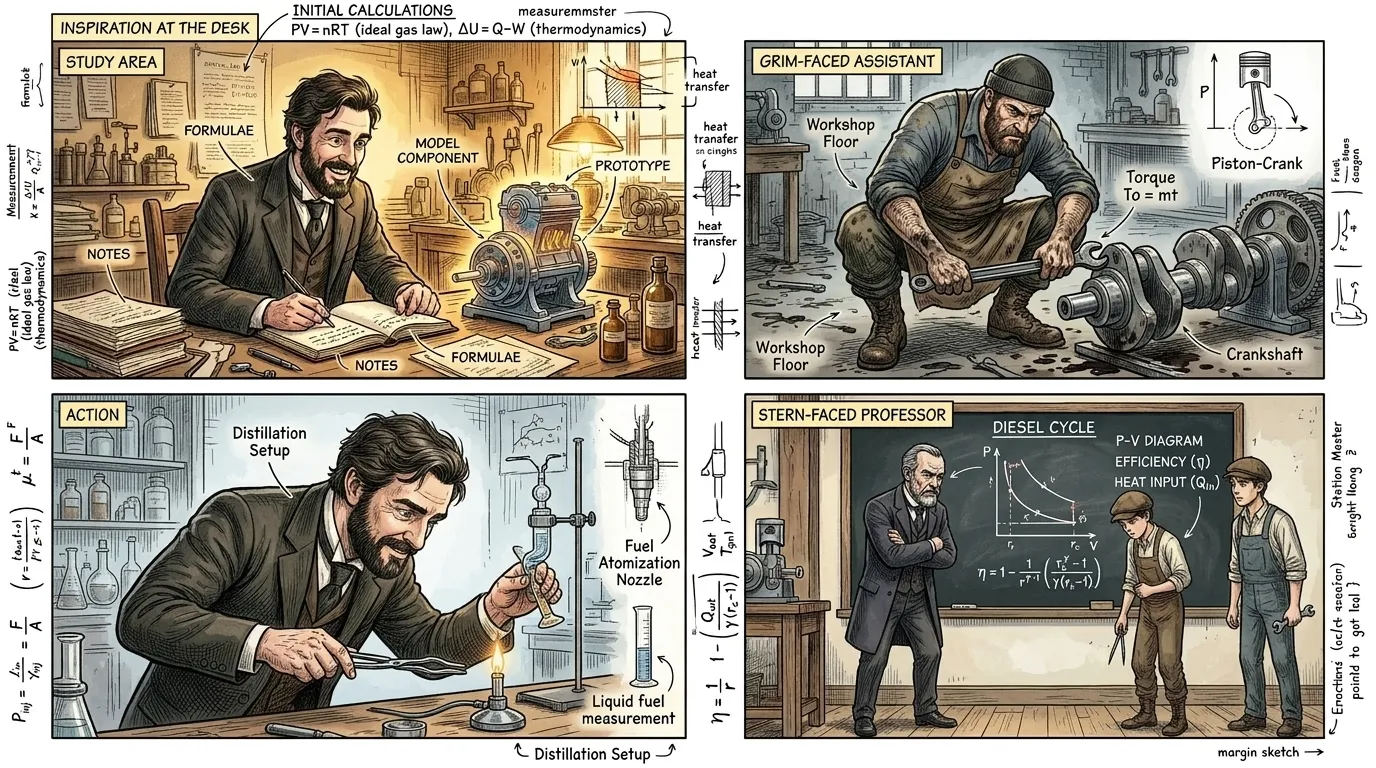
Diesel's early prototypes were fraught with peril. The immense pressures required for compression ignition, far exceeding those in steam or gasoline engines, often resulted in violent explosions and structural failures. Containing such forces within a reliable, robust machine presented monumental engineering hurdles. The risk of serious injury or even death was ever-present in his workshop.
"After a deafening bang that rattles the small workshop, Diesel, coughing and covered in soot, inspects the wreckage of his latest prototype. A metal cylinder lies split, warped by the uncontrolled combustion. 'Another failure!' he exclaims, wiping grease from his face. 'The pressures are astronomical! The steel cannot yet contain them. We must reinforce the cylinder walls, rethink the piston's integrity. As the philosopher Seneca observed, "Every new beginning comes from some other beginning's end." This ending is merely a lesson, not the conclusion.' A grim-faced assistant, a burly man with thick, calloused hands, nods slowly, beginning to clear the debris."
Page 5
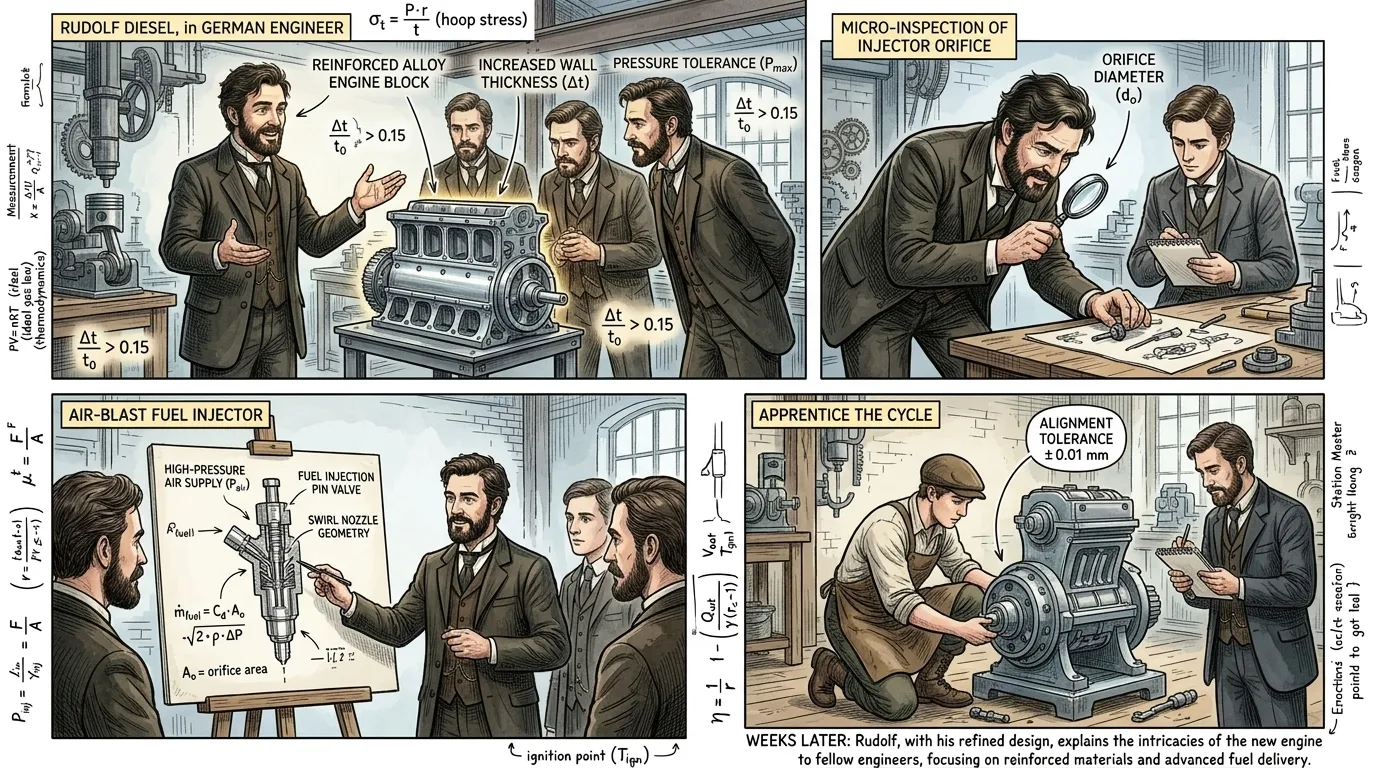
Undeterred by setbacks, Diesel meticulously refined his design. He reinforced engine components, experimented with various materials, and, critically, developed a sophisticated fuel injection system. This system, unlike simple carburetion, needed to deliver a finely atomized spray of fuel at precisely the right moment into the superheated compressed air, ensuring controlled and efficient combustion.
"Weeks later, Diesel explains to a team of engineers, gesturing at a new, heavily reinforced engine block. 'The cylinder walls are now thicker, cast from a superior alloy. But physical strength alone is not enough.' He taps a complex diagram of an air-blast fuel injector. 'The fuel must enter as an atomized mist, not a deluge, timed to the microsecond. The control of the blast air and nozzle design is paramount. Without this precision, our compression ignition is merely an uncontrolled explosion. Every component demands absolute integrity and exact timing.'"
Page 6
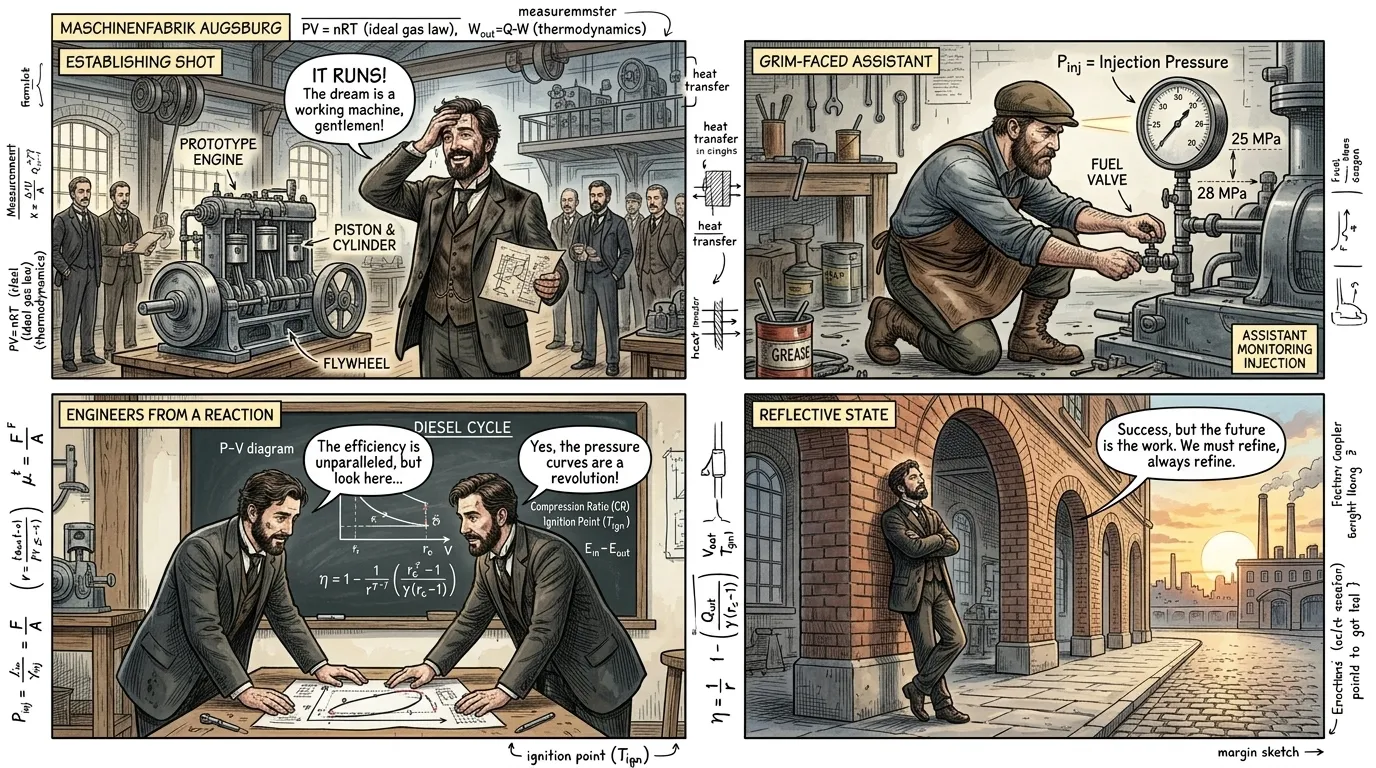
On February 17, 1897, after years of tireless effort, Diesel's first fully functional prototype roared to life at the Maschinenfabrik Augsburg. This monumental achievement validated the principle of compression ignition, demonstrating a revolutionary four-stroke cycle: intake, compression, power, and exhaust. The engine, running on peanut oil, achieved an unprecedented 26.2% thermal efficiency, far surpassing any steam engine of its era.
"As the engine finally runs smoothly, the rhythmic thrum filling the Augsburg workshop, Diesel wipes sweat from his brow. 'It lives!' he exclaims, his voice thick with emotion, to a small gathering of engineers and investors. 'The compression ignites the fuel, as predicted. We have tamed the fire within.' He gestures to the engine. 'Observe the cycle: intake, compression, power, exhaust. Each stroke a testament to focused engineering. This is no mere improvement; it is a new foundation for power!'"
Page 7
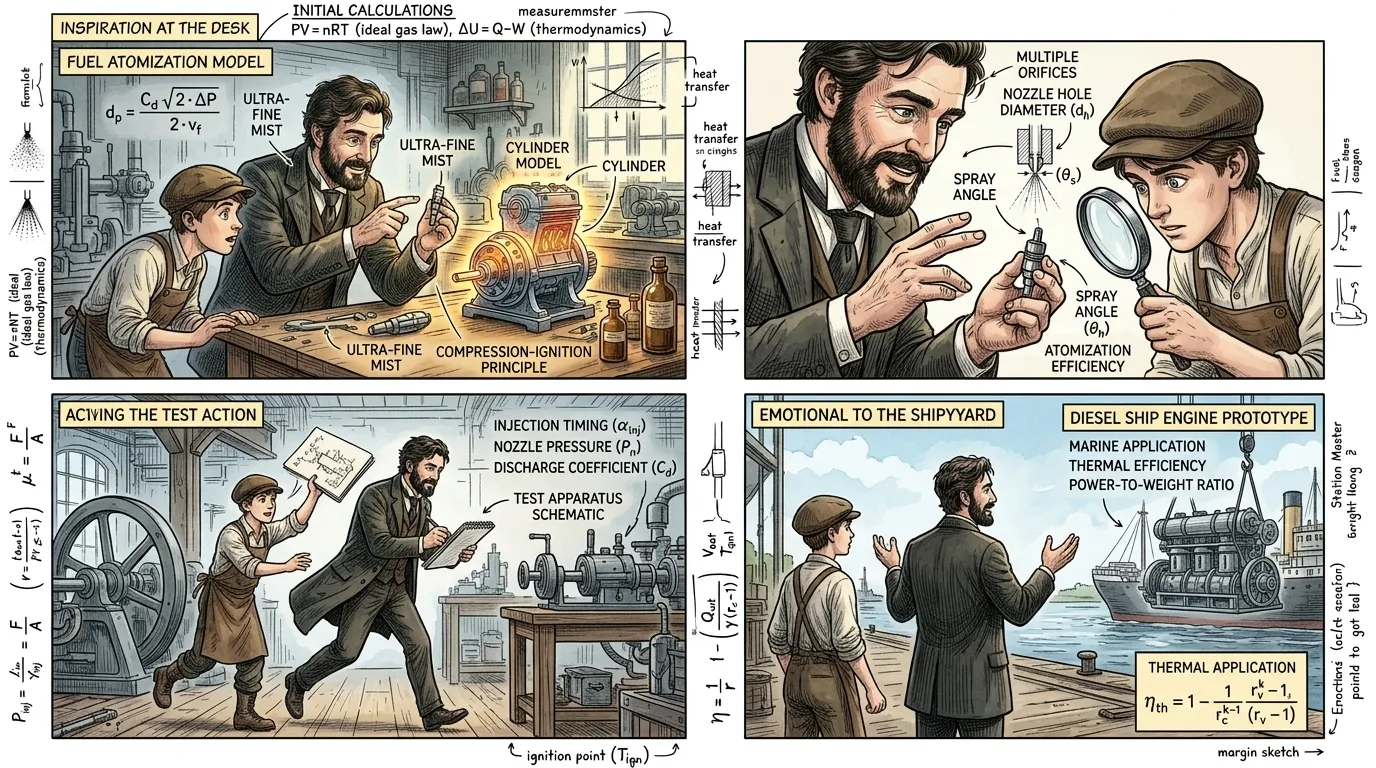
The genius of the Diesel engine lay not just in compression, but in its sophisticated fuel injection. Unlike gasoline engines, which premix fuel and air before ignition, the Diesel engine introduces fuel directly into the superheated air at the peak of the compression stroke. This precise, atomized delivery system is critical for controlled combustion and maximizing fuel economy. Early engines used a blast of compressed air to atomize the fuel.
"Rudolf Diesel holds a refined fuel injector nozzle in his hand, explaining to a captivated apprentice with wide eyes, 'This, my boy, is the very heart of it. The fuel, often heavy oil, isn't ignited by an external spark. Instead, it's forced through this nozzle, forming an ultra-fine mist, precisely when the air in the cylinder is hottest.' He points to a cutaway model of the cylinder head. 'The heat, created by compression, instantly ignites the mist. This atomization and precise timing—it's what differentiates our engine, allowing it to burn heavier, less volatile fuels with such remarkable efficiency, a stark contrast to any spark-ignited machine.'"
Page 8
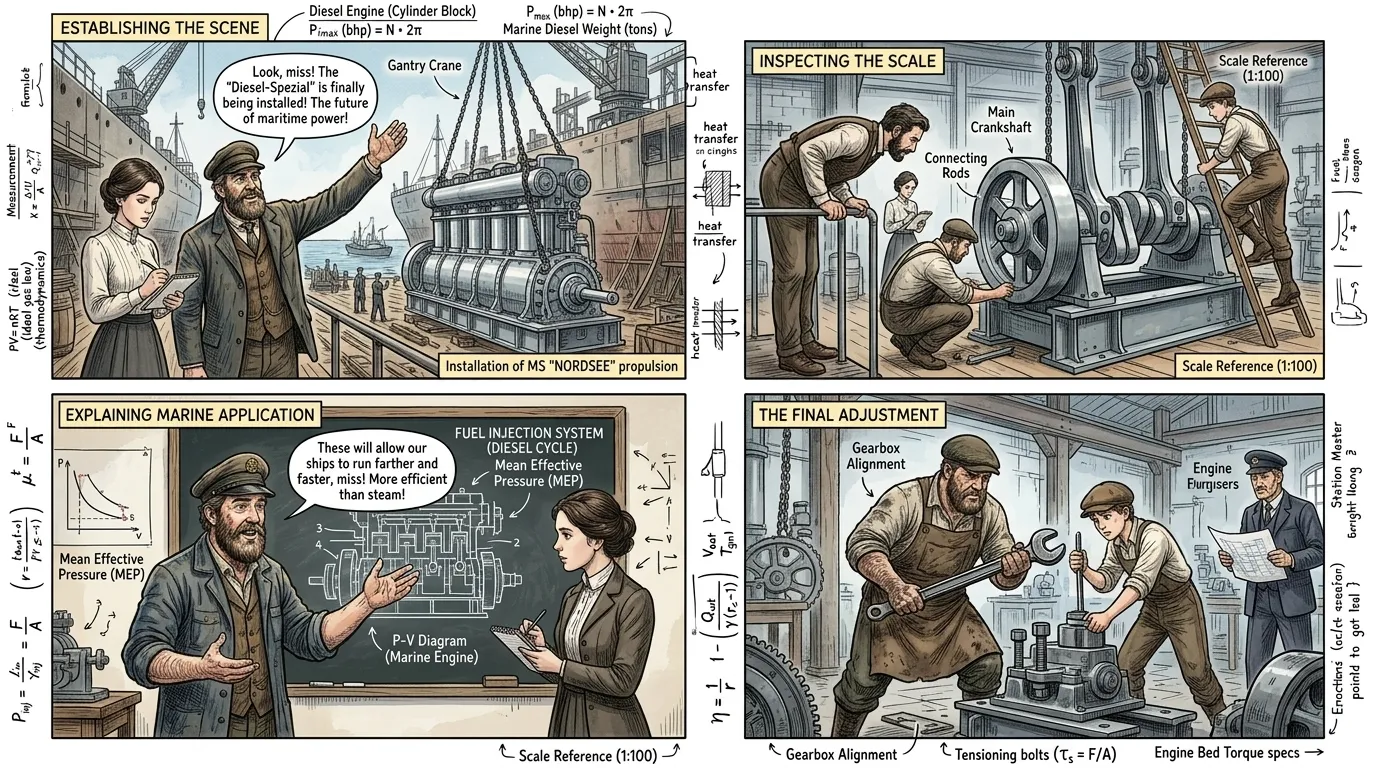
The Diesel engine quickly found its first applications as a reliable and economical stationary power source for factories, mills, and municipal utilities, replacing less efficient steam engines. Its robust nature and lower running costs made it ideal for continuous industrial operation. Soon, its advantages were recognized for marine propulsion, leading to a revolution in shipping with the launch of the MV Selandia in 1912.
"A shipbuilder, a grizzled man with a thick beard and a captain's cap, gazes proudly at the massive diesel engines being installed into a ship's hull. 'These aren't just engines; they're the future of the seas,' he proclaims to a reporter, a young woman diligently taking notes. 'No more mountains of coal, no more stokers in hellish heat. These engines run on heavy oil, cleaner, cheaper, and with far greater range. They free us from the tyranny of steam. It's truly, as Pliny the Elder once said, "The greatest obstacle to progress is not ignorance, but the illusion of knowledge." We thought we knew power, but Diesel has shown us another way.'"
Page 9
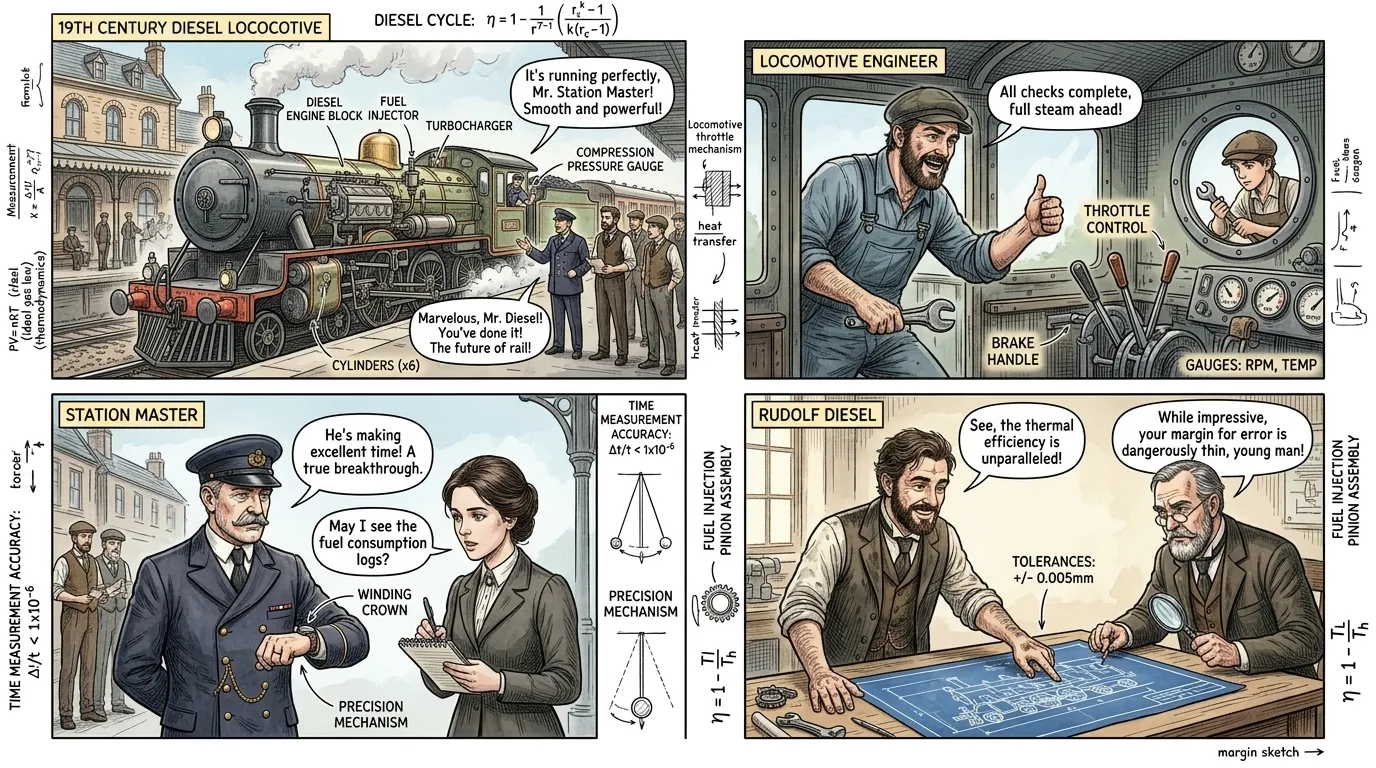
The Diesel engine's high torque, fuel efficiency, and compact design revolutionized transportation across multiple domains. From powering locomotives across vast continents, enabling heavy trucks to traverse early road networks, to granting submarines unprecedented range and stealth beneath the waves, the Diesel engine became the workhorse of global mobility and logistical power.
"A locomotive engineer, leaning out of his diesel train cab, shouts to a station master, 'This engine pulls more weight, burns less fuel, and needs fewer stops than any steam locomotive! The railways are truly entering a new era!' The station master, a sturdy man with a polished uniform and a watch chain, nods vigorously. 'Indeed! It's an engine that understands the scale of our ambitions. And beneath the waves, I hear they're transforming naval power. Imagine the range and endurance! It reshapes our world, on land, at sea, and unseen below.'"
Page 10
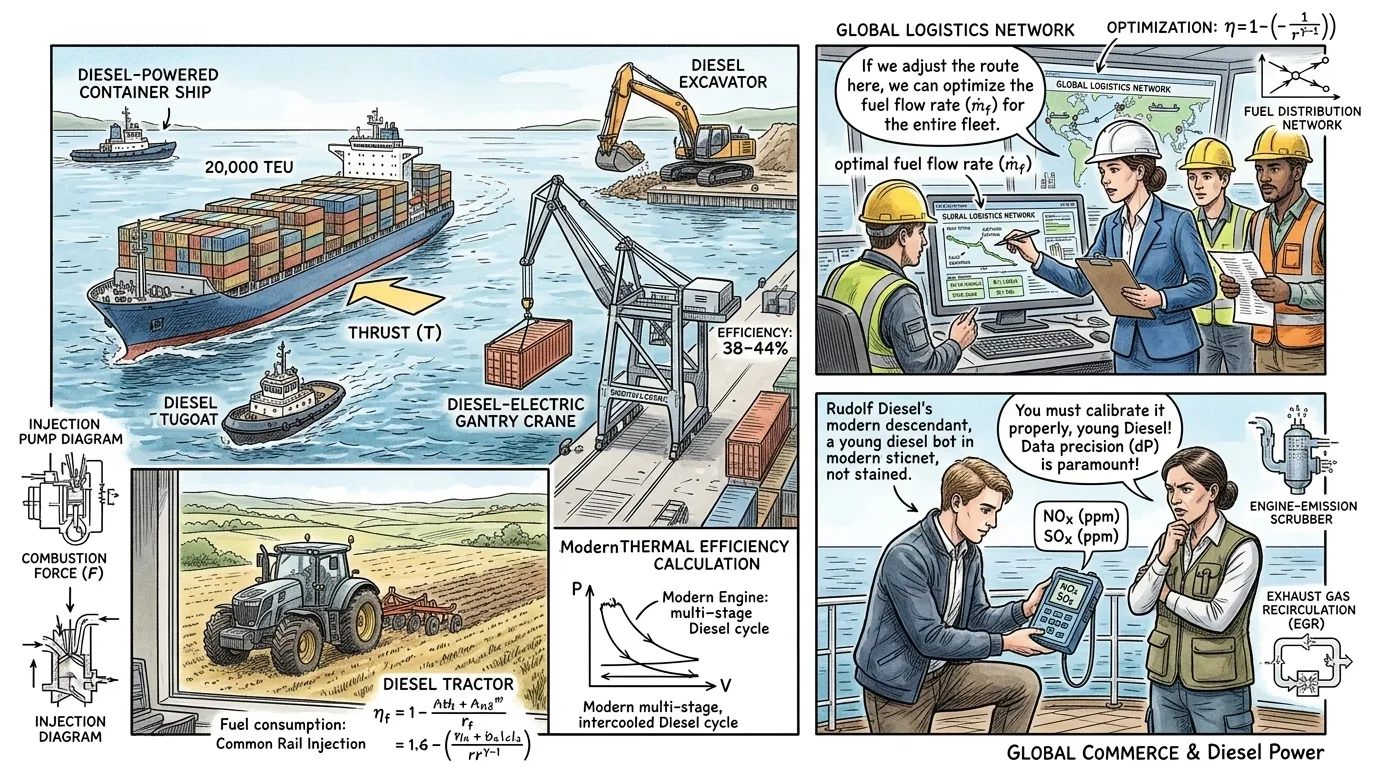
Today, the Diesel engine remains an indispensable pillar of global infrastructure. From powering immense container ships that transport 90% of the world's goods, to the heavy machinery that builds our cities and cultivates our fields, its efficiency and durability are unmatched for many applications. Despite environmental challenges, continuous innovation in emissions control ensures its vital role in the modern world, a testament to Rudolf Diesel's foundational breakthrough.
"No specific dialogue; the visual montage speaks for itself."
About this story
- Location: Global
- Audience: general readers
Questions and answers
Read Wonder Inventions on your phone
Wonder Inventions is available on Android. Get Wonder Inventions on Google Play.