E-book Reader
E-book Reader — an illustrated inventions story, set in Global. 10 illustrated pages, free to read on Wonder Inventions.
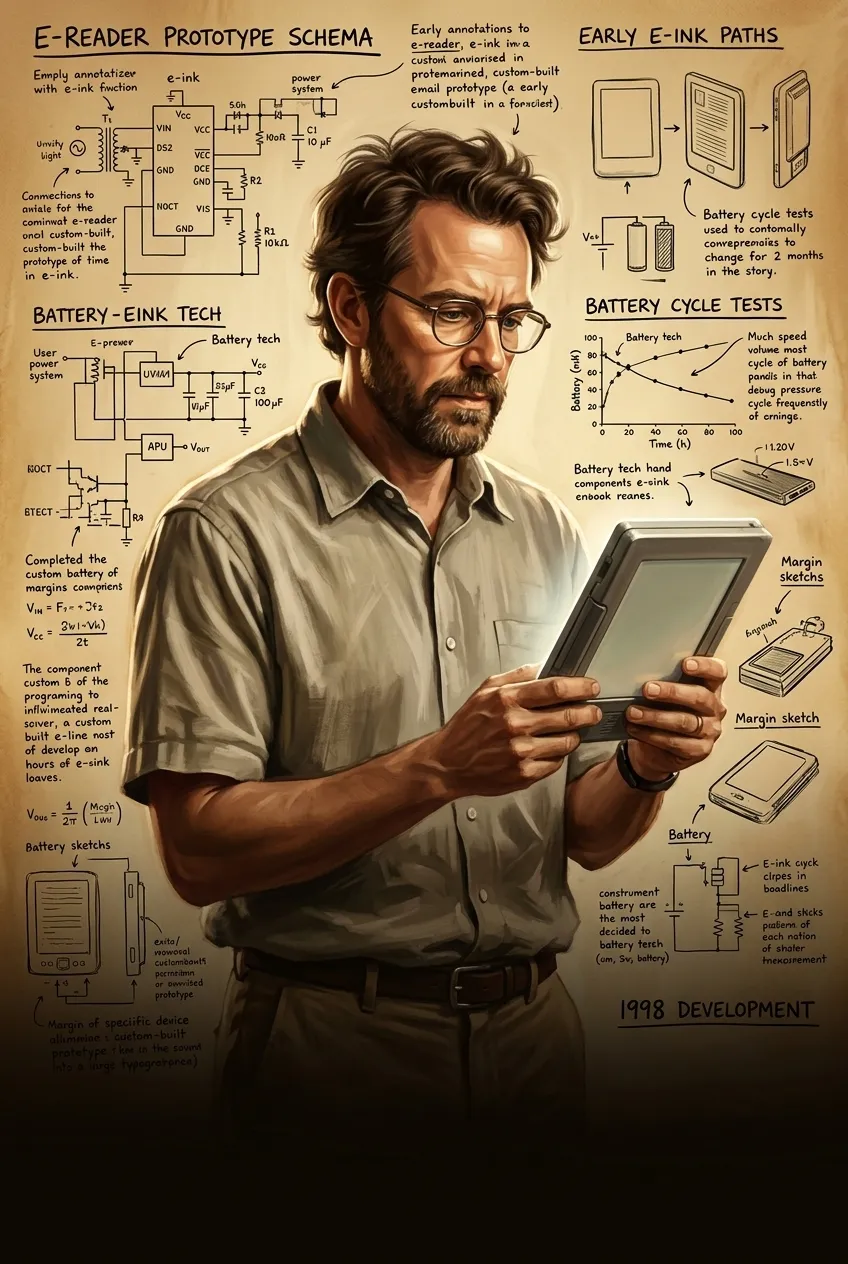
Page 1
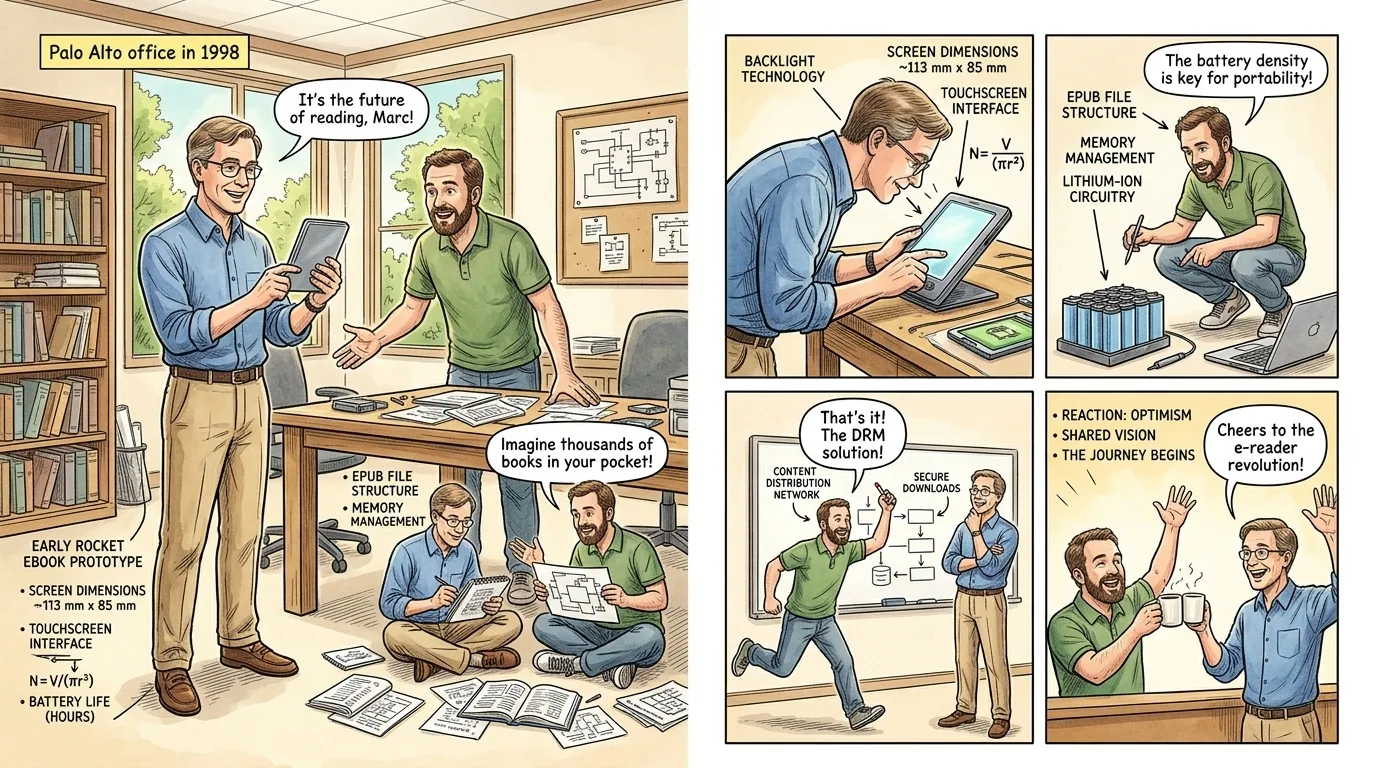
"'The sheer volume of information exploding onto the internet is incredible, yet it's trapped on screens or printed on endless reams of paper,' Dr. Martin Eberhard mused to his colleague, Dr. Marc Tarpenning, in their Palo Alto office. Tarpenning nodded, 'People want to read on the go, without lugging a backpack full of books. Imagine carrying an entire library in your pocket!' Eberhard smiled, holding up a prototype device. 'That's precisely our goal with the Rocket eBook, here in 1998. We're working towards what the visionary Alan Kay once stated: "The best way to predict the future is to invent it." We are inventing the future of reading itself.'"
Page 2
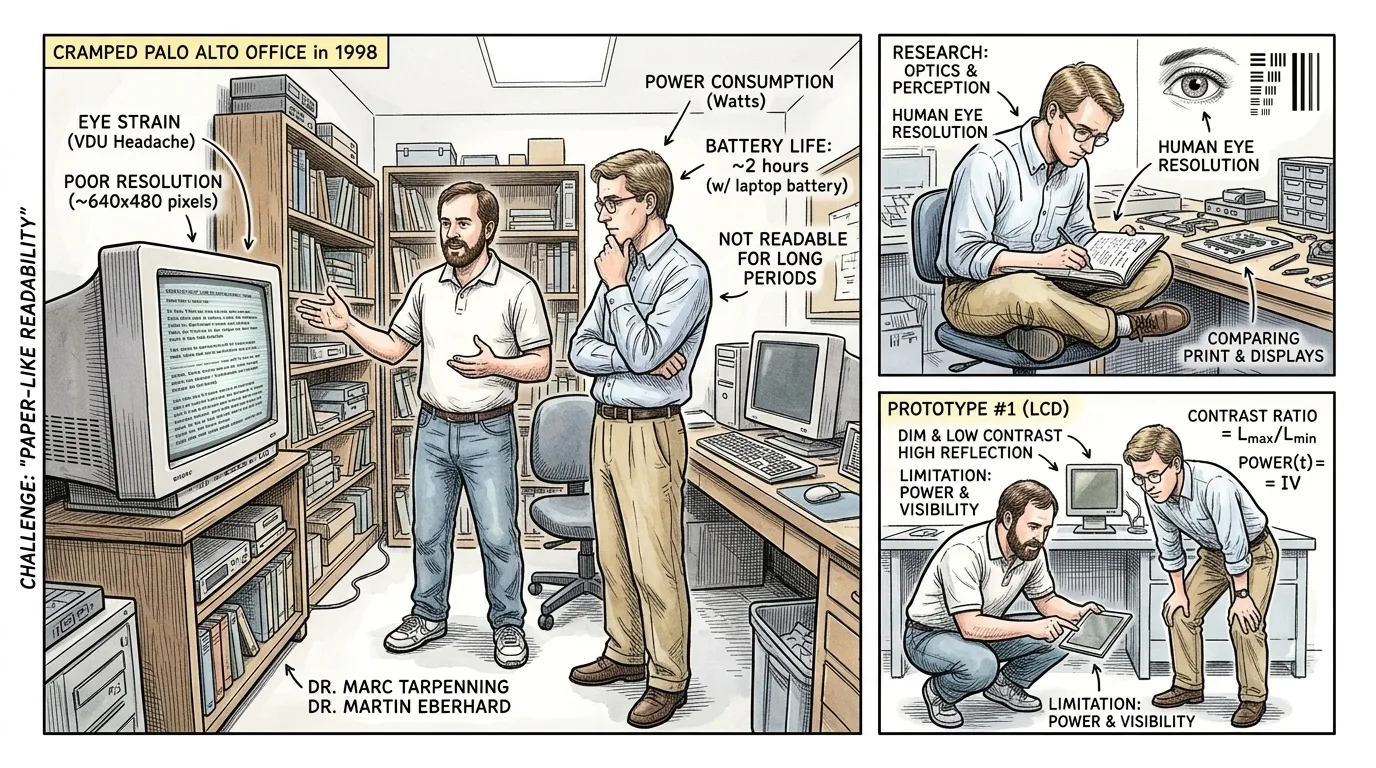
"'Before dedicated e-readers, accessing digital text meant staring at a glowing CRT screen, often resulting in significant eye strain,' Dr. Tarpenning explained, gesturing towards a flickering monitor. Eberhard added, 'The resolution was poor, the backlighting was tiring, and the battery life was abysmal if you dared to disconnect from a power outlet.' 'So the core problem isn't just about digitizing text,' Tarpenning continued. 'It's about achieving a reading experience that rivals paper, one that is comfortable for extended periods and truly portable. This 'paper-like readability' is the elusive ideal we're chasing, a crucial piece of knowledge to unlock a new era.'"
Page 3
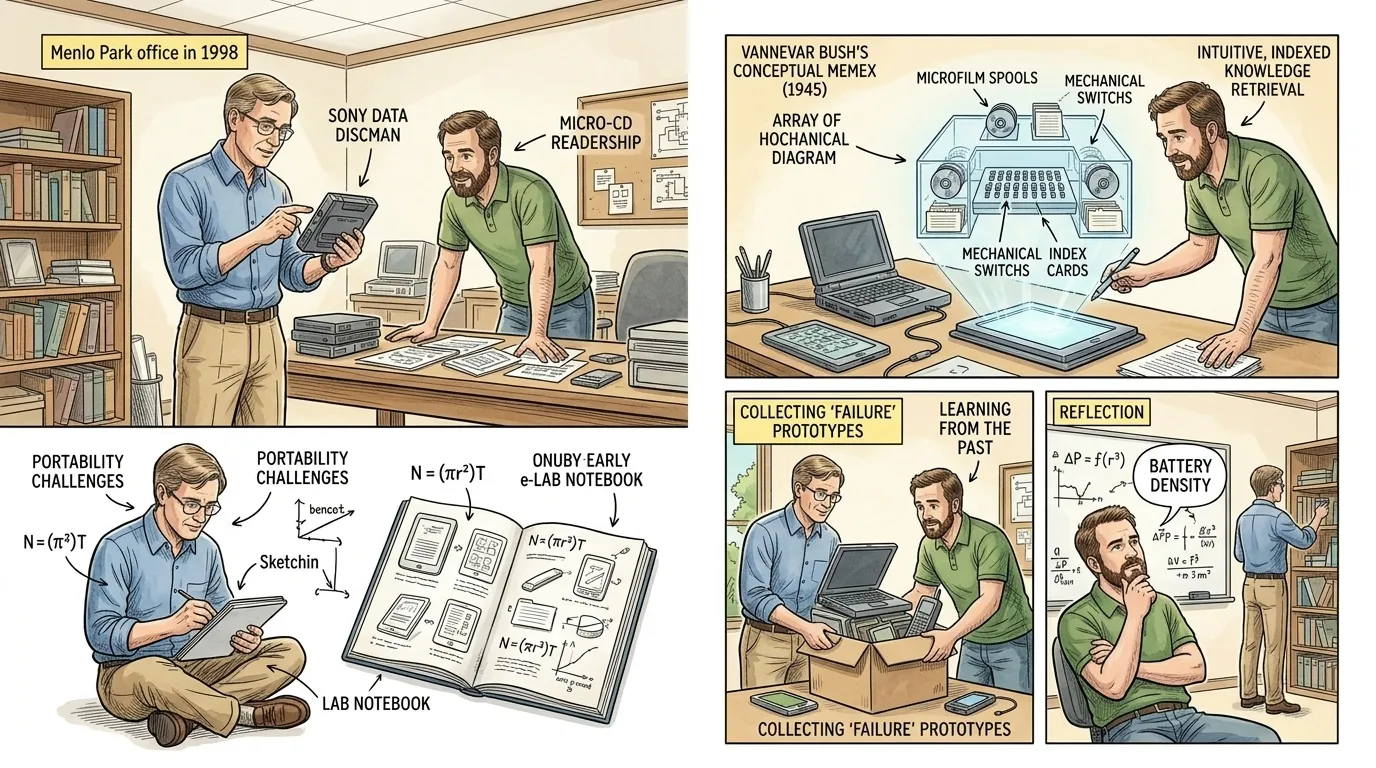
"'Many tried to bridge the gap,' Eberhard recounted, picking up an early device. 'Take the Sony Data Discman from the early 90s; it offered digital encyclopedias but was bulky, monochrome, and its functionality was very limited.' Tarpenning added, 'Even earlier, visionary thinkers like Vannevar Bush proposed the 'Memex' in 1945—a device for storing and retrieving information on microfilm, a conceptual ancestor to our digital libraries. He wrote that it would function as 'an enlarged intimate supplement to his memory.' But turning such grand ideas into a practical, portable reading device was a monumental leap, facing hardware and display limitations that seemed insurmountable at the time.'"
Page 4
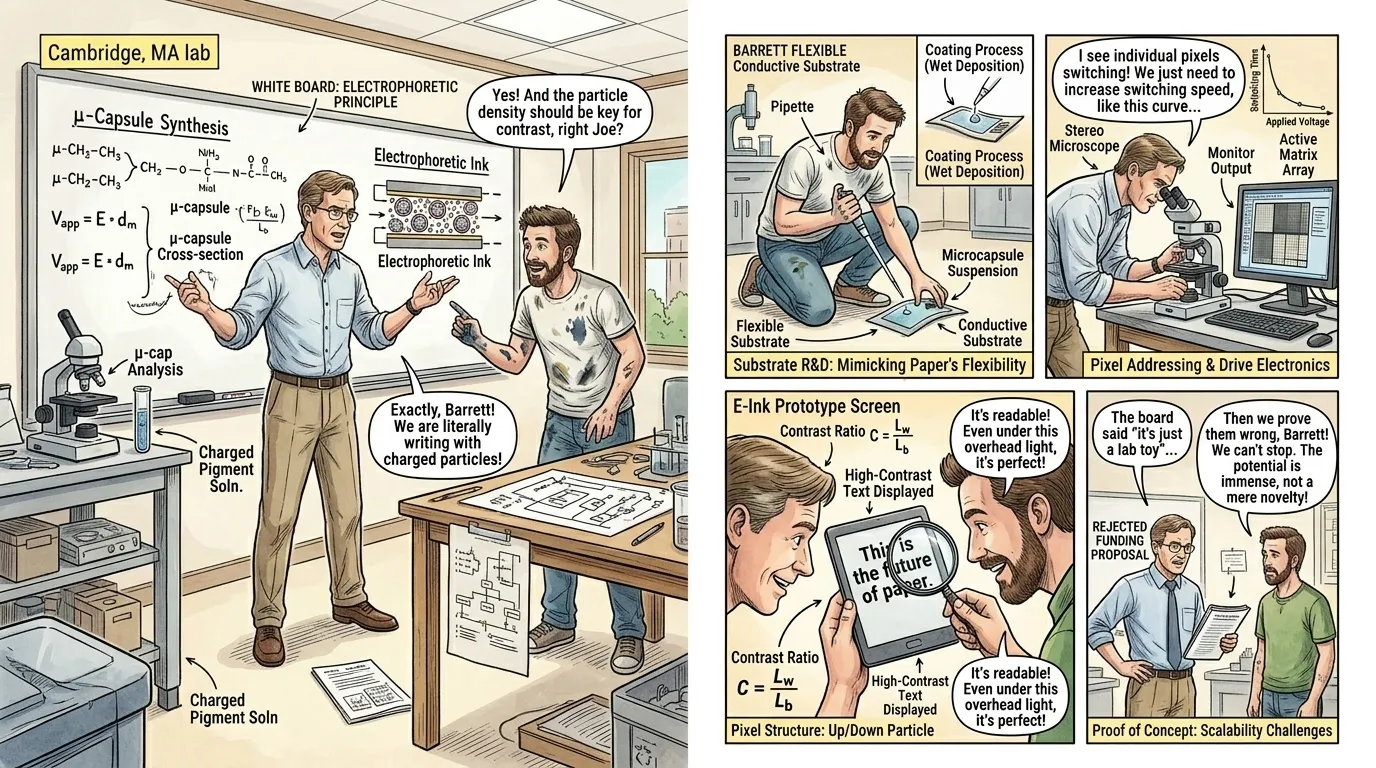
"'The breakthrough didn't come from just refining existing screens,' explained Dr. Joseph Jacobson, gesturing emphatically in his Cambridge, Massachusetts lab. 'It required a fundamentally new approach to display technology.' His colleague, Barrett Comiskey, added, 'We realized that if we could mimic the properties of ink on paper, rather than trying to illuminate pixels, we could achieve that elusive 'paper-like readability'.' 'Our team at the MIT Media Lab, and later at E Ink Corporation, focused on developing electrophoretic displays,' Jacobson continued, 'a concept that uses tiny microcapsules containing charged particles. It's a completely different paradigm for how a screen presents information.'"
Page 5
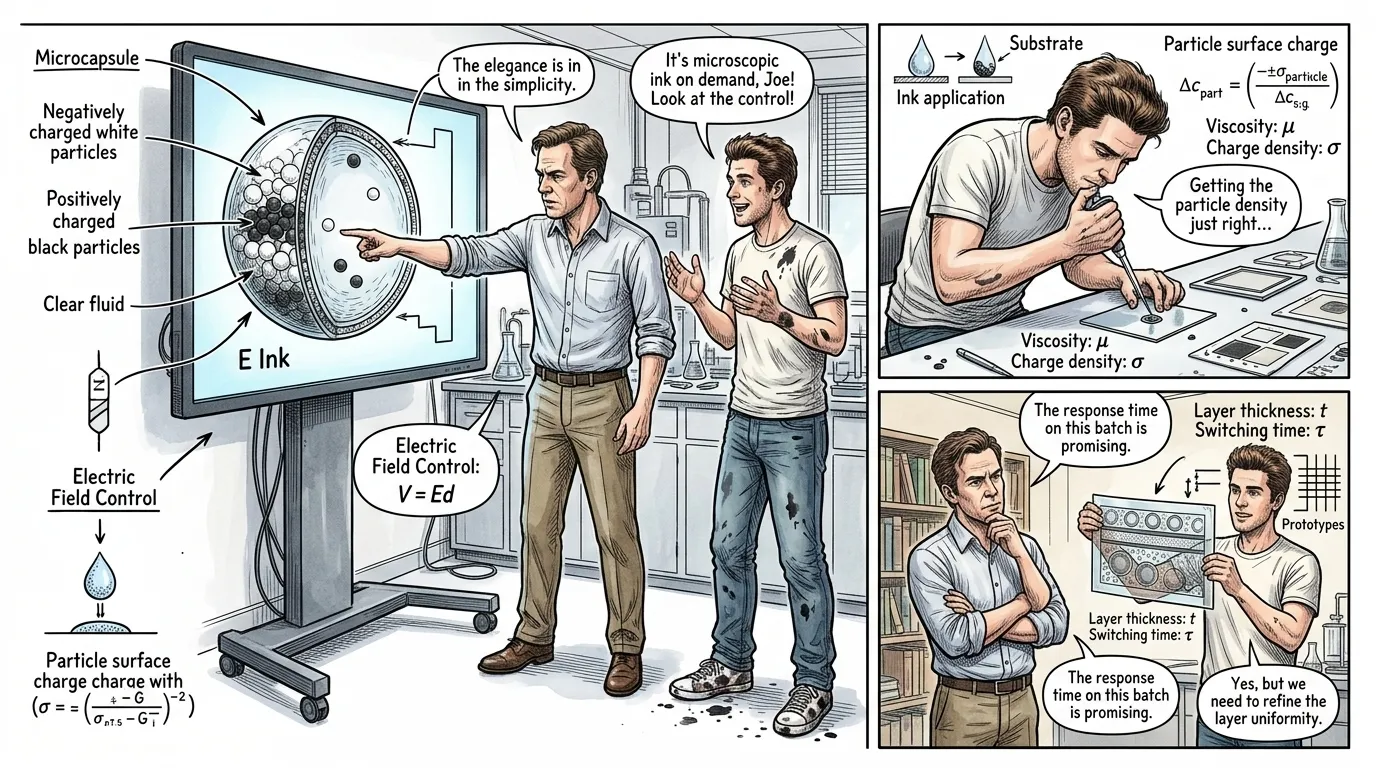
"'The core of E Ink technology relies on millions of tiny microcapsules, each smaller than a human hair,' Dr. Jacobson clarified, pointing to a magnified cross-section on a digital display. 'Inside each capsule, we have negatively charged white particles and positively charged black particles suspended in a clear fluid.' Comiskey elaborated, 'By applying a positive or negative electric field to a specific area, we can precisely control which particles rise to the surface. A positive charge pulls white particles up, making that spot appear white; a negative charge pulls black particles up, making it black.' 'It's literally microscopic ink on demand,' Jacobson concluded."
Page 6
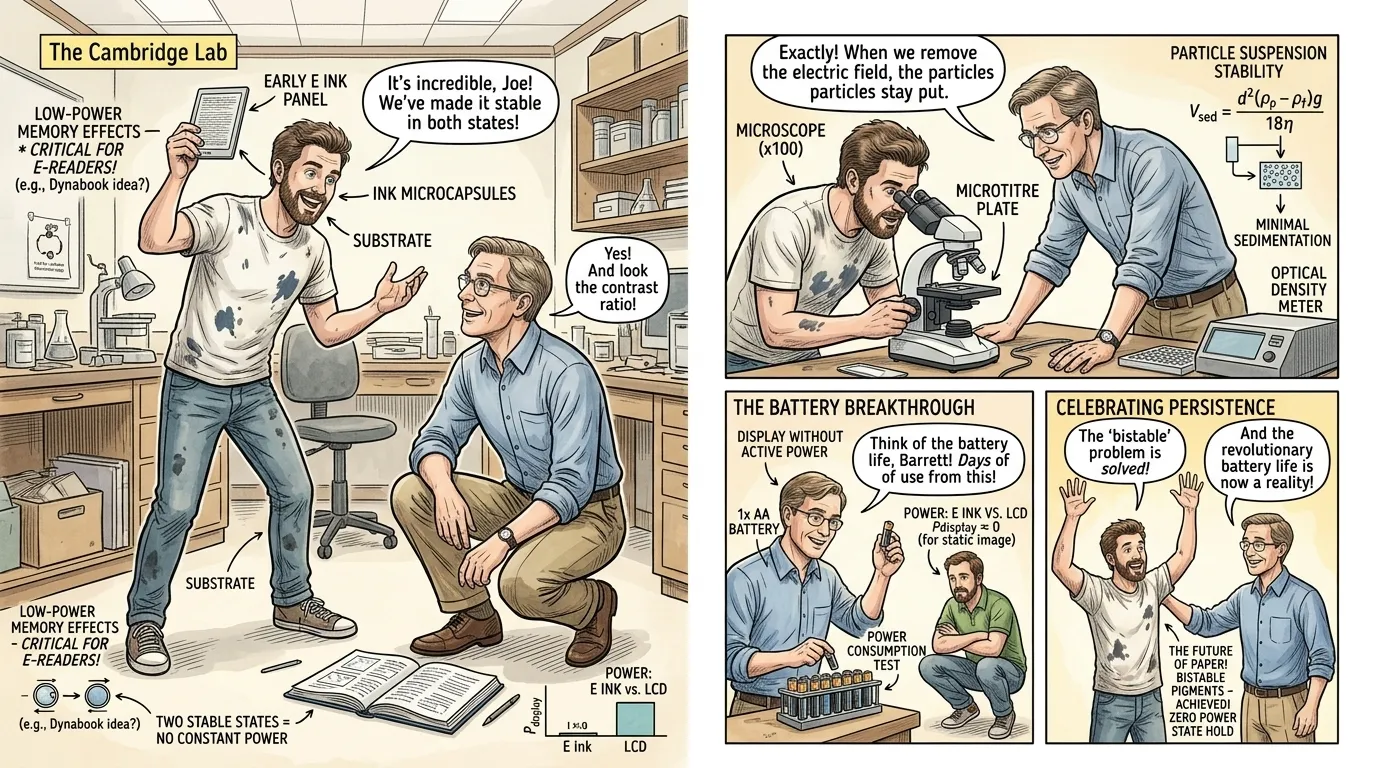
"'Unlike traditional screens that constantly refresh pixels, E Ink displays have a unique property: they only consume power when the image changes,' Dr. Comiskey highlighted. 'Once the electric field has moved the particles into position to form text or an image, they stay there. They're like tiny magnets holding their place.' Dr. Jacobson added, 'This means the display holds its image perfectly even when completely disconnected from power, giving it incredible battery life and true paper-like persistence.' 'It's a "bistable" display,' Comiskey concluded, 'offering a low-power, high-contrast visual experience previously unattainable for portable devices.'"
Page 7
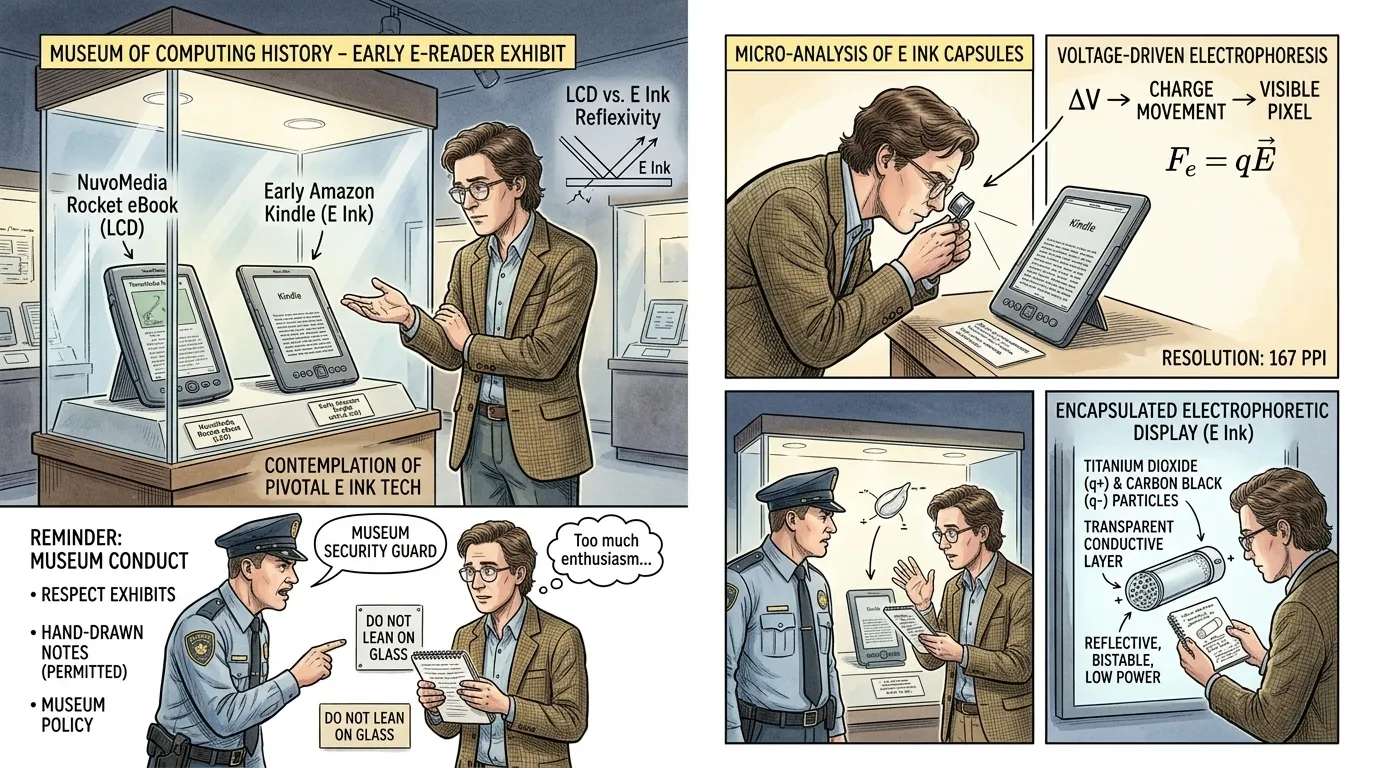
"'While NuvoMedia's Rocket eBook was an important precursor, it was E Ink's display technology that truly unlocked the e-reader's potential for widespread adoption,' a technology historian might explain, observing an early 2000s tech exhibit. 'The demand for a comfortable reading experience was clear.' In 2007, Amazon launched the Kindle, integrating E Ink's electrophoretic display. 'This marked a pivotal moment,' the historian continued. 'Suddenly, the vision of a truly portable, comfortable reading device, one that minimized eye strain and maximized battery life, was realized and accessible to millions. It fundamentally shifted how people thought about books.'"
Page 8
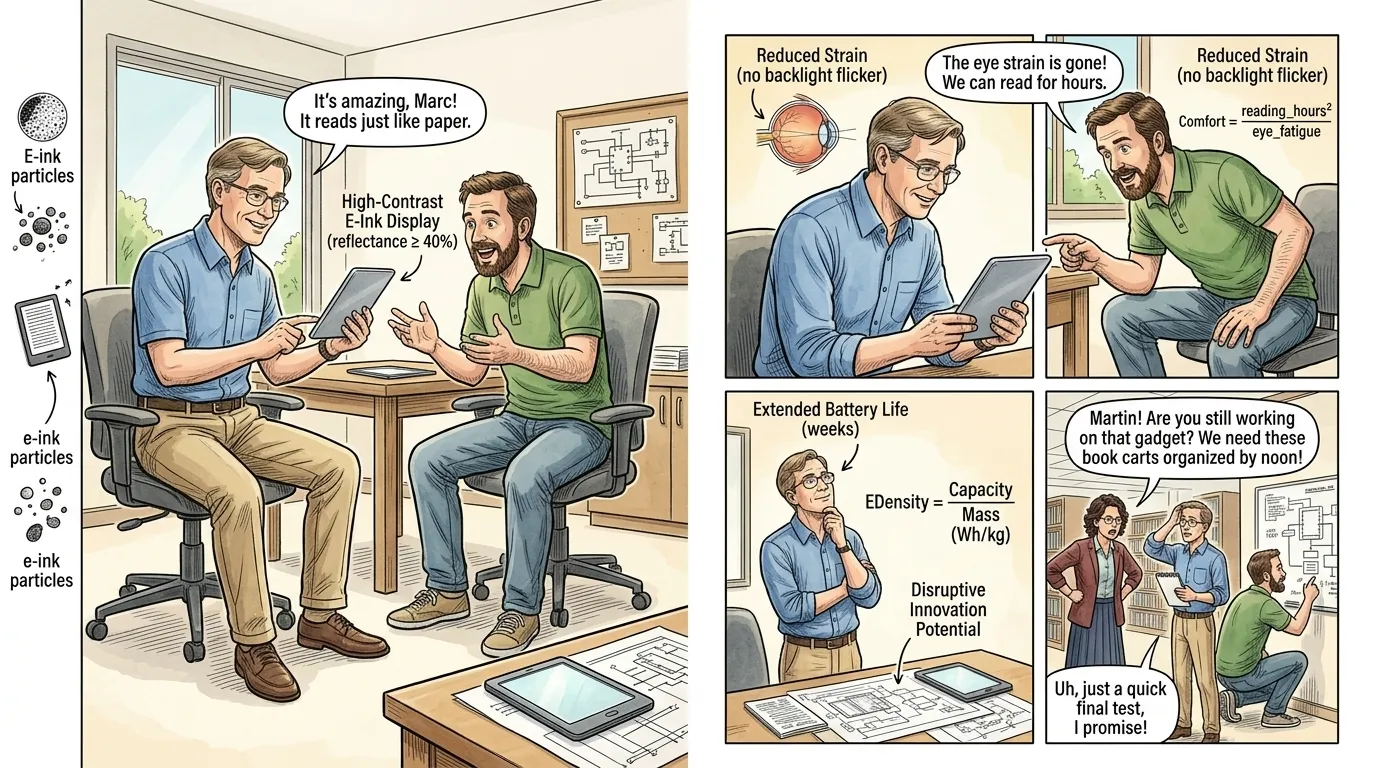
"'The E Ink display completely transformed the reading experience, delivering on that 'paper-like readability' we sought years ago,' Dr. Eberhard might acknowledge, reviewing a modern e-reader. 'The elimination of backlighting and the high contrast dramatically reduced eye strain, a major complaint with early LCD-based digital readers.' Dr. Tarpenning would concur, 'And the bistable nature meant days or even weeks of battery life on a single charge. No longer were readers tethered to outlets; their libraries were truly mobile.' 'This solved the core dilemma of digital text versus comfortable, prolonged reading,' Eberhard concluded, 'making reading anywhere, anytime, a practical reality.'"
Page 9
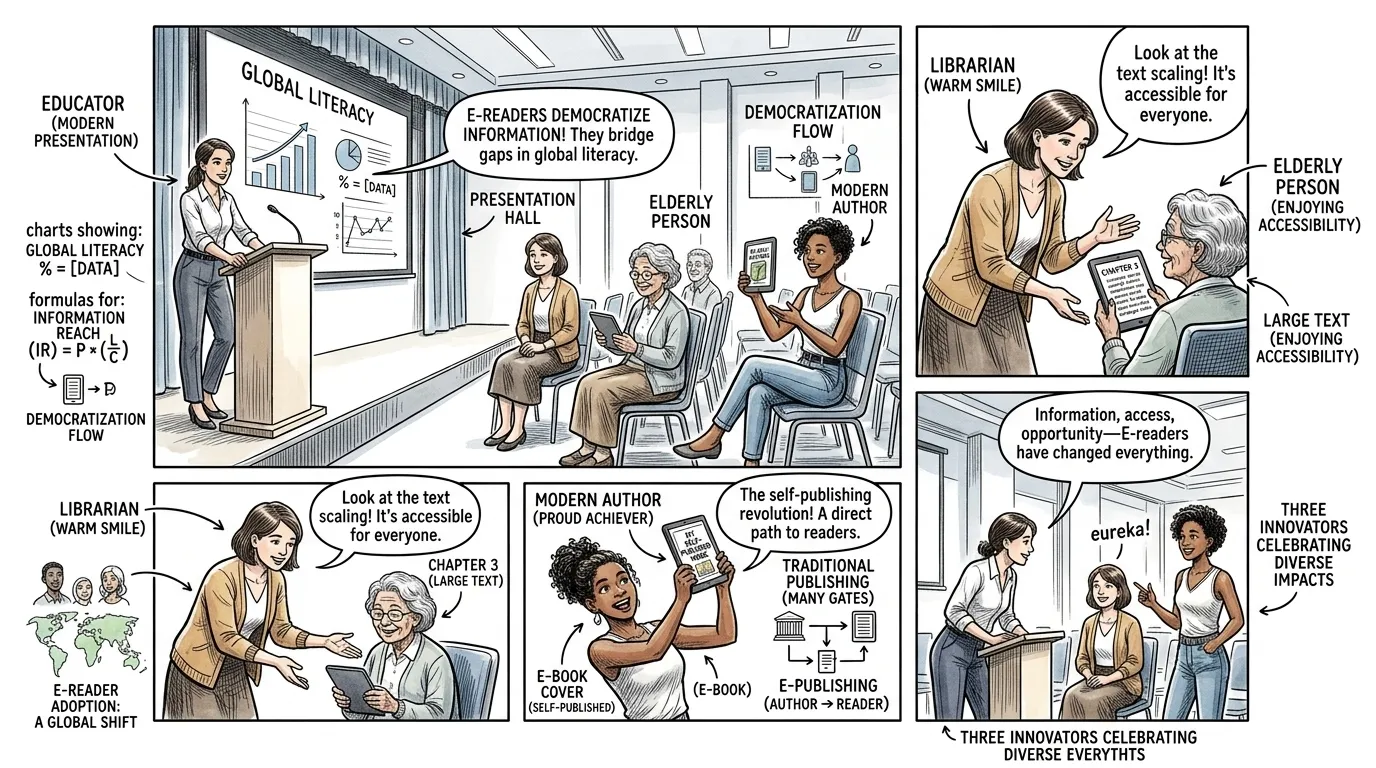
"'The E-book Reader didn't just digitize books; it democratized access to information on an unprecedented scale,' an educator might state during a presentation. 'Students in remote areas can access vast libraries, and researchers can carry entire archives.' A librarian could add, 'For those with visual impairments, adjustable font sizes and text-to-speech features have been revolutionary, making literature accessible in ways traditional books couldn't.' 'It catalyzed the self-publishing revolution too,' a modern author might chime in. 'Giving countless voices a platform without the barriers of traditional printing and distribution.'"
Page 10
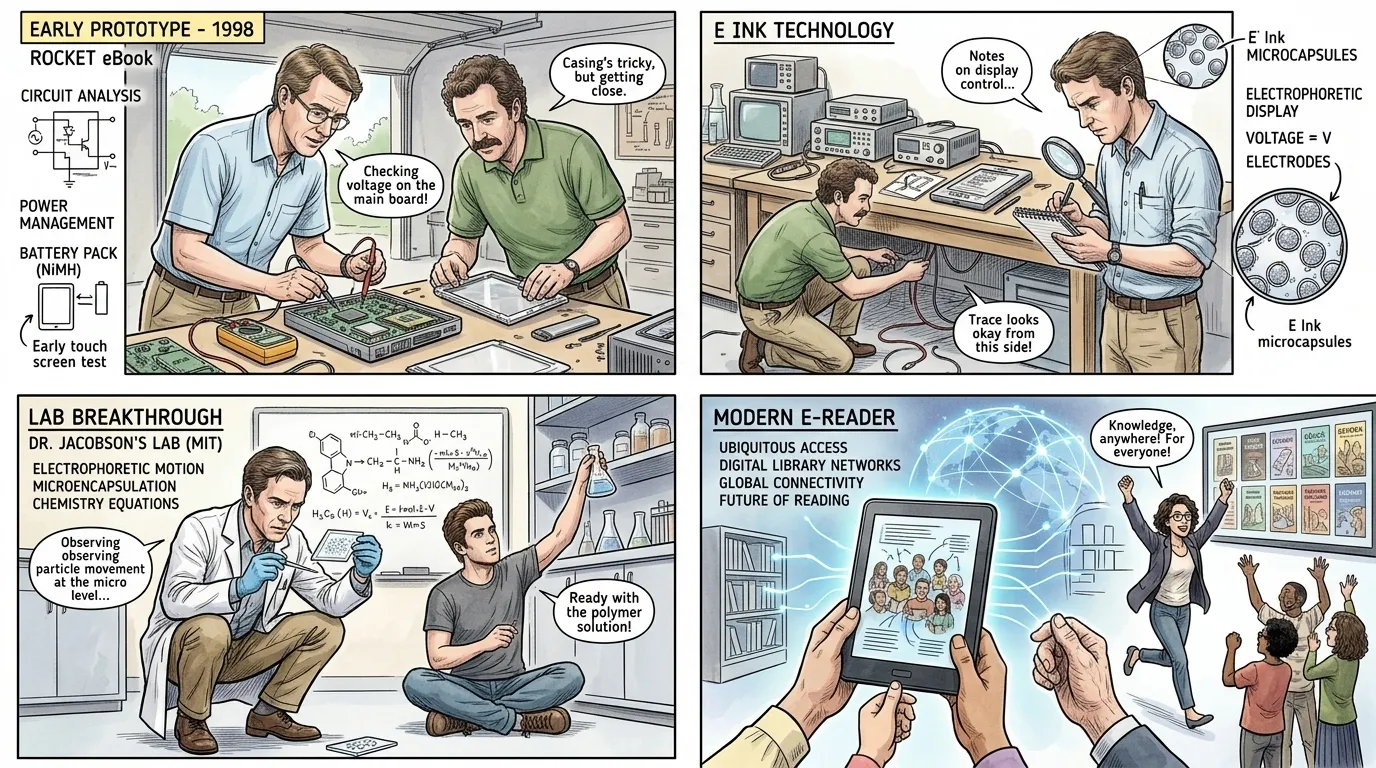
"The e-book reader, from its early, clunky prototypes to its sleek, ubiquitous forms today, has fundamentally reshaped our relationship with text and knowledge. It addressed the pressing problem of physical limitations, offering unparalleled portability and access. The ingenuity of innovators like Martin Eberhard and Marc Tarpenning, coupled with the scientific breakthrough of E Ink's Joseph Jacobson, converged to create a device that not only predicted but actively invented a future where entire libraries reside in the palm of your hand, constantly accessible, quietly revolutionizing how we learn, share, and consume information across the globe."
About this story
- Location: Global
- Audience: general readers
Questions and answers
Read Wonder Inventions on your phone
Wonder Inventions is available on Android. Get Wonder Inventions on Google Play.