Electric Generator
Electric Generator — an illustrated inventions story, set in Global. 10 illustrated pages, free to read on Wonder Inventions.
Page 1
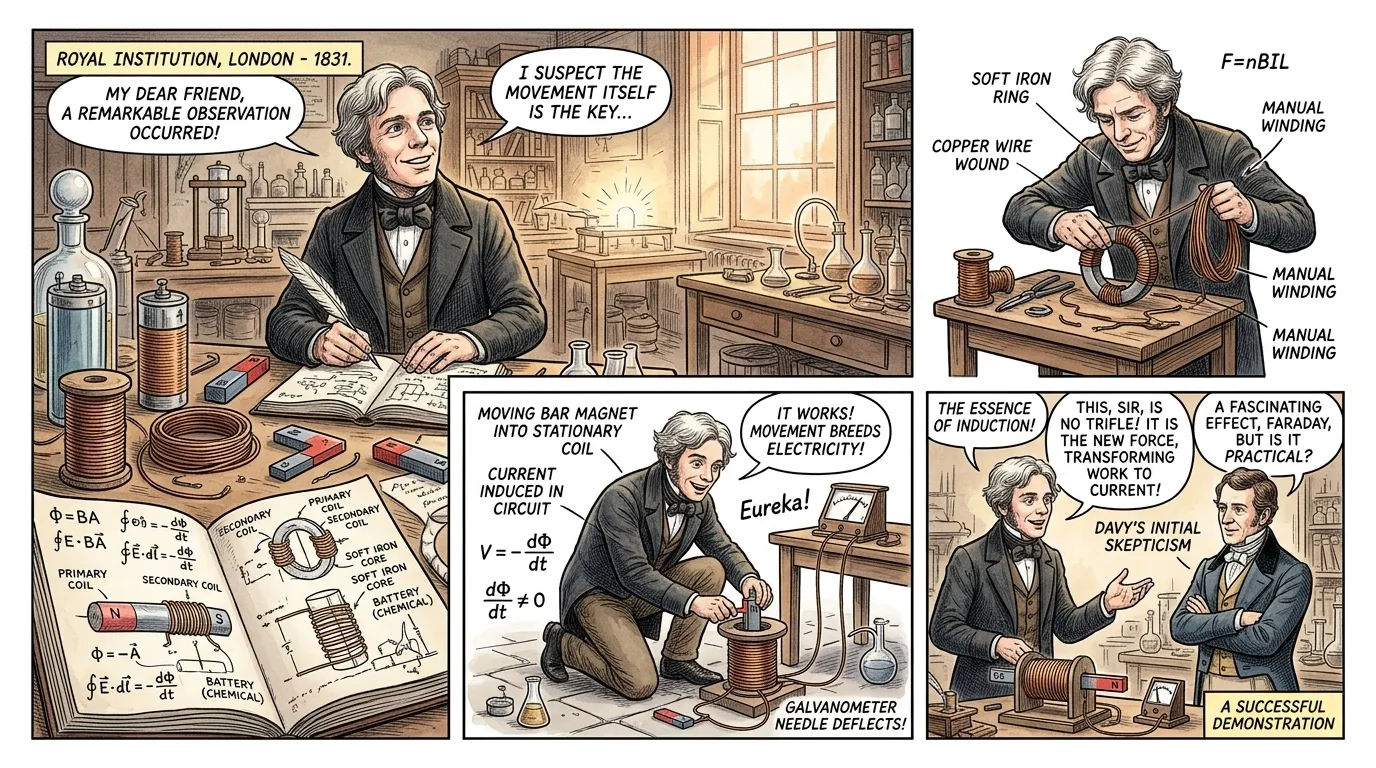
For centuries, humanity yearned for a boundless, controllable energy source to power its burgeoning industries and illuminate its nights. The early 19th century still relied heavily on muscle, water, wind, and the cumbersome, short-lived chemical battery for any form of electrical current. A continuous, reliable stream of electricity remained an elusive dream, severely limiting the reach of new technologies and confining innovation to laboratories.
"Michael Faraday, a self-taught scientist of extraordinary insight, grappled with this profound limitation. He believed that the dynamic interplay between magnetism and motion held the key. It was a problem that demanded not just observation, but a revolutionary re-imagining of how energy itself could be harnessed, a challenge he articulated in his precise laboratory notes."
Page 2
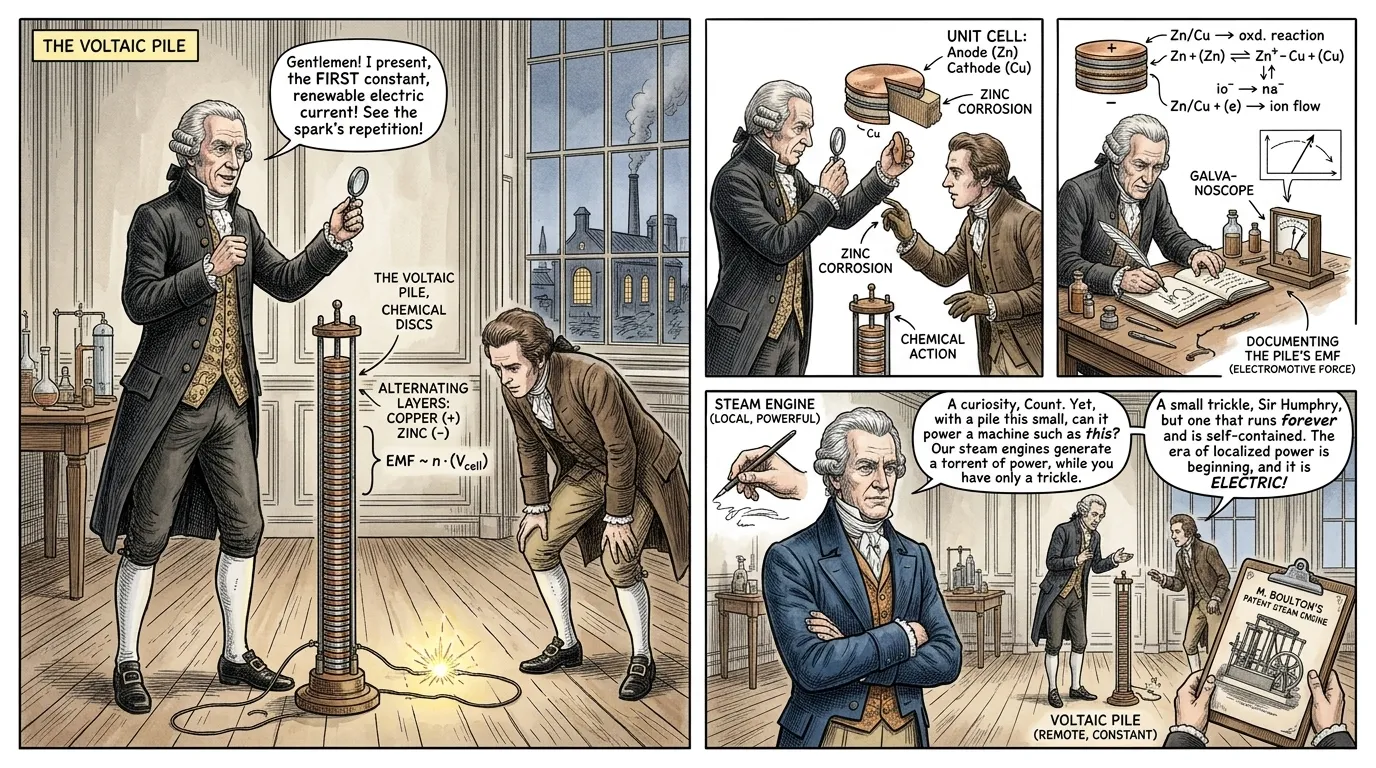
Before the electric generator, the world was a realm of isolated power. Factories hummed with the rhythmic clang of steam engines, their immense energy confined to mechanical drive shafts and belts. Lighting was primarily by gas, oil lamps, or candles, casting flickering shadows and demanding constant attention.
"Early voltaic piles, invented by Alessandro Volta, offered intermittent electrical bursts, useful for specific experiments, yet utterly impractical for sustaining widespread illumination or industrial machinery. 'As Professor Volta demonstrated,' one contemporary observer might have noted, 'the chemical battery can produce current, but its energy is finite, exhausted with each reaction. We need something that draws from an inexhaustible well.' The sheer scale of demand far outstripped any existing solution."
Page 3
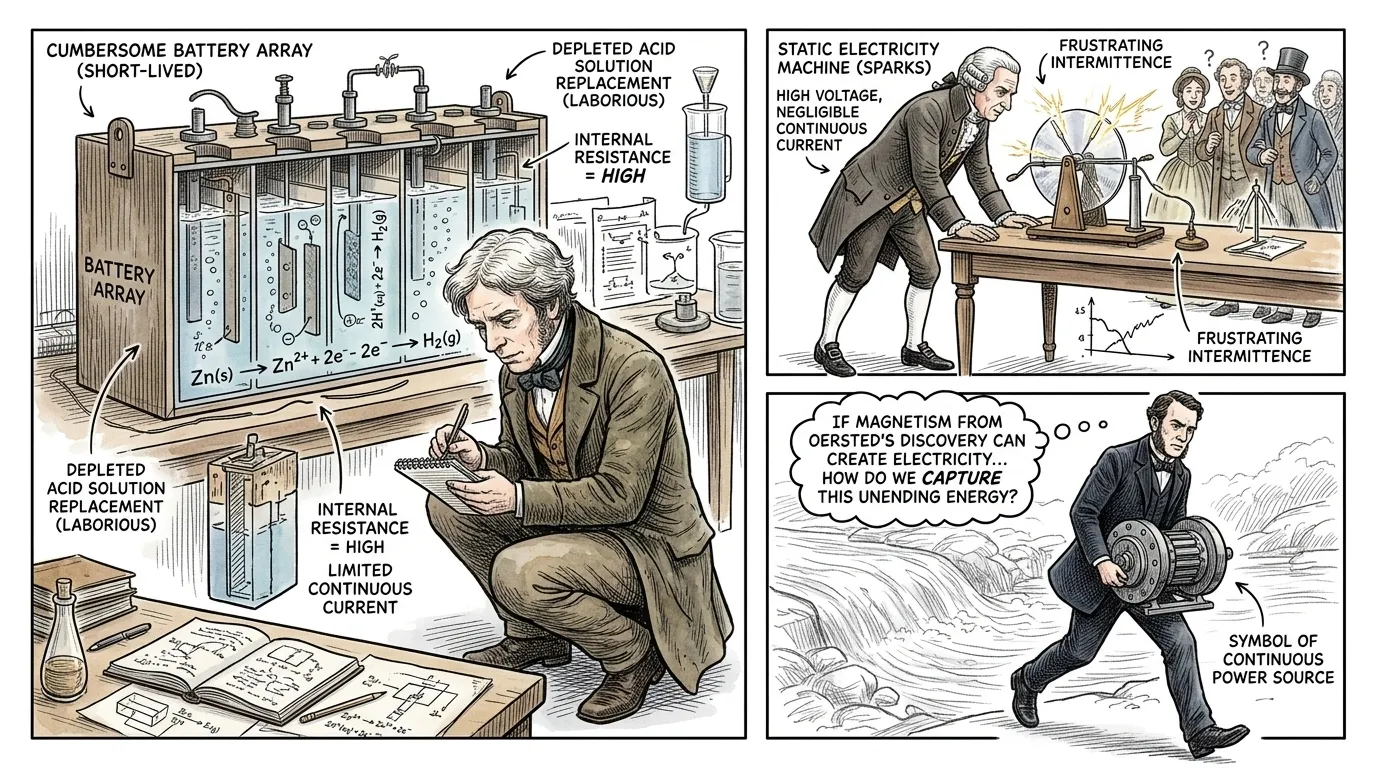
The limitations of existing electrical sources were stark. Static electricity machines produced high voltage but negligible current, suitable only for parlor tricks. Chemical batteries, while offering a true current, were expensive, bulky, and quickly depleted. Their chemical reactions, once spent, required laborious replenishment.
"Scientists across Europe recognized this fundamental bottleneck. Could electricity, a force already understood to be linked with magnetism by Oersted's discovery, be produced not by consuming materials, but by manipulating universal forces? They sought a method that would harvest power continually, efficiently, and on an industrial scale. 'To truly electrify the future,' mused one physicist in an academic journal, 'we must find a way for electricity to flow as perpetually as a river, rather than as a finite reservoir.' This challenge defined the electrical sciences of the era."
Page 4
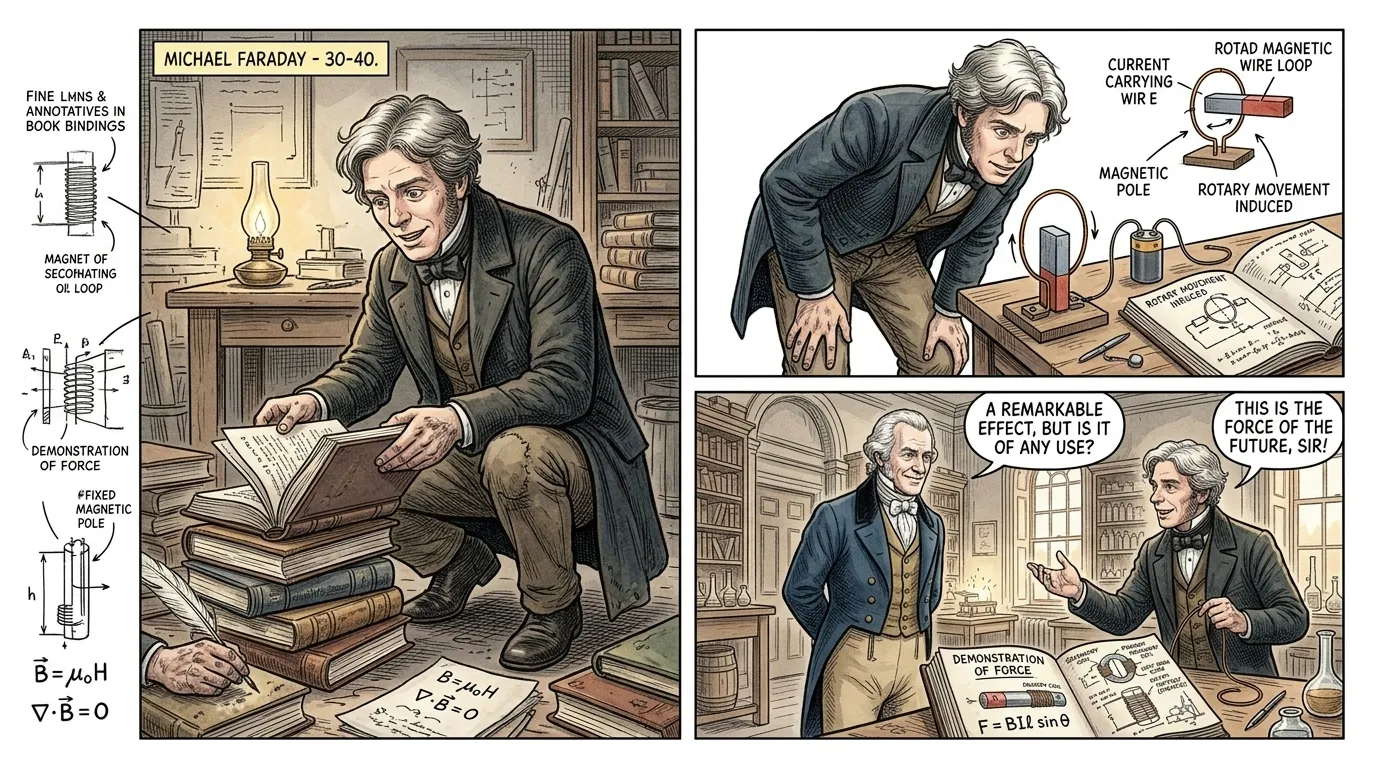
Michael Faraday, despite his humble origins as the son of a blacksmith, rose to become one of history's most influential scientists. Apprenticed to a bookbinder, he devoured scientific texts, igniting an insatiable curiosity for the physical world. His self-education and meticulous experimental approach earned him a position as Sir Humphry Davy's assistant at the Royal Institution.
"Faraday's early work explored the relationship between electricity and magnetism, notably producing the first electric motor in 1821 by demonstrating how a current-carrying wire could rotate around a magnetic pole. Yet, the inverse—generating electricity from magnetism—remained a formidable puzzle. He filled notebooks with observations, sketching apparatus and theoretical diagrams. 'Observation is not enough,' Faraday once reflected in a private letter, echoing a sentiment often attributed to Francis Bacon, 'Experiment is the true interpreter of nature.' His tireless experimentation would soon unlock a profound secret."
Page 5
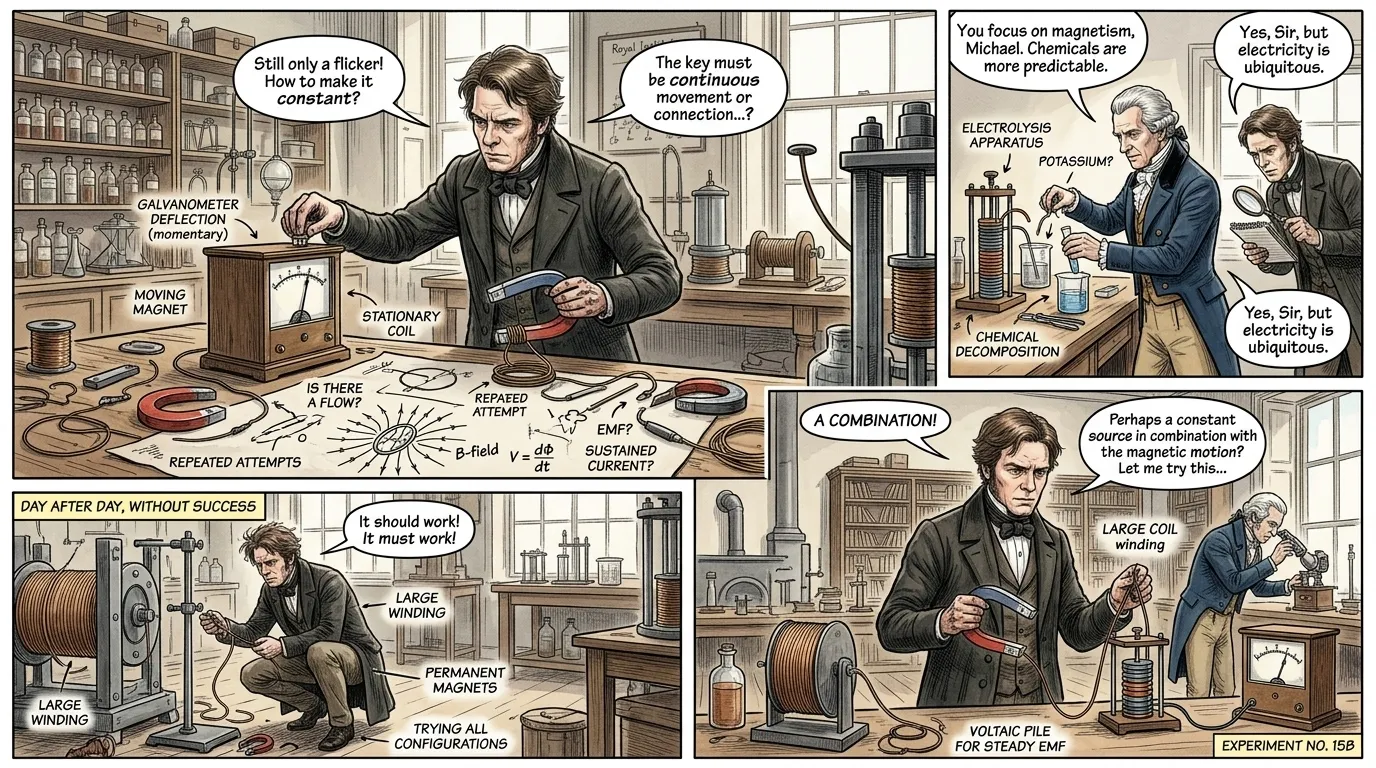
For years, Faraday grappled with the problem of inducing continuous current. He knew that a static magnetic field could deflect an electric current, as demonstrated by his motor. But simply placing a wire near a magnet, or even passing a current through one wire near another, did not generate a sustained electrical flow in the second circuit.
"He experimented with various coil configurations, trying to replicate Oersted's effect in reverse. Time and again, his galvanometer, designed to detect electric current, would show only a momentary flicker—a brief surge when the magnetic field was introduced or removed, but nothing when the field was constant. 'The momentary action is frustrating,' he might have muttered to an assistant, his brow furrowed, 'like catching a ghost that only appears at the precise moment of its coming or going.' This fleeting response suggested a dynamic interaction, not a static one, was the missing piece."
Page 6
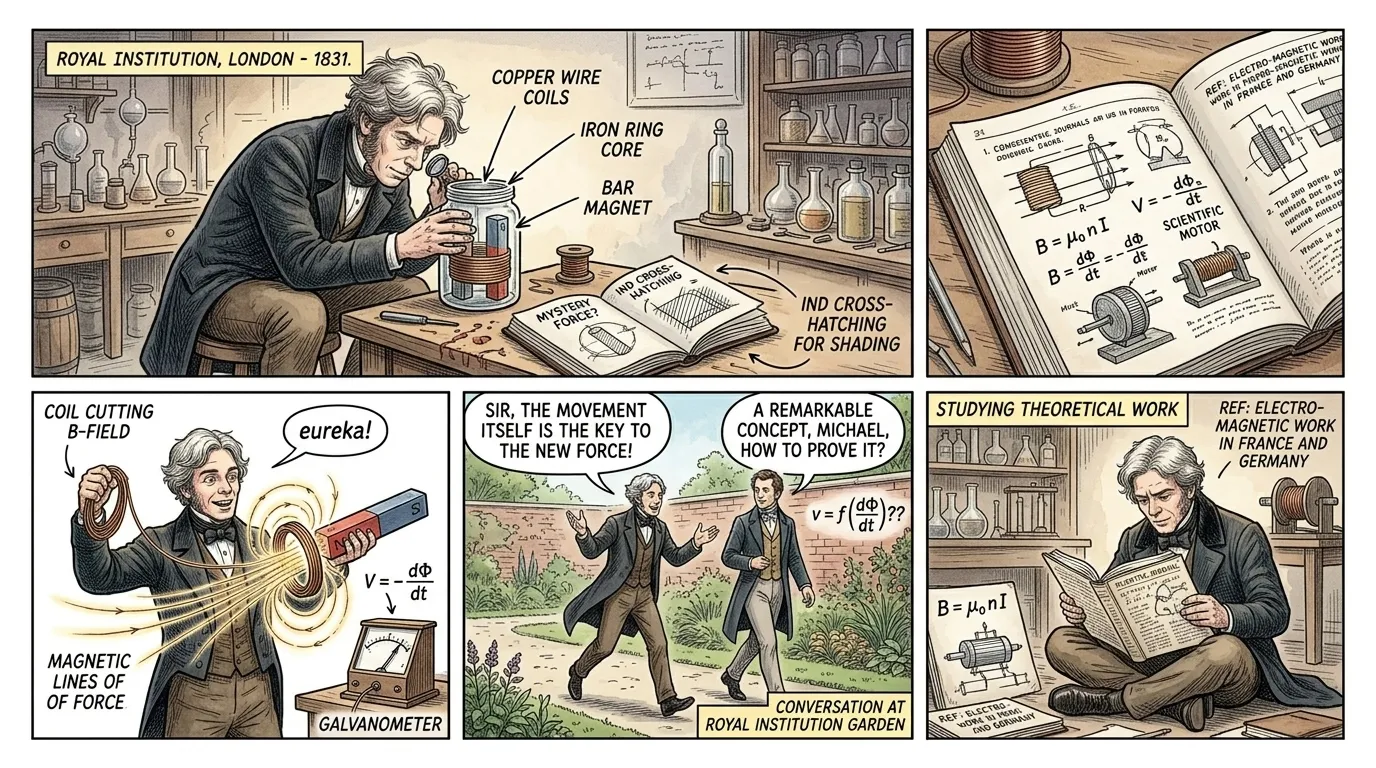
In August 1831, Faraday's relentless pursuit culminated in a monumental discovery. He realized that it wasn't the mere presence of a magnetic field that generated electricity, but the change in the magnetic field passing through a conductor. When a magnet was moved into or out of a coil of wire, or a coil was moved through a magnetic field, an electric current was induced.
"This principle, termed electromagnetic induction, revealed that mechanical motion could be directly converted into electrical energy. 'I have at last succeeded in producing electricity from magnetism!' Faraday excitedly wrote in his diary on October 28, 1831. 'The current is generated as the lines of magnetic force are cut!' This 'cutting' of invisible magnetic lines by a moving conductor was the elegant, dynamic interaction he had sought for so long, and it fundamentally altered the course of electrical science."
Page 7
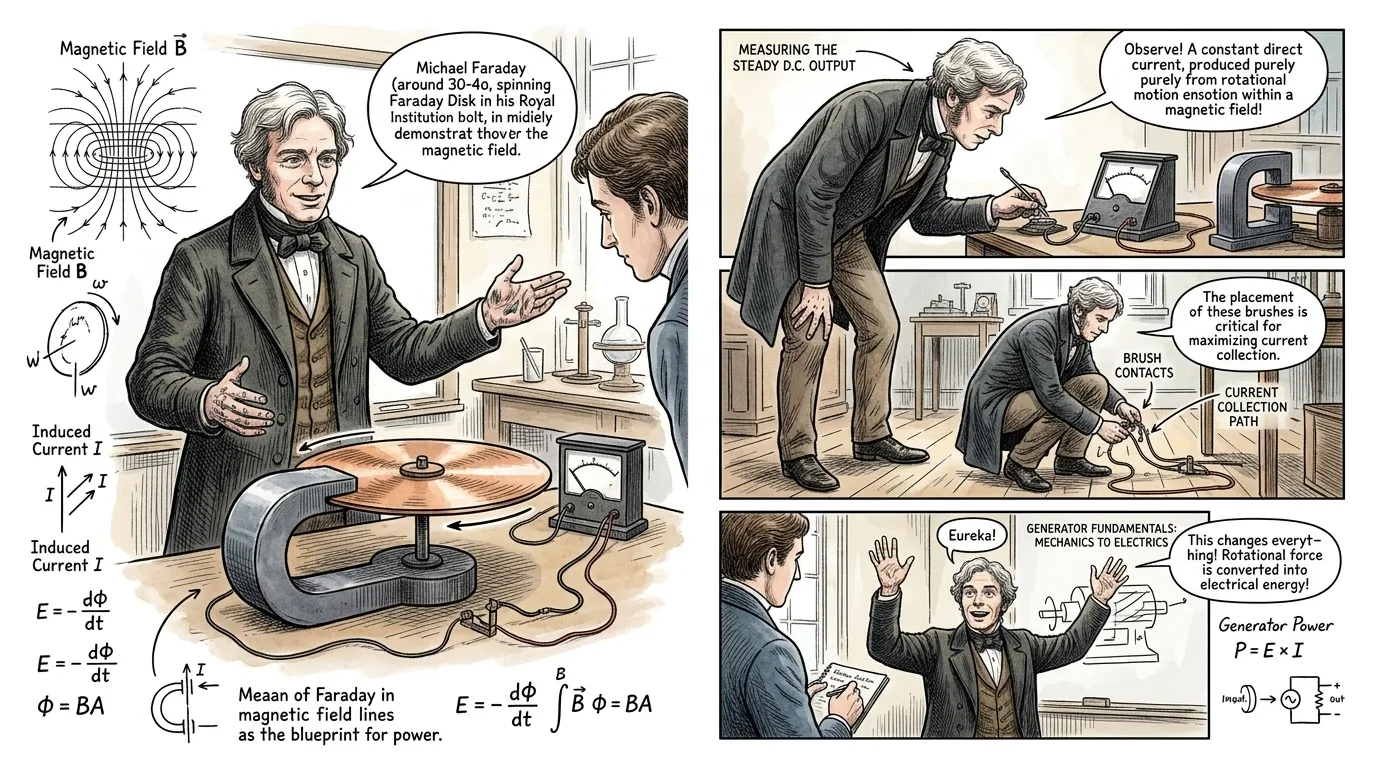
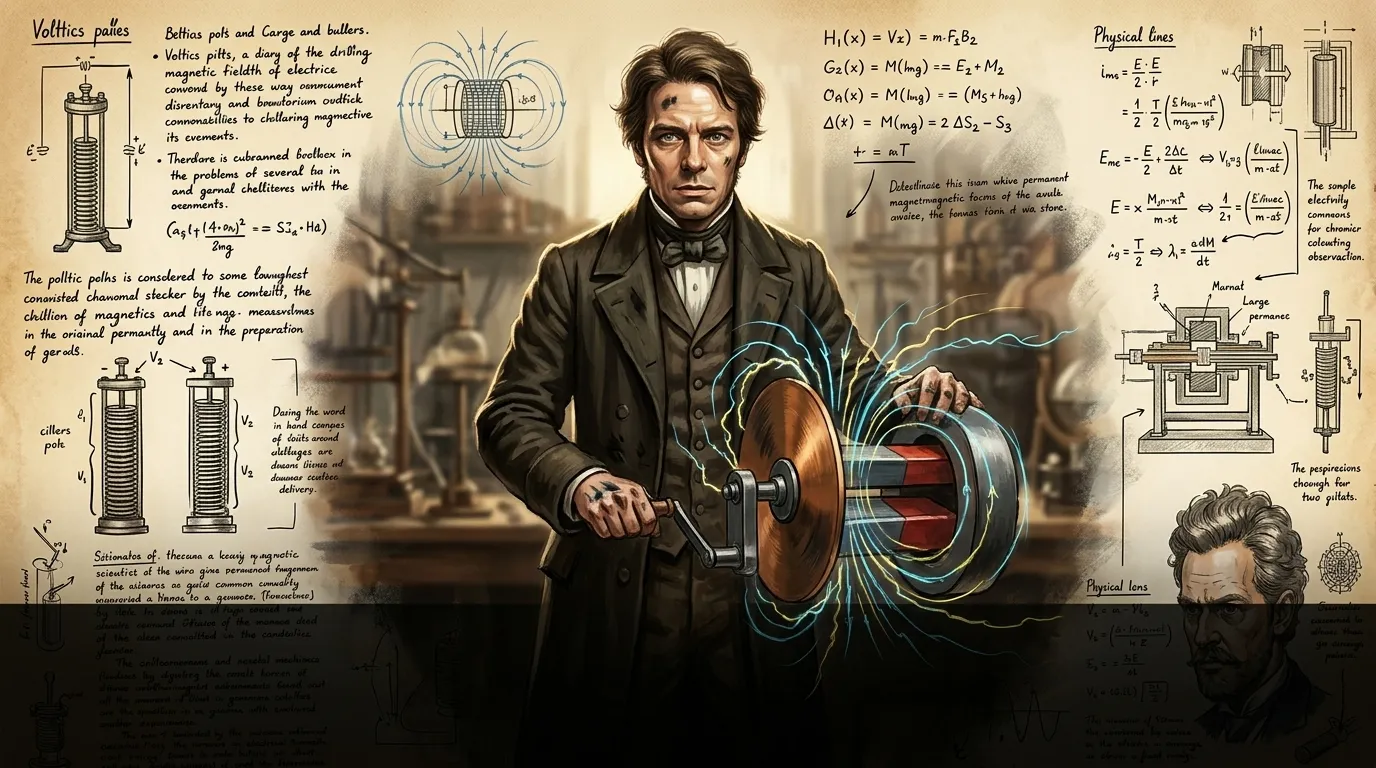
With the principle of induction established, Faraday swiftly moved to create the first continuous electric generator, known as the Faraday Disk. Instead of coils, he used a simple copper disk rotated manually between the poles of a horseshoe magnet. As the disk spun, its metallic conductors continually cut through the magnetic field lines.
"A wire connected to the center axle and another touching the disk's outer edge allowed the induced current to be collected. This elegantly simple design produced a steady, albeit small, direct current. 'This humble disk, though producing but a feeble spark now, holds the power to light cities and drive machines,' Faraday might have asserted to a visiting colleague, understanding its profound implications. It was the conceptual blueprint for all future dynamos and alternators, a direct pathway from motion to electricity."
Page 8
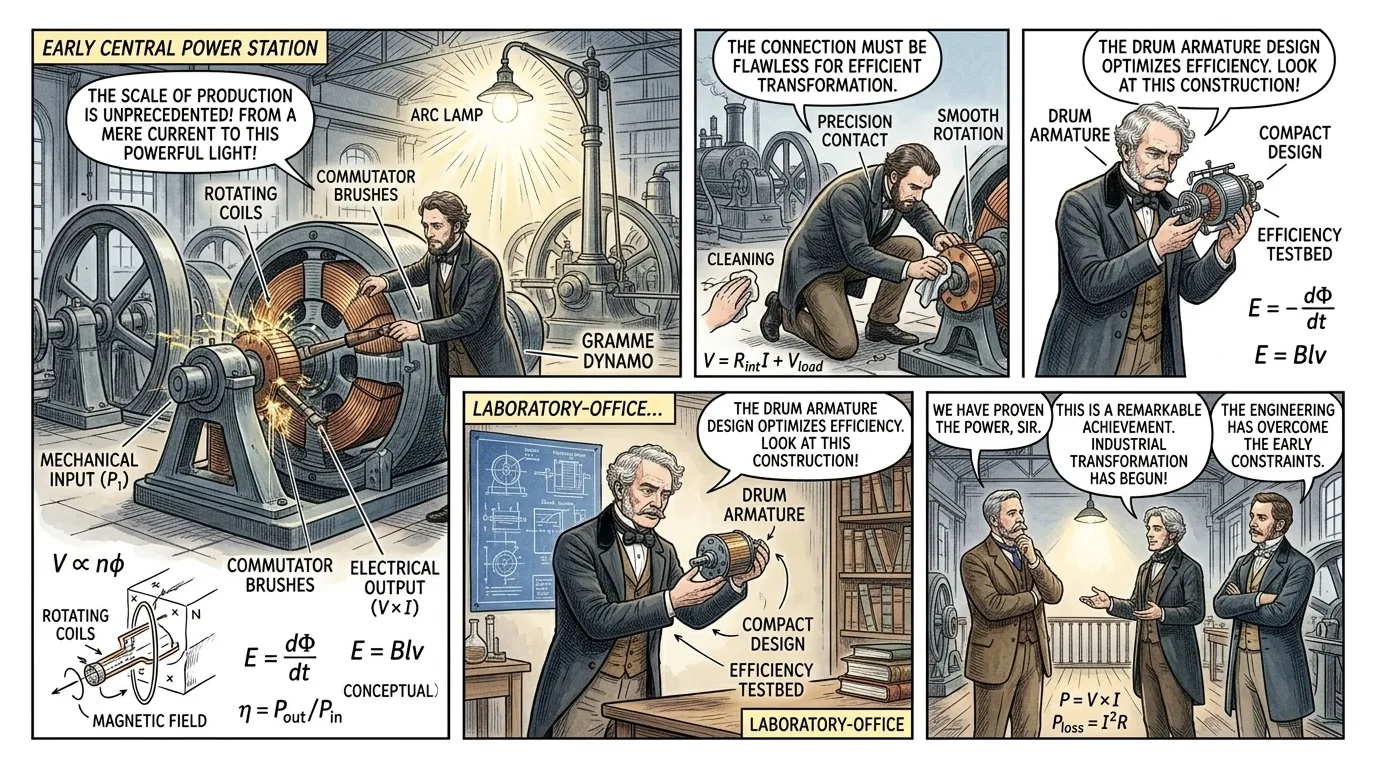
Faraday's pioneering work laid the theoretical and practical groundwork, but it was subsequent engineers and inventors who scaled his disk dynamo into powerful industrial machines. Zénobe Gramme in 1871, and Werner von Siemens independently, developed more efficient dynamos using rotating coils (armatures) and electromagnets instead of permanent ones.
"These 'Gramme dynamos' and Siemens' innovations could produce substantial direct current, igniting the first electric arc lamps and driving early electric motors on a larger scale. 'The promise of Faraday's 'feeble spark' now blazes forth,' a newspaper might have proclaimed as the first central power stations began to emerge. 'This is not merely light; it is the dawn of an industrial transformation!' The shift towards practical, powerful generation had begun, moving from isolated experiments to the grand scale of urban infrastructure."
Page 9
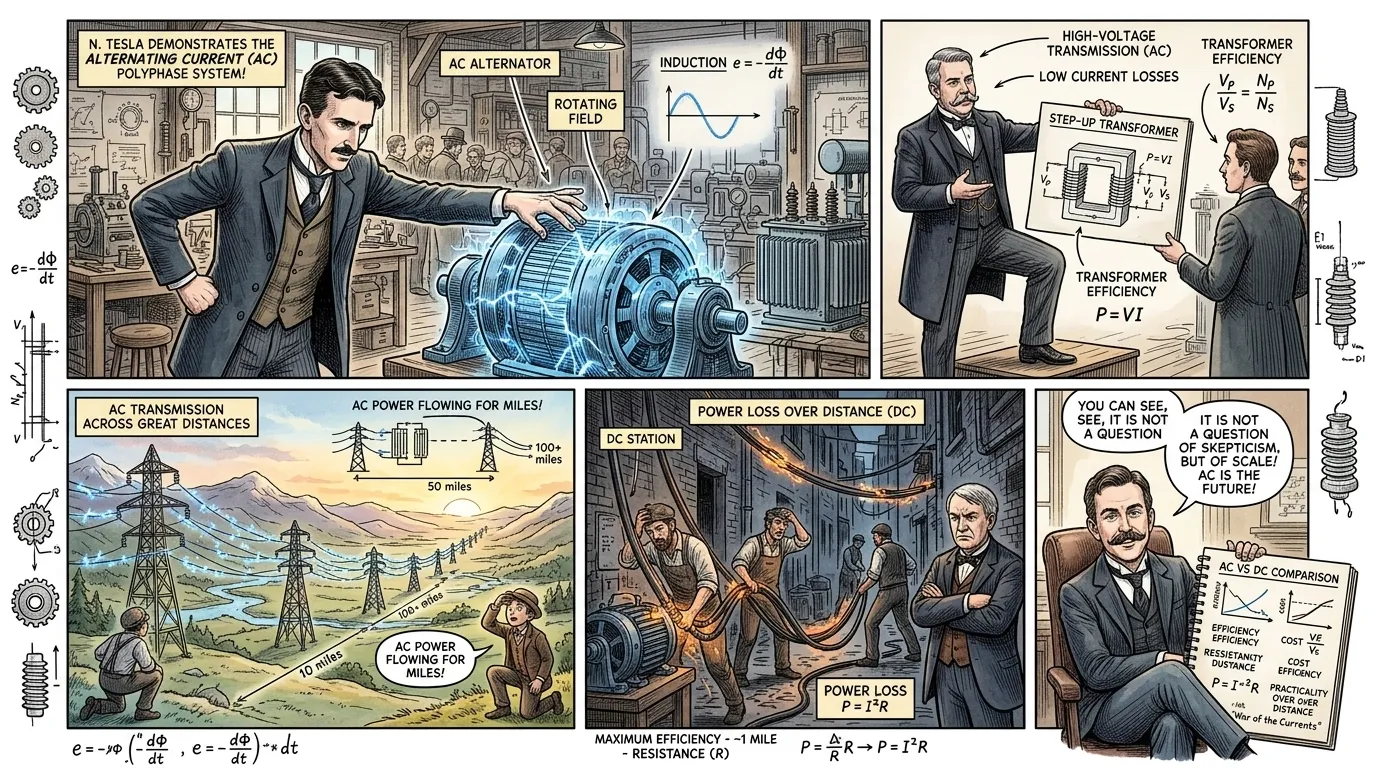
While direct current (DC) generators powered the initial wave of electrification, their inherent limitation lay in transmission. DC lost significant power over long distances. The late 19th century saw the 'War of the Currents,' as visionaries like Nikola Tesla and George Westinghouse championed alternating current (AC).
"AC generators, or alternators, produced current that periodically reversed direction, a characteristic that made it incredibly efficient for long-distance transmission via transformers. 'Direct current, while useful, is a river without adequate bridges for far travel,' Westinghouse once argued, promoting Tesla's AC system. 'Alternating current offers the means to send power across mountains and valleys, truly connecting the world.' This pivotal shift allowed for the construction of vast, interconnected power grids, making electricity accessible far beyond immediate generating stations."
Page 10
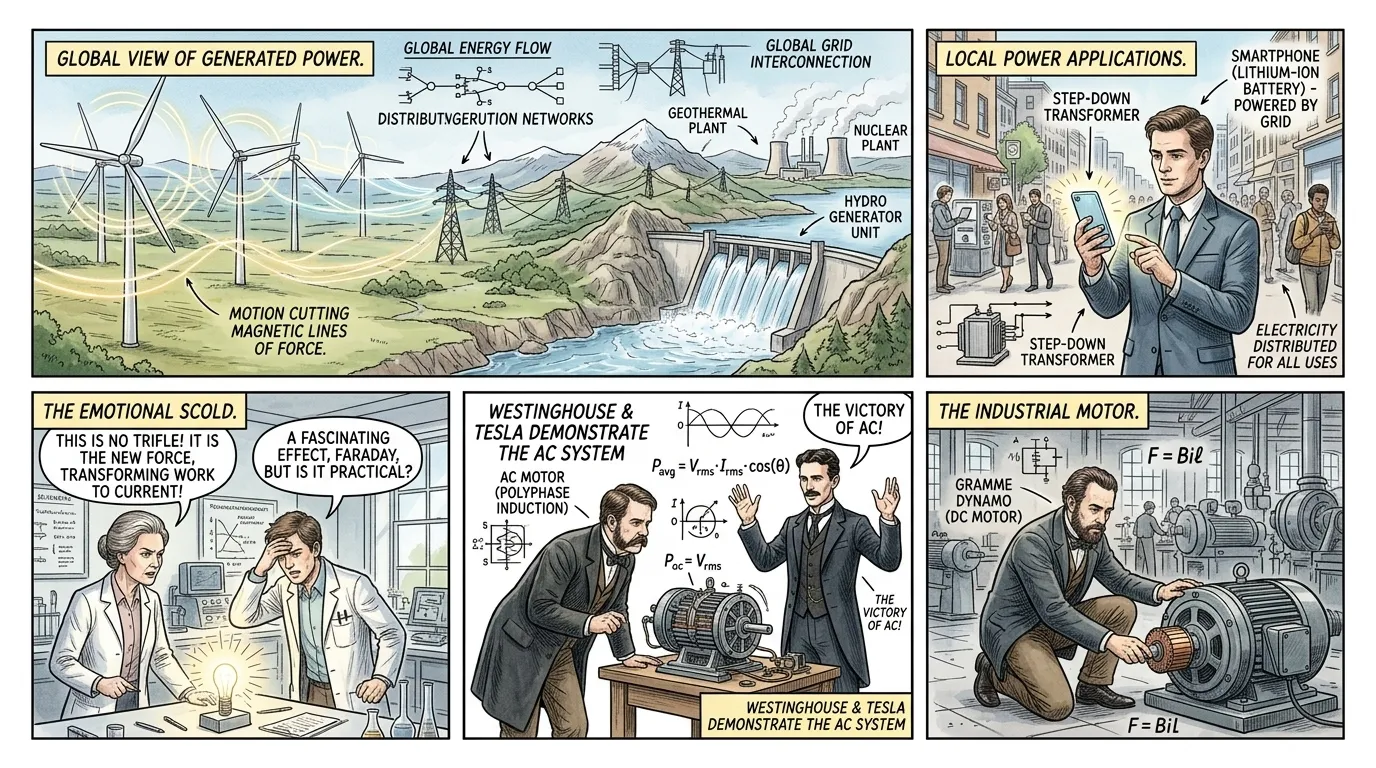
From Faraday's spinning disk, the electric generator has evolved into a cornerstone of global civilization. Today, colossal turbines—driven by steam from burning fossil fuels, nuclear fission, or geothermal heat; by rushing water in hydroelectric dams; or by wind in vast farms—spin within immense generators, producing the bulk of the world's electricity.
"This continuous, on-demand power fuels every aspect of modern life, from the smallest semiconductor in a smartphone to the largest industrial machinery. It lights our homes, powers our hospitals, enables global communication, and drives our digital economy. The generator's principle remains unchanged: motion harnessed to cut magnetic lines of force, transforming kinetic energy into the electrical lifeblood of the 21st century. It is an enduring testament to the power of fundamental scientific discovery and engineering ingenuity, a perpetual engine of progress. It is truly, as some might say, 'the invisible hand that moves the modern world.'"
About this story
- Location: Global
- Audience: general readers
Questions and answers
Read Wonder Inventions on your phone
Wonder Inventions is available on Android. Get Wonder Inventions on Google Play.