Escalator
Escalator — an illustrated inventions story, set in Global. 10 illustrated pages, free to read on Wonder Inventions.
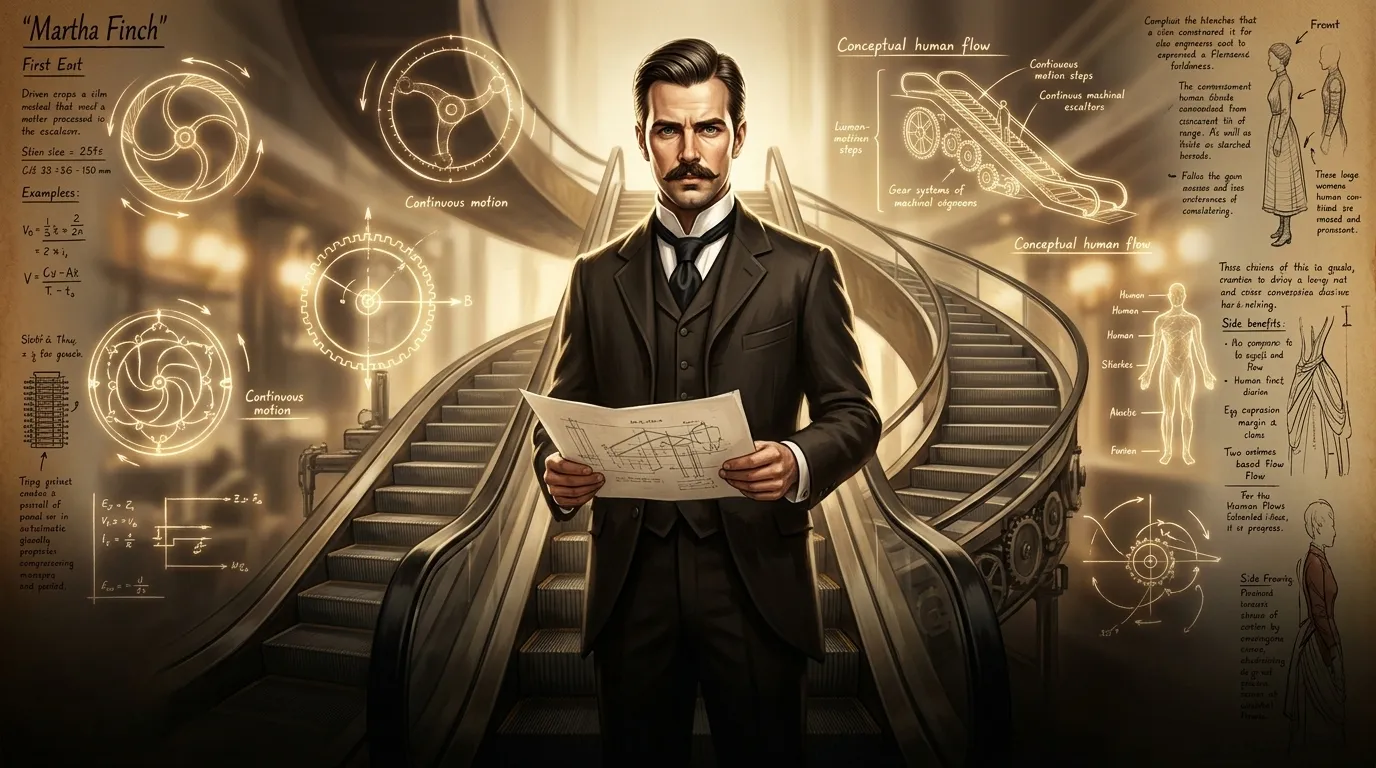
Page 1
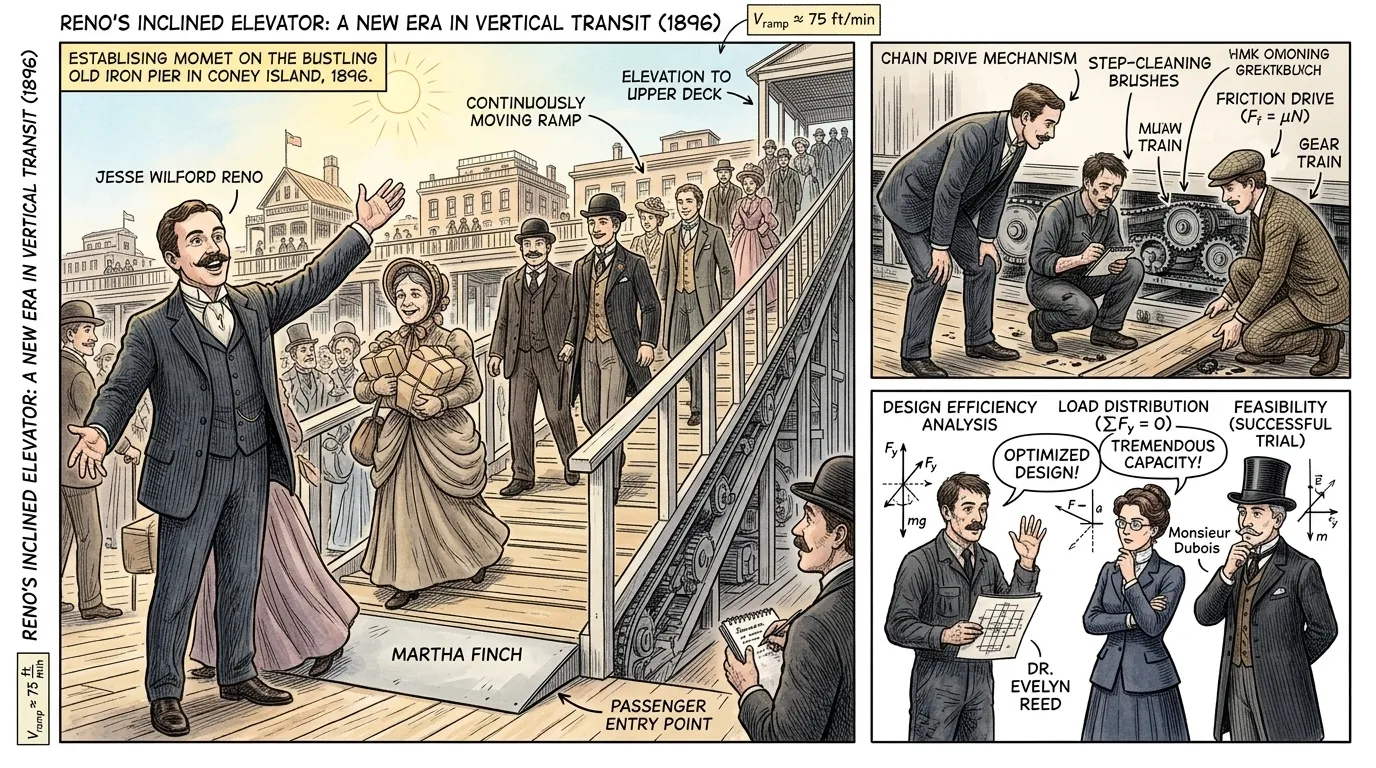
New York, 1896. At the Old Iron Pier in Coney Island, a revolutionary device captivated crowds, promising an end to the arduous climb of staircases in the burgeoning multi-story world. This was not merely a ramp but a continuously moving mechanism, conceived to transport humanity with unprecedented efficiency.
""Observe, gentlemen, the future of vertical transit!" proclaimed Jesse Wilford Reno to a group of investors, gesturing towards his invention. "My 'Inclined Elevator' provides effortless ascent, a true marvel for the modern age.""
Page 2
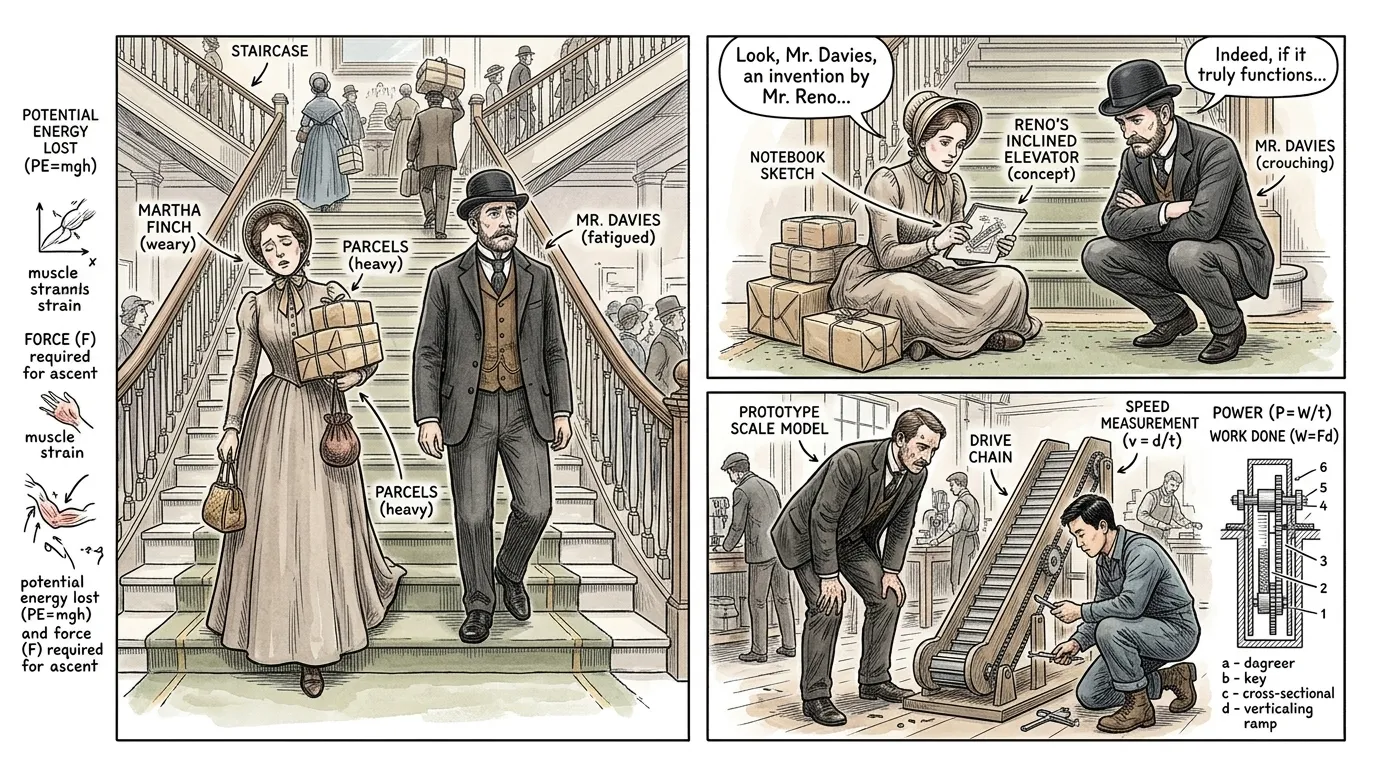
Before such innovations, the multi-story buildings of the late 19th century presented a significant challenge to urban dwellers and commerce alike. Department stores, office blocks, and elevated train stations demanded constant vertical movement, exhausting patrons and impeding the rapid flow of people.
"An exasperated shopper, Martha Finch, sighed, clutching her parcels after ascending four flights. "Another floor, another flight of stairs. It quite takes the wind out of one's sails." Beside her, a businessman, Mr. Davies, nodded gravely. "Efficiency, Martha, is the heartbeat of industry. These stairs are a constant drain on our collective energy.""
Page 3
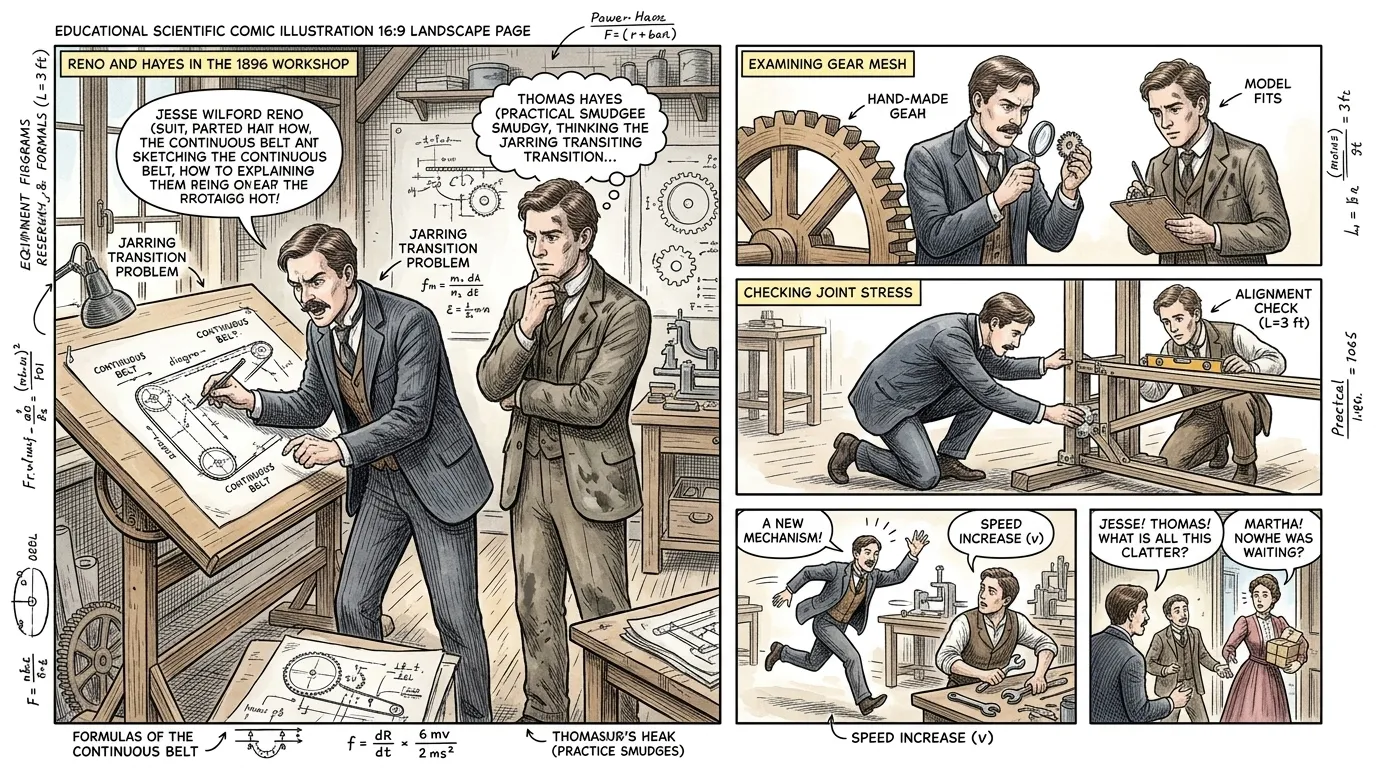
Early attempts at mechanized vertical transport often lacked the sophistication needed for public use. Reno's 'Inclined Elevator' was a significant step, yet its continuous smooth surface, while innovative, presented its own set of challenges, particularly in safely boarding and disembarking.
"In his workshop, Reno sketched furiously, explaining to his chief engineer, Thomas Hayes, "The continuous belt works, yes, but the transition at entry and exit is... jarring. Passengers need a firm footing, a level surface, for a seamless experience." Hayes pondered, "Precisely, sir. The integration of a truly flat step that then smoothly transforms into an incline remains the elusive puzzle.""
Page 4
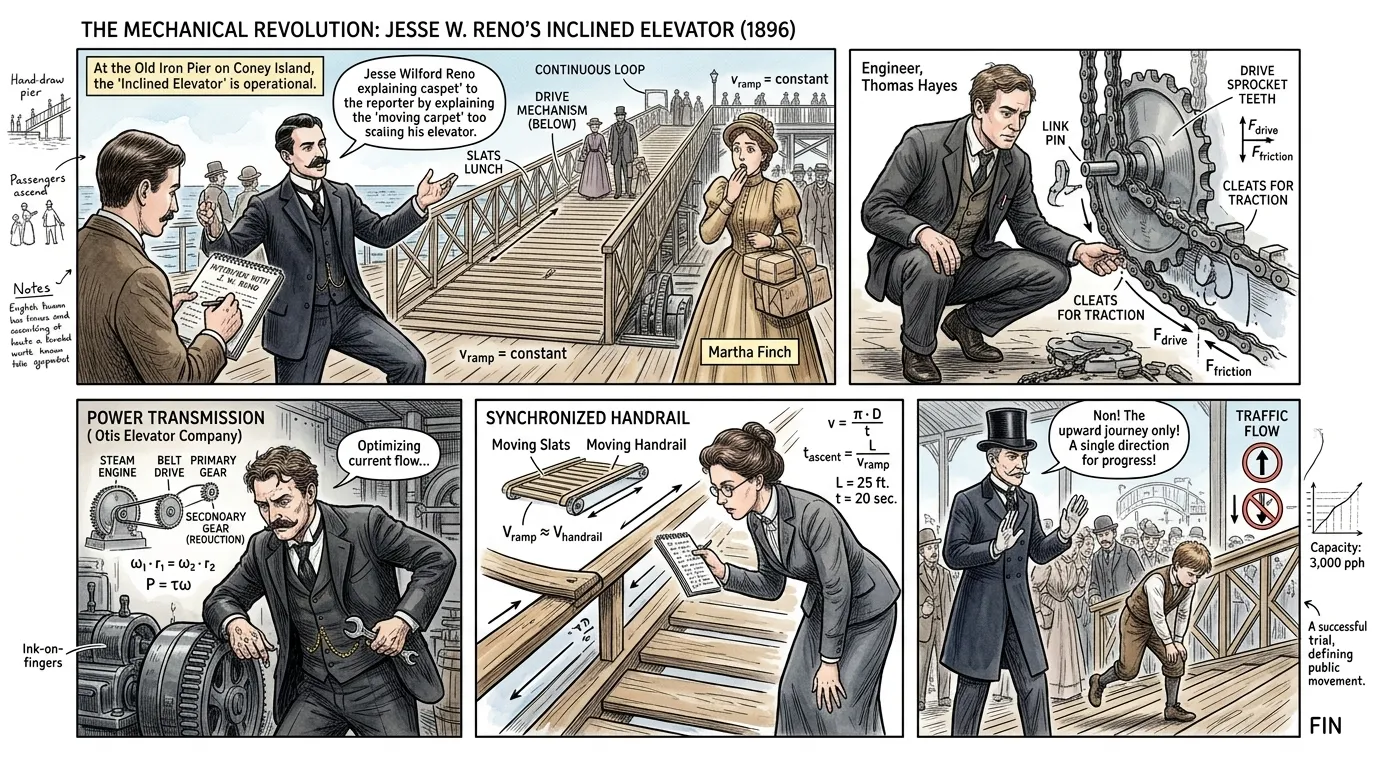
Jesse Wilford Reno, an engineer and inventor, secured a patent for his 'Inclined Elevator' in 1892. His design was ingenious in its simplicity: a continuous loop of wooden slats linked together, forming a moving ramp powered by an electric motor. This offered a novel solution to vertical travel.
"Reno elaborated to a reporter during the Coney Island exhibition, "My system is fundamentally a conveyor. The slats, linked together, travel along a track, creating an endless, upward-moving carpet. It's robust, straightforward, and efficient for moving large numbers of people.""
Page 5
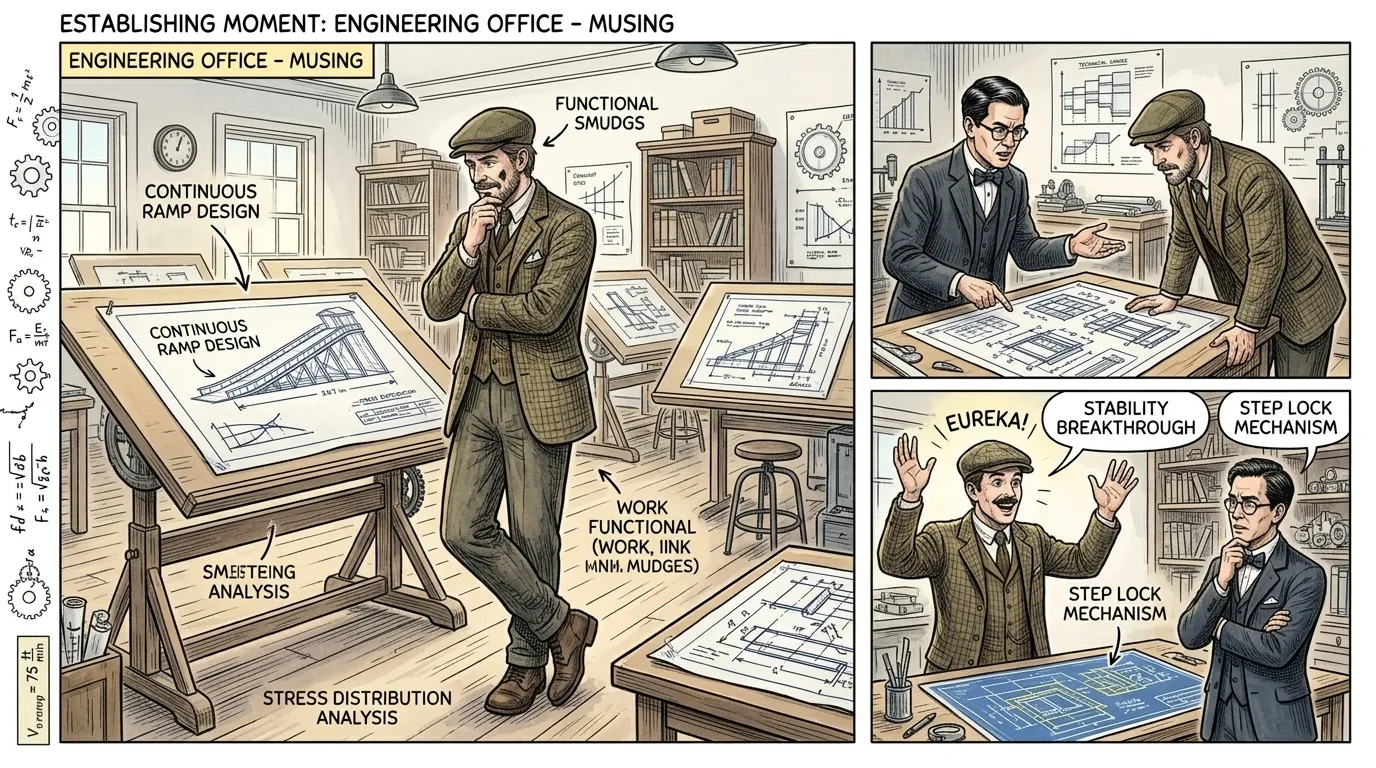
While Reno's inclined elevator served its purpose, the absence of distinct, level steps limited its ergonomic appeal and safety for a wider public. The true breakthrough would require an entirely new approach, one that could mimic the natural action of climbing stairs while in continuous motion.
"An engineer named Mr. Peterson mused to a colleague, "Reno's ramp is good, but people instinctively seek a solid, horizontal surface for balance. A true moving staircase needs to offer that stability." His colleague, Dr. Chen, countered, "Indeed. George A. Wheeler patented a design for moving steps in 1892, but it was Charles Seeberger who truly engineered the practical solution, combining Wheeler's step concept with his own inventive genius.""
Page 6
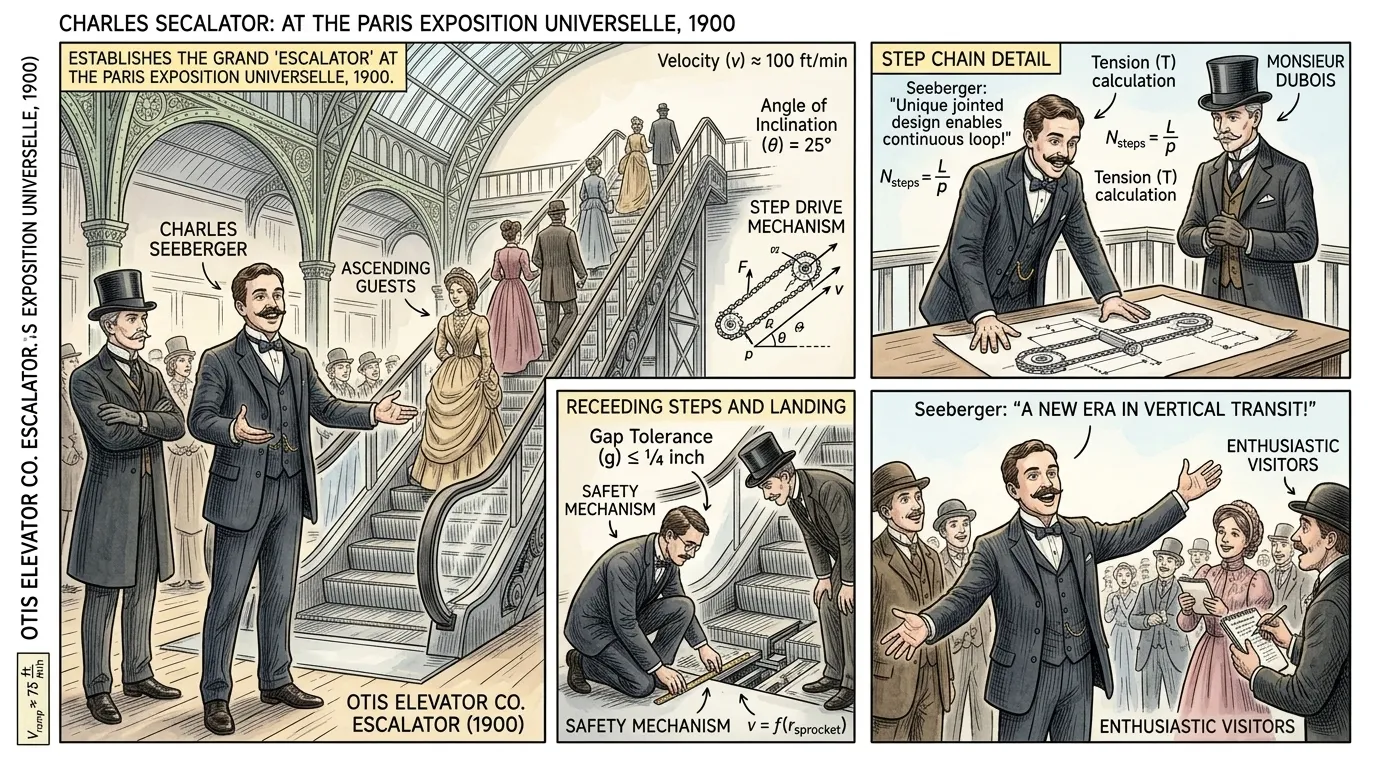
Charles Seeberger, an American inventor and employee of the Otis Elevator Company, was captivated by the idea of a moving staircase. By combining George A. Wheeler's patent for articulated steps with his own crucial modifications, Seeberger patented his 'Escalator' in 1899, a term he coined from the Latin 'scala' for steps and 'elevator.'
"At the Paris Exposition Universelle of 1900, Seeberger proudly watched visitors ascend his creation. "This is more than just transport," he explained to a French official, Monsieur Dubois. "It's a spectacle of modern engineering, providing safety and grace. The steps emerge from the floor, flatten, carry you, and then gracefully recede.""
Page 7
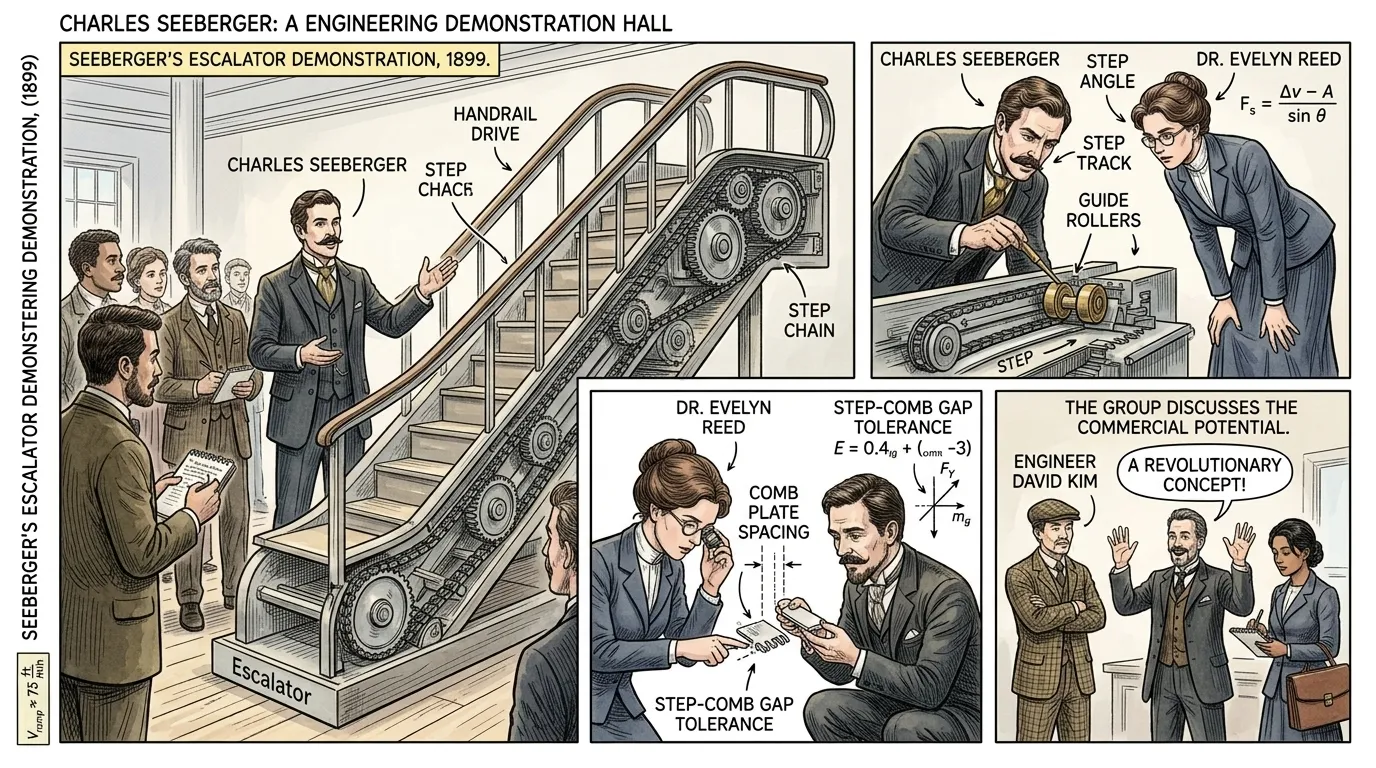
The genius of Seeberger's escalator lay in its intricate internal mechanism, allowing for the steps to be both a continuous chain and individual, level platforms. At the top and bottom, a series of rollers and tracks guide the steps, enabling them to flatten out for safe embarkation and disembarkation, then transform into a staircase for the incline.
"Seeberger demonstrated a model for a group of engineers: "Here, observe how a pair of rollers beneath each step follows a track. At the ends, this track diverges, lifting the rear of the step relative to the front, creating the flat platform. As it enters the incline, the tracks converge, forming the rise and tread." A senior engineer, Dr. Evelyn Reed, added, "And the comb plate, precisely intermeshing with the step treads, is vital for preventing objects from being caught, a critical safety feature.""
Page 8
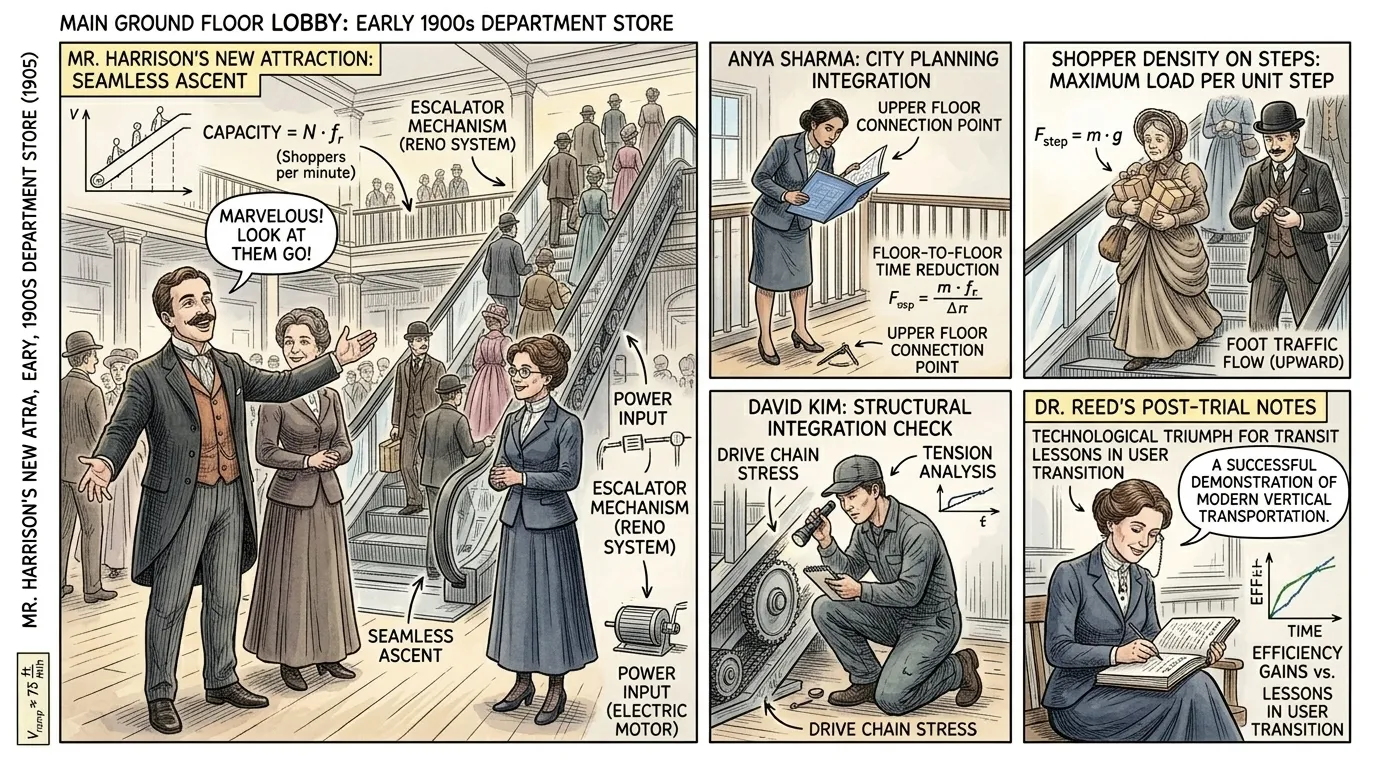
The introduction of the escalator dramatically reshaped urban architecture and commerce. Department stores, previously limited by the physical constraints of stairs, could now expand vertically, drawing more customers to upper floors. Subway systems found an ideal solution for moving vast numbers of commuters efficiently between street level and underground platforms.
"Mr. Harrison, a department store owner, marveled, "Since installing these 'moving stairs,' our sales on the third floor have nearly doubled! People are drawn to the novelty and the ease." Dr. Reed, now a seasoned expert, reflected, "Indeed, the seamless transition provided by Seeberger's leveling steps and comb plates was the ultimate triumph. As Isaac Newton once famously said, 'If I have seen further than others, it is by standing upon the shoulders of giants.' Seeberger built upon Reno's early vision and Wheeler's crucial step patent to create something truly transformative.""
Page 9
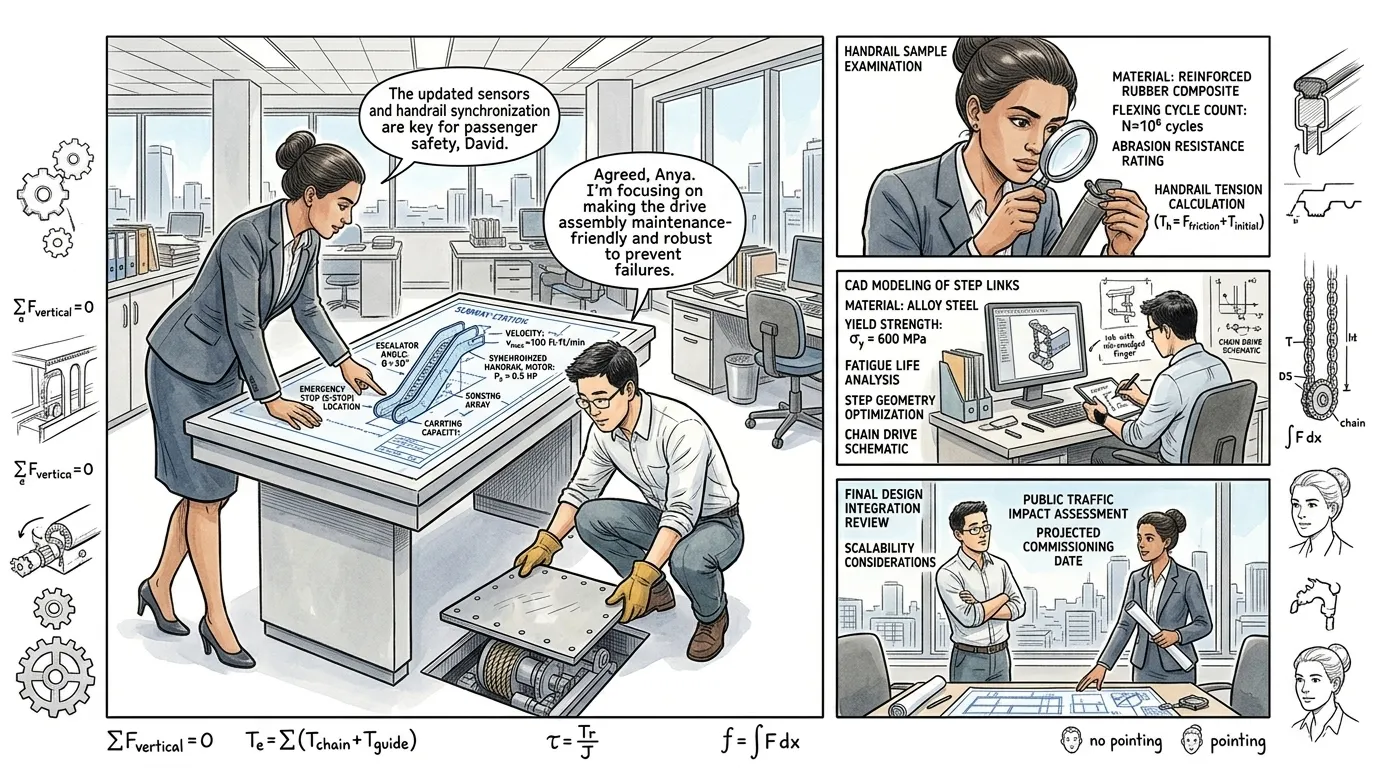
As escalators became ubiquitous, particularly in public transport hubs and retail environments, the focus shifted towards enhancing safety and ensuring standardized design. Innovations in handrail synchronization, emergency stop mechanisms, and material science have continually refined Seeberger's original concept, mitigating risks and improving user experience.
"A city planner, Ms. Anya Sharma, examined blueprints for a new subway station. "Modern escalators integrate myriad sensors to detect obstructions and prevent accidents. The synchronized handrail is no longer just a comfort, but a crucial safety feature." Her colleague, Engineer David Kim, added, "And the robust chain drive, hidden from view, must be meticulously maintained. The engineering marvel of a continuous motion device demands constant vigilance for public safety.""
Page 10
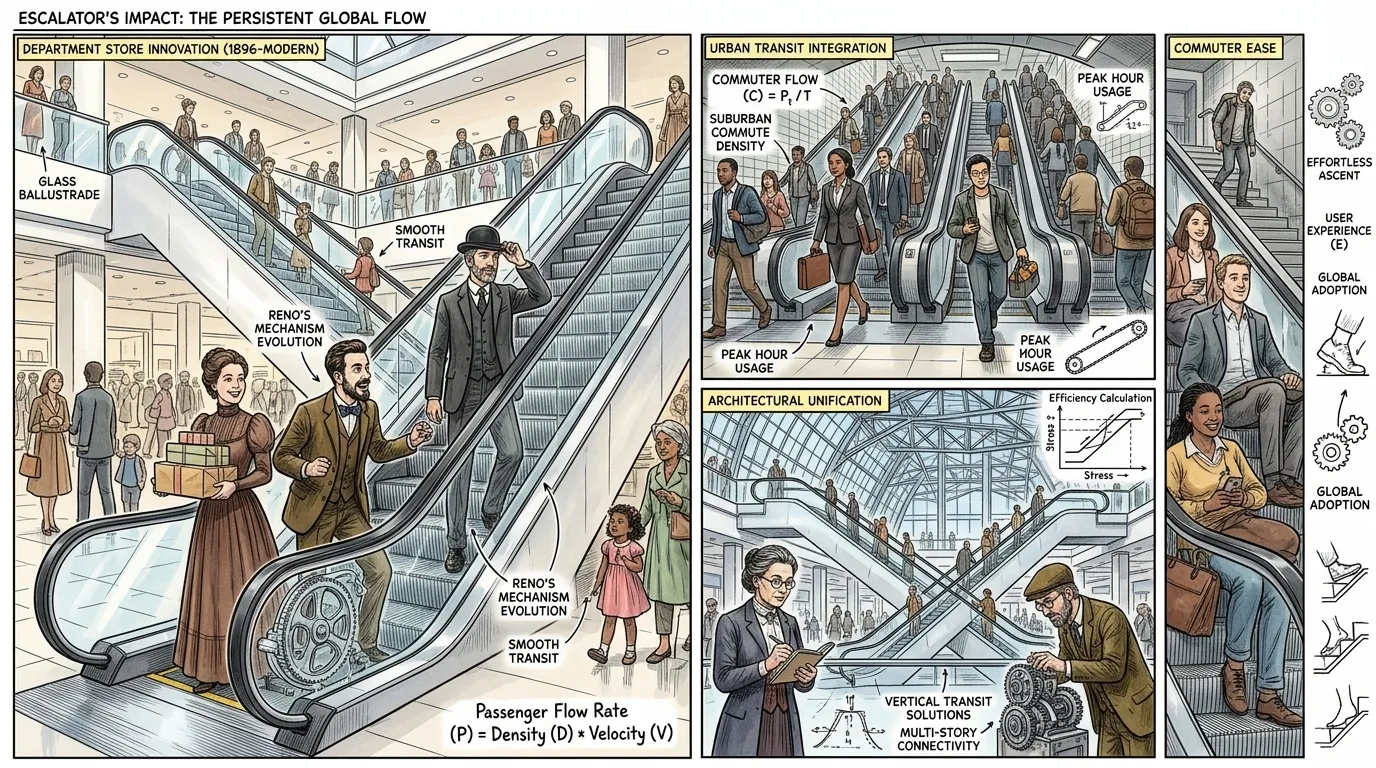
From grand department stores to vital transit arteries and modern architectural marvels, the escalator, born from the simple need to ease vertical travel, has profoundly reshaped the built environment. It stands as a testament to human ingenuity, facilitating the ceaseless flow of millions, every day, in every corner of the globe.
About this story
- Location: Global
- Audience: general readers
Questions and answers
Read Wonder Inventions on your phone
Wonder Inventions is available on Android. Get Wonder Inventions on Google Play.