Eyeglasses
Eyeglasses — an illustrated inventions story, set in Global. 10 illustrated pages, free to read on Wonder Inventions.
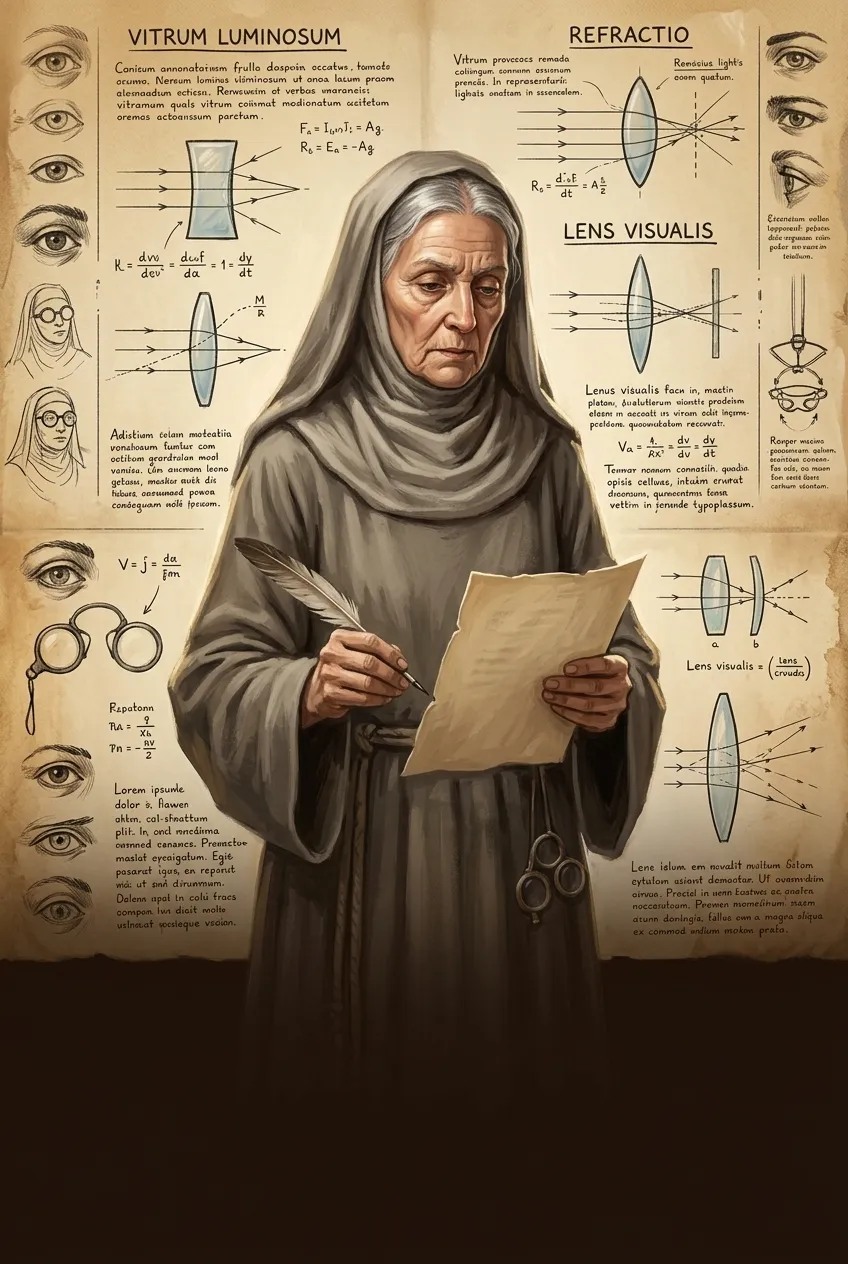
Page 1
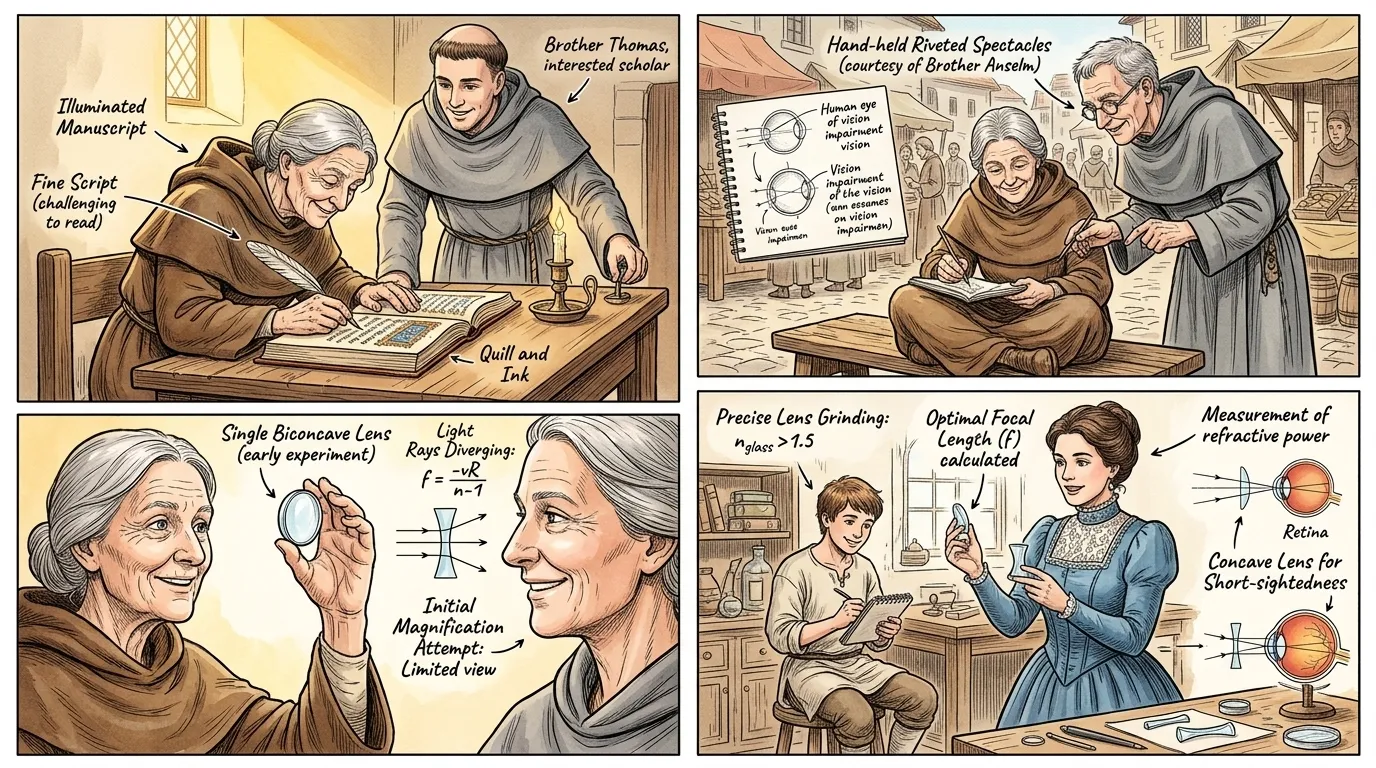
In the quiet scriptoria of late 13th-century Italy, a profound challenge afflicted the intellectual heart of Europe. Aging scholars, whose wisdom deepened with time, found their most vital instrument—their eyesight—betraying them. This silent, pervasive epidemic of presbyopia threatened to cut short careers, limit knowledge transfer, and hinder innovation across countless fields.
Fact: This scene establishes the central problem: the diminishing visual acuity of aging scholars, highlighting the impact on intellectual life. The inventor attribution is purposefully ambiguous, reflecting historical debate.
Page 2
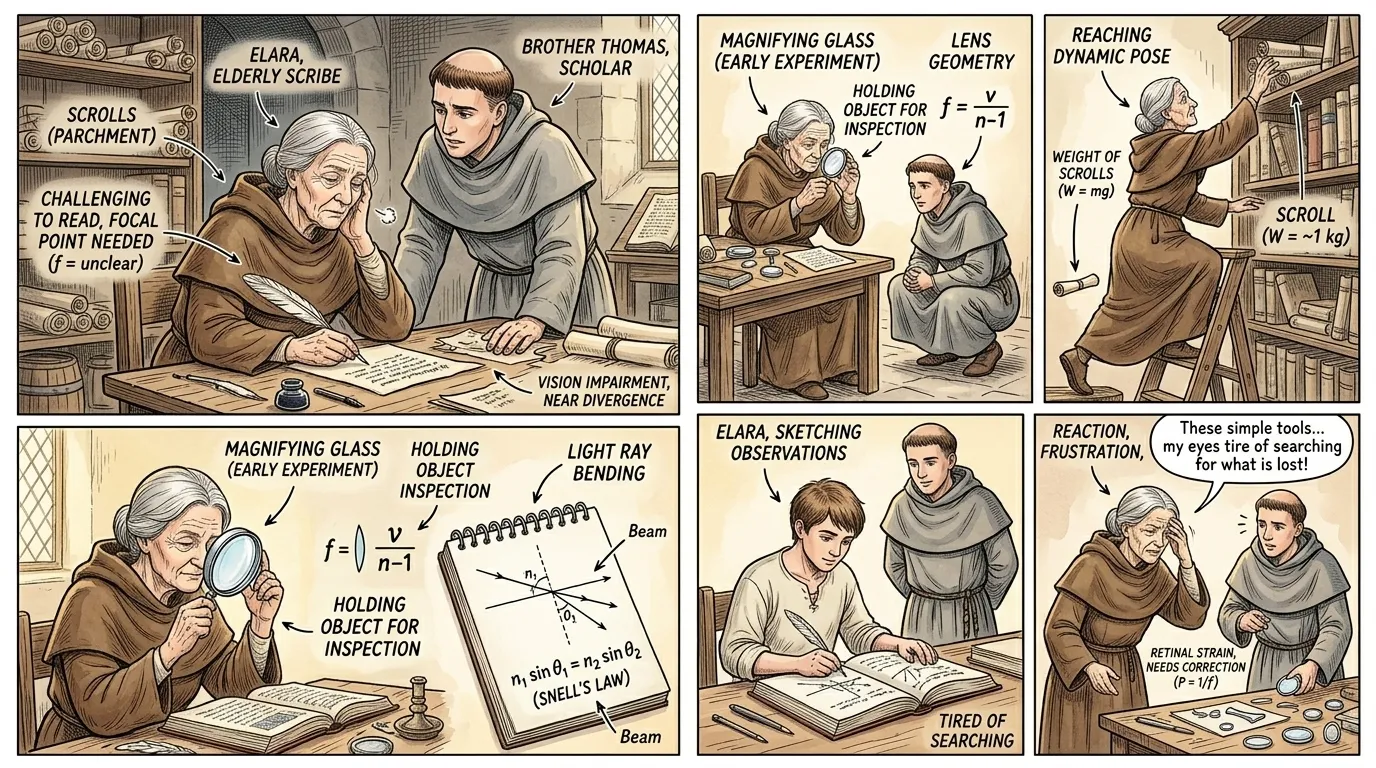
Without effective visual correction, tasks requiring fine detail became impossible, forcing many into early retirement from their vocations. The frustration was palpable, creating a generational gap in skilled crafts and scholarship.
""Brother Thomas, my hand is still steady, but my eyes... they fail me each year," sighed Elara, an aging scribe, her voice raspy with fatigue. "How did the ancients manage such detailed work into their later years, beyond relying on youthful apprentices?" Thomas, a younger scholar, leaned closer, concern etched on his face. "Some spoke of polished emeralds used by Emperor Nero, or water-filled globes that magnified, but these were crude, singular curiosities, not true solutions for a failing gaze. We need more than a temporary trick.""
Fact: Dialogue between historical figures illustrates the problem's severity and introduces early, imperfect attempts at magnification, setting up a future payoff.
Page 3
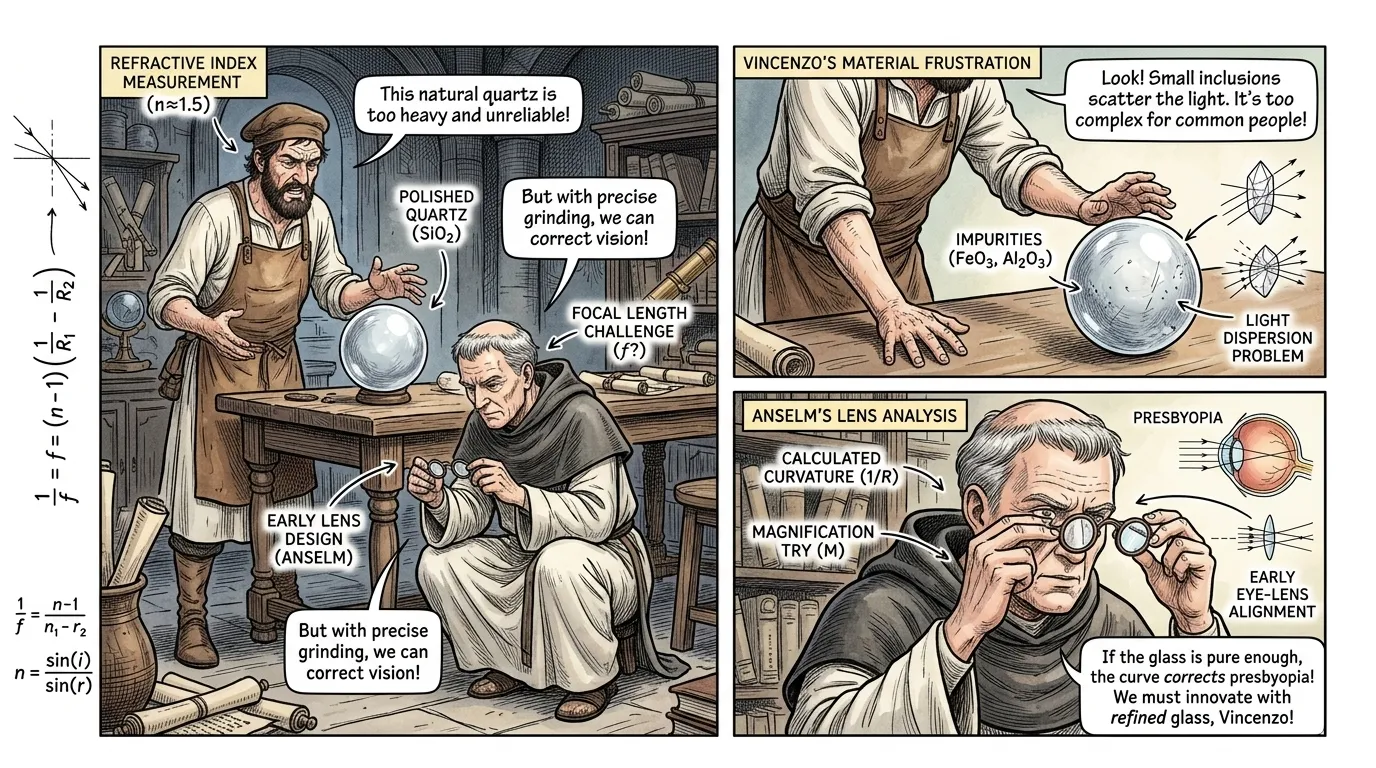
Across Europe, rudimentary forms of magnification existed, from polished rock crystal to glass spheres, but none offered a practical, wearable solution for correcting presbyopia in both eyes. The scientific understanding of light refraction was nascent.
""These reading stones are cumbersome, useful only for a single eye and demanding an uncomfortably close focus," remarked Master Vincenzo, a Venetian glassmaker, gesturing to a large, polished quartz sphere. His colleague, a bespectacled scholar named Brother Anselm, examined a similar device. Anselm adjusted his spectacles and added, "As the great Roger Bacon, a pioneer in optics, once penned, 'Experimental science alone knows how to test what cannot be learned by argument.' We require a systematic approach, not just random curiosities, to truly conquer this visual plight.""
Fact: This page depicts the limitations of early magnification and integrates a historical quote, showcasing the intellectual environment surrounding the problem. The early, held spectacles provide a visual link to the invention.
Page 4
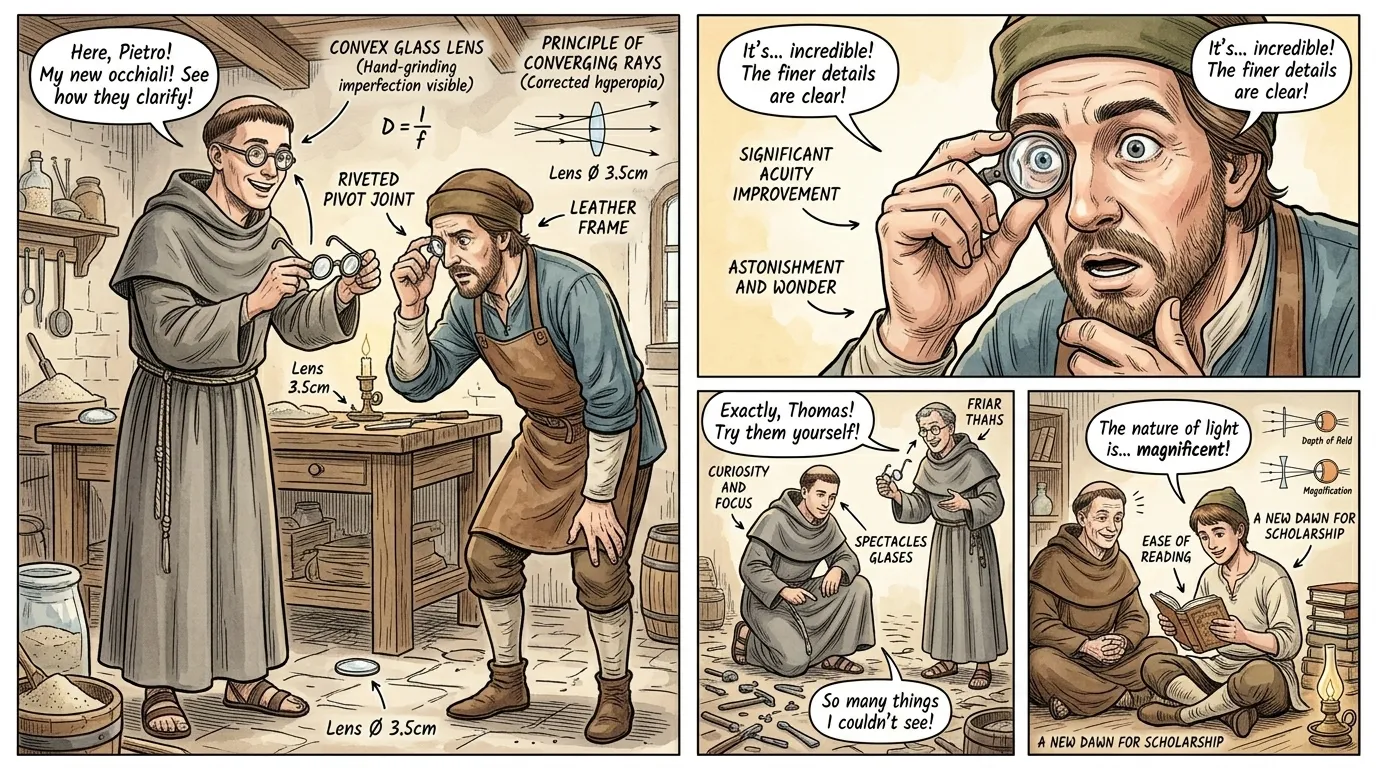
The true breakthrough arrived with the innovation of mounting two convex lenses, carefully ground, into a frame. This simple yet revolutionary concept allowed for simultaneous, binocular correction, freeing the user's hands.
""The elegance lies in its simplicity, Signor Pietro," exclaimed Friar Giordano, holding up an early pair of riveted spectacles, two convex lenses set into a leather frame. "Imagine, two lenses, each perfectly ground, allowing both eyes to see with newfound clarity!" Pietro, a fellow artisan, approached cautiously. "But how? A single lens we understand, but two? The precise curvature of the glass, the way it directs the light... this is truly remarkable. It's like extending the very prime of life.""
Fact: This page visualizes the invention of the first wearable eyeglasses, featuring historical figures discussing the innovation's core concept.
Page 5
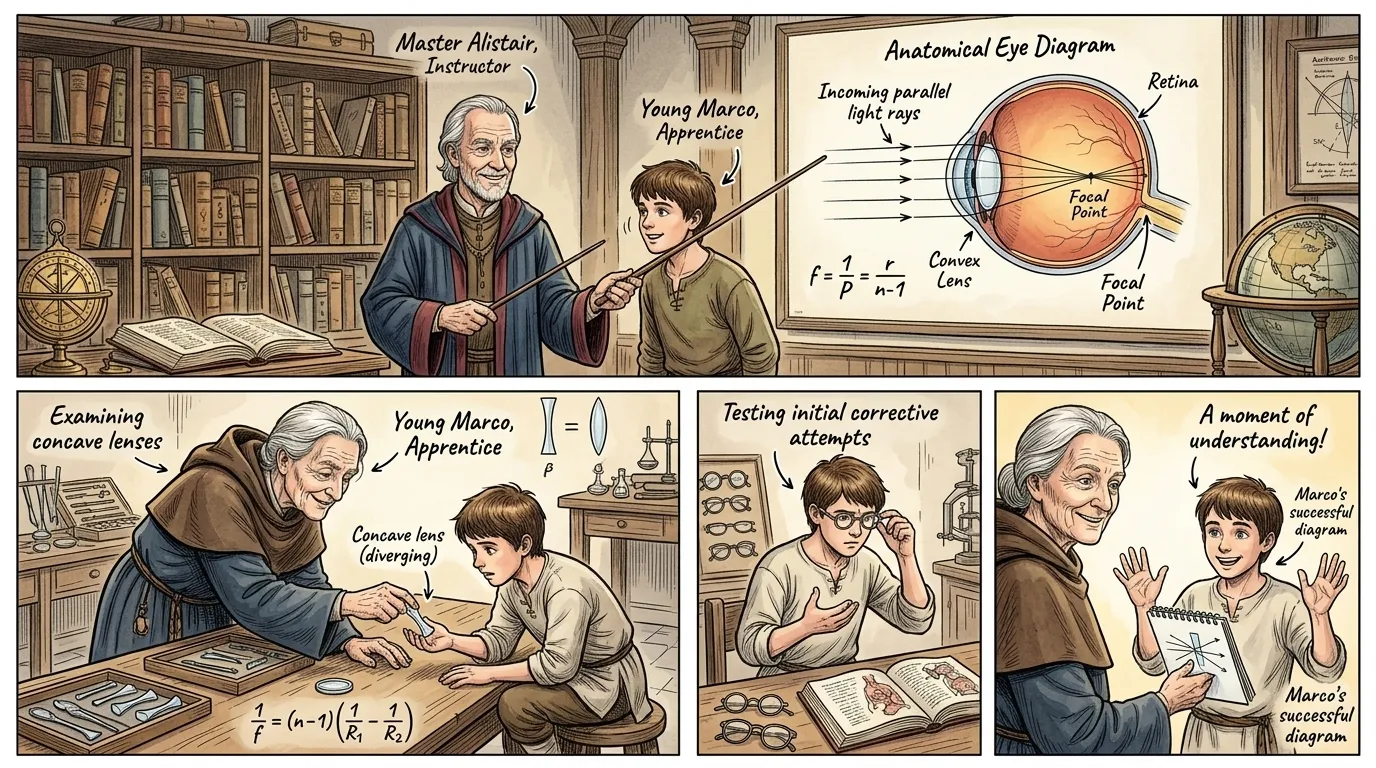
For individuals suffering from presbyopia, the eye's natural lens stiffens, losing its ability to focus on close objects. The convex lens of an eyeglass remedies this by converging incoming light rays before they reach the eye.
""Observe closely, apprentice," Master Alistair instructed, pointing with a long stick at a projected diagram of light rays. "For the farsighted, light entering the eye focuses behind the retina. Our convex lens, thickest in the middle, causes parallel light rays to bend inward, effectively converging them sooner." The apprentice, young Marco, nodded. "So, it shifts the focal point forward, precisely onto the retina, just as a healthy young eye would naturally do?" Alistair smiled. "Precisely. It restores the eye's natural ability to bring distant light into sharp focus.""
Fact: This page provides a clear, visual explanation of the optical mechanism of convex lenses for presbyopia, using a didactic scene.
Page 6
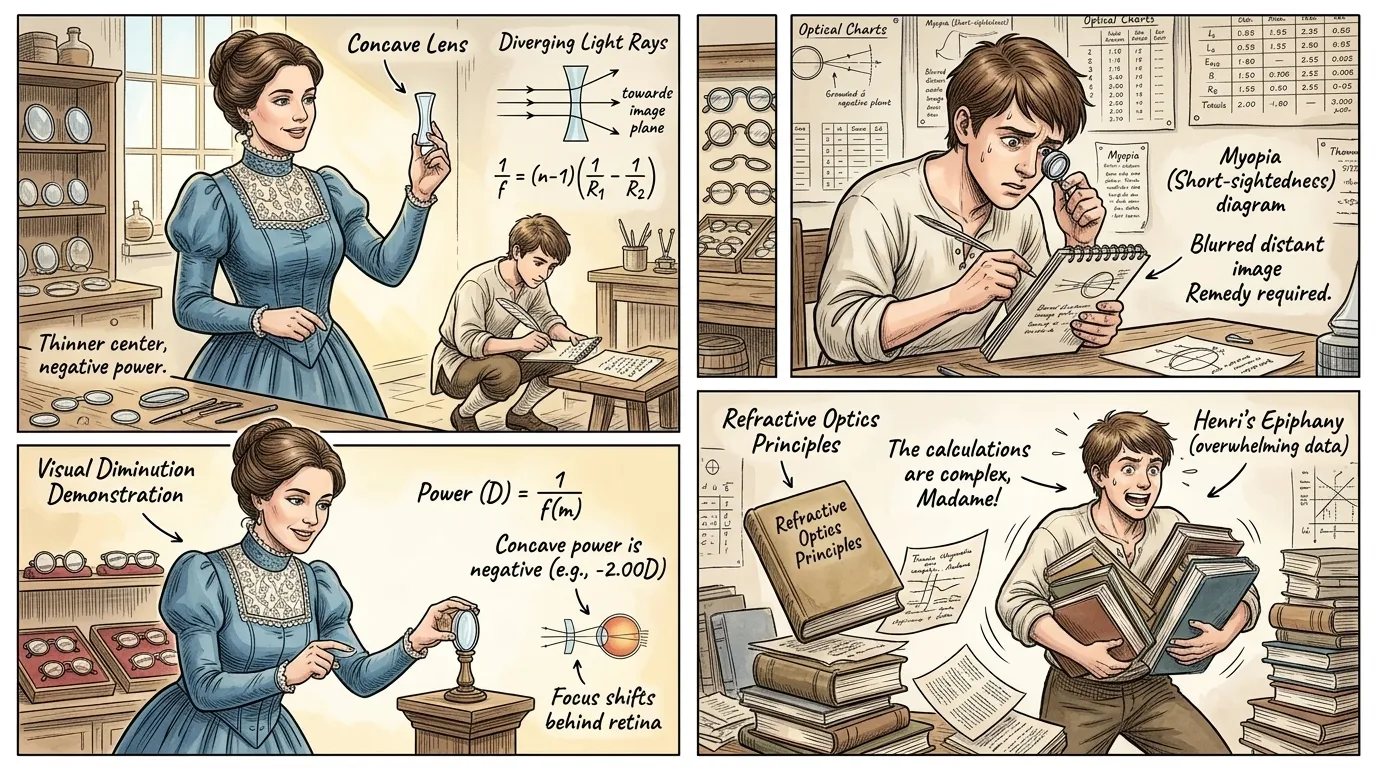
While convex lenses addressed farsightedness, another common affliction, myopia or nearsightedness, required a different optical solution. It wasn't until later centuries that concave lenses became widely used for this purpose.
""Just as convex lenses converge light, concave lenses serve the opposite, yet equally vital, function," explained Optician Madame Dubois, holding up a lens that was thinner in the middle. Her assistant, Henri, scribbled notes. "For the nearsighted, light focuses before the retina. So, this concave form must diverge the light, spreading the rays outwards." Madame Dubois nodded. "Indeed, Henri. It pushes the focal point backward, extending the effective viewing distance for those whose eyes converge light too strongly. A beautiful complement to the convex lens.""
Fact: This page extends the technical explanation to concave lenses, illustrating their function for myopia correction, showing a later historical period.
Page 7
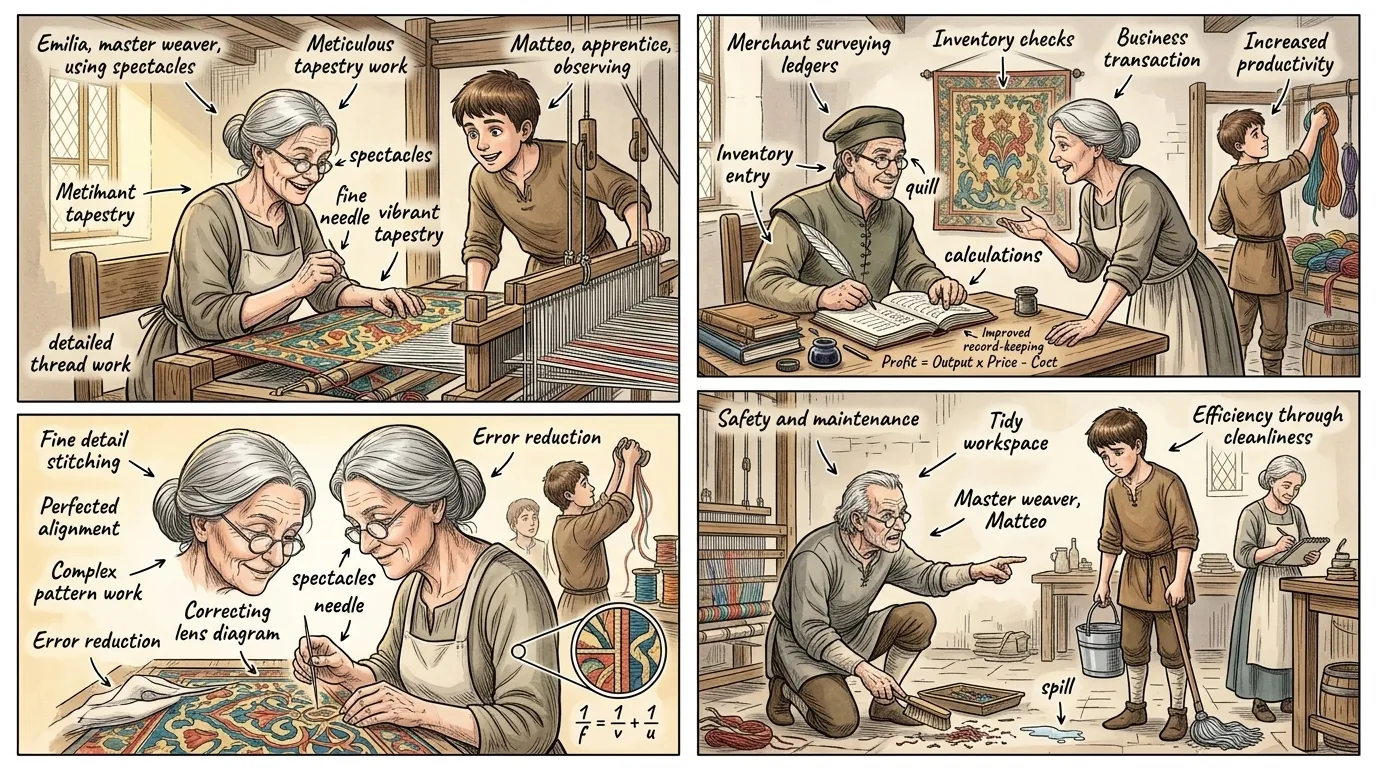
Initially viewed with suspicion or as a novelty for the wealthy, eyeglasses slowly gained acceptance. Their transformative power for scholars, artisans, and merchants became undeniable, extending productive lives and accelerating societal progress.
""With these, I can distinguish the finest threads, complete my tapestries with precision I lost years ago!" marveled Cloth Weaver Emilia, holding her needle with renewed confidence. Her apprentice, young Matteo, peered over her shoulder. "And Master Giovanni, the scribe, he now reads late into the night, completing more chronicles than ever before!" A nearby merchant, surveying his ledger with his own spectacles, chimed in, "Indeed, my friends. What was once a rare luxury for the aged, I tell you, is fast becoming a necessity for commerce and craft alike. Our society demands clear vision.""
Fact: This page depicts the early adoption of eyeglasses across different societal strata, illustrating their practical benefits and shifting perception from novelty to utility.
Page 8
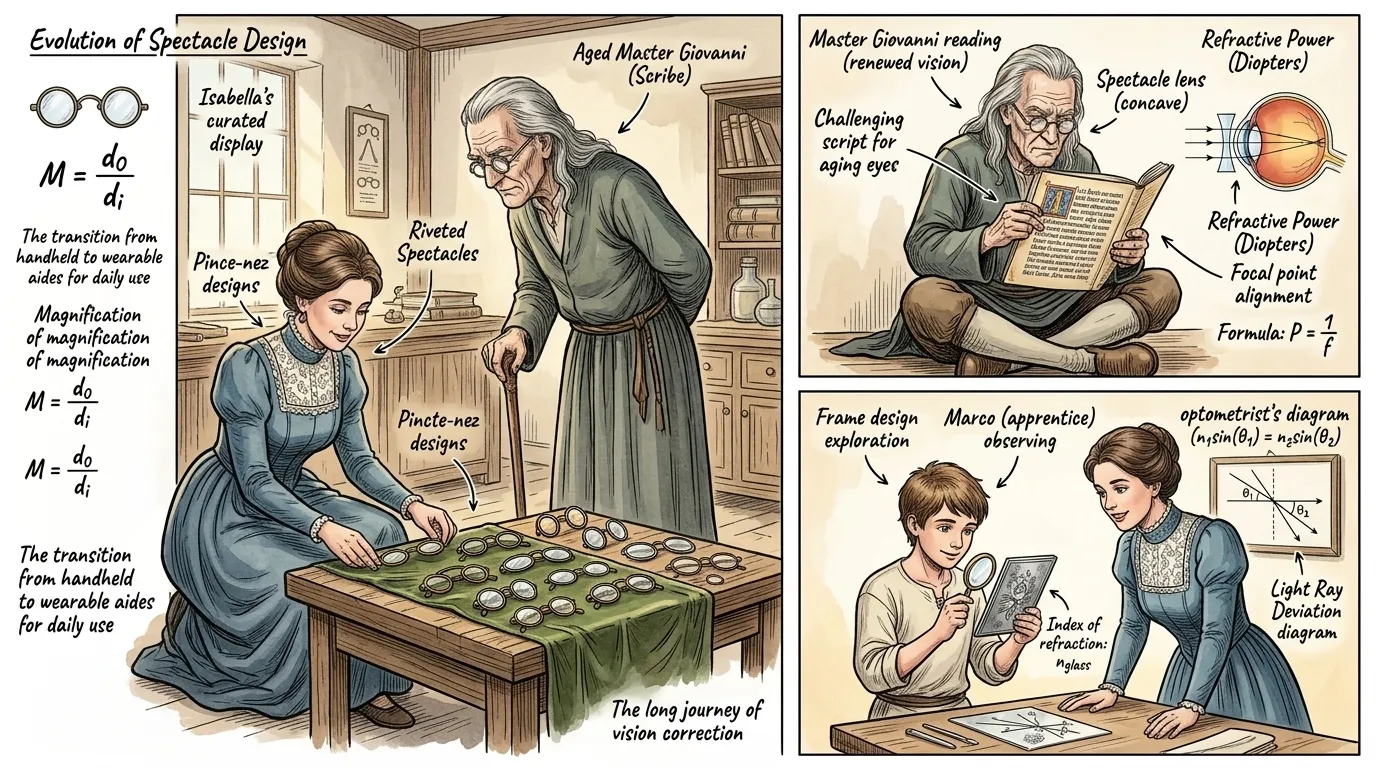
From cumbersome hand-held devices, eyeglasses evolved through riveted 'pince-nez' styles to designs resting on the nose or, eventually, temples extending over the ears. This allowed for greater comfort, stability, and wider accessibility.
""Master Giovanni, these framed spectacles are far beyond those simple polished stones Elara described back in the scriptorium," Isabella remarked, carefully arranging various styles on a velvet cloth. "The ability to wear them, to have two eyes corrected simultaneously, it's truly revolutionary, isn't it?" Giovanni, now older and with an air of profound wisdom, nodded slowly. "Indeed, Isabella. It reminds me of the words of the great scholar Roger Bacon, who championed observation and reason. He said, 'Experimental science alone knows how to test what cannot be learned by argument.' Those crude magnifiers of old were based on simple observation. But applying systematic experimental science to glass, understanding refraction... that gave us the true eyeglasses, truly a testament to persistent inquiry.""
Fact: This page details the design evolution of eyeglasses and incorporates the 'setup and payoff' element by referencing the earlier discussion of crude magnifiers, connecting it to the scientific method and a historical quote.
Page 9
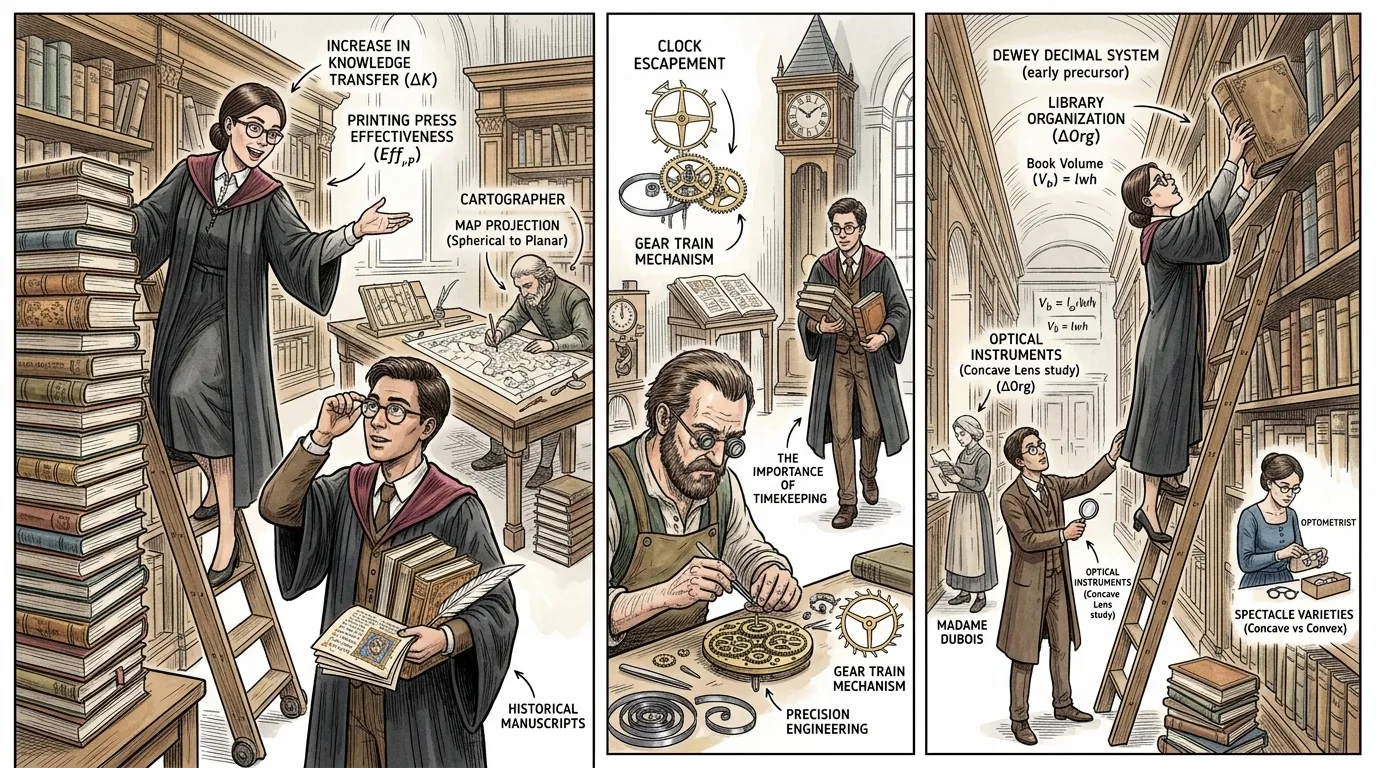
Eyeglasses profoundly accelerated the Renaissance and Scientific Revolution. They extended the working lives of craftsmen, enabled printers to meticulously set type, and allowed scientists and cartographers to record observations with unprecedented accuracy.
""Consider the sheer volume of knowledge now preserved and disseminated," observed Professor Elena, gesturing to stacks of newly printed books in a university library. Her colleague, Dr. Mateo, adjusted his own spectacles. "Indeed, Elena. From the intricate gears of a clockmaker to the precise lines on a cartographer's map, every field requiring visual acuity has been fundamentally transformed. It's not merely about seeing; it's about enabling progress." Elena nodded, "Age is no longer an automatic barrier to contribution; it's a testament to sustained intellectual engagement.""
Fact: This page illustrates the broad societal impact of eyeglasses across academia, skilled trades, and the nascent printing industry, showing how they catalyzed historical periods of innovation.
Page 10
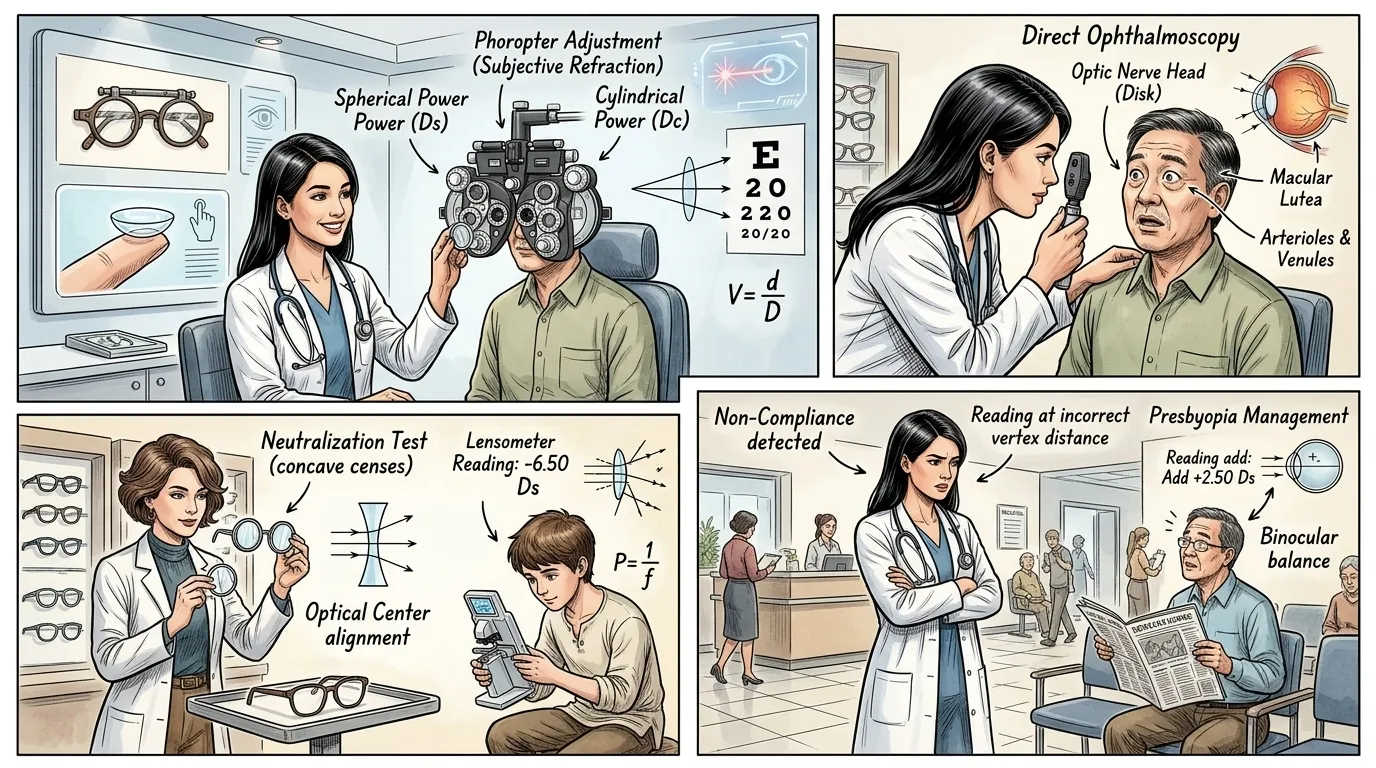
From simple convex lenses to sophisticated variable-focus designs and beyond to contact lenses and refractive surgery, the principle of correcting vision has continuously evolved. Eyeglasses remain a cornerstone of modern life, a testament to an invention that fundamentally reshaped human potential.
""The journey from those early, riveted spectacles to the precision optics of today is truly remarkable," commented Dr. Anya Sharma, an ophthalmologist, as she examined a patient through a phoropter. "It began with recognizing a universal human need." Her patient, Mr. Chen, wearing modern glasses, added, "And it continues to adapt, from the convenience of contact lenses to the miracles of laser correction, always driven by the desire to see the world clearly, to engage fully." Dr. Sharma concluded, "Eyeglasses, in all their forms, are a powerful reminder of how simple ingenuity can unlock profound human capability and extend our productive lives across centuries.""
Fact: The final page serves as a comprehensive impact montage, showcasing the evolution of vision correction, from historical foundations to modern applications, emphasizing its enduring role in human life and potential.
About this story
- Location: Global
- Audience: general readers
Questions and answers
Read Wonder Inventions on your phone
Wonder Inventions is available on Android. Get Wonder Inventions on Google Play.