Fiber Optic Cable
Fiber Optic Cable — an illustrated inventions story, set in Global. 10 illustrated pages, free to read on Wonder Inventions.
Page 1
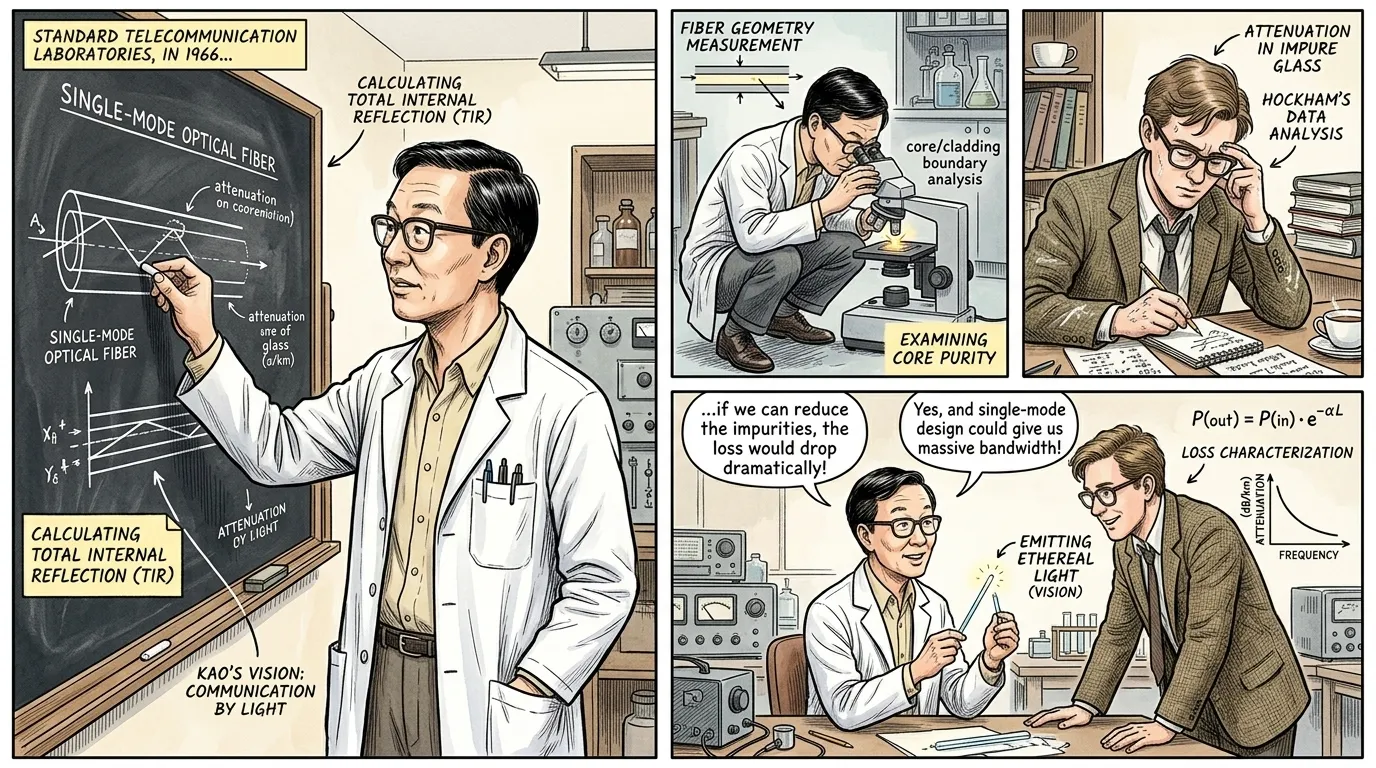
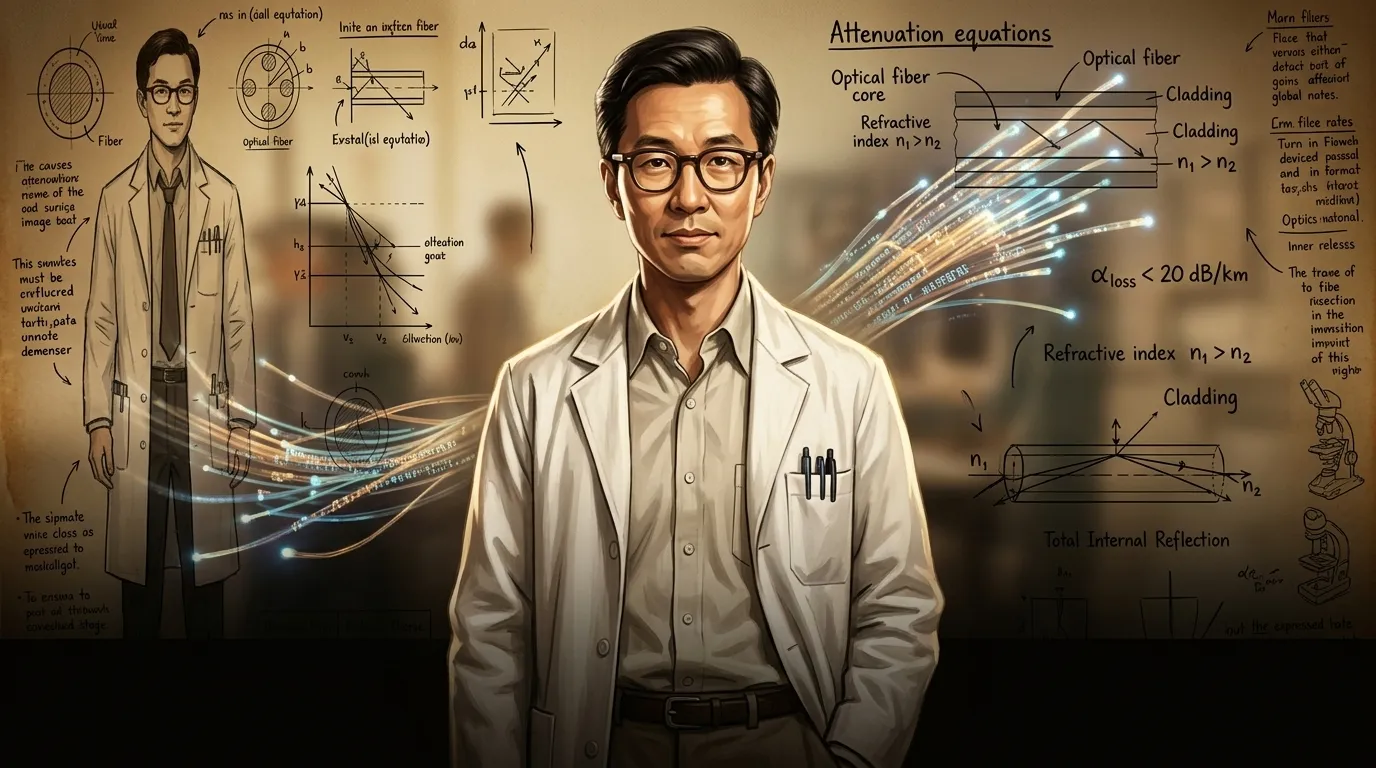
Before the advent of optical fibers, long-distance communication relied heavily on copper wires and microwave radio links. These technologies faced inherent limitations: signal degradation over distance, limited bandwidth, and vulnerability to electromagnetic interference. As the demand for information grew exponentially in the mid-20th century, a new medium was desperately needed to transmit vast amounts of data reliably and rapidly across continents. The challenge was immense, requiring a radical shift in how we conceived of carrying information.
""The copper infrastructure simply cannot keep pace with the data we foresee," Dr. Charles K. Kao remarked to his colleague, George Hockham, at Standard Telecommunication Laboratories in 1966. "We are approaching theoretical limits for electrical signals, plagued by both attenuation and bandwidth saturation. Imagine a world where information flows not as electricity, but as light.""
Page 2
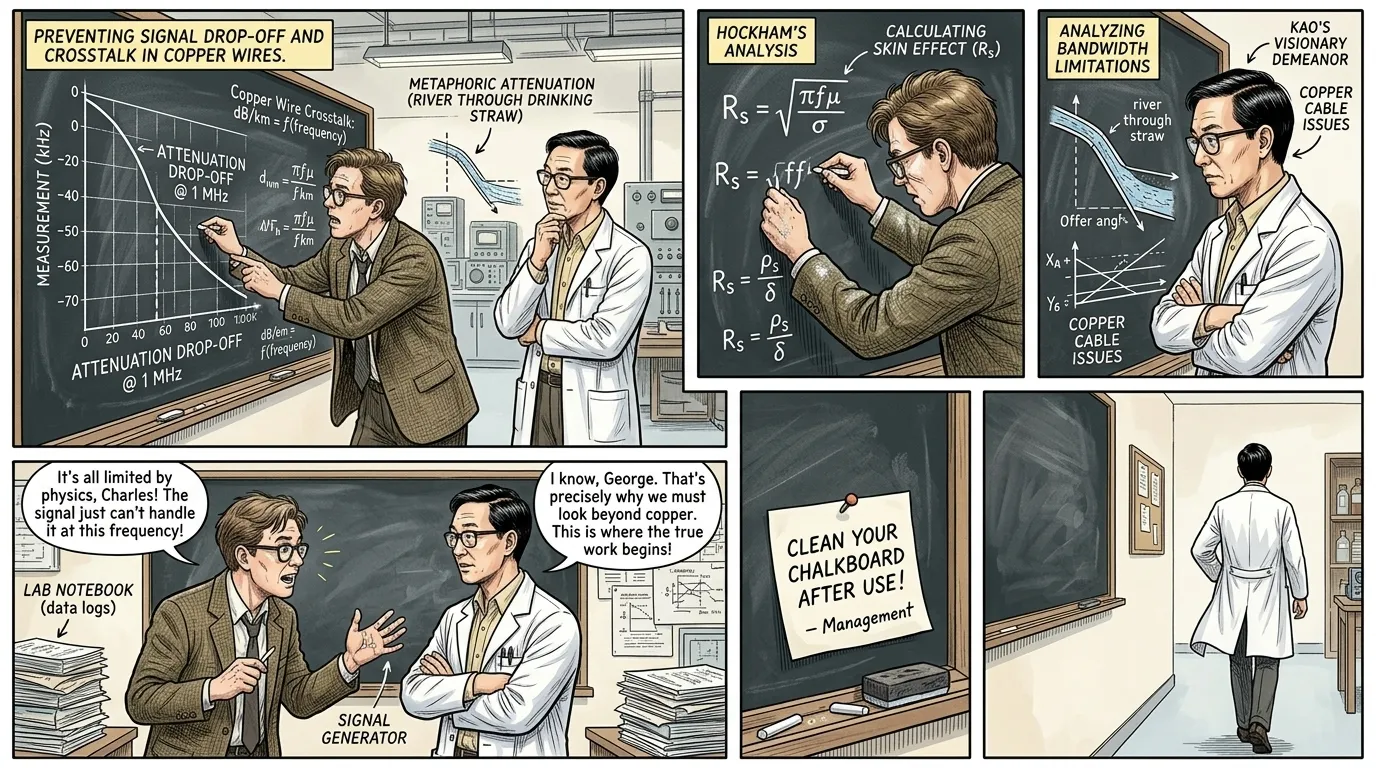
Copper wires, the backbone of telephony for decades, faced escalating challenges with the rise of global communication. Electrical signals traveling through copper experienced significant loss, or attenuation, requiring frequent regeneration by repeaters. Furthermore, the limited frequency range of copper cables severely restricted the volume of information—the bandwidth—they could carry. Every additional phone call, every nascent data transmission, pushed the existing infrastructure closer to its breaking point, creating bottlenecks that hindered progress.
""Our models show a fundamental problem with copper's performance at higher frequencies," George Hockham explained, pointing to a graph on a chalkboard. "Signal strength drops precipitously, and crosstalk becomes an intractable issue. We're essentially trying to funnel a river through a drinking straw when what we need is a vast canal." Kao nodded, deep in thought. "Indeed. We can only add so many parallel lines before the sheer physical footprint becomes impractical. The demand for bandwidth is growing far too fast for metallic conductors.""
Page 3
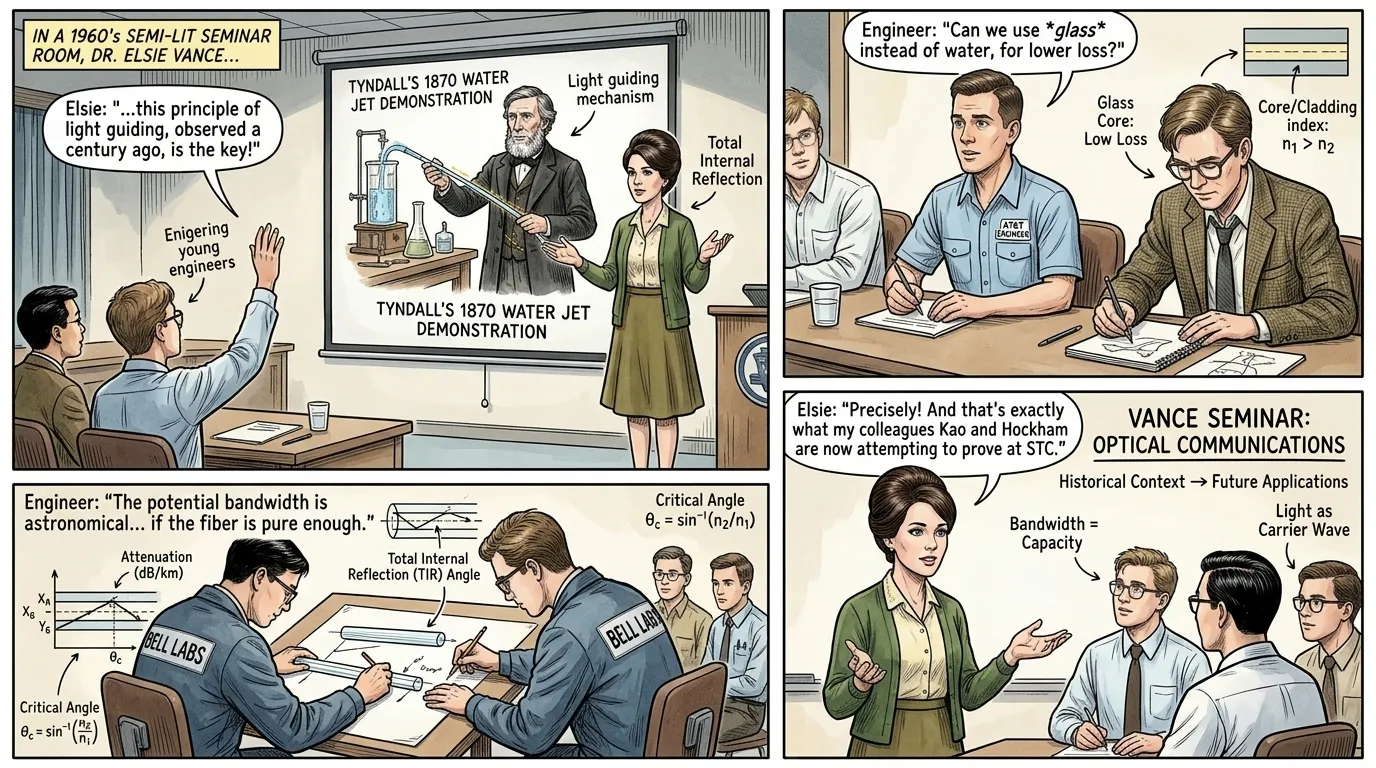
The idea of guiding light was not new. As early as 1870, British physicist John Tyndall demonstrated how light could be 'bent' or guided along a stream of water, using the principle of total internal reflection. This remarkable phenomenon, where light striking an interface at a shallow angle reflects completely back into the denser medium, was visually compelling. However, the leap from a laboratory demonstration with water to a practical communication system using solid materials, capable of transmitting information over vast distances, remained elusive for nearly a century.
""Tyndall's experiments were seminal, proving light could be confined," a senior researcher, Dr. Elsie Vance, explained to a group of young engineers during a seminar in the late 1960s, gesturing towards a projected image of Tyndall's setup. "But water, as a medium, simply isn't stable or transparent enough for serious data transmission over any distance. We need something solid, durable, and above all, incredibly clear." An engineer asked, "So, the principle is sound, but the material presents the true challenge, then?" Dr. Vance replied, "Precisely. As the old adage goes, 'The devil is in the details.' The material science behind light confinement for communication is vastly more complex than a mere demonstration.""
Page 4
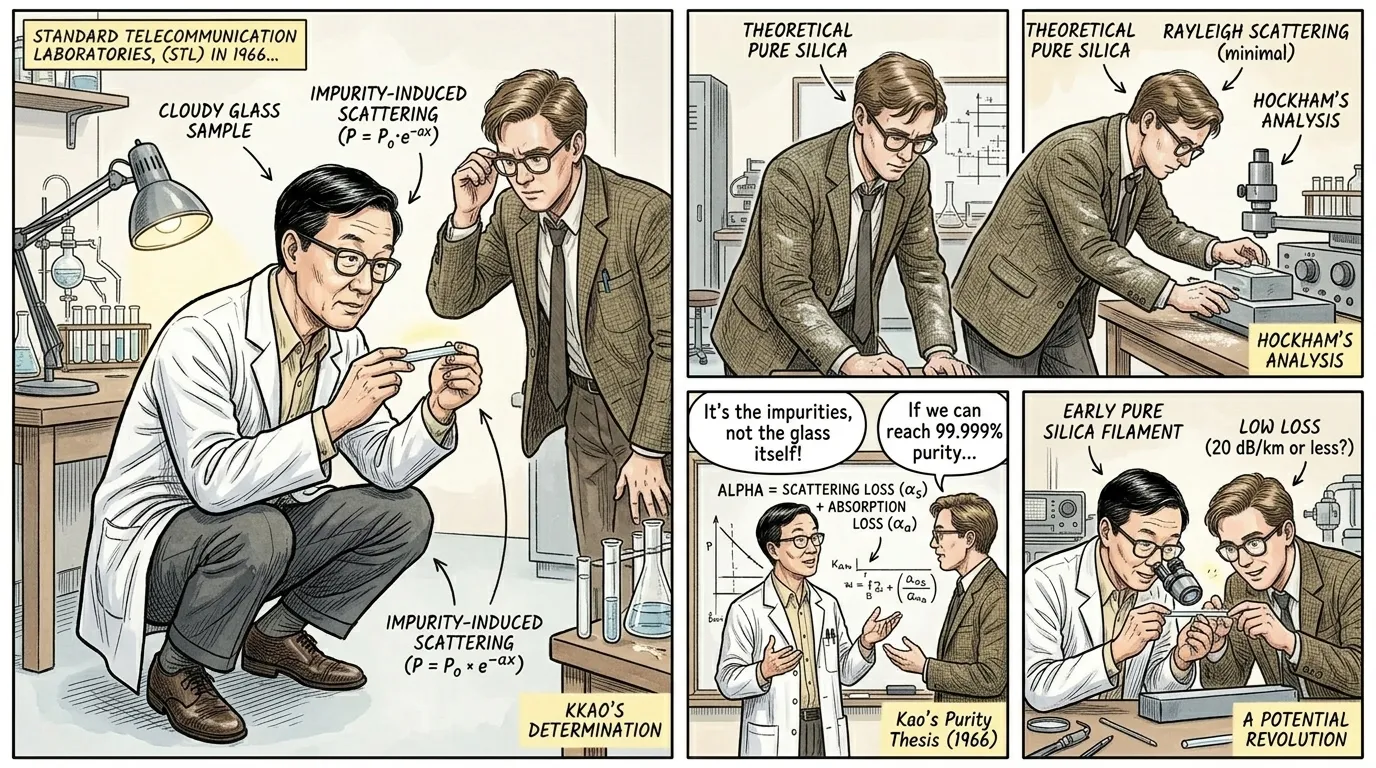
In the mid-1960s, at Standard Telecommunication Laboratories (STL) in Harlow, England, Charles K. Kao and George Hockham began to systematically investigate the potential of glass for optical communication. Their work challenged the prevailing pessimism that glass was inherently unsuitable due to its high optical loss. Most researchers believed that even the purest glass available was simply too opaque for light to travel more than a few meters before dissipating entirely. Kao and Hockham, however, postulated that this was a problem of impurity, not of the material itself.
""The current scientific consensus suggests glass has an attenuation of thousands of decibels per kilometer," Kao stated, holding a small, somewhat cloudy glass rod. "This is deemed prohibitive. But what if this loss isn't intrinsic to silica, but caused by minute impurities?" Hockham nodded, adjusting his glasses. "Precisely. Trace elements, metallic ions, even microscopic bubbles can scatter or absorb light. If we could eliminate these, or reduce them to infinitesimal levels, the theoretical loss could plummet." Kao added, "As Leonardo da Vinci once said, 'Simplicity is the ultimate sophistication.' The solution may be not in a new complex material, but in perfecting an existing one.""
Page 5
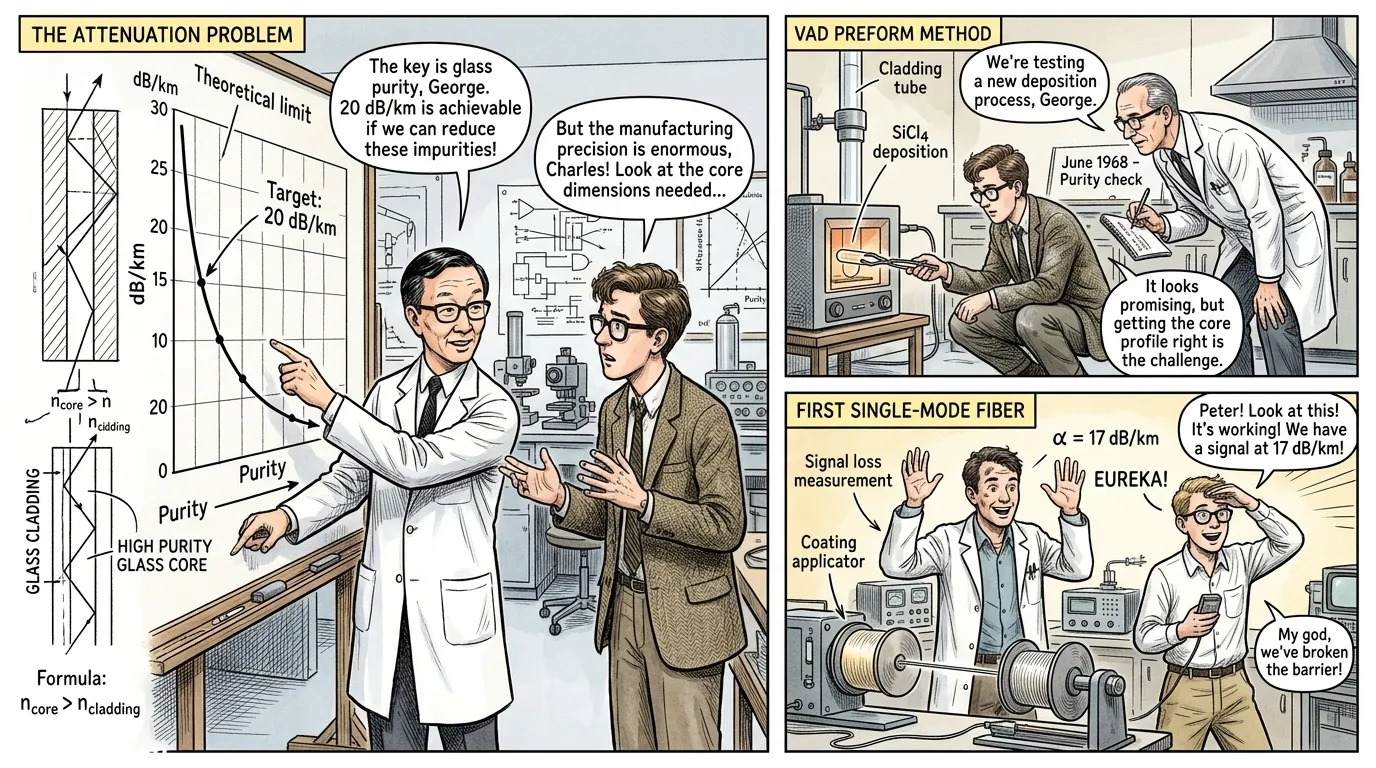
In 1966, Kao and Hockham published a seminal paper that fundamentally altered the perception of optical fibers. They presented theoretical calculations arguing that if glass could be purified to reduce attenuation to less than 20 decibels per kilometer (dB/km)—a staggering improvement over the thousands of dB/km seen in commercial glass—it would become a viable medium for long-distance communication. This figure became a global target, a scientific beacon for researchers worldwide. Their work meticulously detailed how light propagation within a fiber relies on the difference in refractive index between the core and cladding, maintaining the signal through total internal reflection.
""Our calculations indicate that a loss of 20 dB per kilometer would allow for repeater spacings of tens of kilometers," Kao explained, pointing to a graph that showed a sharp drop in theoretical attenuation with increased glass purity. "This is the critical threshold. Anything higher makes it impractical." Hockham emphasized, "Achieving this level of purity in silica will demand unprecedented control over manufacturing processes. We're talking about parts per billion impurity levels. It's not just about transparency; it's about the precision of the refractive index boundary for total internal reflection.""
Page 6
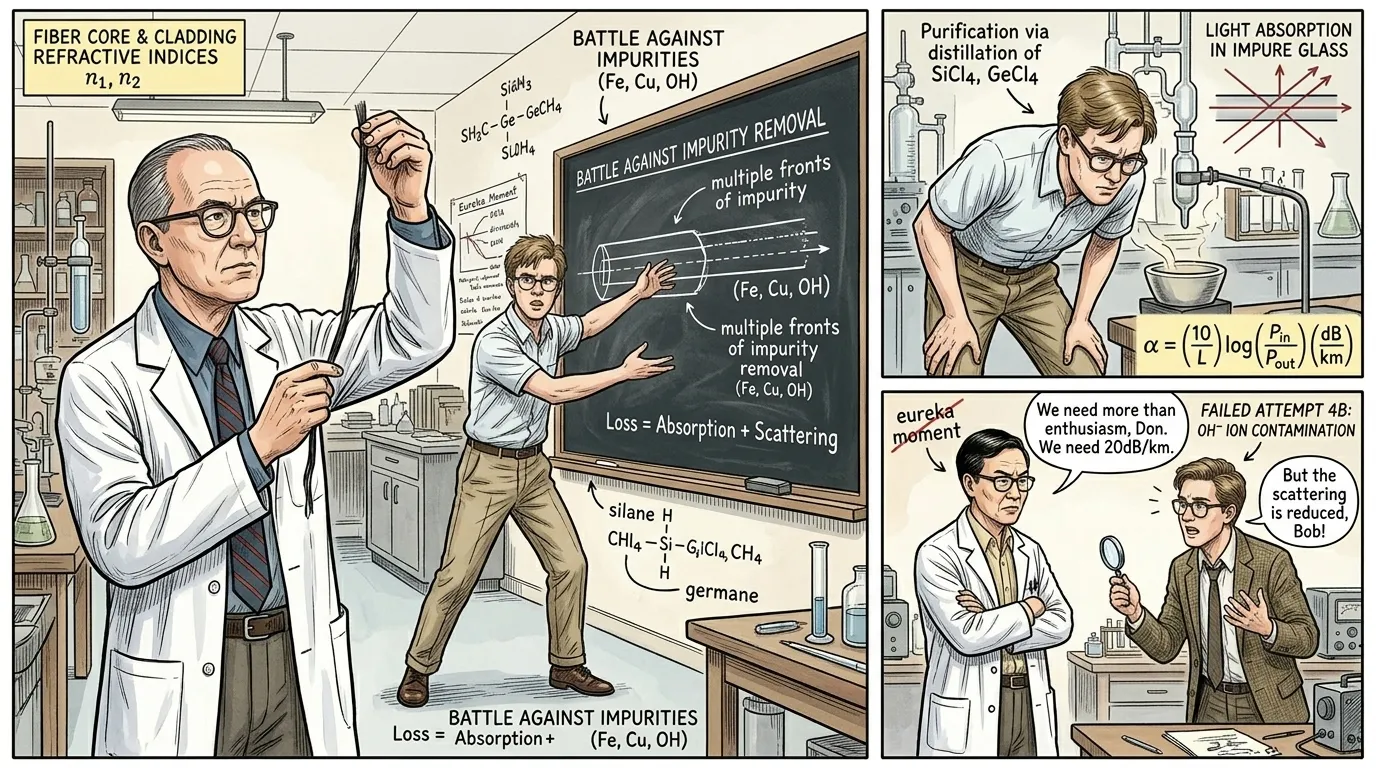
Armed with Kao's theoretical target, industrial research labs worldwide began the formidable task of fabricating ultra-pure glass fibers. The challenge was immense: ordinary glass contains impurities like iron and copper ions that absorb light across various wavelengths. Achieving the necessary purity, where impurities were measured in parts per billion, required entirely new manufacturing techniques, far beyond the capabilities of traditional glassmaking. This involved controlling raw materials to an unprecedented degree and developing innovative methods for drawing fibers with a precise refractive index profile.
""This isn't merely about melting sand and drawing it thin," Dr. Robert D. Maurer, a senior scientist at Corning Glass Works, stated to his team in the late 1960s, examining a rather crude, dark strand of early fiber. "We need to eliminate metallic impurities down to single-digit parts per billion. The slightest contamination renders the fiber useless for our purpose." Dr. Donald Keck, a young physicist on Maurer's team, added, "And it's not just the core. The cladding must also maintain its precise refractive index relative to the core, otherwise, the light simply escapes. It's a battle on multiple fronts.""
Page 7
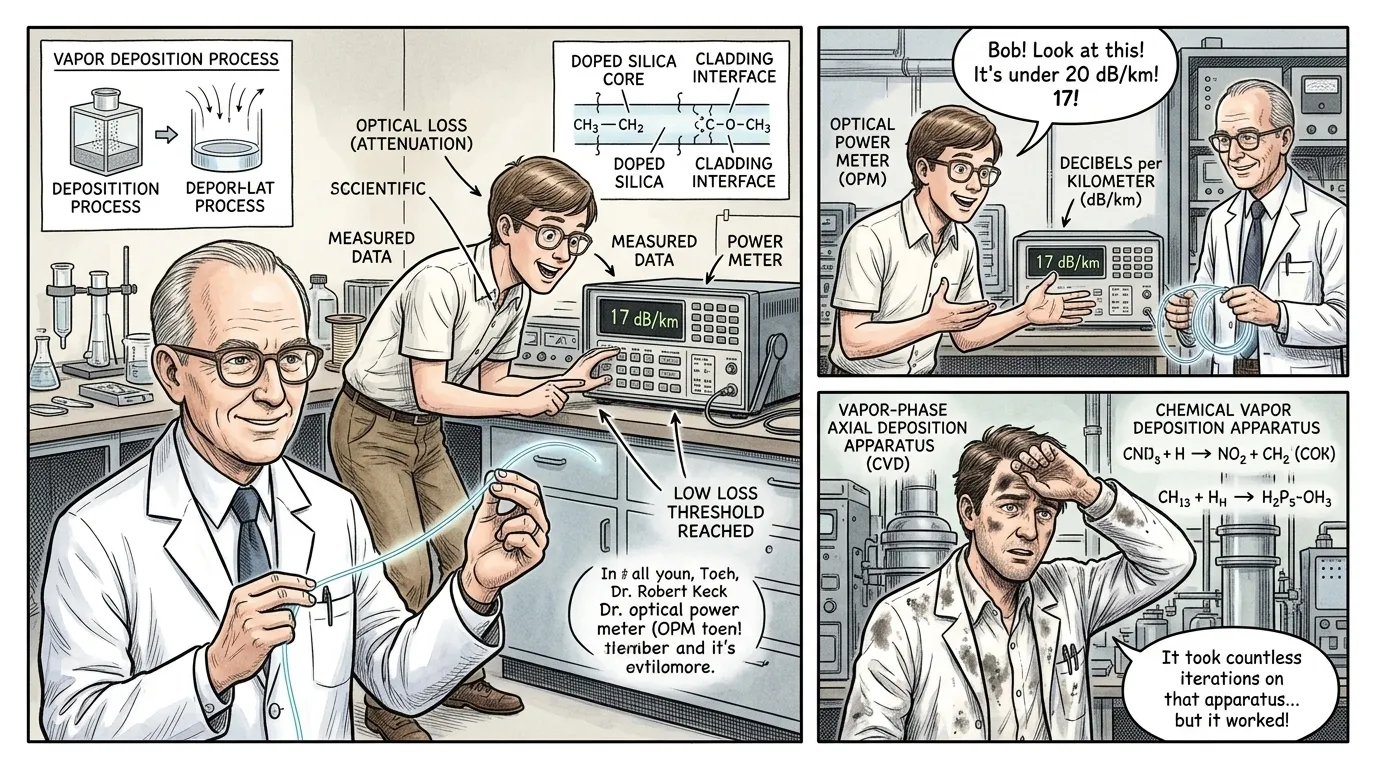
The arduous quest culminated in 1970 at Corning Glass Works in the United States. Dr. Robert Maurer, Dr. Donald Keck, and Dr. Peter Schultz successfully created the first optical fiber with an attenuation below the critical 20 dB/km threshold, achieving a remarkable 17 dB/km. Their breakthrough involved using a process called 'vapor-phase axial deposition' where they deposited highly pure silica soot, doped with titanium dioxide, onto a ceramic rod. This precise chemical vapor deposition technique allowed for unprecedented control over glass purity and the crucial refractive index profile, finally turning Kao's theoretical possibility into a tangible reality. It was a monumental achievement, opening the door to the information age.
""Seventeen decibels per kilometer! We've done it!" Dr. Keck exclaimed, eyes wide with excitement, reviewing data readouts from a sophisticated optical power meter. Dr. Maurer, a calm smile spreading across his face, gripped a delicate, transparent strand of fiber. "The titanium dioxide doping proved effective. This level of purity, this precision in the core-cladding interface, it means long-haul optical communication is now feasible." Dr. Schultz, wiping a smudge from his brow, added, "This isn't just a lab curiosity anymore. This is a foundational element for a global network.""
Page 8
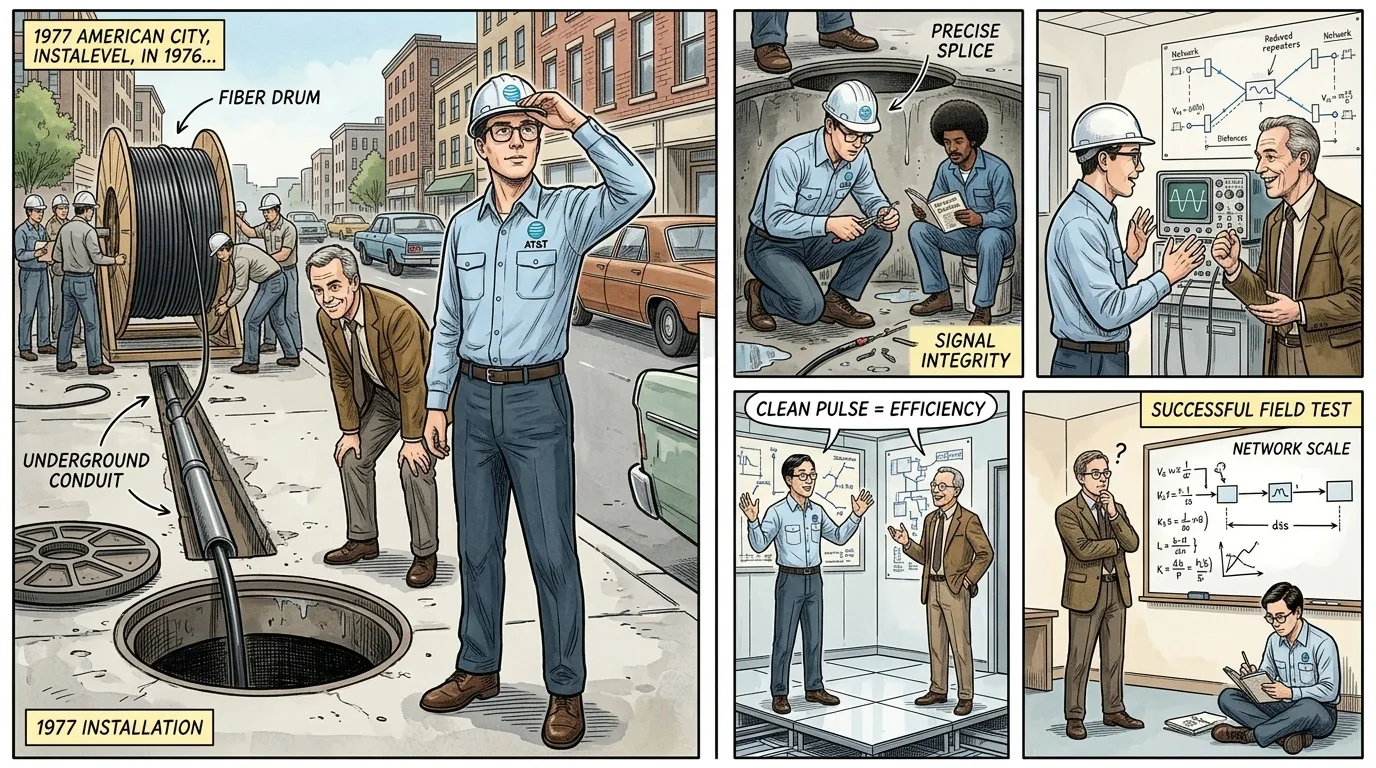
With the 20 dB/km barrier broken, the race was on to deploy fiber optic technology beyond the lab. Early field trials began in the mid-1970s, demonstrating the practical advantages of these new cables. Their capacity to carry vast amounts of data, immunity to electromagnetic interference, and lighter weight compared to copper made them ideal for telephone networks. Governments and telecommunication companies initiated ambitious projects, beginning to replace antiquated copper lines with the new optical infrastructure. The transformation was gradual but inevitable, starting with high-traffic urban centers and expanding outwards.
""The clarity of the signal, even after kilometers, is astounding," an AT&T engineer remarked to a project manager in 1977, observing technicians spooling fiber optic cable into an underground conduit. "We're seeing far less need for repeaters, which drastically reduces maintenance and installation costs." The project manager agreed, "This is more than an upgrade; it's a paradigm shift for our entire communication network. The bandwidth potential is truly remarkable, allowing for multiplexing unheard of with copper.""
Page 9
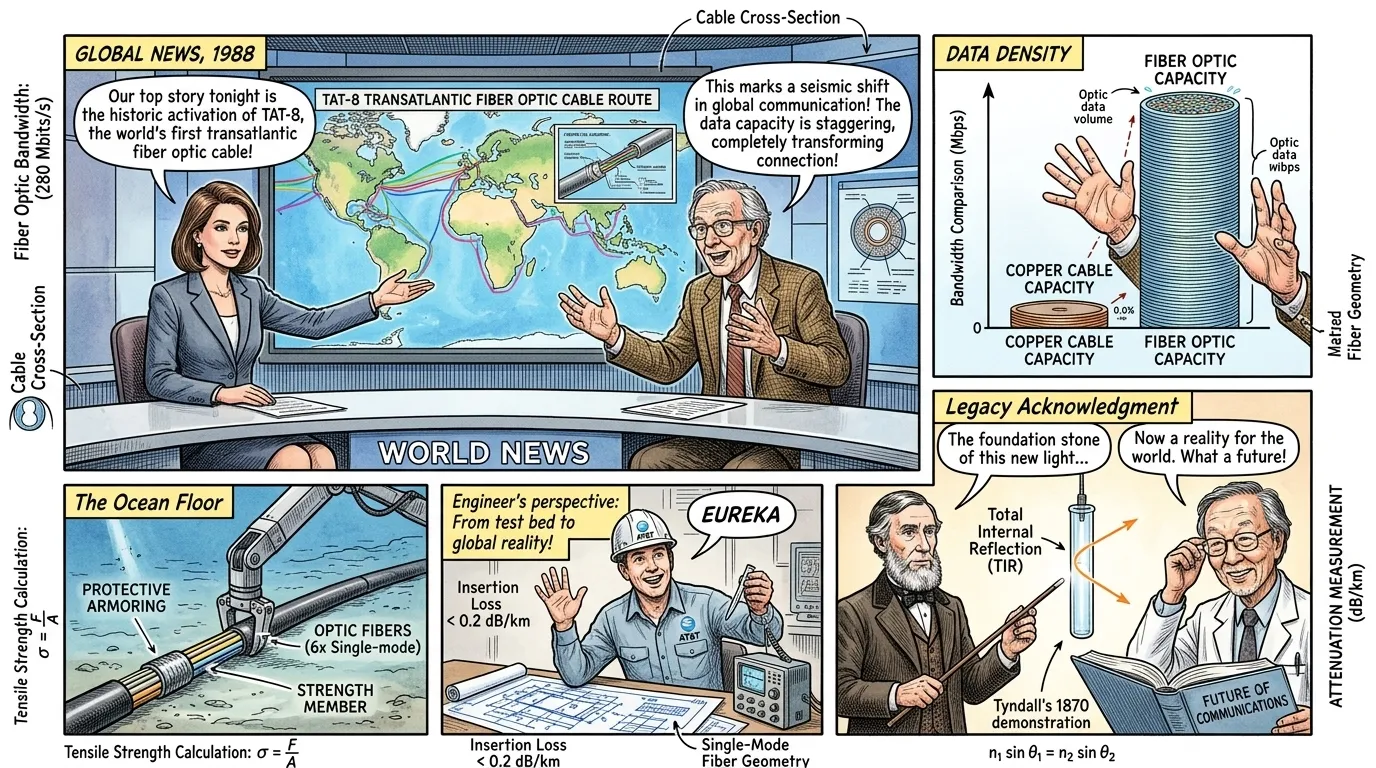
The true scale of fiber optics' impact became evident with the laying of transoceanic cables. Traditional submarine coaxial copper cables struggled with signal loss and limited capacity, but fiber optic cables revolutionized international communication. The first transatlantic fiber optic cable, TAT-8, laid in 1988, carried ten times more phone calls than its copper predecessors. This exponential increase in bandwidth facilitated the explosive growth of the internet, allowing for unprecedented global connectivity. Suddenly, information could traverse oceans at the speed of light, transforming commerce, culture, and personal connections.
""TAT-8 represents a monumental leap," a news anchor reported during a broadcast in 1988, as a graphic of the cable route flashed across the screen. "It's not just more phone lines; it's the foundation for a truly interconnected global network. We are literally laying the groundwork for what will become the information superhighway." An expert commented, "Consider the data volume. This single cable can transmit the entire Encyclopædia Britannica across the Atlantic in seconds. The implications for scientific collaboration, financial markets, and personal communication are profound.""
Page 10
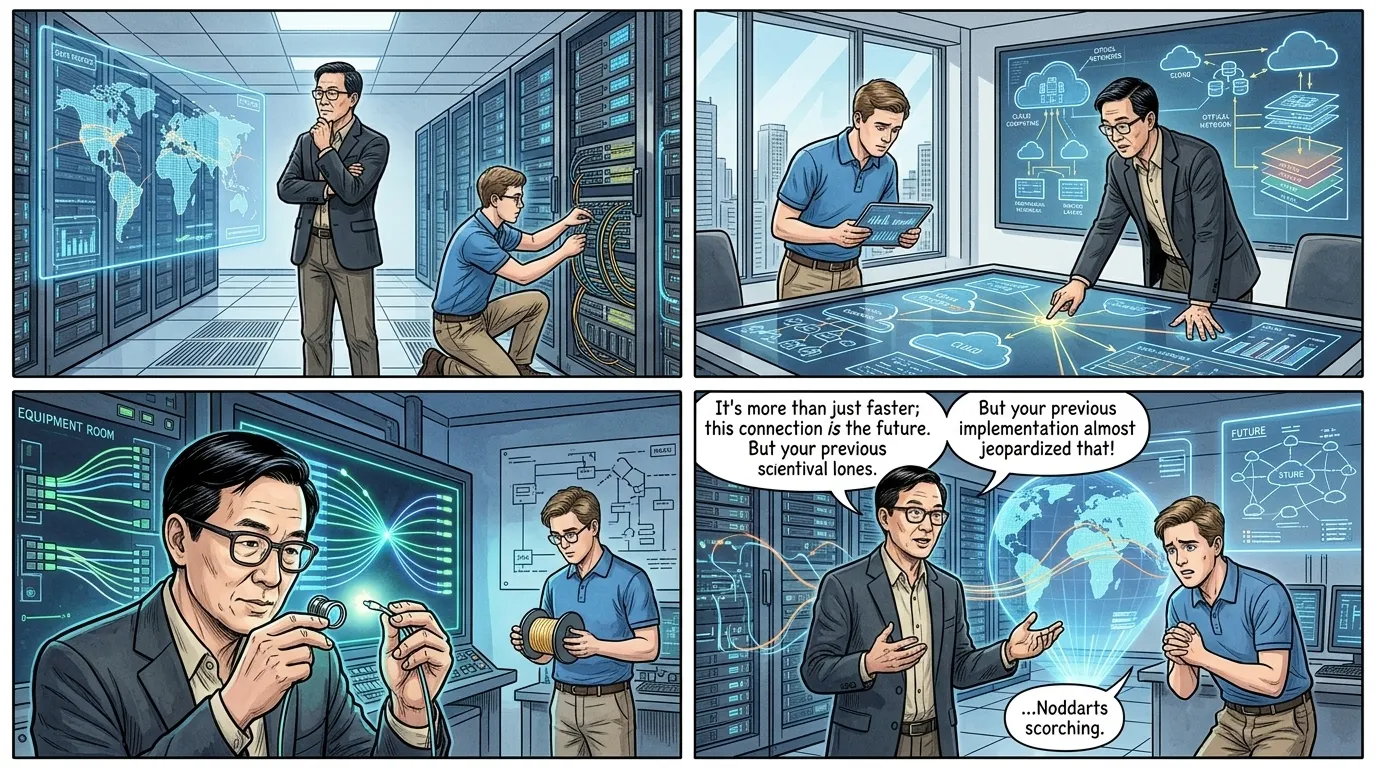
Today, fiber optic cables are the invisible backbone of the modern world. They power the internet, enabling streaming video, cloud computing, and instantaneous global communication. From telemedicine to remote work, from high-frequency stock trading to entertainment, almost every facet of contemporary life relies on the speed and capacity that fiber optics provide. The initial vision of Charles Kao, the relentless pursuit of purity by Corning, and the subsequent engineering efforts have created a global nervous system, continually expanding its reach and capacity, making the world smaller and more connected than ever before. It is a testament to the power of scientific inquiry and human ingenuity.
""We are now witnessing the full realization of what was once a theoretical dream," a contemporary network architect explained during a conference, standing before a futuristic data center display. "Fiber optics has not just connected people; it has fundamentally reshaped economies, education, and social interaction on a global scale. We continue to push its capabilities, knowing that the demands for data will only ever increase." A young engineer added, "It's the silent workhorse. Most people never see it, but its absence would grind the world to a halt. It's the very essence of modern infrastructure.""
About this story
- Location: Global
- Audience: general readers
Questions and answers
Read Wonder Inventions on your phone
Wonder Inventions is available on Android. Get Wonder Inventions on Google Play.