Fiber Optic Network
Fiber Optic Network — an illustrated inventions story, set in Global. 10 illustrated pages, free to read on Wonder Inventions.
Page 1

Before the ubiquitous glow of fiber optics, the world's insatiable hunger for information was bottlenecked by the limitations of copper wires. Signals, transmitted as electrical pulses, rapidly degraded over distance, necessitating bulky repeaters and facing constant electromagnetic interference. The challenge was profound: how to transmit vast quantities of data across continents, reliably and at the speed of light, without these inherent flaws. In 1966, Dr. Charles K. Kao, working at Standard Telecommunication Laboratories (STL) in Harlow, England, published a seminal paper proposing that optical fibers, made from highly purified glass, could carry telephone messages over long distances. This seemingly abstract concept laid the foundation for the Fiber Optic Network, revolutionizing global communication by allowing information to travel as light.
Page 2

For over a century, copper wire had been the undisputed workhorse of telecommunications, connecting distant cities with telegraphs and then voices via the telephone. Its electrical pulses, however, were prone to significant signal attenuation, meaning the strength of the signal diminished rapidly with distance. To counteract this, cumbersome repeater stations were strategically placed every few kilometers, amplifying the weakened signals. These electrical systems also suffered from crosstalk—unwanted interference between adjacent wires—and were vulnerable to electromagnetic noise, severely limiting both the quality and the quantity of information that could be reliably transmitted.
Page 3

The idea of transmitting information using light was not new; Alexander Graham Bell himself experimented with a 'Photophone' in 1880, using sunlight to carry voice over short distances. However, atmospheric conditions like fog, rain, and even clear air caused significant scattering and absorption of light, making long-distance, reliable communication impossible. The fundamental challenge was to guide light through a medium impervious to the whims of weather and visible obstacles. This required a paradigm shift: containing light, not just broadcasting it, and ensuring that the medium itself was virtually transparent.
Page 4

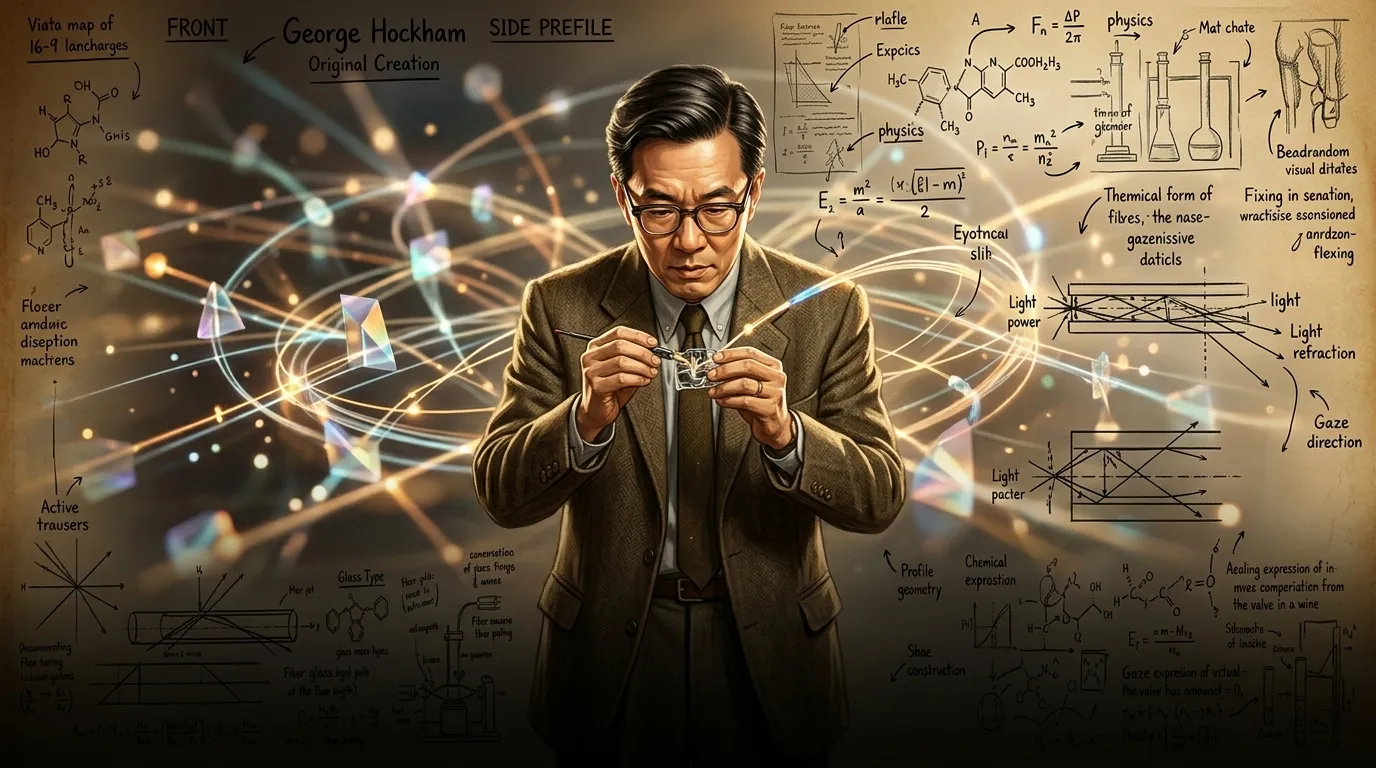
In 1966, Dr. Charles K. Kao, along with his colleague George Hockham, published a groundbreaking paper asserting that light attenuation in glass, then considered too high for practical communication, was primarily due to impurities, not the fundamental properties of glass itself. They boldly hypothesized that if glass could be purified to an unprecedented degree – specifically, to an attenuation level of less than 20 decibels per kilometer (dB/km), and ideally 10 dB/km – it could become a viable medium for long-distance optical communication. This was a radical departure, as existing commercial glass exhibited attenuation rates of thousands of dB/km. It was a call to chemists and material scientists to achieve purity levels previously deemed impossible outside of specialized scientific instruments.
Page 5

The challenge was immense: ordinary glass contains trace impurities like iron, copper, and water molecules, which absorb and scatter light, rendering it useless for long-distance transmission. Achieving Kao's target of 10-20 dB/km required glass so pure that a light beam could travel through kilometers of it with minimal loss. This sparked a global race among material scientists to develop new methods of glass purification. They needed to eliminate contaminants down to parts per billion, leading to innovative techniques such as chemical vapor deposition (CVD) to grow ultra-pure silica, layer by painstaking layer. It was a triumph of material science, transforming ordinary sand into a conduit for light.
Page 6

The core of fiber optic communication relies on a fundamental optical principle: total internal reflection. Each optical fiber consists of two main components: a central, highly pure glass 'core' and a surrounding 'cladding' layer, also made of glass but with a slightly lower refractive index. When light enters the core at a shallow angle, it strikes the boundary between the core and cladding. Because the cladding has a lower refractive index, the light, instead of passing through or refracting out, is reflected completely back into the core, provided the angle of incidence is greater than the 'critical angle.' This continuous reflection allows light to 'bounce' its way along the fiber, even around bends, without escaping.
Page 7

Once ultra-pure silica was available, the next hurdle was reliably drawing it into hair-thin, long fibers. This was achieved through a process involving a 'preform' – a large, precisely manufactured glass rod with the core and cladding layers already formed. The preform is heated to a molten state in a specialized drawing tower, and a fine strand is pulled from its tip. As the fiber cools, it is immediately coated with a protective polymer layer to prevent damage. This intricate manufacturing process ensures the fiber maintains its critical optical properties, creating hundreds of kilometers of pristine, communication-ready glass thread from a single preform. It was an engineering marvel that made Kao's theoretical breakthrough a practical reality.
Page 8

With the purity problem largely solved by Corning Glass Works achieving the 20 dB/km threshold in 1970, and subsequent improvements, the era of practical fiber optics began. The first commercial fiber optic link was installed in 1977 by AT&T in Chicago, carrying live telephone traffic. Other telecommunications giants quickly followed suit, recognizing the immense potential. Fiber optic cables, despite being more expensive initially, offered significantly higher bandwidth and far fewer repeaters compared to copper, making them ideal for high-capacity 'trunk' lines connecting major switching centers. This marked the beginning of a profound shift in global telecommunications infrastructure.
Page 9

The true transformative power of fiber optics became undeniable with the deployment of transoceanic submarine cables. While earlier copper coaxial cables could carry only a few hundred telephone conversations, the first transatlantic fiber optic cable, TAT-8, laid in 1988, could carry 40,000 simultaneous conversations and immense data streams. This enabled the burgeoning internet to become truly global, linking continents with unprecedented speed and capacity. These deep-sea networks, meticulously engineered to withstand immense pressures and harsh environments, formed the invisible backbone of the modern interconnected world, facilitating everything from emails and video calls to global financial transactions.
Page 10

Today, the Fiber Optic Network is the invisible infrastructure underpinning our digital lives, a testament to Dr. Charles K. Kao's foresight. From the gigabit speeds of our home internet to the instantaneous global financial markets, from life-saving medical endoscopes probing inside the human body to critical sensor networks monitoring infrastructure, fiber optics powers it all. Its unparalleled capacity and speed have not only revolutionized communication but have also enabled entirely new industries and ways of living. The legacy of pure glass carrying light has evolved into the nervous system of the information age, continually expanding our ability to connect, learn, and innovate globally. As British physicist Lord Kelvin once observed, 'When you can measure what you are speaking about, and express it in numbers, you know something about it.' Kao's ability to quantify the potential of light in glass led to a measurable revolution.
"'When you can measure what you are speaking about, and express it in numbers, you know something about it,' as the British physicist Lord Kelvin once observed. Kao's work in quantifying the potential of light in glass ultimately led to this measurable revolution."
About this story
- Location: Global
- Audience: general readers
Questions and answers
Read Wonder Inventions on your phone
Wonder Inventions is available on Android. Get Wonder Inventions on Google Play.