Electric Car
Electric Car — an illustrated inventions story, set in Global. 10 illustrated pages, free to read on Wonder Inventions.
Page 1
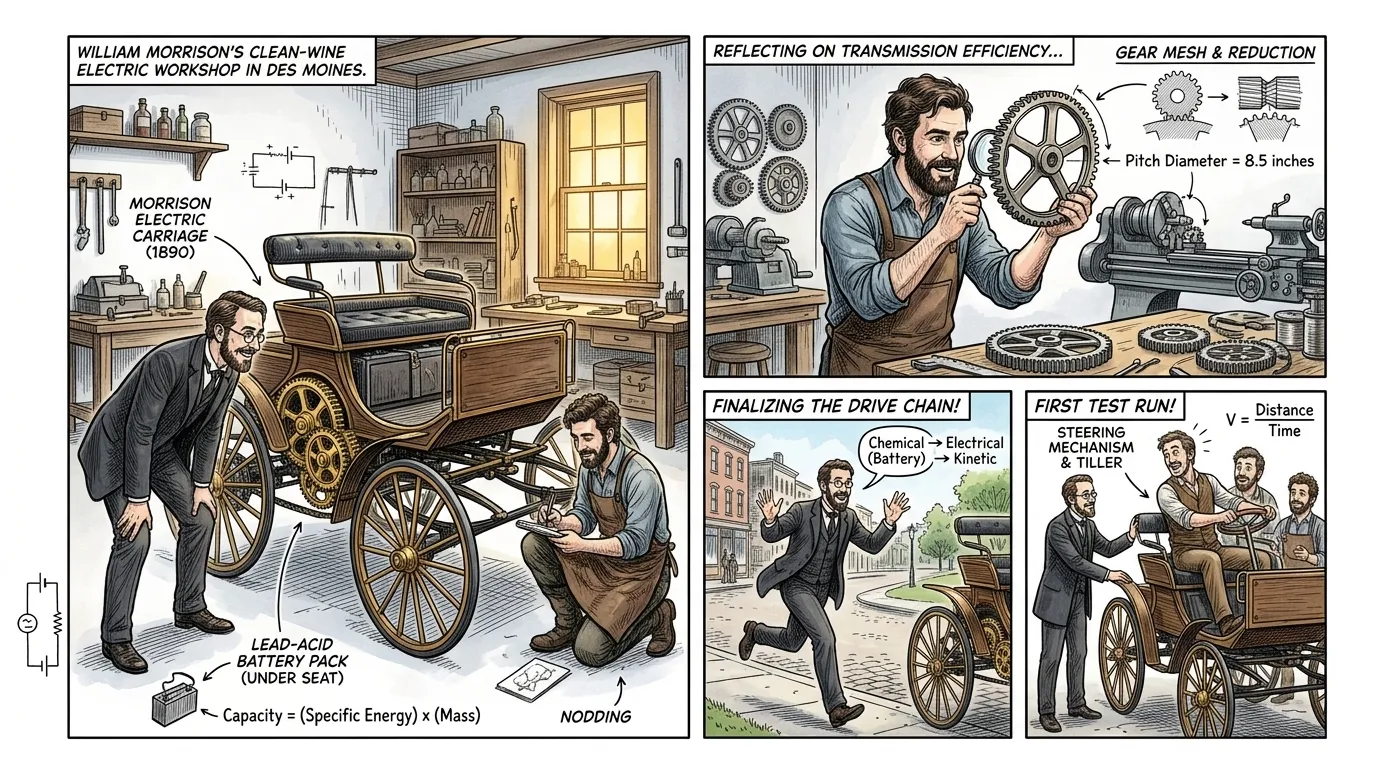
William Morrison, a brilliant chemist in Des Moines, Iowa, carefully inspected the pioneering vehicle before him. 'The era of steam and horses is drawing to a close,' he declared to his lead engineer, Samuel, gesturing towards the groundbreaking electric carriage. 'Our 1890 Electric Car offers a silent revolution, a new definition of personal navigation for the future.' Samuel nodded, adding, 'Indeed, as Leonardo da Vinci once wrote, 'Simplicity is the ultimate sophistication,' and our design aims for exactly that – elegant power.'
Page 2
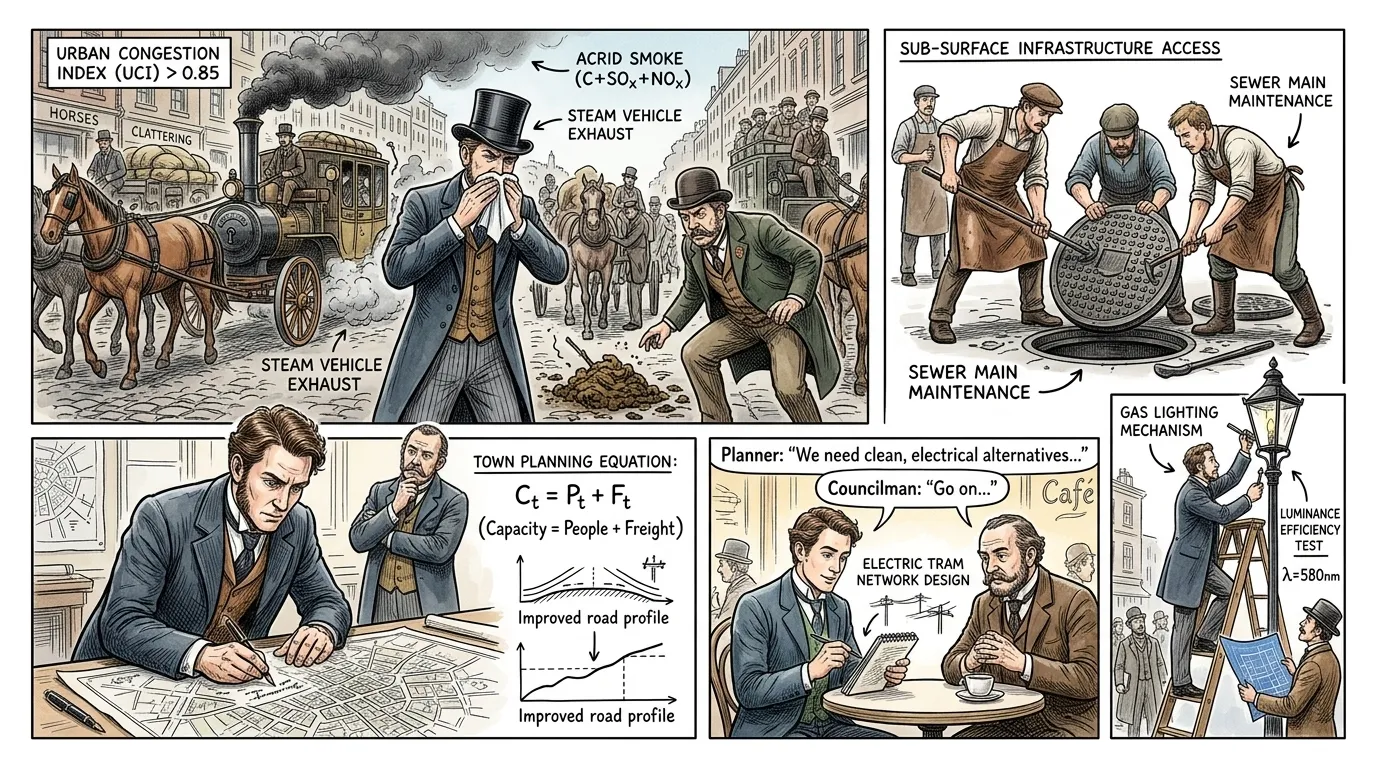
'Imagine a city free from this incessant din and the stench of horse waste,' an urban planner remarked to a city councilman, shielding his face from the acrid smoke of a passing steam carriage. The councilman sighed, 'The pollution from these new steam engines is almost as bad as the mess from thousands of horses, despite their promise of progress.' This was the pervasive challenge before the electric car: congested streets, choked with noise, soot, and the sheer volume of equine waste, made urban life a constant struggle against unpleasant conditions. The need for cleaner, more humane transportation was undeniable.
Page 3
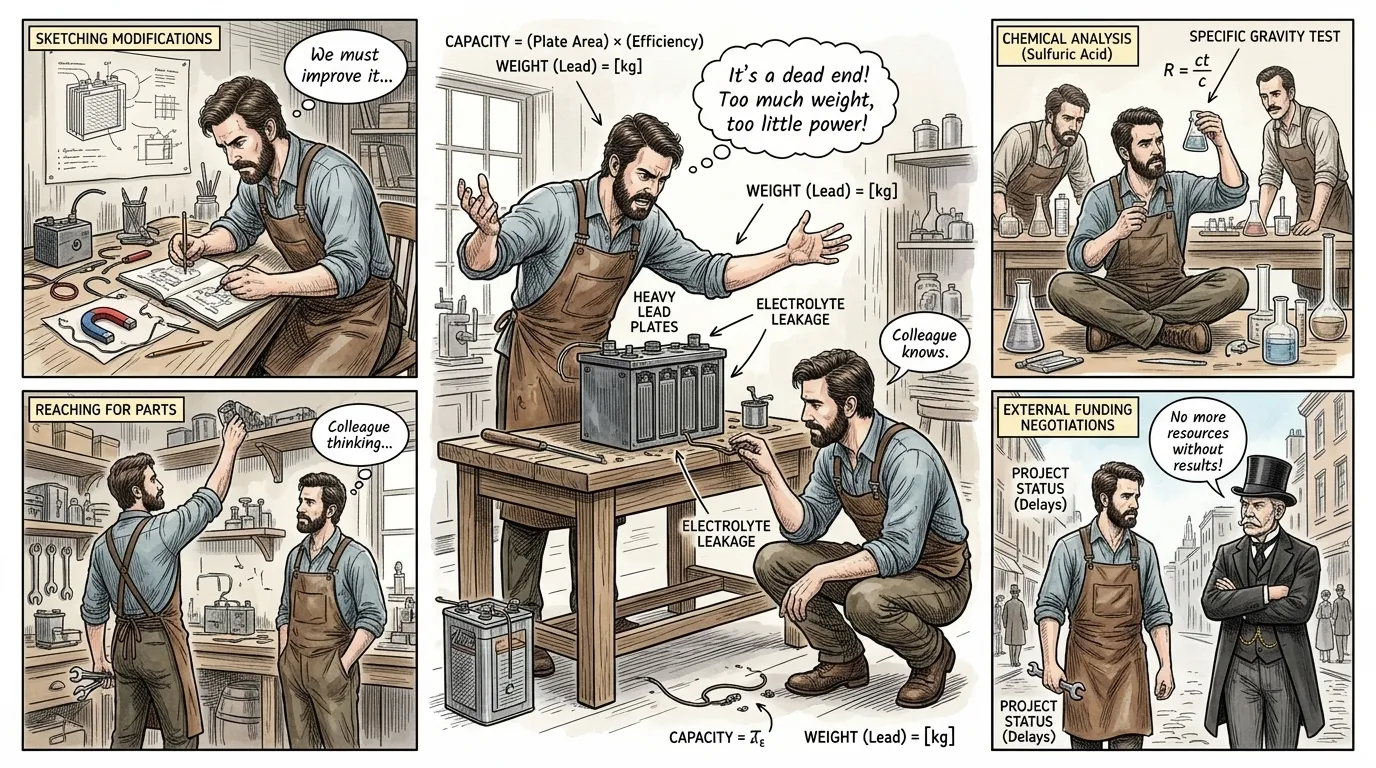
'Our primary hurdle remains the battery,' an early engineer explained to a colleague, gesturing towards a heavy, cumbersome lead-acid cell in his workshop. 'Its weight and limited energy density severely restrict our range and speed.' His colleague nodded, 'Indeed. We need a power source that can sustain operation for longer than a few hours, otherwise, it's merely a novelty.' These fundamental battery limitations were the 'knowledge setup' for all early electric vehicle development, dictating the practical constraints of their performance.
Page 4
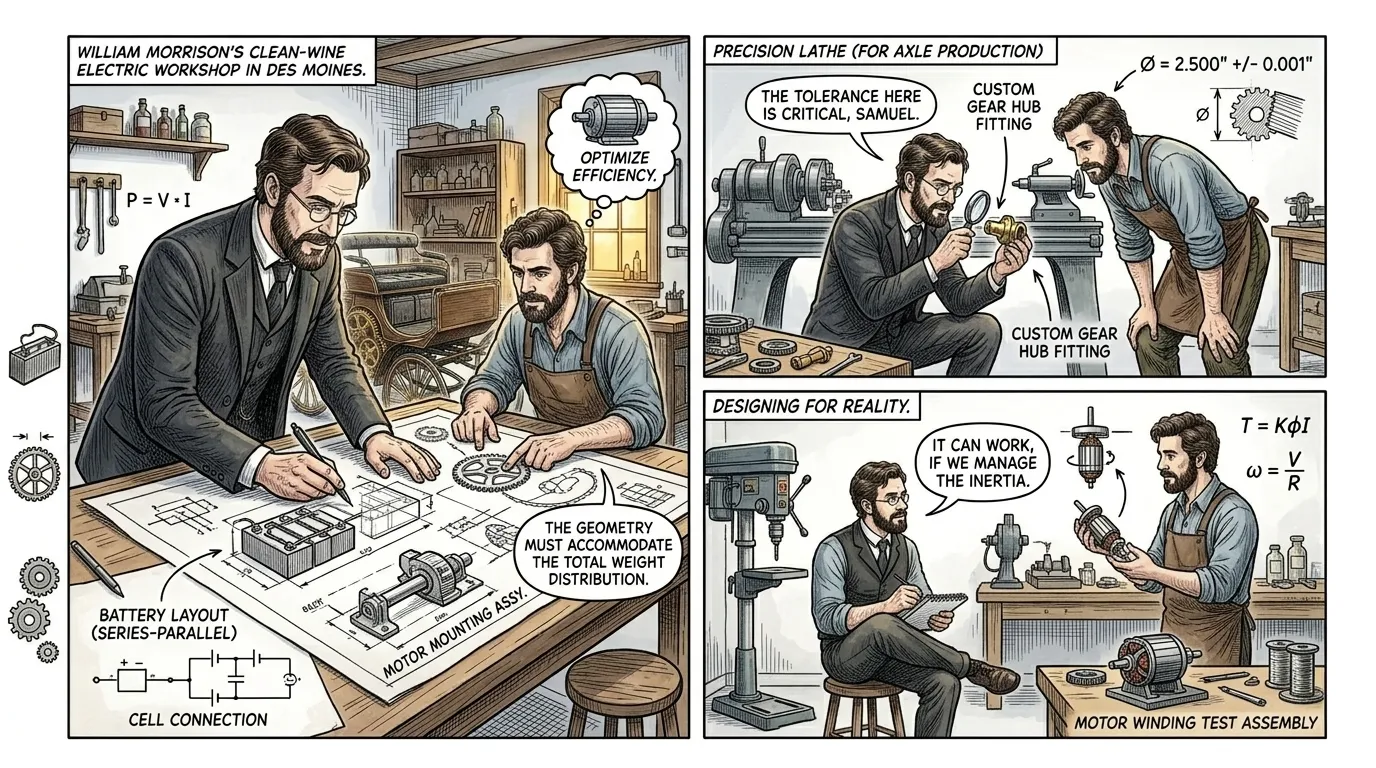
'The challenge is not merely to power a vehicle, but to integrate the motor and battery seamlessly into a practical form,' Morrison stated, sketching intricate diagrams of potential battery layouts and motor mountings. 'We must consider weight distribution, passenger comfort, and efficient power transfer.' Samuel carefully reviewed the blueprints, remarking, 'This attention to holistic design, not just individual components, is what will differentiate our machine.' Morrison's motivation was a blend of scientific curiosity and a clear vision for an accessible, reliable personal transport system.
Page 5
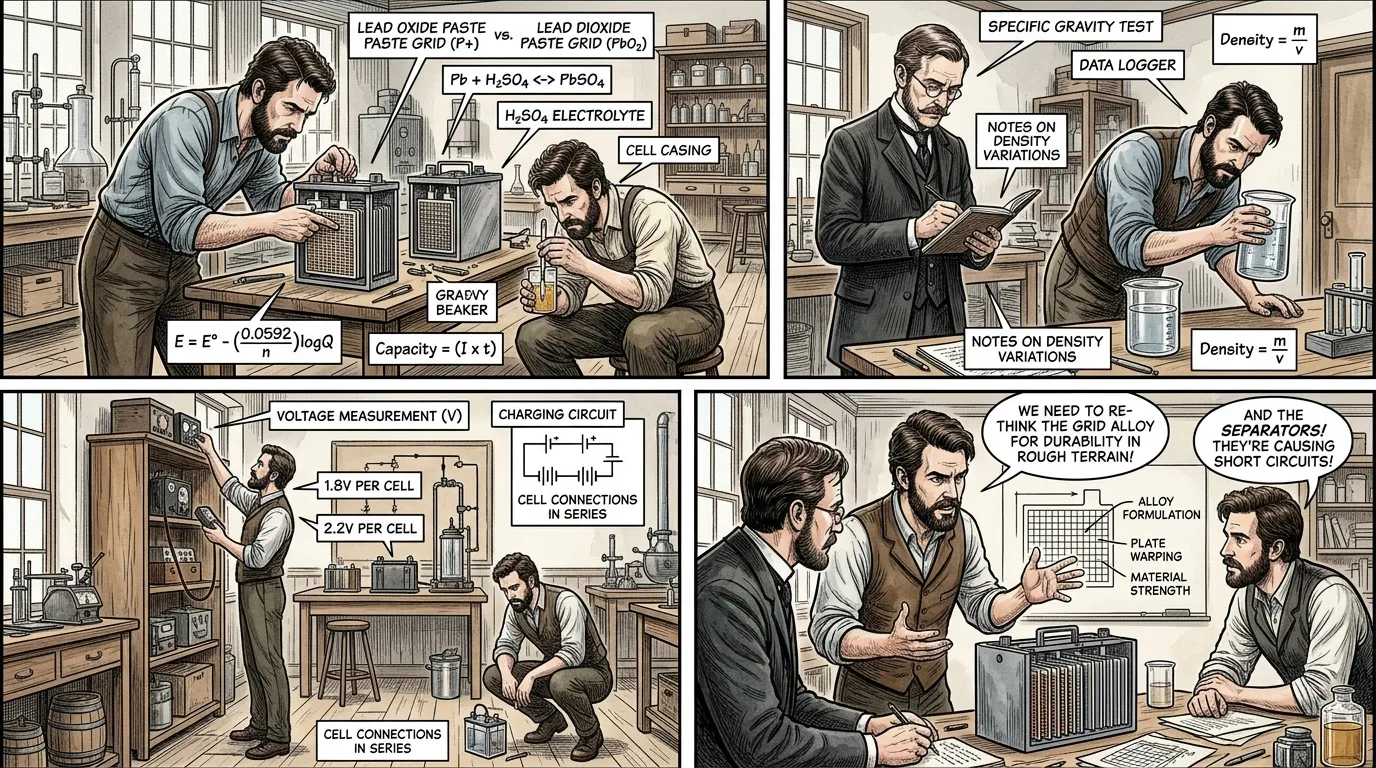
'Each iteration brings us closer to a viable power-to-weight ratio,' an engineer noted, comparing two different lead-acid battery designs mounted side-by-side on a test bench. 'The internal plate structure and electrolyte consistency are critical for improved power density and reduced self-discharge.' Another technician added, 'Even small gains in these areas are monumental; they translate directly into greater range, albeit still limited.' These continuous, incremental improvements in lead-acid battery technology, driven by dedicated research, gradually transformed experimental concepts into functionally practical electric vehicle power plants.
Page 6
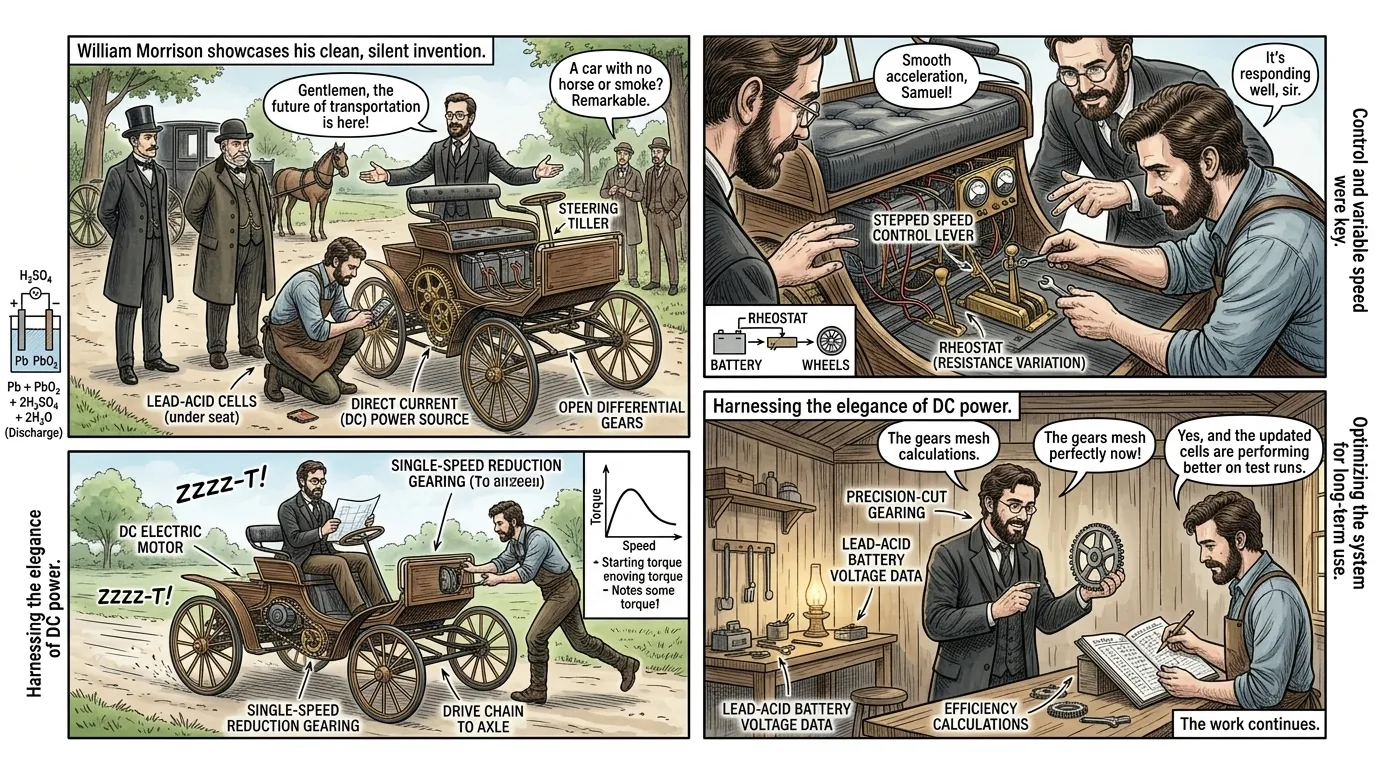
'Unlike steam, there's no boiler to fire, no complex gear system to master, just a simple control of current,' Morrison explained during a demonstration, gesturing to the car's components. 'The battery feeds direct current to the motor, which then rotates, driving the wheels directly.' Samuel highlighted, 'A rheostat regulates the power, making acceleration smooth and intuitive.' This direct, elegant conversion of electrical energy to mechanical motion, with minimal moving parts, was the core breakthrough: problem—energy storage; attempt—battery refinement; breakthrough—direct electric drive; operation—simplified control.
Page 7
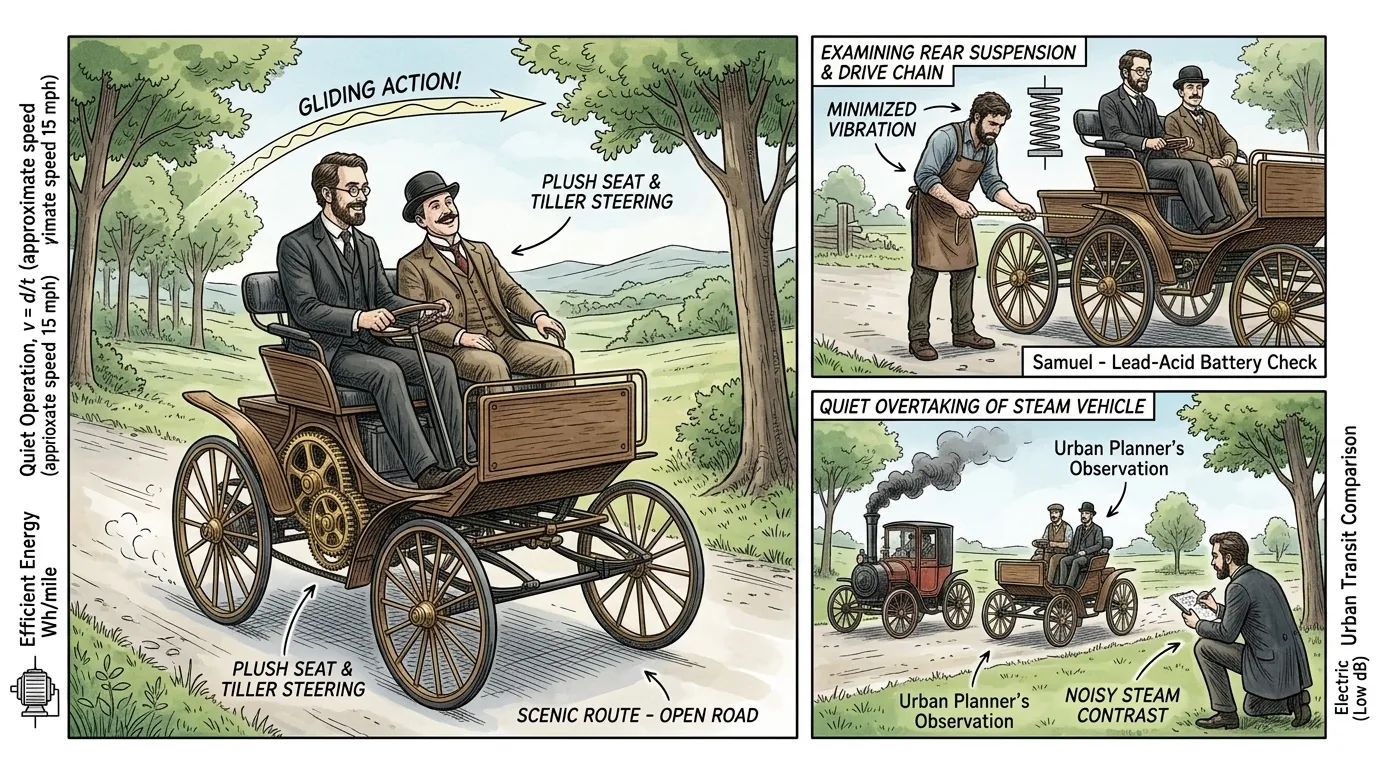
'The ride is incredibly smooth and quiet; you can converse without shouting over an engine,' a passenger exclaimed during an early test drive, delighted by the sensation. 'No hand-cranking, no jarring gears – it simply glides forward.' Morrison, at the tiller, smiled, 'That immediate torque from the electric motor, coupled with our simplified controls, makes it uniquely easy to operate for anyone.' This stark contrast to the noisy, vibrating, and often difficult-to-start gasoline or steam vehicles of the era made the electric car remarkably appealing, especially for urban commuting.
Page 8
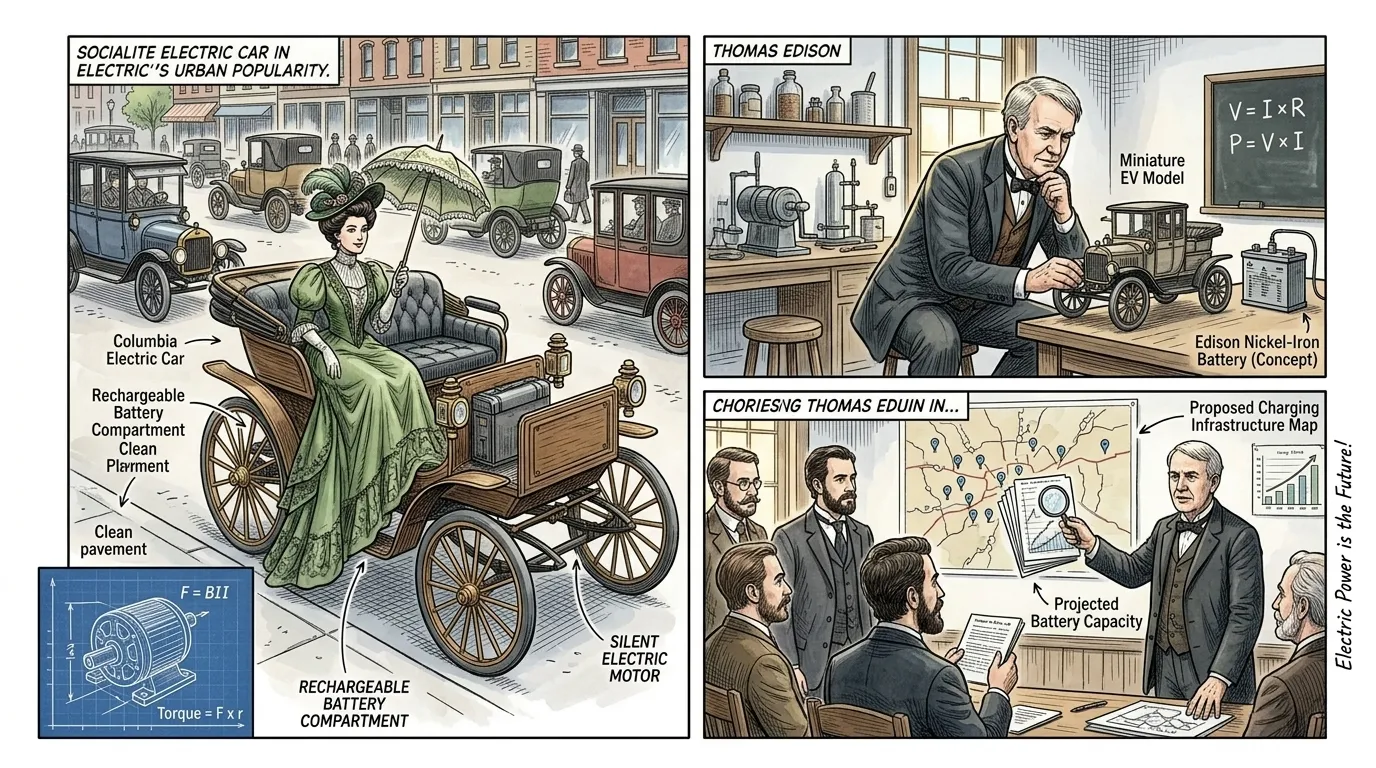
'Electric vehicles are truly the lady's car – so clean, so easy to start and drive!' proclaimed a prominent socialite, stepping gracefully from her newly acquired Columbia Electric in 1905. For a brief, golden period in the early 20th century, electric cars thrived, especially in urban centers where their quiet operation and simple charging—often done overnight at home—made them ideal. Thomas Edison, a staunch advocate, famously stated, 'The electric automobile is the cleanest, the quietest, and gives the steadiest ride.' Indeed, for a time, electric cars outnumbered their gasoline counterparts.
Page 9
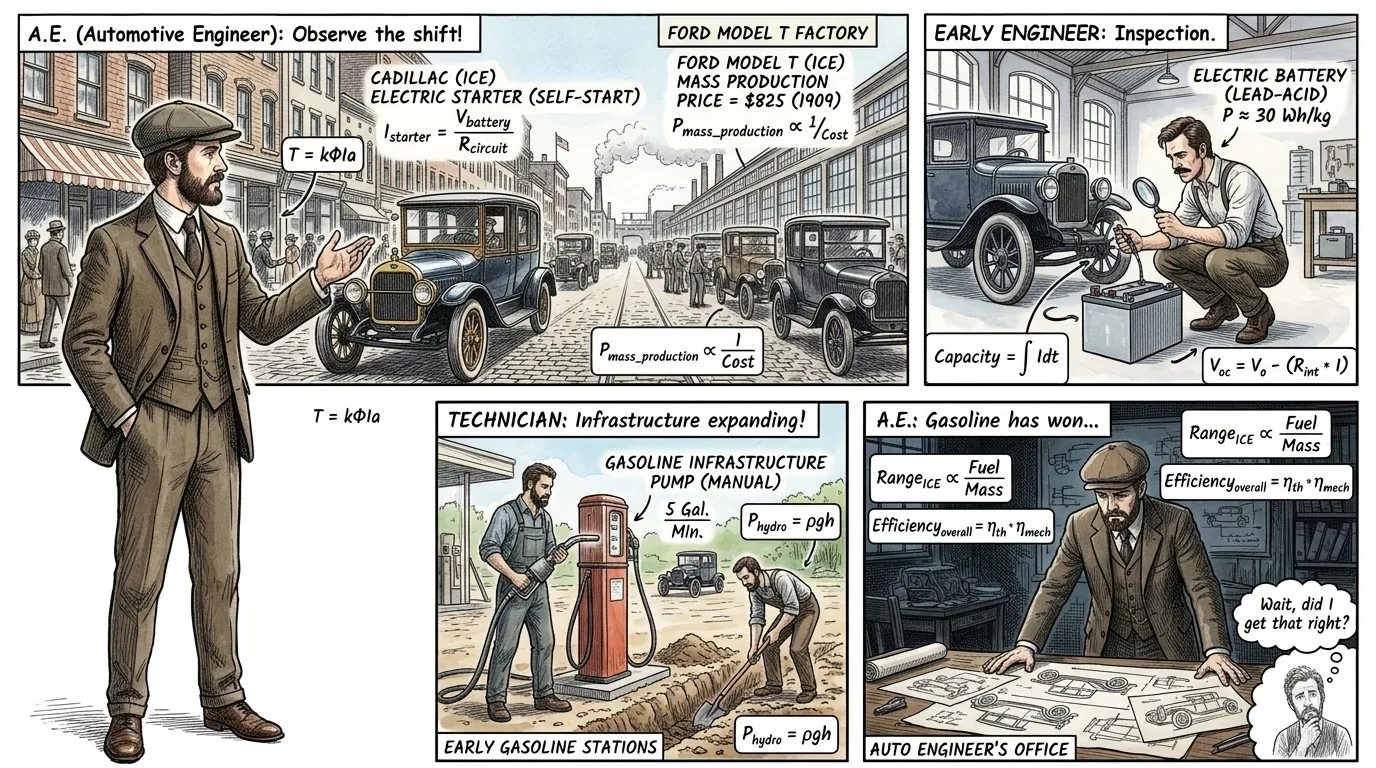
'The advent of the electric starter by Cadillac truly changed the game, eliminating the dreadful hand-crank,' an automotive engineer observed in 1912, recognizing a critical shift. 'Suddenly, gasoline cars became far more accessible and practical for everyday use.' Concurrently, Henry Ford's mass production of the affordable Model T drastically lowered gasoline car prices, while a rapidly expanding network of roads and gasoline stations extended the range of internal combustion engines. These developments, coupled with persistent battery limitations (still the payoff for the earlier 'knowledge setup'), pushed electric vehicles into a swift decline.
Page 10
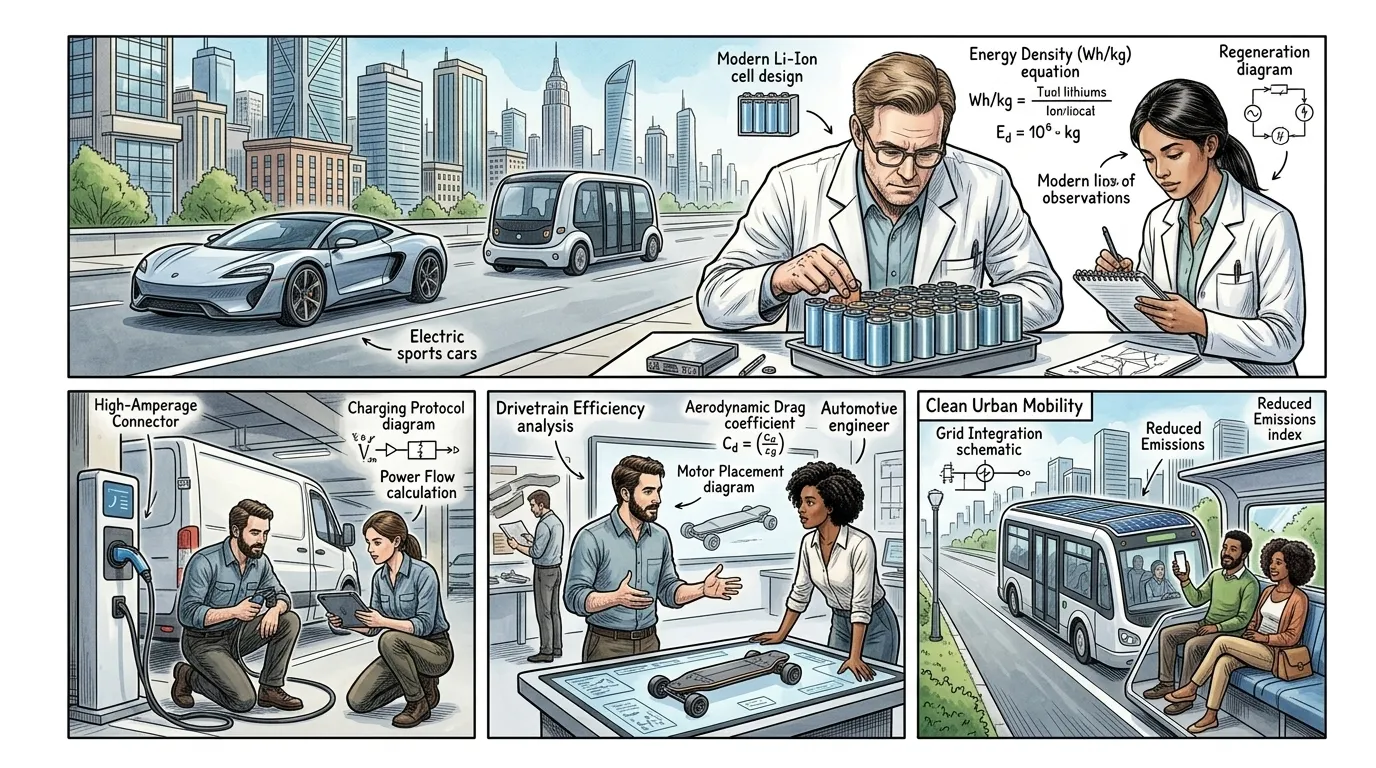
Though overshadowed for decades, the foundational principles of the electric car never faded; researchers continuously refined battery chemistry and motor efficiency. Today, driven by environmental urgency and staggering technological advancements in lithium-ion batteries and power electronics, the electric car has returned with unprecedented momentum. What began as Morrison's quiet revolution is now a global transformation, redefining transport with renewed purpose. From silent urban delivery to high-performance personal vehicles, the electric motor's potential is finally being fully realized, building upon over a century of innovation and persistent challenges.
About this story
- Location: Global
- Audience: general readers
Questions and answers
Read Wonder Inventions on your phone
Wonder Inventions is available on Android. Get Wonder Inventions on Google Play.