Industrial Robot
Industrial Robot — an illustrated inventions story, set in Global. 10 illustrated pages, free to read on Wonder Inventions.

Page 1
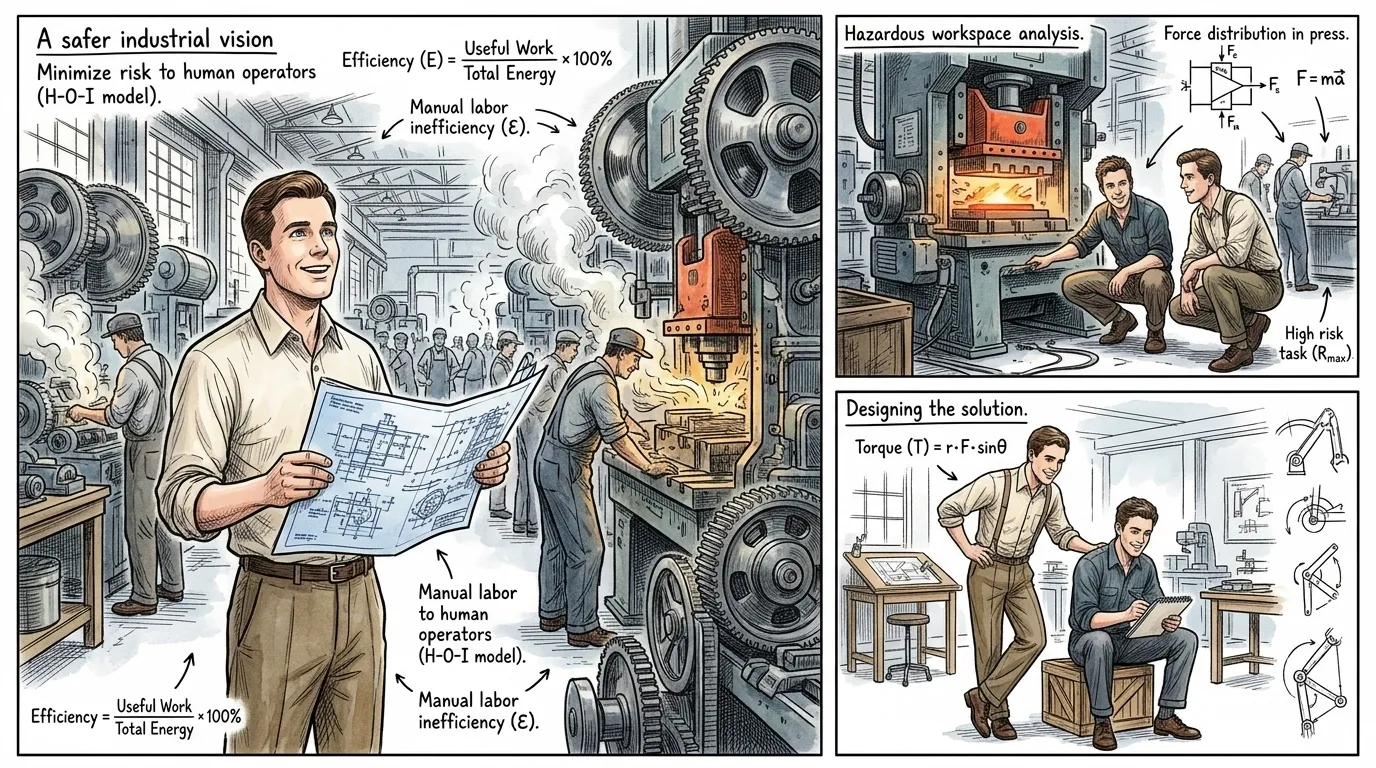
Mid-20th century manufacturing hummed with relentless activity, yet its backbone, human labor, was often perilous and monotonous. Workers toiled in environments marked by heavy machinery, toxic fumes, and repetitive strains, leading to frequent injuries and low morale. The need for a safer, more efficient approach was undeniable, a vision that began to coalesce in the mind of one visionary.
""As Charles Dickens once wrote, 'It was the best of times, it was the worst of times,' and for many factory workers, their daily reality often felt like the latter," George Devol, a thoughtful American inventor, reflected. "We needed a radical shift." He envisioned a machine that could replicate human actions with tireless precision, particularly for dangerous or mind-numbing tasks, patenting his 'Programmed Article Transfer' device in 1954."
Page 2
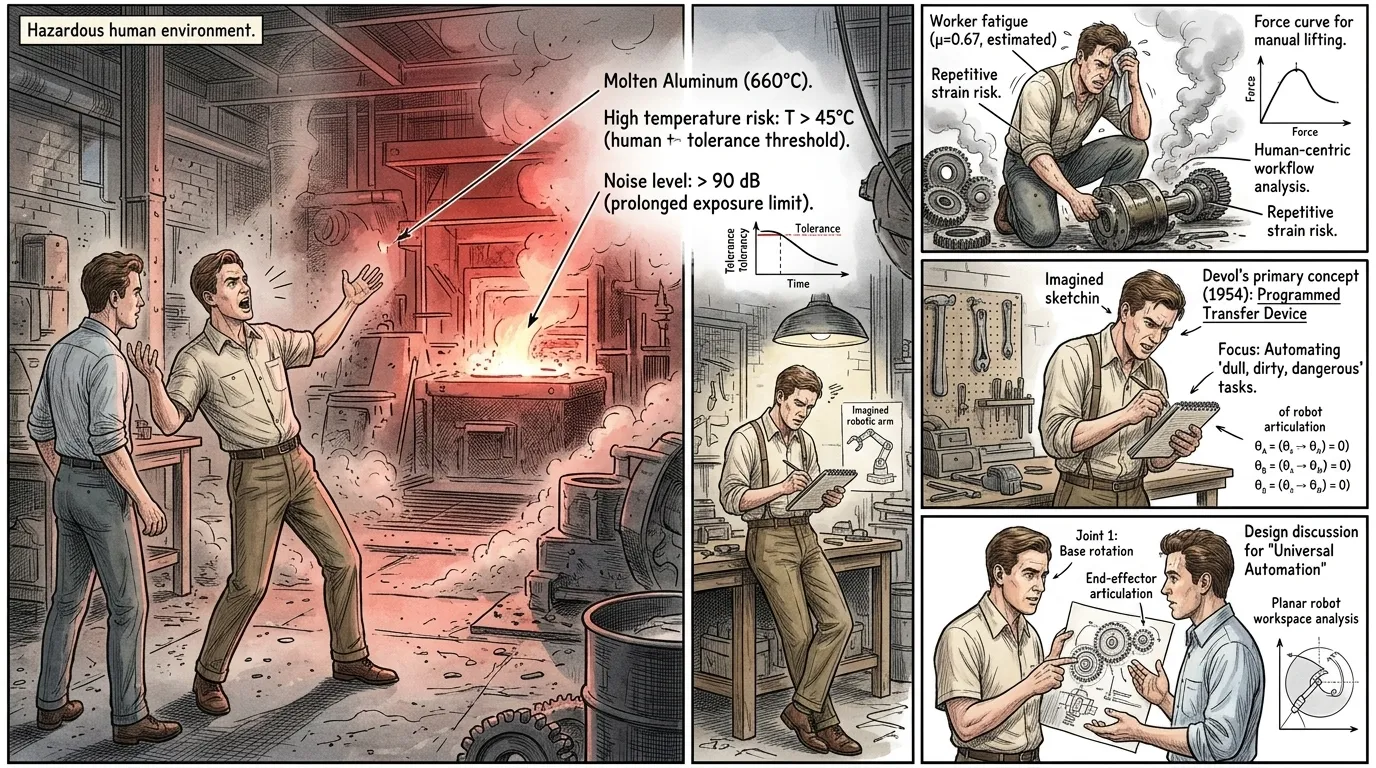
The demands of industrial production far exceeded human endurance. Tasks like manipulating molten metal in die-casting, applying consistent welds in hot, cramped spaces, or spray-painting toxic chemicals required unwavering concentration and stamina. Such work exposed humans to extreme temperatures, hazardous materials, and cumulative trauma disorders, impacting both health and product quality. A solution needed to overcome these inherent biological limitations.
"An engineer, wiping sweat from his brow, gestures towards a large, complex machine. "We need a machine that can perform these actions with unwavering accuracy, day in and day out. It's about more than just speed; it's about absolute reliability," George Devol states emphatically. "Humans simply cannot maintain that consistent, precise motion for extended periods without fatigue or error." He understood the critical need for a new class of automation that could offer repeatable, programmable control."
Page 3
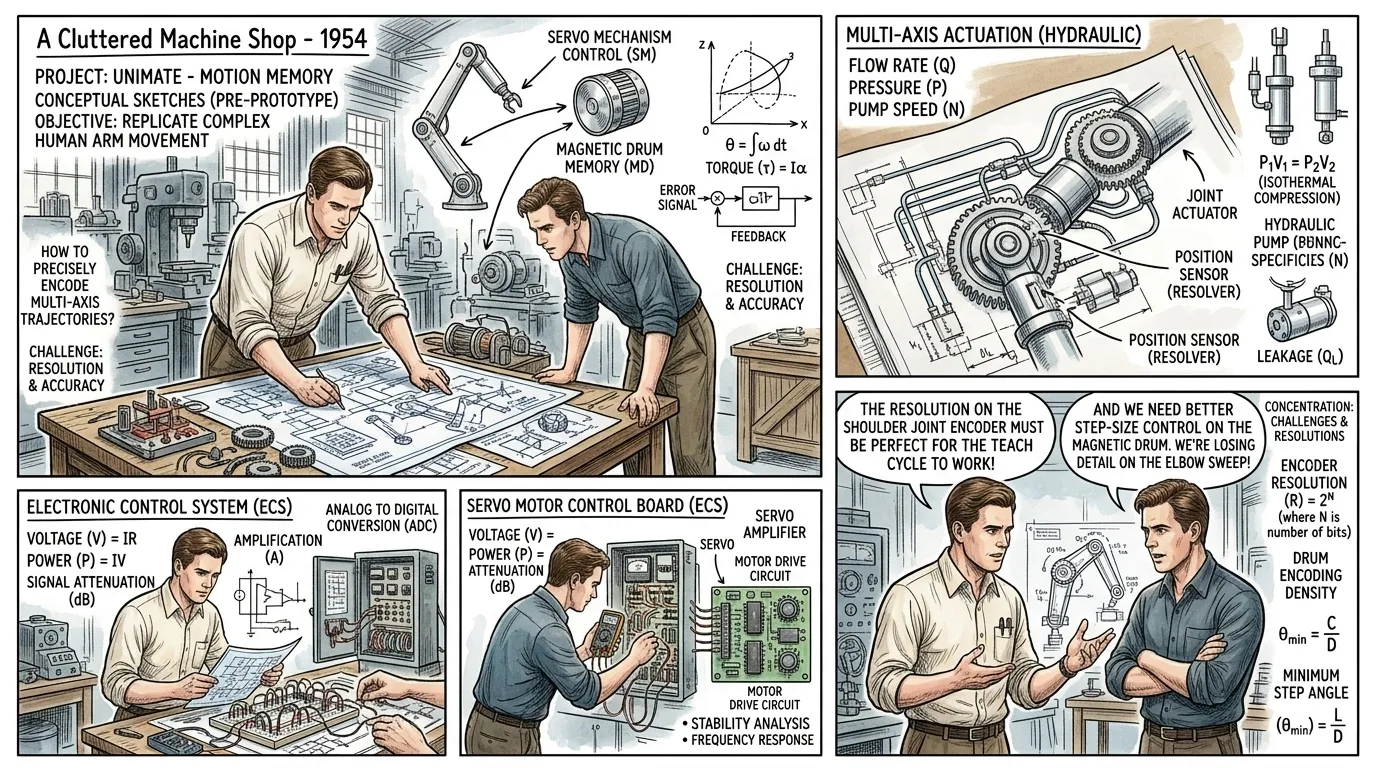
Devol's early concept, patented in 1954, was not merely an automated machine but a 'programmed article transfer' device. It was designed to 'teach' a machine a sequence of movements, record them, and then play them back repeatedly. The core challenge lay in accurately capturing complex, multi-axis motions and then translating them into reliable mechanical actions, a far cry from simple fixed automation. Early prototypes struggled with precision and adaptability, but the fundamental principle of 'motion memory' was taking shape.
"An early engineer, hunched over a cluttered workbench, points to a series of intricate mechanical drawings. "The core idea, as Leonardo da Vinci might have observed when sketching his automata, is to give motion memory to a machine," he explains to a colleague. "But precisely replicating variable speed, force, and complex spatial paths with mechanical linkages is our true challenge." They discuss the crude attempts at creating a 'playback' system."
Page 4
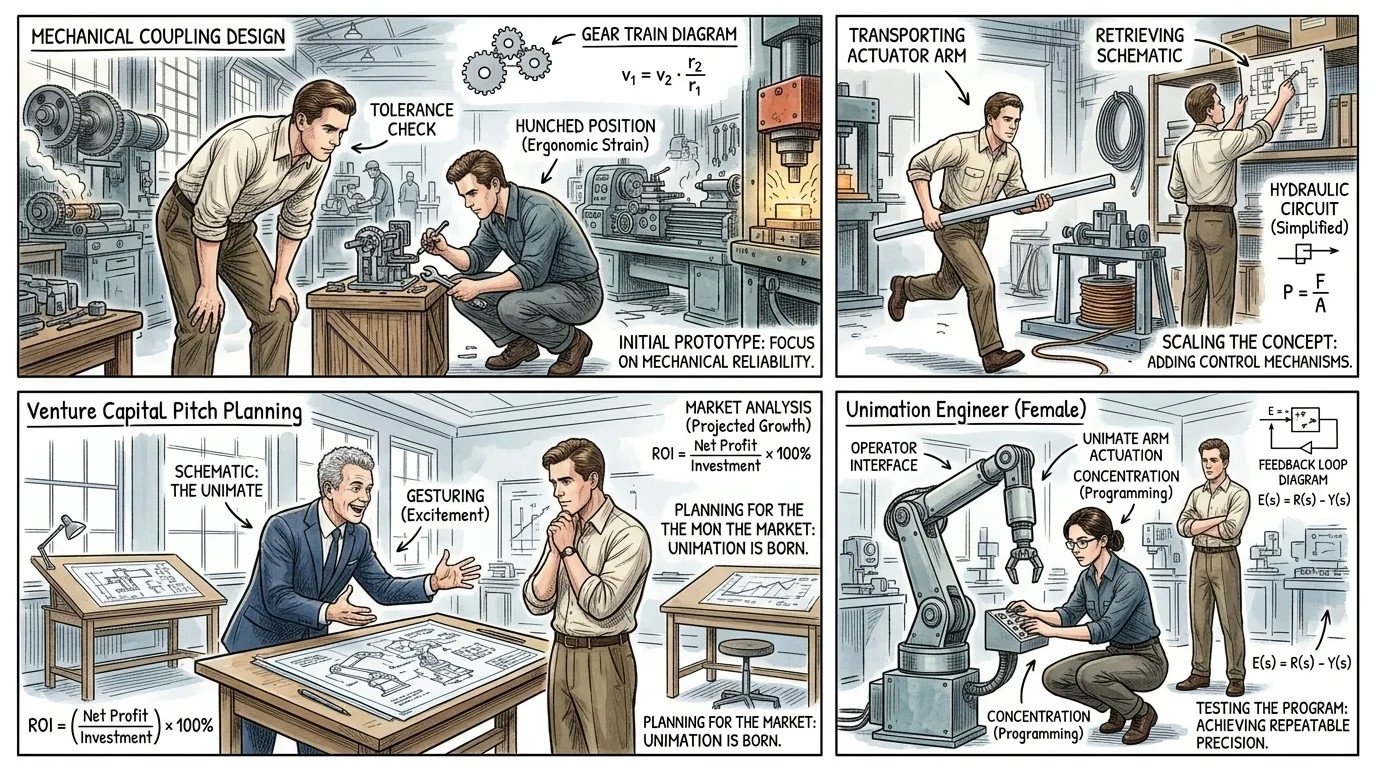
George Devol's innovative concept needed a champion with commercial acumen and engineering leadership. In 1956, he met Joseph Engelberger, an engineer and entrepreneur, who immediately grasped the immense potential of Devol's 'programmed manipulator.' Their collaboration was pivotal, leading to the formation of Unimation Inc. in 1961, the world's first robot company. Engelberger secured critical funding and brought a systematic approach to developing Devol's vision into a marketable product, focusing on hydraulic power and magnetic drum memory for robust, repeatable operations.
"Joseph Engelberger, animated and enthusiastic, gestures towards a detailed schematic on a drafting table. "George, your vision for a programmable manipulator aligns with what Albert Einstein understood about ingenuity: 'Logic will get you from A to B. Imagination will take you everywhere.' We need that imagination, coupled with sound engineering, to make this a reality for industry!" He excitedly outlines the path forward for their new venture, Unimation."
Page 5
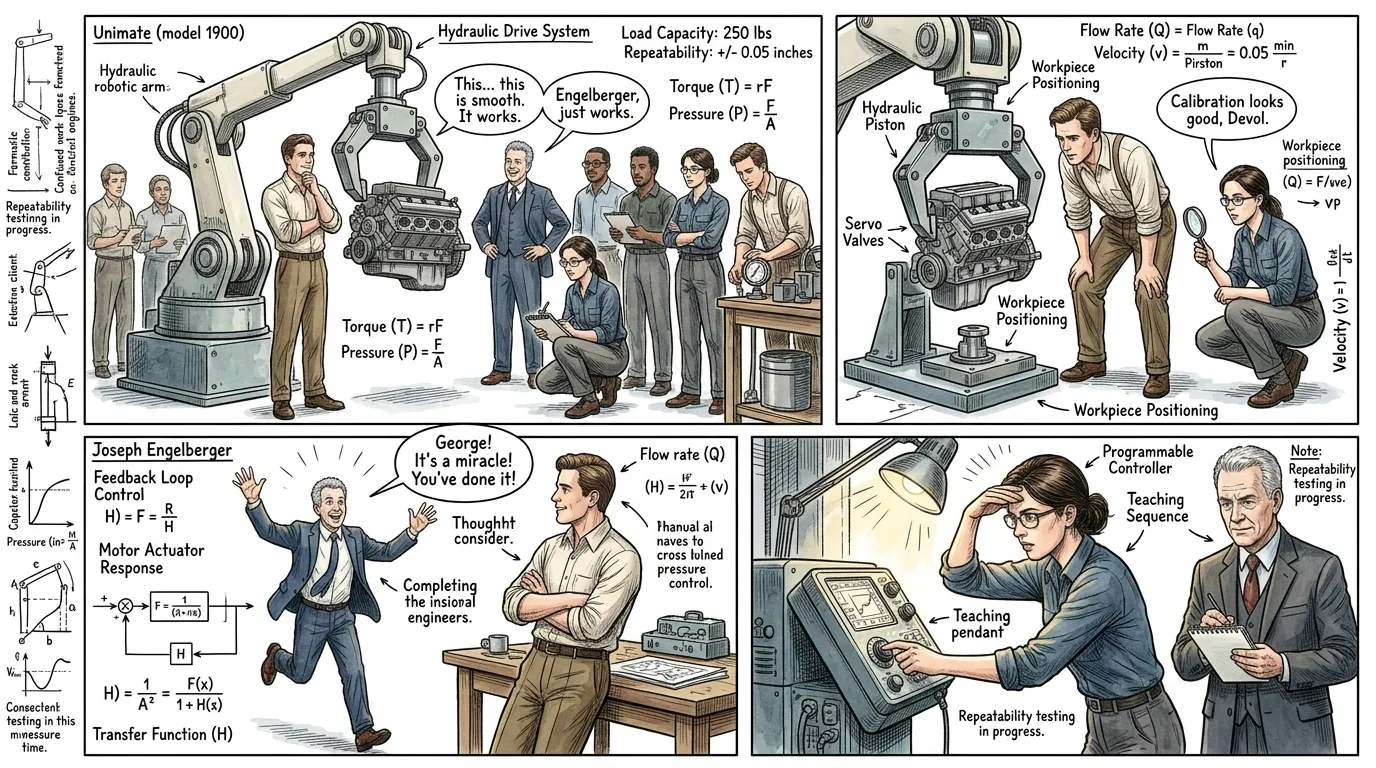
Under the leadership of Devol and Engelberger, Unimation developed the Unimate, the world's first industrial robot. Its design was revolutionary: a heavy, multi-jointed arm capable of six axes of movement, powered by hydraulics, and controlled by a magnetic drum memory. This 'teach playback' system allowed a human operator to physically guide the arm through a desired sequence of movements, which the robot would then meticulously record and repeat. This breakthrough provided the precision, power, and repeatability that traditional fixed automation lacked, promising a new era in manufacturing efficiency and safety.
"Observing the Unimate's first successful, smooth motion, George Devol, with a look of quiet satisfaction, turns to Engelberger. "This machine embodies what Marie Curie might have called 'persistence.' The path of scientific and engineering progress is never easy, but its flawless, repeatable motion proves the concept. We have brought a tireless, precise worker to life." The robot arm effortlessly picks up a heavy component."
Page 6
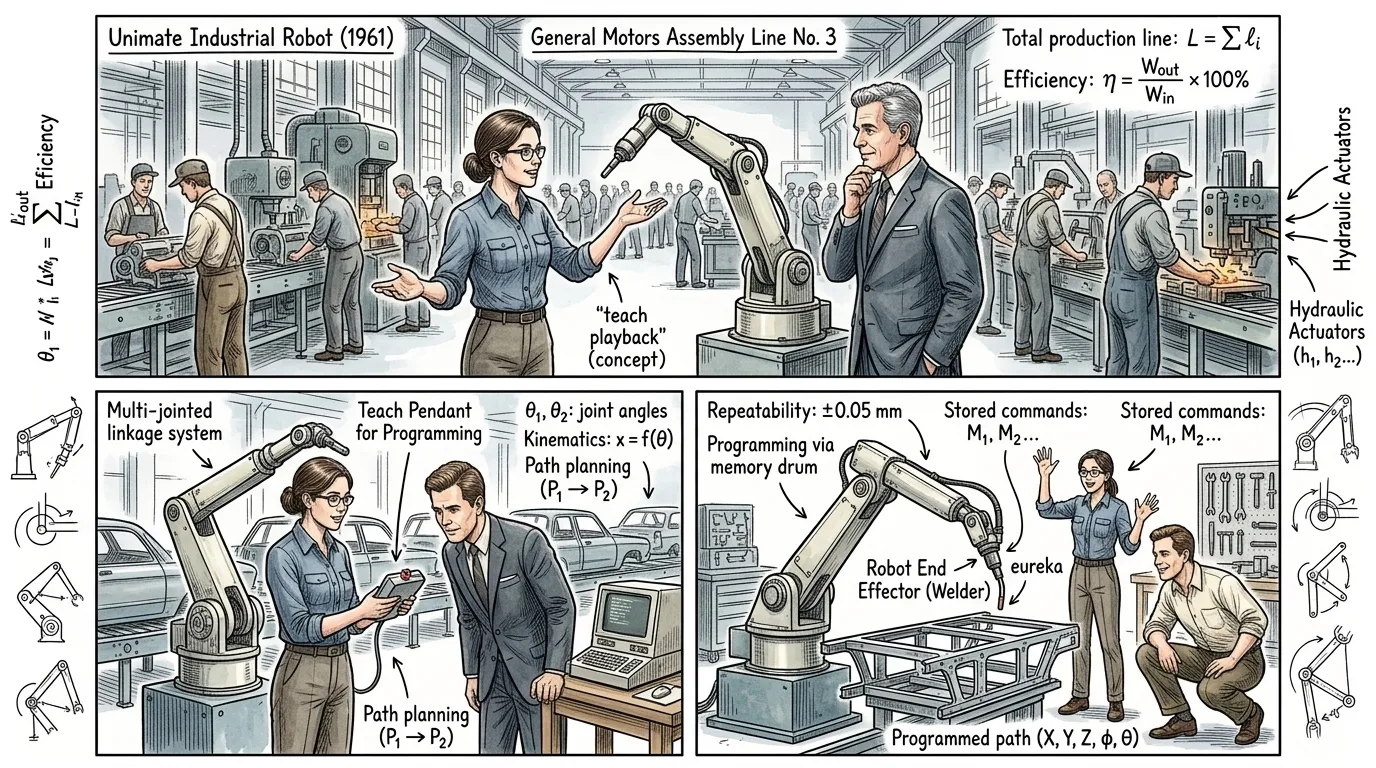
The genius of the Unimate lay in its 'teach playback' system. Instead of complex programming languages, a human operator would physically grasp the robot's arm and guide it through the exact motions required for a task. As the operator moved the arm, the robot's control system—a magnetic drum memory—recorded the precise coordinates and joint angles at each point. Once 'taught,' the robot could then play back these stored instructions, repeating the complex sequence of movements with incredible accuracy and speed, revolutionizing how machines could learn and execute tasks.
"An Unimation engineer, a woman with practical work clothes and glasses, gestures to the Unimate's arm as she demonstrates its programming to a curious factory manager. "The beauty of this system," she explains, "is its intuitive simplicity in teaching. As Confucius taught, 'Give a man a fish and you feed him for a day; teach a man to fish and you feed him for a lifetime.' We're teaching a machine to 'fish' for precise, repeatable movements, empowering it to solve complex tasks.""
Page 7
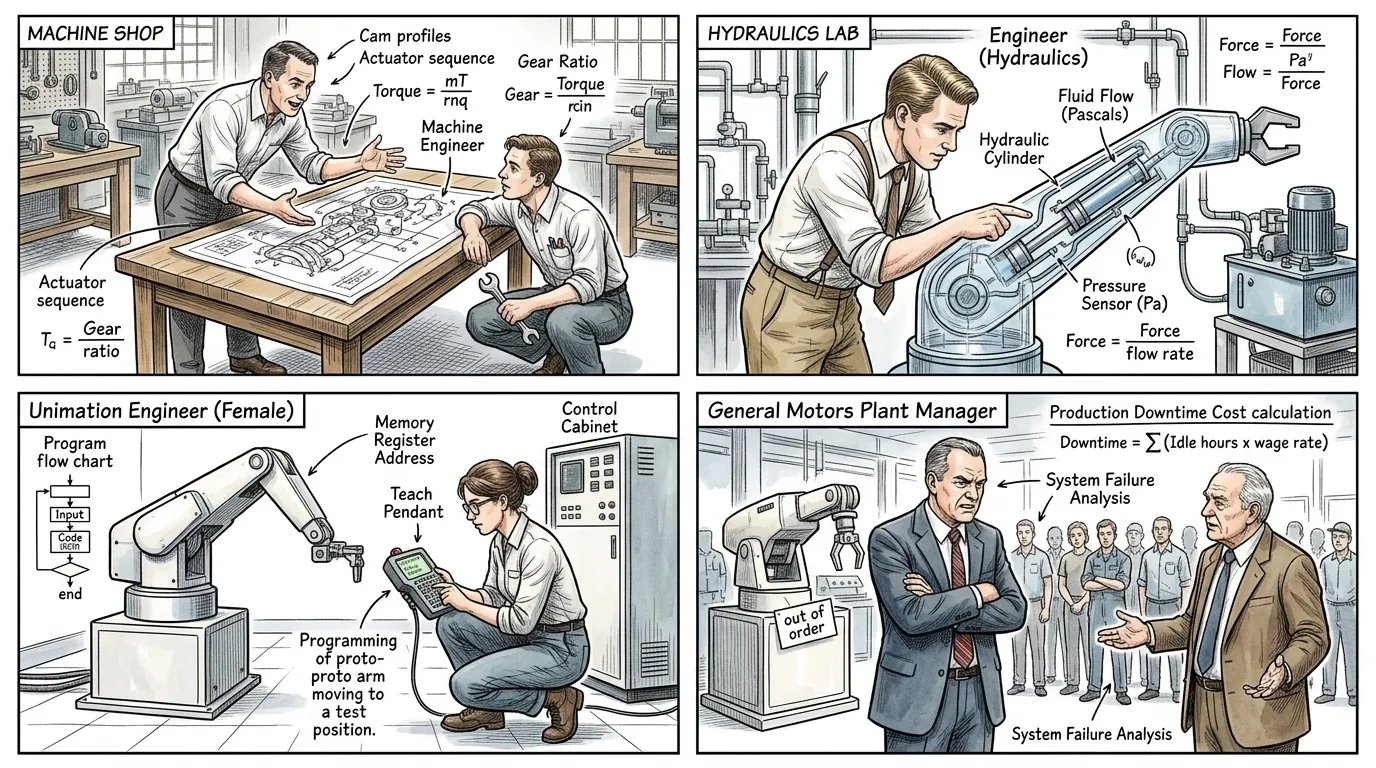
At the heart of the Unimate's robust operation was its hydraulic actuation system. Hydraulic fluid, pressurized by an internal pump, was directed through precise valves into cylinders located at each joint of the robot arm. This high-pressure fluid pushed against pistons within the cylinders, generating immense force to move the heavy arm segments. The controlled flow of fluid allowed for smooth, powerful, and highly accurate movements, enabling the Unimate to handle heavy payloads and withstand the harsh conditions of industrial environments, a critical advantage over less powerful electrical or pneumatic systems of the era.
"An engineer, pointing to a transparent cutaway diagram of the Unimate's arm, explains the mechanism. "This sophisticated hydraulic system, much like the intricate precision of an ancient Greek mechanism, allows for immense force with fine, controlled movement," he states, his finger tracing a fluid line. "It's the muscle and the fine motor skill combined, making the robot both powerful and delicate when needed, far surpassing any purely mechanical system.""
Page 8
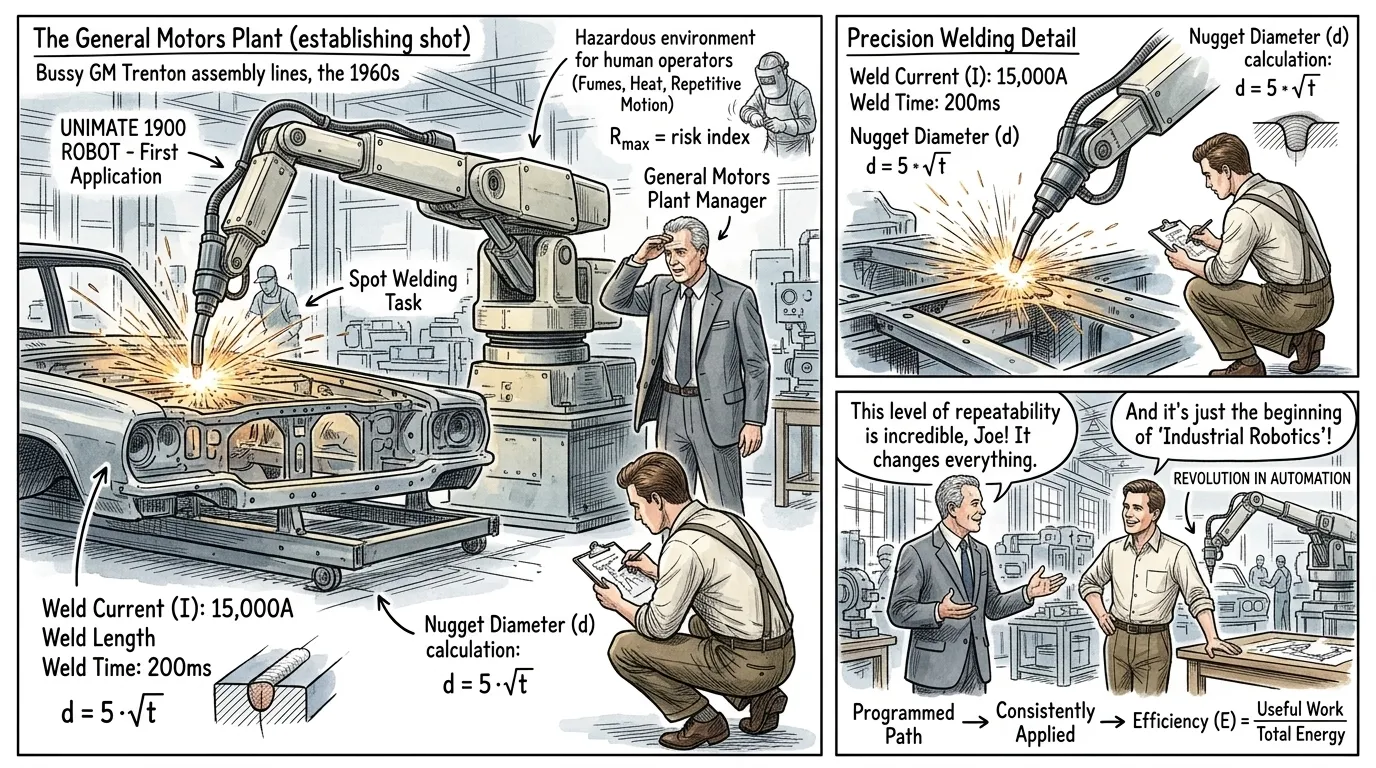
In 1961, a pivotal moment arrived as General Motors adopted the Unimate for its Trenton, New Jersey plant. The robots were deployed for hazardous die-casting tasks, where they extracted hot metal parts from machines and performed spot welding on car bodies—jobs previously prone to severe injuries. The Unimate's consistent, repeatable motion proved invaluable, not only reducing workplace accidents but also improving the quality and speed of production. This marked the industrial robot's undeniable arrival, transforming factory floors and demonstrating the profound potential of automation.
"A General Motors plant manager, visibly impressed, watches as a Unimate robot precisely wields a heavy welding gun on a car chassis. "This is truly transformative," he remarks, reflecting on the arduous work it replaces. "It embodies what Thomas Edison understood: 'There's a way to do it better — find it.' The Unimate has certainly found a better, safer, and more efficient way for us on the assembly line.""
Page 9
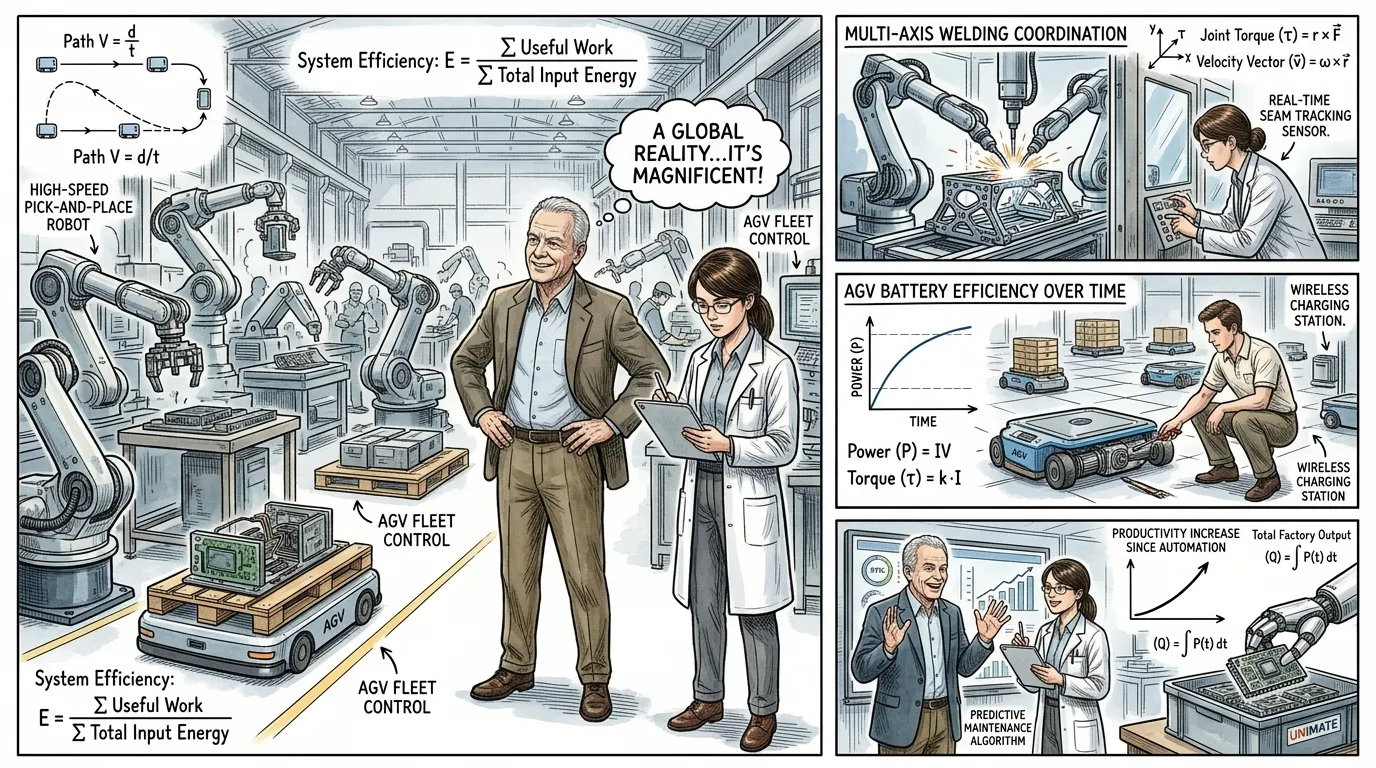
The success at General Motors catalyzed the rapid adoption and evolution of industrial robots. Other manufacturers quickly recognized the benefits, and the technology began to spread globally, particularly in Japan and Germany, where innovation in automation flourished. New robot designs emerged, specializing in tasks like spray painting, material handling, and complex assembly. The shift from hydraulic to electric servo motors in later designs offered greater speed and flexibility, propelling the industrial robot into diverse sectors and fundamentally reshaping global manufacturing landscapes.
"Joseph Engelberger, now a distinguished, older man, surveys a bustling, modernized factory floor filled with a variety of robots. "From a small idea to a global revolution," he muses, a proud smile on his face. "As Isaac Newton famously said, 'If I have seen further than others, it is by standing upon the shoulders of giants.' We built upon the giants of automation and engineering, and in turn, new giants emerged.""
Page 10
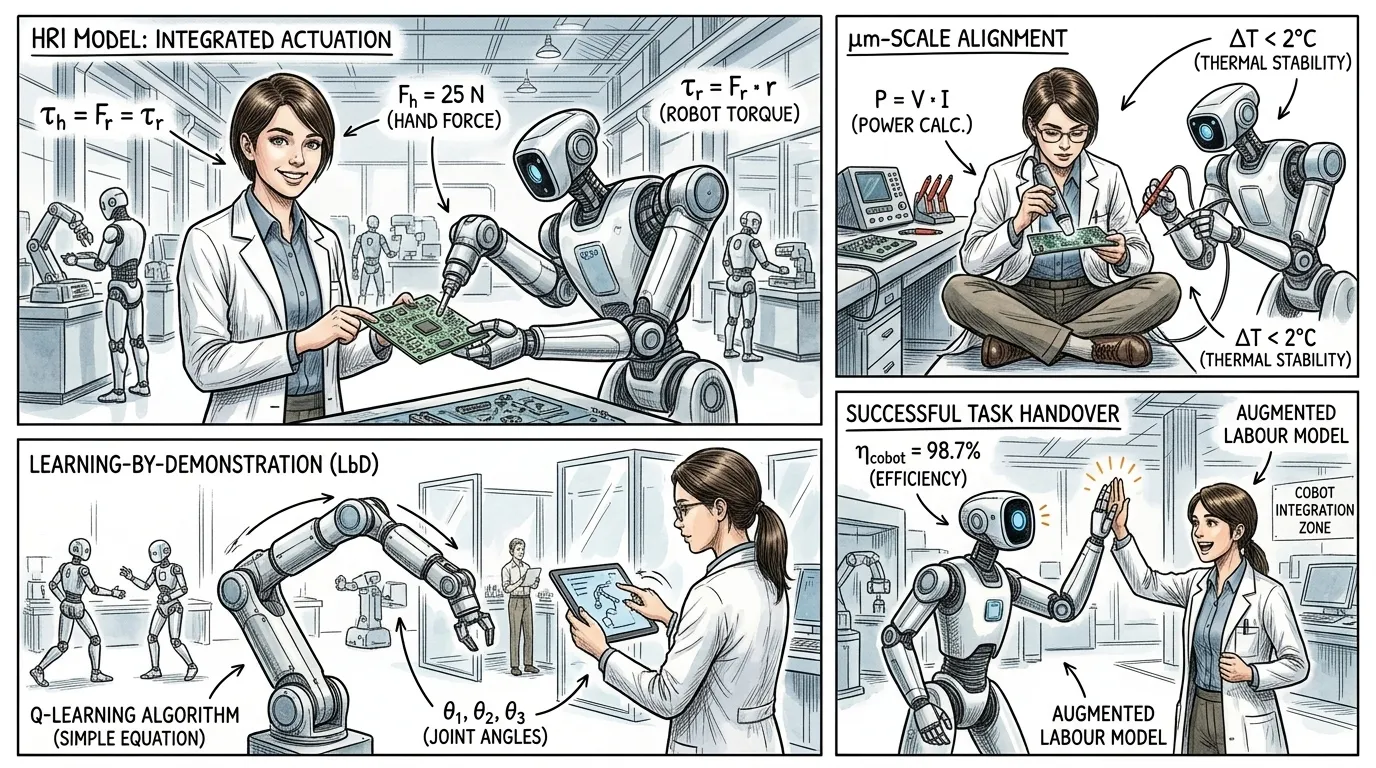
The industrial robot's legacy is profound: it dramatically increased manufacturing efficiency, elevated product quality, and crucially, created safer working environments. Its evolution continues, from early, rigid systems to sophisticated, AI-driven collaborative robots (cobots) that work seamlessly alongside humans. This invention not only redefined labor but also propelled humanity into an age of advanced automation, promising future applications in fields from medicine and space exploration to personalized manufacturing, constantly challenging our perceptions of work and human-machine interaction.
"A modern engineer, a young woman with a sleek, original design uniform and an intelligent expression, stands next to a collaborative robot gently assisting her. "The future of automation is not merely replacement," she states, looking directly at the viewer, "but augmentation, as Helen Keller understood when she said, 'Alone we can do so little; together we can do so much.' Humans and robots, working side-by-side, unlock unprecedented potential.""
About this story
- Location: Global
- Audience: general readers
Questions and answers
Read Wonder Inventions on your phone
Wonder Inventions is available on Android. Get Wonder Inventions on Google Play.