Jet Engine
Jet Engine — an illustrated inventions story, set in Global. 10 illustrated pages, free to read on Wonder Inventions.
Page 1
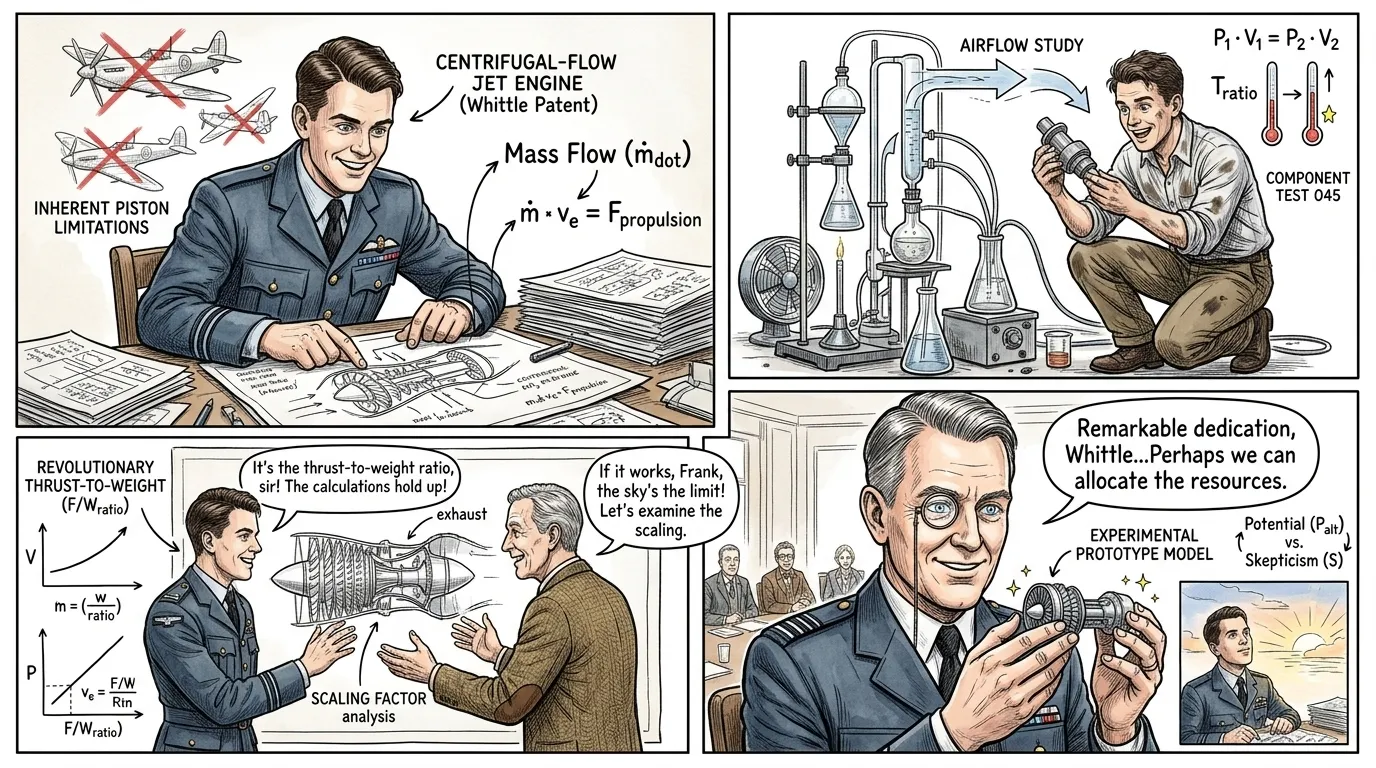
Before the roar of the jet engine dominated our skies, propeller aircraft pushed against the very limits of their design. Their complex piston engines and rotating blades struggled with the increasing demands for speed and altitude, confronting a formidable barrier of drag and inefficiency.
"Frank Whittle, a brilliant young RAF officer, gazed intently at his calculations in the quiet of his workshop. He murmured, 'The conventional propeller is a brick wall. We need a new way to fly, a force of pure reaction.'"
Page 2
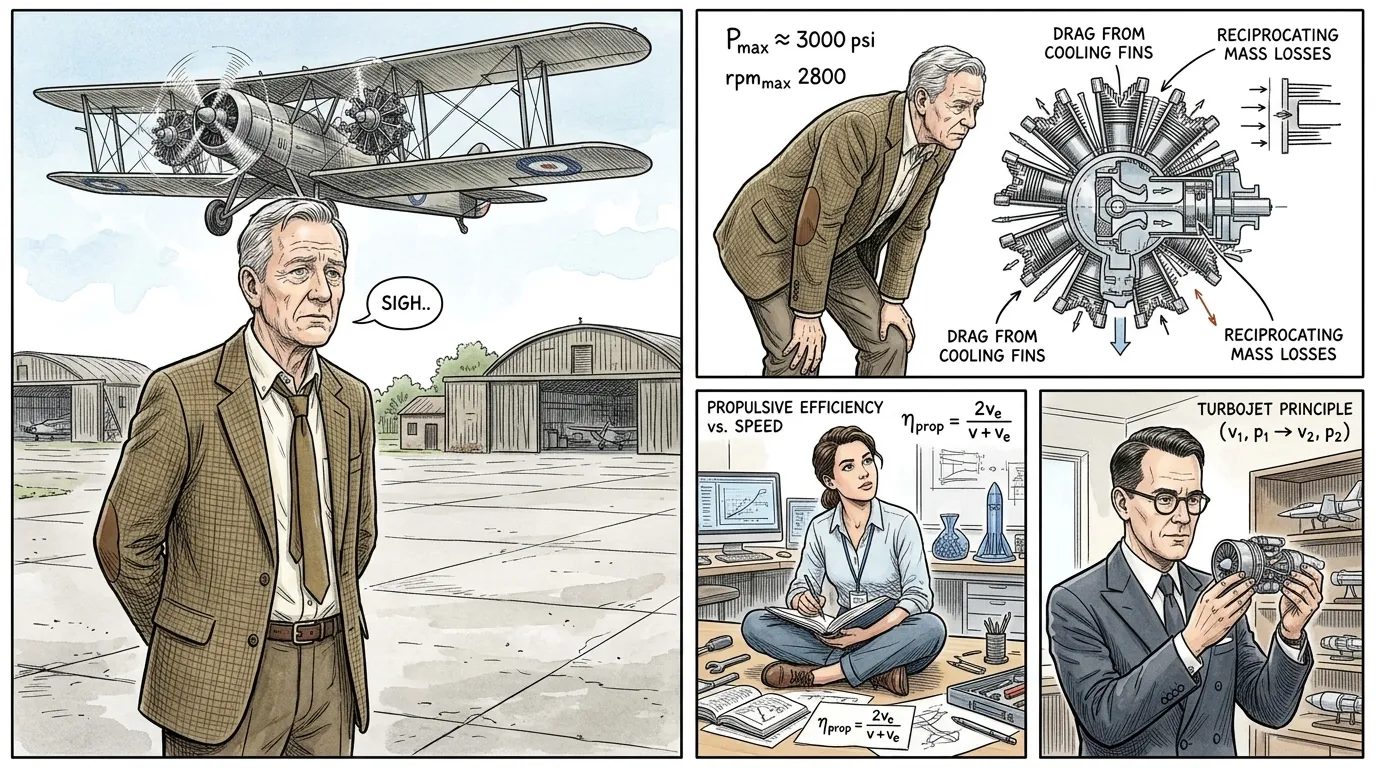
The early 20th century saw aviation transform, yet the fundamental propulsion method remained rooted in the piston engine. These intricate machines, bursting with hundreds of moving parts, converted fuel into rotational energy, spinning propellers to pull or push aircraft through the air.
"A veteran aircraft designer, observing a struggling biplane, remarked with a sigh, 'Every extra mile an hour feels like wrestling the very air itself. The faster we go, the less efficient these blades become, churning against an invisible wall.'"
Page 3
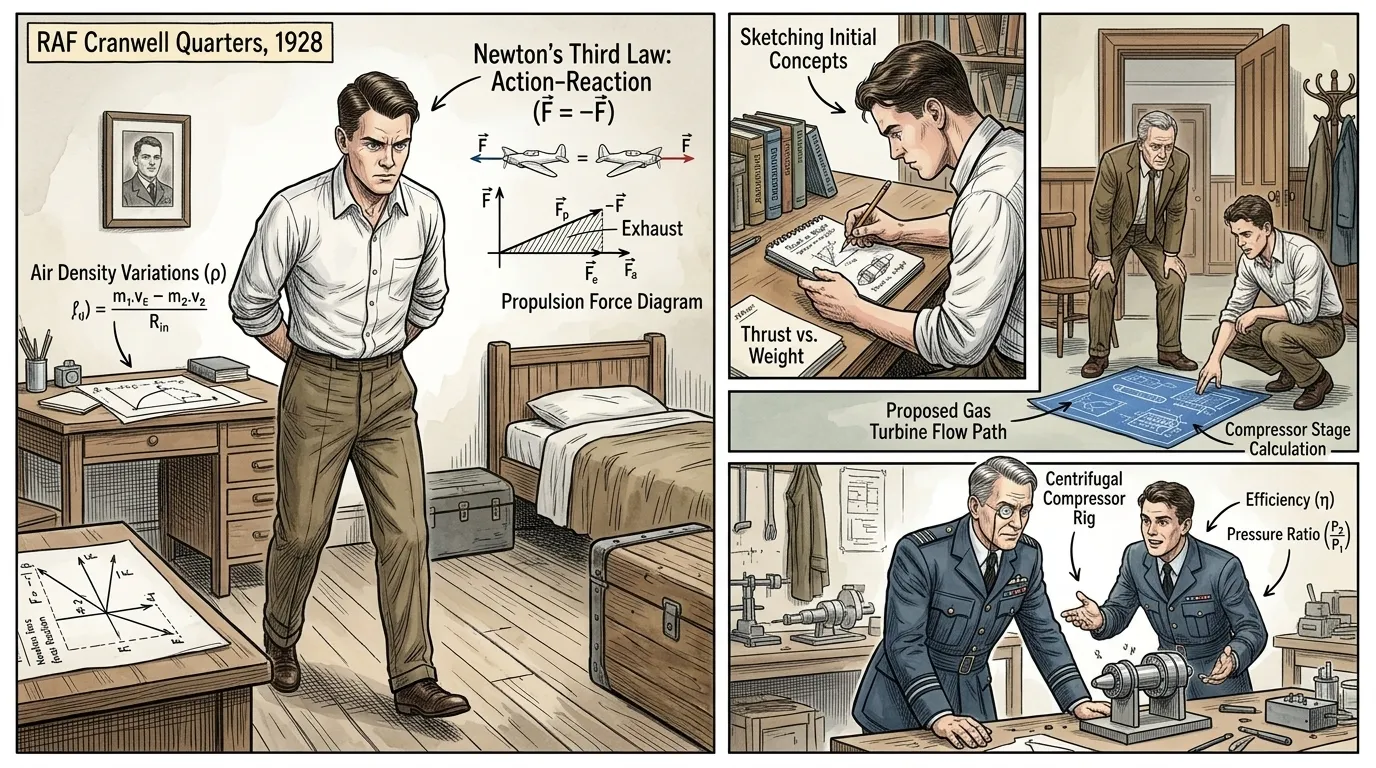
Stationed at RAF Cranwell, Frank Whittle wrestled with the limitations of existing technology, observing how the increasing speeds demanded by modern warfare pushed propeller aircraft beyond their natural operating envelopes. He envisioned a radical departure from conventional propulsion, a system that would generate thrust not by pulling, but by pushing.
"Whittle, pacing his small quarters, reflected, 'As Sir Isaac Newton taught us, 'For every action, there is an equal and opposite reaction.' If we expel mass at high velocity, the reaction force must propel us forward. That is the fundamental truth we must harness.' This theoretical knowledge of reaction forces became the cornerstone of his revolutionary concept."
Page 4
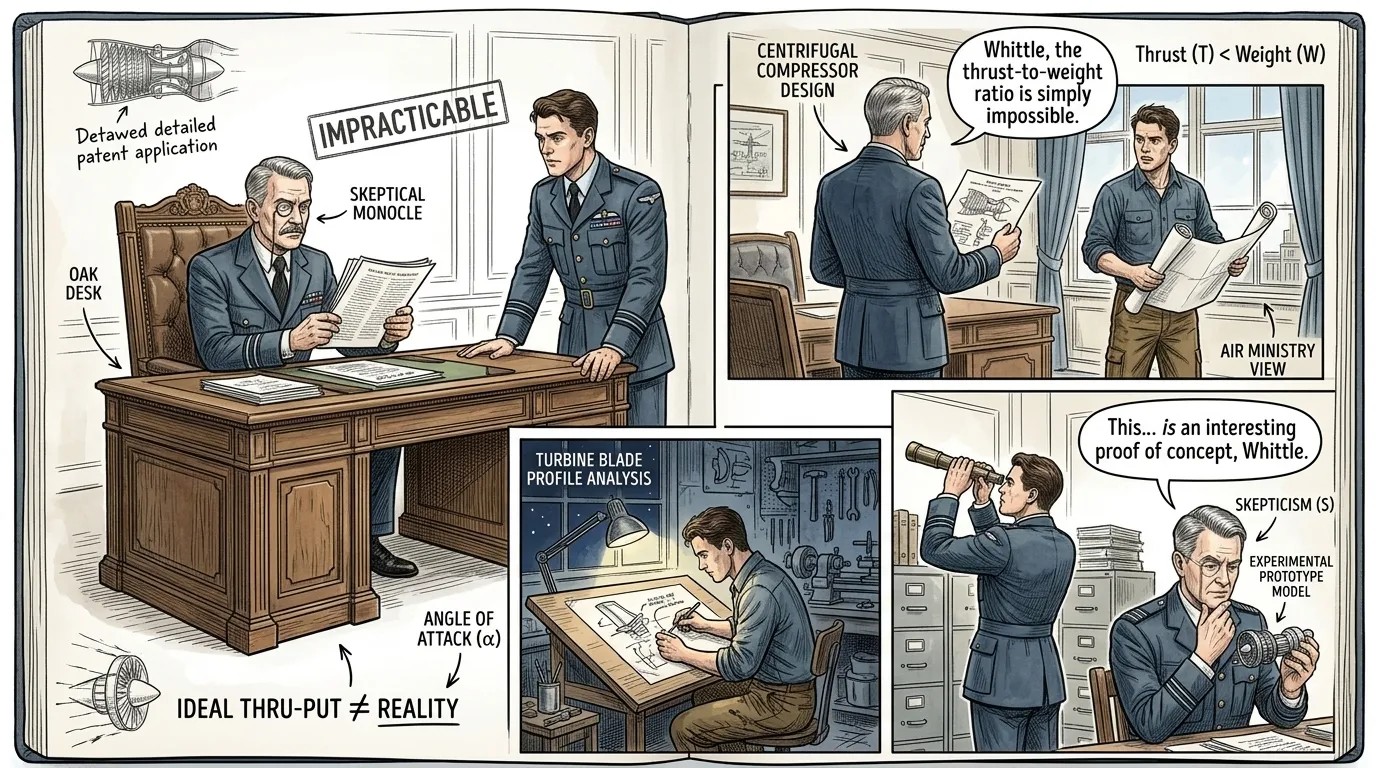
Despite Whittle's profound insights, his ideas met with immediate skepticism. The Air Ministry, deeply invested in established piston engine technology, dismissed his 1930 patent application as 'impracticable.' Funding and material support were scarce, forcing Whittle to pursue his vision with limited resources and against formidable odds.
"An older, stern-faced official, reviewing Whittle's proposal, scoffed, 'A continuous stream of fire to push an aircraft? Pure fantasy, Wing Commander. We build engines that work, not science fiction contraptions.'"
Page 5
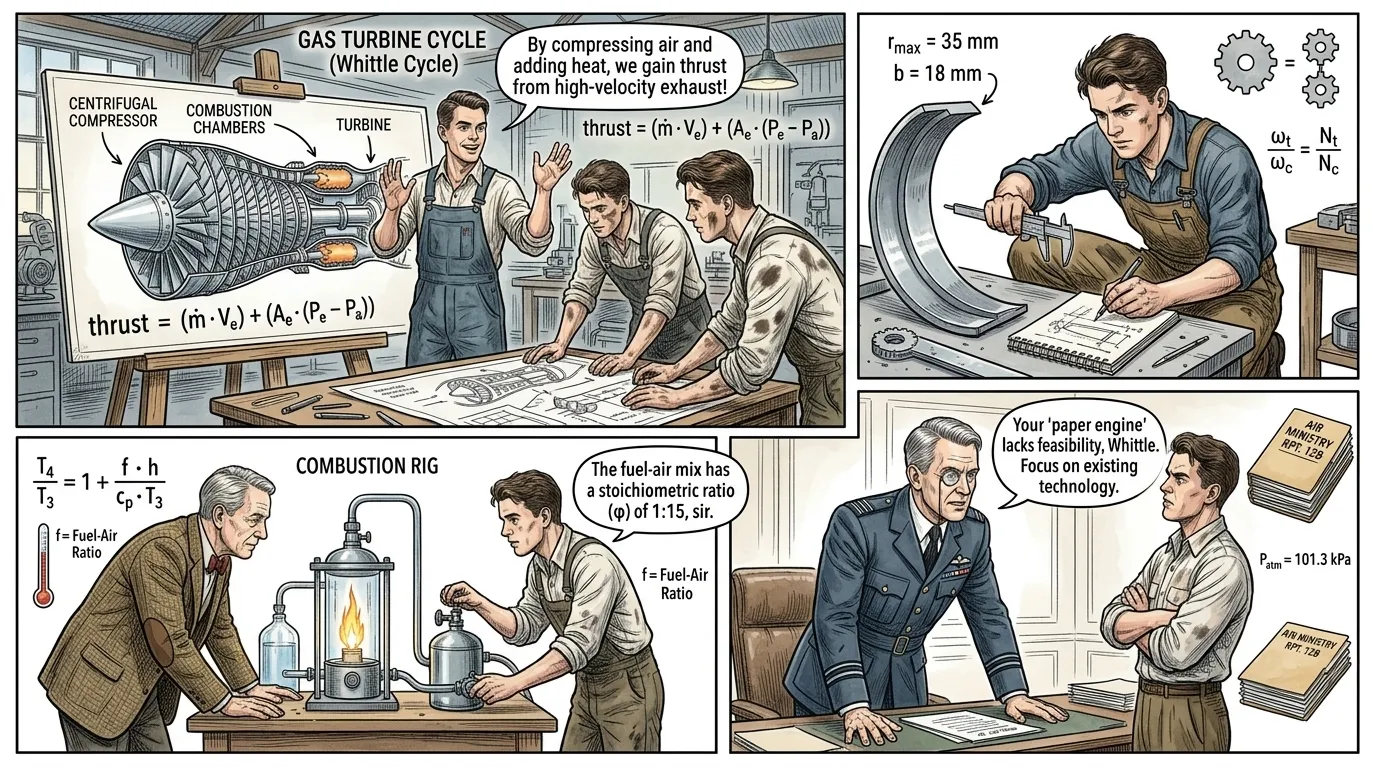
Undeterred, Whittle refined his theoretical framework, focusing on the gas turbine cycle. The core concept involved drawing in vast quantities of air, compressing it, mixing it with fuel and igniting the mixture, then expelling the superheated gas at high velocity to generate forward thrust.
"Whittle, explaining his design to a small team of engineers he finally gathered, declared, 'Think of it as a continuous explosion, carefully controlled. We transform atmospheric air into a high-energy exhaust jet. It's thermodynamics in its purest form, delivering propulsion without the mechanical complexity of a propeller.'"
Page 6
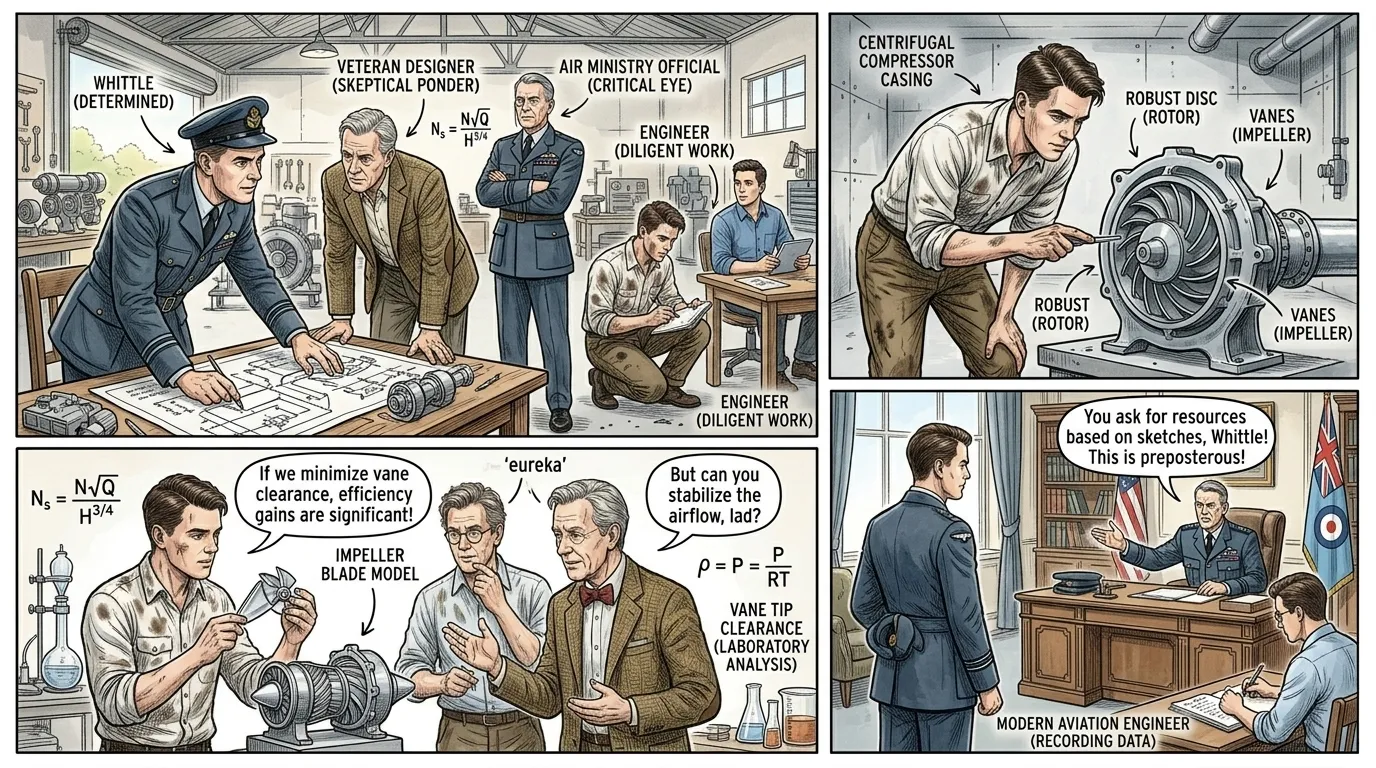
The first critical stage of Whittle's turbojet was the compressor, responsible for capturing and pressurizing incoming air. Early designs, particularly Whittle's W.1 engine, utilized a robust centrifugal compressor, a disc with vanes that spun at immense speeds, flinging air outwards and forcing it into a smaller volume.
"An engineer points to the rotating blades in a cutaway diagram and states, 'This is where the magic begins. The blades spin thousands of times per minute, compressing the air from atmospheric pressure to several times its original density. It's raw mechanical energy channeled into preparing the fuel for combustion.'"
Page 7
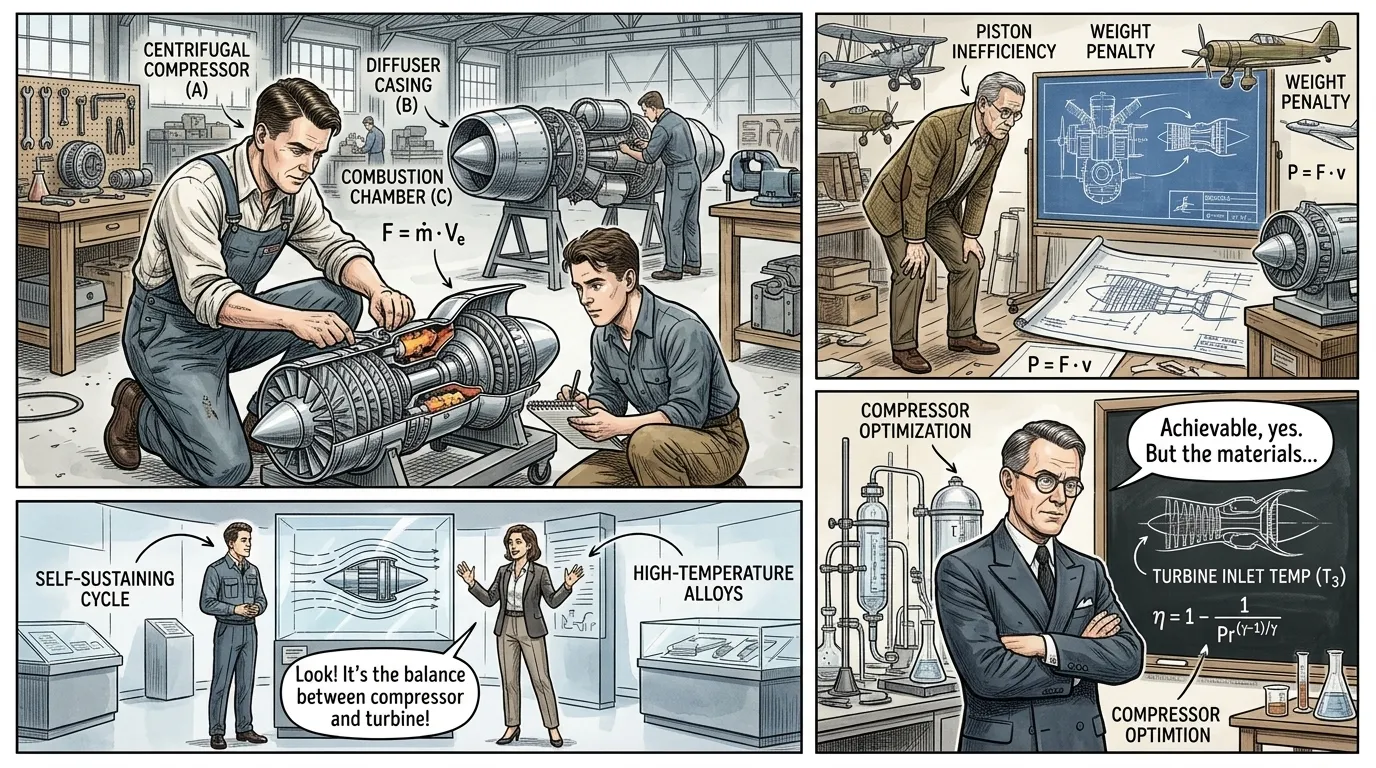
Once compressed, the air entered the combustion chambers, where fuel was injected and ignited, creating a continuous flame. The resulting superheated, high-pressure gas then surged through the turbine section, spinning its delicate blades. This rotation drove the compressor via a central shaft, sustaining the cycle and generating immense exhaust thrust.
"Whittle clarified, 'The turbine is where we extract just enough energy to keep the compressor running, ensuring the cycle is self-sustaining. The remaining energy, in the form of hot, fast-moving gas, is what propels us forward.'"
Page 8
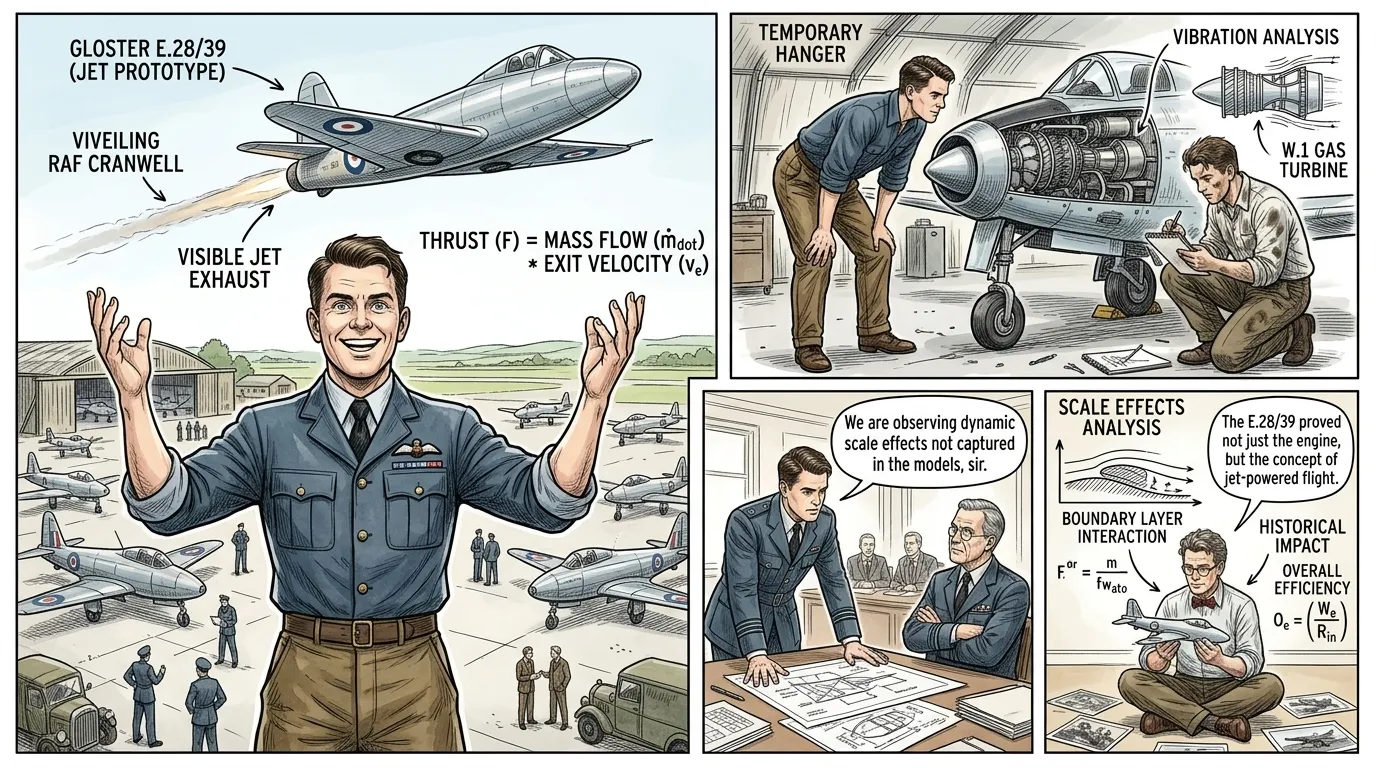
On May 15, 1941, at RAF Cranwell, Frank Whittle's vision culminated in a breathtaking reality. The Gloster E.28/39, powered by Whittle's W.1 jet engine, gracefully lifted into the sky. It was a moment of profound vindication, a clear demonstration of the raw, sustained power of reaction propulsion, fulfilling the theoretical principles Whittle had championed for over a decade.
"As the jet screamed past overhead, a jubilant Whittle exclaimed, 'There it is! The sheer force of the expelled gases, a continuous, powerful push, just as Newton's Third Law predicted. We have truly broken free of the propeller's grasp!'"
Page 9
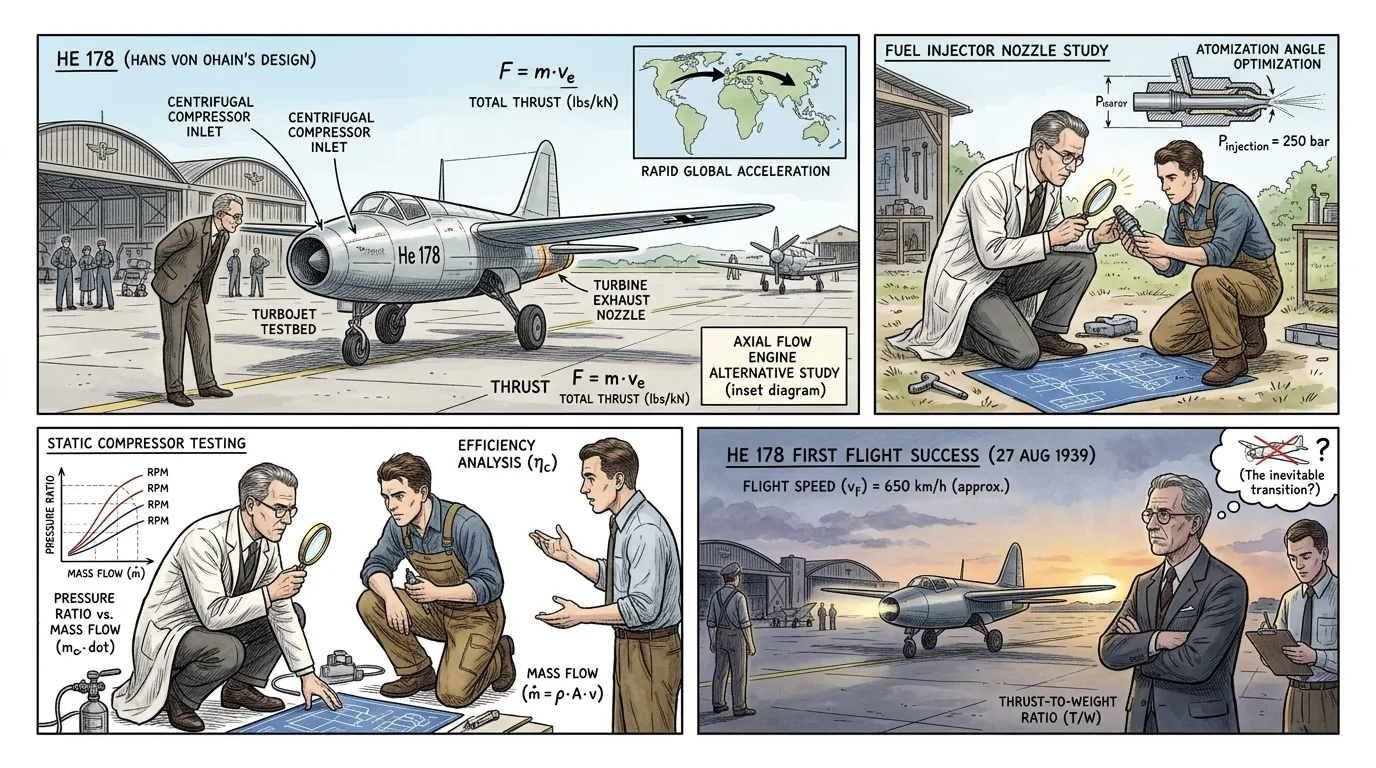
Remarkably, a parallel development occurred in Germany. Dr. Hans von Ohain, working independently for Heinkel, achieved the world's first jet-powered flight in August 1939 with the Heinkel He 178, two years before Whittle's public demonstration. The exigencies of World War II rapidly accelerated jet engine development in both nations, transforming aerial warfare.
"A historian's voiceover states, 'The urgency of conflict forged an arms race in the skies. While Whittle's practical production laid the groundwork for Allied air power, von Ohain's earlier flight underscored the universal drive towards this revolutionary technology.'"
Page 10
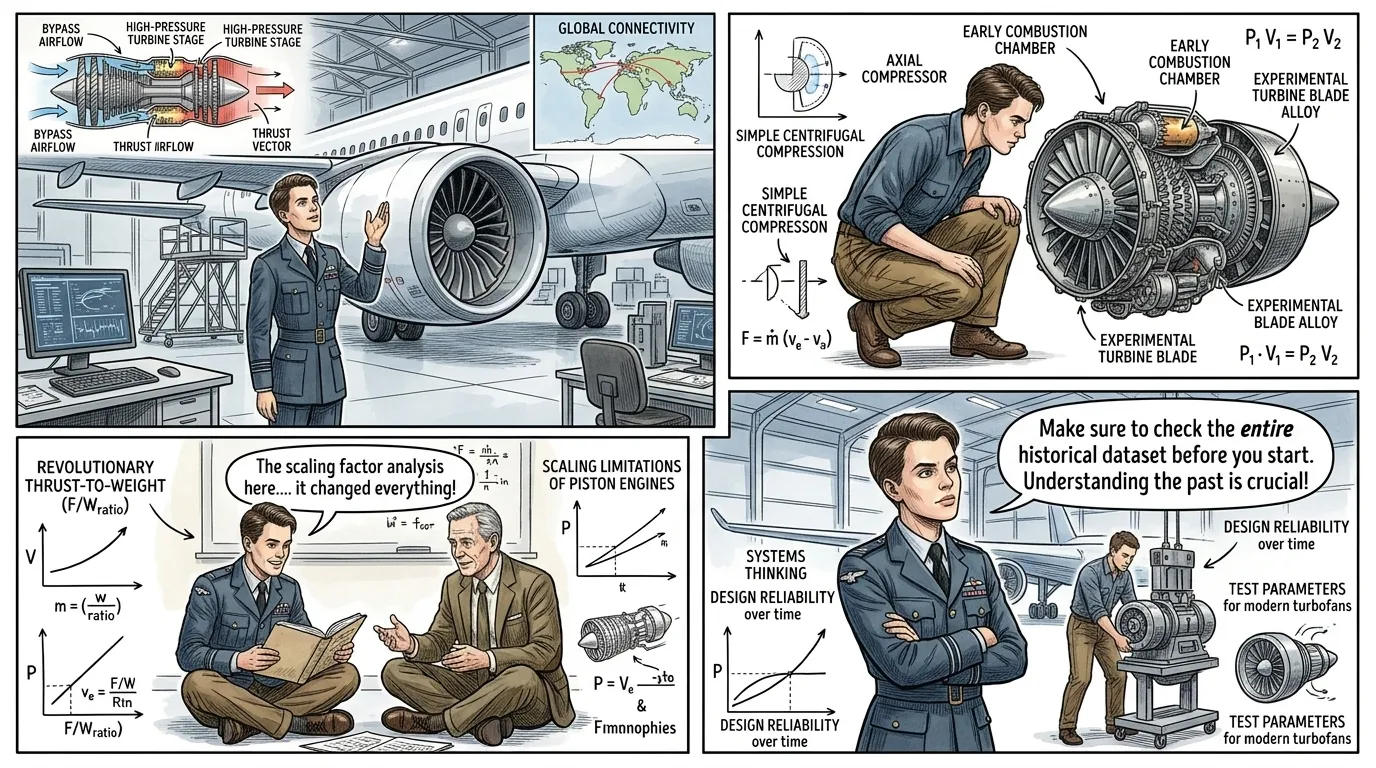
The jet engine irrevocably reshaped human mobility. From military dominance to global commerce, it ushered in an era of unprecedented speed and connectivity. Commercial airliners now traverse continents in hours, cargo jets bridge vast distances, and industrial derivatives power cities, all stemming from the foundational principles pioneered by visionaries like Frank Whittle.
"A modern aviation engineer reflects, 'The jet engine didn't just make us fly faster; it shrank our world. It's a testament to sustained human ingenuity, allowing us to conquer not only the skies but also the vast distances between us.'"
About this story
- Location: Global
- Audience: general readers
Questions and answers
Read Wonder Inventions on your phone
Wonder Inventions is available on Android. Get Wonder Inventions on Google Play.