Laptop Computer
Laptop Computer — an illustrated inventions story, set in Global. 10 illustrated pages, free to read on Wonder Inventions.
Page 1
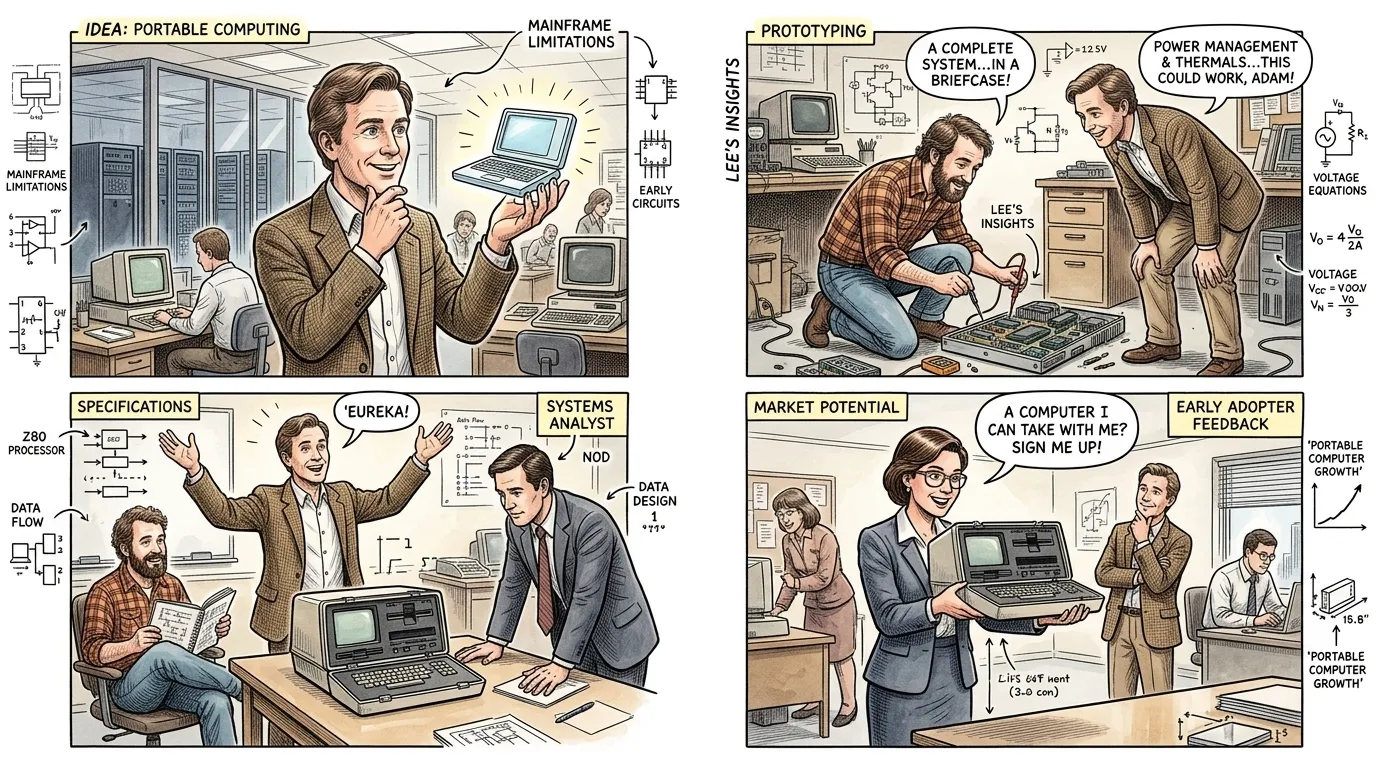
Before the advent of personal portability, computing power was largely confined to static locations. Mainframes hummed in climate-controlled rooms, and early personal computers anchored offices to their desks with bulky monitors and separate towers. This immobility presented a significant barrier to the fluid exchange of information and real-time productivity beyond fixed workspaces. The urgent problem was clear: how could the burgeoning power of personal computing be untethered, allowing professionals to work, collaborate, and innovate without geographic constraints?
"'The ambition was not merely to shrink a computer, but to transform how and where work could be done,' reflected Adam Osborne, a visionary publisher turned inventor, in an interview years later. 'We aimed to make computing a companion, not a fixture.' This ethos crystallized in the creation that would begin to redefine personal technology."
Page 2
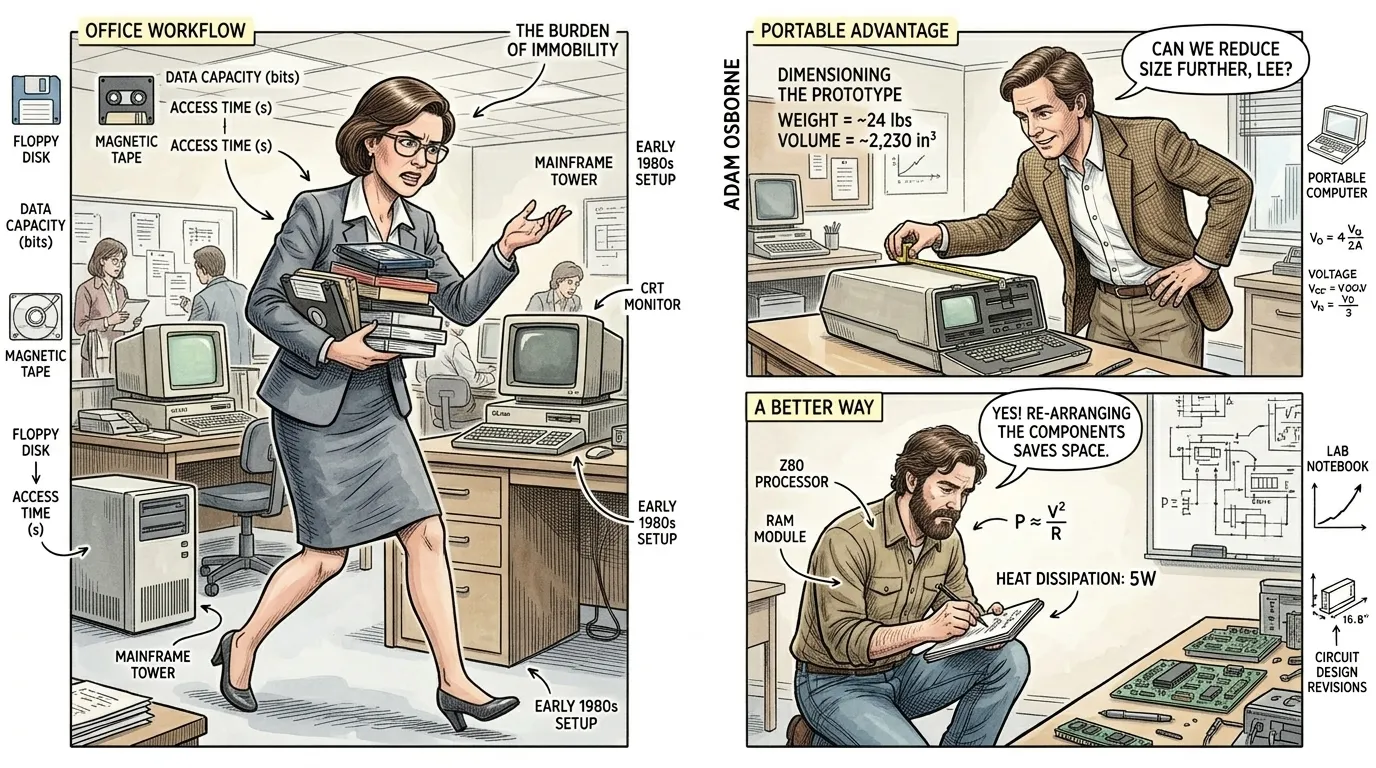
In the early 1980s, the typical computing experience involved a dedicated workspace, often necessitating significant physical infrastructure. Transferring data meant carrying physical media—floppy disks or even magnetic tapes—across locations, a process fraught with inefficiency and the risk of data corruption. This fixed environment limited spontaneous collaboration and restricted critical work to specific, often centralized, departmental hubs. The sheer size and weight of components like Cathode Ray Tube (CRT) monitors and robust power supplies made true portability seem an engineering fantasy.
"'Imagine trying to coordinate a project across multiple offices when your entire workflow is tied to a machine the size of a small refrigerator,' a retired systems analyst once remarked, recalling the limitations. 'It wasn't just inconvenient; it actively impeded the pace of business.' This sentiment highlighted the profound desire for a more adaptable computing solution."
Page 3
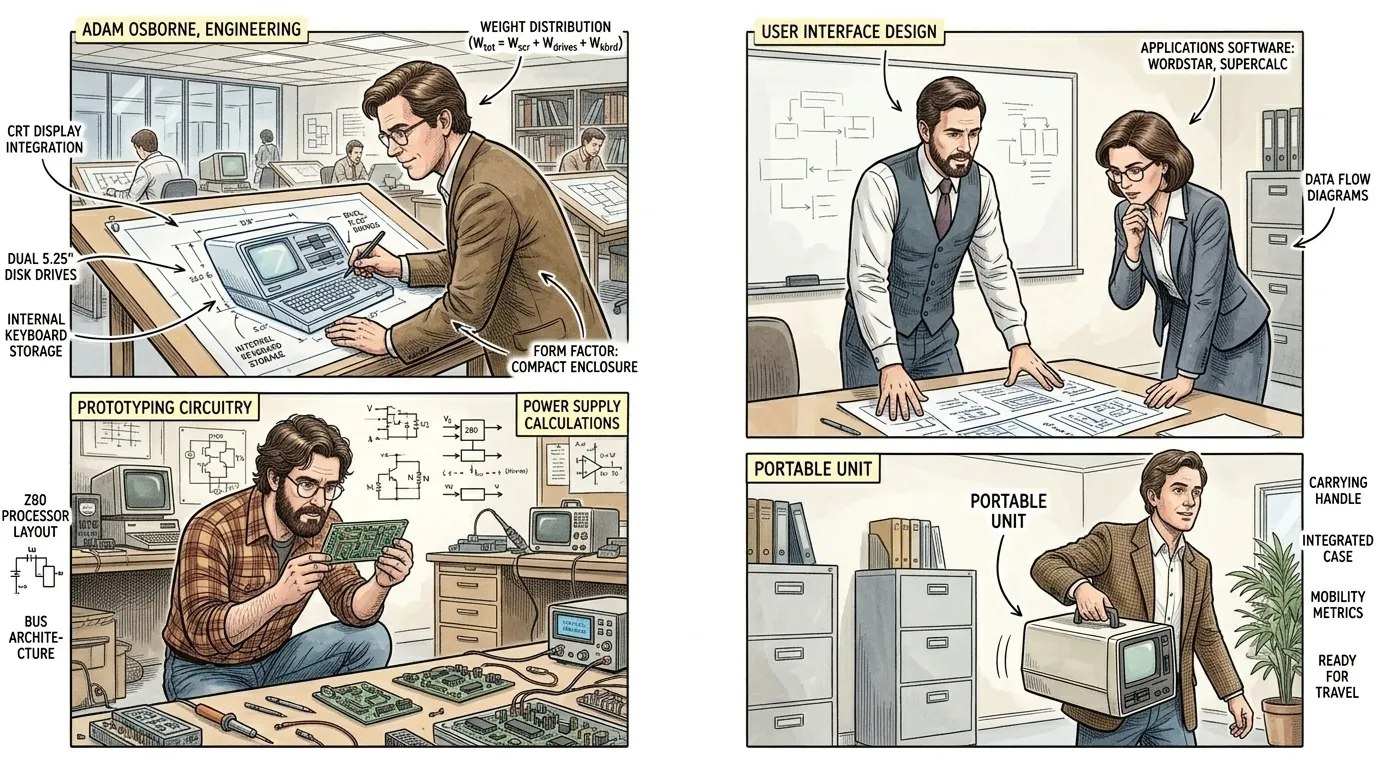
Adam Osborne, a British-American entrepreneur with a background in technical publishing, recognized the nascent demand for a truly personal, transportable computer. His vision went beyond merely shrinking existing designs; it was about integrating all essential components – screen, keyboard, disk drives, and processing unit – into a single, cohesive, and robust enclosure. This radical concept challenged the prevailing modular approach of desktop PCs, where components were typically purchased and connected separately. The fundamental challenge was clear: how to package this functionality affordably and robustly into a single unit without sacrificing critical performance.
"As Osborne himself put it, 'The computer must be an appliance, something you can pick up and carry, not something that requires an entire room.' This insight became the driving force, a core piece of 'knowledge' that guided his team. He understood that true utility meant combining all necessary parts without the need for additional peripherals, establishing the foundational principle for the modern laptop."
Page 4
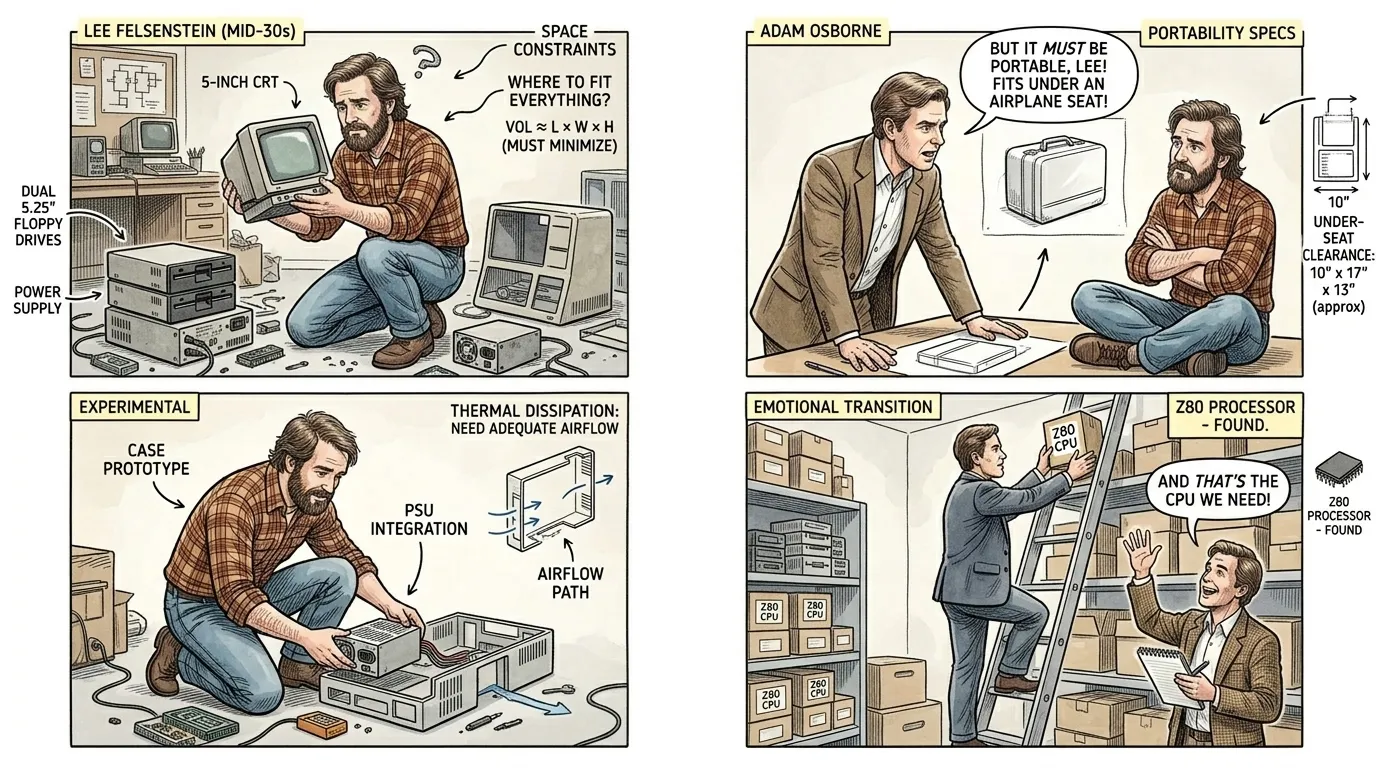
The journey to a commercially viable portable computer was fraught with significant technical hurdles, primarily driven by the limitations of 1980s technology. Engineers grappled with the inherent bulk of CRT displays, the fragility and power demands of early storage devices like floppy drives, and the necessity of creating a robust, self-contained power supply. Early prototypes were often unwieldy, suffering from excessive weight, poor heat dissipation, and susceptibility to damage during transport. Every design choice involved a compromise between size, cost, and functionality, forcing difficult decisions regarding component selection and overall device architecture.
"Lee Felsenstein, the lead engineer on the Osborne 1 project, recounted the daily challenges: 'Every component was a battle against physics. How do you fit a five-inch CRT, two floppy drives, and a complete computer into a case that a person can actually lift? We constantly debated whether to sacrifice screen size for weight, or battery life for processing power.' This candid reflection underscores the complex trade-offs faced."
Page 5
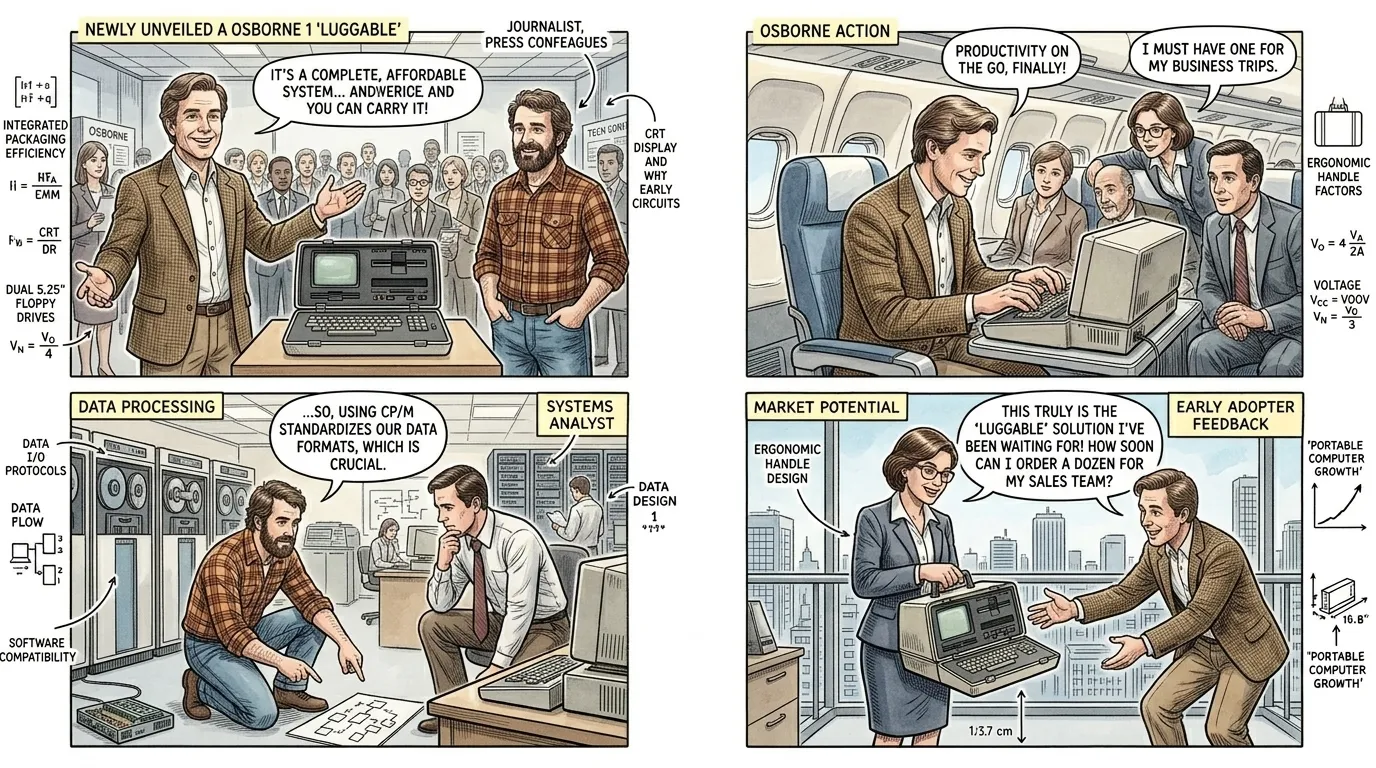
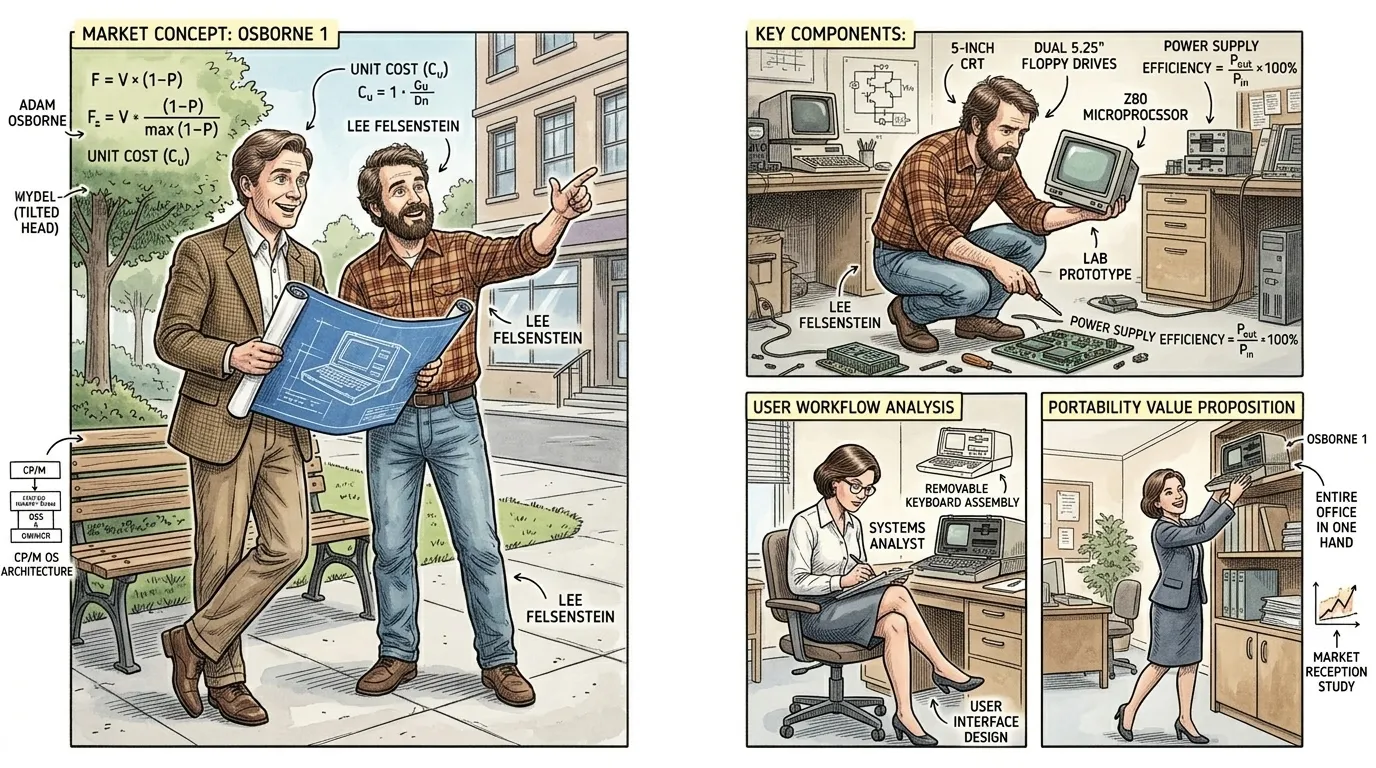
In 1981, Adam Osborne and his team, notably lead designer Lee Felsenstein, unveiled the Osborne 1. It was not a 'laptop' as we know it today, but rather a 'luggable' or 'transportable' computer. Their pragmatic solution involved integrating commercially available, proven components into a single, briefcase-sized unit. This meant utilizing a compact (though small) 5-inch monochrome CRT display, dual 5.25-inch floppy disk drives for storage, and a Zilog Z80 microprocessor with 64 kilobytes of RAM. The design prioritized functionality and affordability over true miniaturization, making a powerful statement about the possibility of mobile computing for the masses.
"'We didn't invent anything fundamentally new inside the Osborne 1,' Osborne candidly stated. 'Our innovation was in the packaging – taking off-the-shelf components and making them work together in a portable, affordable system that could run serious business software right out of the box.' This approach, leveraging existing technology, was key to its market entry and success, providing the crucial 'payoff' to their earlier challenge of integration."
Page 6
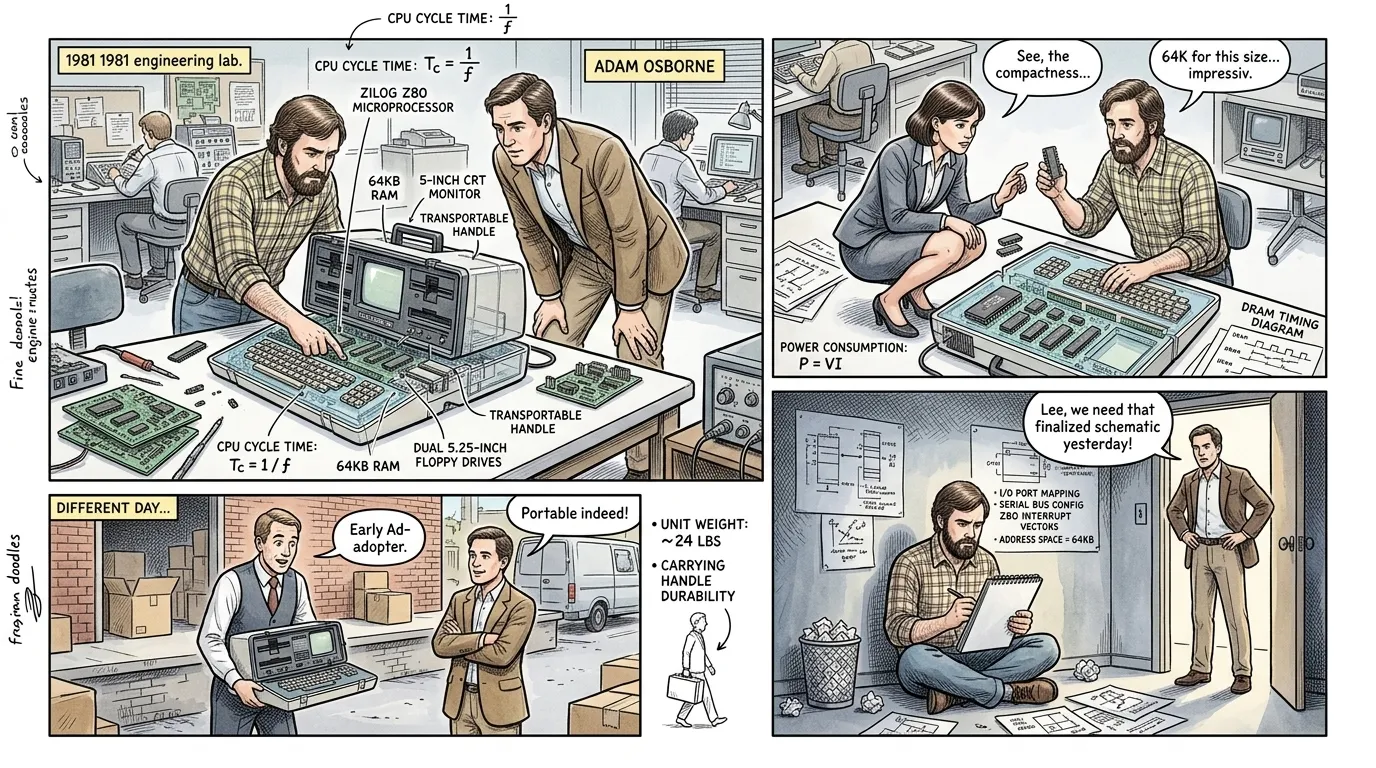
The Osborne 1 achieved its 'transportable' status through careful internal arrangement rather than groundbreaking miniaturization of individual components. At its heart lay the Zilog Z80 microprocessor, a popular 8-bit CPU, paired with 64 kilobytes of RAM. This provided sufficient power for the CP/M operating system and bundled applications like WordStar and SuperCalc. Storage was handled by two 5.25-inch single-sided, single-density floppy disk drives, crucial for loading software and saving data. The most challenging integration was the 5-inch monochrome CRT monitor, placed centrally, with the keyboard designed to fold upwards, covering and protecting the screen during transit.
"An early engineering diagram, uncovered from company archives, bears a handwritten note: 'Every cubic centimeter matters. Position components for thermal efficiency and structural integrity, even if it means a heavier unit.' This directive reveals the meticulous planning behind the visible form. The entire system was encased in a robust plastic shell, designed with a handle, making it a truly self-contained, if hefty, computing solution."
Page 7
To operate the Osborne 1, a user would unfold the keyboard, connect the power cable (as it lacked an internal battery), and insert a floppy disk containing the CP/M operating system. The small, green-on-black CRT display would flicker to life, presenting a command-line interface. Users then loaded application software—often included standard with the machine—from a second floppy drive. This comprehensive software bundle, including WordStar for word processing and SuperCalc for spreadsheets, significantly enhanced the machine's value, making it a complete, immediate productivity tool, a concept revolutionary for its time.
"'It was incredible to carry your entire office in one hand,' an early adopter reminisced. 'You'd boot up, type 'WS' for WordStar, and there it was, ready to go. The ability to just plug in and work, anywhere you could find an outlet, changed everything.' This simplicity of operation, despite its bulk, was a key enabler of its adoption. The bundled software provided out-of-the-box utility, a significant selling point."
Page 8
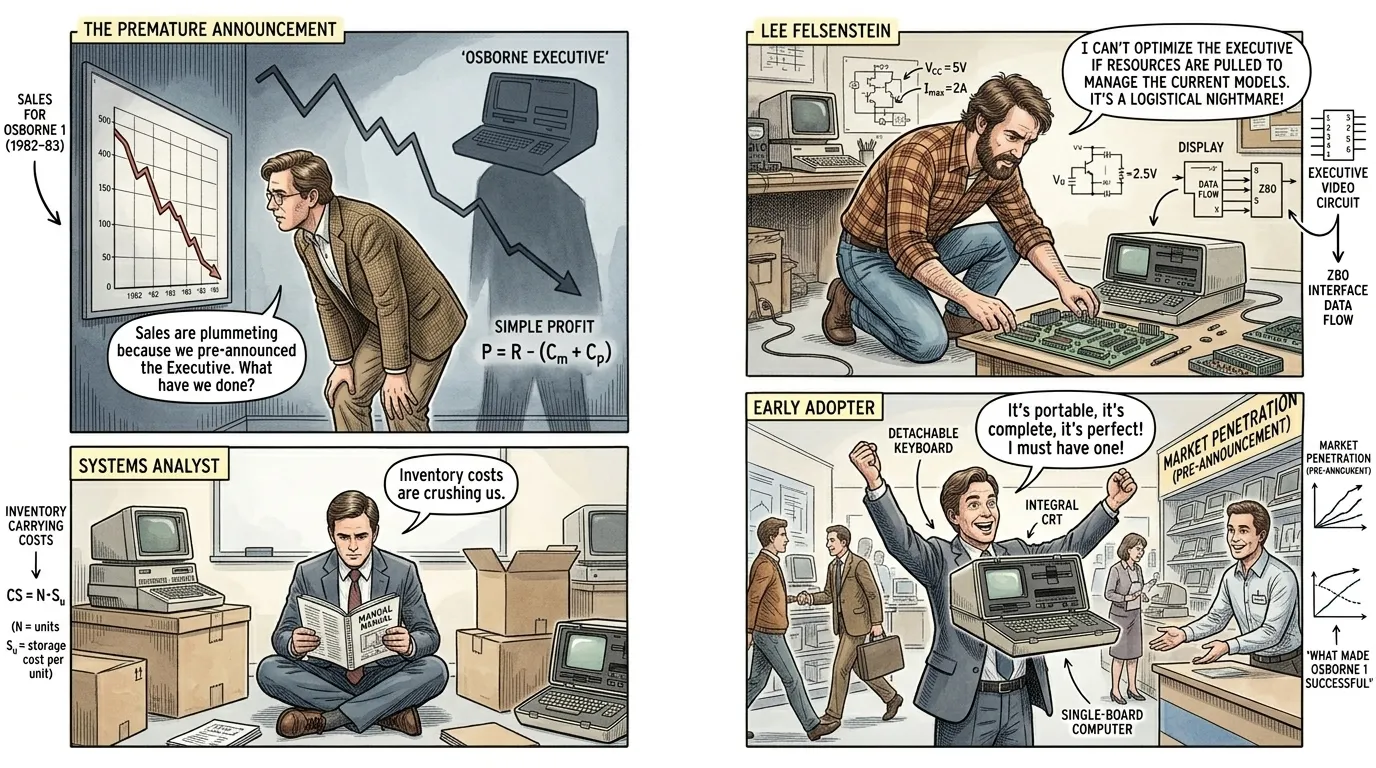
The Osborne 1 achieved considerable initial success, selling approximately 10,000 units per month at its peak. It empowered travelling salespeople, journalists, and engineers to take their work on the road, dramatically increasing productivity and breaking down geographical barriers for computing. However, this success was short-lived. In a now-famous cautionary tale, the company publicly announced a superior successor model, the Osborne Executive, too far in advance of its availability. This 'Osborne Effect' caused a precipitous drop in sales of the existing Osborne 1, as customers chose to wait, ultimately contributing to the company's bankruptcy in 1983.
"As tech historian Robert Cringely observed, 'The 'Osborne Effect' stands as a stark reminder of the delicate balance between innovation and market strategy. It demonstrates how even a revolutionary product can be undone by poor timing and communication.' This pivotal error, despite the Osborne 1's pioneering status, led to its swift commercial demise."
Page 9
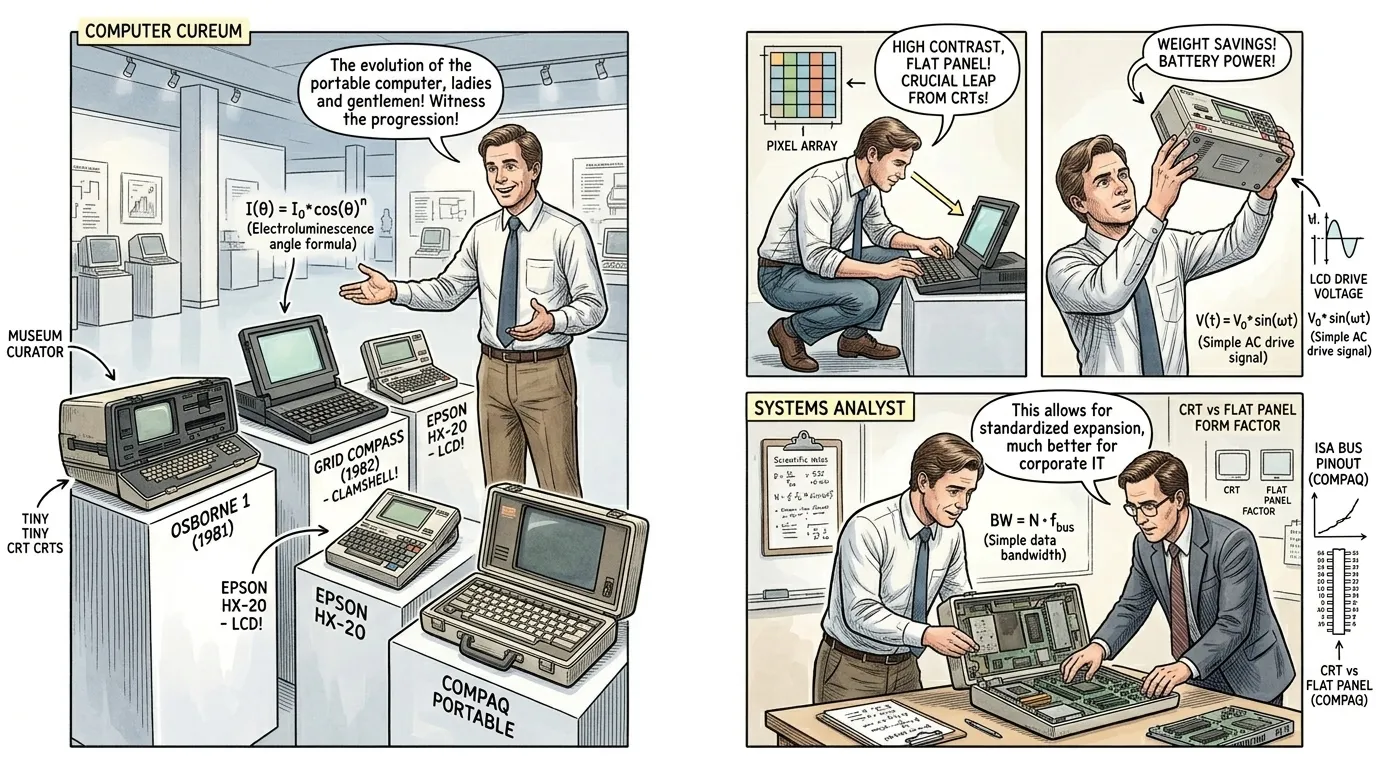
While the Osborne 1 paved the way, the true 'laptop' as we recognize it emerged through continued advancements in display technology and component miniaturization. Early pioneers like the Grid Compass 1101 (1982) introduced the clamshell design and electroluminescent (EL) displays, making them genuinely portable. The Epson HX-20 (1981) demonstrated LCD technology in a notebook format, albeit with limited display capabilities. Subsequent machines, such as the Compaq Portable (1983), although still featuring a CRT, packed more power into a slightly more manageable form, demonstrating rapid iteration in design and engineering. These developments gradually shifted the paradigm from 'transportable' to truly 'portable' computing.
"'The Osborne 1 proved the market existed, but machines like the Grid Compass truly defined the form factor,' commented a computer museum curator. 'Moving from a CRT to a flat-panel display was the critical leap, transforming a heavy suitcase into a slim folio.' This shift in display technology was arguably the single most important factor in the subsequent rapid evolution of the laptop, making them lighter and more practical for mobile use."
Page 10
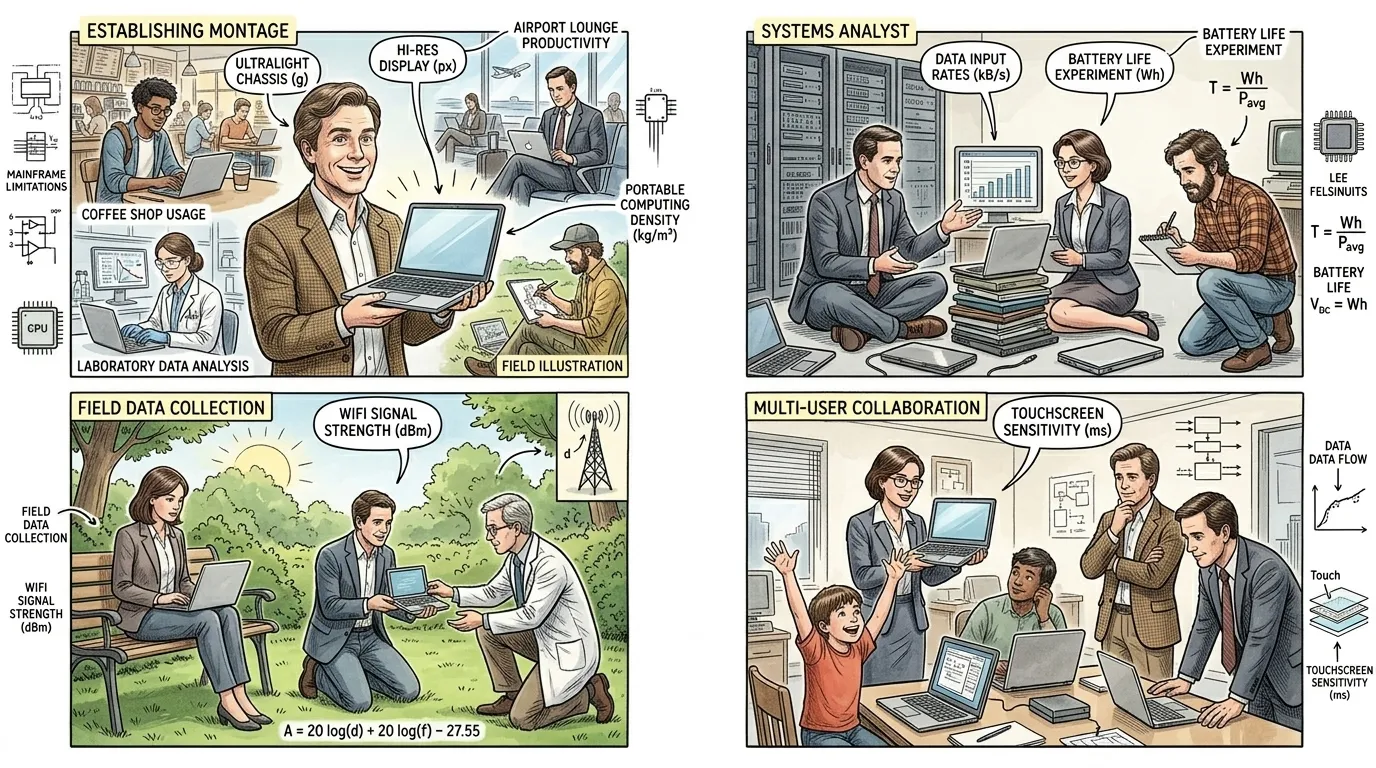
The seeds sown by early transportable computers like the Osborne 1 blossomed into the ubiquitous laptop of today, a device indispensable across virtually every sector. From remote education and global business to scientific research and creative arts, laptops have democratized access to information and computing power. They are the backbone of mobile workforces, critical tools for students worldwide, and essential for personal communication, enabling unprecedented levels of flexibility and connectivity. The dream of taking one's work anywhere has not only been realized but has fundamentally reshaped society, proving that the vision for untethered computing was not just ambitious but transformative.
"As celebrated computer scientist Alan Kay once mused, 'The best way to predict the future is to invent it.' The evolution of the laptop stands as a testament to this principle, continuously invented and reinvented to meet an ever-growing demand for personal, portable computing. It underpins much of our digital age, a powerful reminder of how a single invention can spark a technological revolution."
About this story
- Location: Global
- Audience: general readers
Questions and answers
Read Wonder Inventions on your phone
Wonder Inventions is available on Android. Get Wonder Inventions on Google Play.