Laser
Laser — an illustrated inventions story, set in Global. 10 illustrated pages, free to read on Wonder Inventions.
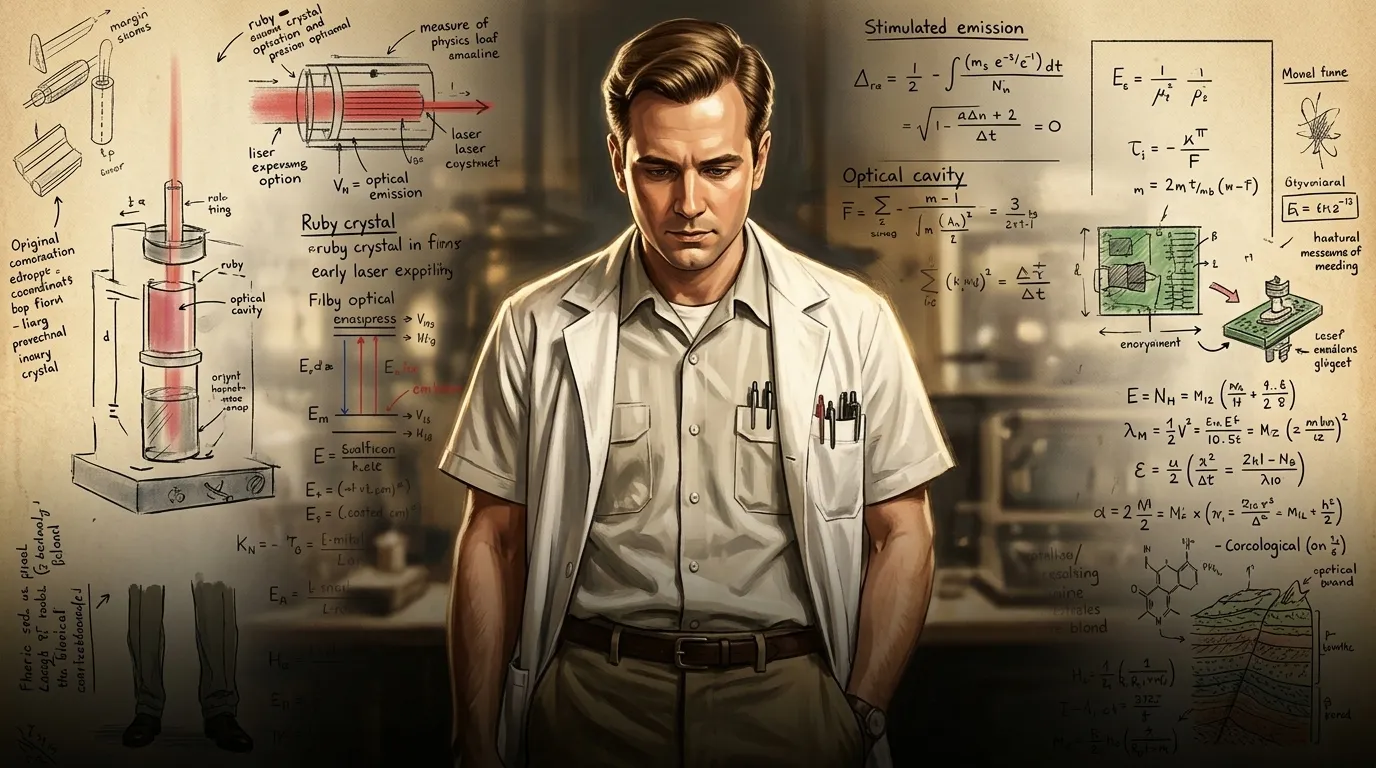
Page 1
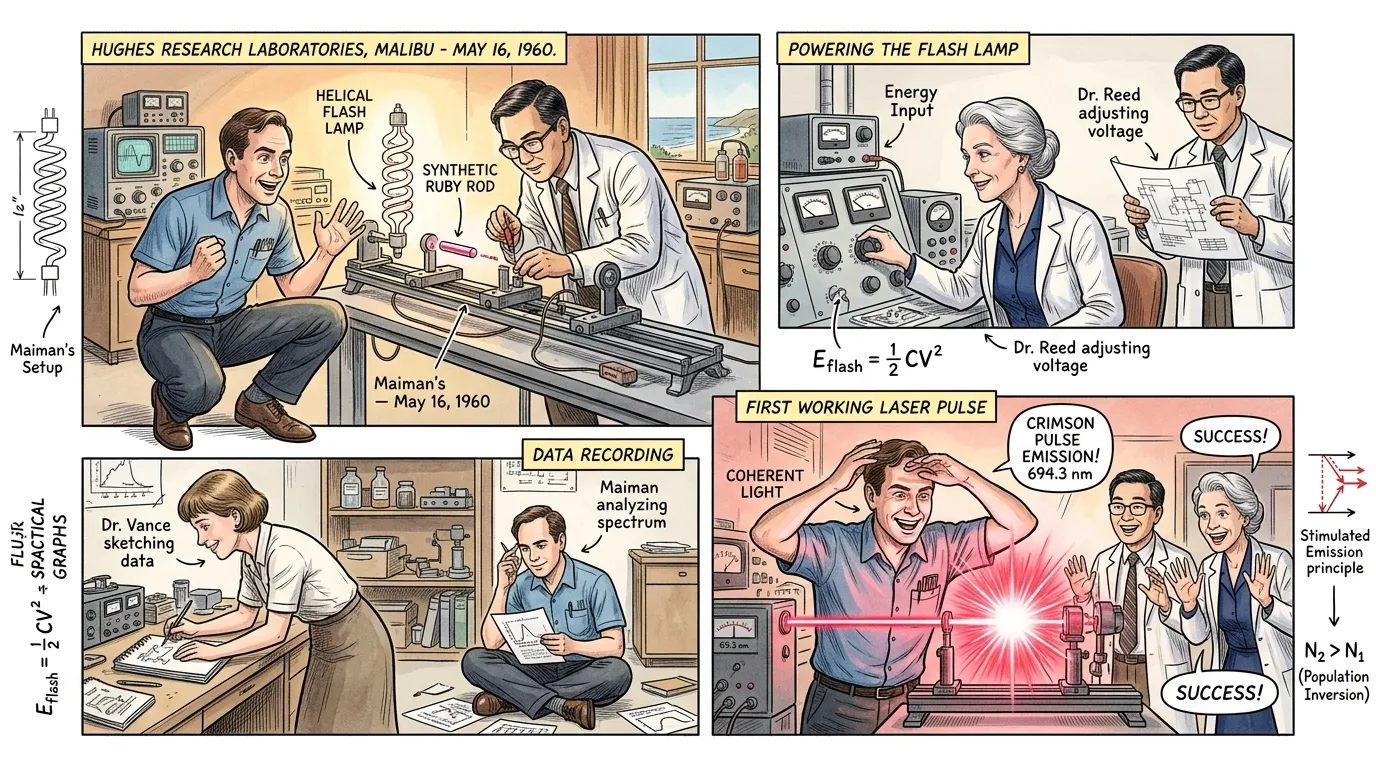
For centuries, humanity yearned for a light source that could transcend the limitations of conventional lamps—a beam both intense and perfectly ordered. This elusive quest culminated in a profound scientific breakthrough. In 1960, at Hughes Research Laboratories in Malibu, California, Theodore Maiman unveiled the world's first working laser, a device that promised to revolutionize technology.
"'This... this is different,' Theodore Maiman murmured, his voice hushed with a mixture of exhaustion and exhilaration, as he stared intently at the crimson pulse emanating from the ruby rod. 'We've managed to amplify light through stimulated emission—it's not just light, it's coherent light.'"
Page 2
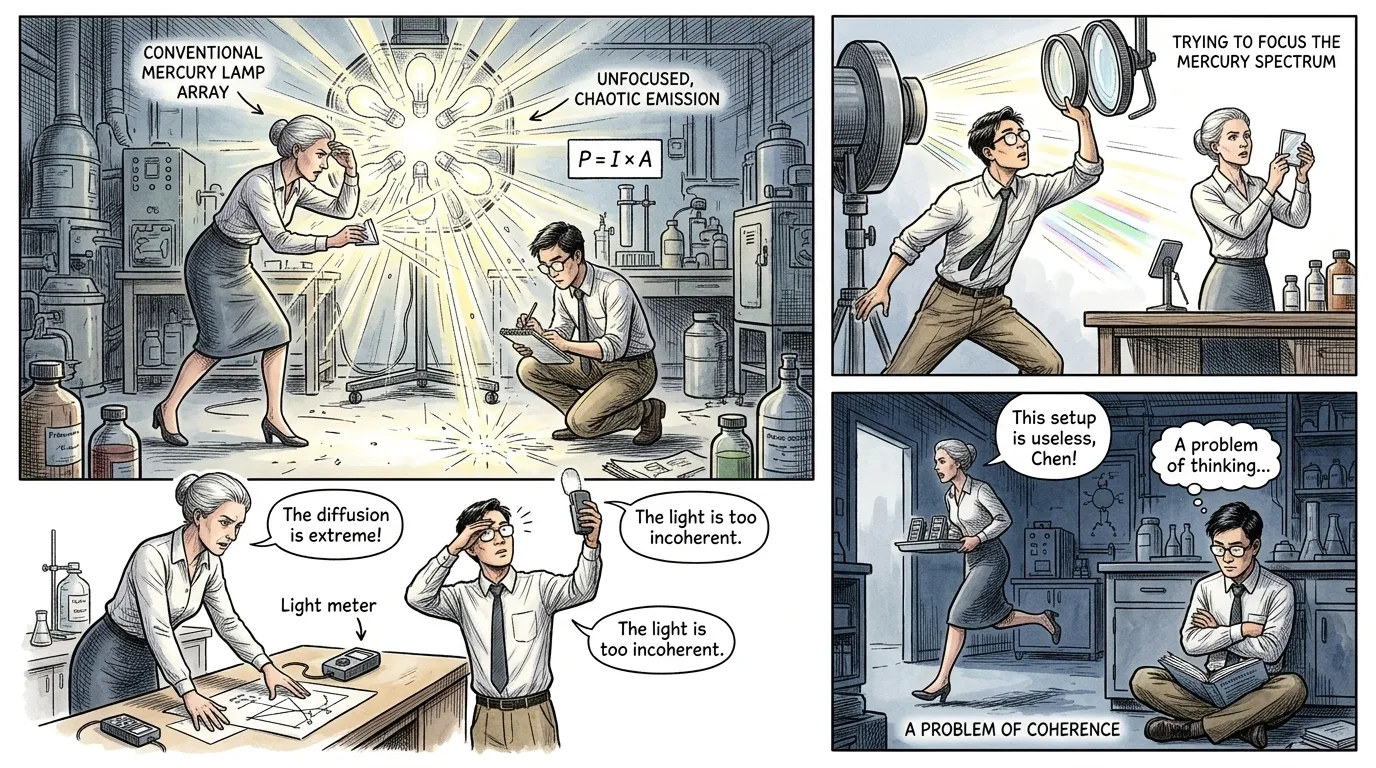
Before the laser, all artificial light sources—from incandescent bulbs to arc lamps—produced incoherent light. This meant the photons were emitted randomly, traveling in all directions, with varying wavelengths and phases. Such light disperses rapidly, making it unsuitable for applications requiring extreme precision or energy concentration.
"A senior engineer, Dr. Evelyn Reed, her silver hair pulled back, pointed to a widely dispersed light beam. 'Observe the conventional mercury lamp,' she explained to a junior colleague, Dr. David Chen, whose spectacles reflected the scattered light. 'Its energy spreads out, making precise manipulation incredibly difficult for our industrial needs.'"
Page 3
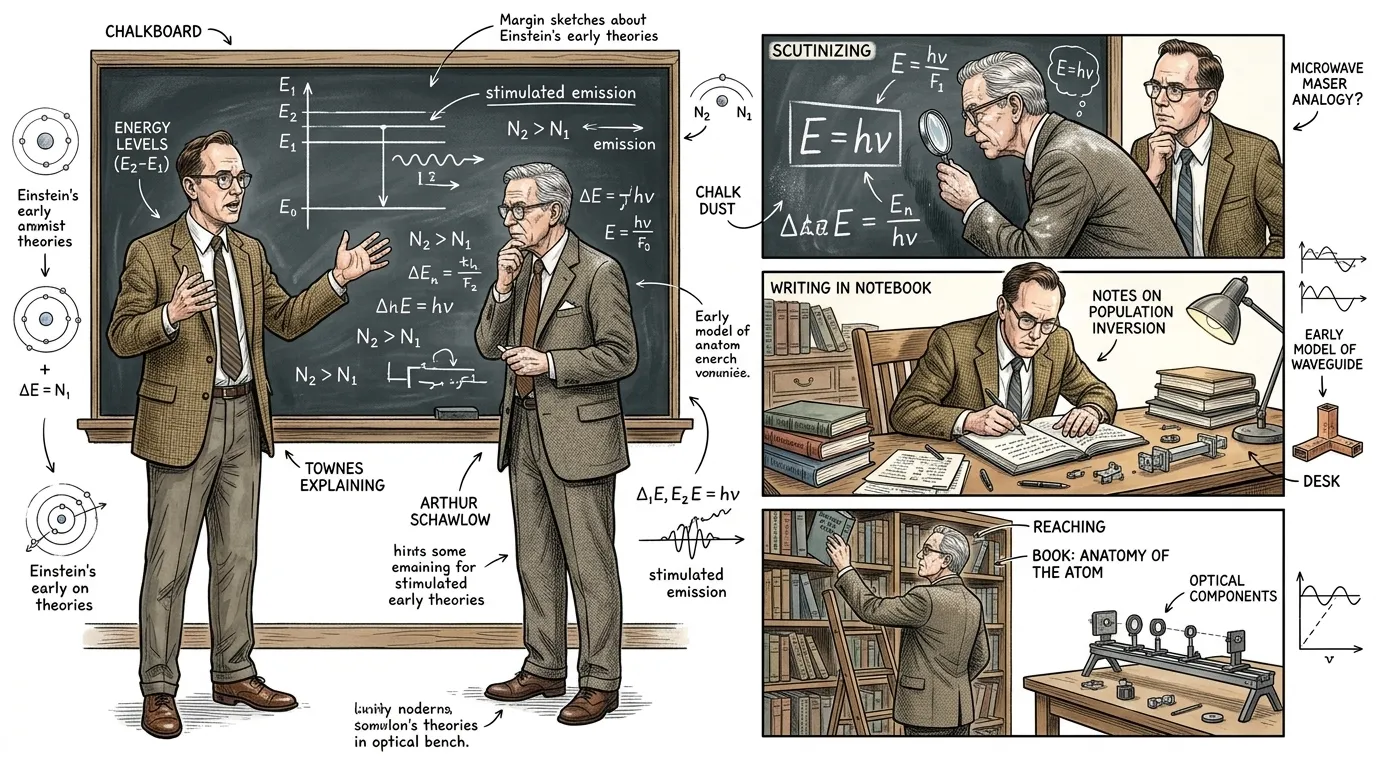
The conceptual bedrock for the laser was laid decades earlier by Albert Einstein, who theorized 'stimulated emission'—the idea that an excited atom could be prompted to release a photon by an incoming photon of the same energy. This principle remained largely theoretical until the mid-20th century, when scientists began exploring its practical applications.
"In 1954, physicist Charles Townes discussed with his colleague, Arthur Schawlow, 'Einstein's theoretical work on stimulated emission gives us a powerful concept. We observed it with microwaves in the maser, but imagine if we could extend that principle to visible light!' Schawlow nodded, deep in thought, reviewing complex equations on a chalkboard."
Page 4
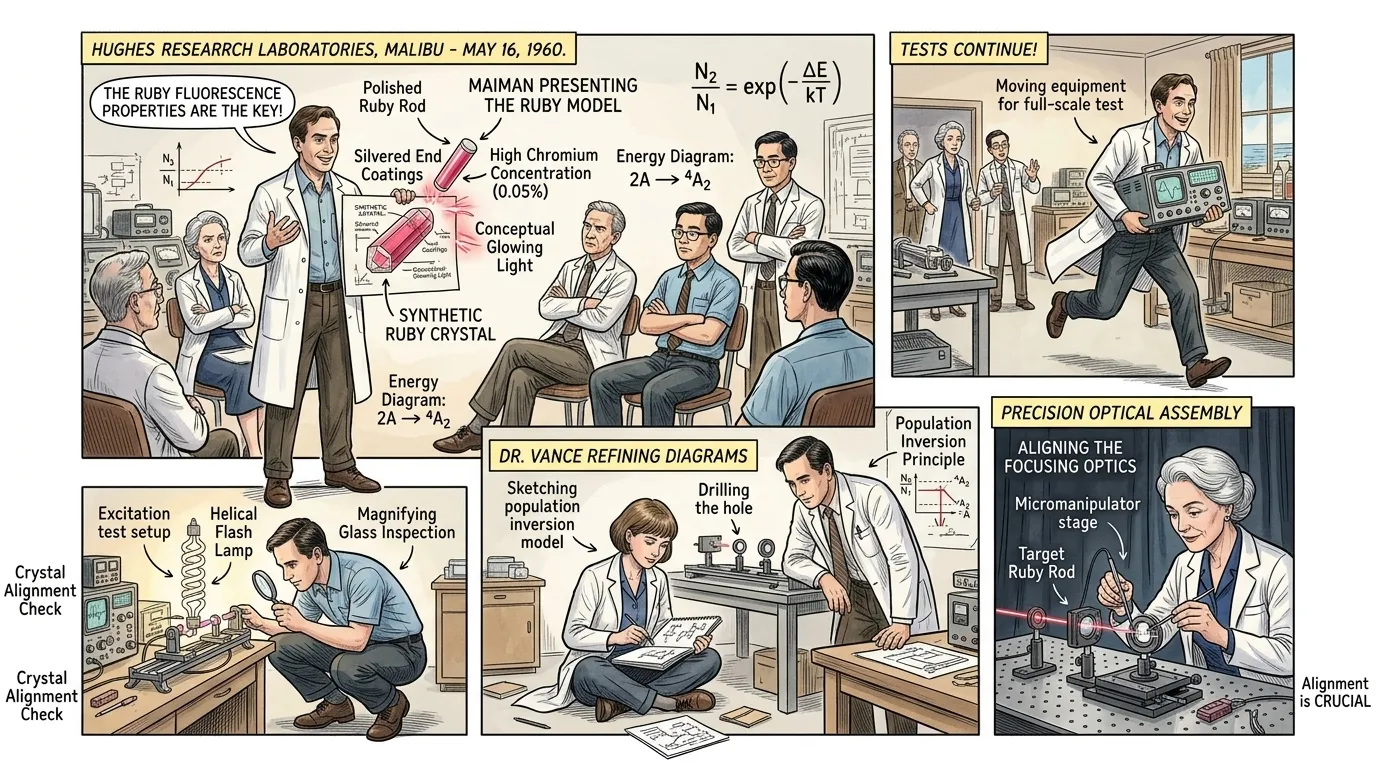
Many research groups worldwide were racing to achieve the first laser, experimenting with various gases and liquids. Theodore Maiman, however, pursued a less conventional path, choosing synthetic ruby as his active medium. His decision was met with considerable skepticism from peers who believed ruby was unsuitable for generating coherent light.
"Maiman, presenting his proposal to his skeptical peers, declared, 'As Leonardo da Vinci wisely stated, "Simplicity is the ultimate sophistication." While others chase gases, I believe the crystalline structure of ruby, imbued with chromium ions, offers a simpler, more direct route to population inversion. Its fluorescence properties are exactly what we need, despite the current doubts.'"
Page 5
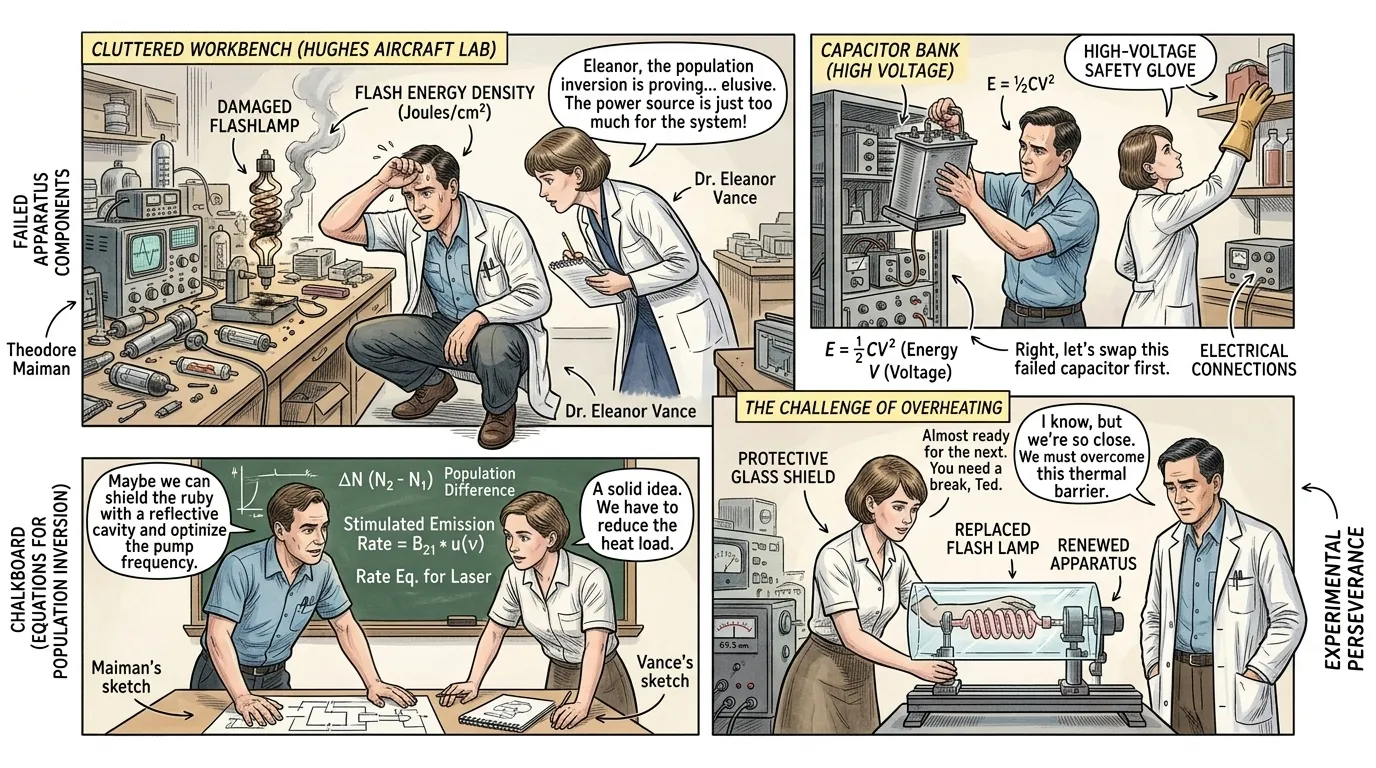
To achieve laser action, Maiman needed to create a 'population inversion'—a state where more atoms are in an excited energy level than in a lower one. This was immensely challenging, requiring an exceptionally powerful light source to 'pump' the ruby atoms. Early attempts struggled with insufficient energy input and inefficient excitation.
"Maiman, wiping sweat from his brow, gestured towards a smoking, failed flash lamp. 'The problem isn't just power; it's getting the right kind of power without overheating the system,' he explained to his assistant, Dr. Eleanor Vance, a focused woman in her late 20s with short, practical hair. 'We need to achieve population inversion reliably, or this simply won't work.'"
Page 6
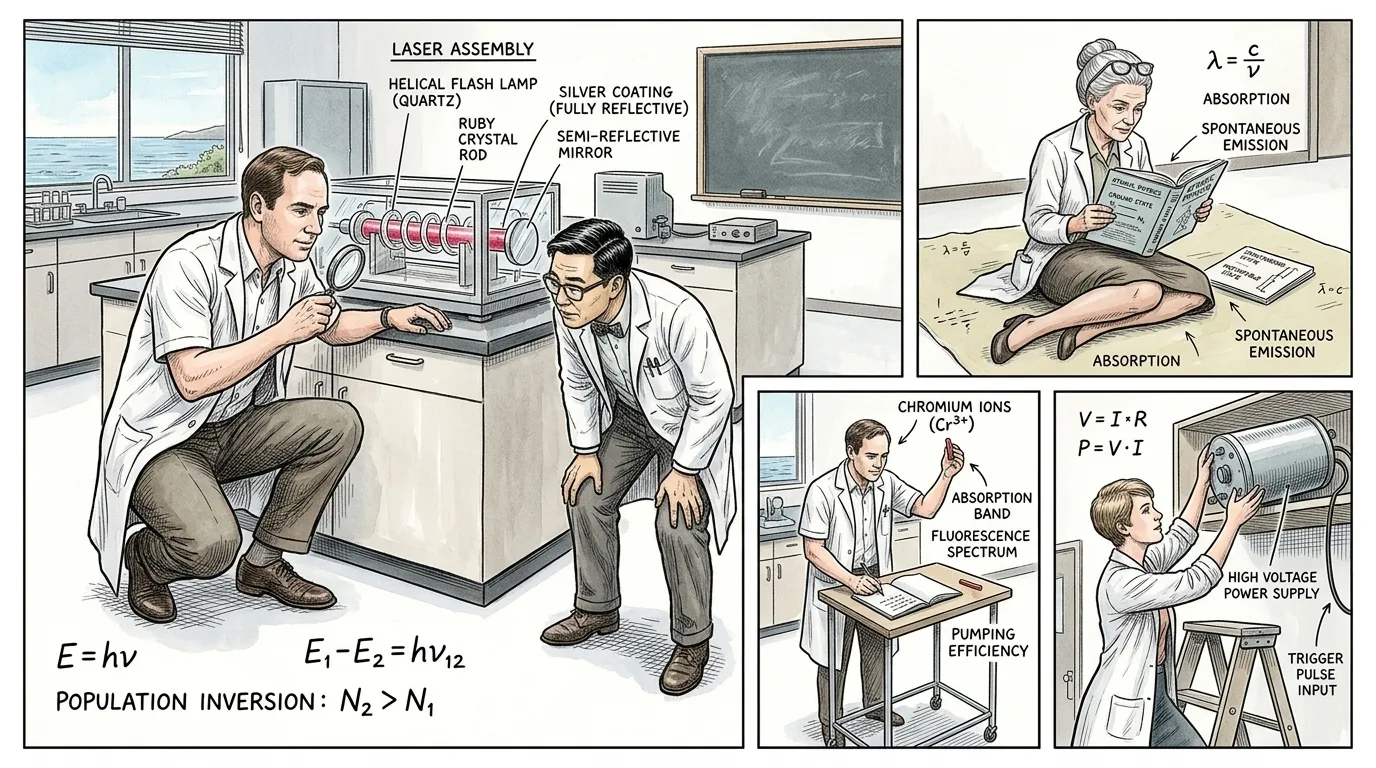
Maiman's breakthrough came when he used a powerful photographic flash lamp to pump the chromium atoms within his synthetic ruby rod. The intense, brief burst of light excited a significant number of these atoms, raising them to a higher energy state. This created the critical population inversion necessary for amplification.
"'The key,' Maiman explained excitedly, carefully demonstrating with a schematic, 'is the flash lamp's incredible energy. It acts like a surge, exciting the chromium atoms in the ruby to higher energy levels. When those atoms fall back, they spontaneously emit photons. These photons then hit other excited atoms, triggering them to emit identical photons through stimulated emission. This is where the magic begins!'"
Page 7
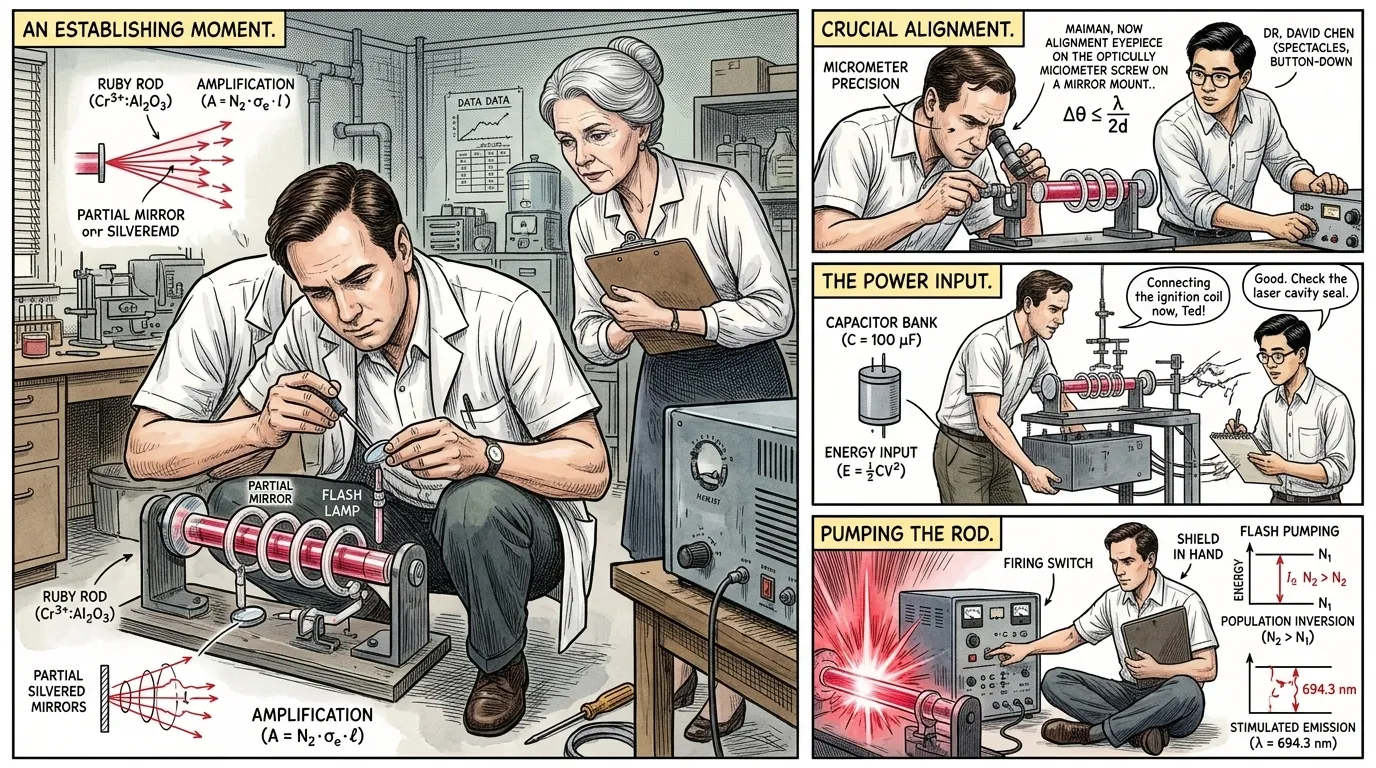
Once stimulated emission began, Maiman harnessed it through an ingenious optical cavity. The ruby rod was coated with reflective surfaces at both ends—one fully reflective, the other partially transmissive. Photons bounced back and forth, amplifying in number with each pass, until a powerful, coherent beam of light emerged from the partially silvered end.
"Maiman carefully pointed to the mirrors on his prototype. 'The reflectivity of these end mirrors is crucial,' he clarified, making slight adjustments. 'Photons generated by stimulated emission ping-pong between them, continually striking more excited atoms. Each pass amplifies the light, creating a cascade. It's a resonance chamber for light! Without this, the coherence would be lost.'"
Page 8
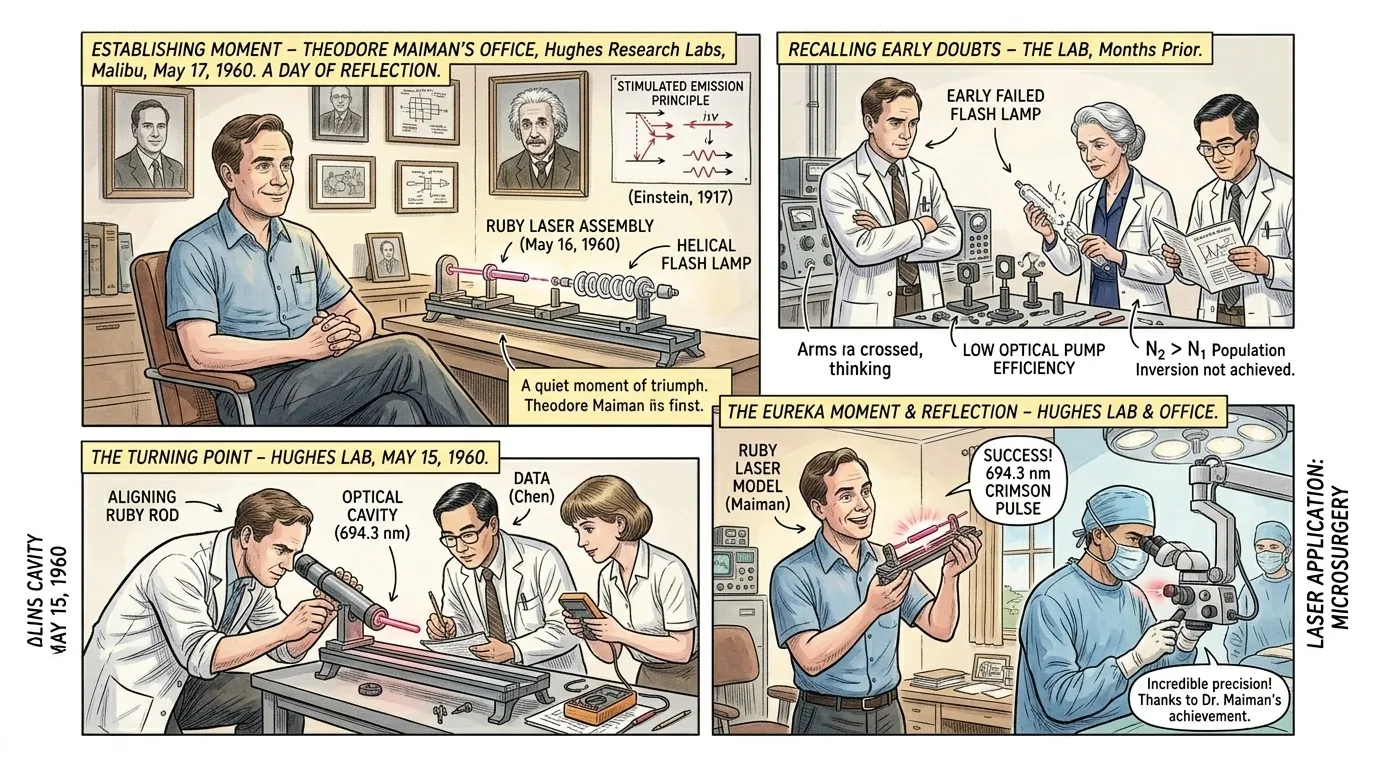
Maiman's demonstration in 1960 marked the birth of the laser. Initially dubbed 'a solution looking for a problem,' its potential was quickly recognized. The principle of 'stimulated emission,' once a theoretical concept, was now tangibly proven, transforming from abstract knowledge into a cornerstone of a new technological era. Scientists across various disciplines immediately began exploring its applications.
"Years after the initial breakthrough, reflecting on the journey, Maiman often quoted Robert H. Schuller: 'Tough times don't last, but tough people do.' He mused, 'That perseverance was essential, especially when others doubted ruby. The initial skeptics soon became the most eager to develop new applications once we had proven stimulated emission's power to generate this perfectly coherent light.'"
Page 9
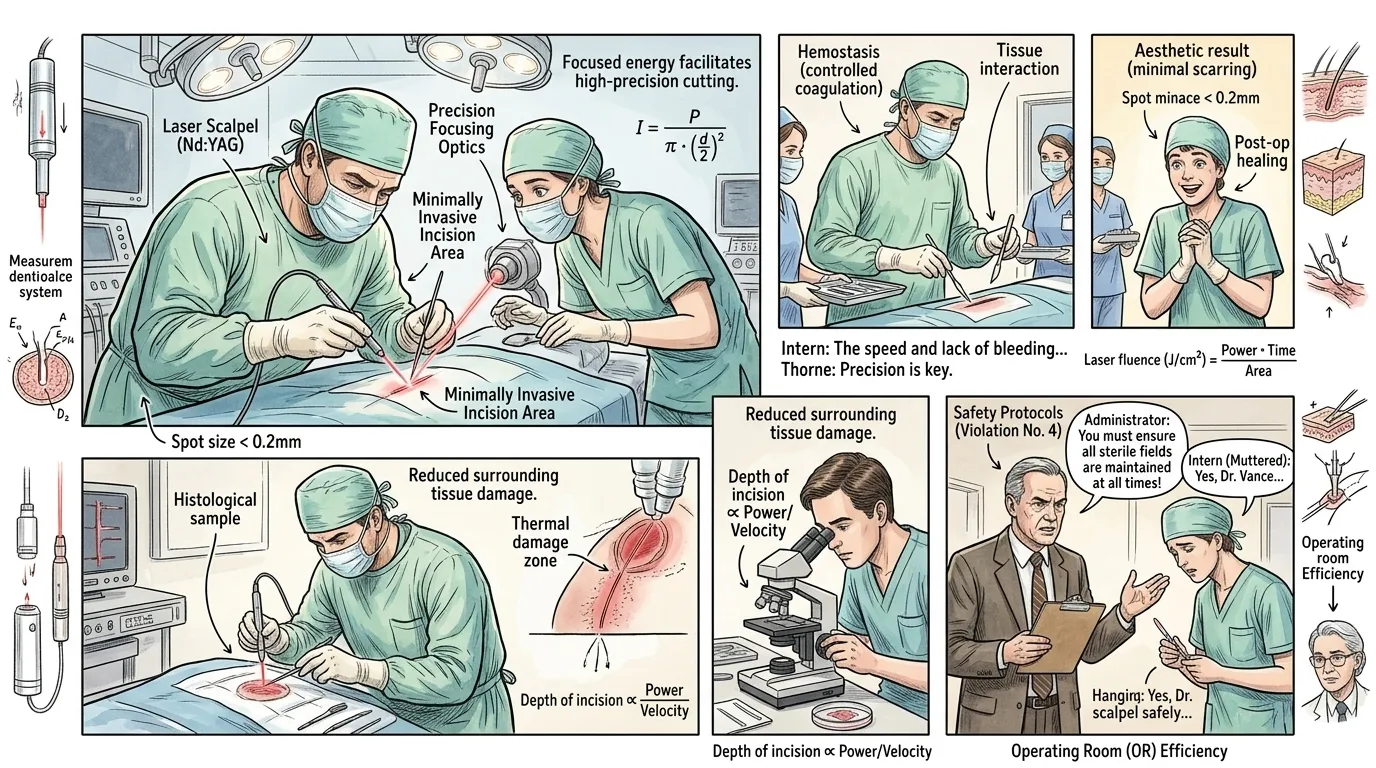
The laser's unique properties—its coherence, directionality, and intensity—made it invaluable for tasks previously impossible. Industries adopted lasers for precision cutting, welding, and material processing, leading to advancements in manufacturing efficiency. In medicine, lasers revolutionized surgery, enabling minimally invasive procedures with unprecedented accuracy.
"A surgeon, Dr. Aris Thorne, in sterile scrubs, carefully guided a laser scalpel with pinpoint accuracy. 'This allows us to make incisions finer than any traditional blade, with minimal damage to surrounding tissue,' he explained to a medical intern. 'It's transformed delicate operations, making them safer and more effective. Precision like this was unimaginable only decades ago.'"
Page 10
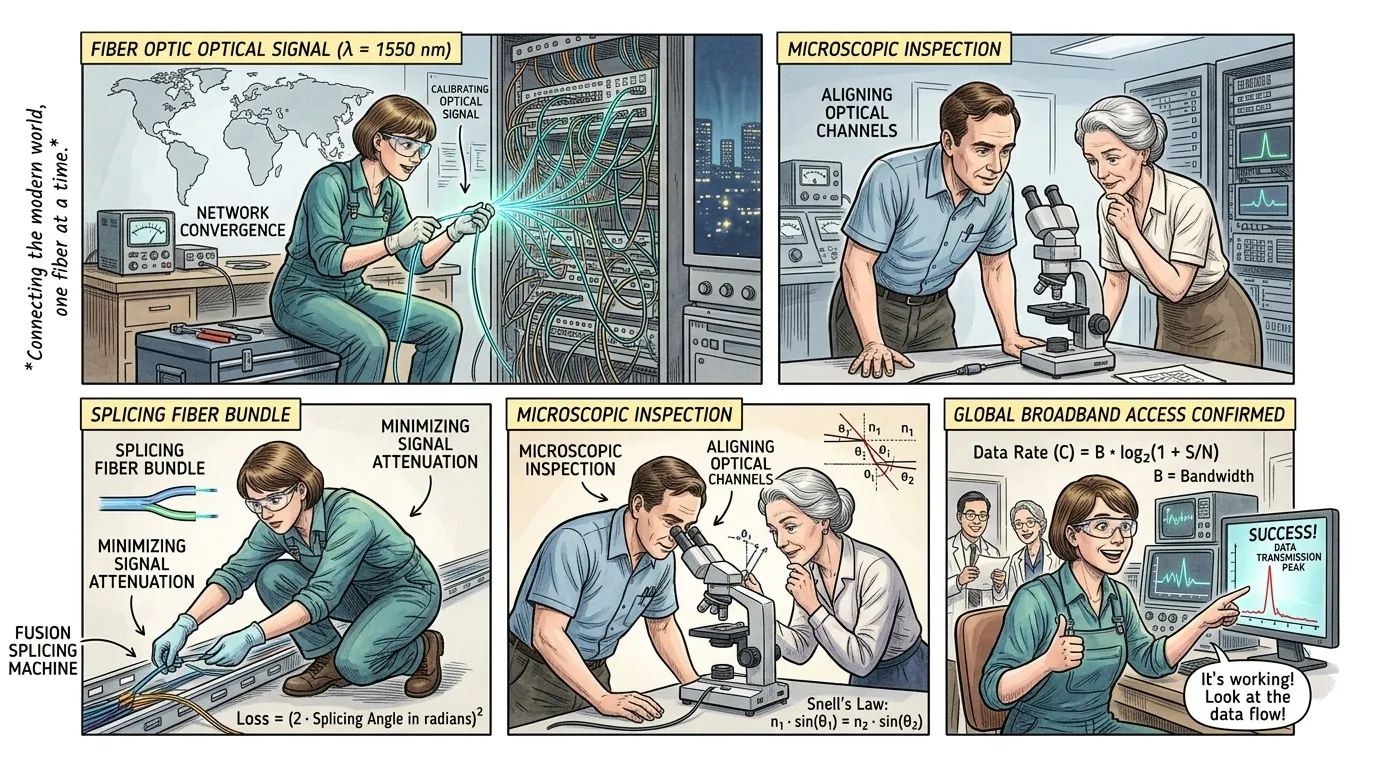
From its humble beginnings, the laser's applications proliferated, becoming an indispensable part of modern life. It underpins global communication, transforms entertainment, enhances manufacturing, and drives scientific discovery. The coherent beam of light, once a scientific marvel, is now a silent, powerful force shaping our everyday world and paving the way for future innovations.
"As a technician calibrated a fiber optic network, connecting continents with light, she remarked, 'It's astounding how a single invention can touch so many aspects of our lives, from scanning groceries to transmitting vast amounts of data across the ocean. The laser's journey reminds us that true innovation often starts with a fundamental understanding of nature's principles, leading to unimagined uses.'"
About this story
- Location: Global
- Audience: general readers
Questions and answers
Read Wonder Inventions on your phone
Wonder Inventions is available on Android. Get Wonder Inventions on Google Play.