Integrated Circuit
Integrated Circuit — an illustrated inventions story, set in Global. 10 illustrated pages, free to read on Wonder Inventions.
Page 1
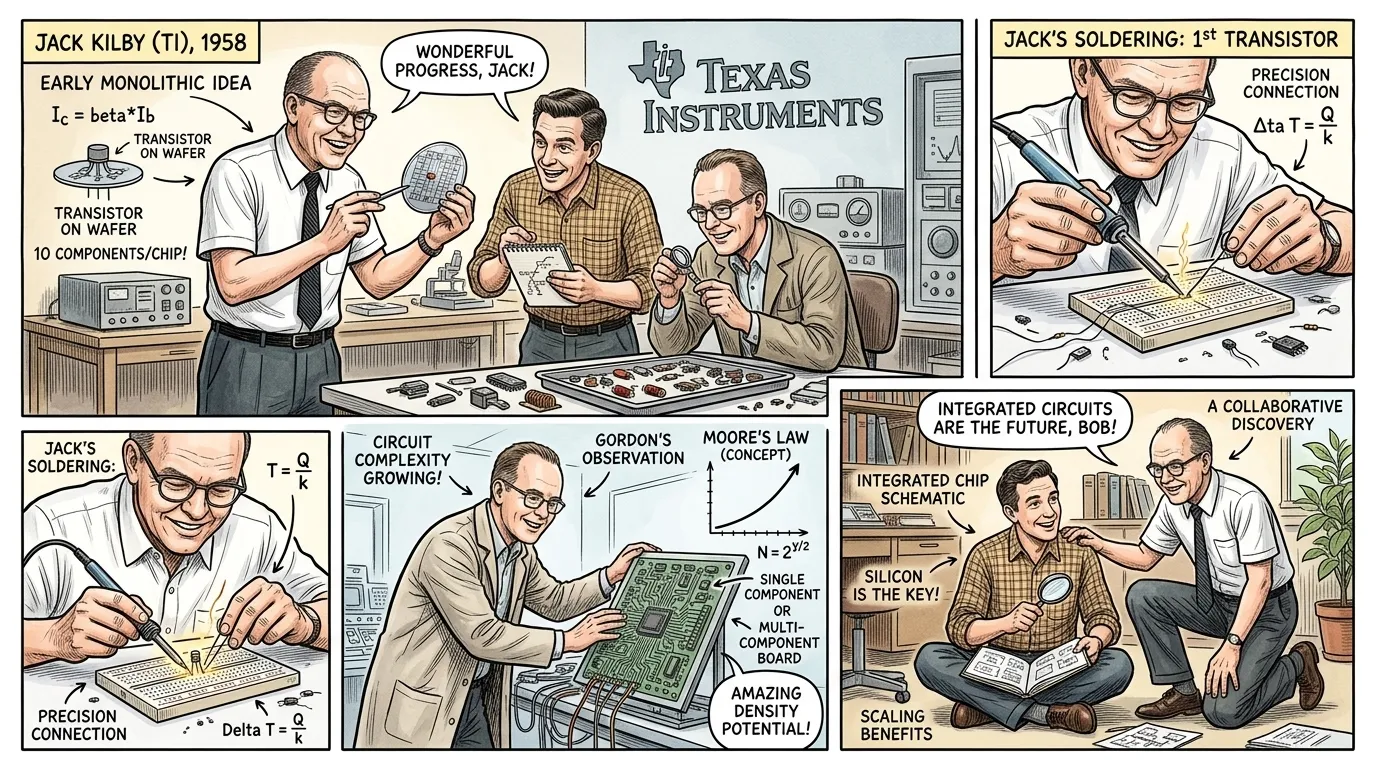
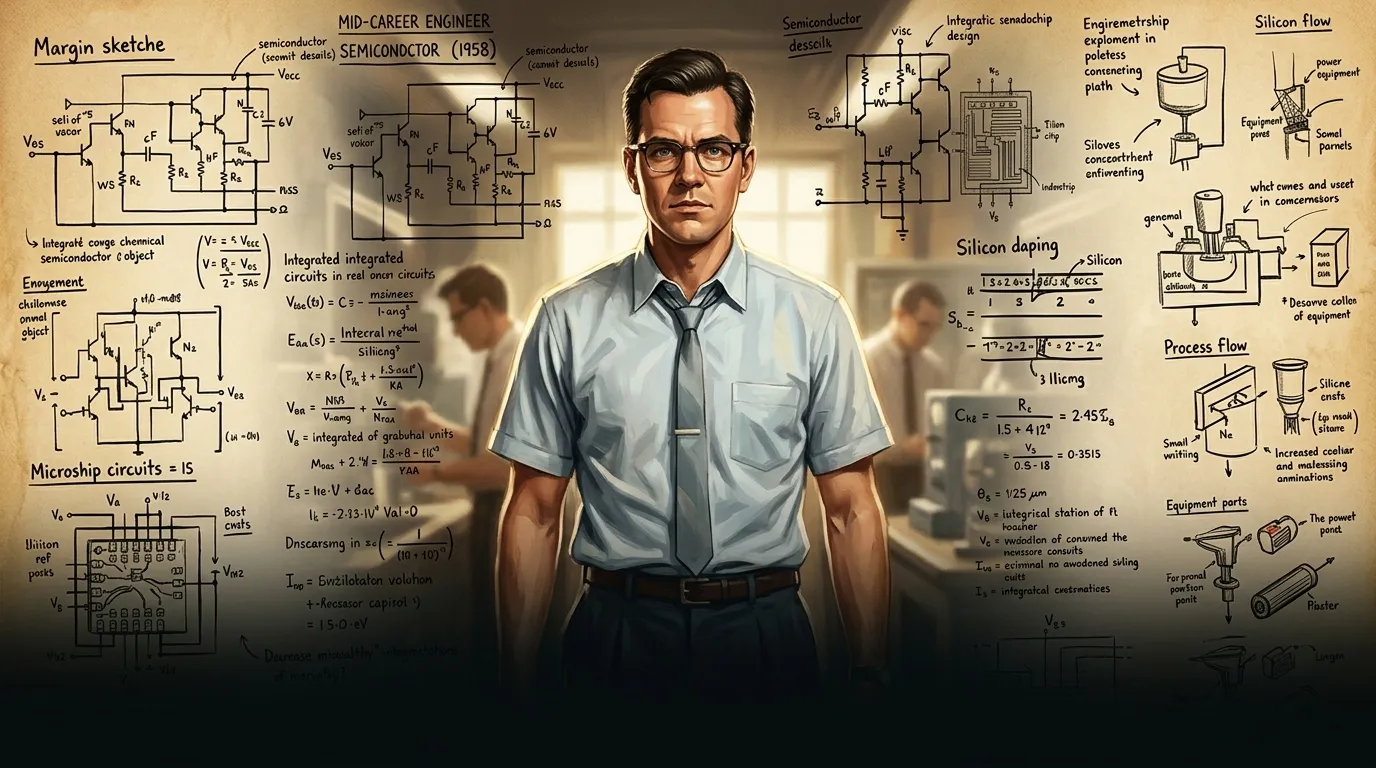
Before the Integrated Circuit, electronic devices were constructed from individual, discrete components like transistors, resistors, and capacitors. These components were hand-soldered onto circuit boards, a labor-intensive process prone to errors and limiting miniaturization. This method severely constrained the complexity and reliability of early computing and control systems, especially critical for emerging fields like aerospace. The challenge was clear: electronics needed to shrink dramatically while becoming exponentially more dependable.
Page 2
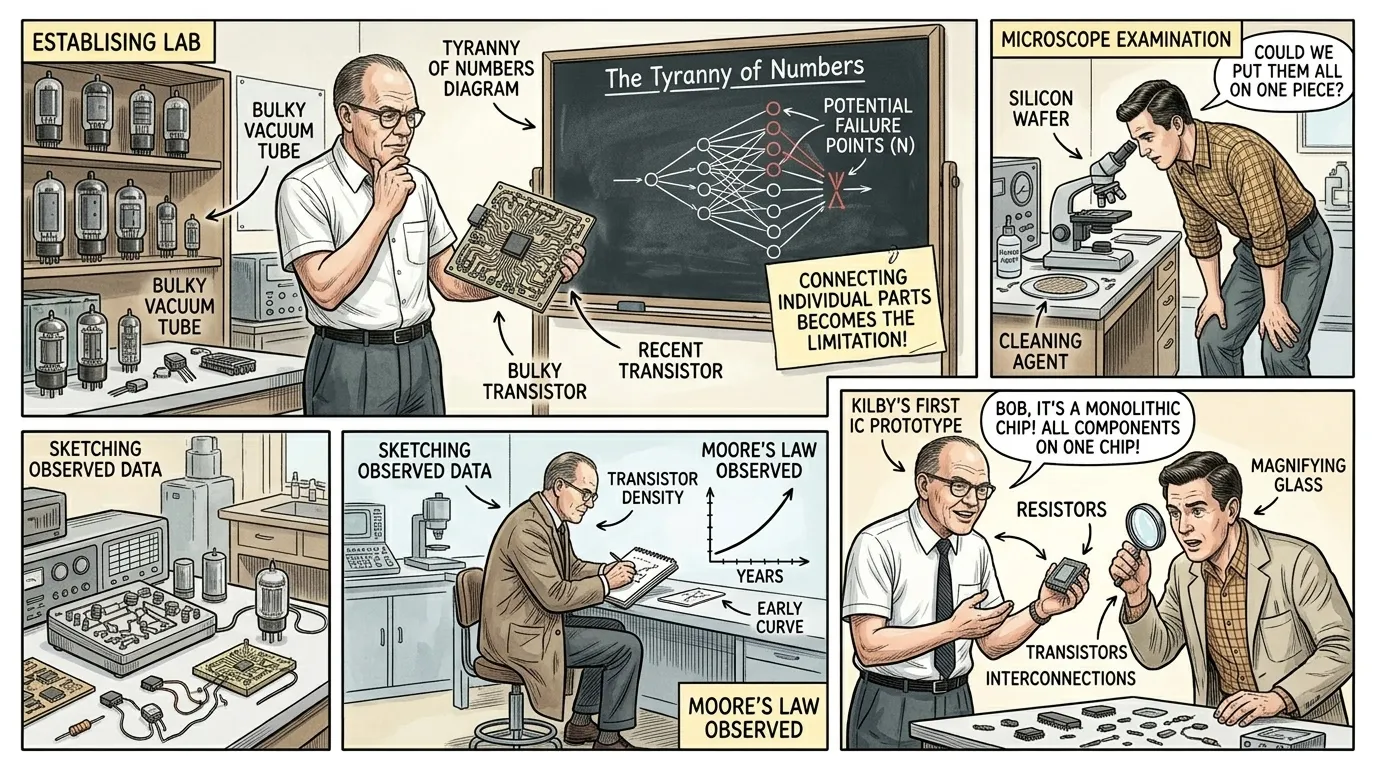
For decades, electronics relied on large, energy-hungry vacuum tubes, which while functional, were bulky and unreliable. The invention of the transistor in 1947 offered a revolutionary step towards miniaturization, yet the fundamental problem of connecting countless individual parts persisted. Each connection remained a potential point of failure, making complex circuits expensive to build and notoriously fragile. This 'tyranny of numbers' threatened to stall the progress of advanced electronics.
Page 3
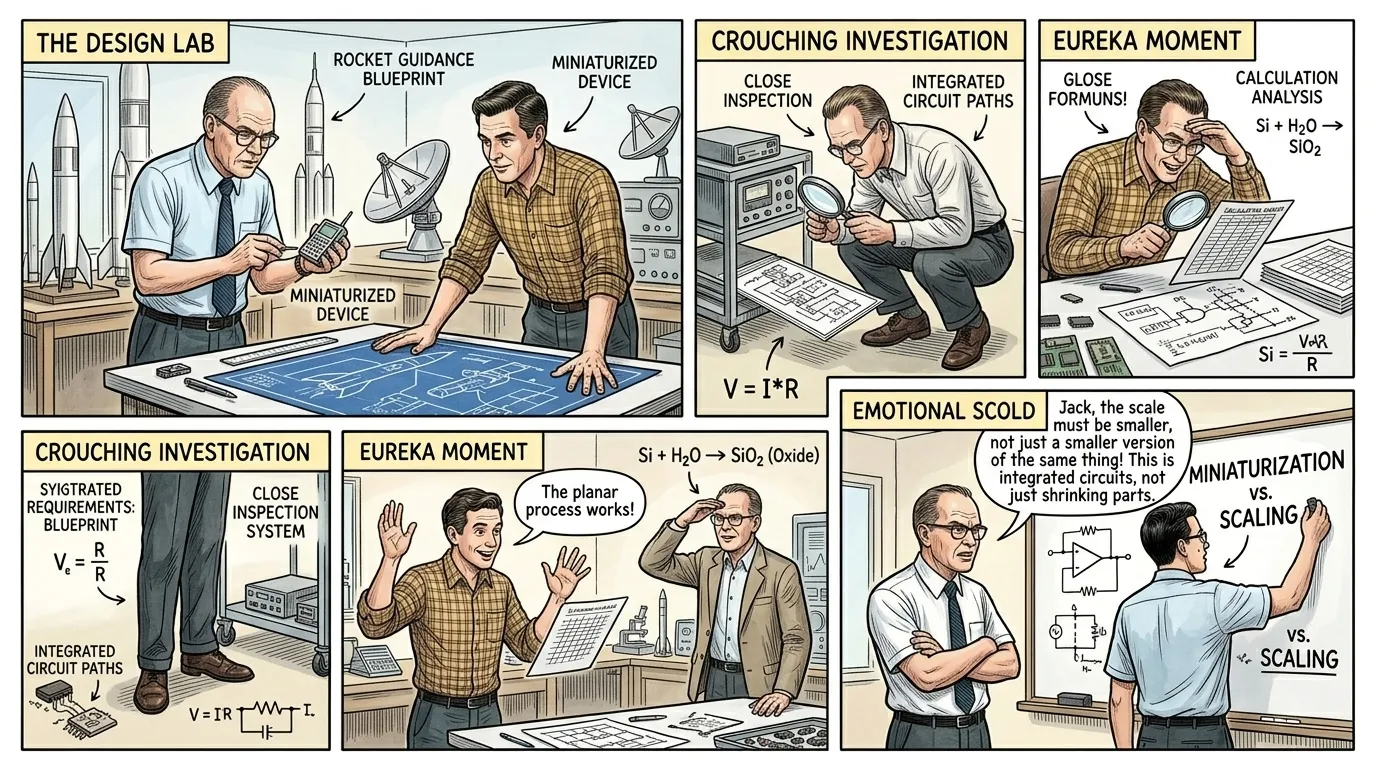
By the late 1950s, the demand for smaller, more reliable electronic devices was immense, particularly for military and burgeoning space exploration programs. Rocket guidance systems and compact communications devices desperately needed circuits that could withstand extreme conditions without failing. Engineers worldwide recognized that a radical departure from traditional assembly methods was necessary to overcome the physical and reliability limitations of discrete components. The future of electronics hinged on integrating entire circuits into a single, indivisible unit.
Page 4
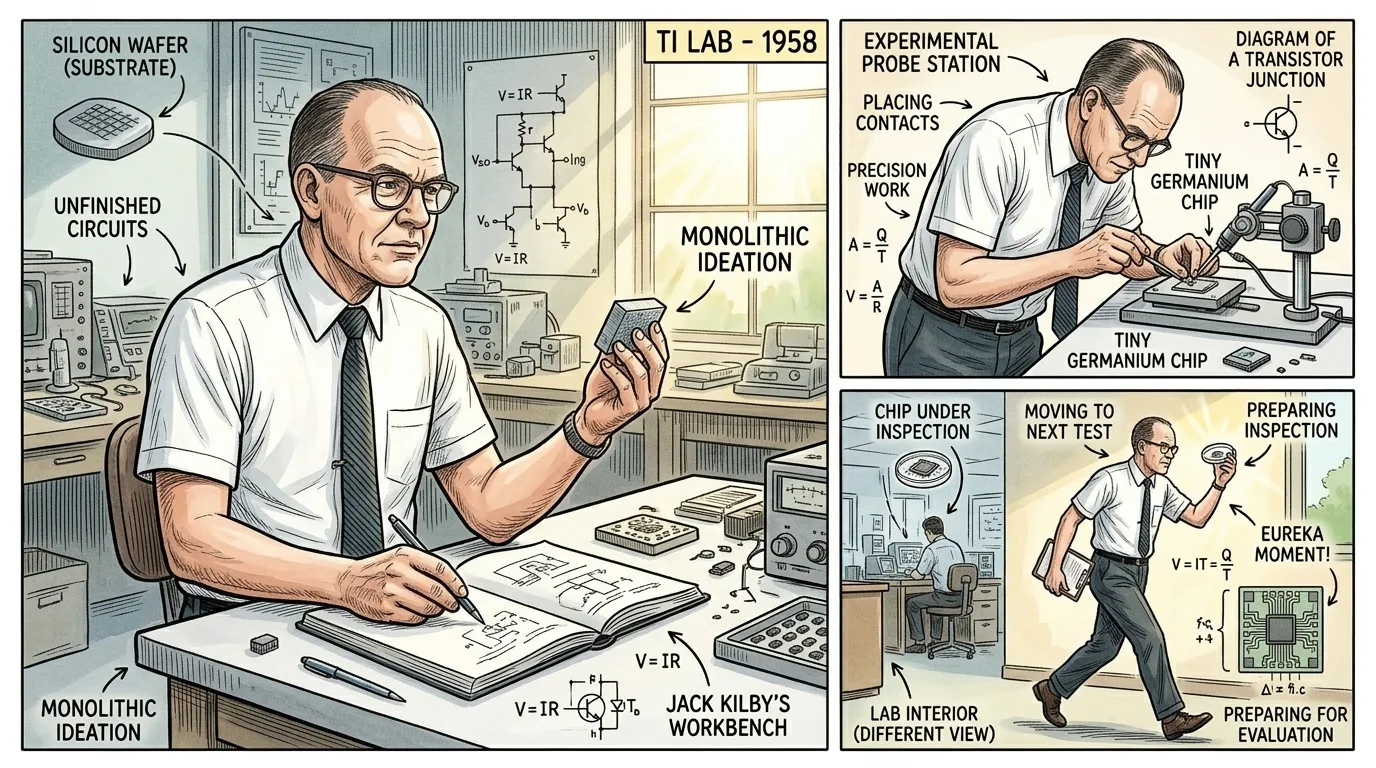
During the quiet summer shutdown of 1958 at Texas Instruments, engineer Jack Kilby pondered the problem. He envisioned a revolutionary solution: fabricating all necessary circuit components, including transistors, resistors, and capacitors, from a single block of semiconductor material. This 'monolithic idea' eliminated the need for individual component packaging and extensive wiring, promising a drastic reduction in size and increase in reliability. It was a radical departure from conventional wisdom, proposing to build an entire circuit, not just a single component, on one substrate.
Page 5
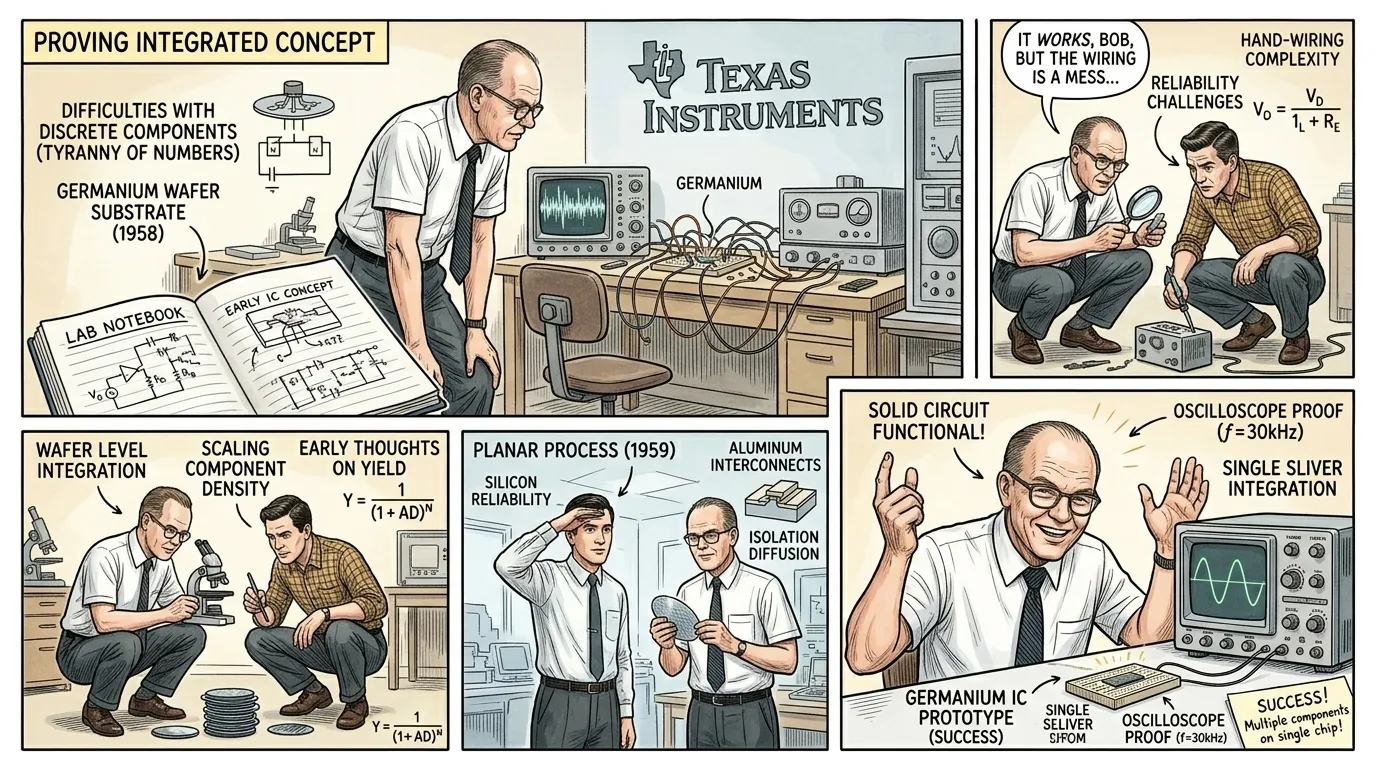
On September 12, 1958, Kilby successfully demonstrated his first working 'solid circuit.' Using a sliver of germanium, he meticulously created a phase-shift oscillator where all components were integrated. Though crudely wired by hand for proof of concept, this tiny germanium bar generated a continuous sine wave, proving the feasibility of the monolithic integrated circuit. This groundbreaking experiment showcased that multiple active and passive electronic components could coexist and function within a single piece of semiconductor material, laying the foundation for all modern electronics.
Page 6
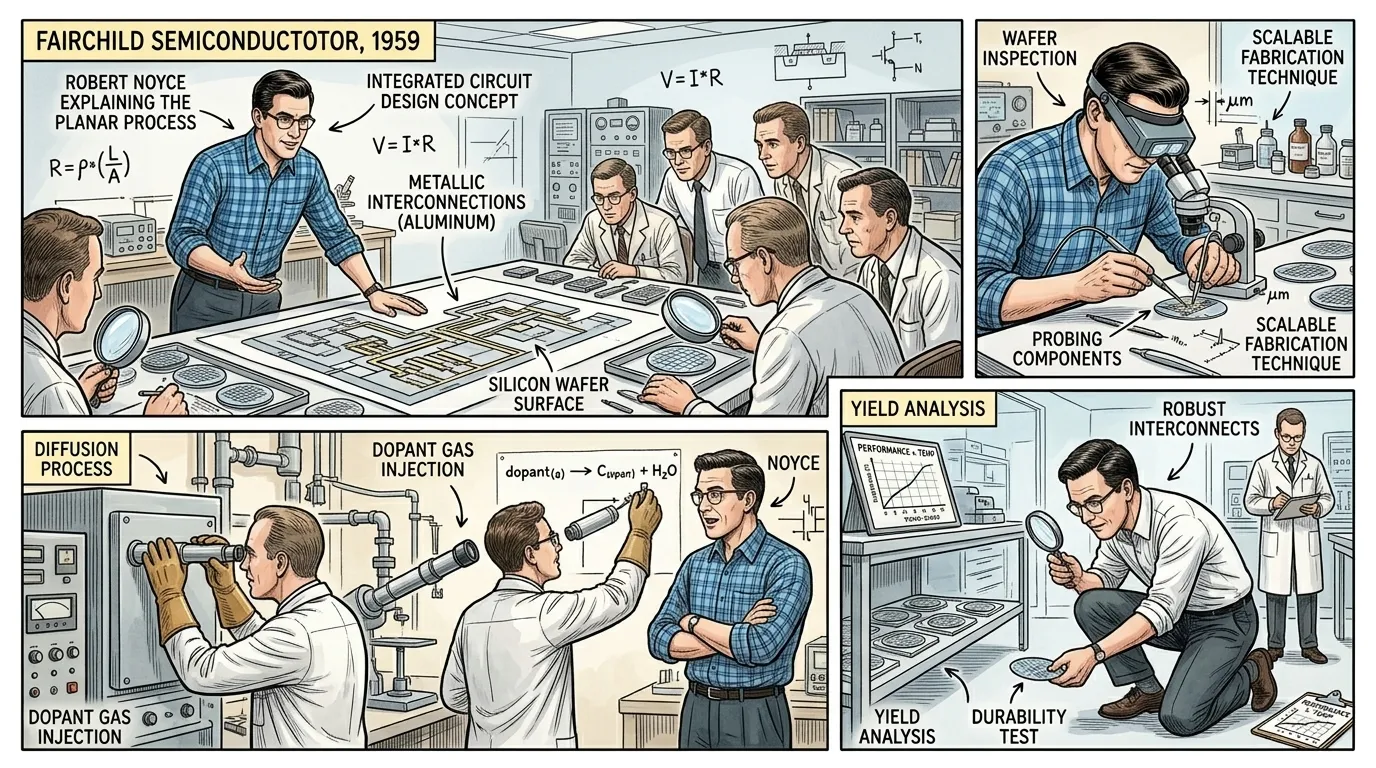
Independently, just months later in 1959, Robert Noyce at Fairchild Semiconductor devised a more elegant and manufacturable solution. While Kilby's prototype used wire bonds on top of a semiconductor block, Noyce's 'planar process' allowed components to be fabricated on the surface of a silicon wafer and interconnected using a metal layer deposited on top. This innovative technique involved layering different materials, selectively etching away parts, and then diffusing impurities to create specific electrical regions. The planar process was scalable, durable, and crucial for mass production.
Page 7
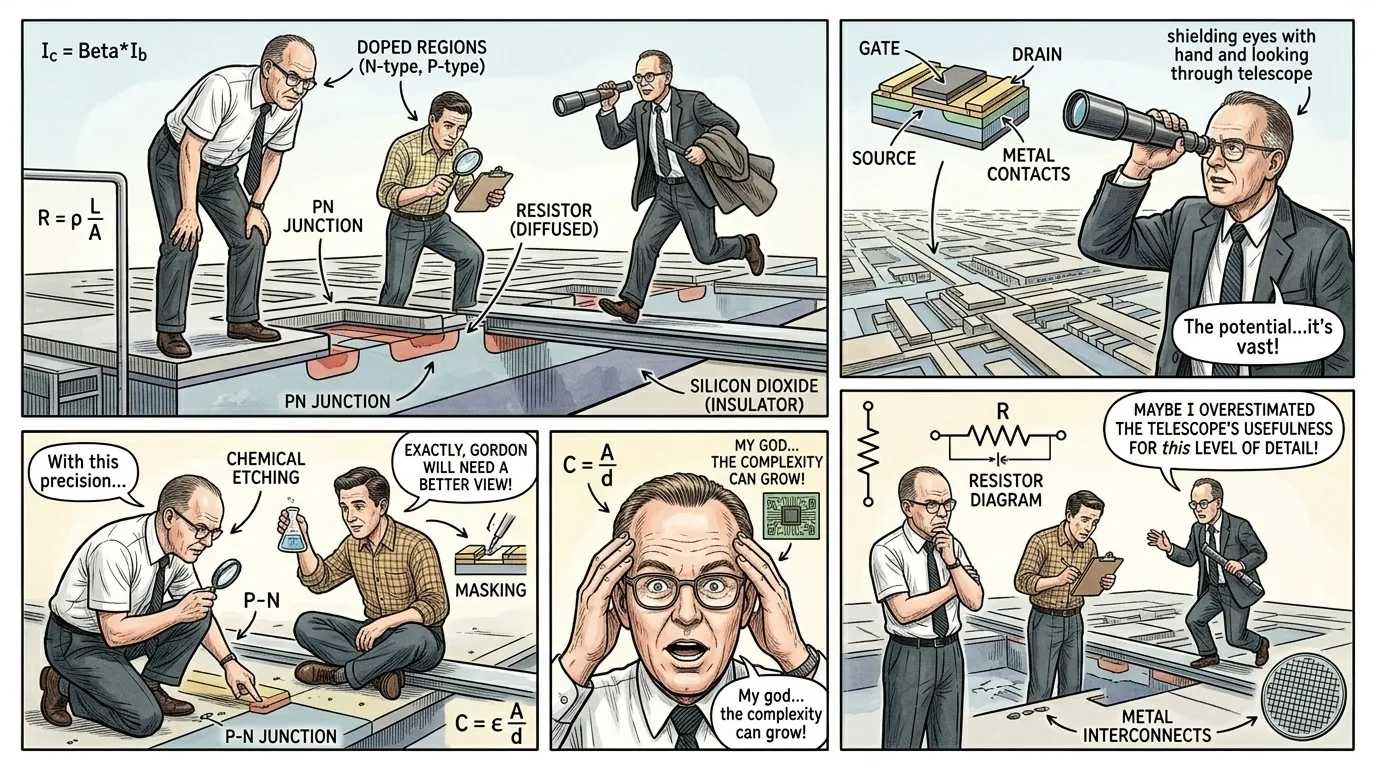
The integrated circuit's brilliance lies in its ability to combine numerous active and passive components within a single, continuous piece of semiconductor material, typically silicon. Transistors are formed by carefully doping specific regions of the silicon with impurities to create P-N junctions. Resistors are made by controlling the length and width of diffused regions, while capacitors exploit the insulating properties of silicon dioxide layers. These components are then electrically isolated by reverse-biased junctions or oxide layers, with thin metal traces deposited atop the insulator to form interconnections, all within a microscopic footprint.
Page 8
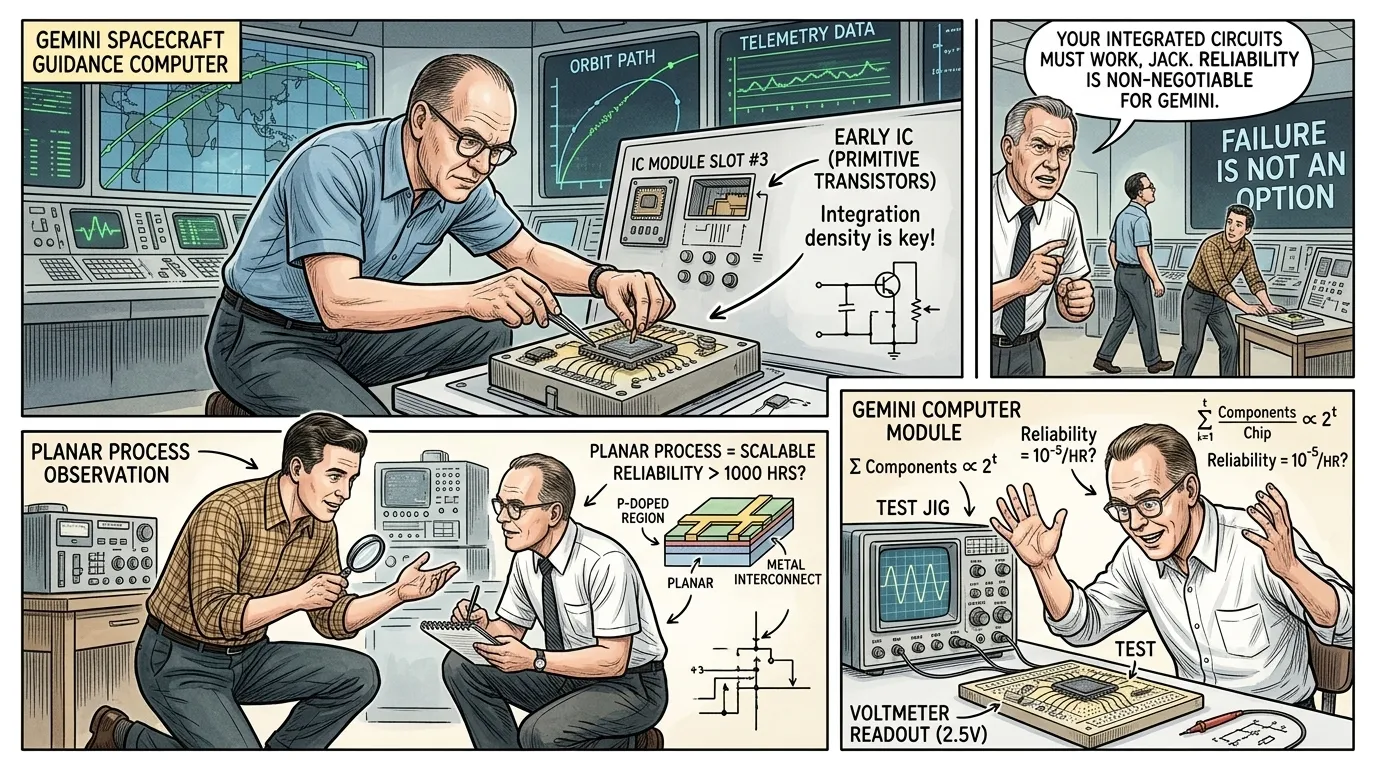
The combined principles of Kilby's monolithic concept and Noyce's planar process paved the way for the integrated circuit's commercialization. Texas Instruments and Fairchild Semiconductor licensed their respective patents, allowing the technology to quickly spread. Early ICs were primitive, containing only a few dozen transistors, but they rapidly found applications in critical areas like missile guidance systems for the U.S. military and early spaceflight programs. The Gemini program, for example, utilized these pioneering circuits, proving their reliability in extreme environments and setting the stage for wider adoption.
Page 9
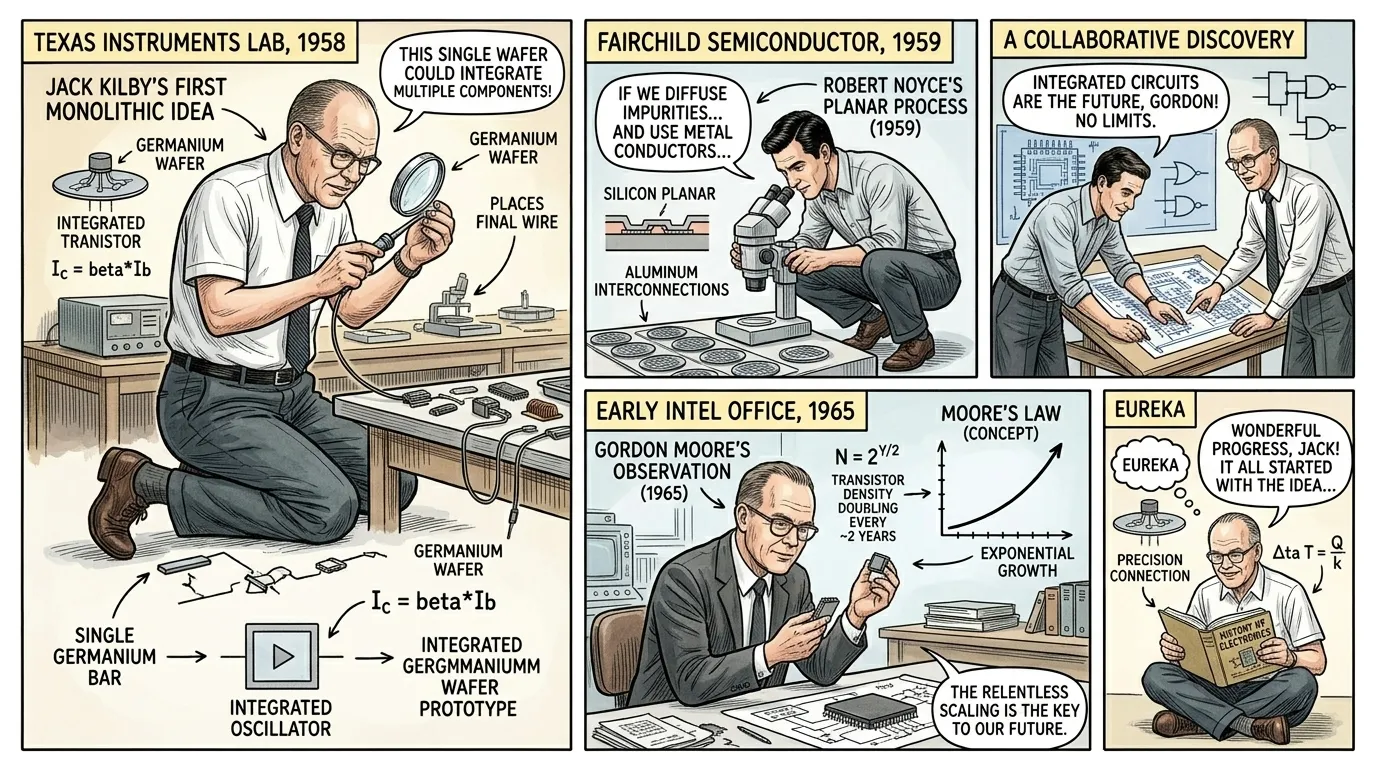
As integrated circuit manufacturing improved, engineers could pack ever more transistors onto a single chip. In 1965, Gordon Moore, a co-founder of Intel, observed that the number of transistors on a microchip roughly doubles every two years, an observation that became known as Moore's Law. This exponential growth in transistor density led to unprecedented increases in computing power, decreases in cost, and rapid miniaturization. The microprocessor, a complex integrated circuit containing an entire central processing unit, emerged in the early 1970s, marking a pivotal moment in the digital revolution. This relentless scaling transformed what was possible in electronics.
Page 10
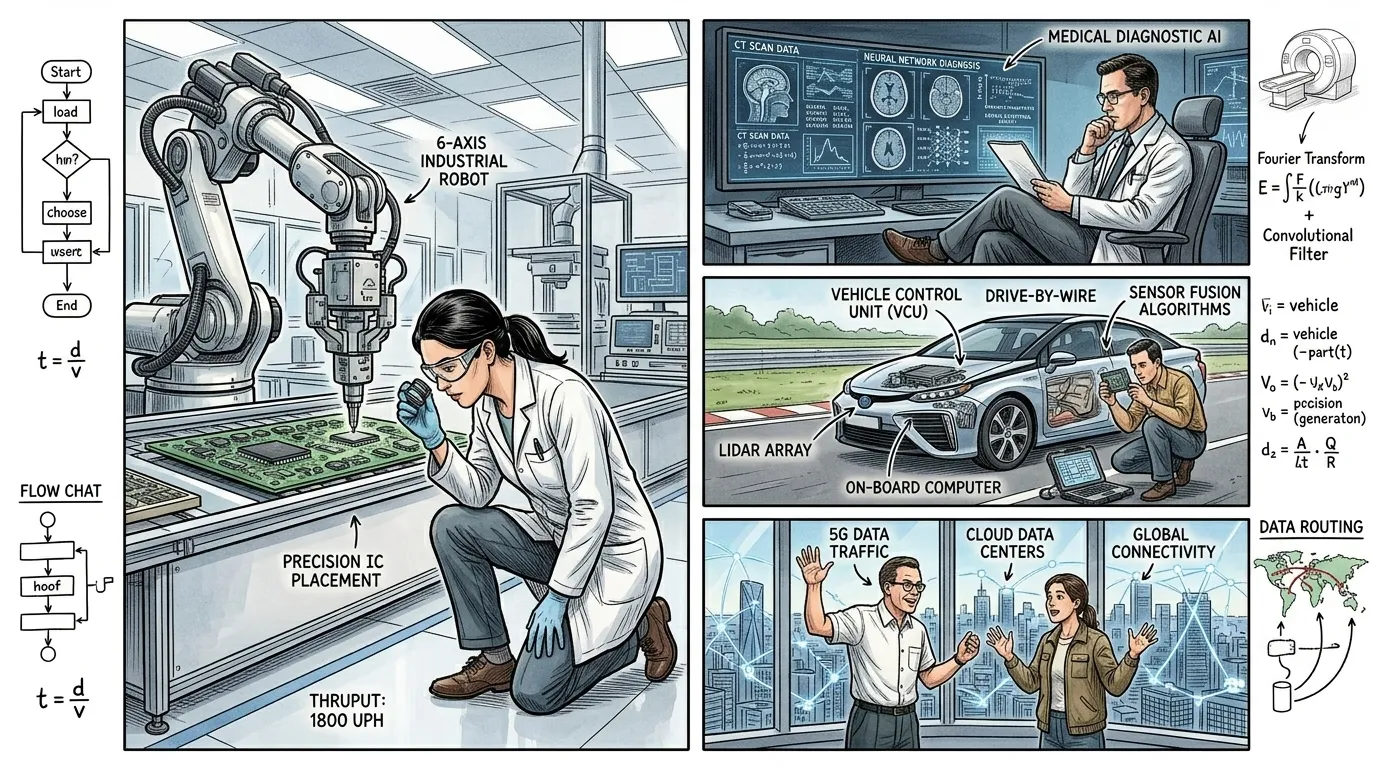
The integrated circuit is the invisible foundation of our modern digital world, profoundly transforming every aspect of human existence. From the vast networks that power global communication to the sophisticated sensors in medical diagnostic equipment, its pervasive influence is undeniable. It enables the artificial intelligence that drives advanced robotics and the complex control systems found in modern automobiles and aircraft. Without the IC, the interconnected, data-rich society we inhabit would simply be impossible, a testament to its singular, transformative impact on civilization.
About this story
- Location: Global
- Audience: general readers
Questions and answers
Read Wonder Inventions on your phone
Wonder Inventions is available on Android. Get Wonder Inventions on Google Play.